
What Are Low Current Systems? Types, Applications, and Technical Guide
What are low current systems, which systems do they cover, and how do they differ from high current systems? We examine CCTV, fire detection, alarm, access control, data and fiber optic cabling, intercom, public address, and building automation systems; including their operating principles, application areas, technical standards, and project design criteria.
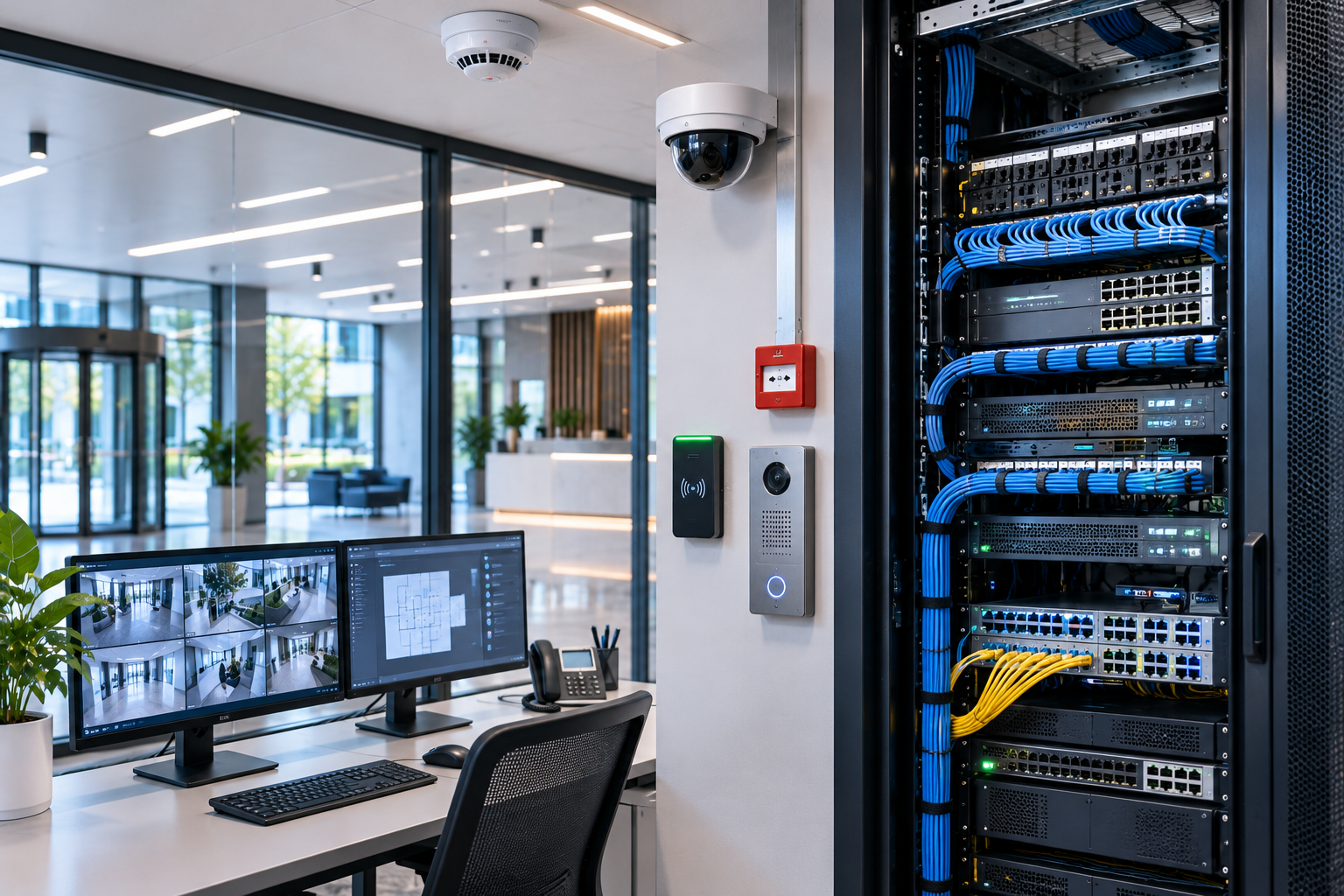
In modern buildings, a large portion of security, communication, data transfer, and automation systems operate over low current infrastructures. Many technologies, from security cameras to fire detection systems, access control to fiber optic networks, are considered within this scope.
In an office building, IP cameras transmitting images to a recording server, fire detectors sending information to an alarm panel, an access control system managing door access, and visitor communication being provided via intercom are common applications of low current systems in daily life.
However, low current systems are not merely about pulling cables or mounting electronic devices. Each system has its unique operating principles, cabling requirements, technical standards, integration features, and maintenance needs.
Especially in large commercial and industrial projects, correct low current design is crucial for security, operational continuity, communication infrastructure, and long-term operating costs.
So, what are low current systems, which systems fall under this scope, and how should a professional low current project be prepared?
What is Low Current?
Low current is a common term in the electrical and electronic installation sector that defines systems primarily used for security, communication, data transfer, signaling, and control purposes.
In English, these systems are often associated with terms such as Low Current Systems or Extra-Low Voltage (ELV) Systems.
However, there is an important technical distinction here.
Low current is not an independent IEC safety classification that defines a single voltage or current limit applicable to all systems.
IEC standards include more specific electrical concepts such as Extra-Low Voltage (ELV), Safety Extra-Low Voltage (SELV), and Protective Extra-Low Voltage (PELV).
For example, under certain conditions, upper limits of 50 V AC or 120 V DC are used for extra-low voltage. However, these values do not mean that all low current installations operate at the same voltage or are automatically electrically safe.
While a security camera might operate on 12 V DC, another camera could be powered via PoE. A fire alarm panel, on the other hand, might be powered by mains electricity while managing its detectors with low-voltage circuits.
Therefore, when evaluating low current systems, not only the supply voltage but also the system's function, electrical safety, communication structure, and applicable technical standards must be considered.
What is the Difference Between Low Current and High Current?
In electrical installation projects, the concepts of low current and high current are widely used to refer to infrastructures used for different purposes.
High current installations are primarily designed for the distribution of electrical energy and powering devices.
Low current systems, on the other hand, are primarily concerned with the transmission and processing of information, audio, video, alarm, and control signals.
| Comparison Criterion | Low Current Systems | High Current Installations |
|---|---|---|
| Primary Function | Data, signal, security, and control | Distribution and use of electrical energy |
| Example Applications | CCTV, fire alarm, data, intercom, access control | Sockets, lighting, motors, and power distribution |
| Cabling | Application-specific copper, fiber optic, and other lines | Power cables and energy distribution conductors |
| Design Priorities | Signal integrity, reliability, integration | Electrical protection, load, and energy capacity |
| Security Requirements | System standard and electrical protection conditions | Electrical installation and protection standards |
This distinction is for explaining industry applications. Some low current systems also carry power and may include components with mains power supply.
Especially in network infrastructures using PoE, both data and power transmission can be carried out over the same cable.
What Are Low Current Systems?
Low current systems are divided into various subgroups according to their intended use.
1. CCTV and IP Security Camera Systems
Security camera systems enable the monitoring, recording, and, when necessary, examination of specific areas of buildings and facilities.
Modern CCTV infrastructures may consist of the following components:
IP or HD analog cameras.
NVR, DVR, or video recording servers.
Video Management Software (VMS).
Network switches and PoE equipment.
Recording and storage systems.
Central security monitoring stations.
In professional camera projects, not only the number of cameras or resolution but also the lens, field of view, image detail, recording duration, and network capacity should be evaluated.
Especially in large-scale projects, the IEC 62676-4:2025 standard is an important technical reference for the planning and implementation of video surveillance systems.
For more detailed information on camera selection criteria, GüvenlikOnline's technical guide titled What to Consider When Choosing a Security Camera? can be reviewed.
2. Fire Detection and Alarm Systems
Fire detection systems are used to detect signs of fire and generate necessary warnings.
These systems may include the following components:
Optical smoke detectors.
Heat detectors.
Multi-criteria fire detectors.
Manual fire alarm call points.
Fire alarm control panels.
Audible and visual alarm devices.
Appropriate emergency control interfaces.
Fire detection systems are one of the most critical components of low current projects.
However, fire alarm infrastructure should not be considered an ordinary communication network with the same reliability and compliance conditions as other building automation or security systems.
In Turkey, the Regulation on Fire Protection of Buildings and applicable TS EN 54 requirements must be taken as a basis.
The ability of a CCTV or automation system to receive information from a fire panel does not mean that mandatory fire safety functions should be dependent on these software systems.
For more information on technology selection, the article How to Determine the Right Fire Detection Solution for Factories? can be reviewed.
3. Intruder Alarm and Intrusion Detection Systems
Intruder alarm systems are used to detect unauthorized entry attempts or specific security events in designated areas.
Main components:
Motion detectors.
Magnetic door and window contacts.
Glass break detectors.
Alarm control panels.
Siren and warning devices.
Alarm communication modules.
System performance depends on the detector type, placement, environmental conditions, and alarm transmission infrastructure.
The IEC 62642 series is one of the references that can be used for technical evaluation of intruder and hold-up alarm systems.
4. Access Control and Time & Attendance Systems (PDKS)
Access control systems manage the entry and exit of authorized personnel to specific areas.
These systems can use RFID cards, PIN readers, mobile access technologies, and appropriate biometric verification methods.
Access control systems can work with the following hardware:
Electronic door locks.
Turnstiles.
Vehicle barriers.
Visitor management systems.
Elevator access control.
Central authorization software.
PDKS (Personnel Data Collection System) focuses on managing employee attendance and working hours information.
Although these two systems can be used together, access control and time tracking are not the same function.
Especially in biometric applications, personal data processing conditions must be evaluated separately.
5. Structured Cabling and Data Network Systems
Structured cabling ensures the standardized creation of a building's data and communication infrastructure.
This infrastructure is not only used for connecting computers to the internet.
IP cameras, access control devices, IP phones, wireless access points, and various building systems can also operate over the appropriate data network.
In structured cabling infrastructure, commonly:
Cat6 and Cat6A copper cables.
Fiber optic cables.
Patch panels and data outlets.
Network cabinets.
Fiber optic termination panels.
Network switches.
Appropriate cable pathways and connection equipment
are used.
For structured cabling, ISO/IEC 11801-1:2017 and its 2025 amendment are important references for general design and performance requirements.
6. Fiber Optic Communication Systems
Fiber optic infrastructures perform data transmission via light signals.
They can be used especially in long-distance connections, applications requiring high data capacity, and environments where electromagnetic interference is significant.
Fiber optic connections can be considered in:
Inter-building communication.
Factory and campus networks.
Data centers.
Security camera backbones.
Industrial communication infrastructures
The correct determination of single-mode and multimode fiber options depends on connection distance, data rate, optical module, budget, and future expansion needs.
Using fiber does not automatically guarantee that the entire system will operate seamlessly or securely. Active network equipment, power supplies, and redundant connections must also be planned separately.
7. Intercom and Video Door Phone Systems
Intercom systems enable audio or video communication between building entrances and users.
Modern IP intercom systems can be integrated with mobile access, camera viewing, and appropriate door opening systems.
They can be used as part of visitor management, especially in residential complexes, residences, offices, hospitals, and industrial facilities.
The security of door opening functions, authentication, and behavior in case of network disconnection must also be evaluated separately.
8. Public Address, Announcement, and Emergency Sound Systems
Public address and announcement systems are used in buildings for general information or to transmit audio to specific areas.
Shopping malls, airports, hotels, schools, factories, and public buildings are important application areas.
However, a general music and announcement system does not have the same requirements as an audible warning system for fire or emergency evacuation.
In emergency applications, relevant product and system standards, backup power, line monitoring, and alarm priority criteria must be evaluated separately.
9. Building Automation and Smart Building Systems
Building automation can enable the monitoring of different technical systems and the centralized management of specific control functions.
For example:
HVAC monitoring and control.
Lighting automation.
Energy monitoring.
Technical alarm management.
Status tracking of specific equipment.
Central Building Management Software (BMS).
These systems can use BACnet, KNX, Modbus, or other communication methods suitable for the application.
However, all devices using the same protocol does not mean that all functions can directly interoperate.
The scope of integration should be determined according to the data points and control functions supported by the devices and software.
10. Other Low Current Systems
Depending on the project's purpose, the following systems can also be included in the scope of low current:
Nurse call systems.
Central clock systems.
TV and satellite distribution systems.
Parking guidance and vehicle access systems.
License plate recognition systems.
People counting and visitor analytics.
Industrial monitoring and specific sensor communication systems.
Not all of these systems have the same technical standards or cabling methods.
Low Current Systems Comparison Table
| System Type | Primary Purpose | Priority Criterion in Project Design |
|---|---|---|
| CCTV and IP camera | Monitoring and recording | Field of view, resolution, recording, and network capacity |
| Fire detection | Detecting fire signs and warning | Regulations, EN 54 compliance, safe operation |
| Intruder alarm | Detecting unauthorized entries | Detector placement, alarm reliability |
| Access control | Managing authorized access | Authentication, door security, evacuation |
| Structured cabling | Data transmission infrastructure | Cable class, connection performance, testing |
| Fiber optic | High-capacity data connection | Distance, optical budget, connection architecture |
| Intercom | Audio/video visitor communication | Call quality, access security |
| Public address and announcement | Information and audio distribution | Coverage, intelligibility, purpose of use |
| Building automation | Monitoring and controlling technical systems | Protocol, integration, continuity |
This table is a general technical classification. Final design and product selection should be carried out considering the facility's characteristics and applicable standards.
What to Consider in Low Current Cabling?
The long-term reliability of low current projects significantly depends on the correct design of the cabling infrastructure.
Cat6 and Cat6A Cable Selection
Cat6 and Cat6A cables have different transmission characteristics.
Which cable to use should be determined based on the targeted data rate, channel length, electromagnetic conditions, power transmission, and future capacity needs.
For example, a Cat6A infrastructure, when installed with appropriate components, can support a 100-meter channel design in certain 10 Gigabit Ethernet applications.
However, the inscription "Cat6A" on a cable does not automatically mean that the installed line meets the relevant performance class.
Cable, connector, patch panel, termination, and test results should be evaluated together.
PoE Power Capacity
PoE (Power over Ethernet) enables power and data transmission to suitable network devices over an Ethernet cable.
IP cameras, wireless access points, and some access control components can operate with PoE.
However, not all devices have the same power requirements.
Especially for PTZ cameras, IR illuminators, and high-power consuming devices, the following should be evaluated together:
PoE standard.
Switch total power budget.
Cable length and conductor characteristics.
Line losses and heating.
Power supply and UPS capacity
Careless routing of data cables along the same path as power cables can create problems in terms of electromagnetic interference, electrical safety, and maintenance.
Therefore, cable pathways, separation distance, physical separators if necessary, and protection methods should be determined according to the relevant installation conditions.
EN 50174-2:2018 is one of the important technical references that can be considered in the planning and installation of information technology cabling within buildings.
Providing a single fixed separation distance for all applications is not correct. Distance and protection requirements depend on the cable structure, circuit characteristics, and electromagnetic environment.
Cable Labeling and Documentation
The source and destination points of each connection line must be identifiable.
Systematic labeling of patch panels, cabinets, data outlets, fiber connections, and device ports helps reduce fault detection and maintenance times.
How Are Low Current Systems Designed?
A professional low current project should begin with determining engineering needs before product procurement.
1. Needs and Risk Analysis
The building's purpose of use, number of users, security needs, technical operations, and growth plans should be evaluated.
2. Defining System Scope
Which low current systems will be installed and which systems will communicate with each other must be defined.
3. Coordination with Architectural and Electrical Projects
Device locations, cable routes, cabinet areas, shafts, power supplies, and installation details should be coordinated with relevant disciplines.
4. Capacity Calculations
In necessary applications, the following should be determined:
Camera bandwidth and recording capacity.
Network switch port and PoE capacity.
Fiber optic connection distances.
Electrical calculations for fire alarm circuits according to manufacturer specifications.
Power and UPS capacity.
Cabinet space and cooling requirements.
Future expansion reserves
It should be explained what data one system will receive from another, what commands it will send, and how it will behave in case of potential failures.
For example, the relationship between an access control system and a fire alarm should not be evaluated solely through software connection.
The reliable operation of mandatory evacuation functions must also be verified separately.
6. Installation and Commissioning
Cables, devices, and control systems must be installed according to manufacturer instructions and relevant standards.
After installation is complete, cabling and system functions must be tested.
7. Handover and Maintenance Documentation
As-built drawings, cable test results, system configurations, device inventory, license information, and maintenance procedures must be prepared.
This documentation supports the reliable management of the system throughout its operational life.
How Are Low Current Systems Integrated with Each Other?
In modern structures, the integration of low current systems can provide significant advantages in terms of security and operational management.
For example, when a forced door alarm is received from an access control system in an office building, the CCTV footage of the relevant area can be displayed on the security operator's screen.
A video intercom call can be linked to the appropriate door control system after authorization.
Building automation software, on the other hand, can monitor the status of supported technical devices from a common platform.
However, integration is not merely about connecting systems to the same network.
Data exchange, communication protocols, authorization, cybersecurity, network performance, and error scenarios must also be evaluated separately.
Critical functions related to fire and life safety, in particular, should not be designed to become ineffective due to the failure of general-purpose automation or video management systems.
Which Standards Are Important in Low Current Systems?
There is no single international standard that covers all low current systems. Each subsystem must be evaluated with its own technical requirements.
Key references include:
ISO/IEC 11801-1:2017 + AMD1:2025: Covers general requirements for structured cabling.
EN 50174-2:2018: Deals with planning and installation practices for information technology cabling within buildings.
IEC 62676-4:2025: Is an application guide for the design, installation, verification, and maintenance of video surveillance systems.
IEC 60839-11-1:2013: Defines functional and performance requirements for electronic access control systems.
IEC 62642-1:2010: Covers general requirements for intruder and hold-up alarm systems within buildings.
CEN/TS 54-14:2018: Is a technical guide for the planning, installation, commissioning, and maintenance of fire detection and fire alarm systems.
IEC 60364-1:2025: Explains the fundamental principles and safety requirements for low-voltage electrical installations. It should be evaluated together with the relevant sections concerning the electrical supply and installation safety of low current systems.
The scopes of these standards differ from each other. Additionally, current legislation in Turkey, equivalent standards accepted by TSE, and relevant project specifications should be checked.
Why is Cybersecurity Important in Low Current Systems?
Today, many low current systems communicate over IP networks.
Therefore, the cybersecurity of physical security systems has also become important.
Especially in camera, access control, intercom, and building automation devices, the following should be evaluated:
Strong user authentication.
Limitation of authorization levels.
Network segmentation.
Secure communication.
Software and security updates.
Event logging and system monitoring.
Limitation of unnecessary internet access.
Backup of critical configurations
The cybersecurity of security devices with IP connectivity is a more comprehensive process than merely setting passwords.
Furthermore, in cases where personal data is processed through cameras and other systems, KVKK (Personal Data Protection Law) requirements must also be considered.
In Which Areas Are Low Current Systems Used?
Offices and Plazas
CCTV, access control, data infrastructure, intercom, fire detection, and building automation systems are used.
Factories and Industrial Facilities
Security cameras, fire detection, perimeter security, fiber optic communication, and personnel access control are important applications.
Shopping Malls and Retail
CCTV, fire alarm, visitor counting, data infrastructure, public address, and central management systems can be used.
Hospitals
Fire detection, nurse call, emergency public address, access control, imaging, and communication systems are prominent.
Hotels and Accommodation Facilities
Electronic door locks, fire systems, IPTV, data infrastructure, CCTV, and building automation can be used.
Data Centers
Fiber optic infrastructure, structured cabling, electronic access control, security monitoring, and technical alarm monitoring systems are important.
Educational Institutions
Fire detection, entrance security, camera systems, network infrastructure, intercom, and emergency warning systems can be considered.
What to Consider When Choosing a Low Current System?
In a low current project, the correct solution cannot be determined by selecting devices with the most features.
Especially the following criteria should be evaluated together:
The building's purpose of use and security risks.
Compliance of systems with relevant standards and regulations.
Performance of cabling and connection infrastructure.
Required network and storage capacity.
Compatibility and integration between devices.
Power continuity and UPS requirements.
Cybersecurity and user authorization.
Fault monitoring, maintenance, and technical service.
Spare parts, software support, and license durations.
Future expansion and total cost of ownership.
These criteria should be checked not only during the procurement phase but also during project design and commissioning.
Technical Checklist for Low Current Systems
Have the facility's system and security needs been determined?
Has the scope of low current systems been defined?
Has coordination with architectural and electrical projects been ensured?
Has the separation of cable routes from power lines been evaluated?
Have Cat6, Cat6A, and fiber optic connections been correctly selected?
Has the PoE power budget and UPS capacity been calculated?
Have camera recording capacity and network bandwidth been verified?
Are fire and emergency functions compliant with relevant standards?
Have integration and communication protocols been checked?
Have cabinet, patch panel, and cable labeling been completed?
Has network and system security been configured?
Have cabling test reports been prepared?
Have system function tests been performed?
Have maintenance and fault response processes been defined?
Have as-built drawings and handover documents been prepared?
This checklist is for general technical evaluation. It does not replace project-specific engineering design and legal compliance review.
Frequently Asked Questions
What are low current systems?
CCTV, fire detection, intruder alarm, access control, intercom, structured cabling, fiber optic communication, public address, PDKS, and building automation are the main low current systems.
What is the voltage of low current?
There is no single voltage value applicable to all low current systems. In the industry, this term mostly refers to installations for communication and control purposes. Electrical voltage and protection classes like ELV, SELV, and PELV are separate technical concepts.
What is the difference between low current and high current?
High current installations primarily focus on the distribution and use of electrical energy; low current systems, on the other hand, focus on communication, security, data, and control functions.
Is an IP camera system low current?
Yes. IP camera and CCTV systems are considered low current systems in common industry classification. However, the power supply and electrical protection requirements of the devices are also considered separately.
Are fiber optic cables used in low current systems?
Yes. Fiber optic cables are used especially in building and campus communication backbones, long-distance IP camera connections, and networks requiring high data capacity.
Should Cat6 or Cat6A be used in low current projects?
The correct choice depends on data rate, channel length, PoE requirements, electromagnetic environment, and future expansion plans. A single cable class cannot be recommended for every project.
Can low current systems be managed from the same software?
With appropriate APIs, communication protocols, and software integrations, some systems can be monitored on a common management platform. However, it is not guaranteed that all functions will operate seamlessly through the same platform.
Conclusion: Low Current Systems Are the Digital Infrastructure of Modern Buildings
Low current systems are important technological infrastructures that enable critical functions such as security, communication, data transfer, fire detection, access control, and building automation.
The reliable operation of these systems depends not only on correct product selection but also on cabling quality, system architecture, relevant standards, and post-installation verification processes.
A successful low current project is built with correct engineering design, standards-compliant infrastructure, reliable system integration, and a sustainable maintenance approach.
Especially in large and complex facilities, planning different low current systems as a whole can provide advantages in terms of operational continuity and technical management.
The primary purpose of professional low current systems is not merely to connect electronic devices to each other, but to meet the building's security, communication, and control needs through a reliable and manageable infrastructure.