
What is RFID? How It Works, Types, and Application Areas
What is RFID (Radio Frequency Identification), how does it work, and where is it used? We examine RFID card, reader, and tag technologies; 125 kHz, 13.56 MHz, and UHF frequencies, NFC differences, access control, personnel attendance systems, stock tracking, security, and criteria for selecting the right system.
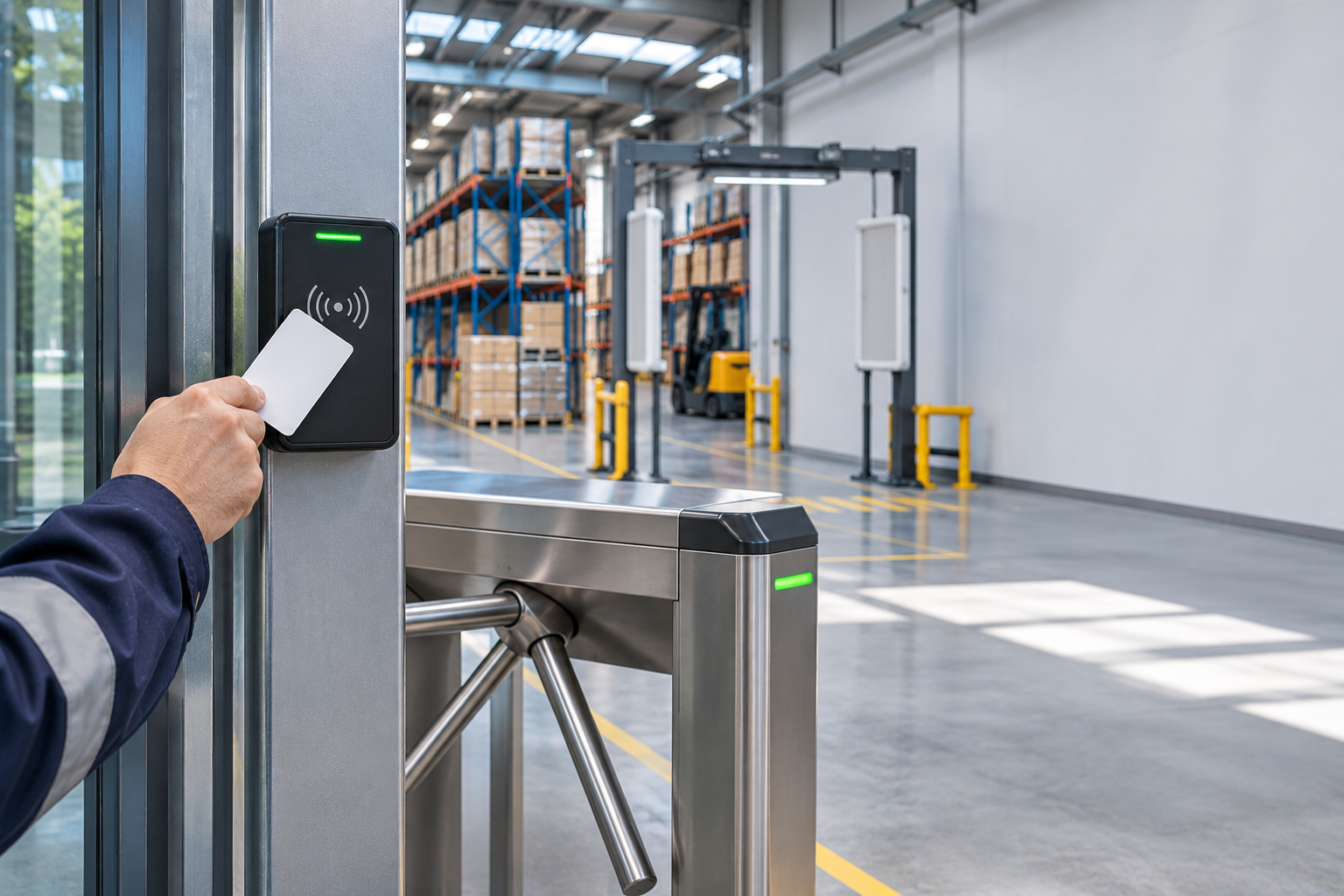
RFID technology is one of the contactless identification and data collection methods used in many areas, from daily life to industrial facilities. Personnel access cards, vehicle access systems, warehouse stock tracking, logistics operations, and product identification applications are among the common uses of RFID.
While traditional barcode systems require the product's code to be visible to an optical reader, RFID systems can read compatible tags via radio frequencies without a direct line of sight.
For example, employees passing through a turnstile with RFID cards at a factory entrance, or a large number of products being identified via RFID tags in a logistics center, are different applications of the same basic technology.
However, not every RFID system has the same operating frequency, reading distance, or security level. Short-range RFID cards used for personnel access and UHF RFID tags used in warehouses have different technical specifications.
So, what is RFID, how does it work, what are the differences between RFID and NFC, and how is the right RFID system chosen?
What is RFID?
RFID is an acronym for Radio Frequency Identification. In Turkish, it is called Radyo Frekansı ile Tanımlama.
RFID is a set of technologies that enable the reading of an electronic identifier assigned to an object or person via radio waves.
In an RFID system, data on a tag is wirelessly received by a compatible RFID reader and processed through software or a database for necessary applications.
Depending on its purpose, RFID systems can perform the following functions:
Identification of persons or objects.
Tracking of personnel entry and exit.
Authorized access control.
Product and stock management.
Tracking of assets and equipment.
Vehicle entry and exit management.
Monitoring of warehouse and logistics operations.
Automatic data collection in specific processes.
RFID itself is not a location tracking, biometric authentication, or personnel tracking software. The implementation of these functions may require appropriate readers, additional sensors, control hardware, and software infrastructure.
How Does an RFID System Work?
RFID systems are based on the principle of communication between a reader and an RFID tag via radio frequency.
The basic operation of the system consists of the following stages:
1. Reader Generates a Radio Frequency Field
The RFID reader generates an electromagnetic field or radio signal through its antenna, suitable for its operating frequency.
The characteristics of this signal depend on the RFID technology used.
2. RFID Tag Detection
When a compatible tag enters the reader's effective reading field, communication can begin.
Passive RFID tags can obtain the energy they need to operate from the radio frequency field generated by the reader.
Active RFID tags, on the other hand, have an internal power source.
3. Tag Data Transmission to the Reader
The tag transmits its identity or other data to the reader according to the protocol it supports.
For example, in passive UHF RFID systems, the tag can transmit data by modifying the reflection of the electromagnetic wave sent by the reader. This method is called backscatter.
In different technologies like HF RFID, load modulation and inductive coupling principles are used.
4. Data Processing by Software
The data obtained by the reader can be transferred to a control panel, personnel tracking software, or stock management system, depending on the application's features.
For example:
If the card is defined, door access may be granted.
If the product tag is read, warehouse movement can be recorded.
If the vehicle tag is authorized, the barrier opening process can be initiated.
If the asset tag is read, the relevant inventory record can be updated.
However, reading an RFID tag is not the same as authorizing a user or physically performing an action.
What Components Make Up an RFID System?
Professional RFID systems consist of mutually compatible hardware and software components.
RFID Tag
RFID tags can consist of an integrated circuit, an antenna, and a physical carrier structure depending on the application.
An identification number or specific information related to the application can be stored inside the tag.
Tags can be produced in various physical forms such as cards, key fobs, adhesive labels, industrial enclosures, or other forms.
RFID Reader
An RFID reader is an electronic device that communicates with compatible tags.
Readers can be found in desktop, handheld, portal, turnstile, or industrial fixed-mount designs.
RFID Antenna
The antenna enables radio frequency communication between the reader and the tag.
In some readers, the antenna is integrated into the device, while in some industrial systems, external antennas are used.
Especially in UHF systems, the gain, direction, polarization, and placement of the antenna significantly affect reading performance.
RFID Software
RFID software associates the read tag information with the relevant business processes.
For example, a personnel card can be matched with an employee record in the personnel attendance control system (PDKS) software.
Similarly, a product tag can correspond to a specific inventory item in the stock management system.
What Are the Types of RFID Tags?
RFID tags can be examined in three main groups based on energy usage.
Passive RFID Tags
Passive RFID tags do not have a separate battery for operation.
The tag communicates by drawing energy from the radio frequency field generated by a suitable reader.
Advantages include:
No battery replacement required.
Low unit cost in suitable applications.
Small physical size options.
Ability to tag a large number of products.
Passive RFID systems are widely used in access control, personnel tracking, retail product identification, and inventory management.
However, reading distance and performance depend on frequency, antenna, and environmental conditions.
Active RFID Tags
Active RFID tags have an internal battery or another power source.
These tags can send signals at specific intervals or communicate with readers, depending on their design.
They can be particularly useful in suitable long-range identification and asset tracking applications.
However, in active RFID systems, battery life, maintenance, device size, and total cost must be considered.
Semi-Passive / Battery-Assisted RFID Tags
Some RFID tags have an internal battery, but passive backscatter methods may be used for communication with the reader.
Such systems can be evaluated in specific sensor and industrial monitoring applications.
The technical scope of terms such as battery-assisted passive, semi-passive, and similar terms used by manufacturers should be checked on a product-specific basis.
What Are RFID Frequencies? Differences Between LF, HF, and UHF
One of the most important factors determining the operating characteristics of RFID technologies is the frequency band used.
LF RFID – Low Frequency
LF (Low Frequency) systems are generally associated with frequencies around 125 kHz or 134.2 kHz.
Operating characteristics:
Generally short-range identification.
Low data transfer rates.
Suitable operating characteristics in certain environmental conditions.
Applications such as access control and animal identification.
The 125 kHz technology is particularly encountered in older generation proximity card systems.
However, 125 kHz alone does not provide a specific level of authentication security.
HF RFID – High Frequency
In HF (High Frequency) RFID systems, the common operating frequency is 13.56 MHz.
This technology can be used for:
Contactless smart cards.
Secure access applications.
Transportation cards.
Specific payment and identification applications.
NFC-related devices.
Some product and document identification systems.
Within HF RFID, there are different standard families such as ISO/IEC 14443 and ISO/IEC 15693.
Although they use the same frequency band, they differ in communication characteristics and application areas.
UHF RFID – Ultra High Frequency
UHF (Ultra High Frequency) RFID is associated with long-range passive RFID technologies widely used, especially in product and asset tracking.
Passive UHF systems, referred to as RAIN RFID, are based on technical standards such as GS1 EPC Gen2 and ISO/IEC 18000-63.
These systems can be used in:
Warehouse stock counting.
Product and pallet identification.
Logistics operations.
Textile and retail inventory.
Industrial equipment tracking.
Suitable long-range vehicle identification.
One of the main advantages of UHF RFID is its ability to quickly read multiple tags with an appropriate reader and antenna structure.
However, environmental conditions, product material, metal surfaces, and liquids can affect reading performance.
RFID Frequencies Comparison Table
| RFID technology | Common frequency | General use | Reading characteristics |
|---|---|---|---|
| LF RFID | 125 / 134.2 kHz | Proximity card, animal identification | Short range |
| HF RFID | 13.56 MHz | Smart card, access control, NFC | Generally close range |
| Passive UHF / RAIN RFID | UHF band depending on regional regulations | Stock, logistics, asset tracking | Several meters or more under suitable conditions |
| Active RFID | Different bands depending on the product | Asset and equipment tracking | Longer distances depending on design |
Reading distances are not fixed or guaranteed values. RFID tag size, antenna, reader power, environmental conditions, and applicable national frequency regulations determine actual performance.
According to GS1's technical explanations, passive LF/HF systems mostly operate at short distances, while passive UHF tags can be read from several meters away under suitable conditions.
Therefore, the highest distance in the reader's catalog should not be used as a performance guarantee applicable to every tag.
What is the Difference Between RFID and NFC?
RFID and NFC concepts are often used interchangeably.
However, the two concepts do not refer to the same scope.
RFID is a broad family of identification technologies covering different frequency bands and various tag-reader technologies.
NFC (Near Field Communication) is a set of technologies and protocols that operate in the 13.56 MHz band, focusing on short-range communication.
NFC is particularly used in smartphones, contactless cards, and certain digital access applications.
RFID and NFC Comparison
| Criterion | RFID | NFC |
|---|---|---|
| Technology scope | LF, HF, UHF, and various active solutions | 13.56 MHz near-field communication |
| Reading distance | Varies by technology | Generally very short range |
| Primary use | Access control, inventory, logistics, asset tracking | Phone, digital key, contactless interaction |
| Phone compatibility | Not available for every RFID type | Possible with compatible phones and protocols |
| Security features | Depends on tag and protocol | Depends on the application and protocol used |
Can an RFID Card Be Read by a Phone?
Some RFID cards can be read by suitable NFC-enabled phones.
However, not every RFID card can be read by a phone.
For example, phones with standard NFC capability generally cannot directly read 125 kHz proximity cards or passive UHF inventory tags.
Furthermore, a phone detecting an HF card does not mean it can access the card's protected data or emulate the card for secure access purposes.
What is an RFID Card? How is it Used in Access Control Systems?
An RFID card is a contactless identification tool containing an appropriate electronic circuit and antenna.
In access control systems, RFID cards can be associated with an employee or user identity.
When a staff member brings their card close to the reader, the system evaluates the identity information provided by the card or the result of secure authentication.
If access authorization exists, the door or turnstile control system can perform the appropriate action.
However, reading an RFID card is not the same as secure authentication.
125 kHz Proximity Cards
In some 125 kHz proximity card systems, identification is done via a fixed card number.
In such applications, simple access systems based on card numbers may be found.
However, reading only a static identification number should not be considered sufficient for high-security access control.
MIFARE Cards
MIFARE is a product family offered by NXP, covering different contactless card technologies.
The security features of products like MIFARE Classic, MIFARE Plus, and MIFARE DESFire differ from each other.
Therefore, a definitive assessment covering the entire product family, such as “MIFARE card is secure,” is not accurate.
For example, MIFARE DESFire EV3, when properly configured, can offer features such as AES-based cryptographic authentication and advanced key management.
However, security depends not only on the card used but also on the reader, application keys, control panel, and system configuration.
In new access control projects, instead of relying solely on the card UID number, secure authentication methods appropriate for the need should be evaluated.
Can RFID Cards Be Cloned?
The risk of RFID cards being cloned or counterfeited depends on the technology used.
Especially some older access control systems that use only a static card number may pose a greater security risk compared to card systems that use advanced cryptographic authentication.
Therefore, in corporate RFID access projects, measures such as the following should be considered:
Mutual authentication.
Appropriate cryptographic algorithms.
Secure key management.
Revocation of authorization in case of card loss.
Secure communication between the reader and the control panel.
Monitoring of user and access events.
The frequency of RFID technology alone does not determine the security of the card.
For example, using a 13.56 MHz card does not automatically mean the system is protected against cloning.
How Does RFID Work with PDKS (Personnel Attendance Control Systems)?
RFID is one of the authentication and event logging methods used in Personnel Attendance Control Systems (PDKS).
When personnel bring their assigned card close to the PDKS reader, the relevant entry or exit event can be recorded.
This data can be transferred to the PDKS software and evaluated for work schedules, shifts, and payroll processing.
However, there is an important distinction here:
The RFID card reading process alone does not always indicate how long the personnel actually worked.
For accurate calculation of working hours, leaves, shifts, breaks, and relevant labor legislation must be considered.
How Are RFID PDKS Systems Evaluated in Terms of KVKK (Personal Data Protection Law)?
The use of RFID cards alone does not mean biometric data processing.
The Personal Data Protection Board's principle decision dated April 29, 2026, and numbered 2026/921, states that less intrusive methods such as RFID/NFC cards and PINs should be preferred over biometric data processing for employee attendance tracking.
However, entry-exit records created with an RFID card and associated with a specific employee may constitute personal data.
Therefore, in RFID-based PDKS systems, illumination, legal basis, data minimization, access security, and appropriate retention periods should also be evaluated.
How is Vehicle Access Control Done with RFID?
RFID technology can enable the identification of vehicles via electronic tags.
In these applications, an RFID tag is placed on the vehicle or on a suitable carrier.
When the vehicle enters the reader's detection area, the tag information is read.
The system can evaluate whether to grant access authorization to the vehicle according to the relevant access rules.
RFID vehicle access systems can be used for:
Site and residence parking lots.
Factory entrances.
Logistics facilities.
Personnel parking lots.
Controlled vehicle parking areas.
Difference Between RFID and License Plate Reading
RFID vehicle identification systems read the electronic tag assigned to the vehicle.
License plate recognition systems (ANPR/LPR), on the other hand, identify characters on vehicle license plates from camera images.
Therefore, the two technologies do not perform the same operation.
For example, reading an RFID tag does not mean that the vehicle's license plate has been verified via an image.
In high-security applications, RFID and ANPR can be used together. However, the relationship between the data of the two systems and the barrier control logic must be designed separately.
How is RFID Used in Stock and Inventory Tracking?
One of the important applications of RFID technology is stock and inventory management.
Especially passive UHF RFID systems can enable the automatic identification of a large number of products or assets by tagging them.
RFID Warehouse Tracking System
Let's consider that RFID tags are assigned to products in a logistics center.
When products pass through a suitable reader or reading gate, tag information can be automatically retrieved.
This information can be transferred to a warehouse management system (WMS).
In suitable applications, the following operations can be supported:
Product reception.
Warehouse entries and exits.
Stock counting.
Pallet and carton identification.
Asset tracking.
Shipment verification.
RFID with Multiple Tag Reading
In UHF RFID systems, appropriate protocols help identify multiple tags in the same reading area.
Anti-collision mechanisms are used in this process.
However, the presence of multiple tags in the same environment does not mean that all of them will be read completely under all conditions.
Especially metal products, liquids, dense stacking, and incorrect antenna placement can affect performance.
Therefore, real field tests and reading rate measurements are important in RFID inventory projects.
Differences Between RFID and Barcode
RFID and barcode are different technologies that can be used for product and object identification.
| Criterion | RFID | Barcode |
|---|---|---|
| Reading method | Radio frequency | Optical imaging |
| Direct line of sight | Generally not required | Required |
| Multiple reading | Supported in suitable systems | Depends on the reader used |
| Tag cost | Depends on technology, generally higher | Generally lower |
| Effect of metal and liquid | Significant, especially in some UHF applications | Readable surface and visibility conditions are important |
| Data update | Possible with some RFID tags | The printed code itself is generally fixed |
| Application infrastructure | RF reader, antenna, tag, software | Optical reader, tag, software |
RFID is not always a better alternative to barcode technology.
Barcode systems may be suitable, especially in low-cost applications where single-item scanning is sufficient.
RFID, on the other hand, can provide significant advantages in multiple reading, automatic data collection, or specific tracking processes.
What Factors Affect RFID Reading Distance?
One of the most common mistakes in RFID systems is to assume that the maximum reading distance in the device catalog applies to all applications.
In reality, reading performance depends on the following factors:
Characteristics of the RFID Tag
The size, design, and surface on which the tag antenna will be used affect reading behavior.
Specialized RFID tags may be required, especially for metal surfaces.
Reader and Antenna Characteristics
The operating capacity of the reader, antenna gain, polarization, and mounting direction are important.
Environmental Conditions
Metal surfaces, liquids, and other surrounding RF sources can affect reading performance.
Tag Orientation
Especially in UHF applications, the orientation of the tag antenna relative to the reader antenna can be critical.
Frequency and Legal Regulations
The frequency and transmission power limits that UHF systems can use depend on the radio equipment regulations of countries.
Therefore, it should not be assumed that all frequencies or power levels specified in international catalogs can be used unconditionally in Turkey.
The correct choice in RFID systems should be made not only based on the maximum reading distance but also on the reliable establishment of the desired reading zone under real field conditions.
How is Reading Accuracy Tested in RFID Systems?
Measuring system performance is important in professional RFID applications.
Especially in warehouses, logistics, and production facilities, how reliably the reader detects tags should be evaluated.
Read Rate
Indicates how many of the tags that should be read under defined test conditions were successfully read.
For example, if 985 tags were successfully read in a controlled test with 1,000 tags:
Read rate = 985 / 1,000 × 100 = 98.5%
This value is only an example calculation; it does not represent the performance of a real product.
Unwanted Reading
An RFID reader may also detect some tags located outside the target reading area.
This is particularly important in systems with nearby shelves, adjacent entry gates, or multiple readers.
Unwanted readings must be correctly filtered via software, and the physical reading zone must be appropriately designed.
Duplicate Reading
The same RFID tag can be read multiple times within a short period.
Therefore, it is important for the application software to distinguish between duplicate readings of the same tag and actual physical events.
An RFID reader seeing a tag does not always prove that the product actually passed through a specific door.
For event accuracy, appropriate sensors, reading direction, time windows, and software rules can be evaluated together.
In Which Sectors Are RFID Systems Used?
Factories and Industrial Facilities
Can be used for personnel access control, production equipment, and material tracking.
Logistics and Warehousing
Can support automatic identification of products, pallets, packages, and assets.
Shopping Malls and Retail
Can be used in product-based stock and inventory management, loss prevention processes, and suitable operational analysis applications.
Hospitals and Healthcare Institutions
Can be evaluated for managing equipment, inventory, materials, and authorized personnel access.
Hotels and Accommodation Facilities
Can be used for room access, staff areas, and suitable electronic lock systems.
Sites and Residences
Can support card-based personnel, resident, and vehicle access control.
Libraries and Educational Institutions
Can be used for identifying books, materials, and assets.
Data Centers
Can be used for personnel access control and specific inventory management processes.
What Standards Are Important in RFID Technologies?
Since RFID systems cover different operating technologies, a single standard cannot be taken as a basis for all RFID applications.
ISO/IEC 14443 Series
Relates to close-range contactless cards and associated communication methods.
It is an important technical reference, especially in certain smart card and access control applications.
ISO/IEC 15693 Series
Covers the communication characteristics of vicinity type contactless cards and objects operating in the 13.56 MHz band.
The ISO/IEC 15693-3:2026 version defines the relevant anti-collision and transmission protocol requirements.
ISO/IEC 18000-63:2021
Addresses the radio interface and communication requirements of passive UHF RFID systems.
It is particularly important in industrial product and inventory identification applications.
GS1 EPC UHF Gen2
One of the important technical protocol standards used in passive UHF RFID systems.
GS1's current Gen2 standard version 3.0.1 was published on February 26, 2026.
However, it cannot be assumed that a specific product is compatible with the latest published version of a standard merely by looking for RFID support in the product description.
The product model, protocol version, application requirements, and compliance documents must be checked separately.
What Should Be Considered When Choosing an RFID System?
The correct choice of RFID technology should be determined by its intended use.
For example, a card technology suitable for personnel access control may not be the right solution for warehouse inventory tracking.
The following criteria should be evaluated during selection:
The purpose of the system.
RFID frequency and protocol compatibility.
Requirement for active or passive tags.
Required reading distance.
Tag and reader security features.
Tag density in the same area.
Metal, liquid, and other environmental effects.
Antenna placement and reading zone.
Software and database integration.
Operational and personal data security.
Compliance with radio equipment regulations in Turkey.
Maintenance, service, and total cost of ownership.
Especially in access control projects, card authentication methods are priority technical criteria, while in industrial RFID projects, real field reading performance is crucial.
Technical Checklist for RFID System Installation
Has the purpose of the RFID system been clearly defined?
Has the choice of LF, HF, or UHF technology been verified?
Are the tag and reader protocols compatible?
Has a card or tag suitable for security requirements been determined?
Has the reading distance been tested under field conditions?
Have metal and liquid effects been evaluated?
Are the positions of the reader and antennas appropriate?
Have unwanted and duplicate readings been tested?
Have appropriate encryption and authentication methods been evaluated?
Has software and database integration been verified?
Has network and power outage behavior been tested?
If personal data is processed, have KVKK obligations been reviewed?
Have radio frequency and device compliance requirements in Turkey been verified?
Have installation and commissioning results been documented?
Has a periodic maintenance and technical support plan been created?
This list has been prepared for technical evaluation purposes. It does not replace product certifications, relevant regulatory review, or project-specific engineering design.
Frequently Asked Questions
What does RFID mean?
RFID is an acronym for Radio Frequency Identification. In Turkish, it means Radyo Frekansı ile Tanımlama.
How does RFID work?
An RFID reader communicates with a compatible RFID tag via radio frequency. The information provided by the tag can be received and processed by the relevant software or control system.
Are RFID and NFC the same thing?
No. RFID is a broad family of technologies. NFC is a short-range communication technology operating in the 13.56 MHz band. Some HF RFID systems may be compatible with NFC devices.
How many meters can an RFID card be read from?
The reading distance depends on the technology used. Short-range personnel cards are generally used by bringing them close to the reader, while passive UHF tags can be read from several meters or further under suitable conditions.
Do RFID cards have batteries?
Common passive RFID cards do not have batteries. However, active RFID tags can use an internal power source.
Can an RFID card be cloned?
Some older card systems that rely solely on a fixed number may have a risk of cloning or counterfeiting. Systems using secure cryptographic authentication have different characteristics.
Can PDKS be done with RFID?
Yes. RFID cards can be used in PDKS systems to record personnel entry and exit events. Working time and payroll calculations require appropriate software and business rules.
What is the main difference between RFID and barcode?
Barcodes are read optically, while RFID communicates via radio frequency. In suitable RFID systems, it may be possible to read tags without a direct line of sight and identify multiple tags.
Can RFID systems work without internet?
Yes. Some RFID readers and local control systems can operate without an internet connection. However, functions such as cloud-based software or remote management may require connectivity.
Is RFID harmful to health?
The safety of RFID devices depends on the frequency used, transmission power, exposure, and relevant compliance requirements. Use in accordance with standards and applicable radio equipment regulations should be observed. It should not be assumed that all RFID systems create the same exposure conditions.
Conclusion: RFID is a Core Technology for Contactless Identification in Security and Automation
RFID technology plays a significant role in electronic security, industrial automation, logistics, and inventory management by providing contactless identification and data collection via radio frequencies.
It has various application areas, from personnel access cards to long-range product tracking systems.
However, not all RFID systems have the same characteristics.
A successful RFID application requires the combined evaluation of correct frequency selection, appropriate tag and reader, secure authentication, proper antenna placement, and software integration.
Especially in access control systems, card security is important, while in warehouse and logistics applications, reading accuracy and field performance are crucial.
The primary purpose of RFID systems is not merely to read a tag, but to reliably identify the correct object or authorized user, thereby ensuring that related processes are managed correctly.