
KVKK-Compliant Access Control Systems: A Guide to Card, Biometric and Mobile Access
How can access control systems be made KVKK-compliant? We examine card access, RFID, mobile access, facial recognition, fingerprints and PDKS technologies from a personal data security perspective. We explain the technical selection criteria for biometric data processing, record retention and cloud systems under KVKK Principle Decision No. 2026/921.
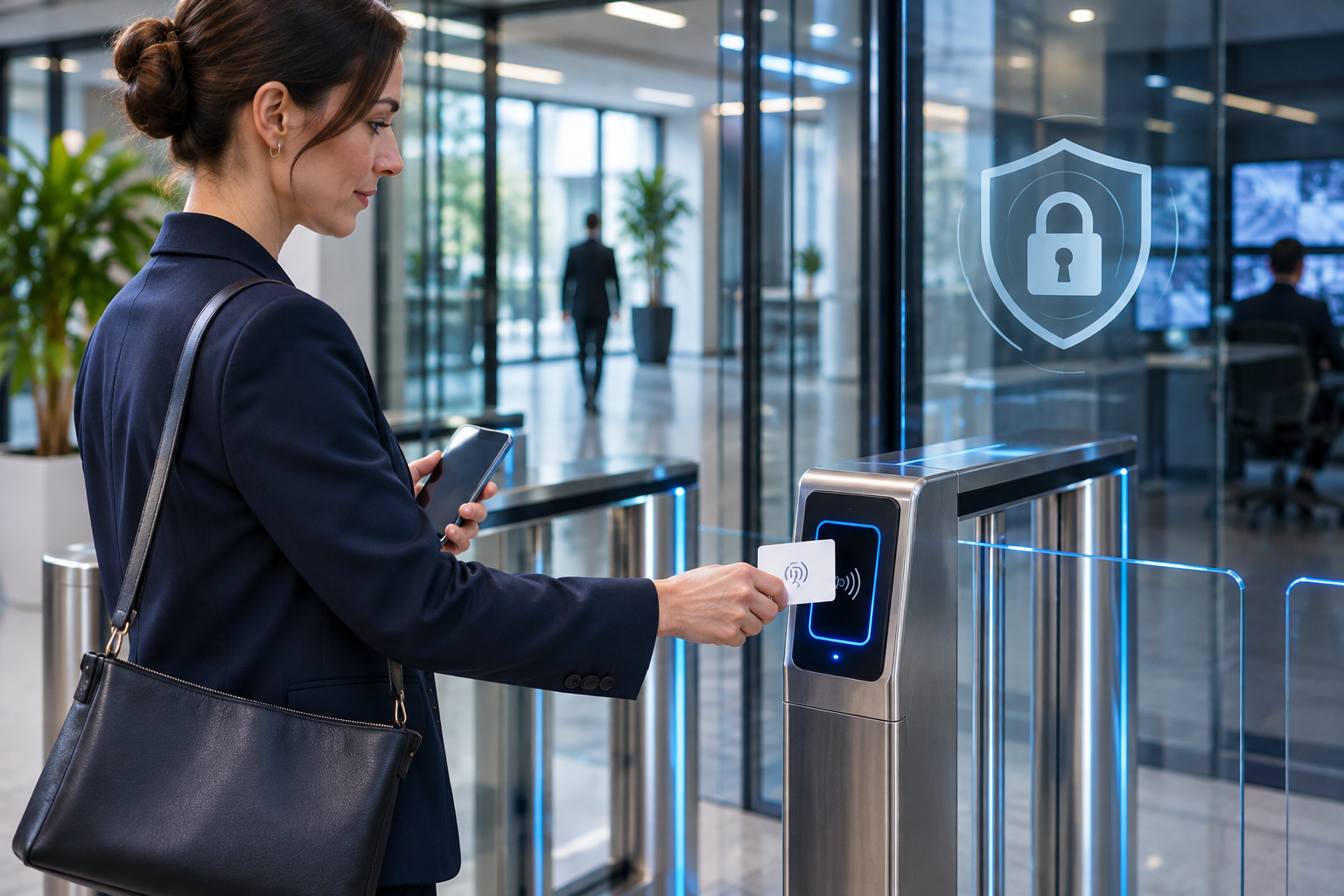
Access control systems are electronic security solutions used in businesses, factories, offices, hospitals, data centers and other facilities to manage authorized individuals’ access to designated areas. Operating with technologies such as card access, RFID/NFC, PINs, mobile authentication, fingerprints and facial recognition, these systems are an important component of physical security.
Modern access control systems, however, do more than manage doors opening and closing. They may also process user identities, access permissions, entry and exit times, visitor information and, in some applications, biometric data.
For this reason, protecting personal data is as important as physical security when designing access control systems.
A KVKK-compliant access control system cannot be achieved simply by using a secure card reader or encrypted software. The data collected by the system, the purposes for which it is processed, the parties with whom it is shared, how long it is retained and how access permissions are managed must all be assessed together.
The KVKK Principle Decision published in 2026 concerning the use of employees’ biometric data for working-hours monitoring has made it even more important to distinguish correctly between access control systems and personnel attendance systems.
What Is a KVKK-Compliant Access Control System?
A KVKK-compliant access control system is an electronic access control infrastructure in which personal data processing activities are carried out in accordance with the general principles and relevant provisions of Personal Data Protection Law No. 6698.
The following personal data may be processed in an access control system:
Employees’ first and last names and personnel numbers
Card or mobile credential identifiers
Door and area access permissions assigned to a user
Entry and exit dates
Access times and events
Visitors’ identity and contact information
Device or mobile application identifiers
Biometric verification data in systems where appropriate
Not all of this data is present in every system.
For example, even in a system that uses only card numbers, processing personal data may be involved if a card number can be linked to a specific employee.
The fact that data contains no name or photograph does not automatically mean that it is anonymous.
Do Access Control Systems Fall Under KVKK?
Yes. Access control systems that process information relating to identified or identifiable individuals fall under KVKK.
However, the data-processing risk is not the same for every access control technology.
Card access systems generally process user identifiers and access records, while biometric systems may involve special-category personal data.
Accordingly, KVKK assessments of access control systems should be based on the technology used and the purpose of processing.
Who Is the Data Controller?
A business that determines the purposes and means of processing personal data in an access control system may be the data controller for the activity concerned.
For example, if a factory determines employees’ access permissions, sets retention periods and decides how access data will be used, the factory operator may be the data controller.
A service provider that installs or maintains the system or manages it in the cloud may act as a data processor, depending on the nature of its activities.
These roles, however, are determined not merely by the titles used in a contract but by the parties’ actual responsibilities.
Comparison of Access Control Technologies from a KVKK Perspective
Technology | Data that may be processed | Key risk from a KVKK perspective |
|---|---|---|
Card access (RFID/NFC) | Card identity, user and access records | Monitoring individuals’ movements |
PIN access | User identity and access events | Unauthorized access and linking of records |
Mobile access | Digital identity, device information and access records | Additional device data and cloud transfers |
QR-code access | Visitor identity, code and access records | Unnecessary data collection and code sharing |
Fingerprint | Biometric template and access records | Processing special-category personal data |
Facial recognition | Biometric facial template and access records | Biometric data and proportionality |
Cloud-based access | User, permission and event records | Third-party access and international transfers |
This table provides a general technical and legal comparison. The actual risk depends on the product’s configuration, data flows and purpose of use.
Are Card Access Systems KVKK-Compliant?
Card access systems are widely used to control employees’ and visitors’ access to designated areas.
Access records generated through RFID or NFC cards constitute personal data when they can be linked to a user’s identity.
Card access systems are therefore also subject to KVKK obligations.
Data Minimization in Card Access
Only information necessary for access control should be processed in the system.
For example, retaining personal information in a card system that is not needed to verify an employee’s authorization to pass through a particular door should be assessed for proportionality.
Retention of Access Records
The retention period for records in card access systems should be set according to the purpose of use and applicable legal obligations.
KVKK does not prescribe one general retention period applicable to all access control records.
It should therefore not be assumed that records must automatically be kept for a set number of years.
Access Permissions
Access to access records should be restricted to authorized individuals who need them for their duties.
For example, security staff may need to view live access events, while detailed reporting on employees’ past movements may be subject to more restricted permissions.
Biometric Access Control Systems and KVKK
Biometric access control systems can verify identity using individuals’ physical or behavioral characteristics.
Technologies such as fingerprints, facial recognition, iris scans and palm-vein scans may fall into this category.
Under Article 6 of KVKK, biometric data is classified as special-category personal data.
Accordingly, when designing biometric access control, the processing conditions and proportionality must be assessed alongside the system’s security level.
Does Encrypting Fingerprint Data Eliminate KVKK Risks?
No.
Converting a fingerprint image into a mathematical template or encrypting it does not automatically remove its biometric nature.
The Personal Data Protection Authority specifically noted this in its statement concerning Principle Decision No. 2026/921.
Therefore, a manufacturer’s statement that “the fingerprint image is not stored; only an encrypted template is retained” does not, by itself, mean that the system is KVKK-compliant.
Can Facial Recognition Systems Be KVKK-Compliant?
When facial recognition technologies are used, through appropriate technical processes, to uniquely identify or verify individuals, biometric data processing may be involved.
Facial recognition systems therefore require assessment of the conditions for processing special-category personal data, data security and proportionality.
In particular, it should be examined whether less intrusive methods, such as cards or PINs, would suffice for ordinary employee entry.
KVKK Principle Decision No. 2026/921: Biometric Monitoring of Working Hours
The Personal Data Protection Board’s Principle Decision dated April 29, 2026, and numbered 2026/921, on Processing Biometric Data for Working-Hours Monitoring is a significant regulatory development for personnel attendance systems.
The Board found that, under the current legal framework, processing biometric data to monitor employees’ working hours does not rely on an appropriate legal basis and fails to meet the principle of proportionality.
The imbalance of power between employees and employers, as well as the availability of less intrusive alternatives, is also significant to this assessment.
For working-hours monitoring, the Board pointed to the following alternatives to biometric methods:
Encrypted card- or PIN-based systems
RFID/NFC employee cards
Traditional signature and attendance sheets
Manual entry methods under an auditor’s supervision
Key takeaway: Obtaining employees’ explicit consent does not automatically make biometric working-hours monitoring lawful.
Is Biometric Access for Physical Security the Same as Working-Hours Monitoring?
No.
In its statement dated August 27, 2026, KVKK said that Principle Decision No. 2026/921 concerns processing biometric data for working-hours monitoring.
It also explained that biometric data processing activities for purposes other than working-hours monitoring should be assessed in light of their own purposes and specific circumstances.
For example, controlling access to a particular technical room in a high-security data center is not the same purpose as tracking all employees’ daily arrival and departure using biometric methods.
This distinction does not mean, however, that biometric data processing for physical security is always permitted.
The legal basis, necessity, proportionality, alternative methods and data security must be assessed for each specific project.
The KVKK Difference Between PDKS and Access Control Systems
Access control systems and personnel attendance systems may use the same hardware, but they serve different purposes.
An access control system checks whether a person is authorized to enter a particular area.
PDKS is used to monitor employees’ working hours, arrival and departure times, and attendance.
If data from the same card reader is used for both physical security and working-hours monitoring, each processing purpose must be assessed separately.
Change of Purpose and Secondary Use
Using data collected to verify an employee’s authorization to enter a particular area later for detailed performance or behavioral analysis may constitute an activity distinct from the original data-processing purpose.
System design should therefore distinguish between purposes such as access security, working-hours monitoring and employee performance analysis.
Are Mobile Access Control Systems KVKK-Compliant?
Mobile access systems can use smartphones as digital access keys.
Authentication can be performed using Bluetooth, NFC or other communication technologies.
In addition to digital credentials, these systems may process device identifiers, application logs and, in some applications, location or connection information.
When assessing mobile access systems, check:
Which device data is collected,
Whether location tracking is performed,
Where mobile credentials are stored,
How access is revoked if a phone is lost,
Whether the application provider can access the data,
Whether data is transferred abroad
must be checked.
The fact that a mobile access system is cloud-based does not, by itself, make it non-compliant with KVKK. However, the requirements for processing and transferring personal data must be met.
Data Security in Cloud-Based Access Control Systems
Cloud-based access control systems can enable centralized management of users and access permissions across multiple locations.
However, user information, card identifiers, access events and administrator activity logs may be processed on third-party infrastructure in these systems.
When selecting a cloud service, therefore, assess not only software features but also data flows and the security architecture.
Data Hosting in Türkiye or Abroad
Storing data on servers in Türkiye does not, by itself, ensure KVKK compliance.
Likewise, processing personal data abroad is not prohibited in every case.
However, if personal data is transferred abroad, the conditions set out in Article 9 of KVKK should be assessed.
Amendments that entered into force on June 1, 2024, established a new transfer system based on adequacy decisions, appropriate safeguards and certain exceptional transfer circumstances.
The Authority must be notified within five business days of signing standard contracts, which are one of the appropriate safeguard mechanisms.
Technical Features to Check in Cloud Systems
Encryption during data transfer
Protection of data at rest
Multifactor authentication for administrator accounts
Role-based user authorization
Administrator activity logs
Backup and recovery procedures
Data deletion and destruction mechanisms
Identification of subcontracted service providers
Data center and remote-access locations
Security updates and incident-response processes
How Long Should Access Control System Data Be Retained?
The retention period for access control records should be determined according to the system’s purpose of use and relevant legal requirements.
For example, the reasons for retaining access records to investigate physical security incidents may differ from those for retaining records relating to employees’ working hours.
It is therefore not appropriate to set one general retention period for all records.
How to Create a Retention Policy
First, identify the data categories.
Then, for each data category, define:
Purpose of processing,
Legal basis,
Reason for retention,
Retention period,
Access permissions,
Deletion or destruction method
must be defined.
Personal data whose retention period has expired and for which no other legal reason for processing exists must be deleted, destroyed or anonymized in accordance with the applicable legislation.
Technical Security in KVKK-Compliant Access Control Systems
Software-level encryption alone is not sufficient to protect personal data.
Every component of the system must be assessed, from the card reader to the control panel and from the server to the cloud platform.
Communication Between the Card Reader and Control Panel
In typical implementations, older Wiegand communication does not provide encrypted data transmission.
Properly configured OSDP Secure Channel can help protect communication between the reader and the control panel.
However, using OSDP alone does not guarantee the cybersecurity or KVKK compliance of the entire system.
User Authorization
System administrators’ access permissions should be limited to what their duties require.
For example, a security operator may need to monitor door alarms, but may not need permission to export the entire personnel history of access movements.
Logs and Audit Trails
Recording administrator actions is useful for investigating unauthorized access and auditing system security.
Audit logs themselves may also contain personal data. Appropriate retention and access policies should therefore be established for them as well.
How to Choose a KVKK-Compliant Access Control System
When selecting a professional system, physical security requirements and personal data protection requirements should be considered together.
1. Define the Purpose of Use
Will the system manage door access only, or will it also handle PDKS and visitor management?
Data-processing requirements should be determined separately for each purpose.
2. Assess the Least Intrusive Technology
If methods such as cards or PINs meet the security need, question whether processing biometric data is genuinely necessary.
3. Map the Data Flow
Document what information is transferred and stored, from the card reader to the server.
4. Review the Conditions for Processing Biometric Data
If biometric access is planned, take into account Article 6 of KVKK, Principle Decision No. 2026/921 and relevant Board statements.
5. Assess Cloud and Third-Party Risks
Review data hosting, remote access, service providers and any potential transfers abroad.
6. Establish a Retention and Destruction Policy
Define technical and administrative processes to prevent data from being kept longer than necessary.
7. Complete Technical Security Testing
Test encryption, authorization, event logs, backups and system update processes.
Technical Checklist for KVKK-Compliant Access Control Systems
- Have the purposes of data processing been clearly defined?
- Have the roles of data controller and data processor been defined?
- Have card, PIN, mobile and biometric methods been compared?
- Have less intrusive authentication options been considered?
- Has Principle Decision No. 2026/921 been taken into account for biometric working-hours monitoring?
- Have the conditions for processing special-category personal data been checked?
- Has the obligation to inform been assessed?
- Have retention periods for access records been set?
- Have cloud and international data transfers been reviewed?
- Is communication between the card reader and control panel secure?
- Have administrator access and activity logs been checked?
- Have deletion, destruction and backup processes been defined?
- Have supplier and integrator responsibilities been defined?
- Have data security tests been conducted after installation?
Frequently Asked Questions
Are card access systems KVKK-compliant?
They can be KVKK-compliant when properly designed and operated. However, card numbers, user identities and access records may constitute personal data.
Can fingerprints be used to monitor employees’ working hours?
In Principle Decision No. 2026/921, the Personal Data Protection Board deemed the use of biometric data to monitor employees’ working hours unlawful under the current legal framework and directed organizations toward less intrusive alternatives.
Are facial recognition access control systems completely banned?
It cannot be said that there is a general ban covering every purpose of use. However, the conditions for biometric data processing, necessity, proportionality and relevant Board decisions should be assessed in relation to the specific application.
For how many years should access control records be retained?
There is no single general period that applies to all systems. The retention period should be determined according to the purpose of processing and relevant legal obligations.
Do cloud-based access control systems violate KVKK?
No. Using the cloud does not, by itself, constitute a violation. However, data security, data processor relationships and the conditions for international transfers should be assessed.
Is obtaining explicit consent enough in an access control system?
No. Even where explicit consent exists, personal data processing must comply with the general principles of KVKK. Explicit consent does not resolve the proportionality issue, particularly in biometric working-hours monitoring.
Conclusion
KVKK-compliant access control systems are solutions that not only manage physical access securely but also make personal data protection a fundamental part of system design.
Card access, PINs, mobile access and biometric authentication technologies involve different data-processing risks.
In particular, KVKK Principle Decision No. 2026/921 has made clear that the use of biometric data to monitor employees’ working hours must be considered carefully from a legal perspective.
Businesses, system integrators and security technology suppliers should therefore assess access security, data minimization, retention policies, user authorization and legal requirements together.
The right access control system is one that not only prevents unauthorized access but also protects personal data from unnecessary processing and unauthorized access.