
Security Systems in School Buses: Cameras, Vehicle Tracking and Student Safety
How is student safety ensured on school buses? We examine interior and exterior cameras, GPS vehicle-tracking systems, emergency buttons, student boarding and alighting checks, and recording technologies in light of current Turkish regulations and technical selection criteria.
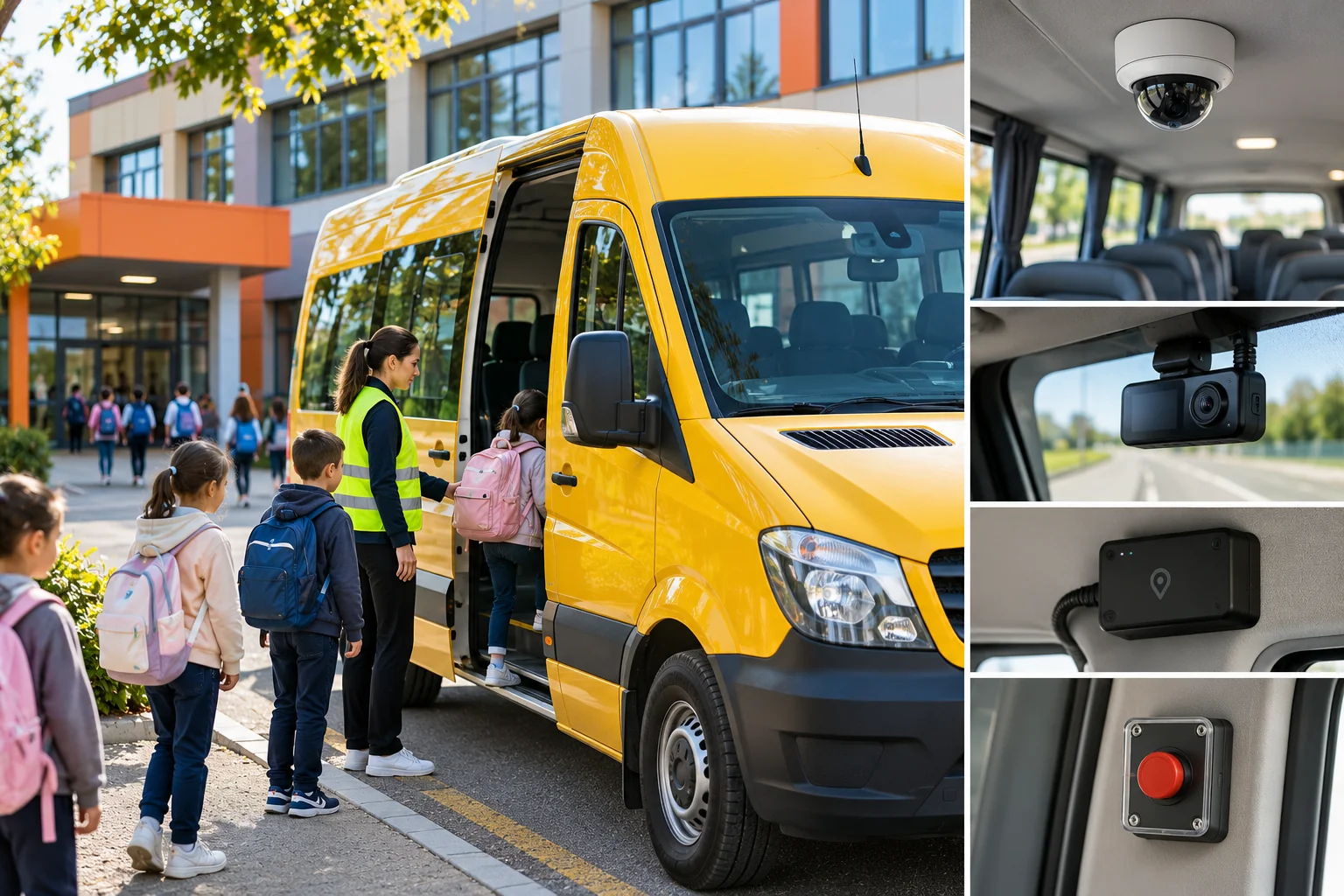
Safety on school buses is an important aspect of transport safety, ensuring that students travel safely from home to school and back. In particular, the supervision of children inside vehicles, risks during boarding and alighting, traffic accidents, deviations from routes, and children being left inside vehicles show that school buses should not be treated merely as a transportation service.
Today, the systems used on school buses include in-vehicle camera systems, GPS vehicle-tracking solutions, emergency buttons, seat sensors and student-tracking technologies, important components that support physical security and human supervision.
For these technologies to be effective, however, the right devices must be selected, installed in compliance with regulations, and operated alongside uninterrupted recording, reliable communications and regular inspection procedures.
What Are Security Systems on School Buses?
School-bus security systems comprise electronic monitoring, recording, positioning, detection and emergency-notification solutions used to support the safety of vehicles and passengers during student transport.
The main objectives of these systems are to:
Record incidents that occur inside the vehicle.
Track the vehicle's position and route movements.
Support students in boarding and alighting safely.
Ensure that authorized persons are notified promptly in emergencies.
Establish checks to reduce the risk of a student being left inside the vehicle.
Improve coordination among school administrators, bus operators and parents.
Electronic security equipment does not replace the responsibilities of drivers and attendant staff. Its purpose is to strengthen human supervision and help identify security incidents earlier.
Are Security Systems Mandatory on School Buses?
In Türkiye, the equipment required on school buses is determined by the relevant regulations, primarily the Regulation on School Service Vehicles and the Highway Traffic Regulation .»؟ Wait
The Regulation on School Service Vehicles, published on 25 October 2017, has undergone various amendments in subsequent years.
The amendments published in the Official Gazette dated 19 August 2025, issue No. 32991, are particularly significant with regard to the technical compliance of in-vehicle and exterior camera systems and recording devices.
Subparagraph (m) of the first paragraph of Article 4 of the Regulation on School Service Vehicles stipulates that school buses must carry interior and exterior cameras and a recording device, positioned to cover all seats and compliant with the technical, equipment, installation and operating requirements set out in the relevant traffic and vehicle-modification regulations.
Transition Periods for Cameras, Vehicle Tracking and Emergency Equipment in 2026
The amendment to the Highway Traffic Regulation dated 19 August 2025 includes transition provisions tied to vehicle model years for existing vehicles covered by the regulation.
Vehicle model year | Transition date specified in the regulation |
|---|---|
2023–2025 models | 1 January 2026 |
2018–2022 models | 1 January 2027 |
2017 models and earlier | 1 January 2028 |
These dates concern the requirement, under the applicable transition provisions, for covered vehicles to have vehicle-tracking, camera, video-recording and emergency-button equipment. The regulation takes as its reference the first vehicle inspection after the specified dates.
Important: These are not single, fixed installation deadlines that apply to all school buses. The date of first registration, the vehicle's existing equipment and special transition provisions may affect the obligations.
For example, separate transition provisions apply to certain registrations between 18 February 2025 and 1 October 2025, as well as to camera equipment compliant with earlier technical regulations.
Bus operators should therefore assess the requirements applicable to their vehicles in light of the current text of the relevant regulations and the vehicles' registration and inspection status.
Official regulations:
Camera Systems on School Buses
Interior and exterior camera systems are among the core elements of the electronic security infrastructure on school buses.
Camera systems can help with the review, when necessary, of students boarding and alighting, incidents inside the vehicle and surrounding traffic conditions.
In-Vehicle Security Cameras
In-vehicle cameras are used to monitor student seats and relevant areas inside the bus.
When positioning cameras, it is not only the number of devices that matters; adequate coverage of all seats and the technical coverage required by regulations.
The following criteria are important when selecting cameras for a vehicle:
A suitable field of view for the seat rows and aisle.
Adequate image quality in daylight and low-light conditions.
Resistance to vehicle vibration and temperature changes.
A video format compatible with the recording system.
Secure cabling and installation.
Recording behavior after a power interruption and restart.
Verification by replaying actual recordings.
A wide-angle camera covering every seat does not necessarily provide the same level of detail at every point.
For this reason, after installation, actual footage of the driver's seat, student seats, aisle and door area should be checked.
Exterior Cameras
Exterior cameras can be used to capture incidents occurring around the school bus.
Depending on project and regulatory requirements, areas that may be considered for coverage include the front of the vehicle, the area around the entrance door and other necessary exterior zones.
Correct camera orientation is particularly important in areas where students approach or leave the vehicle.
However, using exterior cameras does not remove the driver's duty to check the mirrors and drive safely.
Mobile DVR and Vehicle-Mounted NVR Recording Systems
Cameras on school buses can be connected to digital recording devices designed for mobile use.
Depending on the system architecture, operators may choose a mobile DVR, an IP-based vehicle recording system or a manufacturer's proprietary video-recording solution.
The following features should be assessed in vehicle recording devices:
The required number of camera channels.
Recording capacity compliant with the relevant regulations.
Input voltage compatible with the vehicle's electrical system.
Behavior when the ignition is switched on and off.
Resistance to vibration and heat.
Protection of recordings against unauthorized access.
Storage health and fault notifications.
GPS and mobile-data connectivity support, if required.
The installation location, power connection and actual accessibility of recordings are just as important as the technical specifications of the recording device.
GPS Vehicle-Tracking Systems on School Buses
GPS/GNSS-based vehicle-tracking systems help determine the school bus's location and monitor its route movements.
In these systems, satellite positioning data can be transmitted to an authorized tracking platform over the supported communications infrastructure.
A suitably configured system can provide the following information:
The vehicle's current location.
Route history.
Movement and stop information.
Speed data.
Events involving entry to and exit from designated areas.
Route-deviation alerts.
Notifications of communication or location-data interruptions.
The Regulation on School Service Vehicles includes provisions requiring a vehicle-tracking system and retention of tracking records for at least 30 days.
However, determining a location via GPS and transmitting that location to a central system are different functions. Real-time data transmission may be interrupted in areas without mobile-network coverage. Offline data storage and the ability to transmit data once the connection is restored should therefore be assessed.
Student Boarding and Alighting Tracking Systems
Tracking when students board a school bus and at which stop they get off is an important aspect of school-bus safety.
Card identification, QR codes, NFC or suitable student-tracking applications can be used for this purpose.
For example, when a student boards, they can scan their card, and the system can record the event on the authorized tracking platform.
However, the limitations of these systems should be assessed correctly.
A card scan alone does not conclusively prove that a student physically boarded or alighted safely.
Records may differ from what actually happened if a card is forgotten, scanned by another person, connectivity is lost or the system is used incorrectly.
Digital records must therefore be supported by the attendant's direct checks.
Parent Notification Systems
Suitable student-tracking solutions can send parents notifications about specific events.
For example:
The bus approaching a designated location.
A record being created of the student boarding the vehicle.
A record being created of the student alighting.
The bus being delayed on its designated route.
An authorized operator issuing an emergency notification.
The reliability of notifications depends on the data connection, correct system use and user-authorization procedures.
Student locations and movement records should be shared only with authorized persons and for legitimate purposes.
Systems to Prevent Students from Being Left on School Buses
A student being left on a school bus is one of the risks for which human checks are as critical as technological security systems.
Solutions that may help reduce this risk include seat-occupancy sensors, in-vehicle check systems, rear-area inspection buttons and electronic devices that trigger alarms under certain conditions.
Seat Sensors
Seat sensors can detect changes in pressure or occupancy in a seating area.
However, these sensors should be assessed only within the limits of their technical specifications and operating conditions.
For example, a bag or another object on a seat may cause some sensors to register a false occupancy.
Moreover, not every sensor can determine whether the person occupying a seat is a student.
End-of-Route Vehicle Check Systems
Some systems require the driver to move to the rear of the vehicle and carry out an inspection after completing a trip.
Such solutions can help reduce the risk of a student remaining inside the vehicle.
However, pressing the inspection button does not, on its own, technically prove that every seat in the vehicle was actually checked.
The end-of-route inspection procedure should therefore be carried out alongside a student count and physical check by the attendant.
Emergency Buttons and Communications on School Buses
An emergency button is an electronic security component that sends a notification to an authorized center in the event of a specific threat or emergency.
Depending on the system architecture, an emergency button can:
Trigger an alarm event.
Report the vehicle's last known location.
Send an alert to a central monitoring platform.
Notify authorized persons.
Ensure that the relevant event is entered into the system records.
However, emergency buttons do not all have the same functions. It should not be assumed that a system without mobile communications can send an instant alarm to a remote center.
In addition, an emergency notification does not, by itself, mean that a direct, automatic connection to the 112 Emergency Call Center is provided.
Relevant integrations and alarm-routing features should be verified for each product.
A Comparison of Security Technologies for School Buses
Different security technologies are designed to mitigate different risks.
System | Primary function | Technical limitation |
|---|---|---|
In-vehicle camera | Recording incidents inside the vehicle | Field of view and recording quality |
Exterior camera | Recording events in the surrounding area | Blind spots and lighting conditions |
GPS vehicle tracking | Location and route monitoring | Location and communication outages |
Student tracking | Recording boarding and alighting events | User errors and missed scans |
Seat sensor | Occupancy detection | Limitations in distinguishing objects from passengers |
Emergency button | Emergency notification | Dependence on communications and integration |
Mobile recording device | Storage of video data | Storage, power and device failures |
The solutions in the table are not interchangeable technologies.
For example, a vehicle-tracking system cannot verify that students are seated safely. In-vehicle cameras alone cannot guarantee that students have been handed over to authorized persons.
How to Choose Camera and Recording Systems for School Buses
Resolution, channel count or device price alone are not sufficient criteria for selecting the right system.
Vehicle Configuration and Camera Placement
First, assess the vehicle's seating layout, door locations, interior space and potential camera blind spots.
The installation plan should be designed to provide coverage of all required areas.
Recording Capacity
Recording capacity depends on the number of cameras, resolution, frame rate, video compression format, bit rate and intended retention period.
For example, if each camera in a four-camera system is assumed to generate an average of 2 Mbit/s of data, the total video data rate would be approximately 8 Mbit/s.
Assuming continuous recording for 24 hours, this figure corresponds to approximately 86.4 GB of raw compressed video data per day.
However, daily operating hours, recording behavior and camera settings may vary on school buses.
This calculation is illustrative only; actual storage capacity should be determined by taking into account the manufacturer's recording-calculation method, regulatory retention requirements and a safety margin.
Power and Operational Continuity
It is important for the recording device to start when the ignition is switched on and shut down safely when it is switched off.
Battery protection, sudden voltage fluctuations and data integrity following a power outage should be assessed.
Environmental Durability
Vehicle environments may involve conditions such as vibration, temperature fluctuations and electrical interference.
For this reason, it is important to choose products certified as suitable for automotive applications.
System Integration
If cameras, recording devices, vehicle tracking and emergency components are selected from different manufacturers, their integration capabilities should be verified.
The fact that devices are installed in the same vehicle does not mean they can automatically be managed from a single control center.
KVKK and Student Privacy in School Bus Camera Systems
Using cameras on school buses requires particular care in terms of personal data protection because it involves processing images of children.
Under the relevant circumstances, images of students constitute personal data relating to identified or identifiable individuals.
Accordingly, the necessary legal assessment should be carried out when installing camera systems under Personal Data Protection Law No. 6698.
The fundamental principles are as follows:
The purpose for which camera footage is retained should be clearly defined.
The appropriate legal basis for processing should be identified.
The relevant individuals, particularly students and parents, should be provided with the required information.
The people who can access recordings and their permissions should be restricted.
Data should be protected by appropriate technical and administrative measures.
Mandatory retention periods and data-erasure procedures should be established.
Disclosure of recordings for purposes other than those for which they were collected should be prevented.
Additional data-processing activities, such as audio recording or biometric analysis, should be assessed separately.
The existence of a regulatory obligation to use cameras does not mean that every additional feature of the system may be used without restriction.
Data security and transfer requirements should be examined separately, particularly when images of children are viewed online, shared with third-party platforms or transferred to the cloud.
The Personal Data Protection Authority's official statement on the use of security cameras sets out important principles on purpose limitation and proportionality in video recordings, and the protection of children's privacy.
Periodic Checks of School Bus Security Systems
The presence of electronic security equipment in a vehicle does not mean that the systems always operate correctly.
Regular checks and maintenance are important for identifying security vulnerabilities.
Technical Checklist
Do the in-vehicle cameras cover all required seats?
Are the exterior cameras aimed correctly, and is their image quality adequate?
Are the camera lenses dirty or damaged?
Is the recording device working and using the correct date and time?
Can past recordings be played back successfully?
Have storage capacity and disk health been checked?
Are GPS location and route records being verified?
Has the system's behavior during mobile network outages been tested?
Are the emergency button and notification mechanism working?
Have the seat sensors and, if present, end-of-route check mechanisms been tested?
Are the electrical connections and cable fastenings secure?
Have software updates and access permissions been checked?
Have test results and identified faults been recorded?
This checklist has been prepared for technical maintenance planning. It does not replace vehicle inspections, official inspections or specific maintenance procedures prescribed by the manufacturer.
Frequently Asked Questions About School Bus Security
Are cameras mandatory on school buses?
Türkiye's Regulation on School Bus Vehicles contains provisions on having interior and exterior cameras and a recording device on school buses. However, the applicable technical requirements need to be assessed in light of vehicles' initial registration dates, model years and transitional provisions.
Is a GPS vehicle-tracking system mandatory on school buses?
The Regulation on School Bus Vehicles contains a provision requiring a vehicle-tracking system. Nevertheless, the dates on which the relevant equipment must be implemented and checked during inspections should be examined alongside the transitional provisions in current traffic legislation.
How long should school bus camera footage be retained?
The retention period should be determined in accordance with the regulations applicable to the school bus and the relevant vehicle type. Earlier regulations required at least 30 days of camera footage, while the 2025 amendments also made recording devices subject to technical and operational requirements. The current requirements should therefore be verified for each vehicle. Unnecessarily long retention periods should also be avoided.
How can students being left behind on a school bus be prevented?
Seat sensors, end-of-route check systems and student boarding and alighting tracking applications can help reduce the risk. Nevertheless, physically checking inside the vehicle and counting students at the end of each trip are fundamental safety measures.
Can parents watch school bus cameras live?
Some technical systems may provide remote access to live footage. However, the fact that this is technically possible does not mean that granting parents unrestricted access is legally appropriate. Because recordings may also contain images of other students, access permissions and personal data protection requirements should be assessed separately.
Conclusion
Ensuring student safety on school buses is not a process that can be completed simply by installing a camera inside the vehicle or fitting a GPS tracking device.
A safe school bus requires the combined implementation of appropriate vehicle equipment, the right electronic security technologies, regulatory compliance, trained personnel, regular maintenance and clear student handover procedures.
Camera systems can help investigate incidents, GPS systems can help track routes, student-tracking solutions can create boarding and alighting records, and emergency systems can facilitate prompt notifications.
However, no electronic system can replace the careful checks carried out by drivers and attendant staff or their responsibility for safe transportation.
For more information about the school's general physical and electronic security needs, you can also consult GüvenlikOnline's Security in Schools: What Measures Should Be Taken? article.