
What Is an Elevator Security Camera? Installation, Wired and Wireless Systems, KVKK Guide
How do you choose and install an elevator security camera? We examine IP cameras, wired and wireless video transmission, traveling cables, NVR recording, installation safety, KVKK, and the legal requirements for camera use in apartment buildings.
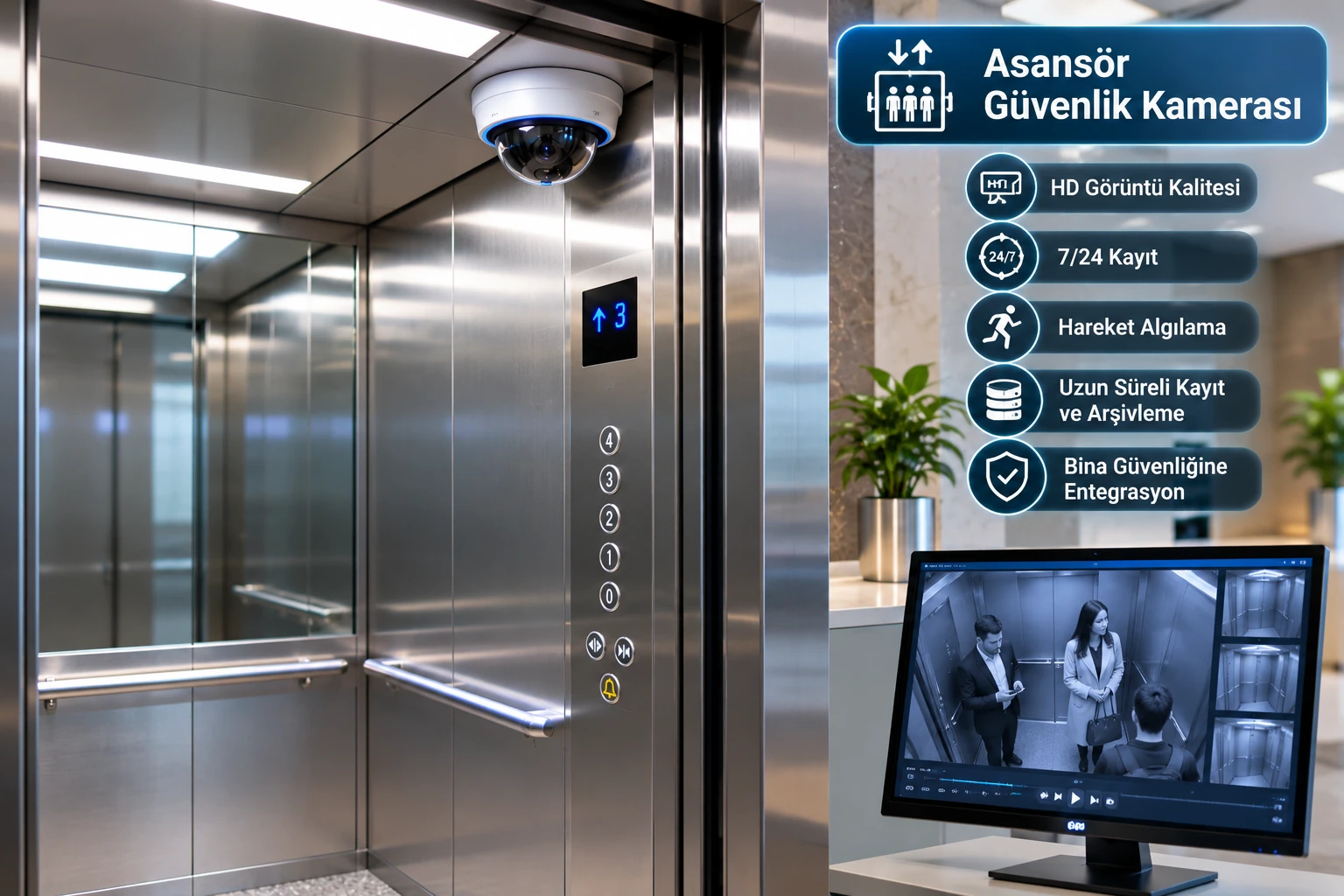
Elevator security cameras are CCTV solutions considered for security in apartment buildings, residential complexes, shopping centers, hotels, hospitals, offices, and commercial buildings. However, elevator cabins have technical and legal requirements that differ from conventional camera installations.
A constantly moving cabin, limited installation space, changing lighting, video transmission infrastructure, and requirements for safe elevator operation call for special measures in camera-system design.
In addition, elevator cabins are confined, enclosed spaces in which people cannot easily avoid being monitored. The necessity and proportionality of camera use must therefore be assessed separately.
A sound elevator security camera project requires coordinated planning of suitable camera selection, safe installation, uninterrupted video transmission, reliable recording infrastructure, and data-processing procedures compliant with KVKK.
What Is an Elevator Security Camera?
An elevator security camera is a camera system used to view or record specific security-related incidents inside an elevator cabin.
Compact dome, mini-dome, or corner cameras may be used in practice. The camera type is selected according to the cabin dimensions and existing infrastructure.
The main components of an elevator camera system are:
Security camera
Suitable power supply
Wired or wireless video transmission infrastructure
NVR, DVR, or suitable recording system
Network and connectivity equipment
Camera mounting brackets
Necessary protective and connection components
However, the same camera or connection method cannot be used for every elevator.
Can Security Cameras Be Installed in Elevators?
In Türkiye, installing cameras in elevators should not automatically be considered either prohibited or permitted in every circumstance.
Elevators in apartment buildings and residential complexes are common areas. At the same time, the cabin’s confined, enclosed nature matters when considering people’s expectations of privacy.
A 2026 statement by the Personal Data Protection Authority on the use of security cameras in apartment buildings said that surveillance in elevators can create an intense sense of being watched and that the grounds for installing a camera must be clearly stated.
The following questions should therefore be answered before placing a camera in an elevator:
What is the specific security need?
Is using a camera genuinely necessary?
Can the same purpose be achieved using less intrusive methods?
For what purpose will the images be processed?
Who will have access to the recordings?
How long will the recordings be retained?
Have the necessary decisions and permissions been obtained under the Condominium Law and the management plan?
A decision by apartment management to install cameras does not, by itself, mean that all KVKK obligations have been met.
How Does an Elevator Security Camera Work?
An elevator security camera captures images inside the cabin and transmits them to a recording or monitoring system using suitable communications infrastructure.
Video can be transmitted using different methods.
Wired Video Transmission
Camera footage is transmitted over connection infrastructure designed to accommodate the elevator’s moving structure.
Depending on the system type, Ethernet, coaxial, or specialized transmission solutions may be considered.
Wireless Video Transmission
Camera footage can be transmitted over a suitable wireless connection between a transmitter on the cabin and a fixed receiver.
With this method, connection quality may be affected by the elevator shaft structure and radio-signal conditions.
Local Recording
In some camera systems, footage can be recorded on the camera itself if suitable storage support is available.
However, local recording does not automatically ensure that footage is transferred to a central system or securely retrieved after an incident.
Differences Between Wired and Wireless Elevator Camera Systems
Feature | Wired system | Wireless system |
|---|---|---|
Video transmission | Physical connection | Radio connection |
Need for traveling cable | Depends on the design | Can be reduced for video transmission |
Connection continuity | Depends on cable and connection quality | Depends on signal conditions |
Installation | Depends on existing cable infrastructure | Requires transmitter and receiver placement |
Maintenance | Cable and connection checks | Signal and device checks |
IP camera compatibility | With suitable Ethernet infrastructure | With a suitable IP bridge |
Power requirements | Locally or through a suitable cable | Local power is generally required |
Wireless systems are not necessarily easier or more reliable in every situation. The elevator shaft geometry, cabin movement, metal surfaces, and location of connection points should be tested.
What Is a Traveling Cable in Elevator Cameras?
A traveling cable is part of a specialized cable arrangement that provides electrical and communications connections between the elevator cabin and the fixed installation.
As the elevator cabin moves, this cable operates within the movement geometry for which it was designed.
Can the Existing Traveling Cable Be Used?
Some projects may have suitable, usable conductors in the existing traveling-cable infrastructure.
However, it should not be assumed that they can be used for a camera.
The following should be verified:
The cable manufacturer’s technical specifications
The intended use of the existing conductors
Suitability for data transmission
Electrical interference conditions
Insulation and safety requirements
Restrictions imposed by the elevator manufacturer
Assessment by the authorized elevator maintenance company
Laying standard Cat6 cable freely in the elevator shaft instead of using a traveling cable is not an appropriate engineering solution.
For continuously moving connections, the cable’s mechanical strength, bending characteristics, and manufacturer approval should be taken into account.
How Is a Wireless Camera System Installed in Elevators?
Wireless video transmission establishes a suitable wireless connection between the camera and the recording infrastructure.
Typical architecture:
Elevator cabin
IP camera + suitable power supply + wireless transmitter
Wireless data connection
Fixed receiver point
In the elevator shaft or a suitable technical area
NVR / VMS
Central recording and authorized monitoring
This diagram is conceptual. The actual transmitter and receiver locations should be determined according to the elevator manufacturer’s instructions and site conditions.
Considerations for Wireless Connections
Connection quality should be tested on every floor.
Packet loss and video interruptions should be measured while the cabin is moving.
Keep transmitters and receivers away from moving mechanical parts.
Verify that the frequencies and devices used comply with applicable regulations.
Ensure network access and wireless connection security.
Determine how recording loss will be handled if the connection is interrupted.
Wireless video transmission and the camera’s electrical supply are separate requirements. Even when a wireless connection is used, the camera and transmitter must be powered safely.
Which Camera Should You Choose for an Elevator?
Cameras used in elevator cabins may need different features from standard corridor or open-area cameras.
Mini-Dome Cameras
Their compact design makes them suitable for consideration in cabin applications.
Corner Cameras
When mounted appropriately in an upper corner of the cabin, they can provide a view of specific areas.
IP Cameras
With suitable network infrastructure, they can connect to a central NVR or VMS system.
Analog HD Cameras
They may be considered in some projects with existing DVR infrastructure.
In new projects, however, video transmission, recording infrastructure, and long-term integration requirements should be considered together.
Choosing a Lens for an Elevator Camera
Elevator cabins generally have limited space.
Wide-angle lenses that provide a suitable field of view at short distances may therefore be used.
However, choosing an excessively wide-angle lens can cause geometric distortion in the image.
For example, a 2.8 mm lens may provide a wide field of view with some camera sensors. However, the actual field of view cannot be determined from focal length alone.
Sensor size and lens characteristics should also be assessed.
The aim of camera placement is to capture enough footage to meet the security need, without creating unnecessary close-ups or excessively broad surveillance.
What Resolution Should Elevator Cameras Have?
When selecting camera resolution for elevators, megapixel count alone should not be the deciding factor.
Cameras with 2 MP, 4 MP, or higher resolution can be used technically.
However, the required resolution depends on:
Cabin dimensions
Camera placement
Lens field of view
Imaging purpose
Lighting
Recording quality
Data-minimization requirements
Higher resolution is not necessarily the more suitable option in every case.
In particular, avoid unnecessary face-focused or excessively detailed recording in elevator cabins.
Is Night Vision Necessary for Elevator Cameras?
Elevator cabins are lit under normal operating conditions.
However, situations such as a power outage or lighting failure should be considered.
IR-enabled cameras can capture images under certain low-light conditions.
However, the following may adversely affect image quality:
IR reflections
Shiny metal surfaces
Cabins with mirrors
Reflections from the camera housing
may adversely affect image quality.
In addition, the elevator’s emergency lighting system is subject to safety requirements independent of the camera system.
How Is an Elevator Security Camera Installed?
Installing an elevator camera is not simply a matter of fixing a camera to the cabin ceiling.
It must be remembered that an elevator is a moving machine with safety-critical functions.
1. Initial Site Survey
The cabin type and dimensions, lighting, existing wiring, and recording system are examined.
2. Coordination with the Elevator Maintenance Company
Before installation, coordination is arranged with the authorized elevator maintenance company and the relevant technical officers.
3. Determining the Camera Location
The camera location is assessed in terms of both security purpose and privacy.
4. Planning the Power Supply
The power supply for the camera and connection equipment is engineered safely.
5. Selecting the Video Transmission Method
A suitable wired or wireless method is selected according to the existing infrastructure.
6. Mechanical Installation
Installation is carried out in accordance with the elevator manufacturer’s instructions and applicable safety requirements.
7. Recording Integration
The camera is connected to a suitable NVR, DVR, or VMS system.
8. Movement Tests
Video continuity is checked as the elevator travels between all floors.
9. Security and Data-Protection Checks
Authorization, access to recordings, lighting, and retention policies are verified.
10. Handover and Documentation
Installation points, cable routes, equipment used, and test results are documented.
Important: Work in the elevator shaft, on top of the cabin, or near moving mechanical components must not be carried out by unauthorized camera-installation personnel. Authorized technical coordination in accordance with elevator safety and maintenance procedures is required.
Mistakes to Avoid When Installing Elevator Cameras
Unauthorized interference with the traveling cable
Improper use of standard network cable near moving mechanisms
Modifying elevator safety components to install a camera
Inappropriate drilling and fastening in the cabin ceiling
Testing the wireless connection on only one floor
Selecting the power supply without considering safety requirements
Recording footage with an unnecessarily wide field of view
Enabling audio recording without justification
Failing to restrict access permissions for recordings
Failing to coordinate with the elevator maintenance company
How Do You Connect an Elevator Camera to an NVR or DVR?
With IP cameras, footage can be sent to an NVR or VMS system over a suitable network connection.
Analog cameras require a DVR or recording infrastructure compatible with the video format used.
What to Check When Integrating with an NVR
Camera and NVR compatibility
Video codec support
Stream resolution
Frame rate
Network bandwidth
Behavior when the connection is lost
Recording timestamps
User access permissions
Devices that support ONVIF can use standard interfaces. However, ONVIF support does not guarantee that all manufacturer-specific features will work together automatically.
How Is Elevator Camera Retention Time Calculated?
Retention time should be determined in light of the system’s data-processing purpose and applicable legal requirements.
When calculating recording capacity technically, consider:
Number of cameras
Average video bit rate
Daily recording time
Number of days recordings will be retained
Codec
Motion-based or continuous recording
Storage allowance
are assessed.
Can Elevator Cameras Record Audio?
Audio recording on elevator cameras should be assessed separately from video recording.
Personal Data Protection Board Decision No. 2020/212 is an important source regarding the possibility that audio recording may constitute a more serious interference with the privacy of private life.
Therefore, the technical presence of a microphone in an elevator does not automatically make audio recording lawful.
Whether audio recording is genuinely necessary for general security purposes should be assessed separately and rigorously.
Are Elevator Cameras in Apartment Buildings and Complexes Compliant with KVKK?
The legal compliance of elevator camera systems depends on the specific conditions of use.
Is an Elevator a Common Area?
Under Condominium Law No. 634, elevators are among the common areas.
However, being a common area does not mean that unrestricted camera surveillance is permitted.
Is a Decision Required to Install Cameras?
Camera installation in apartment buildings and residential complexes should be assessed under the management plan and the Condominium Law.
Applicable decision and consent requirements may vary depending on whether the work constitutes an installation or alteration in common areas.
It is therefore incorrect to specify one unconditional voting threshold for all camera installations.
Is a Camera Surveillance Notice Required in an Elevator?
If personal data is processed using a camera, the KVKK duty to inform must be fulfilled.
Appropriate warning signs and accessible privacy notices may be used.
However, putting up a sign that says only “This area is monitored by camera” does not guarantee that all information obligations have been met.
Who Can View Elevator Camera Recordings?
Only authorized persons should have access to recordings for specified purposes.
It is inappropriate to share recordings indiscriminately with residents, in messaging groups, or on social media.
How Many Days Should Recordings Be Retained?
It should not be assumed that there is one general retention period applicable to all apartment elevator cameras in Türkiye.
The retention period should be set with regard to the purpose of data processing and relevant legislation.
If footage relating to an incident must be retained separately for legal proceedings, this should be limited to the recordings necessary.
Is Artificial Intelligence Used in Elevator Security Cameras?
Some cameras and video analytics systems can detect people or analyze specific incidents in elevator footage.
However, elevator cabins require special consideration from a privacy perspective.
Human Detection
It can detect whether a person is present in the image.
However, by itself it cannot determine the person’s identity or whether they pose a security threat.
Fall Detection
Some specialized algorithms attempt to detect movements resembling a fall.
However, a confined cabin, obstructed views, and normal movements such as sitting can produce false results.
Facial Recognition
Facial recognition may be used for biometric identification or verification.
Using facial recognition in elevator cabins poses serious personal-data protection risks and should not be assumed necessary for general security purposes.
Crowd Analysis
Some systems can estimate the number of people in the cabin.
However, this result is no substitute for elevator load sensors or certified overload safety systems.
Elevator security cameras must not be used as substitutes for elevator safety circuits, alarm buttons, emergency communication systems, or rescue procedures.
Elevator Security Camera Selection Guide
Selection criterion | Technical assessment |
|---|---|
Camera type | Mini-dome, corner, or suitable compact camera |
Resolution | Appropriate to the actual security need |
Lens | Cabin size and field of view |
Night vision | Lighting and reflection conditions |
Power | Safe, approved supply |
Video transmission | Traveling cable or wireless connection |
Recording | NVR, DVR, or suitable local recording |
Network security | Authorization and access control |
Installation | Authorized elevator technical coordination |
KVKK | Necessity, proportionality, and notification |
Maintenance | Connection and recording continuity tests |
Periodic Maintenance of Elevator Camera Systems
The operation of elevator camera systems should not be verified only at the time of initial installation.
Periodic checks should cover:
Camera image quality
Video transmission continuity
Connection loss while the cabin is moving
Mechanical condition of the camera installation
Power-supply stability
Recording-device health
Storage capacity
Time synchronization
User access
Software updates
should be checked.
If any intervention affecting elevator safety is required, coordination with the authorized maintenance company should be arranged.
Elevator Security Camera Technical Checklist
- Has a specific reason for using the camera been identified?
- Have less intrusive alternatives been considered?
- Have the Condominium Law and management plan been reviewed?
- Has a technical assessment been obtained from the elevator maintenance company?
- Have the cabin dimensions and camera field of view been determined?
- Has a wired or wireless connection method been selected?
- Has the suitability of the traveling-cable infrastructure been verified?
- Has the power supply for the camera and transmitter been planned?
- Has the image been tested on every floor?
- Has recording-device integration been completed?
- Is audio recording disabled, or has it undergone a separate legal assessment?
- Has a recording-retention and deletion policy been established?
- Has the KVKK duty to inform been fulfilled?
- Have user access permissions been restricted?
- Has a periodic maintenance plan been established?
Frequently Asked Questions
Is it prohibited to install a security camera in an elevator?
Installing a camera in an elevator is not automatically prohibited in every case. However, the specific security rationale, proportionality, KVKK, and relevant common-area regulations should be assessed.
Can an elevator camera be wireless?
Yes. Video can be transmitted using suitable wireless transmitter and receiver systems. However, the connection must be tested along the elevator’s entire travel route.
Which lens is suitable for an elevator camera?
Wide-angle lenses may be considered according to the cabin dimensions and mounting position. However, an excessively wide angle can result in unnecessary surveillance and geometric distortion.
How many megapixels should an elevator camera have?
There is no single mandatory megapixel value. Resolution should be selected according to the security purpose, camera position, lens, and required image detail.
Can an elevator camera be connected to an NVR?
Yes. With a suitable IP camera and network infrastructure, it can be connected to an NVR or VMS system.
Can an elevator camera record audio?
Technically, some cameras support audio recording. However, audio recording requires a separate legal assessment, and general security purposes alone may not provide sufficient grounds.
Can an apartment manager view elevator camera recordings?
Access should be granted only with appropriate authorization, for a specified purpose, and under the applicable legal conditions. Unrestricted or arbitrary access is inappropriate.
How many days should an elevator camera record for?
There is no single general period applicable to all elevator cameras. The retention period should be determined according to the specific purpose and applicable legal obligations.
Can a regular camera-installation team install an elevator camera?
A team specializing in camera systems can carry out the work; however, operations involving the elevator cabin, shaft, or moving wiring must be coordinated with authorized elevator technical personnel.
Conclusion
Elevator security camera systems are CCTV applications that require special technical and legal assessment.
Cabin movement, video transmission, safe power supply, camera placement, and recording infrastructure must be properly engineered.
The choice between wired and wireless connection methods depends on the elevator’s existing infrastructure and actual site conditions.
At the same time, the fact that elevator cabins are confined spaces that are difficult to avoid makes the necessity and proportionality of camera use especially important.
The success of a professional elevator camera system should be judged not only by its ability to record uninterrupted footage, but also by whether it operates without interfering with safe elevator operation, meets a specific security need, and complies with personal-data protection principles.