
Security Systems for Fuel Stations: Camera, License Plate Recognition, and Alarm Solutions
Security at fuel stations requires a comprehensive assessment of pump islands, vehicle entry-exit points, convenience stores, cash registers, tanker unloading, and tank farms. We examine IP cameras, license plate recognition, burglar alarms, POS-video integration, Ex/ATEX equipment, fire and gas detection systems, considering their technical specifications, EPDK regulations, KVKK, and proper project design criteria.
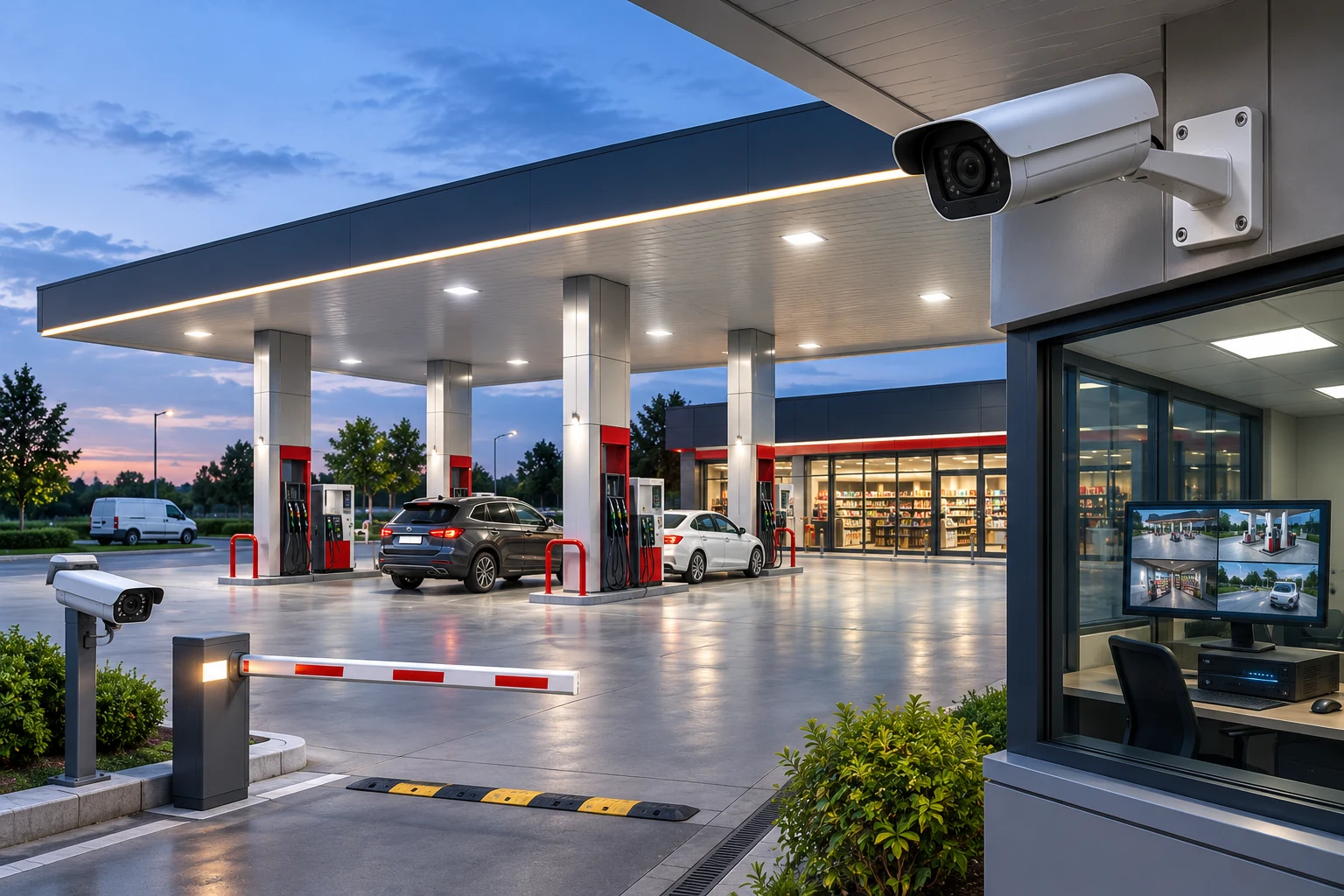
Fuel stations are commercial facilities that operate 24 hours a day, have heavy vehicle and customer traffic, and store and sell flammable and combustible materials. Due to these characteristics, the security needs of fuel stations differ significantly from a standard store or workplace.
Security at petrol stations is not limited to camera recordings alone. IP security cameras, license plate recognition systems, burglar alarms, convenience store and cash register security, access control, fire and gas detection, perimeter security, and central monitoring systems must be evaluated together.
Specifically, fuel pump islands, vehicle entry-exit points, tanker unloading points, LPG filling areas, station convenience stores, and technical rooms harbor different security risks.
Therefore, the purpose of a correct security system is not merely to record events; it is to detect specific risks early, generate necessary notifications, support the evaluation of incidents, and contribute to the safe operation of the facility.
However, it is not possible for all security equipment used in fuel stations to have the same features or for standard cameras and alarm devices to be used in every area. Especially in areas with a risk of explosive atmospheres, selecting appropriate equipment and installation methods is critically important.
What is a Fuel Station Security System?
A fuel station security system is the entirety of physical and electronic security components aimed at protecting people, vehicles, products, facility infrastructure, and designated operational areas within the station.
The main systems are:
CCTV and IP camera systems: Monitoring pump islands, vehicle entrances, convenience stores, and other areas.
License plate recognition systems (ANPR/LPR): Reading vehicle license plates and associating them with relevant security events.
Burglar alarm systems: Protecting convenience stores, offices, warehouses, and unauthorized access points.
Access control systems: Managing access in technical rooms and personnel areas.
POS-video integration: Associating supported sales transactions with camera recordings.
Perimeter security systems: Monitoring tank farms, rear service areas, and facility boundaries.
Fire and gas detection systems: Detecting signs of fire and dangerous gas accumulations in appropriate systems.
Centralized security management: Monitoring multiple stations from a common platform.
Backup power and communication: Ensuring essential security functions can continue during outages.
These solutions perform different functions. For example, a license plate recognition system helps read vehicle identity, while a gas detector is used to detect specific hazardous atmospheric conditions.
Therefore, one security technology does not automatically replace another.
Major Security Risks at Fuel Stations
Security risks at fuel stations can be evaluated under four main headings.
Vehicle and Customer Safety
Pump islands and vehicle entry-exit points experience heavy movement.
Main risks:
Vehicle collisions.
Physical damage to pump and station equipment.
Incidents of leaving the station without paying for fuel.
Security incidents that may occur between customers and employees.
Unauthorized entry and theft attempts during night hours.
Camera and license plate recognition systems can support the evaluation of these incidents.
Convenience Store and Cash Register Security
Station convenience stores face risks of product loss, cash register operations, theft, and unauthorized access.
These areas can benefit from security technologies similar to retail stores.
Tank and Technical Area Security
In areas where fuel storage and transfer operations are carried out, unauthorized access, physical intervention, and facility security must be evaluated together.
Specifically, tanker unloading points, tank access areas, and automation equipment may require controlled access.
Fire and Explosion Risks
Fuel vapors and flammable gases like LPG can create explosive atmospheres under suitable conditions.
Therefore, fire and gas safety have different engineering requirements than standard burglar alarm and CCTV systems.
In security project design, it should not be assumed that these risks can be solved with a single camera system.
Camera Systems at Fuel Stations
CCTV and IP camera systems are among the most important security components of fuel stations.
A properly designed camera infrastructure enables the monitoring of vehicle movements, events related to sales transactions, customer entries, and designated facility areas.
However, it is not correct to use every camera for the same viewing purpose.
Where Should Security Cameras Be Placed?
Camera location | Primary purpose | Important technical criterion |
|---|---|---|
Vehicle entry point | Monitoring incoming vehicles | License plate and vehicle details |
Vehicle exit point | Recording outgoing vehicles | Night license plate image |
Pump islands | Monitoring refueling operations | Pump and vehicle coverage |
Convenience store entrance | Monitoring customer entry-exit | Face detail, WDR |
Convenience store sales area | General security monitoring | Reducing blind spots |
Cash register | Monitoring transaction area | Close-up detail |
Tanker unloading area | Security monitoring of transfer area | Ex compliance and safe positioning |
Tank farm | Monitoring unauthorized access | Area classification and environmental conditions |
Station rear area | Evaluating unauthorized entries | Night vision and perimeter security |
Technical room | Monitoring access to equipment | Authorization and event logging |
The table is an example placement approach. The number and location of cameras should be determined according to the station's architecture and risk analysis.
Pump Island Cameras
When placing cameras on pump islands, the angle from which vehicles will be viewed, the inclusion of pump equipment in the frame, and the traceability of movement should be evaluated.
Specifically:
Visibility of the pump area.
Ensuring vehicles are not in blind spots.
The effect of night lighting on camera performance.
Glares from vehicle headlights.
Camera mounting position.
Hazardous area classification.
are important.
A wide-angle camera showing the entire pump island alone does not guarantee that vehicle license plates or event details will be recorded with sufficient quality.
Which Cameras Should Be Preferred for Fuel Stations?
Cameras with different features can be used in different areas of the station.
IP Bullet Cameras
Bullet cameras can be considered for outdoor areas of the station and specific approach points.
For outdoor use, IP protection class, mounting durability, and operating temperature are important.
Dome and Turret Cameras
Can be considered for station convenience stores, entrances, and suitable indoor areas.
When selecting cameras, lighting, viewing angle, and resistance to physical intervention should be taken into account.
Varifocal Lens Cameras
Varifocal cameras allow lens settings to be adjusted for monitoring risky areas at different distances.
For example, viewing a wide pump island and recording license plates at a vehicle entrance may require different optical requirements.
PTZ Cameras
PTZ (Pan-Tilt-Zoom) cameras can enable remote steering or optical zooming to examine specific areas.
However, when a PTZ camera looks in another direction, monitoring of the previous area may be limited.
Therefore, if continuous recording of critical areas is required, they should be evaluated in conjunction with appropriate fixed cameras.
WDR and Night Vision
At fuel stations, significant brightness differences can occur between powerful spotlights, vehicle headlights, convenience store lighting, and daylight.
WDR (Wide Dynamic Range) technology can help suitable cameras produce more balanced images in such scenes.
However, merely choosing a camera with a high WDR value is not sufficient.
Actual night performance, motion blur, and license plate readability should be tested under installation conditions.
License Plate Recognition Systems at Fuel Stations
A license plate recognition system is a technology for automatically reading vehicle license plates from camera images.
In international terminology, it is referred to as Automatic Number Plate Recognition (ANPR) or License Plate Recognition (LPR).
At fuel stations, license plate recognition can facilitate the investigation of specific security incidents.
How Does a License Plate Recognition System Work?
In a typical license plate recognition application:
The vehicle enters the camera's field of view.
The camera captures the vehicle's license plate.
An OCR or artificial intelligence algorithm reads the license plate characters.
The license plate information can be associated with the relevant event.
Authorized users can search records by license plate or time information in appropriate systems.
The accuracy of this process depends on camera position, lighting conditions, license plate visibility, and the algorithm's characteristics.
Vehicles Leaving Without Paying for Fuel
One of the incidents that can be encountered at fuel stations is a vehicle leaving the station without paying after refueling.
License plate recognition and CCTV systems can support easier investigation of such incidents.
However, the system detecting a vehicle does not automatically determine the driver or legal responsibility of the vehicle.
Incident records should be evaluated by authorized personnel; necessary legal processes should be carried out appropriately.
Is License Plate Recognition the Same System as UTTS?
No.
The National Vehicle Identification System (UTTS) is a regulatory system that enables the transfer of vehicle license plate information, related to the vehicle, to new-generation pump payment recording devices via appropriate vehicle identification hardware during fuel sales.
CCTV-based ANPR/LPR, on the other hand, reads the license plate from an image.
Feature | ANPR/LPR | UTTS |
|---|---|---|
Primary purpose | Reading license plates from images | Transferring vehicle information in a regulated sales process |
Technology | Camera and image processing | TTB, TTO, and related communication hardware |
Camera requirement | License plate imaging | Primary operation does not rely on camera OCR |
CCTV video recording | In appropriate systems | Not its primary function |
Regulatory function | Depends on usage purpose | Defined by GİB legislation |
Therefore, installing a license plate recognition camera does not mean that UTTS obligations are met.
For a detailed examination of the technical operating principles of ANPR/LPR technology, GüvenlikOnline's article What is a License Plate Reading System? can be consulted.
Use of Exproof Cameras at Fuel Stations
One of the most critical technical issues in camera projects for fuel stations is the suitability of equipment to be used in areas where an explosive atmosphere may occur.
In certain areas containing fuel vapors or flammable gases, electrical equipment can create an ignition source if not designed appropriately.
Therefore, in areas classified as hazardous by risk assessment, Ex-protected devices suitable for the relevant zone may be required.
What are Zone 0, Zone 1, and Zone 2?
The basic zone classifications used for explosive gas atmospheres are:
Zone | General description |
|---|---|
Zone 0 | An environment where an explosive gas atmosphere is continuously, for long periods, or frequently present |
Zone 1 | An environment where an explosive gas atmosphere is expected to occur occasionally during normal operation |
Zone 2 | An environment where an explosive atmosphere is not expected to occur during normal operation; if it does, it is expected to persist only for a short period |
These classifications directly affect equipment selection and installation requirements.
However, it should not be assumed that the entire pump island or canopy at a fuel station automatically falls into the same Zone classification.
The boundaries of hazardous areas should be determined based on relevant engineering assessment and the Explosion Protection Document.
Is an Exproof Camera Mandatory at Every Pump Island?
It cannot be said that a single type of Exproof requirement applies to every camera on all pump islands.
It must be evaluated whether the camera body and associated electrical equipment are mounted within a hazardous area.
A standard outdoor camera placed in an appropriate location outside the hazardous zone can be used if the relevant conditions are met.
However, if the device is to be placed within a hazardous zone, Ex protection compatible with the relevant Zone, gas group, temperature class, and equipment protection level must be sought.
An IP66 or IP67 camera enclosure alone does not provide suitability for explosive atmospheres.
Considerations for Exproof Camera Installation
Hazardous area classification should be examined.
The product certificate should be verified to cover the full model and hardware combination.
The camera body, cable entries, and connection components should be evaluated together.
Cable routing and electrical protection methods should be designed appropriately.
Earthing and equipotential bonding should be evaluated.
Installation and initial inspection should be carried out by competent personnel.
IEC 60079-14:2024 is one of the current international references for the selection, design, installation, and initial inspection of electrical equipment in explosive atmospheres.
For more detailed technical information, GüvenlikOnline's guide What are Exproof Camera Systems? can be consulted.
Burglar Alarm Systems at Fuel Stations
Burglar alarm systems can be used to detect unauthorized entries, especially in convenience stores, offices, warehouses, and controlled technical areas.
Main components:
Burglar alarm control panel.
PIR motion detectors.
Magnetic door contacts.
Glass break and shock detectors.
Indoor and outdoor sirens.
Alarm communication modules.
Video alarm verification in appropriate systems.
Different alarm zones can be created by considering the station's operating hours and user movements.
For example, the sales area of a 24-hour convenience store and a management office used outside business hours may require different alarm scenarios.
However, for alarm equipment and connection components to be used in areas with explosive atmosphere risk, an additional Ex compliance assessment must be performed.
Convenience Store, Cash Register, and POS-Video Integration
Fuel station convenience stores are of particular importance for retail security.
Camera systems can provide monitoring of cash registers and designated sales areas.
In appropriate POS-video integrations:
Specific sales transactions.
Return and cancellation transactions.
Cash drawer events.
Transaction time.
Related camera recording.
can be correlated with each other.
For example, Milestone XProtect Transact is a software solution for matching supported POS data with video recordings.
However, it should not be assumed that a station's pump automation and CCTV recording system can be automatically connected to each other.
Pump Automation and CCTV Integration
In projects with suitable software interfaces, it may be possible to establish a relationship between refueling operations and video recordings.
For this, the following should be checked:
Data transfer capabilities of pump automation.
Transaction IDs.
Date and time synchronization.
POS/VMS interface compatibility.
Authorization.
Data security.
Important: CCTV integration does not automatically fulfill the duties and compliance obligations of the dealer audit system established under EPDK.
Changes to the dealer audit system must be addressed in accordance with the responsibilities of authorized parties and relevant regulations.
Tanker Unloading and Tank Farm Security
Tanker unloading areas and tank farms at fuel stations are important for both operational safety and fire-explosion risk.
With appropriate design in these areas, the following can be provided:
Monitoring unauthorized access.
Monitoring tanker entry-exit.
Recording security incidents in the unloading area.
Evaluating physical intervention and sabotage risks.
Notifying relevant alarm and access events.
However, a video analytics system monitoring a tanker unloading operation does not guarantee that the fuel transfer is technically safe.
Tank automation, appropriate level measurement, overflow prevention, and related process safety functions should be considered as separate systems.
Security cameras can support these functions but should not be used in their place.
Fire and Gas Detection Systems at Fuel Stations
Fire and gas detection systems are critical components for life and facility safety at fuel stations.
Different detection methods may be required depending on the type of fuel used and the facility's architecture.
Fire Detection
Appropriate fire detection and alarm systems can be used in convenience stores, offices, and certain technical areas.
These systems must be designed within the scope of the Regulation on Fire Protection of Buildings and relevant TS EN 54 requirements.
LPG Gas Detection
At stations with LPG, there are special regulations for gas detection and emergency control systems.
Articles 110 and 111 of the Regulation on Fire Protection of Buildings contain important provisions regarding LPG supply and storage safety.
This includes appropriate Ex-protected gas detection, audible/visual alarms, and necessary emergency control functions.
Especially, the fact that LPG is heavier than air is important for the placement of appropriate gas detectors. However, mounting the detector only close to the ground should not be considered sufficient; relevant legislation, manufacturer instructions, and facility geometry must be evaluated together.
Thermal Cameras and AI-Powered Fire Detection
Certain thermal cameras or video-based fire detection solutions can be evaluated for additional monitoring in appropriate sections of the station.
However, adding AI software to a standard CCTV camera does not automatically mean that the device is certified fire detection equipment.
Fire detection, gas detection, and process safety functions should not be solely dependent on general-purpose CCTV software.
Access Control and Perimeter Security Systems
Not all areas at fuel stations need to be open to customers.
Specifically:
Technical rooms.
Electrical and communication rooms.
Management offices.
Storage warehouses.
Designated tank and service areas.
may require controlled access.
With appropriate access control systems, personnel access to specific areas can be authorized, and access events can be recorded.
However, for readers, locks, connections, or other electrical components to be installed in areas with explosive atmosphere risk, relevant Ex requirements must be examined separately.
Emergency exit and fire evacuation functions should not be jeopardized by access control.
Centralized Security Management in Chain Fuel Stations
For companies with multiple stations, centralized video management and security monitoring systems can be considered.
On supported platforms, the following can be tracked:
Station-based security incidents.
Online status of cameras and recording devices.
Alarm notifications.
Authorized remote viewing.
Recording device failures.
Specific video analytics events.
Centralized user and authorization management.
However, continuously transferring high-resolution images from all stations to the central location can create significant internet bandwidth requirements.
Centralized Management or Local Recording?
Architecture | Advantage | Limitation |
|---|---|---|
Local NVR | Appropriate local recording even if internet is cut | Physical security of the device |
Central VMS | Multi-station management | Network capacity and connection continuity |
Cloud recording | Remote storage with suitable infrastructure | Data security and connection requirement |
Hybrid recording | Combined use of local and remote methods | Integration and operational complexity |
In multi-station projects, a combination of local recording and centralized management can be considered.
However, each facility's network capacity, recording needs, and data security obligations must be analyzed separately.
How Many Days Should Camera Recordings Be Stored at Fuel Stations?
The retention period for camera recordings should be evaluated together from technical and legal perspectives.
EPDK's statements regarding the dealer audit system address camera positioning and the preservation of necessary recordings according to the nature of the relevant activities and automation elements.
However, the examined EPDK frequently asked questions source does not explicitly state a single fixed number of days that can be applied to all fuel stations.
Therefore, a general conclusion that recordings must be stored for 30, 60, or 90 days at every fuel station should not be drawn.
The operator's current license, dealer audit, contract, and other specific regulatory obligations must be verified.
Additionally, the purpose of image processing and the necessary retention period under KVKK should be evaluated.
Example: HDD Calculation for a 16-Camera Station
Let's assume the following values:
Number of cameras: 16.
Average bitrate: 3 Mbps.
Recording method: 24 hours continuous.
Video recording format: Appropriate H.265 configuration.
Simplified formula:
Recording (TB) = Number of cameras × Mbps × 10.8 × Days / 1,000
Recording duration | Theoretical video data |
|---|---|
15 days | 7.78 TB |
30 days | 15.55 TB |
60 days | 31.10 TB |
90 days | 46.66 TB |
This example is not based on actual field bitrate measurements and is not a legal recording duration recommendation.
When determining disk capacity, RAID, usable disk space, variable bitrate, and capacity reserve should also be calculated separately.
For details on this topic, GüvenlikOnline's guide Security Camera Systems Recording and Storage Techniques can be consulted.
KVKK in Fuel Station Security Systems
CCTV, license plate recognition, and certain entry-exit records at fuel stations may constitute personal data processing activities.
Especially, images of customers and employees, and vehicle license plates that can be associated with real persons, must be carefully evaluated.
Within the scope of the Personal Data Protection Authority's public announcement dated June 8, 2026, regarding workplace security cameras:
There must be a clear and legitimate purpose for camera use.
Personal data processing conditions must be determined.
The necessary obligation to inform must be fulfilled.
Camera angles and monitoring scope must be proportionate.
Disproportionate camera surveillance should not be conducted for the purpose of continuously monitoring employees' general performance.
Toilets, changing rooms, and other private areas should not be monitored.
The necessity of audio recording should be evaluated separately.
Only authorized persons should be able to access recordings.
Retention and destruction processes must be established.
Especially when license plate recognition, POS, and video recordings are correlated, personal data processing purposes and access authorizations must be evaluated separately.
Cybersecurity at Fuel Stations
In modern fuel stations, camera recording devices, automation systems, payment terminals, and various network components work together.
This can lead to devices with different security levels being present in the same infrastructure.
From a cybersecurity perspective:
CCTV networks should be appropriately separated from payment and automation networks.
Default passwords should be changed.
Remote access should be performed using secure methods.
User permissions should be limited.
Firmware and security updates should be checked.
Unnecessary open network services should be closed.
The interruption behavior of alarm and recording systems should be tested.
Event logs and access logs should be protected.
Especially, connections that may affect the current operation of dealer audit and pump automation systems should be evaluated with authorized automation parties.
The ability of the CCTV system to access the internet does not necessitate granting unlimited network access to pump automation.
Relevant Legislation and Standards at Fuel Stations
Legislation / standard | Primary scope |
|---|---|
Petroleum Market Law No. 5015 | Basic regulatory framework in the petroleum market |
EPDK Board Decision No. 10338 | Dealer audit systems and authorization |
EPDK Board Decision No. 1240 | Implementation principles of the dealer audit system |
Regulation on Fire Protection of Buildings | Fire and LPG safety requirements |
Regulation on Protection of Employees from the Dangers of Explosive Atmospheres | Explosive atmosphere risks and zone classification |
2014/34/EU | Suitability of equipment for use in explosive atmospheres |
IEC 60079-14:2024 | Selection and installation of Ex electrical installations |
IEC 62676-4:2025 | Design and application of video surveillance systems |
KVKK Law No. 6698 | Processing and protection of personal data |
International versions of standards and their TS/TS EN equivalents to be applied in Turkey should be evaluated separately.
Additionally, depending on whether the facility includes LPG, fuel, a convenience store, car wash, or other activities, additional requirements may arise.
Comparison of Fuel Station Security Systems
System | Primary function | Main selection criterion |
|---|---|---|
IP camera / CCTV | Monitoring and recording | Lens, image quality, mounting location |
ANPR/LPR | License plate reading | Night performance, camera geometry |
Burglar alarm | Unauthorized entry detection | Detector coverage and communication |
POS-video | Transaction and image matching | Software, time, and data compatibility |
Ex camera | Safe monitoring in hazardous areas | Zone and certificate compliance |
Gas detection | Detecting dangerous gas accumulation | Gas type, sensor, and compliance |
Fire alarm | Detecting fire signs and warning | Legislation and EN 54 compliance |
Access control | Authorized area access | Access, evacuation, and equipment compatibility |
Central VMS | Management of multiple stations | Network capacity, user security |
These technologies are not direct alternatives to each other. They can be used together depending on the project scope.
Example Fuel Station Security Architecture
Let's consider an example fuel station with a convenience store, multiple pump islands, vehicle entry-exit points, and tanker unloading areas.
The following approach can be used for initial evaluation at this facility.
Area | Security solution to be considered |
|---|---|
Vehicle entry | License plate recognition and general monitoring |
Vehicle exit | License plate recognition and event recording |
Pump islands | Appropriate IP camera system |
Convenience store entrance | Entrance monitoring camera |
Inside convenience store | General CCTV |
Cash register | Detail camera and appropriate POS connection |
Warehouse | Camera and burglar alarm |
Technical room | Access control and alarm |
Tanker unloading zone | Monitoring suitable for area classification |
LPG/tank area | Appropriate gas detection and necessary Ex equipment |
Management area | NVR/VMS, UPS, and network security |
This table is an example system architecture. It is not a recommendation for a specific number of devices, product models, or mounting locations.
The actual project should be created with facility layout, risk analysis, Explosion Protection Document, requirements of authorized parties, and site survey.
What to Consider When Choosing a Fuel Station Security System?
1. Create a Risk Map of the Facility
Evaluate pump islands, entry-exit points, tanker unloading, convenience store, and technical areas separately.
2. Define Camera Tasks
Create different viewing criteria for general monitoring versus license plate reading or transaction detail recording.
3. Verify Hazardous Zones
Base the selection of Ex-protected equipment on hazardous zone classification.
4. Check Automation Integration
Evaluate the technical and regulatory suitability of connections to be established between CCTV, POS, and pump automation.
5. Determine Recording Duration
Calculate storage capacity according to relevant legislation, contracts, KVKK, and recording requirements.
6. Plan for Interruption Scenarios
Determine how critical functions will behave during power, internet, network, and disk failures.
7. Test System Reliability On-Site
Verify functions such as day and night images, license plate reading, alarm transmission, fault notifications, and playback of recordings.
Fuel Station Security Systems Technical Checklist
- Has a security risk analysis of the station been conducted?
- Have EPDK and relevant license obligations been examined?
- Has camera placement been planned for pump islands and vehicle entrances?
- Has night license plate reading performance been tested?
- Has camera coverage for the convenience store and cash register been verified?
- Has hazardous area classification been examined?
- Has the certificate and installation suitability of Ex equipment been checked?
- Have LPG/gas detection and emergency control functions been verified?
- Has POS and video integration been tested?
- Have pump automation connections been evaluated with authorized parties?
- Has NVR recording capacity been calculated?
- Have the recording duration and KVKK retention policy been determined?
- Has UPS and necessary power continuity been provided?
- Has remote access and network security been checked?
- Have notifications for alarm and security system failures been configured?
- Have field tests and a periodic maintenance plan been created?
This checklist is for technical preliminary assessment purposes. It does not replace a definitive engineering project and compliance evaluation.
Frequently Asked Questions
What security systems are used at fuel stations?
IP cameras, license plate recognition, burglar alarms, access control, convenience store security, fire and gas detection, perimeter security, and centralized monitoring systems can be used.
Is a camera system mandatory at fuel stations?
EPDK's statements regarding Board Decisions No. 10338 and 1240 foresee camera positioning when necessary, according to the nature of the activity and station automation. The station's applicable obligations must be verified separately.
How many cameras should a petrol station have?
There is no single camera count applicable to all stations. The number of cameras should be determined based on the facility's size, pump islands, vehicle entrances, convenience store, and other risk areas.
Is an Exproof camera mandatory at fuel stations?
Electrical equipment to be placed in areas classified as hazardous must comply with the relevant Ex requirements. However, it cannot be said that all station cameras must automatically be Exproof.
Can a license plate recognition system detect vehicles that leave without paying for fuel?
In supported systems, vehicle license plates and related images can be recorded. However, the exact nature of the incident and legal responsibility cannot be determined solely by the license plate reading result.
Is UTTS the same as license plate recognition?
No. UTTS is used for transferring vehicle information via regulated hardware during fuel sales transactions. ANPR/LPR, on the other hand, reads license plates from camera images.
Is a gas detector necessary at fuel stations?
Especially at stations with LPG, the relevant regulation contains special provisions regarding gas detection and emergency control. Exact system requirements must be evaluated according to the facility's operational and risk conditions.
How many days should camera recordings be kept at fuel stations?
Obligations under EPDK and other applicable legislation must be checked. A general 30 or 90-day period should not be assumed for all fuel stations.
Can convenience store and pump cameras be connected to the same NVR?
Technically possible with an appropriate recording system and network architecture. However, device compatibility, access permissions, recording requirements, and relevant automation obligations must be evaluated.
Can chain fuel stations be monitored centrally?
With appropriate VMS and communication infrastructure, cameras, alarms, and specific security events from multiple stations can be monitored centrally.
How to Design a Proper Security System for Fuel Stations?
The selection of a security system for fuel stations should not be based solely on the number of cameras or the brand of alarm used.
While monitoring and license plate recognition are paramount at pump islands and vehicle entry points, recording detail and transaction security gain importance in convenience store and cash register areas. In technical rooms and tank farms, preventing unauthorized access and facility security create different requirements.
Especially in hazardous areas containing fuel and LPG, equipment selection must be carried out in accordance with the relevant explosive atmosphere classification and installation standards.
The foundation of a successful fuel station security project lies in accurate risk analysis, selection of compliant equipment, reliable CCTV recordings, controlled integration, verified field performance, and sustainable maintenance processes.
Therefore, fuel station security should be approached as designing the entire facility's security architecture, rather than purchasing independent devices.
Resources
EPDK — Frequently Asked Questions Regarding Petroleum Market and Dealer Audit System — Cameras, automation, and responsibilities under decisions 10338 and 1240.
Official Gazette — Board Decision No. 10338 on Dealer Audit System Authorization — Regulation regarding the dealer audit system.
T.C. Ministry of Justice — Regulation on Fire Protection of Buildings — Especially provisions regarding LPG supply and storage safety.
T.C. Ministry of Health — Regulation on Protection of Employees from the Dangers of Explosive Atmospheres — Hazardous area classification and Explosion Protection Document.
T.C. Ministry of Trade — Equipment Used in Explosive Atmospheres and 2014/34/EU — Equipment compliance under ATEX.
IEC — IEC 60079-14:2024 — Design of electrical installations and equipment selection in explosive atmospheres.
IEC — IEC 62676-4:2025 — Planning, installation, testing, and maintenance of video surveillance systems.
GİB — Announcement Regarding the National Vehicle Identification System — Regulatory and technical scope of UTTS.
Milestone Systems — XProtect Transact — Correlation of POS and transaction data with video.
Personal Data Protection Authority — Public Announcement on Points to Consider in the Use of Security Camera Systems in Workplaces — Image processing, proportionality, authorization, and retention principles.