
What are Ex-Proof Camera Systems? ATEX, IECEx, and Correct Camera Selection
Ex-proof camera systems are specialized CCTV solutions developed for safe surveillance in industrial areas with a risk of explosive gases, vapors, or combustible dust. We examine ATEX and IECEx certifications, Zone 1, Zone 2, Zone 21, and Zone 22 classifications, camera housings, cabling, and installation criteria in technical detail.
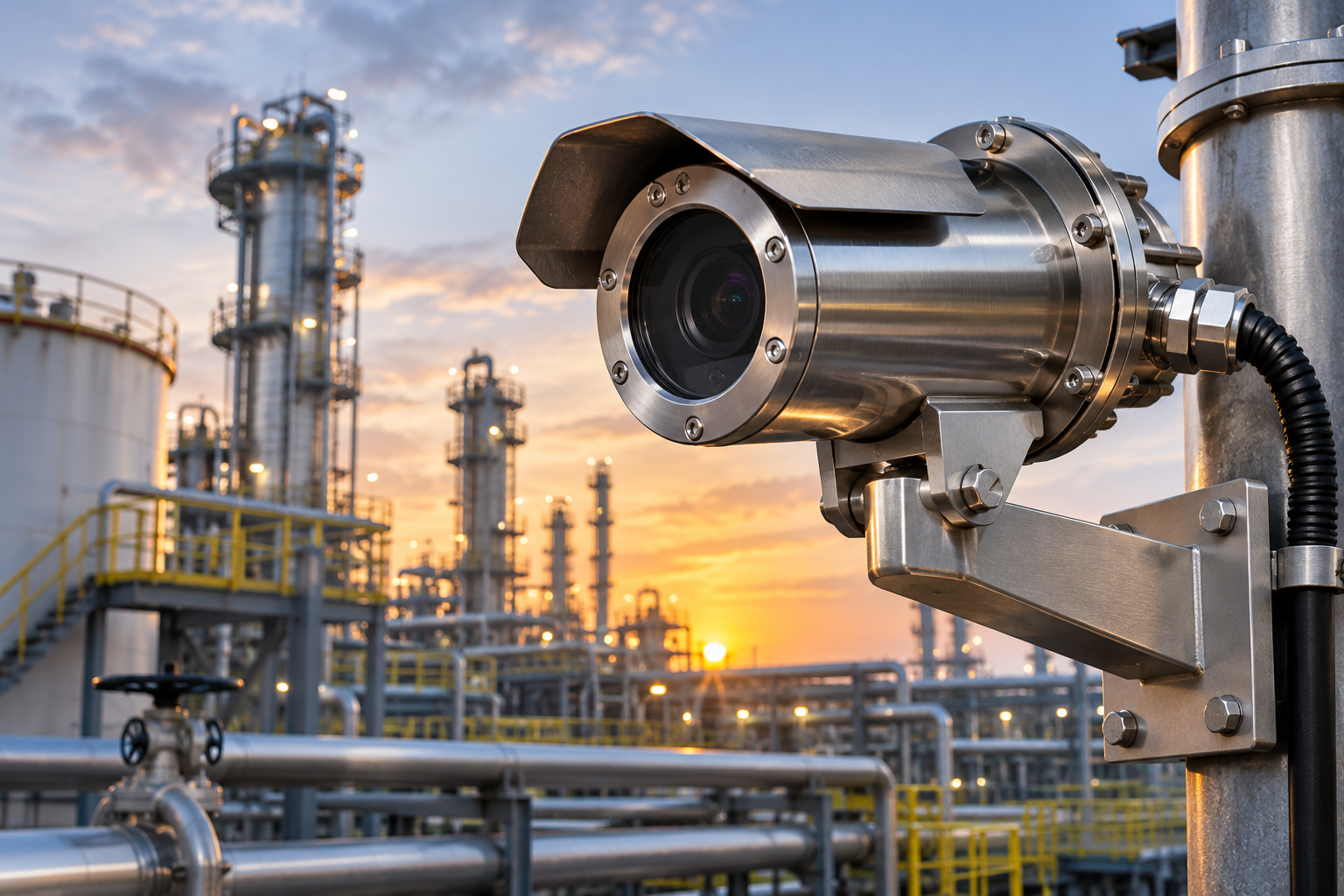
In oil refineries, natural gas facilities, chemical factories, paint production plants, and industrial areas containing combustible dust, security camera selection involves technical requirements different from standard CCTV applications.
In such facilities, flammable gases, vapors, or combustible dust suspended in the air can create an explosive atmosphere under certain conditions. Electrical equipment, if not properly designed, can generate sparks, hot surfaces, or other ignition sources.
Therefore, for security cameras to be used in areas with explosion risk, merely being high-resolution, waterproof, or durable is not sufficient.
Ex-proof camera systems are specialized industrial imaging solutions designed in accordance with the relevant explosive atmosphere classification, with necessary protection methods applied, and their compliance documented.
However, not every Ex-proof camera can be used in the same hazardous environment. Selecting the correct product depends on the facility's Zone classification, gas or dust group, temperature requirements, and the scope of the product's certification.
So, what is an Ex-proof camera, how does it work, what are the differences between ATEX and IECEx, and how should the correct camera be selected for facilities with explosion risk?
What is an Ex-Proof Camera?
An Ex-proof camera is a specialized security camera designed for use in areas where an explosive atmosphere is likely to occur, in accordance with relevant protection methods and device compliance requirements.
In the industry, it is also defined by terms such as Explosion-Proof Camera, Flameproof Camera, Ex-Proof CCTV, or ATEX Camera.
However, the technical scopes of these concepts are not identical.
Specifically, Ex d is a particular explosion protection method related to the protection of electrical equipment with a flameproof enclosure. The term Ex-proof, however, can be used in the industry to define a broader product group.
In the flameproof enclosure method, structural features are used to prevent a specific internal explosion that may occur within the enclosure from igniting the external explosive atmosphere.
This does not mean that the camera will withstand all types of explosions or external explosion pressures.
An Ex-proof camera is not an explosion prevention or suppression system. Its purpose is to control the risk of the camera creating an ignition source in a hazardous environment through its appropriately certified design.
Where are Ex-Proof Cameras Used?
Ex-proof cameras can be utilized in various industrial applications that carry the risk of explosive gases, vapors, or combustible dust.
Oil Refineries and Petrochemical Facilities
They can be used for monitoring refining units, specific pump areas, tank surroundings, and process equipment.
In these facilities, hazardous area classification depends on the properties of the substances being processed and the process conditions.
Natural Gas and LPG Facilities
In certain areas where gas processing, storage, and transfer operations take place, there may be a risk of an explosive atmosphere.
Cameras and electrical components used in these areas must comply with the zone classification.
Chemical and Paint Production Facilities
Special protected camera solutions may be required in production and storage sections containing flammable solvents, gases, or vapors.
Fuel Storage and Filling Facilities
Ex-protected imaging systems can be used in fuel transfer, filling equipment, and related process areas based on risk assessment.
Flour, Sugar, and Other Combustible Dust Processing Facilities
In production areas containing combustible dust, explosive atmosphere conditions different from those with gases can occur.
Especially in facilities processing flour, sugar, starch, certain chemical dusts, and specific metal dusts, the risk of dust explosion must be assessed.
In these applications, a camera certified only for gas environments may not be sufficient.
Mining and Other Industrial Facilities
Special protected imaging equipment may also be required in some mining applications with explosion risk.
However, certain hazardous environments in underground mines are evaluated with different equipment groups and requirements than general industrial facilities.
It should not be assumed that an Ex-proof camera certified for Group II can automatically be used in underground mines with methane (firedamp) risk.
What is ATEX? Why is it Necessary for Ex-Proof Cameras?
ATEX is a concept referring to legislation on equipment and workplace safety related to explosive atmospheres.
One of the fundamental regulations in the European Union concerning equipment for use in explosive atmospheres is the ATEX Directive 2014/34/EU.
In Turkey, the Regulation on Equipment and Protective Systems Intended for Use in Potentially Explosive Atmospheres (2014/34/EU) is applied within this framework.
The regulation was published in the Official Gazette dated June 30, 2016, and numbered 29758.
This regulation addresses the essential health and safety requirements, conformity assessment, and market placement conditions for relevant products.
When evaluating the ATEX conformity of an Ex-proof camera, merely having an Ex mark on it is not sufficient.
The product's:
Full model and variant information,
Equipment group and category permitted for use,
Suitability for gas or dust environments,
Explosion protection method,
Temperature class or maximum surface temperature,
Ambient temperature limits,
Conformity assessment documents,
Manufacturer's installation conditions
must be examined together.
What is IECEx? What are the Differences with ATEX?
IECEx is an international conformity assessment and certification system for equipment and services intended for use in explosive atmospheres.
Under IECEx, equipment certificates are evaluated in accordance with relevant IEC standards.
Although ATEX and IECEx systems are based on many common technical standards, they are not the same legal regulation.
| Criterion | ATEX | IECEx |
|---|---|---|
| Basic structure | Product legislation and conformity assessment | International certification system |
| Primary reference | 2014/34/EU and national harmonization legislation | IEC 60079 series and IECEx rules |
| Certification | Procedures determined by product category | IECEx certification programs |
| Contribution to product selection | Legal product conformity in the relevant market | International technical conformity verification |
| Project evaluation | Together with relevant national legal requirements | Together with product certificate and installation conditions |
Possession of an IECEx certificate does not automatically mean compliance with applicable ATEX product legislation in Turkey. Both frameworks must be checked specifically for the product and project.
Especially in international projects, presenting both ATEX and IECEx documents can facilitate technical evaluation.
What are Zone 0, Zone 1, and Zone 2 in Ex-Proof Camera Selection?
Areas with explosion risk are classified according to the likelihood and duration of an explosive atmosphere being present.
This classification plays a fundamental role in determining the level of protection the camera should have.
Gas and Vapor Environments
Zone 0: Areas where an explosive gas atmosphere is present continuously, for long periods, or frequently.
Zone 1: Areas where an explosive gas atmosphere is expected to occur occasionally during normal operation.
Zone 2: Areas where an explosive gas atmosphere is not expected to occur during normal operation; if it does occur, it is expected to be present only for a short period.
Combustible Dust Environments
Zone 20: Areas where an explosive dust atmosphere is present continuously, for long periods, or frequently.
Zone 21: Areas where an explosive dust atmosphere is expected to occur occasionally under normal operating conditions.
Zone 22: Areas where an explosive dust atmosphere is not expected to occur during normal operation; if it does occur, it is expected to be present only for a short period.
Equipment Selection According to Zone Classification
| Hazardous zone | Environment type | General ATEX equipment category | Relevant EPL level |
|---|---|---|---|
| Zone 0 | Gas/vapor | 1G | Ga |
| Zone 1 | Gas/vapor | 2G or suitable higher protection | Gb or Ga |
| Zone 2 | Gas/vapor | 3G or suitable higher protection | Gc, Gb or Ga |
| Zone 20 | Combustible dust | 1D | Da |
| Zone 21 | Combustible dust | 2D or suitable higher protection | Db or Da |
| Zone 22 | Combustible dust | 3D or suitable higher protection | Dc, Db or Da |
This table shows the general classification relationship. Final equipment suitability is determined by explosion risk assessment, gas or dust group, temperature requirements, product certification, and manufacturer's usage conditions.
For example, a camera with only Zone 2 suitability cannot be installed in a Zone 1 area unless it possesses the necessary Zone 1 suitability.
Similarly, a camera certified for a gas environment should not be assumed to be suitable for a combustible dust environment.
What Do Ex Marks Mean on Ex-Proof Cameras?
The marks found on the labels of Ex-proof cameras provide important information regarding the conditions under which the device can be used.
For example, a representative marking prepared for a gas environment is as follows:
II 2G Ex db IIC T6 Gb
The main components of this marking are:
II: Equipment group for industrial applications other than mining.
2G: Category 2 equipment for gas environments.
Ex db: Flameproof enclosure protection method and relevant protection level.
IIC: Gas group classification.
T6: Temperature class under relevant conditions.
Gb: High equipment protection level in gas environments.
The T6 class is associated with a limit of 85°C in terms of maximum surface temperature under standard defined conditions.
However, the actual ambient temperature range permitted for device use and other certification conditions must be checked separately.
In combustible dust environments, different protection marks such as Ex tb, dust groups, and maximum surface temperature values may be found.
Important: This marking is for illustrative purposes only. It cannot be used as the actual certificate or direct purchase specification for any camera model.
What are the Types of Ex-Proof Cameras?
Fixed Ex-Proof Cameras
Fixed Ex-proof cameras can be used for continuous monitoring of specific process equipment, production zones, or security areas.
These products may feature fixed or adjustable focus lenses.
In process-oriented applications, low-light performance, resolution, and lens selection are important depending on the imaging purpose.
Ex-Proof PTZ Cameras
PTZ cameras can provide horizontal and vertical movement along with optical zoom.
PTZ systems with appropriate Ex protection can be used for monitoring large process areas or for operators to focus on specific equipment.
However, all moving mechanisms, motors, and electrical components must comply with the scope of the relevant product certification.
Ex-Proof Thermal Cameras
Ex-protected camera systems utilizing thermal imaging can enable monitoring of temperature patterns or image acquisition in low visible light conditions in suitable fields.
Some systems include both thermal and visible light cameras.
However, the use of a thermal camera does not automatically imply a certified fire detection function or precise temperature measurement accuracy.
Ex-Proof Camera Housings
In some solutions, the camera module is housed within a specially protected enclosure.
However, placing any standard IP camera into a metal enclosure does not automatically make the system ATEX or IECEx compliant.
The certification scope of the enclosure, camera, electrical components, connections, and any auxiliary equipment must be evaluated together.
Which Features are Important in an Ex-Proof Camera Housing?
The housing structure and materials used for Ex-proof cameras must be suitable for the device's operating conditions.
Stainless Steel Body
Some Ex-proof cameras are offered with AISI 304 or AISI 316L stainless steel body options.
Appropriate material selection is crucial, especially in facilities exposed to chemical effects, humidity, or saline environments.
However, having a 316L stainless steel body alone does not indicate Ex certification.
Corrosion resistance and suitability for an explosive atmosphere are distinct characteristics.
IP Protection Class
Classes such as IP66, IP67, or IP68 indicate the level of protection of the device enclosure against dust and water ingress under specific test conditions.
However, an IP protection class is not a certificate for safe use in an explosive atmosphere.
For example, a standard IP67-protected camera cannot be installed in a Zone 1 area solely due to this feature.
Temperature Resistance
The operating ambient temperature specified by the camera manufacturer and the permitted temperature conditions defined in the Ex certificate must be examined together.
In high-temperature process areas, solar radiation, ambient temperature, and the device's own heat generation can become significant.
Auxiliary Equipment
Some models may include wipers, heaters, special lighting, or remotely controlled movement mechanisms.
The use and electrical connections of these components must also be evaluated within the scope of the relevant Ex compliance.
What Should Be Considered During Ex-Proof Camera Installation?
The installation of electrical equipment operating in explosive atmospheres has different safety requirements than standard CCTV installation.
IEC 60079-14:2024 addresses the technical requirements related to the selection, installation, and initial inspection of electrical equipment in explosive atmospheres.
1. Hazardous Area Classification Must Be Verified
Before camera installation, the facility's current hazardous area classification and Explosion Protection Document prepared for the relevant zone must be reviewed.
The Zone class, gas or dust group, and temperature conditions of the camera location must be determined.
2. Camera Certificate Must Be Checked
The model, equipment group, EPL, temperature limits, and usage conditions in the selected product's certificate must be compared with the installation point.
The product's certificate number and special usage conditions must be verified.
3. Cable Entries and Connections Must Be Appropriate
In Ex-protected devices, cable glands, connection elements, and necessary sealing arrangements are important.
Inappropriate cable glands or connection procedures not approved by the manufacturer can compromise the Ex protection integrity of the device.
The camera, junction box, and cable entries must be evaluated together.
4. Earthing and Equipotential Bonding Must Be Checked
In the relevant system, necessary earthing and equipotential bonding must be carried out according to the manufacturer's instructions and applicable electrical standards.
Static electricity and other potential ignition sources must be considered in the risk assessment.
5. Installation and Mechanical Integrity Must Be Maintained
The fasteners, covers, and certified joint surfaces of Ex enclosures must be maintained in accordance with manufacturer instructions.
Unauthorized drilling, modification of the enclosure, or addition of unapproved components on-site is not appropriate.
6. Installation Must Be Performed by Competent Personnel
Installation, inspection, and maintenance operations in hazardous areas must be carried out by competent personnel familiar with relevant standards and occupational safety procedures.
Ex-proof camera installation should not be considered as merely connecting the same cable in place of a standard camera.
How Should Image Quality Be Evaluated When Selecting an Ex-Proof Camera?
Ex-proof certification is a fundamental requirement for the device to be used in a hazardous environment. However, the imaging performance of the security camera must be evaluated separately.
This includes:
Camera resolution.
Image sensor and lens features.
DORI/PPM or applicable current image detail criteria.
Low-light performance.
WDR and backlight behavior.
Image compression.
Recording and video management system compatibility.
Optical properties of the camera housing.
Corrosion, contamination, and maintenance conditions
must be examined.
Especially, the properties of the optical glass used in the Ex-proof camera housing can affect image quality.
Furthermore, in facilities with high process temperatures, heavy contamination, or vibration, merely looking at the resolution information in the camera catalog is not sufficient.
Image quality must be verified at the actual installation point.
Can Artificial Intelligence and Video Analytics Be Used in Ex-Proof Camera Systems?
Video analytics functions can be used in appropriately Ex-protected camera systems.
For example, depending on product and software features:
Detection of entry into specific security zones.
Human or vehicle classification.
Virtual boundary violation.
Identification of unauthorized area movements.
Visual monitoring of process areas.
Centralized alarm and video management
can be performed.
However, these applications have a significant technical limitation.
AI-powered video analytics is not an automatic alternative to a certified gas detector, fire detection system, or process safety system.
For a video analytics function to be used in a safety-critical control function, its necessary performance and suitability must be evaluated separately.
Common Mistakes in Ex-Proof Camera Systems
Common mistakes to avoid in Ex-proof camera projects include:
Not reviewing the Zone classification before camera selection.
Treating gas and combustible dust environments as the same.
Considering IP66/IP67 protection equivalent to Ex certification.
Selecting products based solely on a stainless steel body.
Not verifying the certificate number and model variant.
Ignoring the suitability of cable glands and connection elements.
Using auxiliary components not covered by the certification.
Focusing on camera resolution without evaluating the lens and target distance.
Not documenting commissioning and initial inspection procedures.
Not establishing competent personnel and an appropriate maintenance plan for Ex enclosures.
Preventing these errors is crucial for both personnel safety and the long-term reliability of the system.
Maintenance and Periodic Inspection in Ex-Proof Camera Systems
For Ex-proof camera maintenance, merely cleaning the lens and checking recordings is not sufficient.
IEC 60079-17:2023 addresses the requirements for inspection and maintenance of electrical installations designed for explosive atmospheres.
The following points should be considered in the maintenance plan:
Legibility of Ex labels and markings.
Mechanical integrity of the enclosure.
Signs of corrosion and physical damage.
Cable entries and connection elements.
Appropriate earthing and equipotential bonding conditions.
Suitability of camera and enclosure components.
Image quality and recording continuity.
Relevant special usage conditions.
Documentation of interventions and maintenance records.
In addition to the necessary inspections, repair and revision operations must be carried out according to relevant Ex standards and manufacturer conditions.
Unauthorized opening or modification of the camera housing can pose a serious safety risk.
Technical Checklist for Ex-Proof Camera Systems
The following questions should be answered before procurement and project planning:
Has the facility's Explosion Protection Document been reviewed?
Has the Zone classification of the area where the camera will be installed been verified?
Has the type of gas or dust environment been determined?
Has the required equipment group, category, and EPL level been determined?
Have the temperature class or surface temperature requirements been evaluated?
Have the product's ATEX conformity documents been checked?
If applicable, has the IECEx certificate been verified from the current database?
Has the certification scope of the camera and enclosure been examined?
Are the cable entries and connection elements suitable?
Have ambient temperature and corrosion conditions been evaluated?
Have the lens and imaging purpose been correctly determined?
Has video recording and central management integration been verified?
Have installation and initial inspection procedures been prepared?
Has a periodic maintenance plan been established?
Has the competence of the personnel who will perform the installation been verified?
This checklist supports the technical selection process. It does not replace hazardous area classification, conformity assessment, or authorized engineering work.
Frequently Asked Questions
What is the difference between an Ex-proof camera and a standard security camera?
Ex-proof cameras are designed with special protection methods for use in explosive atmosphere conditions specified in their certificates. Standard security cameras may not have the necessary Ex compliance for such use.
Can every Ex-proof camera be used in a Zone 1 area?
No. The camera's relevant gas environment, equipment protection level, temperature conditions, and certification must be suitable for Zone 1 use.
Is an IP67 camera considered Ex-proof?
No. IP67 relates to enclosure protection against water and dust ingress. It does not replace the necessary Ex certification for use in explosive atmospheres.
Are ATEX and IECEx the same document?
No. ATEX is related to product legislation and conformity assessment, while IECEx is an international certification system. The scope of documents and relevant legal requirements must be checked separately.
Does an Ex-proof camera prevent fire or explosion?
No. An Ex-proof camera aims to control ignition risks that may arise from its own equipment through appropriate protection methods. It does not replace the facility's general explosion prevention, gas detection, or fire safety systems.
Does an Ex-proof camera have to be stainless steel?
It cannot be said that the same body material must be used in all cases. The material and housing structure depend on the product's certified design and environmental conditions. The use of stainless steel alone does not provide Ex compliance.
Can an Ex-proof PTZ camera be used?
Yes. PTZ camera systems certified as suitable for the relevant hazardous area can be used. The suitability of motors, moving components, and connection equipment must also be evaluated.
Conclusion: Certification and Site Suitability are Priorities in Ex-Proof Camera Selection
Ex-proof camera systems are specialized CCTV solutions developed to meet imaging and security monitoring needs in industrial facilities with explosion risk.
However, determining the correct Ex-proof camera requires a much more comprehensive engineering evaluation than simply purchasing a high-resolution or durable camera.
ATEX compliance, IECEx certification, Zone classification, equipment protection level, temperature requirements, cabling, and installation conditions must be examined together.
Furthermore, imaging performance, central recording system, and maintenance processes are also integral parts of the project.
Especially in production areas such as refineries, petrochemicals, natural gas, paint, and those containing combustible dust, camera selection must be carried out in alignment with the facility's current hazardous area classification.
The primary goal of a successful Ex-proof camera project is not merely to image the risky area, but to meet the imaging need without compromising explosive atmosphere safety.
To examine different product types, GüvenlikOnline's Ex-Proof Camera Systems Product Catalog can be considered. The actual certificates and technical specifications of the products must be verified separately with manufacturer documents.
References
IEC – IEC 60079-10-1:2020, Explosive Gas Area Classification
IEC – IEC 60079-10-2:2026, Explosive Dust Area Classification
IEC – IEC 60079-14:2024, Electrical Installation Design and Selection
IEC – IEC 60079-17:2023, Electrical Installations Inspection and Maintenance
IECEx – Certificate Verification and Frequently Asked Questions