
What is a License Plate Recognition System? How Does It Work and How to Choose One?
What is a License Plate Recognition (ANPR/LPR) system, how does it work, and where is it used? Explore this technical selection guide covering artificial intelligence, OCR, license plate recognition cameras, night vision, mounting angle, barrier integration, reading accuracy, and KVKK criteria.
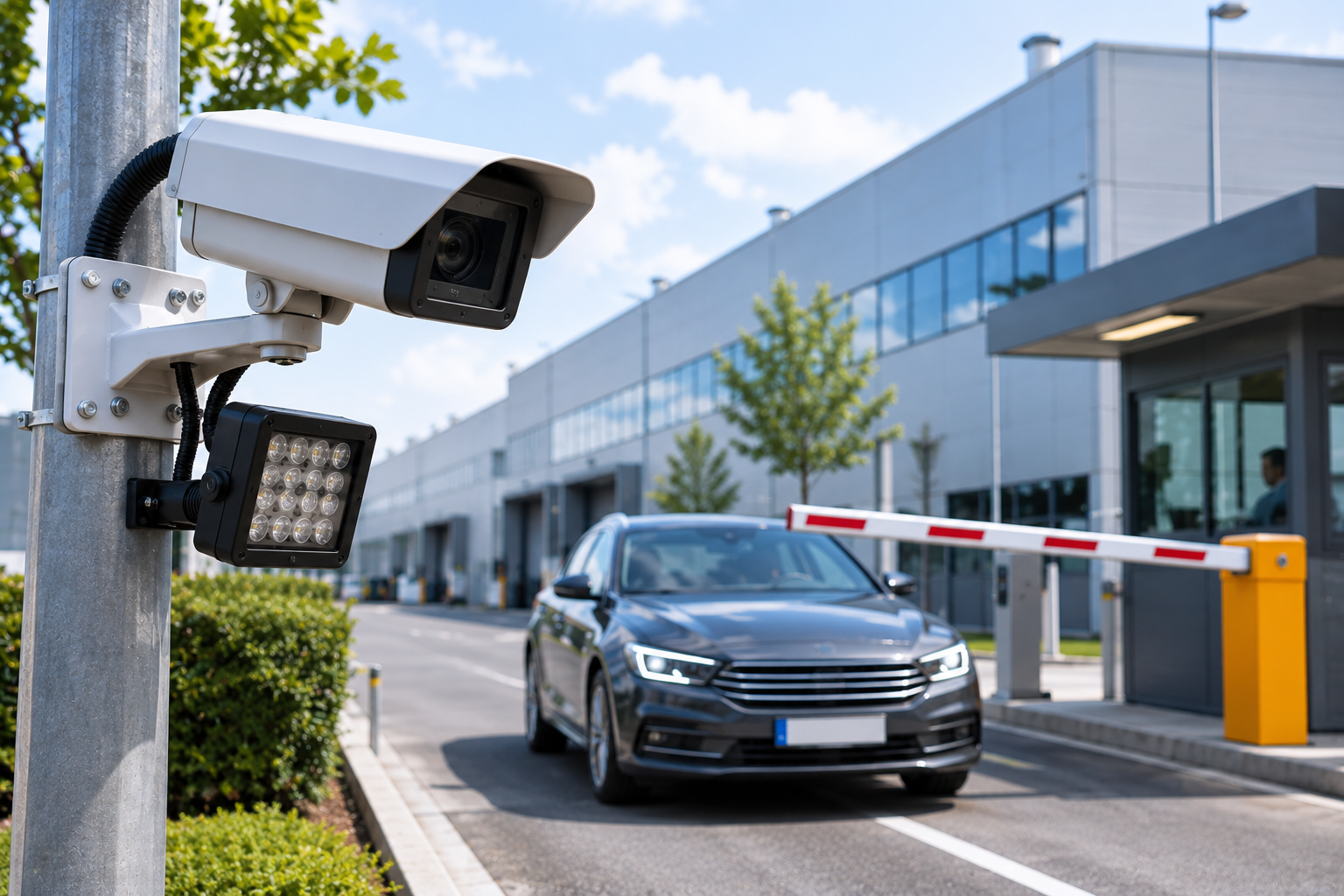
License plate recognition systems are technological solutions that automatically detect vehicle license plates from camera images, convert the letters and numbers on them into digital data, and use this information for security or vehicle access management purposes.
Today, license plate recognition systems are widely used in residential complexes, factories, shopping malls, parking lots, logistics facilities, hotels, and other controlled vehicle entry points.
While traditional vehicle access systems may grant entry permission via physical keys, remote controls, cards, or security personnel checks, in license plate recognition systems, the vehicle's license plate can be used as automatic access information under suitable conditions.
For example, at a factory vehicle entrance, a license plate recognition camera can read the approaching vehicle's license plate and compare it with an authorized vehicle list. If a match and other security conditions are met, the barrier can open automatically.
However, a successful license plate recognition system does not solely depend on the camera capturing the plate. Camera position, lens, vehicle speed, lighting conditions, OCR algorithm, software integration, and system accuracy must be evaluated together.
So, what is a license plate recognition system, how does it work, what technologies does it use, and how should the correct license plate recognition solution be chosen?
What is a License Plate Recognition System?
A license plate recognition system is an automatic vehicle license plate recognition technology referred to as LPR (License Plate Recognition) or ANPR (Automatic Number Plate Recognition) in international technical literature.
The system identifies the area where the vehicle license plate is located within the image obtained from the camera and reads the characters on the plate using software to create a digital record.
This record can be used, depending on the system's purpose:
For monitoring vehicle entries and exits,
For automatic passage of authorized vehicles,
For parking management,
For visitor and vehicle access control,
For managing logistics and loading areas,
For reporting vehicle passage events.
The primary goal of license plate recognition systems is not just to read plate characters. Associating the read information with the correct vehicle and passage event, authorizing it when necessary, and managing it reliably are also important functions of the system.
How Do License Plate Recognition Systems Work?
Modern license plate recognition systems perform multiple image processing and control stages together.
1. Vehicle Detection
When a vehicle enters the camera's defined reading zone, the system begins image processing.
Depending on the application, vehicle detection can be supported by continuous image analysis from the camera or by suitable external sensors.
For example, in some parking applications, vehicle presence can be verified with appropriate vehicle detection sensors.
2. License Plate Region Detection
The software attempts to identify the region containing the license plate within the camera image.
In modern AI-based systems, this stage can be performed using trained image processing models for license plate detection.
3. Image Processing
After the license plate region is detected, necessary corrections can be applied to the image.
These operations may include perspective correction, contrast adjustment, image scaling, and noise reduction.
However, it should not be assumed that details completely absent from the image can be precisely recovered by software.
4. Character Reading with OCR
OCR (Optical Character Recognition) is a technology that converts letters and numbers found in an image into digital characters.
In license plate recognition applications, OCR can be performed using classic character recognition methods or deep learning-based models.
The software attempts to construct the character string on the license plate.
5. License Plate Information Verification
The read license plate can be compared with country-specific character structures or with the authorized vehicle list in the system, according to the application's features.
Some systems also generate a confidence score along with the license plate reading result.
The method of calculating this score may vary from manufacturer to manufacturer.
6. Recording and Action
The read license plate and the associated passage event can be stored in accordance with the system's recording policy.
When the necessary conditions are met, actions such as opening a barrier, sending a notification to an operator, or creating a passage record can be performed.
License plate reading, access authorization, and the physical movement of the barrier are distinct stages. All these stages must be controlled in a reliable system design.
What is the Difference Between LPR, ANPR, OCR, and LPC?
Some terms used in license plate recognition technologies are often confused.
| Technology | Description | Core function |
|---|---|---|
| LPC | License Plate Capture | Capturing a readable image of the license plate |
| LPR | License Plate Recognition | Automatic recognition of license plate characters |
| ANPR | Automatic Number Plate Recognition | Automatic license plate recognition and associated workflow |
| OCR | Optical Character Recognition | Converting letters and numbers in an image to digital text |
LPR and ANPR terms are mostly used interchangeably in practice for the same automatic license plate recognition function.
LPC, however, is an important technical distinction.
A camera can generate a readable image of a license plate but may not have automatic character recognition software on board.
In this case, the camera can be used for LPC purposes; LPR/ANPR software is additionally required for automatic license plate recognition.
The fact that a license plate is human-readable in an image does not mean that the system can perform automatic license plate recognition.
What Components Does a License Plate Recognition System Consist Of?
Professional license plate recognition systems are created by the collaborative operation of hardware and software components.
License Plate Recognition Camera
Ensures that the license plate is captured with sufficient image detail, clarity, and contrast.
Special LPR/LPC cameras can be designed with sensors, lenses, illumination, and image processing features suitable for license plate imaging applications.
OCR and Artificial Intelligence Software
Identifies the license plate region in the camera image and reads the characters.
The algorithm can run within the camera, on a local server, or on another suitable processing infrastructure.
Vehicle and Authorization Database
Authorized vehicles, temporary visitor vehicles, or specific access rules can be managed according to the operational purpose.
Barrier or Gate Control Unit
In appropriate vehicle access projects, it converts the authorization result into a physical access action.
Management and Reporting Software
Can manage vehicle passage events, time information, authorization lists, and system alerts.
Network, Power, and Storage Infrastructure
Provides data communication between the camera and control systems, necessary power supply, and secure storage of records.
Not all these components are present in the same structure in every project. For example, some devices can perform license plate recognition and list management within the camera itself.
What Are the Types of License Plate Recognition Systems?
On-Camera License Plate Recognition (Edge ANPR)
In Edge ANPR systems, the license plate recognition algorithm runs directly on the compatible camera.
This approach can reduce the need for a separate analysis server in certain applications.
However, camera processing capacity, supported features, licensing, and software versions should be evaluated.
Server-Based License Plate Recognition
In these systems, images from the camera are analyzed on a separate server or central software.
It can be considered for projects requiring multiple cameras, multiple locations, or comprehensive reporting.
However, processor capacity, network bandwidth, and software license requirements must be planned separately.
Barrier-Integrated License Plate Recognition
If the vehicle's license plate matches a defined access list, the barrier can be opened, provided other security conditions are also met.
This method is particularly useful in residential complexes, offices, factories, and controlled parking lots.
Traffic and Wide Area License Plate Recognition
In traffic applications where moving vehicles are monitored at different speeds, camera selection and imaging conditions may differ from controlled entry systems.
Specifically, vehicle speed, multi-lane roads, reading distance, and lighting requirements should be evaluated separately.
How to Choose a License Plate Recognition Camera?
One of the most common mistakes in selecting a license plate recognition camera is focusing solely on camera resolution or the maximum reading distance stated by the manufacturer.
However, for successful license plate reading, the camera must obtain an image of sufficient quality.
Camera Resolution
There must be enough pixels on the image to distinguish license plate characters.
However, a higher megapixel value does not guarantee higher license plate reading accuracy under all conditions.
Especially in systems where analysis is performed on the camera, excessively high resolution can increase the processing load.
Lens and Optical Zoom
The lens directly affects the area the license plate occupies in the image.
A wide-angle camera can show multiple vehicle lanes, but the detail of license plate characters at a distant point may be insufficient.
Therefore, the width and distance of the target reading zone must be correctly determined.
Image Sensor and Low Light Performance
To achieve high image quality in night and low-light conditions, the sensor's light sensitivity, lens, and illumination features should be evaluated together.
Vehicle Speed
As vehicle speed increases, the risk of motion blur in the image may increase.
Therefore, camera exposure settings and the length of the reading zone should be determined according to the actual passage speed of vehicles.
Illumination and IR Technology
Appropriate infrared illumination can be used in night license plate reading applications.
However, the intensity, angle of IR illumination, and camera exposure settings must be configured correctly.
Manufacturer Software and Integration
It should be examined not only whether the camera reads the plate but also through which interfaces it can transmit plate information, as well as barrier management, database, and VMS integration.
What Should Be Considered When Mounting a License Plate Recognition Camera?
Camera placement is one of the most important factors affecting the accuracy obtained in license plate recognition systems.
Camera Angle
The camera should be positioned so that the license plate can be viewed as directly as possible.
Axis Communications' License Plate Capture technical document recommends keeping the total angle between the camera and the vehicle's direction of travel as small as possible, generally below 30 degrees.
However, this value is not a definitive performance guarantee for all camera models.
The horizontal and vertical angle of the camera should be evaluated together with the manufacturer's requirements.
Mounting Height
High mounting can provide advantages in terms of the camera's physical security and its ability to see vehicles. However, excessive height can cause the license plate to enter the image at a very oblique angle.
Therefore, it is not correct to provide a single ideal camera height applicable to all projects.
Reading Distance
The distance between the camera and the point where the license plate will be read should be determined together with the lens and image detail.
The maximum IR distance specified in the camera's catalog should not be considered as the automatic license plate reading distance.
Multi-Lane Applications
If multiple vehicle lanes are planned to be read with a single camera, the image geometry in each lane should be checked separately.
Especially the license plate angle and image size in the distant lane may differ from the near lane.
Mechanical Mounting
Poles, brackets, and camera connections should be designed to prevent vibration.
Camera movements caused by wind or vehicle passages can affect image clarity, especially in long focal length applications.
What Mistakes Are Made in Night License Plate Recognition Systems?
Common problems in night license plate recognition applications include headlight glare, over-illumination of the license plate, motion blur, and insufficient IR light.
IR Reflection
Reflective surfaces used on vehicle license plates can strongly reflect infrared light.
Therefore, excessive IR illumination or incorrect exposure settings can lead to the license plate appearing white in the image.
Exposure Time
Short exposure times may be required for imaging moving vehicles.
For example, some LPR camera applications may use exposure times of 1/500 second or shorter.
However, 1/500 second is not a mandatory or ideal setting for all license plate recognition projects.
The required value depends on vehicle speed, camera angle, lighting, and the specific camera features used.
WDR Settings
WDR can be useful in images with intense light differences. However, some WDR methods can cause image distortions in moving license plates.
Therefore, it is not correct to keep WDR constantly enabled in every license plate recognition camera.
The manufacturer's recommended license plate reading image profile should be used and tested in real-world conditions.
Why Are PPM and Pixel Density Important in License Plate Recognition Systems?
The license plate occupying sufficient size in the image is important for OCR success.
The PPM (Pixels Per Meter) value indicates the number of pixels per meter of the horizontal field of view at a certain distance.
PPM = Horizontal image resolution / Image width at target distance
Example Pixel Density Calculation
Let's assume a camera with 1920 horizontal pixels images an area 6 meters wide at the license plate reading point.
1920 / 6 = 320 PPM
A hypothetical license plate approximately 0.50 meters wide in the same plane could correspond to approximately 160 horizontal pixels in the image.
However, this calculation does not account for:
The angle of the license plate to the camera,
Perspective loss,
Motion blur,
Image compression,
The optical quality of the lens,
The actual detail of the characters.
Therefore, 160 pixels in this example is not a universal limit that would be considered sufficient in all LPR systems.
License plate reading success cannot be determined solely by the PPM value. The manufacturer's target license plate pixel measurement and actual field performance must be verified separately.
How Is Accuracy Measured in License Plate Recognition Systems?
High accuracy rates may be announced by manufacturers for license plate recognition software.
However, it is important under what test conditions and with what calculation method these rates were obtained.
Vehicle or License Plate Detection Rate
Indicates how many of the tested suitable passages had the vehicle or license plate detected by the system.
Full License Plate Reading Accuracy
Evaluates whether all characters of the read license plate are correct.
An incorrect character reading can lead to an erroneous full license plate match.
End-to-End Correct Reading Rate
The ratio of passages where the license plate was correctly detected and completely read within the total suitable vehicle passages.
Example Accuracy Calculation
Let's assume a system evaluated 1,000 suitable vehicle passages in a controlled test.
Total passages: 1,000
Passages with license plate detected: 980
Passages with full license plate read correctly: 950
Accordingly:
License plate detection rate = 980 / 1,000 × 100 = 98%
End-to-end correct reading rate = 950 / 1,000 × 100 = 95%
In this example, the full correct reading rate only within the 980 detected license plates is approximately 96.9%.
These rates should not be confused with each other.
Values are for calculation example only. They do not represent the measured performance of a real product.
False Match and Barrier Risk
Only the correct reading rate should not be evaluated in license plate recognition performance.
Especially in barrier-controlled access systems, an unauthorized vehicle gaining access due to a false match is a significant security risk.
Therefore, failed readings, false license plate matches, and unauthorized opening events should be tested separately.
How Does a License Plate Recognition System Work with a Barrier?
A license plate recognition system can automate barrier control with appropriate integration infrastructure.
The basic process is as follows:
The vehicle enters the reading zone.
The camera captures the license plate image.
The software reads the license plate.
The read license plate is compared with the authorized vehicle list.
When the necessary access conditions are met, an opening command is sent to the control unit.
The barrier moves according to its own security control mechanism.
The passage event can be recorded.
However, the presence of the license plate in the authorized vehicle list does not mean that the barrier should open under all conditions.
Situations such as an obstruction in front of the barrier, another vehicle passing, unauthorized tailgating, or a malfunction in the control system should be evaluated separately.
The relay output of the license plate recognition system should not be used to bypass the barrier's appropriate safety control circuits.
Furthermore, license plate information alone does not verify a person's identity. Additional access verification may be required in projects where license plate cloning and other security risks are significant.
Where Are License Plate Recognition Systems Used?
Residential Complex and Residence Parking Lots
Can be used to manage the entry and exit of registered vehicles and to implement appropriate barrier automation.
Factories and Industrial Facilities
Can support the management of passages for personnel, visitors, suppliers, and service vehicles.
Shopping Malls and Commercial Parking Lots
Can be used in managing vehicle entry-exit events, calculating parking duration, and appropriate parking automation applications.
Logistics Centers and Warehouses
Can help associate entry and exit information of trucks, lorries, and other commercial vehicles with relevant operations.
Hotels and Accommodation Facilities
Can be evaluated for managing parking usage by guests and authorized vehicles.
Hospitals and Campuses
Different access rules can be applied for staff and visitor parking lots.
Public and Traffic Applications
Can be used by authorized institutions in traffic or security applications within the scope of relevant legislation and special technical requirements.
Not all these applications have the same device, software, or data processing authorities.
Differences Between a License Plate Recognition System and a Standard IP Camera
| Technical criterion | Standard IP camera | Camera optimized for license plate recognition |
|---|---|---|
| Primary use | General surveillance | Capturing license plate images |
| Night illumination | General scene illumination | IR settings suitable for license plate reflection |
| Exposure | Based on general image quality | Based on vehicle movement and license plate clarity |
| Lens selection | General field of view | Target license plate size and reading distance |
| OCR | Separate software may be required | Integrated or external depending on model |
| Barrier integration | Additional software and hardware may be required | Special vehicle access functions in compatible systems |
A standard IP camera can be the image source for an LPR system under suitable conditions. The advantage of a special LPR camera is that its optical, imaging, and software features can be jointly optimized for the purpose of license plate recognition.
ONVIF Profile M and License Plate Recognition Integration
License plate recognition systems can be integrated with video management or security software via appropriate interfaces.
ONVIF Profile M supports the transmission of video analytic metadata and events with standard interfaces.
Within Profile M, there are interfaces related to license plate and vehicle metadata, as well as license plate recognition events.
However, it should not be assumed that every camera with Profile M support has an automatic license plate recognition algorithm.
It should be checked separately which analytic functions a system offers and by what method it can transmit them.
Especially in multi-brand projects, ONVIF compliance, software versions, and actual integration behavior should be tested.
How Are License Plate Recognition Systems Evaluated Under KVKK?
In license plate recognition systems, vehicle license plates, passage times, and in some applications, vehicle images may be recorded.
Vehicle license plates can constitute personal data when they can be associated with a real person.
Therefore, the requirements of Law No. 6698 on the Protection of Personal Data (KVKK) should be evaluated in license plate recognition applications.
The Personal Data Protection Board's decision dated June 1, 2023, and numbered 2023/924, is an important example regarding the processing of license plate and related user data by parking lot operators.
The decision specifically addressed the obligation to inform and the requirements for preventing unauthorized access to personal data.
What Should Be Considered in License Plate Recognition Projects?
The purpose of data processing and its legal basis must be determined.
Relevant individuals must be appropriately informed.
The system should only collect necessary data.
Access permissions to records must be restricted.
Data retention period must be determined according to relevant legal requirements.
Security of personal data must be ensured.
Unnecessary data sharing and unauthorized queries must be prevented.
If cloud usage and international data transfer are involved, relevant provisions must be evaluated separately.
It should not be assumed that there is a single general record retention period applicable to every license plate recognition project.
Furthermore, the establishment of a license plate recognition system by private businesses does not automatically grant them the authority to query vehicle or driver records held by public institutions.
Periodic Maintenance and Calibration in License Plate Recognition Systems
Even if license plate recognition systems provide high accuracy at initial installation, this performance may change over time.
For example:
Changes in camera mounting angle,
Lens contamination,
IR illumination degradation,
Changes in vehicle passage route,
Changes in lighting conditions,
Software updates,
New license plate formats or different vehicle types
can affect reading performance.
Therefore, within the scope of periodic maintenance, camera image, reading results, false matches, barrier control, and system events should be evaluated together.
In appropriate projects, verification tests should be performed during day and night, with different vehicle types, and at actual operating speeds.
Adjusting camera focus and exposure settings and measuring software accuracy are distinct operations.
Successful maintenance work should evaluate not only that the camera is working but also that the license plate recognition system continues to operate with the expected accuracy.
Technical Checklist When Choosing a License Plate Recognition System
Is the system's purpose of use and security level determined?
Has vehicle passage speed and number of lanes been evaluated?
Are the camera and license plate reading distance determined?
Are the mounting angle and height appropriate?
Have the lens and license plate pixel size been evaluated?
Has night IR and exposure performance been verified?
Does the OCR software support relevant country and license plate formats?
Has reading accuracy been measured under real field conditions?
Have false match and missed plate events been tested?
Has barrier and control unit integration been verified?
Have network and power outage scenarios been evaluated?
Is the necessary NVR, VMS, or central software integration provided?
Is record and user management secure?
Have KVKK requirements been evaluated?
Is a technical service, maintenance, and verification plan prepared?
This checklist is for general technical evaluation purposes. It is not a definitive product or engineering design recommendation for every facility.
Frequently Asked Questions
What is a license plate recognition system?
A license plate recognition system is an electronic security and vehicle management solution that detects vehicle license plates from camera images and converts the letters and numbers on them into digital information using OCR technology.
Can a license plate recognition system work without internet?
Some license plate recognition systems can operate without an internet connection using a local network or on-camera processing infrastructure. However, functions requiring cloud, remote access, or other central services may require internet.
Can every IP camera read license plates?
Not every IP camera can perform automatic license plate recognition. Some cameras can generate readable license plate images under suitable conditions. Automatic recognition additionally requires OCR or LPR functionality.
Do license plate recognition systems work at night?
They can work at night with appropriate sensors, lenses, IR illumination, and exposure settings. However, actual success depends on environmental conditions and the system's technical capacity.
Does a license plate recognition system automatically open the barrier?
When integrated with a compatible control system, automatic opening can be performed for authorized vehicles. This feature is not available in every camera model.
What is the accuracy rate in license plate recognition systems?
There is no single accuracy rate applicable to all products. Actual accuracy depends on camera placement, vehicle speed, license plate characteristics, lighting conditions, and the OCR algorithm. Performance should be measured with field tests.
How many megapixels are required for license plate recognition?
There is no single mandatory megapixel value. The important thing is that the license plate can be imaged with sufficient pixel detail, clarity, and appropriate contrast at the target distance.
Do license plate recognition systems process personal data?
Yes, vehicle license plates can constitute personal data when they can be associated with real persons. Therefore, the system's purpose of use, obligation to inform, access permissions, and record security must be evaluated under KVKK.
Conclusion: A Correct License Plate Recognition System Requires Reliable Imaging and Accurate Analysis
License plate recognition systems are important electronic security solutions that enable automatic management of vehicle entries and exits, recognition of authorized vehicles, and recording of passage events.
With the development of artificial intelligence and OCR technologies, these systems can be used in various industrial and commercial applications beyond traditional parking automation.
However, a successful license plate recognition project is not completed solely by choosing advanced software or a high-resolution camera.
Correct camera positioning, appropriate lens, night imaging, vehicle speed, OCR accuracy, secure barrier integration, and data security must be evaluated together.
In professional projects, measuring reading accuracy with real field tests after installation particularly helps increase system reliability.
The primary goal of license plate recognition systems is not just to read vehicle license plates, but to reliably process correct information belonging to the correct vehicle, thereby creating a secure and manageable vehicle access infrastructure.