
People Counting Systems and Visitor Analysis in Technology Stores
People counting systems in technology and electronics stores enable the measurement of retail performance by correlating visitor traffic with sales and in-store behavior data. We examine 3D people counting sensors, AI-powered visitor analytics, product experience area performance, sales conversion rates, peak hour analysis, and technical criteria for selecting the right system.
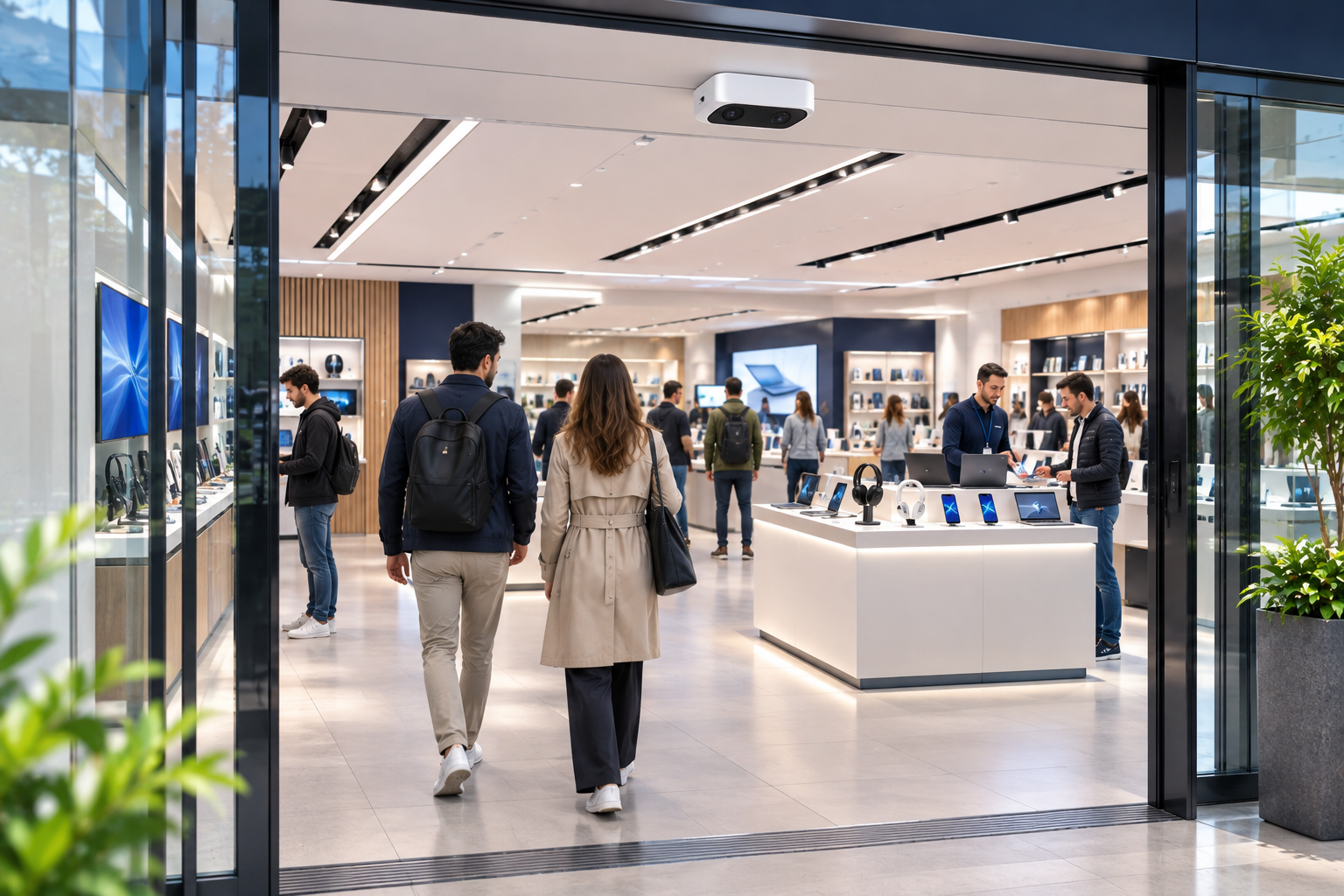
In technology stores, the number of visitors is one of the important indicators for evaluating sales performance. In stores selling smartphones, computers, televisions, white goods, and electronic accessories, customers may spend a long time comparing and experiencing products even without making a purchase. Therefore, looking only at daily turnover or the number of products sold is not enough to understand the store's true customer potential.
People counting systems in technology stores help analyze customer density, peak hours, and changes in visitor traffic by measuring visitors entering and exiting the store. Advanced retail analytics systems can evaluate visitor movements in product experience areas, regional density, and time spent in specific areas.
Analyzing people counting data together with POS sales records and store operations can help technology retailers better evaluate sales opportunities and plan resources according to actual visitor density.
What is a People Counting System in Technology Stores?
A people counting system in technology stores is a sensor and software infrastructure that automatically detects, counts, and reports data on individuals passing through the store's entry and exit points.
These systems are defined in the international retail sector with terms such as People Counting, Footfall Analytics, Retail Traffic Analytics, and Store Traffic Monitoring.
Depending on the technology used, the following data can be obtained:
Number of visitors entering and exiting the store.
Hourly, daily, weekly, and monthly customer traffic.
Busiest visiting hours and days.
Estimated real-time store occupancy level.
Visitor distribution for different entry points.
Conversion rate correlated with sales transactions.
Visitor traffic comparisons between branches.
Visitor density and visit duration for product areas with suitable additional analytic sensors.
There is an important technical distinction here: the number of store entries is not the same as the number of unique customers.
If a person enters the store twice in a day, a standard entry counting system may record it as two separate visits. Unique visitor analysis requires different tracking and data processing features.
The general operating principles of people counting technologies are explained in detail in GüvenlikOnline's What is a Store Customer Counter? How Does It Work and How to Choose It? guide.
Why is Visitor Analysis Important in Technology Stores?
Technology retail differs from traditional retail stores in some aspects.
Customers can try different smartphone models before purchasing, compare the image quality of televisions, or get information about the technical specifications of laptops from sales consultants.
Purchase decisions for large electronic products may also result from multiple store visits.
Therefore, there is not always a direct and constant proportional relationship between the number of visitors in the store and actual sales.
People counting systems provide the necessary traffic data to better analyze this difference.
1. Measuring the Store's True Visitor Potential
A technology store may have a high daily sales turnover. However, this result might be due to a small number of customers purchasing high-priced products.
Another store might attract more visitors but generate lower sales.
Evaluating visitor traffic and sales data together makes it possible to analyze the performance of these two stores from different perspectives.
2. Determining Sales Consultant Needs
In technology stores, customers may request consultation on product features, warranty conditions, accessory compatibility, and product comparisons.
Knowing the hourly distribution of visitor traffic helps plan sales consultants according to peak hours.
However, staffing needs should not be determined solely by the total number of visitors. Product category, consultation duration, and services offered should also be considered.
3. Examining the Impact of Campaigns on Store Traffic
New phone launches, television discounts, computer campaigns, or special shopping periods can create changes in store visitor numbers.
People counting data allows for the comparison of visitor traffic before and after campaigns.
However, an increase in visitors should not be solely attributed to a specific campaign. Seasonality, weekday vs. weekend differences, store location, and other variables should also be evaluated.
How to Calculate Customer Conversion Rate in Technology Stores?
Sales Conversion Rate is one of the retail performance indicators that correlates visitor traffic with sales results.
Simple transaction-based calculation:
Sales conversion rate (%) = (Number of sales transactions / Number of store entries) × 100
For example, let's assume a technology store's daily data is as follows:
Performance indicator | Example value |
|---|---|
Daily store entries | 1,200 visits |
Daily sales transactions | 96 transactions |
Transaction-based conversion rate | 8% |
These values are hypothetical examples used only to explain the calculation method.
There are significant limitations in the calculation. The same customer may generate multiple sales receipts, a family may make a single transaction, or a customer may purchase the product online later.
Therefore, the transaction-based conversion rate should not be confused with the purchase rate of unique customers. Calculation rules used for returns, cancellations, staff movements, and group visits should also be clearly defined in the report.
Especially in technology stores, high visitor traffic with a low instant sales rate does not always mean unsuccessful store performance. Customers may decide to purchase at a later date after experiencing the products.
Visitor Analytics in Product Experience Areas
In technology stores, knowing only whether customers enter the store may not be enough.
Which product categories they gravitate towards, where density occurs, and where they spend more time are also indicators that can be used to evaluate store layout.
Smartphone and Tablet Experience Areas
Customer density in smartphone and tablet display areas can be measured with appropriate regional analytics systems.
This allows for analysis of how many people are drawn to a specific display area or at what times the area is busier.
However, a customer being in a specific area is not definitive proof that they are examining the displayed product or have an intention to purchase.
Measuring actual product interactions may require appropriate sensors or additional data from sales and product experience systems.
Computer and Gaming Technologies Areas
In areas with laptops, gaming computers, and gaming equipment, customers may spend time testing products.
Through regional density and visit duration analysis, usage trends of product experience areas can be evaluated.
Especially during product launches or promotional events, how density changes can be examined.
Television and Home Electronics Areas
In television display sections, customer tendencies to gravitate towards areas with specific screen groups can be analyzed.
This information can be used for product placement within the store and consultant planning.
However, in-store heatmaps do not directly indicate product sales performance. Regional interest data must also be correlated with sales records.
Which People Counting Technologies Are Used in Technology Stores?
The size of the store, entrance width, visitor density, and the desired type of analysis directly affect the counting technology to be used.
3D Stereoscopic People Counting Sensors
3D stereoscopic people counting sensors aim to distinguish people passing through the detection area by using depth information.
They are typically mounted on the ceiling, overlooking the passage area from above.
They can be considered especially in technology stores with wide entrances and high visitor traffic.
Key usage features:
Separate measurement of entry and exit directions.
Separation of people passing side-by-side under suitable conditions.
Filtering based on object height or size in supported models.
Estimation of store occupancy using entry-exit data.
Integration with central visitor reporting software.
The use of depth information does not guarantee error-free counting in every environment. Mounting height, sensor coverage, and overlapping passages can affect performance.
AI-Powered Video Analytics Systems
AI-powered video analytics systems analyze human movements in camera images using specific algorithms.
Depending on the supported software and camera features, entry-exit counting, object classification, regional density, and movement analysis can be performed.
These systems can be considered in projects where existing CCTV infrastructure is planned to be utilized.
However, it should not be assumed that a camera installed for security purposes is also suitable for people counting. Camera angle, resolution, field of view, and the algorithmic requirements of the software must be verified separately.
Infrared and Thermal People Counting Systems
Infrared beam counters can detect movements across a specific passage line. While they can be used in simple and narrow entrances, side-by-side visitors and complex passage movements can create limitations.
Thermal sensors, on the other hand, can detect people by utilizing differences in infrared energy in the environment.
The performance of thermal solutions depends on ambient temperature, sensor resolution, and the detection method used.
Comparison of People Counting Technologies
Technology | Strength | Key Limitation | Applicable Use Case |
|---|---|---|---|
3D stereoscopic sensor | Person separation with depth information | Mounting and coverage conditions | Busy store entrances |
AI video analytics | Flexible analysis and regional data in suitable models | Camera angle, processing load, data protection | Entrance and in-store analysis |
IR beam counter | Simple passage detection | Separation in side-by-side passages | Narrow and controlled entrances |
Thermal sensor | Detection by heat differences | Environmental conditions and resolution | Suitable indoor passages |
No single technology is automatically the most accurate solution for all store conditions. Performance evaluation should be based on the device model and actual field tests.
Where Should a People Counting Sensor Be Mounted in Technology Stores?
One of the primary conditions for obtaining reliable data from people counting systems is the correct mounting position.
In technology stores, especially glass entrances, wide doors, intense LED lighting, and customer movements around the entrance should be considered.
Mounting at Store Entrances
The entrance sensor should be placed in a position where the passage movement can be clearly monitored and individuals fully pass through the detection area.
Before mounting, the following conditions should be checked:
Is the ceiling mounting height within the range supported by the device?
Does the sensor cover the entire width of the entrance?
Do opening door leaves obstruct the view or detection area?
Can customers standing at the entrance generate re-counts?
Are display tables inside the store too close to the passage area?
Does intense lighting or glass reflections affect detection?
Are all multiple entrances and exits being measured?
Especially in wide entrances, it should not be assumed that a single sensor will cover the entire area. The mounting height and field of view of the sensor to be used should be determined according to manufacturer documentation.
Regional Analysis Within the Store
If analysis of in-store product areas is desired, additional analytical devices positioned differently from entrance sensors may be required.
Areas such as smartphone, computer, and television sections can be defined as separate analysis zones.
However, a customer visiting multiple product areas may generate a separate visit for each region. These regional visits should not be aggregated as the store's total unique visitor count.
Counting Accuracy, Calibration, and Validation
The level of accuracy achieved by people counting systems in a real store environment is as important as their technical specifications.
Incorrect counting can lead to erroneous interpretation of indicators such as sales conversion rate and staff efficiency.
Factors Affecting Accuracy
In technology stores, the following situations, in particular, can affect measurement performance:
Visitors entering side-by-side or in groups.
Children and height differences.
People waiting at the entrance or turning back.
Sales consultants frequently entering and exiting.
Sensor coverage gaps in wide doors.
Display products and moving objects in the camera's field of view.
Light changes, reflections, and door movements.
Sensor mounted at an angle or inappropriate height.
Accuracy Test with Manual Reference Counting
During validation, entries and exits can be manually counted during specific time periods and compared with the sensor report.
Simple total error indicator:
Absolute counting error rate (%) = |Sensor count − Reference count| / Reference count × 100
However, a small total difference alone is not sufficient. Under-counts and over-counts can balance each other out.
Therefore, entry and exit directions should be checked separately; tests should be conducted during peak and quiet hours, group passages, and different lighting conditions.
A single accuracy percentage stated by a manufacturer cannot be used as a guarantee for all devices and store conditions. Project acceptance criteria should be determined in advance.
How to Manage Staff Movements and Repeat Visits?
In technology stores, sales consultants, warehouse staff, and technical service employees may use different entry points throughout the day.
Including staff movements in visitor traffic can affect data, especially in stores with low visitor density.
Some systems can separate staff movements using special staff tags, defined passages, or appropriate analytical methods.
However, it should be remembered that the staff exclusion function is not available on every device, and the method used must be verified separately.
Similarly, if the same customer exits the store and re-enters, it may be considered a new entry in standard counting.
RE-ID (person re-identification) technologies can be used in suitable systems to match re-seen individuals. However, matching time, reliability, and data processing method vary by manufacturer.
It should not be assumed that a system without RE-ID support provides unique visitor or repeat visit rates.
POS Integration and Store Performance Reporting
For a people counting system to create more value in retail management, it is important to analyze visitor data together with sales results.
With appropriate software and data integrations, the following indicators can be calculated:
KPI | Data Used | Management Objective |
|---|---|---|
Store entry traffic | People counting sensor | Demand trends |
Transaction-based conversion | Number of entries + Number of POS transactions | Sales performance |
Revenue per visitor | Net sales turnover + Number of entries | Commercial efficiency |
Peak hour analysis | Hourly visitor count | Staff planning |
Regional visit | Internal area analytic sensors | Product area performance |
Average regional visit duration | Compatible regional tracking analytics | Evaluation of area utilization |
When using indicators such as revenue per visitor or transaction-based conversion, the same counting and sales definitions must be applied across stores.
For example, if staff and service movements are excluded in one store but included in visitor traffic in another, the comparison can be misleading.
Similarly, in-store sales transactions and online order deliveries should be separated.
Real-World Application Examples in Technology Retail
There are published examples from manufacturers regarding the use of people counting technologies in the electronics retail sector.
FootfallCam's published references include applications for Elektra, an electronics retailer, to analyze store visitor trends; Cavaraty to analyze visitor movements; and Eddy Home & Electronics to analyze in-store area densities.
These examples demonstrate the variety of uses for visitor counting in the electronics retail sector. However, manufacturer reference descriptions should not be considered as independently measured sales increases or return on investment results.
KVKK and Data Privacy in People Counting Systems
The data processing methods of systems used for people counting can differ.
Some devices only generate aggregated counting data, while some camera-based systems can process images or evaluate specific personal characteristics for advanced analysis.
Therefore, the use of a people counting system does not automatically mean that personal data is not being processed.
Especially if camera images are recorded, individuals are re-identified, or staff movements are monitored, KVKK obligations must be evaluated separately.
The Personal Data Protection Authority (KVKK) states that in camera systems in workplaces, the purpose of monitoring, scope, proportionality, obligation to inform, and data security must be considered.
In applicable situations, data minimization, short retention periods, authorization limitations, and reporting only necessary statistics should be preferred.
People Counting System Selection Checklist for Technology Stores
The following checks should be performed before system selection and commissioning:
Have all store entrances and exits been identified?
Has the difference between the number of entries and unique visitors been defined?
Is the sensor technology suitable for the store's actual passage conditions?
Have the mounting height and detection width been verified?
Has the method to be applied for staff movements been determined?
Have additional analytical requirements for product experience areas been defined?
Are POS integration and sales data matching rules clear?
Has a manual accuracy test been performed for entry and exit directions?
Has counting performance been checked during peak campaign hours?
Has it been determined how data will be protected in case of internet or network outages?
Have common KPI definitions been established across branches?
Have data privacy and access permissions been evaluated?
Have calibration, periodic inspection, and fault notification processes been established?
It is not recommended to select a system based solely on manufacturer technical specifications or stated accuracy values without completing these checks.
Frequently Asked Questions About People Counting Systems in Technology Stores
What do people counting systems do in technology stores?
They help evaluate visitor density, sales conversion rate, and peak hours by measuring people entering and exiting the store. With supported additional analytical solutions, usage trends of product areas can also be examined.
Can a people counting system determine which products attract more interest?
An entrance sensor alone does not measure product interest. With appropriate in-store analytical infrastructure, the visitor density and visit duration of specific product regions can be analyzed. This data does not directly imply purchase intent.
Which is the most accurate people counting technology in technology stores?
No single technology guarantees the highest accuracy under all store conditions. 3D stereoscopic sensors and suitable AI analytical solutions can be considered for complex entrances. The final selection should be based on accuracy tests performed in the field.
Can a people counting system work with existing security cameras?
It may be possible if there is a suitable camera angle, image quality, and supported software features. However, it should not be assumed that existing CCTV cameras will meet all people counting requirements.
Does a people counting system guarantee an increase in sales?
No. People counting systems do not directly generate sales. They provide visitor and operational data to help make management decisions measurable. Commercial results depend on the decisions made and other business conditions.
Data-Driven Retail Management in Technology Stores
Visitor analysis in technology stores has a broader application scope than just determining how many people passed through the entrance.
Evaluating entrance traffic, sales records, peak hours, and appropriate in-store analysis data together can create measurable indicators for product area performance, staff planning, and the improvement of store operations.
However, reliable results are based on correct sensor selection, appropriate mounting, real-world validation, and consistent KPI definitions.
Especially in multi-branch technology retailers, applying the same measurement standards helps make healthier comparisons between stores.