
People Counting Systems for Exhibition Venues: Visitor and Booth Analytics
People counting systems for exhibition venues measure visitor traffic, hall occupancy and booth performance, providing organizers and exhibiting companies with data-driven decision support. We examine 3D people-counting sensors, AI-powered visitor analytics, real-time occupancy, exhibition KPIs, counting accuracy and KVKK requirements.
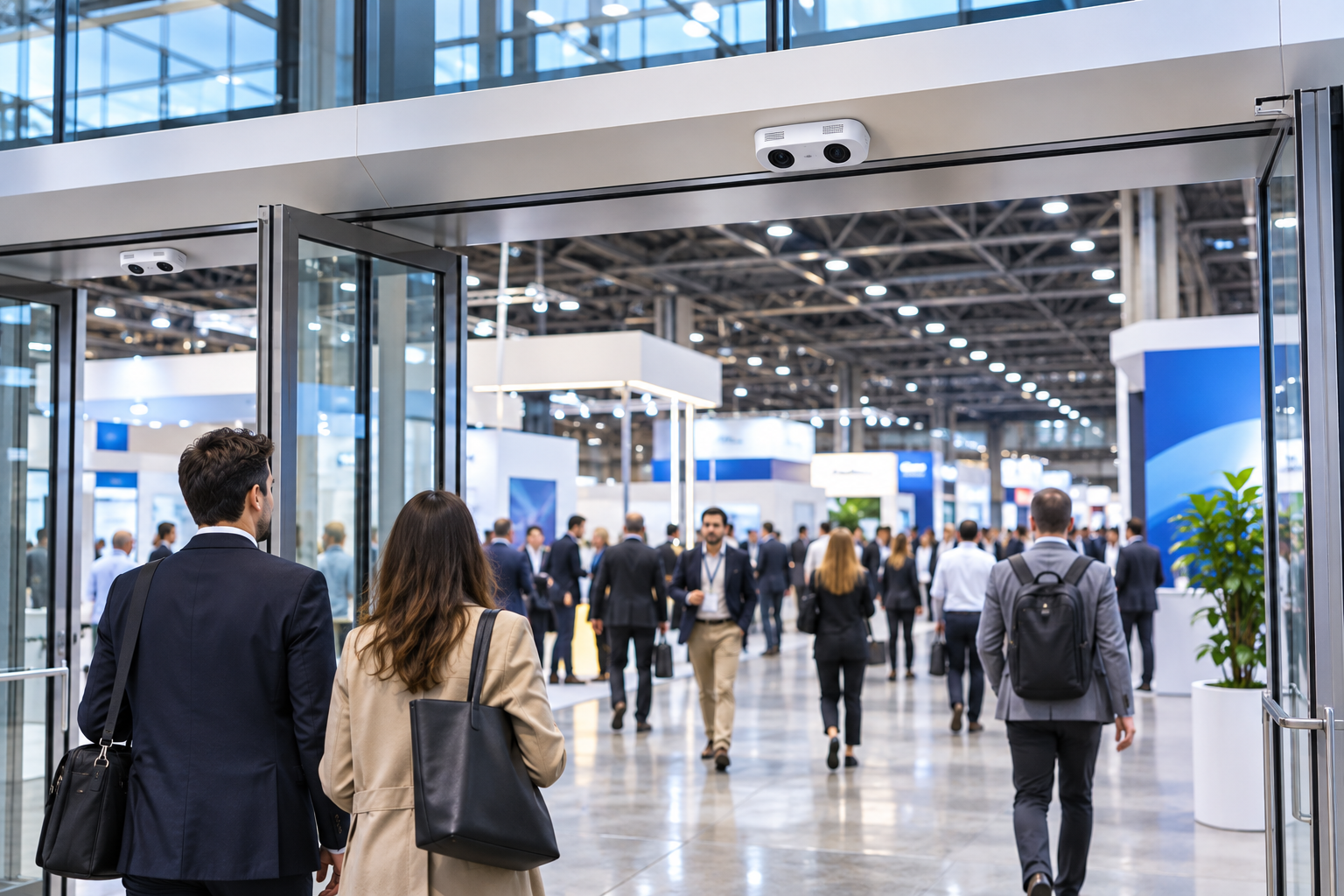
Accurately measuring visitor traffic at exhibition venues is an important source of data for assessing event success, making efficient use of halls, and analyzing the commercial performance of exhibiting companies. However, knowing how many people registered for an exhibition is not enough to explain how many people actually attended or which halls and booths attracted their interest.
People counting systems for exhibition venues are hardware and software solutions that automatically measure visitors’ entry and exit movements, analyze crowd levels in different exhibition halls, and, with suitable technologies, report on visitor movements around booths.
Today, human traffic at exhibition venues can be assessed hourly, daily and by event using 3D people-counting sensors, AI-powered video analytics systems and other sensing technologies.
These systems provide exhibition organizers with information about space utilization and operations management, while enabling exhibiting companies to assess visitor traffic in the area where their booths are located.
However, total entry movements, unique visitors, people passing a booth, booth visitors and potential customers are different performance indicators. Reports produced without distinguishing between them may lead to misleading conclusions about an exhibition’s success.
What Is a People Counting System for Exhibition Venues?
An exhibition people counting system is a technology system that automatically detects people passing through exhibition center entrances, hall doors or other designated access points and consolidates the resulting counts in a centralized reporting infrastructure.
Internationally, these solutions are referred to using terms such as Exhibition People Counting, Trade Show Visitor Analytics, Event Footfall Analytics and Exhibition Attendance Monitoring.
Depending on the system’s features and installation scope, the following data can be obtained:
Exhibition center entries and exits.
Hourly and daily visitor traffic.
Peak visiting hours.
Entry movements into different exhibition halls.
Variations in traffic levels between halls.
Estimated real-time occupancy.
Pedestrian traffic around booths.
Booth-front dwell and waiting times in systems that support these measurements.
Usage levels in corridors and shared spaces.
Comparative traffic reports across exhibition periods.
However, not all people counting systems provide all of this data.
For example, a standard people-counting sensor mounted at an entrance can measure how many entries were made into an exhibition center. However, on its own, it cannot determine which visitor held a sales meeting at which booth.
For this reason, the system’s purpose and the indicators to be measured should be clearly defined before installation.
Why Is Visitor Counting Important at Exhibitions?
Exhibitions are large-scale commercial events that bring together exhibitors, visitors and professionals from different industries.
Visitor attendance is one of the key indicators organizers use to assess an exhibition’s success.
However, accurately measuring attendance is a more comprehensive process than simply reviewing registration or ticket-sales information.
Measuring Actual Visitor Traffic
Not everyone who registers before an exhibition may attend the event.
Similarly, some visitors may enter the exhibition with free admission, invitations or through other registration channels.
By measuring actual movements through designated physical entrances, automated counting systems provide organizers with an additional source of data.
This data can be compared with registration and ticketing systems.
However, if a visitor enters more than once during the day, the number of physical entries may differ from the number of unique visitors.
Assessing Hall Utilization
An exhibition may consist of multiple halls.
For example, at an event where electronic security, building automation and data center technologies are exhibited in different halls, visitor traffic may not be distributed evenly across them.
People counting systems can measure entry traffic in different halls separately.
This data can help with:
Assessing hall layouts.
Identifying high-traffic corridors.
Planning rest and service areas.
Improving visitor wayfinding.
Reviewing hall allocation for future events.
It can help with these tasks.
Operations and Staffing Planning
The needs of security staff, visitor reception teams, information desks and cleaning services at exhibition venues may change throughout the day.
Measuring hourly visitor traffic can help organizers assess these operations in line with actual crowd levels.
However, people-counting data alone does not determine the required number of staff. Service times, workload, role definitions and operational requirements should be assessed separately.
What Is the Difference Between Exhibition Visitor Count and Entry Count?
One of the most important considerations in exhibition people-counting projects is correctly defining the concepts of visitors and visits.
UFI (The Global Association of the Exhibition Industry) explains that exhibition audits should distinguish between the number of visitors and the number of visits, which also includes repeat visits.
It is important to state clearly in reports which type of data is being used.
Registered Visitor Count
The number of people or registrations created for the exhibition.
Some of these people may not attend the event at all.
Actual Entry Count
The number of entry movements made through a physical entrance.
When someone exits and enters again, this can create multiple entry movements on the same day.
Unique Visitor Count
The number of different people who visited during the defined period.
Calculating unique visitors requires an appropriate registration and identity-matching mechanism.
The fact that a standard anonymous 3D people-counting sensor measures entry movements does not, by itself, mean it can identify unique visitors.
Repeat Visits
When a visitor returns to the same event or venue at a later time.
However, this data can be interpreted in different ways, such as repeat attendance across the exhibition as a whole or re-entry through the same door within a short period.
The definition of a repeat visit should be clear in the reporting system.
Example Exhibition Entry Report
At a hypothetical three-day exhibition:
Indicator | Example value |
|---|---|
Visitor registrations created | 12.000 |
Physical entry movements | 14.200 |
Unique visitors identified through separate registration verification | 9.100 |
Day the exhibition is open | 3 |
The data is for illustrative purposes; it is not statistics from a real exhibition.
The 14.200 entry movements in this table do not mean that 14.200 different people visited the exhibition.
Likewise, creating 12.000 registrations does not mean that 12.000 people necessarily attended the event.
Furthermore, the physical entry movements above are not automatically equivalent to UFI’s audited visitor statistics.
Exhibition organizers should clearly state their reporting definitions and the data sources used.
How Is Visitor Density Measured in Exhibition Halls?
At exhibition centers with multiple halls, people counting systems can be installed at different doors and access points.
Entry and exit traffic for each hall can be measured independently.
Hall-Based People Counting
For example, at a technology exhibition:
Hall | Daily entry movements | Measurement area |
|---|---|---|
Hall 1 | 4.200 | Electronic security |
Hall 2 | 3.600 | Smart building technologies |
Hall 3 | 2.400 | Data center solutions |
Hall 4 | 1.800 | Networking and infrastructure |
The example data is entirely hypothetical. People moving between halls may have been counted in more than one hall.
This type of report shows which halls had more entry movements.
However, the sum of the entry counts for the four halls should not be treated as the exhibition’s unique visitor count.
A visitor may visit multiple halls during the day or re-enter the same hall.
Traffic Distribution Between Halls
Suitable analytics infrastructure can examine hall entrances and movement directions to show how visitor flows are concentrated in particular areas.
However, knowing the entry counts for two halls does not mean that visitors’ exact movement routes have been identified.
Additional suitable data-linking or area-tracking technologies may be required for this.
People Counting and Visitor Analytics at Exhibition Booths
One of the most important questions for exhibitors is how much visitor interest their booths attract.
Traditionally, this performance is generally assessed through sales representatives’ observations, business cards, form submissions and meetings held.
However, when total pedestrian traffic around a booth is not measured separately, an important dimension of commercial performance may be missing.
Suitable people-counting and area analytics systems can provide additional data on this.
Number of Visitors Passing a Booth
Pedestrian movements through a defined corridor area around a booth can be measured.
This indicator can provide insight into the traffic potential of the booth’s location.
However, it should not be assumed that everyone passing through the corridor is interested in or has visited the booth.
Number of Visitors Entering a Booth
People passing through the booth’s defined entrance area can be counted.
This measurement can be used especially for large booths with a clearly defined entrance boundary.
For open-fronted booths with access from multiple directions, however, defining the entrance area can be more complex.
Dwell Time in Front of a Booth
In supported video analytics solutions, it is possible to estimate how long visitors remain in an area defined in front of a booth.
This data can help assess interest in product presentations or demonstration areas.
However, dwell time in front of a booth is not direct evidence of interest in a product or purchase intent.
The Difference Between Booth Traffic and Sales Meetings
1.000 people may have passed in front of a booth.
Only some of them may have visited the booth, and a smaller number may have been interested in a product demonstration or met with a sales representative.
For this reason, booth performance should be examined using multiple indicators.
How Is the Conversion Rate at Exhibition Booths Calculated?
Exhibiting companies can create certain conversion indicators by comparing suitable people-counting data with CRM or lead records.
Example Booth Performance Analysis
Hypothetical data from a technology company’s participation in an exhibition:
KPI | Value |
|---|---|
Pedestrian movements past the booth | 1.400 |
Events involving people remaining in front of the booth for the defined duration | 210 |
Qualified sales meetings recorded | 63 |
Dwell / pass-by rate | %15 |
Meeting / dwell rate | %30 |
Meeting / pass-by rate | %4,5 |
These rates are:
calculated as follows.
Because the data here combines different measurement types, the results are operational KPIs, not the actual sales conversion rate of unique individuals.
The same person may pass through the corridor more than once. In addition, a booth representative may hold multiple meetings with one person.
The definition of a qualified meeting should also be established before reporting.
Can the Return on Investment (ROI) of an Exhibition Be Measured?
People-counting data can help assess exhibition investments.
However, booth traffic alone is not sufficient to calculate the actual return on investment.
Costs and outcomes that can be assessed include:
Booth rental and setup costs.
Staff and transportation expenses.
Logistics and promotional expenses.
Number of qualified leads.
Value of sales opportunities.
Completed sales attributable to the exhibition.
Contribution or gross profit from these sales.
Tracking sales opportunities through CRM after the exhibition can help link people-counting data to commercial outcomes more reliably.
High visitor traffic alone does not mean high sales performance.
People Counting Technologies Used at Exhibition Venues
Different sensor and analytics technologies can be used at exhibition venues.
3D People-Counting Sensors
Depending on the model used, 3D people counting systems use stereoscopic imaging or other depth-sensing methods.
Suitable devices can separately measure entry and exit directions from overhead.
They can be considered especially for hall entrances and specific controlled access points.
Advantages may include:
Bidirectional entry and exit measurement.
Using depth information in high-density traffic.
Local data processing options.
Data transfer to centralized reporting systems.
Contribution to occupancy calculations on suitable devices.
These features may be available.
However, it should not be assumed that all 3D sensors have the same accuracy in dense group traffic.
AI-Powered Video Analytics
AI-based systems can analyze human movements in suitable camera footage to generate density and passage data for specific areas.
These systems can be used especially for:
Assessing open corridors.
Measuring crowd levels around booths.
Dwell time in specific areas.
Generating heat maps within a suitable scope.
These applications are possible.
However, the fact that a standard CCTV camera can detect people does not guarantee that it can perform reliable people counting and booth interaction analysis.
Different tasks may require separate calibration, camera placement and algorithm suitability.
Infrared People Counters
Infrared beam sensors can be used to detect people passing through a specific access line.
They can be considered for narrow, controlled entrances.
However, visitors walking side by side and crowd movements can affect measurement accuracy.
Thermal and mmWave Sensors
Suitable thermal and mmWave devices can be used in specific human-presence and movement-analysis applications.
In some projects, these methods can provide a detection option without producing visible-light images.
However, presence detection, directional people counting and distinguishing individuals in a crowd are different technical capabilities.
Technology Comparison for Exhibition Venues
Technology | Key application | Main limitation |
|---|---|---|
3D people counting | Halls and main entrances | Mounting height, width and overlap |
AI video analytics | Crowd levels in corridors and around booths | Perspective, crowds and data protection |
IR people counting | Narrow, controlled access points | Group and side-by-side passage |
Thermal sensor | Suitable passage or presence analysis | Environmental thermal conditions |
mmWave | Specific presence and movement analyses | Distinguishing multiple people; device-specific capability |
Ticket / badge system | Registration and visit verification | Registration quality, access processes, data protection |
These methods serve different purposes. In some projects, it may make more sense to use multiple data sources together.
How Is Real-Time Occupancy Calculated at Exhibition Venues?
For exhibition organizers, in addition to visitor movements, it is important to know the estimated number of people present at the same time in specific halls.
Estimated real-time occupancy can be calculated using suitable entry and exit data.
For example, if 2.500 people enter a hall that has been confirmed empty at the start and 900 people leave, the estimated occupancy is:
This is the result.
However, for this calculation to be reliable, all entries and exits for the hall in question must be measured.
It should also be clearly defined whether event staff, exhibiting company employees and other people are included in the count.
Data Drift in Occupancy Calculations
Small counting errors in entry and exit directions can accumulate over time and cause deviations in estimated occupancy.
For this reason:
Verify the starting occupancy.
Monitor all relevant doors.
Synchronize sensor clocks.
Detect data interruptions.
Verify occupancy at suitable intervals.
Apply counter correction procedures when necessary.
Important: An exhibition people counting system does not replace the legal occupant capacity specified in the fire safety design or the approved emergency evacuation plan. For occupancy applications that are safety-critical, the system’s reliability and redundancy requirements should be assessed separately.
Heat Maps and Corridor Analysis at Exhibition Venues
In busy exhibition environments, visitor concentrations in specific corridors or around booths can affect operational planning.
Supported analytics systems can generate heat maps showing usage levels in specific areas.
This data can help with:
Identifying busy corridors.
Reviewing visitor wayfinding.
Planning rest areas.
Assessing booth placement.
Arranging waiting and demonstration areas.
These applications are possible.
However, two different analytics functions should be distinguished:
Area density analysis produces statistics on people present in or passing through a specific area.
Visitor route analysis may require linking an individual’s movements across different areas.
This second approach may require additional technical capabilities and a data protection assessment.
It should not be assumed that all heat map systems can identify individual visitor routes.
How Should Sensors Be Installed at Exhibition Venues?
Exhibition venues can present technical conditions for people counting systems that differ from those at standard retail entrances.
Large doors, high ceilings, temporary booth structures, dense group entries and layouts that change between events must be taken into account.
Using Multiple Sensors at Wide Entrances
The entrances to exhibition halls may exceed the coverage width of a single sensor.
In this case, multiple people-counting sensors can be used with suitable models.
However, if the fields of view of the devices overlap without proper control, the same person may be counted more than once.
AXIS’s official technical documentation explains methods for using multiple counters at wide entrances.
Nevertheless, in these types of multi-sensor scenarios, model compatibility, shared configuration and counting-area boundaries are important.
Temporary Exhibition Installations
Booths and wayfinding structures at exhibition venues may change from one event to another.
This can affect the fields of view of sensors that previously worked correctly.
For this reason, before each new event, check:
Entrance layout.
Sensor field of view.
Passage width.
Ceiling and mounting height.
Temporary advertising and wayfinding elements.
Obstructions created by new booth structures.
These should be checked.
Dense Group Traffic
At exhibition opening times and when certain conferences end, many visitors may head for the same door within a short period.
In these scenarios, people partially blocking one another (occlusion), changes of direction and pauses at the entrance can affect counting performance.
Sensor accuracy should be tested not only at low density but also during the expected peak hours of the exhibition.
Accuracy and Validation of Exhibition People Counting Systems
The fact that a people counting system produces reports does not, by itself, show that the counts are accurate.
Manual reference measurements and system validation should be performed after installation.
How Is Counting Accuracy Calculated?
For example, at an exhibition hall entrance:
Manual reference count: 500 people.
Automatic people-counting result: 485 people.
Absolute counting difference: 15 people.
Let this be the case.
In this example, accuracy based on the total count:
can be expressed as follows.
However, this value shows only the total counting difference over the measurement interval in question.
A system may both overcount and undercount, resulting in a small net difference. Therefore, where possible, missed and false counts at the individual-event level should also be examined.
Under What Conditions Should Validation Be Performed?
For exhibition applications, the following should be included in particular:
Normal entry traffic.
High traffic at opening time.
Simultaneous entry and exit.
Visitors moving side by side.
Group passage.
People waiting in front of the door.
People turning around and exiting through the door.
Child visitors.
People carrying belongings, suitcases or large bags.
Temporary changes to booth layouts.
These should be included in the test scope.
AXIS People Counter documentation recommends validating the relevant counters by manually comparing at least 100 passages.
However, accuracy targets stated by a manufacturer under specific conditions are not an automatic performance guarantee for all exhibition entrances or all sensors.
The main purpose of validation is to identify measurement error in the actual site environment and improve system calibration when necessary.
Centralized Reporting and Data Integrity at Exhibitions
Large exhibition centers have multiple entrance doors and halls.
For this reason, having each sensor produce separate reports may not fully meet the organizer’s needs.
A centralized reporting system should manage the following together:
Sensor location and identification information.
Hourly and daily visitor traffic.
Entry and exit directions.
Hall-level totals.
Data transfer status.
Device downtime.
Counting accuracy tests.
Event start and end dates.
These should be managed together.
Event-Based Data Segmentation
Multiple events may be held on different dates at the same exhibition center.
For this reason, it is important to segment reports not only by calendar day but also by event ID and actual opening times.
Staff movements during setup and dismantling periods should not be included in visitor attendance statistics.
Data Loss During Internet Outages
Suitable people counting systems may have an offline recording buffer.
However, it should not be assumed that all products provide the same storage capacity.
Before the project, it should be tested whether counting continues when the internet or network connection is lost, how long data is stored, and whether it is transferred automatically when the connection is restored.
Are People Counting Systems at Exhibition Venues Subject to KVKK?
Personal data protection in exhibition people-counting projects should be assessed according to the data processed by the system used.
Storing only anonymous aggregate visitor counts is not the same as linking people’s identity details or movement records.
Some devices may process images locally and transfer only counting results.
Other systems, on the other hand, may:
Record camera footage.
Match data with visitor badge or registration information.
Process device identifiers.
Link individual movement routes.
Transfer data to cloud systems.
For this reason, the data processing methods of the technology used should be examined separately.
KVKK for Exhibition Organizers and Exhibiting Companies
The data-processing roles of the exhibition center operator, event organizer, exhibiting company and technology provider may not be the same in every project.
Controller and processor relationships should be assessed in contracts and actual processing activities.
If personal data is processed:
Determine the legal basis.
Fulfill the obligation to inform.
Use data only for defined purposes.
Avoid processing unnecessary footage and identifiers.
Establish retention and deletion periods.
Restrict access permissions.
Assess the terms for cloud services and international data transfers.
Solutions designed to track individual visitors between booths may not have the same scope of data processing as anonymous people counting systems.
The Personal Data Protection Authority’s guide to the obligation to inform and its statements on security cameras are key reference sources for this assessment.
Key KPIs for Exhibition Organizers and Exhibitors
KPI | Description | Purpose |
|---|---|---|
Total entry movements | Entries made through exhibition doors | Physical traffic volume |
Verified unique visitors | Different visitors in a suitable registration system | Official attendance analysis |
Hourly entry traffic | Entry counts by hour | Operations planning |
Hall entries | Hall-level entry movements | Comparing hall utilization |
Estimated real-time occupancy | Starting occupancy + entries - exits | Crowd-level monitoring |
Booth-front traffic | Passages through a designated corridor area | Location and traffic potential |
Booth visits | Entry movements within a defined booth boundary | Assessing booth access |
Dwell / pass-by rate | Defined dwell events / passages | Supporting indicator of interest |
Qualified meeting | Contact verified through CRM or meeting records | Commercial opportunity tracking |
Counting error | Difference from the reference count | Data quality |
Not all of these KPIs are obtained directly from a standard people-counting sensor.
Additional records and business processes are needed especially for data such as unique visitors, qualified meetings and sales opportunities.
What Should You Consider When Choosing a People Counting System for Exhibition Venues?
1. Define the Measurement Objective
Will only the main entrances be measured, or is hall- and booth-level data also required?
This requirement directly affects the number and placement of sensors and the software infrastructure.
2. Suitability for Wide Entrances
The width of exhibition doors and expected dense group traffic should be priority criteria when selecting sensors.
3. Installation and Calibration
High ceilings, temporary architectural elements and changing entrance layouts should be assessed.
4. Multi-Sensor Integration
Sensors used for wide entrances should be configured correctly to prevent the same person from being counted twice.
5. Centralized Reporting
Data from multiple exhibition halls should be viewable in a single system.
6. Separating Events and Exhibitors
Reports should be segmented by exhibition, hall, door and defined booth.
7. Integration
If necessary, integration with ticketing, registration, badge-reading or CRM systems should be assessed, and data-sharing permissions should be defined.
8. Data Reliability
Network outages, time synchronization and the accuracy of data transfer should be checked.
9. KVKK and Data Minimization
Avoid processing personal data that is not required for the measurement.
10. Site Validation
Performance validated under actual exhibition conditions should take precedence over catalog accuracy stated by the supplier.
Technical Checklist for People Counting Systems at Exhibition Venues
The following checks should be performed during project surveys and commissioning:
- Have the exhibition center and hall entrances been mapped?
- Have visitor, staff, exhibitor and logistics entrances been distinguished?
- Have entry movements and unique visitor definitions been established?
- Have the KPIs required by the exhibition organizer been defined?
- Has the need for booth-level analysis been assessed separately?
- Are the sensor mounting height and coverage width suitable?
- Has the multi-sensor configuration for wide doors been validated?
- Has a counting test been performed during dense group traffic?
- Has the scope of hall-level occupancy calculations been checked?
- Has it been examined whether temporary exhibition architecture affects the sensors’ fields of view?
- Are sensor clocks and centralized reports synchronized?
- Has data retention behavior during internet outages been tested?
- Are the start and end times for event-based reports correct?
- Has an accuracy test been performed against a manual reference count?
- Have KVKK and data-sharing responsibilities been defined?
- Have technical maintenance and pre-event revalidation been planned?
Frequently Asked Questions About People Counting Systems at Exhibition Venues
What is a people counting system for exhibition venues used for?
It automatically measures people’s movements at exhibition center and hall entrances, providing visitor traffic, peak hours, estimated occupancy and, in suitable systems, analytics around booths.
How is the number of exhibition visitors measured?
People-counting sensors can be used at physical entrances. Suitable registration and visit verification methods may be needed to obtain unique visitor statistics.
Can the same person be counted more than once at an exhibition venue?
Yes. In standard entrance-counting systems, when a person re-enters, this can create a new entry movement. For this reason, entry count should not be confused with unique visitor count.
Can the number of visitors to exhibition booths be measured?
With suitable sensor placement, booth entries or movements around a booth can be measured. However, it is important to define the entrance area correctly for open-fronted booths.
Are people passing in front of a booth considered potential customers?
No. Corridor traffic is an indicator of potential reach. Additional business records are needed to count qualified customers or sales opportunities.
Can visitor density at an exhibition venue be monitored in real time?
Estimated real-time occupancy can be calculated using suitable entry-exit counting and centralized software infrastructure. However, all passages must be monitored and counting errors controlled.
Which technology is more suitable for exhibition people counting systems?
3D people counting, AI-powered video analytics or other sensing methods can be used. The right choice depends on entrance width, crowd levels, reporting needs and site conditions.
Can standard security cameras be used for people counting?
Cameras with a suitable model and software support can be used. However, standard CCTV imaging capability does not guarantee high-accuracy people counting.
Do exhibition people counting systems comply with KVKK?
Compliance depends on the data processed by the system used and the actual data-processing process. Anonymous aggregate counting and identity or image processing are not assessed under the same legal scope.
Do people-counting data show the return on investment of an exhibition?
They provide supporting indicators of visitor traffic and booth performance. Calculating actual ROI also requires investment costs, sales meetings and completed commercial outcomes.
Conclusion: Turning Exhibition Visitor Traffic into Measurable Performance
People counting systems at exhibition venues are technological solutions that help organizers and exhibiting companies assess physical visitor traffic in greater detail.
Measuring main entrances, halls and specific booth areas can provide important data on exhibition crowd levels, space utilization and visitor interest.
When assessed alongside clearly defined KPIs, this data can support operations planning, the design of future events and exhibitor performance analysis.
However, entry count, unique visitors, booth visitors and qualified sales meetings are different indicators.
Real success in exhibition analytics is not simply achieving high count values; it is producing reliable, clearly defined data that can be used in decision-making.
For this reason, the right people counting system should be developed through a combined assessment of suitable technology selection, correct sensor placement for wide entrances, validation under high-density conditions, centralized reporting and data security processes.