
People Counting Systems in Shopping Malls and Mall Visitor Analysis
People counting systems in shopping malls provide management with data by measuring mall entries/exits, visitor density, and traffic distribution between floors. We examine the technical selection criteria for 3D people counting sensors, AI-powered analytics, tenant store performance, real-time occupancy, counting accuracy, calibration, and central reporting.
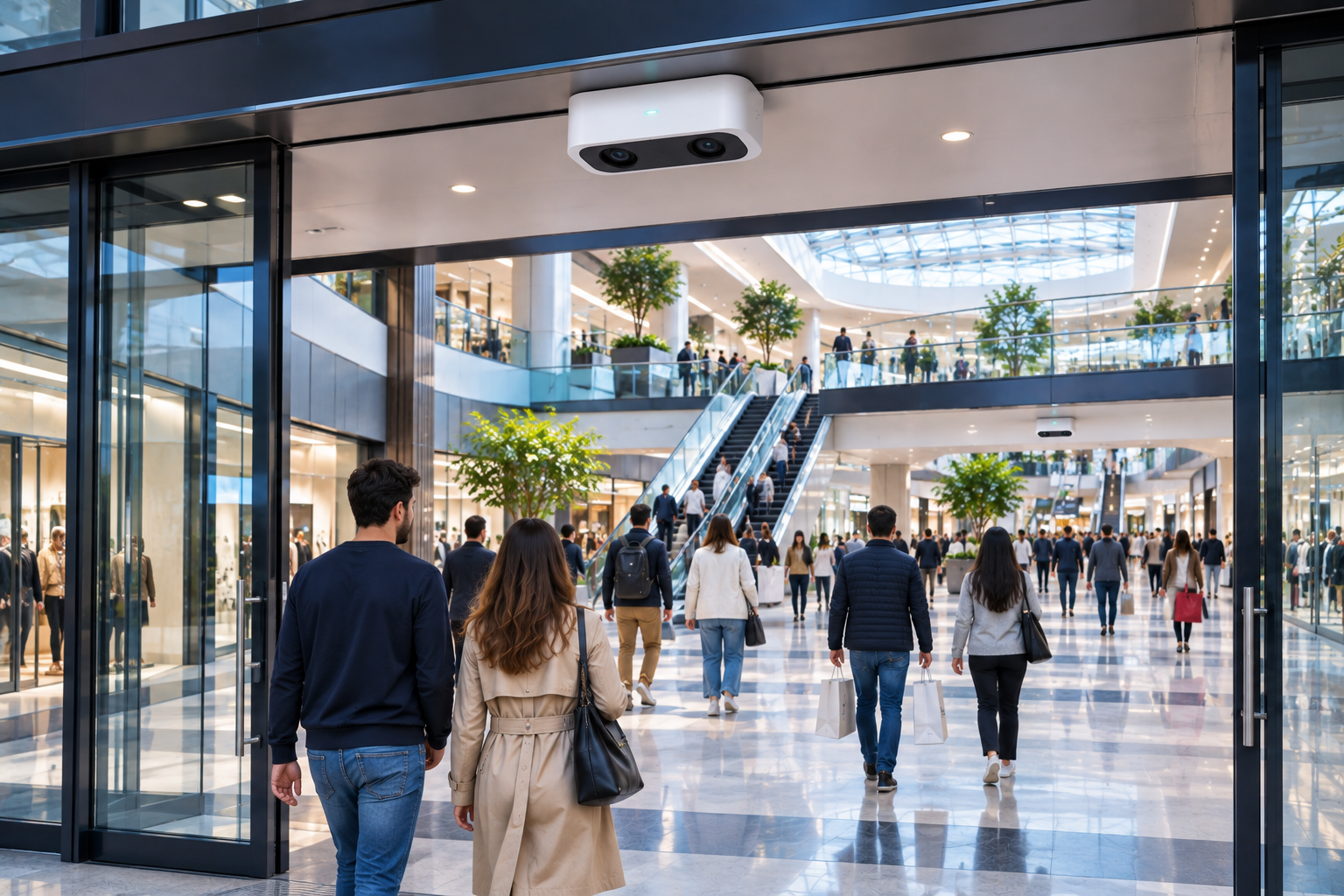
Accurate measurement of visitor traffic in shopping malls plays a significant role in evaluating the operational and commercial performance of mall management. The number of people entering a shopping mall throughout the day, which doors visitors use, where density occurs on which floors, and how this movement reflects on stores are valuable data supporting business decisions.
People counting systems in shopping malls are sensor and software solutions that automatically measure visitor movements at entry and exit points, consolidating the collected data on central reporting platforms. Advanced systems can evaluate not only total visitor traffic but also movement density in corridors, usage of specific areas, and, with appropriate analytical infrastructure, store visitor performance.
However, obtaining reliable visitor data in a large-scale shopping mall is not merely about placing people counting devices at entrances. Sensor technology, installation conditions, accurate identification of all entrances, counting accuracy, calibration, and data integrity must be considered together.
What is a Shopping Mall People Counting System?
A shopping mall people counting system is an electronic system that measures human movements at designated entry, exit, and transition points of a shopping mall, converting the data into digital reports.
These technologies are defined in the international retail sector with terms such as Shopping Mall People Counting, Mall Footfall Analytics, Visitor Traffic Analytics, and Shopping Centre Footfall Measurement.
Modern shopping mall people counting systems generally consist of three main components:
People counting sensors: Detect people entering and exiting, generating direction-based counting data.
Network and data communication infrastructure: Ensures the transfer of data from sensors to central systems.
Visitor analytics and reporting software: Evaluates different entrances, floors, zones, and date ranges in common reports.
Depending on the system used, mall management can examine the total number of entries, peak hours, traffic shares of entrance doors, regional visitor density, and estimated occupancy levels of specific areas.
The important distinction here is: the number of entries into the mall is not the same as the number of unique individuals visiting the shopping mall.
A visitor exiting and re-entering the shopping mall within the same day might be recorded as two separate entries in a standard entry counting system. Determining the number of unique visitors requires different technologies and verification methods.
Why Are People Counting Systems Important in Shopping Malls?
In mall management, visitor numbers can be used for different purposes in terms of marketing, operations, leasing, and facility management.
1. Measuring Total Mall Visitor Traffic
Counting data obtained from all suitable entrances of the shopping mall can be consolidated in a central reporting system.
This allows daily, weekly, monthly, and annual visitor traffic to be monitored.
It becomes possible to compare changes occurring especially during holiday periods, weekends, school holidays, and special campaigns.
However, when comparing seasonal traffic, only the total number should not be considered. Conditions such as operating days, working hours, closed entrances, and data deficiencies should also be taken into account.
2. Comparing the Performance of Mall Entrance Doors
Large shopping malls may have main entrances, parking connections, public transport connections, and entrances on different facades.
Thanks to people counting systems, the shares of these entrances in the total mall traffic can be determined.
For example, the density of visitors coming from parking connections can be compared with the density of visitors coming from main street entrances at different times of the day.
This data can be used for security personnel planning, cleaning services, wayfinding, and entrance area operations.
3. Analyzing Floor and Corridor Traffic
The total number of visitors to a mall does not directly indicate how visitors are distributed within the shopping mall.
While the ground floor of a mall may have high visitor traffic, upper floors might experience lower activity.
With appropriate regional people counting systems, human movements in corridors, atriums, floor connections, and specific transition points can be measured.
This data can support evaluations related to tenant placement, wayfinding, event planning, and common area usage.
4. Measuring the Impact of Mall Events on Visitor Traffic
Shopping malls can host concerts, children's events, exhibitions, product promotions, and seasonal campaigns.
People counting data can show how visitor traffic changes during the periods when these events take place.
However, an increase in visitor numbers on a specific event day does not prove that the entire increase is due to the event.
For a healthier evaluation, similar days, weather conditions, seasonal effects, and previous period traffic should be examined together.
How is People Counting Done at Mall Entrances?
Sensors placed at shopping mall entrances detect people passing through the designated counting area and classify them according to entry and exit directions.
In modern systems, this process is typically performed using ceiling-mounted 3D sensors or appropriate AI-powered video analytics systems.
The counting process generally consists of the following stages:
The sensor detects human movement in the entrance area.
The appropriate algorithm attempts to separate individuals.
The direction of the person in the defined passage area is determined.
Upon completion of the passage, an entry or exit event is generated.
Data is transferred to the central reporting system with a timestamp.
Data from different entrances is consolidated according to the mall's defined boundaries.
In a multi-entrance mall, it is crucial to correctly determine which doors are external entrances to the mall and which are merely internal circulation points.
For example, a visitor passing through an escalator between two mall floors should not be counted as re-entering the mall. This movement should be considered as a separate inter-floor traffic indicator.
Similarly, connections between large stores accessible from outside and common mall areas should be carefully examined when defining counting boundaries.
Technologies Used in Shopping Mall People Counting Systems
Shopping malls require special consideration in sensor selection due to their wide entrances, high visitor density, and varying physical conditions.
3D Stereoscopic People Counting Sensors
3D stereoscopic sensors utilize multiple imaging components to calculate depth information in the detection area.
Depth analysis can help distinguish individuals walking side-by-side under suitable conditions.
These are among the solutions evaluated especially at main entrances and high-traffic transition points.
Key features:
Separate measurement of entry and exit directions.
Distinguishing individuals in crowded passages.
Height or object size filtering in supported models.
Regional analysis in specific models.
Integration with central reporting systems.
However, the use of 3D technology does not guarantee the same level of accuracy under all entrance conditions.
AI-Powered Video Analytics
AI-powered video analytics systems can detect people through camera images and perform specific counting and movement analysis functions.
Depending on the architecture used, analysis can be run on the camera, a local processing unit, or a central server.
This option can be considered in shopping malls with existing CCTV systems.
However, it should not be assumed that every security camera is suitable for people counting applications.
Viewing angle, object size, crowd density, resolution, and algorithm features can affect system performance.
For the operating principles of video analytics technologies, GüvenlikOnline's article Video Analytics Systems: AI and Technical Selection Guide can be reviewed.
ToF and Other Depth Sensors
Time of Flight (ToF) technology enables the acquisition of distance or depth information by utilizing measurements related to the reflection of a transmitted light signal.
ToF-based people counting sensors can evaluate the position and movement of visitors in the detection area under supported conditions.
The suitability of these systems should be determined based on detection range, field of view, mounting height, and environmental conditions.
Infrared Beam Counters
Infrared beam systems create a count by changing the beam detection status of objects passing through a specific line.
While usable in simple applications, distinguishing individuals walking side-by-side in busy mall entrances can pose a significant limitation.
Comparison of Mall People Counting Technologies
Technology | Advantage | Limitation | Applicable area |
|---|---|---|---|
3D stereoscopic | Depth analysis and person separation | Mounting height and coverage conditions | Busy mall entrances |
AI video analytics | Flexible analysis and utilization of suitable cameras | Camera perspective and processing load | Entrances and internal areas |
ToF depth sensor | Distance-based detection | Detection range and environmental conditions | Compatible transition points |
IR beam counter | Simple passage measurement | Limited separation in group passages | Narrow and controlled passages |
This table compares general technology features. Final system selection should be made based on manufacturer's technical documentation and performance tests in a real mall environment.
How are Real-time Visitor Count and Occupancy Calculated in Shopping Malls?
Measuring all external entries and exits of a shopping mall allows for the estimation of the number of people inside under certain conditions.
Basic calculation:
Estimated real-time occupancy = Initial number of people + Total entries − Total exits
For example, assume there are 1,400 people in a mall at the beginning of a specific time interval.
If 800 entries and 680 exits occur during this period:
1,400 + 800 − 680 = 1,520 people
This example is entirely hypothetical.
In real systems, the reliability of occupancy estimation depends on the accuracy of the initial count and the complete measurement of all entries and exits.
Counting errors can accumulate over time. Especially in multi-entrance malls, synchronizing sensor data and verifying occupancy estimates when necessary is important.
Important safety distinction: The real-time occupancy estimated by the people counting system should not be considered as the building's approved maximum user capacity or the definitive number of people for emergency evacuation purposes.
Such safety and capacity decisions should be based on applicable regulations, fire safety projects, and evaluations by authorized experts.
Floor, Corridor, and Regional Visitor Analytics in Shopping Malls
The total number of entries to a mall does not explain which floors or corridors are used more frequently.
Therefore, in advanced visitor analytics projects, regional traffic measurement can be evaluated alongside entry counting.
Inter-Floor Traffic Analysis
Escalators, elevator connections, and transition points between floors are important measurement areas for understanding visitor circulation.
With appropriate sensors, visitor movements directed to specific floors can be examined.
However, movements occurring between floors should not be re-added to the total mall entry count.
Corridor and Atrium Density
Densities occurring in main corridors, atriums, and large store connections can be compared on a time-based basis.
These analyses can help identify busy and less-used areas within the mall.
However, the number of people passing through a corridor and the number of people simultaneously present in that corridor are different indicators.
Visitor Heatmaps
With appropriate analytical sensors and software, heatmaps showing the usage density of specific areas can be created.
These maps can be used to evaluate usage trends of common areas and specific event points.
However, it should not be assumed that detailed people movement heatmaps can be created solely from numbers obtained from entry-exit counters. This function requires appropriate additional data and analytical infrastructure.
How is Mall Visitor Count Related to Tenant Store Performance?
One of the important issues in the commercial management of shopping malls is evaluating how total visitor traffic reflects on tenant stores.
A mall recording 50,000 entries daily does not mean that every tenant has the same visitor potential.
The floor, corridor, storefront facade, and other nearby businesses can affect the pedestrian traffic a store is exposed to.
1. Corridor Traffic
The number of people passing in front of a store can be used to evaluate the potential visibility of the store at its location.
However, corridor traffic is not the number of visitors entering the relevant store.
2. Store Entry Rate
When store entries and appropriate pedestrian traffic in front of the store are measured together, the conversion rate from corridor traffic to store visits can be calculated.
Basic calculation:
Store entry rate (%) = Number of store entries / Pedestrian traffic in front of store × 100
Hypothetical example:
Pedestrian traffic in front of store: 12,000 passages
Number of store entries: 900 entries
Calculated entry rate: 7.5%
For this calculation to be meaningful, the two numbers must have the same time interval, comparable measurement scope, and consistent counting definitions.
It is possible for a person to be counted multiple times in front of store traffic. Therefore, the calculated rate should not be interpreted as the conversion rate of unique individuals to the store.
3. Sales Conversion Rate
When people counting data from stores is combined with POS transaction numbers, a transaction-based sales conversion rate can be calculated.
Transaction-based conversion rate (%) = Number of sales transactions / Number of store entries × 100
This indicator differs from individual customer conversion. The same visitor may make multiple purchase transactions, or multiple people may make a purchase with a single sales transaction.
4. Comparing Tenant Performance
Mall management can evaluate store traffic and sales data together when necessary data sharing and appropriate contractual arrangements are in place.
However, ranking stores operating in different sectors solely by visitor numbers can be misleading.
For example, a jeweler and a supermarket have different visitor densities, average transaction amounts, and shopping frequencies.
In evaluating tenant performance, store category, area size, location, and other commercial indicators should be considered together.
Important Visitor KPIs for Mall Management
The true management value of people counting systems emerges when the collected data is transformed into clearly defined performance indicators.
Performance indicator | Measured data | Purpose of use |
|---|---|---|
Total mall entry traffic | Inward counts from external entrances | Visitor trends |
Door-based traffic | Separate count for each entrance | Entrance operations |
Hourly visitor density | Time-based number of entries | Staff planning |
Estimated real-time occupancy | Entry-exit balance and initial count | Occupancy monitoring |
Floor and corridor traffic | Internal zone passage counts | Area usage analysis |
Store entry rate | Store entries / traffic passing in front | Window display and location evaluation |
Transaction-based sales conversion | Number of POS transactions / store entries | Commercial performance |
Event period traffic change | Comparable period counts | Marketing evaluation |
Standardizing definitions in KPI calculations is important. Especially when comparing different malls, the same measurement scope, time interval, and data cleaning rules should be used.
Where Should Mall People Counting Sensors Be Mounted?
Correct sensor positioning is a technical issue that directly affects counting accuracy.
Large shopping malls may have different ceiling heights, glass facades, automatic doors, and wide passage areas.
Therefore, the physical conditions of each entrance should be evaluated separately.
Entrance Width and Number of Sensors
In wide entrances, it should not be assumed that a single sensor will cover the entire passage area.
The required number of devices should be determined based on the sensor's field of view, mounting height, and entrance width.
If multiple sensors need to monitor the same passage, the relationship between detection zones and the risk of double counting should be checked separately.
Door Movements and Physical Obstacles
Automatic sliding doors, revolving doors, and swing doors can create different passage movements.
It is necessary to ensure that door leaves do not obstruct the sensor's field of view and to correctly evaluate points where people wait immediately before or after entering the counting area.
Revolving doors and congested passage areas may require special installation and validation work depending on the technology used.
Ceiling Height
Ceiling heights of main mall entrances and parking connections may differ.
When selecting sensors, the manufacturer's supported mounting height range and appropriate optical features should be checked.
Very high ceilings may require suitable mounting brackets or a different detection architecture.
Lighting and Environmental Conditions
Direct sunlight from glass facades, reflections, and variable lighting at the entrance can affect the performance of image-based systems, in particular.
It is important to conduct tests under different lighting conditions during actual operating hours at mall entrances.
Accuracy, Calibration, and Validation in Mall People Counting Systems
In large shopping malls, small counting errors can lead to significant differences in long-term visitor reports.
For example, assume a mall's actual monthly entry count is 1,000,000.
If the system systematically undercounts entries by 5%, the reported value would be approximately 950,000.
Therefore, the accuracy rates declared by manufacturers for people counting devices should not be automatically accepted as results provided under project conditions.
How is Counting Accuracy Measured?
One method is to compare sensor counts with manual reference counts performed over specific periods.
Simple total absolute error rate:
Error rate (%) = |Sensor count − Reference count| / Reference count × 100
However, this formula alone does not explain all errors.
For example, a sensor undercounting some people and overcounting other passages might balance each other out in the total result.
Therefore, the following checks should be performed together in accuracy evaluation:
Entry and exit directions should be compared separately.
Quiet and busy hours should be tested.
Groups walking side-by-side should be examined.
Counting rules for children, strollers, and people carrying loads should be defined.
People waiting at the entrance and turning back should be checked.
Results for each entrance should be reported separately.
Error rates and the number of tested samples should be recorded.
Axis Communications recommends verification with manual passage counts in its AXIS People Counter documentation.
FootfallCam, on the other hand, divides accuracy auditing into processes of improving device settings and comparing with manual counts.
These methods are manufacturer-specific documentations. The declared accuracy targets should not be interpreted as a common engineering standard for all brands and devices.
Calibration and Periodic Inspection
People counting systems should also be checked after installation.
Especially architectural changes in the entrance area, repositioning of sensors, modification of door arrangements, or software updates can affect accuracy.
The periodic inspection process should include data integrity review, sample passage tests, device health status, and recalibration if necessary.
Data Integrity and Central Reporting in Multi-Entrance Malls
For reliable reporting in shopping malls, it is as essential to collect data completely as it is for sensors to count accurately.
In systems consisting of numerous sensors, the following issues are important:
Time synchronization: Sensors must operate with the same time reference. Otherwise, discrepancies may occur between door-based and hour-based reports.
Local data buffering: In cases of network connection loss, it should be checked whether the device can store counting data.
Missing data detection: Devices that are disconnected or not generating counts should be visible in the reporting system.
Monitoring device health status: The online status of sensors, last data transmission time, and potential malfunctions should be centrally monitored.
Central data rules: External entrances, parking connections, internal corridors, and store passages should be differentiated.
Integration: In necessary projects, compatibility with API, data export, and business intelligence systems should be evaluated.
For a mall, technical success should be evaluated not only by sensor accuracy but also by measurement continuity at all entrances and the traceability of reports over the long term.
RE-ID and Unique Visitor Analysis in Mall People Counting Systems
Standard people counting systems record individuals passing a specific counting line as an entry or exit event.
This data does not directly show the number of unique individuals visiting the shopping mall.
RE-ID (Re-Identification) technology, in suitable systems, is a method for evaluating whether person observations in different images or time intervals are associated with the same individual.
This technology can be used in certain advanced analytical applications to evaluate repeat visits or regional passages.
However, there are significant limitations:
Not all people counting systems support RE-ID.
Matching the same person at different times cannot be guaranteed.
Clothing, viewing angle, crowd density, and time difference can affect matching.
Identity association methods used in unique visitor analysis may create personal data obligations.
Matching accuracy must be verified based on manufacturer and field conditions.
In standard mall counting reports where RE-ID is not used, it is more appropriate to use terms that accurately define the measurement, such as 'number of entries' or 'number of visits', instead of 'unique visitor'.
KVKK and Data Privacy in Mall People Counting Systems
The data processing methods of technologies used for people counting in shopping malls differ.
Some sensors only generate aggregated counting statistics, while some systems may process camera images, device identifiers, or data for re-identifying individuals.
Therefore, it must be determined what data the technology used actually collects and for how long it stores it.
The Personal Data Protection Authority (KVKK) draws attention to issues such as purpose limitation, data minimization, proportionality, obligation to inform, and data security in the use of camera-based systems.
In mall projects, the following issues should be evaluated in particular:
Whether the system used processes personal data.
The purpose of processing and the appropriate legal basis.
Whether image recordings are necessary.
Who can access the data.
Data retention and destruction policies.
Data transfer and hosting conditions if cloud is used.
Additional legal requirements if RE-ID or biometric features are present.
In applications where only statistical counting data is needed, evaluating solutions that do not require identifying individuals or storing their images can be beneficial for data minimization.
Technical Checklist for Mall People Counting System Selection
When preparing a people counting project in shopping malls, the following questions should be answered:
Have all external entries and exits of the mall been identified?
Have internal corridor, floor, and store passages been differentiated from external entrances?
Have entrance widths and ceiling heights been measured?
Have sensor coverage areas been calculated according to manufacturer data?
Has a test plan been made for side-by-side and group visitors?
Has it been checked whether door movements affect counting?
Have counting rules for children, staff, and service movements been defined?
Has a manual reference count been performed for each entrance?
Have entry and exit directions been correctly defined in the central system?
Has time synchronization of sensors been ensured?
Have data loss and re-transfer scenarios been tested in case of network outage?
Has an automatic notification mechanism been established for device malfunctions?
Have mall and store KPI definitions been separated?
Have RE-ID and unique visitor claims been technically verified?
Have KVKK, access permissions, and data retention requirements been evaluated?
Has a periodic maintenance, calibration, and re-validation process been defined?
This checklist has been prepared for preliminary technical evaluation purposes. The final system architecture should be determined based on measurement objectives, architectural plans, manufacturer technical specifications, and field validation results.
Frequently Asked Questions About Mall People Counting Systems
What are people counting systems used for in shopping malls?
They help analyze visitor traffic, peak hours, and the use of different entrances by measuring entries and exits to the shopping mall. With appropriate additional analytical systems, floor and corridor densities can also be evaluated.
How many people counting sensors are needed in a shopping mall?
The number of sensors depends on the number of entrances, the width of the entrances, the ceiling height, and the detection capacity of the devices to be used. A single sensor may not be sufficient for every entrance.
How are mall visitor numbers calculated?
The total entry traffic can be calculated by consolidating inward passage counts from designated external entry points in a central system. Internal passages should not be counted as re-entries.
Is the total number of visitors in a mall the number of unique individuals?
No. Standard systems count entry events. The same person re-entering the mall may be recorded as a new entry.
Can mall people counting systems measure the performance of tenant stores?
Visitor traffic can be compared with appropriate store entry and corridor counting. Sales performance evaluation also requires appropriate sales data and common KPI definitions.
Can mall visitor counting be done with existing CCTV cameras?
It may be possible with appropriate camera angles, image quality, and supported analytical software. However, it should not be assumed that existing cameras will provide the necessary counting accuracy in busy entrances.
How is accuracy checked in mall people counting systems?
Device data is compared with manual reference counts. Entry and exit directions, different density levels, group passages, and data continuity of devices should also be tested.
Do mall visitor counting systems increase sales?
Systems do not directly increase sales. However, by measuring visitor traffic and area usage, they can support the evaluation of operational and commercial decisions with more data.
How to Ensure Reliable Visitor Analytics in Shopping Malls?
People counting systems in shopping malls can be used not only for reporting visitor numbers but also for evaluating various operations of mall management with measurable data.
Examining total entry traffic, door-based visitor distribution, peak hours, floor and corridor activity, and store visitor performance together provides mall management with a more comprehensive analytical basis.
However, reliable visitor analytics are based on correct sensor technology, complete coverage, error-free data collection, systematic validation, and consistent reporting rules.
In large-scale mall projects, the main goal should not only be to use devices with high counting accuracy claims but to establish a measurement infrastructure where the obtained data can be verified under real field conditions and its reliability can be maintained in the long term.