
People Counting Systems in Stores: Visitor and Sales Performance
People counting systems in stores measure visitor traffic, enabling the analysis of sales conversion rates, staff planning, and branch performance. We examine how people counting data is combined with POS systems in retail stores, how customer behavior is evaluated, and the technical criteria required for reliable reporting.
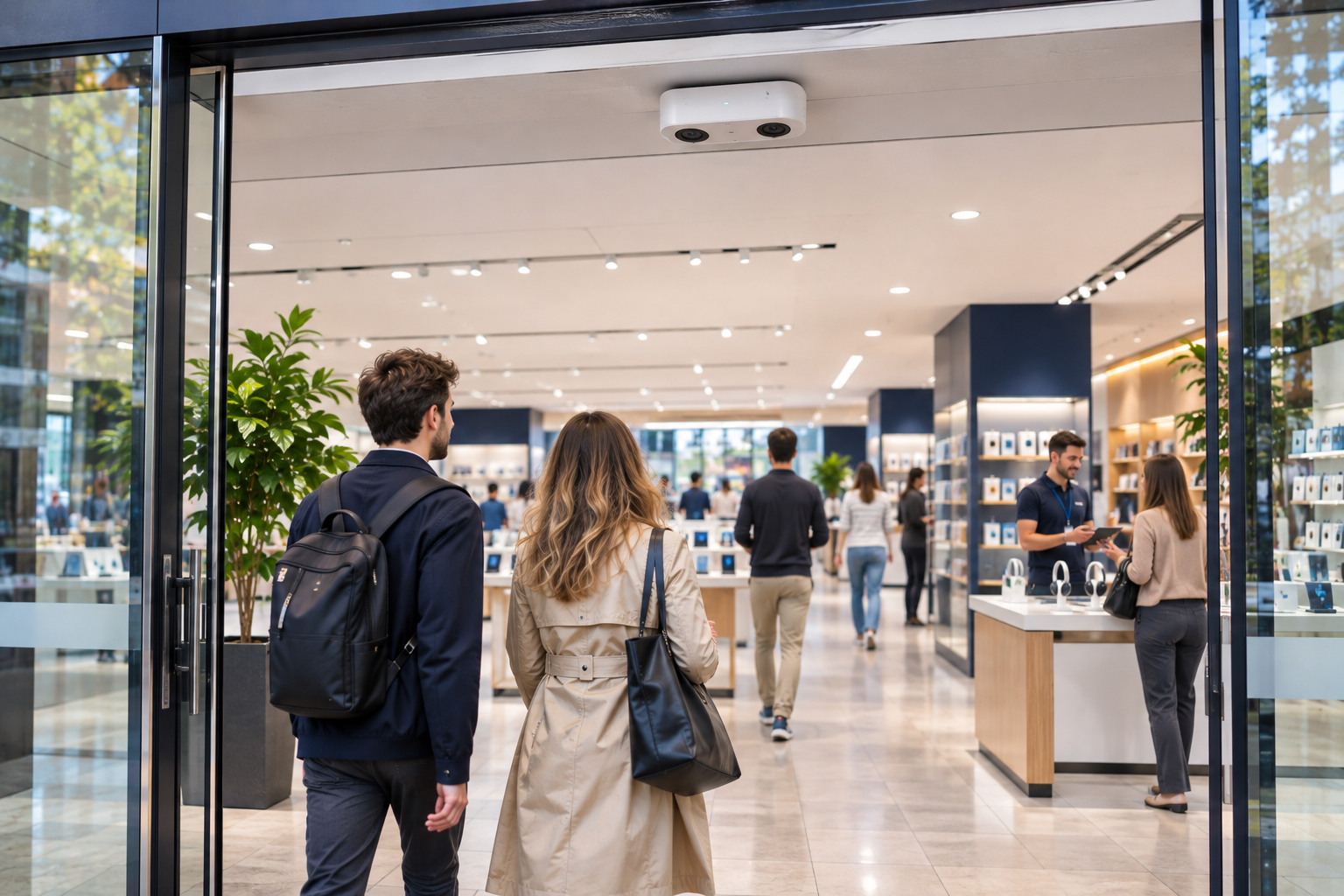
People counting systems in stores are technological solutions that measure visitors entering and exiting physical retail establishments, transforming customer traffic into analyzable data. While traditional store management uses sales turnover, transaction count, and number of items sold as key performance indicators, modern retail analytics adds visitor traffic to this data.
An increase in a store's turnover does not always mean it has gained more customers. Similarly, a drop in sales does not necessarily indicate a decrease in customer interest. Evaluating visitor traffic alongside sales data helps to interpret changes in store performance more accurately.
The fundamental value of people counting systems in stores is not merely to show how many people entered the store, but to be able to link visitor traffic with sales conversion, customer experience, staff planning, and operational efficiency.
What Do People Counting Systems Do in Stores?
Store people counting systems measure visitor movements via sensors placed at entry and exit points and transfer this data to local or central reporting software.
Depending on the technology and software features used, the following indicators can be obtained:
Hourly, daily, weekly, and monthly store visits.
People counts based on entry and exit directions.
Peak customer hours.
Branch visitor traffic performance.
Estimated real-time store occupancy.
Transaction-based sales conversion rate with POS integration.
Average sales revenue per visitor.
In-store regional density with appropriate additional analytical systems.
Traffic changes during campaigns and special periods.
People counting systems support different decision-making based on measured data. However, the number of entries generated by the device is not the same as the number of unique customers entering the store.
The same person entering the store multiple times can be recorded as multiple entries in standard counting.
For detailed information on sensor technologies, operating principles, and hardware selection, GüvenlikOnline's guide What is a Store Customer Counter? How Does It Work and How to Choose One? can be reviewed.
The Relationship Between Store Visitor Traffic and Sales Performance
When evaluating sales performance in retail businesses, visitor traffic and sales conversion rate should be examined together.
Different reasons may underlie a decrease in a store's turnover:
The number of visitors to the store may have decreased.
The sales conversion rate may have dropped while the number of visitors remained constant.
The average sales amount per transaction may have changed.
Product availability or stock status may have affected sales.
Campaigns, pricing, or in-store service conditions may have changed.
People counting systems do not directly measure all these factors. However, by correlating visitor data with sales results, they help identify certain discrepancies.
Example: Analyzing a Drop in Sales
Let's consider hypothetical data for a store across three different periods:
Indicator | Period A | Period B | Period C |
|---|---|---|---|
Store entries | 1,000 | 800 | 1,000 |
Sales transactions | 80 | 64 | 60 |
Transaction-based conversion | 8% | 8% | 6% |
In Period B, visitor traffic and sales transactions decreased at the same rate. The transaction-based conversion remained unchanged. This table primarily necessitates an examination of the drop in traffic volume to the store.
In Period C, despite the number of visitors remaining constant, the transaction-based conversion decreased. In this scenario, evaluating the in-store sales process, stock, staff capacity, or other operational conditions may be meaningful.
These examples alone do not establish a cause-and-effect relationship; they demonstrate how business data can be interpreted together.
How is the Sales Conversion Rate Calculated in Stores?
One of the key indicators used in retail analytics is the Sales Conversion Rate.
Transaction-based calculation is performed as follows:
Transaction-based conversion rate (%) = (Number of sales transactions / Number of store entries) × 100
For example, in a clothing store during one day:
Store entries: 1,500
Sales transactions: 90
Net sales turnover: 180,000 TL
let's assume.
In this case:
Transaction-based conversion = (90 / 1,500) × 100 = 6%
Turnover per visitor entry:
180,000 TL / 1,500 = 120 TL
Average transaction amount:
180,000 TL / 90 = 2,000 TL
These indicators provide different information to store management.
While the conversion rate shows the ratio of sales transactions to store entries, turnover per visitor measures the relationship between total revenue and entry traffic.
However, these calculations have significant limitations. One person might make multiple sales transactions, a single family might complete one transaction, or some individuals might enter the store multiple times within a day.
Therefore, the transaction-based conversion rate should not be presented as the exact ratio of unique visitors who made a purchase.
Which KPIs Do Store People Counting Systems Provide?
A properly configured people counting system can provide data for calculating various performance indicators in retail businesses.
KPI | Calculation / Data Source | Management Use |
|---|---|---|
Visitor Traffic | Entry count | Monitoring demand directed to the store |
Transaction-based conversion | Sales transactions / Entry count | Sales performance |
Turnover per visitor | Net turnover / Entry count | Relationship of traffic to revenue |
Average transaction amount | Net turnover / Transaction count | Sales basket performance |
Peak hours | Hourly entry count | Staff planning |
Regional visit density | Additional regional analytics | Evaluation of store areas |
Estimated real-time occupancy | Entry-exit balance | Monitoring space utilization |
Branch traffic change | Comparable period counts | Chain store management |
Not all these indicators can be obtained solely from an entry sensor. Additional data sources and integrations are required, especially for sales, product zone, and transaction amount analyses.
Peak Hour Analysis and Staff Planning in Stores
Customer traffic in stores is not constant throughout the day. Different densities can occur during lunch hours, evenings, weekends, and campaign periods.
People counting systems provide data for staff planning by showing the hourly distribution of visitor traffic.
Planning Sales Staff at the Right Hours
For example, if a store's visitor traffic is concentrated between 17:00 and 20:00, the working hours of sales associates can be evaluated considering this information.
However, planning shifts based solely on visitor count is not sufficient.
The store's product category, customer engagement time, cashier operations, stock operations, and staff task distribution should also be taken into account.
Density in Cashier and Service Areas
Entry counting indicates the store's overall visitor load. However, it does not directly measure the number of people waiting at the cashier.
If cashier queue analysis is desired, additional queue detection, waiting time measurement, or appropriate camera-based analytical solutions may be required.
Therefore, store entry traffic, cashier density, and customer waiting time are distinct performance indicators.
How Are Customer Behaviors Analyzed Within the Store?
Entry and exit counting does not show visitors' movements within the store in detail.
In addition to entry sensors, in-store analytics technologies can be used to evaluate customer behavior.
Regional Visitor Density
In clothing, technology, furniture, or cosmetics stores, the visitor density of different product areas can be analyzed.
With appropriate analytical systems, the number of visitors passing through or present in specific product sections can be evaluated.
However, regional density and product sales performance are not the same concept.
Heatmap and Space Utilization
In-store heatmaps, with appropriate sensor and software infrastructure, can show areas where visitors are concentrated.
This data can help in evaluating product placement, display layout, and aisle utilization.
It should not be assumed that a single people counting device placed at the store entrance will generate a detailed heatmap for the entire store.
Visit Duration Analysis
The time spent in specific areas can be measured or estimated using appropriate tracking or regional analytical methods.
However, a long visit duration does not always imply high customer satisfaction or purchase intent.
Especially in furniture and technology stores, product evaluation time may differ from supermarkets or stores where quick shopping is done.
Use of People Counting Systems in Different Store Types
Not all stores in the retail sector exhibit the same visitor behavior. Therefore, commercial indicators derived from people counting data should be evaluated according to the store type.
Clothing and Footwear Stores
In clothing stores, entry traffic, sales transactions, and the use of fitting rooms can be evaluated together with appropriate additional data.
Identifying peak hours can support sales associate and cashier planning.
Technology and Electronics Stores
In electronics stores, customers can experience smartphones, computers, or other products before purchasing them.
Therefore, evaluating the density of product experience zones along with entry traffic can be beneficial.
However, visiting a product experience zone does not directly imply purchase intent.
Grocery Stores and Supermarkets
In grocery stores, visitor density can be used for planning cashier capacity, peak hours, and shopping operations.
Since high entry counts and short visit durations can be observed together in grocery stores, the sensor's performance under high traffic conditions is crucial.
Furniture and Home Decor Stores
In furniture stores, visitors may stay for extended periods to evaluate different product groups.
In such businesses, in addition to the total number of entries, regional visits, customer consultation, and the length of the sales cycle should be considered.
Jewelry and Luxury Retail Stores
In luxury retail stores, even if the number of visitors is relatively low, the sales amount per transaction can be high.
Therefore, store performance should not be evaluated solely based on total traffic.
Visitor count, transaction-based conversion, customer service process, and average transaction amount should be examined together.
How Should Store People Counting Technologies Be Compared?
In retail businesses, technologies such as IR beam sensors, 2D video analytics, 3D stereoscopic, and ToF depth sensors can be used.
Technology | Main Advantage | Technical Limitation |
|---|---|---|
IR beam counter | Simple passage measurement | May struggle to differentiate people passing side-by-side |
2D AI video analytics | Various analysis possibilities with suitable cameras | Perspective, occlusion, and lighting conditions |
3D stereoscopic | Depth-based person differentiation | Mounting height and sensor coverage |
ToF sensors | Distance/depth-based detection | Range and environmental conditions |
High counting accuracy cannot be determined solely by the technology name. Different manufacturers and models within the same technology class may have varying performance characteristics.
The final evaluation should be made based on the store's entrance structure, visitor density, budget, data requirements, and field tests.
How Are People Counting Systems Integrated with POS and ERP?
For people counting data in stores to generate commercial value, evaluating it together with sales data is an important step.
POS (Point of Sale) systems record sales transactions, while people counting sensors measure visitor entries.
In an appropriate integration architecture, these two data sources can be combined on the same reporting platform.
Things to Check During Integration
Correct matching of store and branch codes.
Time synchronization of sensor and POS systems.
Separation of sales transaction count from the number of items sold.
Calculation logic for cancellations and returns.
Reporting rules for online orders and in-store pickups.
Whether staff entries should be included in visitor data.
Management of interruptions, retransmissions, and lost records in data transfer.
API connections, access permissions, and data security.
Especially in multi-branch stores, it is important to report different data sources with common definitions.
If staff entries are excluded from visitor traffic in one branch but not in another, the conversion rates of these two stores should not be directly compared.
Centralized People Counting and Reporting in Chain Stores
One of the important applications of people counting systems in chain retail businesses is monitoring traffic data from different locations through a common platform.
Thanks to a centralized reporting system, store managers and headquarters teams can make the following comparisons:
Branch-specific visitor traffic.
Previous period performance of the same store.
Weekday vs. weekend density differences.
Branch-specific transaction conversion rates.
Regional visitor traffic trends.
Traffic changes during campaign periods.
Sensors generating incomplete data or disconnected.
However, ranking stores solely based on absolute visitor numbers can be misleading.
For example, the entry traffic of a store inside a shopping mall versus a store on a street may differ due to their locations and operating hours.
Store concept, sales area, opening hours, location, and previous period conditions should be considered in comparisons.
Why is Counting Accuracy Important in Store People Counting Systems?
Inaccurate data generated by a people counting system also affects the commercial indicators calculated with this data.
For example, if a sensor records only 900 entries in a store where 1,000 entries actually occurred, the calculated conversion rate might appear higher than it is, even if the number of sales transactions remains unchanged.
Therefore, when setting up the system, it is crucial to check not only whether the sensor is working but also how accurately it measures actual passages.
Accuracy Test and Validation
During validation, the sensor's entry and exit data can be compared with manual reference counts.
Simple total absolute counting error:
Error rate (%) = |Sensor count − Reference count| / Reference count × 100
This indicator measures the total numerical difference.
However, since overcounts and undercounts can balance each other out, a low total error rate does not prove that all passages are accurately detected.
Therefore, the following conditions should be examined separately during evaluation:
Entry and exit directions.
Single and group passages.
Peak and quiet hours.
Children and strollers.
Visitors waiting at the entrance or turning back.
Staff movements.
Doors and physical obstacles affecting the sensor's field of view.
Axis Communications' AXIS People Counter documentation describes methods for accuracy testing with manual reference passages and improving device settings.
However, test values described in manufacturer documentation should not be used as a universal accuracy guarantee for all people counting devices.
How Are Staff Movements Differentiated?
Frequent entry and exit by staff in stores can affect visitor data.
In suitable systems, using separate routes for staff, special identification methods, or supported staff exclusion features can be considered.
Technical documents published by FootfallCam explain that staff exclusion results should be independently verified.
Therefore, the device having a staff differentiation feature does not mean that all employee movements are automatically and flawlessly excluded.
Data Integrity, Calibration, and Periodic Maintenance
After a people counting system is installed, the accurate operation of the sensors needs to be monitored long-term.
The following checks are particularly important in chain store applications:
Device connection status: Whether sensors are connected to the network and their last data transmission time should be monitored.
Data continuity: The devices' ability to store data locally during network outages and transmit it when the connection is re-established should be checked.
Time synchronization: It must be ensured that POS and visitor data are evaluated within the same time intervals.
Installation changes: Changes in the display layout at the entrance or the door system can affect counting performance.
Periodic validation: The system's performance should be re-checked at regular intervals with manual reference counts.
Alarm and reporting: Devices that do not generate data, send unexpected values, or are disconnected should be detectable.
Especially, the reliability of traffic data used in commercial decisions for different branches depends not only on the initial installation accuracy of the devices but also on long-term data integrity.
How is the Return on Investment for People Counting Systems in Stores Evaluated?
When evaluating the commercial contribution of a people counting system, one should not look solely at the device price.
Total investment cost may include:
Sensors and other hardware.
Installation and cabling.
Reporting software and licenses.
POS and ERP integration.
Calibration and validation.
Periodic maintenance and technical support.
In evaluating the investment, the impact of operational decisions made as a result of measuring visitor traffic can be examined.
For example, changes in staff planning, more accurate capacity planning during campaign periods, or improvements in conversion rates can be measured.
However, attributing the entirety of sales increase solely to the people counting system is not accurate.
In a sound ROI evaluation, a clear relationship must be established between the measured commercial results and the decisions implemented based on the data provided by the system.
Are People Counting Systems in Stores Compliant with KVKK?
The personal data processing status of people counting systems depends on the characteristics of the technology used.
A system that only generates aggregated entry-exit counts does not have the same data processing architecture as a system that records images or correlates individuals' movements.
Therefore, it should be examined whether devices used in stores process images, device identifiers, or other personal data.
In the Personal Data Protection Authority's statements regarding the use of security cameras in workplaces, principles such as clearly defining the data processing purpose, proportionality, data minimization, transparency, and data security are emphasized.
Especially in cases where employee movements are monitored, person re-identification (RE-ID) is used, or image recordings are utilized for other analyses, additional legal evaluation may be required.
In projects where only counting data is needed, solutions that prevent unnecessary personal data processing should be preferred.
People Counting System Selection Checklist for Stores
Before purchasing the system and completing installation, the following questions should be answered:
Have all store entries and exits been identified?
Have the KPIs to be reported been defined?
Have the entrance width and ceiling height been measured?
Does the sensor's detection area cover the entire entrance?
Has an accuracy test for group visitors been planned?
Has it been determined how staff movements will be handled?
Have POS or ERP integration requirements been verified?
Have store codes and reporting hours been matched?
Has entry and exit accuracy been checked with manual reference counting?
Has data storage behavior during network outages been tested?
Can device health status and malfunctions be monitored remotely?
Have personal data processing and access permissions been evaluated?
Has a maintenance, calibration, and re-validation plan been created?
This list is for preliminary technical evaluation of the system. Final product selection and capacity planning should be validated with actual store conditions.
Frequently Asked Questions About People Counting Systems in Stores
What does a people counting system do in stores?
It helps analyze customer traffic, peak hours, and visit trends by measuring visitors entering and exiting the store. Transaction-based sales conversion can be calculated in conjunction with POS data.
Do store customer counting systems increase sales?
They do not directly increase sales. However, by correlating visitor traffic with sales data, they support making staff planning, campaign evaluation, and other operational decisions measurable.
How accurately do store people counting systems count?
Accuracy varies depending on sensor technology, installation conditions, traffic density, and device settings. For reliable results, validation with manual reference counting should be performed in a real store environment.
Is a single people counting sensor sufficient for a store entrance?
Not always. Entrance width, mounting height, sensor's field of view, and visitor density determine the required number of sensors.
Does the people counting system also count staff?
It depends on the technology and configuration used. Some systems include staff exclusion methods, but these need to be validated in the field.
Can store people counting systems be integrated with POS?
It can be possible with appropriate software or API infrastructure. Transaction-based conversion can be reported by evaluating POS transaction counts and visitor entries within the same time intervals.
What determines the price of a store people counting system?
It varies based on sensor technology, number of entrances, installation conditions, software license, integration, data validation, and maintenance services.
Can a store people counting system identify unique customers?
Standard systems primarily count entry events. Unique visitor estimation or RE-ID functionalities require separate analytical features; their accuracy and personal data processing conditions should be evaluated separately.
Data-Driven Performance Management in Stores
People counting systems in stores enable physical retail businesses to transform visitor movements into measurable data.
When this data is evaluated together with sales transactions, store operations, and appropriate additional analytical solutions, more comprehensive analyses can be performed regarding sales conversion, customer density, staff planning, and branch performance.
However, using only a people counting sensor is not sufficient for reliable retail analytics.
Correct sensor selection, proper installation, manual accuracy testing, management of staff movements, POS integration, and long-term data integrity must be considered together.
The main goal for stores is not just to collect more data, but to be able to measure the results of business decisions with reliable data.