
Honeywell Fire Detection Systems: NOTIFIER, ESSER, and VESDA Solutions
Honeywell fire detection and alarm systems offer a broad portfolio, ranging from NOTIFIER, ESSER, Morley-IAS, and Gent control panels to System Sensor detectors, and Xtralis VESDA and FAAST aspirating smoke detection solutions. We technically examine their product families, EN 54 compliance, CLSS remote monitoring technology, application areas, and system selection criteria.
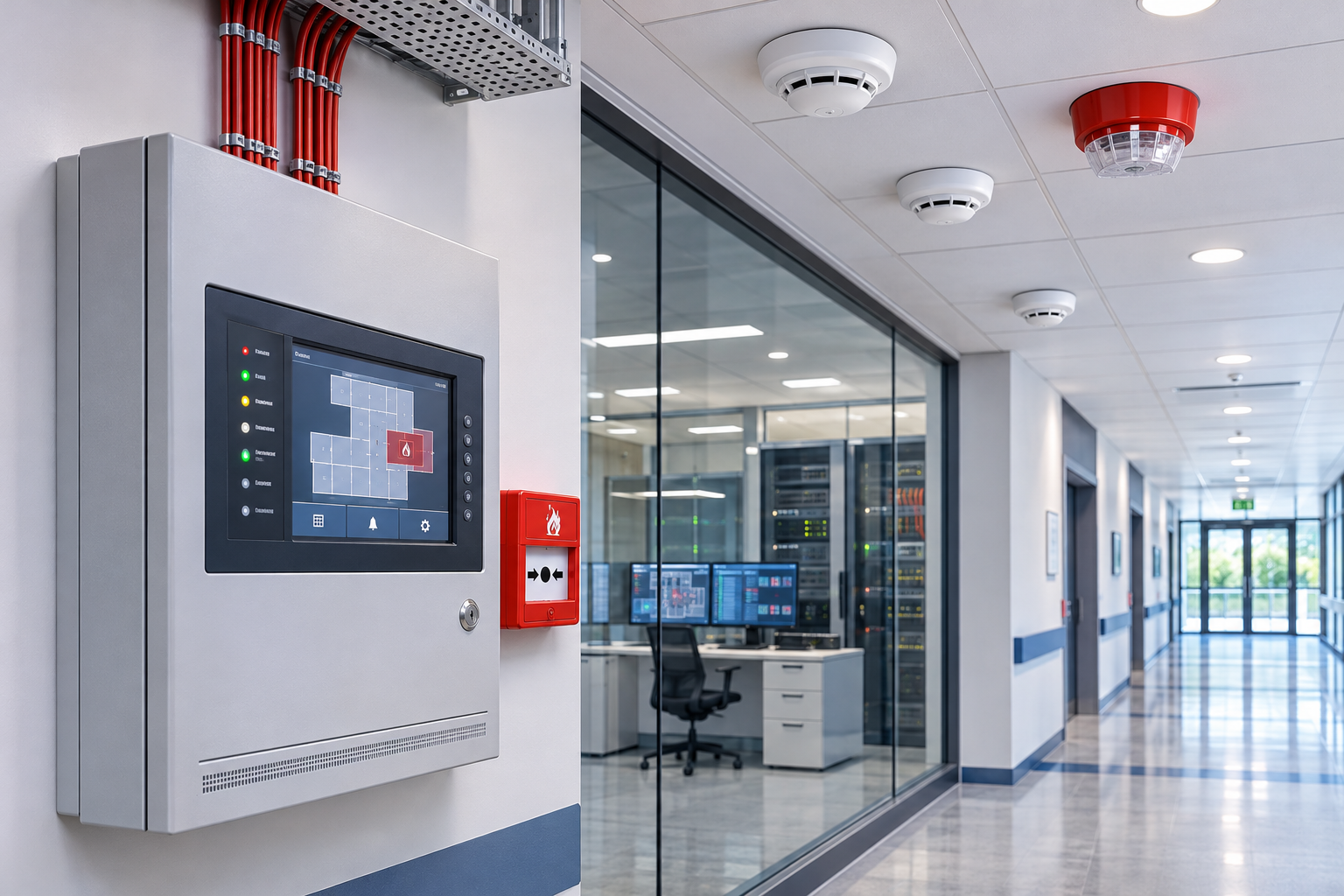
Honeywell fire detection systems consist of professional solutions developed for detecting signs of fire, managing alarm events, and initiating necessary safety scenarios in various structures, from residential buildings to commercial properties, hospitals to industrial facilities.
Honeywell's fire safety portfolio is not limited to a single brand or control panel family. Brands such as NOTIFIER, ESSER, Morley-IAS, Gent, System Sensor, and Xtralis offer diverse technologies in addressable fire alarm panels, multi-criteria detectors, aspirating smoke detection, voice evacuation, and central monitoring.
Alongside these products, digital services like Connected Life Safety Services (CLSS) can be utilized for remote monitoring of compatible fire systems and supporting maintenance processes.
However, not all fire detection products within Honeywell are directly compatible with each other. The control panel, detector communication protocol, regional certification, software version, and the system's intended use must be evaluated together.
To determine the correct Honeywell fire system, the risks of the structure to be protected and relevant regulatory requirements must first be defined, followed by the selection of the appropriate product family.
What are Honeywell Fire Detection Systems?
Honeywell is an international technology company operating in building automation, industrial control, and security technologies.
Fire detection and life safety solutions are one of the key product groups within Honeywell Building Automation.
Honeywell's fire safety products can be categorized as follows:
Fire alarm control panels: Centralized management of addressable and conventional fire systems.
Automatic fire detectors: Detection of signs such as smoke, heat, and carbon monoxide in suitable models.
Manual call points: User-initiated fire alarm activation.
Sounders and visual alarm devices: Generation of audible and visual warnings.
Aspirating smoke detection systems: Early smoke detection in appropriate areas.
Beam smoke detectors: Monitoring of large open spaces and high-ceiling areas.
Input/output modules: Connection of the fire system with other building equipment.
Voice alarm and evacuation solutions: Transmission of voice messages during emergencies.
Software and remote monitoring: Management of event, fault, and maintenance information.
Each product group has different technical requirements. For example, the performance of a point smoke detector used with a central fire panel cannot be evaluated by the same criteria as an aspirating system or an industrial flame detector.
Which Brands are Included in Honeywell Fire Systems?
Honeywell's fire safety product ecosystem includes brands tailored for different markets and application needs.
NOTIFIER: Professional Fire Alarm and Network Systems
NOTIFIER is one of Honeywell's professional fire detection and life safety brands.
Its product portfolio includes addressable and conventional fire alarm panels, automatic detectors, input/output modules, voice evacuation solutions, and networked systems.
NOTIFIER systems can be considered especially in projects requiring multiple fire zones, a high number of devices, or central management.
ESSER by Honeywell: Modular Fire Detection
ESSER stands out particularly with its modular control panels, addressable detectors, and integrated management solutions for fire alarm and voice evacuation functions.
The FlexES Control, IQ8Control, and IQ8Quad product families are part of the ESSER portfolio.
ESSER is one of the product brands featured on official Honeywell fire safety pages for the Turkish market.
Morley-IAS: Addressable Fire Detection Solutions
Morley-IAS offers control panels for various fire detection requirements, from small and medium-sized buildings to more comprehensive structures.
The DXc and MAX product families are options with different control panel architectures.
Some Morley-IAS panels are multi-protocol, supporting specific detector communication protocols.
However, it should not be assumed that all panels support the same device or protocol combinations.
Gent: Intelligent Detectors and Voice Alarm
Gent is one of Honeywell's fire detection and alarm product brands.
The Vigilon control panel family and S-Quad detector technology are Gent's prominent solutions.
The S-Quad product family, in suitable models, can combine different detection methods with audible or visual alarm features.
System Sensor: Fire Detection and Notification Devices
System Sensor offers products in smoke and heat detection, notification devices, and aspirating smoke detection technologies.
The FAAST solutions within its product family include options for aspirating smoke detection.
Xtralis: Early Smoke Detection
Xtralis is one of Honeywell's brands known for its aspirating smoke detection technologies.
Product families like VESDA and OSID are considered for early smoke detection in critical areas and monitoring large volumes.
When choosing among these brands, the commonality of the manufacturer group, country-specific product portfolio, certification, and technical compatibility of devices are important.
Honeywell NOTIFIER Fire Alarm Systems
NOTIFIER offers addressable fire alarm control panels and central management systems for facilities of various sizes.
The product portfolio includes the NOTIFIER INSPIRE platform and the ONYX system family.
NOTIFIER INSPIRE Platform
NOTIFIER INSPIRE is a platform aiming to provide advanced fire detection, alarm event management, and building security functions in an integrated structure.
According to Honeywell's announcement published on June 23, 2026, new smoke control features have been added to the NOTIFIER INSPIRE platform.
The manufacturer states that the new features can contribute to more integrated management of smoke control-related components, simplification of system design, and easier maintenance processes.
However, this development does not mean that all existing systems using the INSPIRE platform automatically support the new functions.
The control panel, software version, relevant interfaces, and regional approvals must be checked.
NOTIFIER ONYX Systems
NOTIFIER ONYX is a control panel family for addressable fire detection, network communication, and central event management.
NOTIFIER's product history includes large-scale fire alarm control panels such as the NFS2-3030.
In this architecture, it is possible to manage fire alarms, faults, and system events via appropriate devices.
However, when selecting devices for ONYX systems, the detector protocol, loop card, and the control panel's hardware and software version must be evaluated together.
NOTIFIER SWIFT Wireless Detection
SWIFT is a wireless fire detection technology used with compatible NOTIFIER products.
The manufacturer states that SWIFT systems utilize a mesh network architecture.
This approach can offer an option for areas where traditional cabling is difficult in suitable applications.
However, in wireless detection systems, radio coverage, device power requirements, communication redundancy, and relevant regional standards must also be evaluated.
The fact that certain NOTIFIER products are UL-approved does not automatically mean that these products meet European EN 54 or Turkish TS EN 54 requirements.
ESSER by Honeywell Fire Detection Systems
The ESSER product family includes modular fire alarm panels and addressable detectors with different sensor structures.
ESSER FlexES Control
FlexES Control is a family of fire alarm control panels with a modular hardware and software architecture.
Honeywell's official product description for Turkey specifies a system architecture for FlexES Control that can support up to 18 loops.
This value represents the upper capacity applicable in suitable configurations.
Key features of the FlexES Control platform:
Modular control panel structure.
System components expandable as needed.
Multi-panel configuration with supported network modules.
Management of addressable devices and alarm events.
Fire safety integrations in suitable systems.
In a new FlexES project, in addition to panel capacity, the loop current budget, module compatibility, cable infrastructure, and future expansion needs of the system must be calculated.
ESSER IQ8Control
IQ8Control is one of ESSER's addressable fire detection control panel families.
According to the manufacturer's documents, IQ8Control offers compatibility features with certain older System 8000 panels via the essernet network.
This can be considered for modernizing existing ESSER infrastructures.
However, supporting network connection with previous generation control panels does not mean that all detectors and modules can be transferred to the new system without replacement.
essernet Communication Network
essernet is a network technology developed for connecting compatible ESSER control panels.
Manufacturer documents state that essernet supports a resilient ring network architecture against specific faults such as line breaks and short circuits.
Depending on the appropriate network modules, common event management can be performed for multiple panels.
However, network topology, communication distance, and the number of panels must be verified according to the modules used.
ESSER IQ8Quad Multi-Sensor Fire Detectors
IQ8Quad is ESSER's family of addressable detectors developed to detect different fire indicators.
The series includes optical smoke, heat, and in certain models, carbon monoxide detection functions.
Some IQ8Quad devices also offer integrated voice alarm features in addition to detection functions.
How Does Multi-Criteria Detection Work?
In multi-criteria detectors, information obtained from different sensors is evaluated together.
For example, in a suitable detector, smoke formation and temperature change can be analyzed together to support an alarm decision.
This approach can help differentiate some environmental effects from actual fire indicators.
However, the use of multi-sensor detectors does not mean that the risk of false alarms is completely eliminated in every environment.
IQ8Quad Detector Examples
The official ESSER product registrations in Turkey include the following models:
Model | Detection approach |
|---|---|
IQ8Quad 802371 | Optical smoke detection |
IQ8Quad 802373 | Optical and heat detection |
IQ8Quad 802374 | Dual optical and heat detection |
IQ8Quad 802473 | Smoke, heat, and CO detection |
The detection methods supported by the detector should be evaluated according to the application area and the actual fire risk.
For example, a fire detector with a CO sensor should not be assumed to directly replace all types of independent gas detection requirements.
Morley-IAS Fire Alarm Panels
The Morley-IAS product portfolio offers control panel options for fire detection systems of different scales.
Morley-IAS DXc
DXc is the manufacturer's fire alarm panel family developed for small and medium-sized structures.
Honeywell's product descriptions for DXc include one, two, and four-loop panel options.
However, it is an important detail that the DXc product family is marked as discontinued in some regional Honeywell catalogs.
Therefore, for maintenance and modernization of existing DXc systems:
The full part number of the product.
Country-specific supply status.
Supported detector protocol.
Spare parts and firmware support.
Alternative control panel to be used.
must be checked.
Morley-IAS MAX
MAX is Morley-IAS's control panel family developed for more comprehensive addressable fire detection systems.
The manufacturer's technical documents include MA-1000, MA-2000, and MA-8000 models.
The system architecture includes a touchscreen user interface, modular expansion, and in certain product combinations, the ability to create a panel network via CAN bus.
The capacities of these panels vary by model.
When selecting MAX systems, not only the number of loops but also network capacity, supported detectors, alarm outputs, and application software should be evaluated together.
Gent Vigilon and S-Quad Fire Detectors
Gent is one of Honeywell's product brands in the field of addressable fire detection.
The Vigilon control panel family and S-Quad detectors can be evaluated together in suitable projects.
S-Quad Technology
The S-Quad product family includes features such as smoke, heat, and in certain models, CO detection.
The manufacturer states that some S-Quad models perform optical scattering measurements from different angles.
The purpose of this approach is to help better differentiate actual smoke indicators from misleading effects such as water vapor or dust.
Some models can combine multiple functions on the same device:
Automatic fire detection.
Audible alarm.
Visual alarm.
Voice message functions in supported versions.
S-Quad Self-Test
Certain S-Quad Self-Test models from Gent feature technology that supports test and monitoring functions defined by the manufacturer.
However, for the Self-Test feature to be usable, a compatible Vigilon control panel, necessary software versions, and relevant CLSS components may be required.
Automatic detector testing does not eliminate the need for physical inspection and periodic maintenance obligations for the entire system.
Xtralis VESDA: Aspirating Early Smoke Detection
Xtralis VESDA is one of Honeywell's important technology families for early smoke detection.
VESDA systems take air samples from the protected area via pipes and perform analysis in a central detection unit.
This method can be used to provide early smoke warning in suitable environments and support the protection of specific critical volumes.
VESDA-E VEP
VESDA-E VEP is one of the piped aspirating smoke detection systems.
It can be evaluated in specific technical volumes and suitable industrial environments.
VESDA-E VEA
VESDA-E VEA is a system designed for individually defining sampling points.
The manufacturer offers options for monitoring up to 40 sampling points in this architecture.
This feature can be particularly valuable in applications where it is important to distinguish which sampling point a fire indicator originated from.
VESDA-E VES
VESDA-E VES offers a solution for sector-based monitoring of multiple air sampling lines.
This approach can simplify evaluation in applications where multiple zones need to be monitored.
Critical Parameters in VESDA Selection
In VESDA systems, project conditions should be evaluated before device sensitivity.
Length of air sampling pipes.
Placement of sampling holes.
Air transport time.
Detection class.
Filtering and contamination conditions.
Monitoring of airflow faults.
Maintenance access.
Especially the detection class supported under the EN 54-20 standard should be examined along with the product's test and design conditions.
A high-sensitivity VESDA device may not provide the expected early warning performance due to an unsuitable pipe network design.
System Sensor FAAST Aspirating Detection
FAAST is an aspirating smoke detection technology within the System Sensor product ecosystem.
FAAST FLEX and certain FAAST products can be evaluated for technical volumes of different sizes.
According to the manufacturer's official page, FAAST FLEX is an aspirating detection solution offered with single or dual-channel versions.
Application areas include electrical rooms, small and medium-sized warehouses, cold storage facilities, elevator shafts, and specific technical volumes.
The manufacturer also publishes product compliance information for FAAST FLEX under EN 54-20.
What is the Difference Between FAAST and VESDA?
Both product families use aspirating detection technology.
However, their device structure, sampling line capacity, detection class, networking, and maintenance features differ.
Therefore, selection between the two systems should not be made based solely on brand name or sensitivity claims.
Comparison of Honeywell Fire Detection Technologies
Honeywell's different product families are not direct alternatives for the same technical need.
Product family | Primary function | Critical selection criterion |
|---|---|---|
NOTIFIER | Fire alarm panel and network system | Panel, protocol, certification, and integration |
ESSER FlexES / IQ8Control | Modular fire control | Loop, module, essernet compatibility |
Morley-IAS | Fire alarm control panels | Scale, product generation, and detector support |
Gent Vigilon / S-Quad | Addressable detection and notification | Panel, detector, and function compatibility |
System Sensor FAAST | Aspirating detection | Pipe design, sensitivity class |
Xtralis VESDA | Early smoke detection | Sample transport, zone, and detection class |
Honeywell CLSS | Connected system monitoring and maintenance | Gateway, license, panel, and zone support |
This table compares the general functions of the products. It should not be assumed that all product families can be used together under the same country, project, or certification scope.
What is Honeywell CLSS? Remote Fire System Monitoring
CLSS (Connected Life Safety Services) encompasses Honeywell's connected monitoring, maintenance, and reporting services for compatible fire detection systems.
In supported systems, specific information from the fire alarm panel can be transmitted to the CLSS infrastructure.
What operations can be performed with CLSS?
Depending on the service used and device version:
Monitoring of fire system status information.
Viewing alarm and fault events.
Evaluation of device inventory.
Documentation of maintenance operations.
Planning of service activities.
Generation of specific reports.
may be possible.
The CLSS Gateway acts as an interface between supported fire alarm panels and related connected services.
However, the availability of the product itself and the cloud service should be evaluated separately.
While some CLSS Gateway models are marked as discontinued in certain regional Honeywell product catalogs, relevant solutions continue to be listed in other regions.
Therefore, for new projects, the exact gateway model, software and subscription status, country-specific service coverage, and supported panel list must be verified.
The presence of CLSS does not mean that cloud connectivity replaces mandatory fire alarm functions. Life safety functions must be maintained locally in accordance with the approved system architecture.
Can Honeywell Fire Systems Be Integrated with Building Automation?
Honeywell's compatible fire alarm panels can connect with other building systems via supported interfaces.
In the event of a fire, the following functions can be considered within the scope of an approved cause-and-effect matrix:
Control of fire doors and door holders.
Scenarios related to smoke dampers and ventilation.
Transition of elevators to the relevant fire operating mode.
Activation of public address and voice evacuation systems.
Transmission of status information to the central building management system.
Monitoring of relevant extinguishing system statuses.
However, not all these functions are standard in every Honeywell panel.
Required interface modules, communication methods, system compatibility, and relevant safety requirements for the application must be checked.
Especially the triggering of automatic extinguishing systems should not be considered a general automation function that can be solved with a simple relay connection.
EN 54 Standards in Honeywell Fire Systems
In Turkey, one of the main legal bases for the design of fire detection and alarm systems is the Regulation on Fire Protection of Buildings.
Article 74 of the Regulation governs general requirements for fire detection and alarm systems and provisions for TS EN 54 compliance.
The main standards used in the technical evaluation of Honeywell fire systems are:
Standard | Technical scope |
|---|---|
EN 54-2 | Fire alarm control and indicating equipment |
EN 54-4 | Power supply equipment |
EN 54-5 | Point heat detectors |
EN 54-7 | Point smoke detectors |
EN 54-11 | Manual call points |
EN 54-13 | Compatibility and connectability of system components |
EN 54-17 | Short-circuit isolators |
EN 54-18 | Input/output devices |
EN 54-20 | Aspirating smoke detectors |
EN 54-23 | Visual alarm devices |
EN 54-16 | Voice alarm control and indicating equipment |
The current consolidated record of the EN 54-13 standard in Europe has been published as EN 54-13:2017+A1:2019. For EN 54-20:2006, there is an AC:2008 amendment.
CEN/TS 54-14 serves as a guide for the planning, design, installation, commissioning, use, and maintenance of systems.
In applications in Turkey, the current versions accepted by TSE must also be checked.
Having EN 54 compliance for a Honeywell product does not mean that devices from different Honeywell brands can operate on the same panel.
Product compatibility, communication protocol, certification, and the system's approved component list must be taken as a basis.
In Which Facilities Can Honeywell Fire Systems Be Preferred?
Honeywell's various fire detection technologies can be evaluated in different types of structures.
Application area | Technology to be considered | Primary requirement |
|---|---|---|
Office buildings | Addressable panel and point detectors | Zonal detection and management |
Hospitals | Networked systems, multi-criteria detection | Alarm reliability and continuity |
Shopping malls | Modular panels and voice alarm integration | Large capacity, evacuation scenarios |
Factories | Environmentally suitable detectors, special detection | Dust, temperature, and process risks |
Data centers | VESDA or suitable FAAST solutions | Early smoke detection |
Logistics warehouses | Suitable ASD or beam detectors | High ceilings, large volumes |
Campuses | Networked control panels | Multi-building and central event management |
Electrical rooms | Suitable point or aspirating detection | Early warning and technical access |
These selections are not direct product prescriptions to be applied.
For example, when considering aspirating detection in a data center, airflow, sampling points, and other relevant fire safety requirements must be evaluated together.
For detailed information on the selection criteria for different technologies, GüvenlikOnline's technical guide titled How to Determine the Right Fire Detection Solution for Factories? can be reviewed.
What to Consider When Choosing a Honeywell Fire Detection System?
1. Determine the fire risk of the structure
Detector and control panel selection should be made according to the fire hazards in the protected area.
The same detector solution may not be suitable for an office, an electrical room, or a dusty production area.
2. Verify the regional suitability of the product family
Honeywell's NOTIFIER, ESSER, Gent, and other brands have different regional product portfolios.
The compliance of products to be used in Turkey with relevant TS EN standards, national regulations, and project requirements must be checked.
3. Examine control panel and detector protocols
Devices from the same manufacturer group may use different communication protocols.
Therefore, it should not be assumed that detectors from different brands or generations will work together with one panel.
4. Perform loop and power calculations
In addressable fire systems, the number of devices, loop current, cable distance, voltage drop, power supply, and backup battery capacity must be calculated together.
5. Verify detection performance according to site conditions
Especially in aspirating systems like VESDA and FAAST, pipe design and sample transport time are important.
6. Define integration requirements
Connections with fire doors, elevators, ventilation, extinguishing, and public address systems should be planned via an approved cause-and-effect matrix.
7. Evaluate remote monitoring and cybersecurity
If connected services like CLSS are to be used, network access, data communication, administrator privileges, and update processes must be defined.
8. Check the product lifecycle
Especially in the modernization of existing facilities, old control panels, detectors, licenses, and spare parts support must be examined.
It should not be assumed that discontinued products and newly launched products have the same technical and commercial conditions.
Technical Checklist for Honeywell Fire Systems
The following list can be used before procurement and project planning:
- Are the fire risks of the protected areas defined?
- Is the availability of the Honeywell product family in Turkey verified?
- Is control panel and detector protocol compatibility checked?
- Are the relevant EN 54 and TS EN documents reviewed?
- Are loop capacity and cabling calculations performed?
- Is backup power capacity calculated?
- Are detector installation and environmental conditions evaluated?
- Are pipe and sample transport calculations prepared for ASD systems?
- Is the placement of sounders and visual alarm devices planned?
- Is the integration of the fire panel with other building systems defined?
- Is the model and regional compatibility of services like CLSS checked?
- Are software, firmware, and product lifecycle evaluated?
- Are commissioning and functional tests planned?
- Are periodic maintenance and technical service responsibilities defined?
This checklist is for technical evaluation purposes. It does not replace the necessary engineering evaluations for final project design and regulatory compliance.
For more comprehensive information on post-installation maintenance and verification procedures, GüvenlikOnline's article titled How to Perform Periodic Maintenance on Fire Detection Systems? can be reviewed.
Frequently Asked Questions
Which brands do Honeywell fire alarm systems cover?
Honeywell's fire safety portfolio includes brands such as NOTIFIER, ESSER, Morley-IAS, Gent, System Sensor, and Xtralis. Product families are developed for different system architectures and regional markets.
What is the difference between NOTIFIER and ESSER?
Both brands offer fire detection and alarm solutions. However, their control panels, detector communication protocols, network architecture, and certification structures may differ. It should not be assumed that a detector from one brand will automatically work with a panel from the other brand.
What is Honeywell VESDA?
VESDA is an aspirating smoke detection technology offered under the Xtralis brand. It can be considered for early warning and protection of critical technical areas in suitable projects.
Are VESDA and FAAST the same system?
No. Both product families use aspirating detection methods; however, their device architectures, sampling capacities, detection classes, and software features differ.
Do Honeywell fire systems work without internet?
Properly designed fire alarm panels can maintain local fire detection and alarm functions independently of an internet connection. However, cloud-based remote services like CLSS may require connectivity.
Are Honeywell fire systems EN 54 certified?
Honeywell's various brands have products certified under EN 54. However, certification must be evaluated according to the product model, function, and region of use. It cannot be assumed that all Honeywell products have the same approvals.
Does Honeywell CLSS replace periodic maintenance?
No. Connected services like CLSS can contribute to status monitoring and maintenance reporting in suitable systems. However, field tests, physical inspections, and maintenance procedures required by relevant regulations must be performed separately.
How to Determine the Right Solution in Honeywell Fire Systems?
Honeywell offers fire detection solutions for both standard building applications and special-risk industrial facilities with its diverse brands and technology families.
NOTIFIER, ESSER, and Morley-IAS control systems; Gent and System Sensor detectors; Xtralis VESDA and FAAST aspirating smoke detection solutions can be evaluated for different project requirements.
However, what is important in a successful fire safety project is not just choosing an advanced control panel or a high-sensitivity detector.
The correct system must be determined by evaluating fire risk, product compatibility, relevant standards, control panel capacity, building systems integration, and maintenance continuity together.
To examine product categories and technical hardware options from different manufacturers, GüvenlikOnline's Fire Alarm Systems Catalog can be used.
Sources
Honeywell Building Automation — Fire Detection and Alarm Systems — Honeywell's general fire safety product portfolio.
Honeywell Building Automation — NOTIFIER — Fire control panels, network systems, and wireless detection solutions.
Honeywell — June 23, 2026 Fire Safety Product Announcement — NOTIFIER INSPIRE smoke control and connected life safety innovations.
Honeywell Fire Safety Turkey — Fire Detection Systems — ESSER and Morley-IAS product families.
Honeywell Fire Safety Turkey — ESSER Control Panels — FlexES Control and IQ8Control features.
Honeywell Fire Safety Turkey — IQ8Quad Multi-Sensor Detector — Multi-criteria fire detection features.
Honeywell — Morley-IAS DXc — DXc panel family and system architecture.
Honeywell — Gent S-Quad — Multi-criteria detection and integrated notification features.
Honeywell — Xtralis — VESDA and OSID detection technologies.
Honeywell — FAAST FLEX — Aspirating detection and product compliance.
Honeywell — CLSS Gateway — Connected monitoring infrastructure for fire systems.
T.C. Ministry of Justice — Regulation on Fire Protection of Buildings — Fire detection and alarm requirements in Turkey.
EVS — EN 54-13:2017+A1:2019 — Compatibility of fire system components.
EVS — EN 54-20:2006 — Aspirating smoke detectors and related amendment.