
Bosch Fire Detection Systems: AVENAR, AVIOTEC, and Smart Fire Solutions
Bosch fire detection systems encompass AVENAR 2000 and 8000 addressable panels, multi-sensor detectors, AVIOTEC video-based fire detection, and remote monitoring solutions. We examine Bosch's LSN improved, Intelligent Signal Processing, AVENAR IO, and NEXOSPACE technologies, including their application areas, technical specifications, integration capabilities, and system selection criteria.
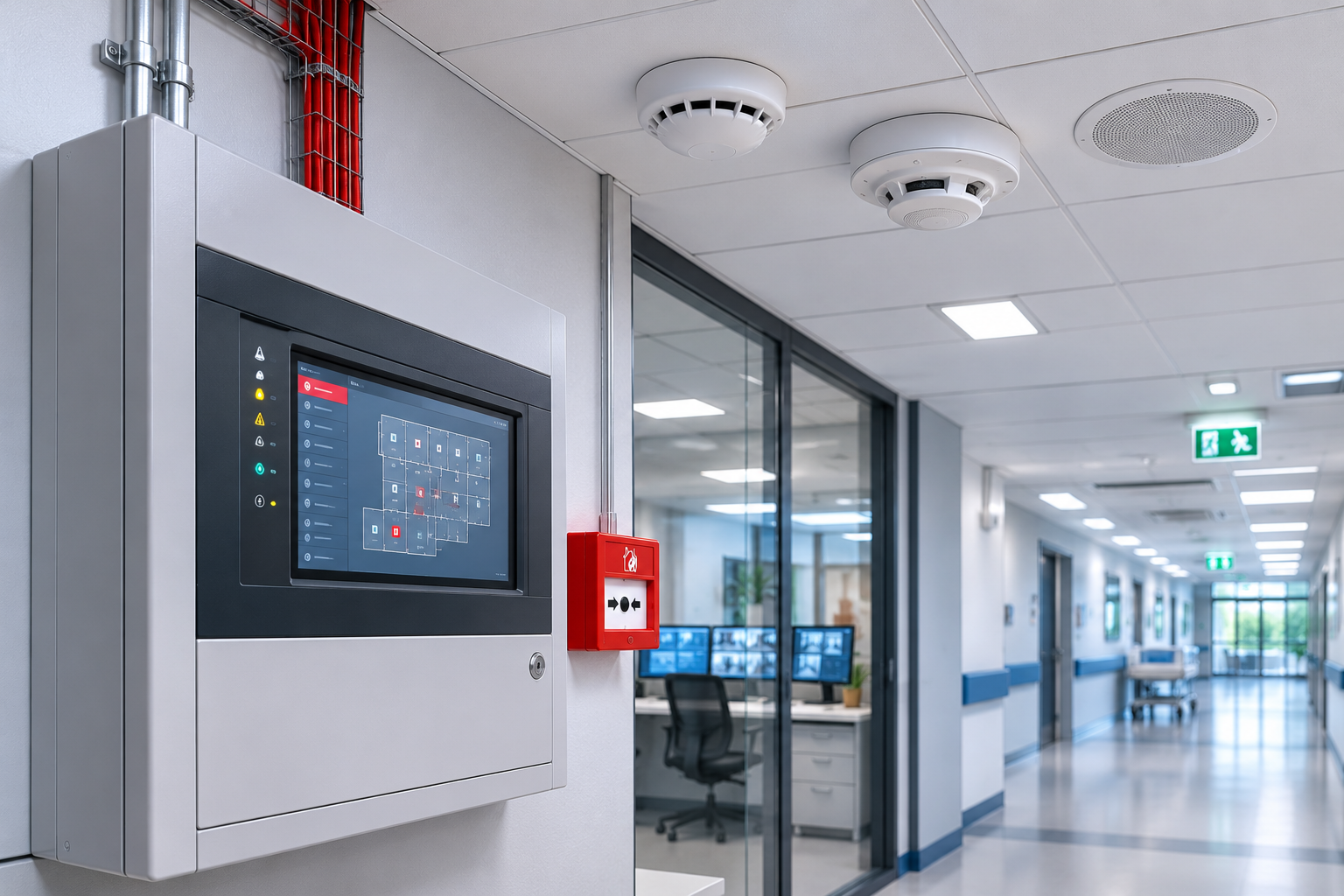
Bosch fire detection systems are electronic fire safety solutions developed for detecting fire indicators, managing alarm events, and coordinating the operation of related security systems in buildings and industrial facilities.
Bosch's fire safety portfolio encompasses various technologies, from addressable and conventional fire alarm panels to smart smoke and heat detectors, and from aspirating smoke detection systems to video-based fire detection cameras.
Key product families of the brand include AVENAR panel 2000 and 8000, AVENAR detector 4000, AVIOTEC 8000i IR, AVENAR IO modules, and NEXOSPACE Fire System Explorer.
These products have been developed to address various fire risks, building sizes, and operational requirements.
However, not all Bosch fire detection systems possess the same technical capacity, communication architecture, or application features. The correct solution must be determined not only by product specifications but also by fire risk, building usage, relevant standards, and the overall system design.
What Are Bosch Fire Detection Systems?
Bosch is one of the international manufacturers that develops products for buildings of various scales in fire detection and alarm technologies.
The company's fire safety solutions are offered within the Life Safety Systems product portfolio of Bosch Building Technologies.
The primary objective of Bosch fire detection systems is to detect early signs of fire and initiate the necessary alarm and safety scenarios.
A typical system may consist of the following components:
Fire alarm control panel: Evaluates information received from detectors and other devices.
Automatic fire detectors: Detect smoke, heat, or other supported fire indicators.
Manual call points: Allow users to manually initiate a fire alarm.
Sounders and visual alarm devices: Alert occupants in case of fire.
Input/output modules: Establish control and monitoring connections between the fire alarm system and other building equipment.
Special detection devices: Offer solutions for applications such as aspirating smoke detection, beam-type detection, or video-based fire detection.
Monitoring and maintenance software: Facilitates status tracking, fault monitoring, and service operations in supported systems.
The combined operation of these components can ensure that the fire detection system not only raises an alarm but also manages relevant building systems according to predefined scenarios during a fire event.
Bosch AVENAR Fire Alarm Control Panels
In Bosch's current fire alarm control panel family, AVENAR panel 2000 and AVENAR panel 8000 stand out.
Both series are developed for the central management of addressable fire detection systems.
The modular structure, communication capabilities, and varying capacities supported by the panels allow them to be considered for projects of different sizes.
Bosch AVENAR Panel 2000
AVENAR panel 2000 is a compact and modular control panel designed for small to medium-scale fire detection applications.
According to the manufacturer's official technical descriptions, it can offer up to four detection loops and a capacity of up to 1,016 devices in suitable configurations.
This capacity depends on the limits of the panel's specific model and system configuration.
Applications where it can be considered:
Offices and commercial buildings.
Medium-sized accommodation facilities.
Educational institutions.
Specific warehouse and production areas.
Commercial facilities with multiple detection zones.
AVENAR panel 2000 can operate with other compatible panels via network connection in supported configurations.
However, when calculating panel capacity, not only the number of detectors but also loop modules, current consumption, cable lengths, and other system components must be considered.
Bosch AVENAR Panel 8000
AVENAR panel 8000 is a modular control panel solution for more extensive fire detection projects.
According to Bosch's product descriptions, it offers an architecture expandable up to 46 modules and 32 detection loops in suitable configurations.
AVENAR 8000 can be considered for applications involving multiple buildings, a high number of detectors, or complex security scenarios.
Example application areas:
Shopping centers.
Hospitals.
Airports.
University campuses.
Industrial facilities.
Logistics centers.
Large commercial complexes.
In large projects, the networked operation of multiple panels can help centralize event monitoring and manage different building sections.
However, network connectivity and multi-panel system design must comply with the manufacturer's supported topology and project requirements.
AVENAR 2000 vs. AVENAR 8000 Comparison
Technical criterion | AVENAR 2000 | AVENAR 8000 |
|---|---|---|
System architecture | Compact modular | Extensive modular |
Detection loops | Up to 4 | Up to 32 |
Module capacity | Up to 6 | Up to 46 |
Prominent project scale | Small and medium | Medium and large |
Network connectivity | In supported configurations | Modular network architecture |
Expansion approach | More limited physical capacity | More extensive expansion |
The values in the table represent the upper capacity information declared by Bosch for its product family. The actual number of supported devices and loops in a real project must be calculated based on licenses, modules, firmware, and system configuration.
Instead of opting for the highest capacity when selecting a panel, both current needs and future expansion requirements should be considered together.
Bosch AVENAR Detector 4000: Smart Fire Detectors
AVENAR detector 4000 is Bosch's family of automatic detectors supporting a multi-sensor fire detection approach.
The product series utilizes optical, thermal, and in certain models, gas detection features for evaluating different fire indicators.
The combined evaluation of these sensors can help interpret fire indicators more meaningfully in suitable applications.
What is Intelligent Signal Processing (ISP)?
Bosch's Intelligent Signal Processing (ISP) technology aims to analyze data received from detectors using advanced evaluation methods.
According to the manufacturer's statements, the AVENAR detector 4000 family uses a signal processing approach based on over 4,000 fire patterns.
This number is technology information declared by the manufacturer; it does not imply independently verified detection success in every environment.
The primary goal of ISP is to help distinguish fire-related indicators from normal environmental influences.
Dual Ray Technology
Dual Ray technology, used in some Bosch AVENAR detectors, utilizes optical measurements at different wavelengths.
This approach can help reduce the effect of misleading environmental conditions such as steam or similar factors by evaluating the characteristics of smoke particles.
However, it cannot be assumed that a detector with Dual Ray technology will not generate false alarms in all dusty or steamy environments.
The suitability of the detector for actual environmental conditions must be evaluated separately.
eSmog Technology
The eSmog function in the AVENAR detector 4000 family is a feature for monitoring the electromagnetic environment.
Bosch defines this technology as a mechanism that facilitates the detection and evaluation of potential issues in detectors caused by electromagnetic influences.
Understanding electromagnetic conditions can assist in maintenance and fault diagnosis, especially in buildings with extensive electronic equipment.
AVENAR 4000 Detector Options
Bosch's product family includes various detection combinations.
FAP-425-O-R: Optical smoke detection.
FAH-425-T-R: Heat detection.
FAP-425-OT-R: Optical and thermal detection.
FAP-425-DOT-R: Dual optical and thermal detection.
FAP-425-DOTCO-R: Dual optical, thermal, and carbon monoxide detection.
Multi-sensor detectors allow for the combined evaluation of different fire indicators under specific conditions.
However, it should be noted that not all detectors have the same sensor combination.
The relevant product family can be reviewed on GüvenlikOnline's Bosch AVENAR 4000 Detector Product Page.
How Does Bosch LSN Improved Technology Work?
LSN (Local Security Network) is the system infrastructure used by Bosch to enable communication between compatible security devices.
LSN improved, on the other hand, is an architecture that offers features for advanced device and system communication requirements.
In fire detection systems, detectors, manual call points, alarm devices, and interface modules can communicate with the control panel via suitable LSN loops.
Why are short-circuit isolators important?
In addressable fire detection systems, short-circuit isolators are used to prevent a cable fault on the loop from affecting the operation of all devices.
Integrated isolators in Bosch's compatible detectors help limit the impact of specific line faults.
However, this feature does not guarantee uninterrupted system operation in all cable faults.
Loop topology, number of devices, cable length, power budget, and isolator placement must be verified according to manufacturer requirements.
Bosch Special Fire Detection Systems
In large or high-risk facilities, standard point detectors may not always be the appropriate solution.
Bosch's fire safety portfolio includes special detectors with different operating principles.
Aspirating Smoke Detection
The Bosch FAS product family includes options for aspirating smoke detection applications.
In these systems, air drawn from the protected area via a pipe network is analyzed in a central detection unit.
It can be considered for electrical rooms, certain critical technical spaces, and areas where detector access is difficult.
However, pipe length, sample transport time, airflow, and filtration conditions must be calculated.
Beam-Type Smoke Detection
Beam-type detectors can be used in some areas with large spans and high ceilings.
These devices evaluate the attenuation caused by smoke in a specific optical beam path.
High shelving, moving cranes, or structural movements can affect detection performance.
Linear Heat and Flame Detection
Bosch's special detector portfolio also includes options for linear heat detection and flame detectors.
These systems must be evaluated according to the type of fire and application conditions.
Especially in industrial facilities, it should not be assumed that a single detection technology is suitable for every section.
For a comparison of different detection technologies, GüvenlikOnline's technical guide titled How to Determine the Right Fire Detection Solution for Factories? can be reviewed.
Bosch AVIOTEC 8000i IR: Video-Based Fire and Smoke Detection
AVIOTEC 8000i IR is one of Bosch's video-based fire detection solutions.
The device has been developed to evaluate flame and smoke indicators via camera images using internal video analytics and AI-based algorithms.
Unlike traditional point smoke detectors, it aims to detect fire indicators directly at the source area under suitable viewing conditions.
According to Bosch's manufacturer statements, the prominent technical features of AVIOTEC 8000i IR include:
4-megapixel image sensor.
Built-in video analytics.
Flame and smoke detection algorithms.
Integrated infrared illumination.
Detection options for low-light and dark environments.
Separate relay outputs for alarm and fault notifications.
IP67 rated housing.
These features are product information declared by the manufacturer.
Where can AVIOTEC be used?
AVIOTEC can be considered in suitable projects for the following areas:
Industrial facilities with high ceilings.
Large storage areas.
Paper and packaging production facilities.
Specific waste and recycling areas.
Semi-open industrial sections.
Special risk areas where video-based fire detection is suitable.
The manufacturer states that in certain applications, AVIOTEC can detect fire indicators earlier than traditional point detectors.
However, this statement does not mean it will provide faster detection in all fire scenarios.
Technical limitations of AVIOTEC
In video-based systems like AVIOTEC, detection performance depends on the camera's field of view and image conditions.
Specifically:
Flame or smoke being obscured by physical barriers.
Contamination of the camera lens.
Changes in the field of view.
Inadequate lighting conditions.
Insufficient distinguishability of the fire indicator in the image.
Such situations can affect performance.
Important: The fact that AVIOTEC offers advanced video analytics does not mean the product can replace a mandatory fire detection system in every project.
There is an ISO 7240-29:2024 standard addressing the performance requirements for video fire detectors. However, the compliance of a specific product with this or any other standard must be verified through certificates and product documentation.
Bosch Manual Call Points and Sounder Systems
Fire detection systems do not consist solely of automatic detectors.
Manual call points and audible-visual alarm devices are important for alerting occupants in case of fire.
Bosch Manual Call Points
Bosch's FMC product family includes devices used to initiate manual fire alarms.
For example, the FMC-210-DM model is a double-action manual call point.
The operating characteristics, addressing method, and control panel compatibility of the product must be evaluated according to the relevant system architecture.
The existing product record can be reviewed on GüvenlikOnline's Bosch FMC-210-DM Manual Call Point page.
Bosch Fire Sounders
Fire sounders are used to generate audible warnings in an alarm situation.
Bosch's FNM product family includes sounder options with different connection and sound characteristics.
When selecting a sounder, only the maximum sound level specified by the manufacturer should not be considered.
Ambient noise, sound transmission, device placement, and audibility criteria required by relevant standards must also be examined.
The necessity of visual alarm devices in high-noise industrial environments must be evaluated separately.
Bosch AVENAR IO Modules and Building Systems Integration
Input/output modules can be utilized for the fire alarm control panel to connect with other building systems.
Bosch's AVENAR IO module 4000 product family has been developed for the coordinated management of various building systems with the fire detection infrastructure.
The product family includes modules such as FLM-430-I4R2 and FLM-430-I2M1.
What do AVENAR IO modules do?
In suitable integrations, the following functions can be considered:
Control and status monitoring of smoke dampers.
Release of fire door holders.
Monitoring of specific extinguishing system status information.
Transfer of alarm and fault information to building automation.
Monitoring the status of external equipment.
Implementation of cause-and-effect scenarios with compatible security systems.
For these functions to be usable, the electrical characteristics of the module, system compatibility, and relevant safety requirements must be verified.
The ability of an input/output module to command equipment does not, by itself, guarantee that the equipment will operate correctly and in compliance with regulations from a fire safety perspective.
Especially for fire doors, dampers, elevators, and automatic extinguishing systems, relevant engineering and safety requirements must be considered.
What is Bosch NEXOSPACE Fire System Explorer?
Bosch NEXOSPACE Fire System Explorer is a digital service platform for remote monitoring and managing maintenance processes of supported fire detection systems.
System integrators and maintenance teams can centrally evaluate specific status information related to fire detection systems in different facilities with appropriate connection infrastructure.
Among the features declared by the manufacturer are:
Remote monitoring of system status.
Evaluation of fault and maintenance information.
Documentation of service activities.
Review of system history and status records.
Remote test functions on supported devices.
are included.
Detector Self-Test feature
Bosch offers a Detector Self-Test feature for supported addressable point detectors within NEXOSPACE.
The manufacturer states that this feature helps perform certain detector checks remotely and document the results.
However, the presence of a remote test function does not mean that all periodic maintenance and field tests can be performed remotely.
On-site inspections may be required for the physical condition of detectors, mounting conditions, contamination, cable infrastructure, and other relevant safety components in fire detection systems.
Therefore, digital monitoring services like NEXOSPACE should be considered as tools supporting appropriate maintenance processes; they are not an automatic equivalent for all physical inspections required by regulations.
Fire Detection System Design with Bosch Safety Systems Designer
Bosch's Safety Systems Designer (SSD) software has been developed to assist in the selection of system components and capacity planning for fire detection projects.
According to the manufacturer's official statements, the software supports system design for Bosch's relevant EN 54 product portfolio.
Through the software:
Panel and loop modules can be configured.
System capacity can be evaluated.
Number of devices and loop loads can be calculated.
Cable lengths and relevant limits can be examined.
System material lists can be generated.
Supported network configurations can be planned.
SSD also includes tools for AutoCAD integration.
This feature can facilitate the association of device lists with project drawings.
However, automatic capacity calculation does not replace fire risk analysis or the engineering assessment required by national regulations.
In Which Areas Can Bosch Fire Detection Systems Be Used?
Bosch's product portfolio has been developed for evaluation in various building types.
Application area | Applicable Bosch solution | Key technical need |
|---|---|---|
Offices and business centers | AVENAR panel, automatic detectors | Addressable detection and central management |
Shopping centers | AVENAR 8000, IO modules | Multi-zone system and integration |
Hospitals | AVENAR, multi-sensor detectors | Detection reliability and continuity |
Factories | AVENAR, special detectors, AVIOTEC | Detection suitable for environmental conditions |
Logistics and warehouses | Beam, ASD or suitable AVIOTEC solution | High ceilings and large volumes |
Hotels | Addressable detectors and alarm devices | Detection, alarm, and evacuation coordination |
Campuses | Networked AVENAR panels | Management of multiple buildings |
Critical technical areas | Suitable special detection solutions | Early warning and maintenance access |
The products in the table are example solution families. The definitive selection must be made in accordance with site conditions and relevant standards.
Advantages and Technical Limitations of Bosch Fire Detection Systems
Technology | Potential advantage | Points to consider |
|---|---|---|
AVENAR 2000/8000 | Modular panel architecture | License, module, and capacity limits |
AVENAR detector 4000 | Evaluation of multi-sensor data | Environmental suitability and model differences |
LSN improved | Addressable device communication | Loop design and electrical calculations |
AVIOTEC 8000i IR | Fire indicator analysis via video | Line of sight, environment, and suitability conditions |
AVENAR IO | Coordination with building systems | Cause-and-effect matrix and safe state |
NEXOSPACE | Remote status and maintenance monitoring | Connectivity, service, and field maintenance requirements |
Safety Systems Designer | System capacity and design planning | Engineering and regulatory control |
The advantages of Bosch technologies should be evaluated in conjunction with the verified features of the selected models and appropriate project design.
EN 54 Standards and Turkish Legislation in Bosch Fire Systems
In Turkey, the Regulation on Fire Protection of Buildings is one of the fundamental regulations for the design of fire detection and alarm systems.
Article 74 of the Regulation addresses fire detection and alarm systems as an integrated system and includes provisions regarding the compliance of system components with TS EN 54 standards.
Therefore, it is not sufficient for a fire alarm panel or detector to have a specific certificate. The entire system must be properly designed, installed, operated, and maintained.
Some standards that may be encountered in Bosch fire detection projects include:
Standard | Scope |
|---|---|
EN 54-2 | Fire alarm control and indicating equipment |
EN 54-4 | Power supply equipment |
EN 54-5 | Point heat detectors |
EN 54-7 | Point smoke detectors |
EN 54-11 | Manual call points |
EN 54-17 | Short-circuit isolators |
EN 54-18 | Input/output devices |
EN 54-20 | Aspirating smoke detectors |
EN 54-23 | Visual alarm devices |
EN 54-24 | Loudspeakers for voice alarm systems |
CEN/TS 54-14, on the other hand, serves as a guide for the planning, design, installation, commissioning, use, and maintenance of fire detection and alarm systems.
The 2026 version of this document has been published in the records of some national standards organizations in Europe. However, the current TS equivalent to be used in projects in Turkey must be verified separately through TSE.
Standard compliance in Bosch's product documentation must also be examined based on the exact model, intended use, and scope of certification.
What to Consider When Choosing a Bosch Fire Detection System?
The selection process for a fire detection system to be created with Bosch products should primarily begin with a risk assessment.
Fire risk and environmental conditions
The fire risk of each area must be evaluated separately.
The same detector technology may not be suitable for electrical rooms, offices, high-ceiling warehouses, and heavily dusty production areas.
Control panel capacity
When selecting AVENAR 2000 or AVENAR 8000, future expansion requirements should be considered in addition to the current number of detectors.
Loop and cabling infrastructure
When planning LSN device loops, electrical limits, cable lengths, current consumption, and the behavior of short-circuit isolators must be considered.
System integration
How fire doors, dampers, extinguishing systems, and other building equipment will operate during a fire alarm must be predefined.
Network and remote access security
In networked systems, authorization, secure remote access, firmware management, and the protection of system connections are important.
Technical service and maintenance
The ability to install, test, diagnose faults, and sustain long-term maintenance of the product is as important as its initial setup.
Bosch Fire Detection System Technical Checklist
- Is the fire risk analysis for the protected areas complete?
- Have appropriate detector technologies been determined?
- Has the AVENAR panel capacity and loop count been calculated?
- Have device and firmware compatibilities been verified?
- Have cabling and current calculations for LSN loops been performed?
- Have short-circuit isolators and fault scenarios been evaluated?
- Has the placement of sounders and visual alarm devices been planned?
- Have input/output modules and the cause-and-effect matrix been defined?
- Has integration with voice evacuation and other building systems been checked?
- Have backup power and power outage scenarios been calculated?
- Have EN 54 and relevant national standard compliances been verified?
- Has a commissioning, functional testing, and maintenance plan been created?
- If remote monitoring is to be used, have access security and service scope been determined?
This checklist has been prepared for technical evaluation purposes. It does not replace authorized project design and regulatory compliance review.
Frequently Asked Questions
Are Bosch fire detection systems addressable?
Bosch's product portfolio includes both addressable and conventional solutions. AVENAR 2000 and 8000 are panel families for addressable fire detection systems.
What is the difference between AVENAR 2000 and AVENAR 8000?
AVENAR 2000 offers a more compact system architecture with limited expansion capacity. AVENAR 8000, on the other hand, can be considered for large and complex projects with higher module and loop capacities.
Do Bosch AVENAR detectors prevent false alarms?
Features such as ISP, Dual Ray, and eSmog in the AVENAR detector 4000 family can help evaluate unwanted alarm sources. However, no detector technology completely eliminates the risk of false alarms under all conditions.
Can Bosch AVIOTEC camera replace a fire detector?
AVIOTEC has been developed to detect flame and smoke indicators via video. However, its usability as a replacement for a mandatory fire detection system depends on the product's compliance documents, national regulations, and project requirements.
Can Bosch fire systems be monitored remotely?
In supported AVENAR systems, remote monitoring and maintenance management functions can be used with digital services like NEXOSPACE Fire System Explorer. The technical and commercial conditions of the service must be verified separately.
Can Bosch FPA-5000 and AVENAR systems work together?
Bosch states that network and system integration possibilities exist between certain older FPA-5000 panel systems and new AVENAR platforms. However, actual compatibility must be verified based on the control panel's hardware and firmware version, network topology, and relevant modules.
Correct Project Design is Crucial in Bosch Fire Systems
Bosch's fire detection product portfolio offers solutions for various application needs with AVENAR control panels, multi-sensor detectors, LSN improved communication infrastructure, special detection devices, AVIOTEC video fire detection, and remote monitoring technologies.
To benefit from the advantages of these technologies, merely examining the technical specifications of the products is not sufficient.
It is necessary to define the fire risk, select appropriate detectors, calculate control panel capacity, plan integration with relevant building systems, and verify all functions during the commissioning phase.
At the core of a reliable Bosch fire detection system lies the correct product combination, standards-compliant design, verified field performance, and sustainable maintenance processes.
Resources
Bosch Life Safety Systems — Fire Detection Systems — Bosch fire safety product portfolio.
Bosch — AVENAR Panel 2000 and 8000 — Panel architecture, loop, and module capacity.
Bosch — Automatic Fire Detection Solutions — AVENAR detectors, ISP, and Dual Ray technologies.
Bosch — AVENAR Detector 4000 Series — Multi-sensor detection, eSmog, and short-circuit isolators.
Bosch — AVIOTEC 8000i IR — Video-based flame and smoke detection.
Bosch — AVENAR IO Module 4000 — Building systems integration modules.
Bosch — NEXOSPACE Fire System Explorer — Remote monitoring, maintenance, and Detector Self-Test.
Bosch — Safety Systems Designer — Fire detection system design and capacity planning software.
Bosch — Building Information Modeling and Product Library — Panel, detector, and other fire detection components.
Bosch Media Service — Building Technologies Realignment — Statement regarding the preservation of the fire alarm product business within Bosch.
T.C. Ministry of Justice — Regulation on Fire Protection of Buildings — Fire detection and alarm system requirements in Turkey.
IPQ — CEN/TS 54-14:2026 — 2026 guide version for the design, installation, and maintenance of fire detection systems.
ISO — ISO 7240-29:2024 — Performance requirements for video-based fire detectors.