
What Should Outdoor Field Panels and Cabinets for Low-Voltage Systems Be Like?
How do you choose an outdoor field panel and cabinet? We examine the technical criteria for CCTV, PoE switches, and fiber-optic and access-control systems, including IP65, IP66, IK10, IEC 62208, temperature and condensation control, grounding, power distribution, surge protection, and installation.
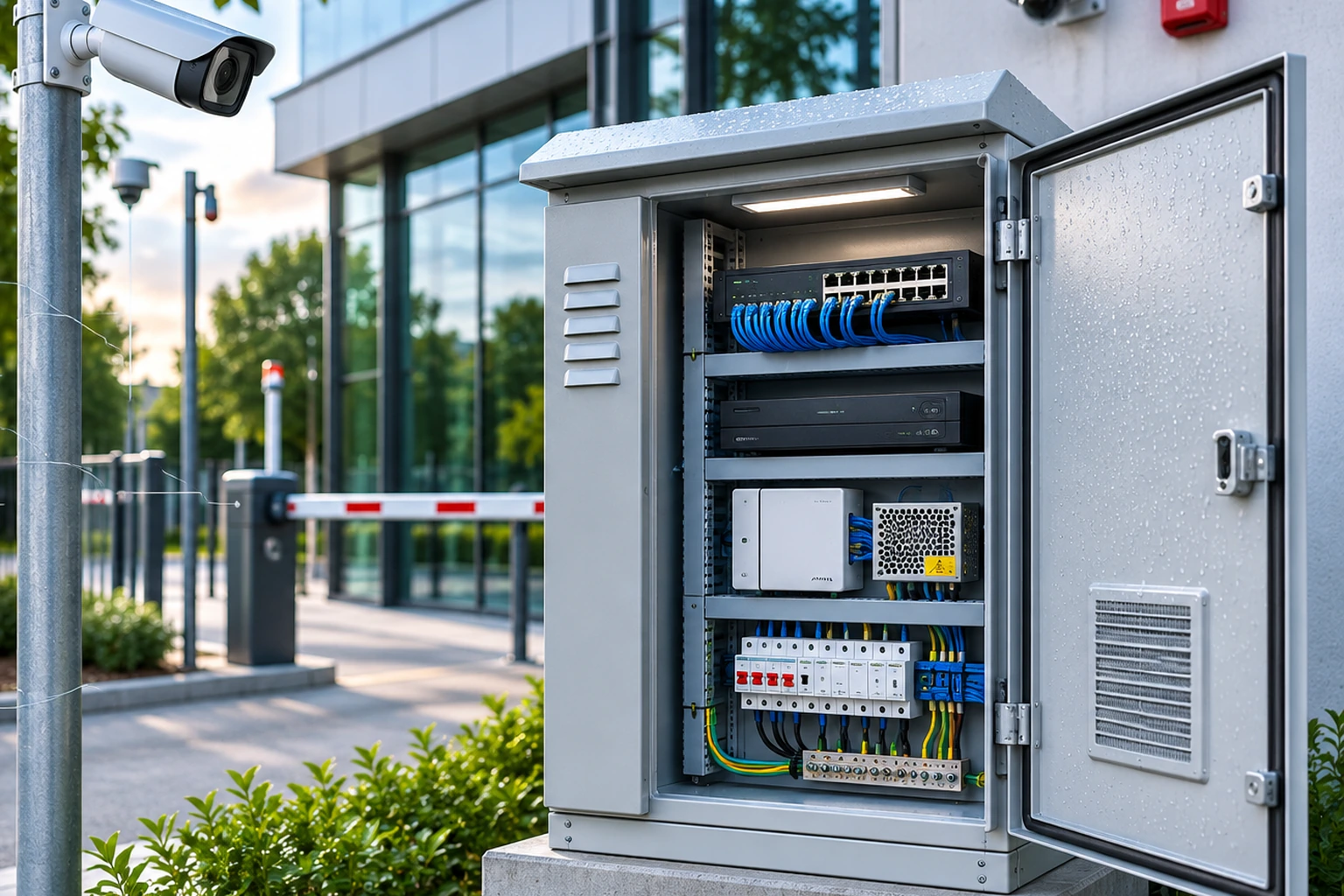
Outdoor field panels and cabinets for low-voltage systems are important infrastructure components that protect electronic security and communications equipment used outdoors from environmental conditions. IP cameras, PoE switches, fiber-optic connections, and control devices used around factory perimeters, at residential-community entrances, in open parking lots, ports, logistics facilities, campuses, and industrial sites are often interconnected through these cabinets.
Electronic equipment operating outdoors is affected by more than just rain and dust. Rising temperatures caused by solar radiation, condensation, high humidity, corrosion, lightning-induced surges, vibration, and unauthorized physical tampering can also affect system reliability.
Therefore, an outdoor field cabinet should not be selected solely on the basis of panel dimensions or IP rating. The cabinet material, heat generated by the equipment inside, electrical safety, cable entries, mounting arrangement, power continuity, and maintenance access should all be assessed together.
What Is an Outdoor Field Panel and Cabinet?
An outdoor field panel is a protective enclosure designed to house electrical and communications equipment safely in outdoor conditions.
In low-voltage systems, these cabinets are generally used as local distribution points for network and security equipment.
A field cabinet may contain the following components:
Industrial Ethernet switches and PoE switches.
Fiber-optic termination box or ODF.
SFP/SFP+ optical modules.
Fiber patch cords and Ethernet patch cables.
Suitable AC/DC power supplies.
Electrical protection and isolation components.
Surge protection devices (SPDs).
Access-control units and control relays.
4G/LTE modems or communications devices.
UPS or battery-backed power systems.
Thermostats, fans, filters, heaters, and environmental sensors.
Not all field cabinets have the same electrical and mechanical requirements. The design approach for a box containing only passive fiber-optic connections should differ from that for a panel containing an active PoE switch and mains-voltage power distribution.
Where Are Outdoor Field Panels Used?
CCTV and IP Camera Systems
In perimeter-security and wide-area video-surveillance projects, field panels are used to bring together local network connections and power feeds for multiple IP cameras.
For example, in an installation where four cameras around a factory are connected to a field PoE switch, the camera cables enter the cabinet and can be routed through the switch to the fiber-optic backbone.
When properly designed, this architecture can reduce the need for long copper links and simplify centralized network management.
Access-Control and Barrier Systems
They can be used to protect control units and communications equipment at vehicle entrance gates, turnstiles, barriers, and outdoor access-control systems.
In these locations, lock security and monitoring of the door-open status may be particularly important.
Fiber-Optic Distribution Points
Outdoor field cabinets may be used to splice and terminate fiber-optic connections at campuses and industrial facilities, and to connect them to active network devices when required.
Industrial and Smart Infrastructure Systems
They can also be used in solar power plants, transport systems, outdoor sensing devices, environmental monitoring, and remote communications solutions.
What Should You Consider When Choosing an Outdoor Field Panel?
1. IP Protection Rating
IP (Ingress Protection) indicates the level of protection an enclosure provides against the ingress of solid foreign objects and water.
IP classification IEC 60529 is based on the standard.
IP rating | Dust protection | Water protection |
|---|---|---|
IP54 | Protection against harmful quantities of dust | Protection against water splashes |
IP55 | Protection against harmful quantities of dust | Protection against water jets |
IP65 | Dust-tight | Protection against water jets |
IP66 | Dust-tight | Protection against powerful water jets |
IP67 | Dust-tight | Protection against temporary immersion in water under specified conditions |
For outdoor low-voltage cabinets, IP65 or IP66 ratings may be considered for many outdoor applications.
However, IP66 is not a mandatory minimum level for every project. The selection should be based on water exposure, dust concentration, ventilation approach, and enclosure design at the installation location.
IP67 is not necessarily more suitable than IP66 in every situation, either. Immersion testing and powerful water-jet protection tests are different.
Why Is the IP Protection Rating Not Enough on Its Own?
A cabinet having been tested at the factory to IP66 does not guarantee that it will retain the same protection after holes are cut on site or cable glands are installed incorrectly.
The following points are particularly important:
Condition of the door seals.
Cable-entry glands.
Ventilation components.
Holes drilled during installation.
Cable pass-through adapters.
Door hinges and locking mechanism.
The cabinet's protection rating in its final, fully installed configuration should be assessed.
What Is the IK Impact-Resistance Rating?
The IK classification indicates the level of protection an enclosure provides against mechanical impacts from outside.
The principal standard for this classification is IEC 62262.
IK rating | Test impact energy |
|---|---|
IK07 | 2 joules |
IK08 | 5 joules |
IK09 | 10 joules |
IK10 | 20 joules |
Cabinets with higher mechanical strength may be preferred in public areas, parking lots, factory perimeters, and locations where there is a risk of deliberate tampering.
However, IK10 certification does not guarantee that a panel is resistant to forced entry or every form of vandalism.
The locking system, mounting connections, door hinges, and physical-access security should be assessed separately.
What Material Should an Outdoor Cabinet Be Made Of?
Common materials for outdoor field cabinets include galvanized or painted steel, stainless steel, aluminum, and glass-fiber-reinforced polyester (GRP).
Comparing Metal and Composite Cabinets
Material | Main advantage | Point to consider |
|---|---|---|
Painted galvanized steel | Mechanical strength and wide availability | Coating damage and corrosion |
Stainless steel | Corrosion resistance when the appropriate grade is selected | Cost and stainless-steel grade |
Aluminum | Relatively lightweight construction | Galvanic corrosion and surface protection |
GRP polyester | Electrical insulation and corrosion resistance | UV, impact, and temperature properties |
Galvanized Steel Cabinets
They are widely used in industrial applications.
However, painting galvanized sheet steel does not mean the material will last indefinitely in every corrosive environment.
Cut edges, weld points, and coating damage should be examined carefully in particular.
Stainless Steel Cabinets
They may be considered for coastal locations, ports, and corrosive industrial environments.
The choice between stainless-steel grades such as 304 or 316 should depend on the chloride and chemical conditions of the environment.
Using 316 stainless steel does not eliminate all corrosion risks, either.
GRP Polyester Cabinets
Glass-fiber-reinforced polyester cabinets can offer advantages in terms of electrical insulation and corrosion resistance.
However, mounting, grounding, thermal behavior in sunlight, and the weight of equipment the cabinet can support should be assessed for each product.
The right cabinet material should be chosen not only on the basis of price, but also according to the installation environment and intended service life.
How Should Field Cabinet Dimensions Be Determined?
When sizing an outdoor field panel, it is not enough simply to ensure that the existing devices physically fit.
The following factors should be considered in particular:
Width, height, and depth of the equipment.
DIN-rail or 19-inch rack requirements.
Space for power supplies and protection components.
Bend radius space for patch cords and fiber-optic cables.
Cable-entry and exit arrangement.
Recommended ventilation clearances for devices.
Required electrical separation.
Access during servicing.
Equipment that may be added in the future.
For example, a small panel that seems adequate for a PoE switch may not be suitable if it also needs to contain a power supply, SPD, fiber termination, and battery.
Cabinet size should be determined not solely from catalog dimensions, but by preparing an equipment layout drawing.
Temperature and Ventilation in Outdoor Cabinets
One of the most significant technical risks in outdoor field panels is temperature management.
Switches, power supplies, modems, and other active devices inside an enclosed cabinet convert some of the electrical energy they consume into heat.
In panels exposed to direct sunlight, the internal temperature can rise above the ambient temperature.
Why Does Temperature Rise in a Field Panel?
Power consumption of active network devices.
Efficiency losses in power supplies.
Solar radiation.
Cabinet color and surface properties.
Insufficient air circulation.
Equipment installed too closely together.
High ambient temperature.
How Is the Thermal Load Calculated?
For an initial assessment, the heat losses of the equipment inside the cabinet can be calculated.
For example, assume the following values:
Equipment | Example heat loss |
|---|---|
Industrial PoE switch | 20 W |
Power supply | 10 W |
Fiber media converter | 5 W |
LTE modem | 8 W |
Total | 43 W |
These values are illustrative and are not actual device data.
Also, not all the electrical power delivered to cameras by a PoE switch is converted into heat inside the switch cabinet. The cabinet's internal thermal-load calculation should account for the device's own losses and other internal heat sources.
The cabinet's overall thermal behavior cannot be determined solely by the 43 W generated by the devices. Solar load, ambient temperature, cabinet surface, and cooling-system performance must also be calculated.
Fan Ventilation or Air Conditioning?
Passive ventilation, filtered fans, heat exchangers, or active panel coolers can be used.
However, openings made for ventilation can reduce the cabinet's IP protection.
For example, installing a standard fan in an IP66 cabinet does not mean the system will automatically retain an IP66 rating after installation is complete.
Therefore, when selecting a cooling solution, the enclosure's protection rating and heat management should be considered together.
Condensation Problems in Field Panels
Preventing water ingress into outdoor cabinets does not mean that no moisture will form inside them.
Temperature fluctuations between night and day can cause the air inside the enclosure to reach its dew point.
As a result, condensation may form on interior surfaces, connection terminals, or metal parts.
How Can Condensation Be Prevented?
A suitable enclosure heater can be used.
Control can be provided by a hygrostat or thermostat.
Suitable membrane ventilation components can be considered.
Water ingress through cable entries must be prevented.
The enclosure's installation location and exposure to sunlight should be assessed.
The environment can be monitored using humidity and temperature sensors.
The method selected to reduce condensation must not compromise the enclosure's environmental protection requirements.
In particular, a completely sealed enclosure does not guarantee that condensation will not form.
How Should PoE Switches and Network Equipment Be Installed?
The operating temperature and environmental characteristics of active devices used in outdoor field enclosures are critically important.
It should not be assumed that standard office network switches are always suitable for outdoor enclosure applications.
Industrial PoE Switch Selection Criteria
Permitted operating temperature.
Number of ports and data rate.
PoE standard and power capacity per port.
Total PoE power budget.
Required SFP connections.
Supply voltage and power supply compatibility.
Redundant power input, if required.
Network management and fault monitoring.
Cybersecurity and update support.
Vibration and electromagnetic compatibility.
The stated power budget of a PoE switch and the total power it draws from the mains are not the same thing.
For example, when designing the power supply and thermal management for a switch powering a 120 W PoE load, power-conversion losses must also be taken into account.
Fiber-Optic Termination
Fiber-optic connections should be installed inside the enclosure using suitable termination and cable-management arrangements.
The minimum bend radii of fiber patch cords must be maintained, and cable slack must be arranged so that it is not subjected to mechanical stress.
Although the fiber connection itself carries no metallic conductor, the cable armor or metal support components used must also be assessed for electrical safety.
Electrical Safety in Outdoor Field Enclosures
Field enclosures may contain both mains-voltage and low-voltage equipment.
In such cases, power supply, protection, isolation, and access safety must be designed in accordance with the applicable electrical installation rules.
Power Distribution
The enclosure should contain suitable circuit protection, a power supply, terminals, and isolation devices where necessary.
The protective devices used must be selected according to the supply type, fault currents, conductor cross-sections, and connected equipment.
Separating Power and Data Cables
The layout of mains-voltage and communications lines must meet electrical safety and electromagnetic compatibility requirements.
Their presence in the same enclosure does not mean that all connections can be installed side by side without separation.
Earthing and Equipotential Bonding
Protective connections for the metal enclosure body, mounting plate, and other required conductive parts must be made in accordance with the relevant electrical design.
The protective conductor or suitable connection arrangement on the panel door should be assessed in light of the door's construction and the components used.
Using an arbitrary, independent earth rod for every metal enclosure is not sound engineering practice.
Electrical safety must be considered as part of the facility's overall earthing and equipotential-bonding system.
Lightning and Surge Protection in Field Enclosures
Outdoor camera poles, field panels, and communications lines may be exposed to transient overvoltages caused by lightning.
Long-distance copper Ethernet lines and outdoor power supplies in particular should be included in the risk assessment.
What Is an SPD?
A Surge Protective Device (SPD) is a protective device used to limit the effects of certain transient overvoltages.
However, not all SPD products are suitable for the same application.
For example:
An SPD suitable for AC power supplies.
An SPD suitable for DC power circuits.
An SPD suitable for Ethernet/PoE communications lines
may have different technical specifications.
For network lines using PoE, the device's data rate, PoE type, and protection characteristics must be assessed together.
IEC 61643-21:2025, covers surge protection devices connected to telecommunications and signal networks; networks that transmit power over the same line, such as PoE, are also within its scope.
However, the presence of an SPD does not mean that cameras or the field panel are fully protected against a direct lightning strike.
Technical Standards for Outdoor Field Enclosures
It should not be assumed that a single standard meets all safety requirements in field-enclosure design.
Different standards may apply to the enclosure, electrical panel, equipment used, and site conditions.
Standard | Scope |
|---|---|
IEC 60529 | IP dust and water protection ratings |
IEC 62262:2002+A1:2021 | IK mechanical impact resistance |
IEC 62208:2023 | Empty enclosures for low-voltage switchgear assemblies |
IEC 61439-1:2020 | General rules for low-voltage switchgear and controlgear assemblies |
IEC 61439-2:2020 | Power switchgear and controlgear assemblies within scope |
IEC 62444 | Technical requirements for cable glands |
IEC 62305:2024 series | Lightning protection |
IEC 61643-21:2025 | SPD for telecommunications, signal, and suitable PoE lines |
Difference Between IEC 62208 and IEC 61439
This distinction is particularly important when technically assessing outdoor field enclosures.
IEC 62208, defines the characteristics and test requirements of empty enclosures manufactured for use in low-voltage switchgear assemblies.
IEC 61439 series addresses the design and verification requirements for completed low-voltage switchgear and controlgear assemblies within its scope.
Therefore, installing a circuit breaker, power supply, and other components in an empty enclosure compliant with IEC 62208 does not automatically mean that the completed panel meets the requirements of IEC 61439.
Nevertheless, not every field box containing only passive communications equipment should be directly classified as a power panel within the scope of IEC 61439.
The applicable standard should be determined according to the function and electrical classification of the resulting product.
Types and Comparison of Outdoor Enclosures
Enclosure type | Application | Key design criterion |
|---|---|---|
Compact pole-mounted field panel | IP cameras and small-scale PoE distribution | Weight, IP protection, temperature |
Outdoor wall-mounted enclosure | Outdoor building control points | Mounting, access, and corrosion |
Freestanding field enclosure | Multi-device distribution points | Foundation, thermal management, security |
19-inch outdoor enclosure | Rack-mounted network equipment | Depth, ventilation, cable management |
Passive fiber distribution box | Fiber splicing and termination | Fiber layout, sealing |
Cooled active field enclosure | Applications with high thermal loads | Heat calculation, energy, and maintenance |
This table is a preliminary selection guide. No single enclosure model is ideal for every outdoor field project.
How Should an Outdoor Enclosure Be Installed?
Pole Mounting
Pole-mounted enclosures can be secured with suitable mounting clamps or purpose-designed brackets.
However, the total load the pole can support must be assessed.
The weights of the camera, bracket, panel, battery, and other equipment, together with wind effects, must be calculated.
Wall Mounting
For wall-mounted panels, fasteners should be selected according to the construction of the supporting surface and the enclosure's total weight.
Adequate load-bearing capacity should not be assumed based solely on the number of wall plugs.
Freestanding Field Enclosures
Freestanding enclosures can be secured to a suitable foundation or platform.
When selecting the installation location, assess:
Accumulation of rainwater.
Risk of flooding and inundation.
Risk of vehicle impact.
Maintenance access.
Exposure to sunlight.
Cable routes.
Risk of physical tampering.
These factors must be assessed.
However firmly an outdoor enclosure is secured to the ground, installing it at an unsuitable location exposed to flooding can adversely affect system reliability.
Common Mistakes in Field Enclosure Installation
Unsuitable IP Protection
Using an indoor enclosure without accounting for exposure to rain and dust can cause long-term failures.
Failure to Account for Solar Effects
Sunlight can raise the temperature inside a panel even when it contains devices with low power consumption.
Incorrect Selection of Cable Glands
Unsuitable glands can allow water ingress, cause mechanical stress, or damage the cable sheath.
Ignoring the Risk of Condensation
A closed and sealed enclosure does not guarantee that condensation will not form on interior surfaces.
Inadequate Power Protection
Failure to assess transient overvoltage risks on mains or PoE connections can lead to equipment damage.
Incorrect PoE Power Calculation
The switch's total PoE budget may not meet the maximum power requirements of the connected cameras.
Failure to Plan for Maintenance Access
Locating the enclosure where service personnel cannot reach it safely can increase maintenance costs and response times.
Technical Checklist for Outdoor Field Panels
Inspection item | Item to verify |
|---|---|
Application | Outdoor conditions and safety risks |
Enclosure material | Corrosion and mechanical strength |
IP protection | Protection target after installation |
IK rating | Mechanical impact resistance |
Enclosure dimensions | Equipment and connection layout |
Thermal management | Solar load and equipment losses |
Condensation | Heater, sensor, or suitable ventilation |
Power | Supply and circuit protection |
PoE | Port and total power budget |
Fiber-optic | Termination and bend clearance |
SPD | Power and communications line protection |
Earthing | Protection and equipotential bonding |
Mounting | Pole, wall, or foundation strength |
Cybersecurity | Access and device management |
Testing | Power, temperature, connection, and function tests |
Documentation | Schematic, labeling, and test report |
This checklist is intended for professional field assessment. It does not replace the engineering work required to ensure electrical compliance and structural safety.
Frequently Asked Questions
Must an outdoor field panel be at least IP65?
There is no single minimum IP rating that applies to every application. IP65 or IP66 may be considered for many outdoor applications. The final selection should be based on site conditions and equipment requirements.
Is an IP66 enclosure waterproof?
IP66 indicates protection against dust and powerful water jets under defined test conditions. It does not mean that the enclosure can withstand continuous immersion in water or all environmental conditions.
Is a fan necessary in an outdoor field cabinet?
The need for a fan depends on the heat losses of the devices, the ambient temperature, solar load, and the cabinet’s thermal behavior. It is not mandatory for every cabinet.
Why does condensation form inside a cabinet?
Temperature changes can cause interior surfaces to fall below the dew point, resulting in condensation. Appropriate heating, humidity control, and ventilation solutions may be considered.
Can a standard PoE switch be installed in an outdoor field cabinet?
It can be used if the device’s permitted temperature, humidity, and other environmental operating conditions are met. However, standard office-grade switches should not be assumed to be suitable for every outdoor cabinet application.
Is grounding required for a fiber field cabinet?
The electrical requirements differ between a box containing only passive, fully dielectric components and a cabinet with a metal enclosure, mains power, and active devices. Suitability should be assessed based on the actual system architecture.
Conclusion
Outdoor field panels and cabinets are critical infrastructure components that enable low-voltage systems to operate reliably in outdoor conditions.
When selecting the right cabinet, focusing only on the IP rating or cabinet dimensions is not enough. Material durability, temperature management, condensation control, power distribution, PoE capacity, fiber connections, surge protection, and maintenance requirements must all be considered together.
A professional outdoor field cabinet is not merely a box that protects electronic equipment; it is an integrated field infrastructure that supports the continuity of power, networking, communications, and security systems.
A properly designed and installed field cabinet, with commissioning tests completed, can help reduce system failures, simplify maintenance, and improve the long-term operational performance of security infrastructure.