
How Are Camera Systems Protected from Lightning? A CCTV and PoE Protection Guide
How are security camera systems protected from lightning? We examine lightning, surge, SPD, grounding and fiber-optic protection methods for IP cameras, PoE switches, NVRs and camera poles. Technical selection and installation criteria based on IEC 62305 and IEC 61643 standards.
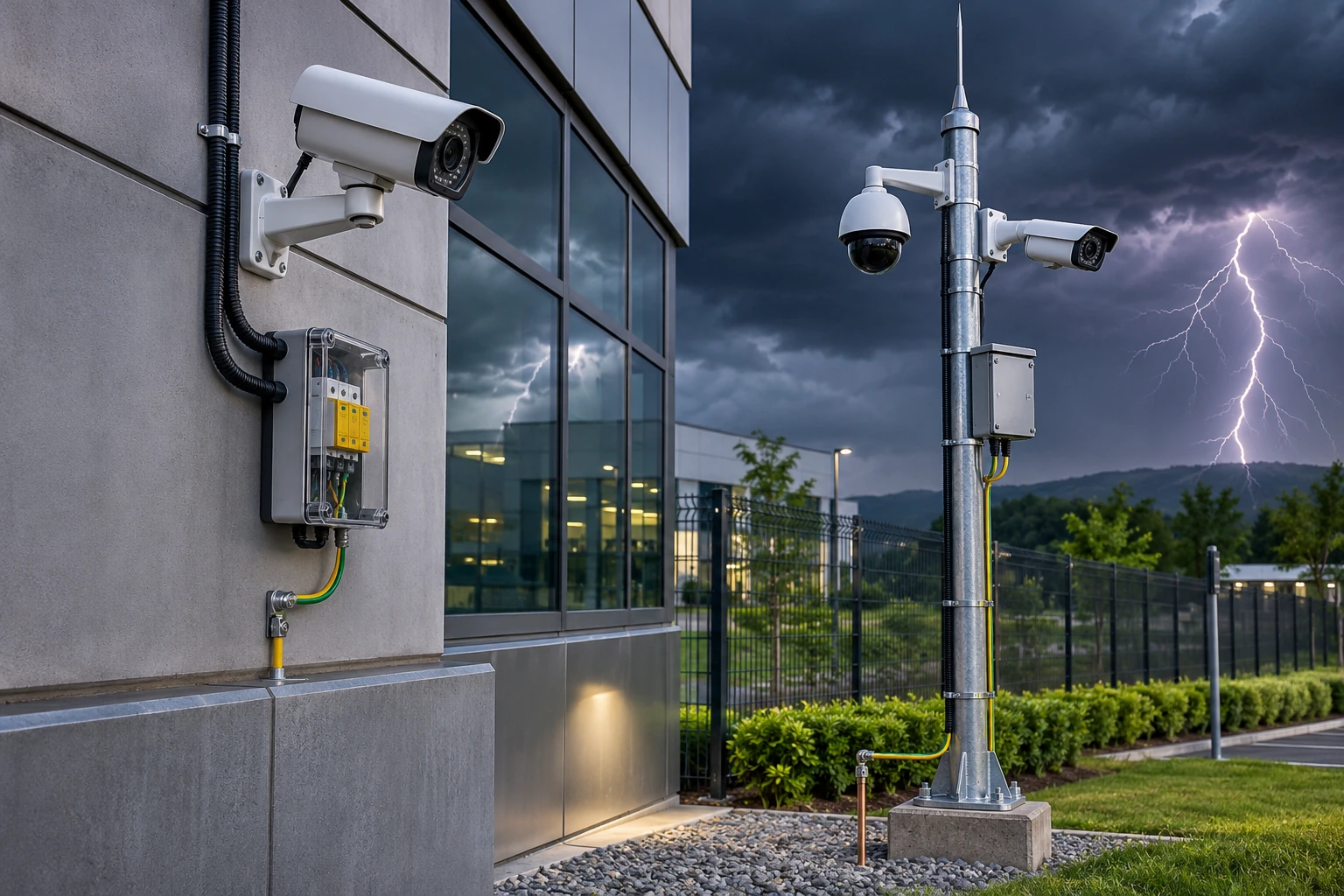
Security camera systems can be exposed to electrical risks caused by lightning and surges, particularly outdoors. CCTV cameras installed around factories, in parking lots, ports, power plants, campuses and on tall poles are among the applications where these risks need careful assessment.
An electrical event caused by lightning may do more than damage the camera. A PoE switch, NVR recorder, fiber media converter, power supply and other electronic equipment connected to the same network may also be damaged.
Long copper Ethernet runs, outdoor camera poles and metallic connections between buildings can provide paths that carry transient overvoltages into the system.
Therefore, protecting camera systems from lightning is not simply a matter of installing a protection device next to the camera or attaching a grounding cable to the pole. Effective protection requires the coordinated design of lightning risk analysis, an appropriate lightning protection system, equipotential bonding, surge protective devices and the right cabling architecture.
How Does Lightning Damage Camera Systems?
Lightning is a natural electrical phenomenon that can produce very high currents and powerful electromagnetic effects.
Damage to camera systems does not occur only when lightning strikes the camera or pole directly.
Lightning strikes in the vicinity can also create hazardous voltages in cables and electronic systems.
1. Direct Lightning Strike
This occurs when lightning directly strikes the camera pole, the camera or the structure to which it is attached.
Such an event can result in high currents, a rise in temperature, mechanical effects and a risk of structural damage.
A direct lightning strike is not something that can be safely handled by a small electronic protection device alone.
For this risk, an appropriate external lightning protection system, air-termination arrangement, down conductors and grounding infrastructure should be assessed.
2. Nearby Lightning Strike
A lightning strike near the camera pole can pose a significant risk even if the pole itself is not struck directly.
Changes in the electromagnetic field generated by lightning can induce transient voltages in cables.
This effect can be significant, particularly in long metallic lines located outdoors.
3. Ground Potential Rise
As lightning current is conducted into the ground, significant differences can arise between ground potentials at different locations.
For example, a transient potential difference may develop between the electrical reference points of a camera pole and a distant building.
A copper Ethernet or power line connecting these two points can provide a path for unwanted currents.
When assessing this situation, the presence of grounding electrodes is as important as equipotential bonding and the system’s overall electrical connection architecture also.
4. Surge Coming from the Power Supply Line
If the camera system is powered from the building’s electrical supply, surges can also enter through the power line.
In such an event, the NVR, PoE switch, adapter or UPS equipment may be affected even if the camera is not damaged.
For this reason, data-line protection and power-line protection should be planned together.
How Is Lightning Protection Implemented in Camera Systems?
A professional CCTV lightning protection design consists of multiple complementary layers of protection.
The main measures include:
Assessment of lightning risk.
Design of the required external lightning protection system.
Appropriate electrical connections for camera poles and metal structures.
Surge protection on power lines.
Protection on PoE and other copper communication lines.
Assessment of fiber-optic architecture for connections between buildings.
Coordination of cable routes and protection zones.
Testing and periodic inspection after installation.
Not all of these measures may be necessary to the same extent for every camera system.
For example, the risk profile of a camera using a short Ethernet connection inside a building differs from that of a PTZ camera mounted on a 10-meter pole in an open area.
What Is an SPD in Camera Systems?
SPD (Surge Protective Device)is a protective device used to limit certain transient overvoltages on electrical or communication lines and, under suitable conditions, divert surge currents.
SPDs are manufactured for different connection types in electronic security applications.
The main types are:
AC power-line SPDs.
DC power-line SPDs.
Ethernet and PoE data-line SPDs.
Coaxial video-line protectors.
RS-485 and other signal-line protectors.
These products differ in operating voltages, surge withstand ratings, connection methods and protection characteristics.
For example, an AC power-line SPD is not a device designed to connect directly to an Ethernet data line.
What Are Type 1, Type 2 and Type 3 SPDs?
Surge protective devices used in AC power systems are assessed according to different test classes under the applicable IEC standards.
SPD type | General function | Application approach |
|---|---|---|
Type 1 | Protection designed to withstand lightning-current components | Where required, boundaries between the service entrance and lightning protection zones |
Type 2 | Limiting transient overvoltages | Suitable distribution panels |
Type 3 | Supplementary protection close to sensitive equipment | Coordinated final-stage protection |
Important: This classification is not a general product selection table that can be applied in the same way to all PoE data-line SPDs.
SPDs for Ethernet and signal lines have their own testing and classification requirements.
Whether Type 1, Type 2 and Type 3 devices need to be used together or separately in a project is also determined by the risk analysis and the facility’s electrical architecture.
PoE Lightning Protection for IP Camera Systems
A significant proportion of IP security cameras operate using Power over Ethernet (PoE) technology.
With PoE, a camera can receive both data communication and electrical power over the same Ethernet connection.
While this feature simplifies installation, it also makes it important to assess the copper connection for electrical surges.
What Is a PoE Surge Protector?
A PoE SPD is a protective device used to limit certain overvoltages that may occur on a suitable Ethernet line.
It is generally installed on the copper line between the camera and the PoE switch.
However, having only a RJ45 connection does not mean that the product is suitable for every PoE camera system.
What Should You Consider When Selecting a PoE SPD?
Supported Ethernet speed.
Supported PoE type and power level.
Relevant line voltages.
Surge current withstand parameters.
Voltage protection level.
Withstand characteristics of the protected equipment.
Suitability of the device for indoor or outdoor use.
Grounding and equipotential bonding method.
Installation location.
Compliance with the relevant test standard.
IEC 61643-21:2025 covers the requirements for SPDs connected to telecommunications and signal networks. This scope may also include transmission of both data and power over the same line, as in PoE.
Should a PoE SPD Be Installed on the Camera Side or the Switch Side?
There is no single answer to this question that applies to every project.
In outdoor camera applications, it may be necessary to protect both the equipment on the camera side and the switch or NVR on the building side.
For example, the following connection arrangement can be considered:
Representative outdoor IP camera protection architecture
The diagram is conceptual; actual SPD connection points, cable lengths and protective conductors should be designed according to the project.Using protection at both ends may be an appropriate approach in some outdoor applications. However, routing the cable through a metal pole, the existing lightning protection system, protection zones and other design conditions may call for a different arrangement.
DEHN’s CCTV protection technical guide presents different scenarios for camera poles and building connections.
Therefore, using two SPDs alone does not guarantee protection against all lightning risks.
How Should Camera Poles Be Protected from Lightning?
In outdoor CCTV applications, cameras are often mounted on metal poles.
In addition to wind and mechanical loads, these poles should also be included in the lightning risk assessment.
Should a Camera Pole Be Grounded?
The electrical safety and lightning protection arrangement for a metal pole should be determined according to the facility’s existing grounding and equipotential bonding infrastructure.
Connecting a grounding electrode to the pole at random or driving an independent rod into the ground does not provide adequate protection in every case.
In particular, dangerous potential differences can arise during a lightning event between grounding connections established at separate locations.
For this reason, the pole, camera, power supply, communication cables and relevant protective components should be assessed together.
Is a Lightning Rod Needed on a Camera Pole?
It cannot be said that a lightning air-termination rod must automatically be installed on every camera pole.
Whether one is required depends on the risk assessment for the structure and the external lightning protection system being designed.
If protection against a direct lightning strike is required, the camera can be positioned within the designed protection volume.
Suitable air-termination rods, conductors and protection geometry can be used for this purpose.
However, having the lightning rod extend a certain number of centimeters above the camera does not prove that the camera is automatically protected.
The protection volume and safe separation distances should be assessed in accordance with the provisions of IEC 62305.
Lightning Protection for PTZ Cameras
In some applications, PTZ cameras are mounted on tall poles and may include high-power motors, lighting or heating components.
Therefore, the protection assessment should cover not only the Ethernet connection but also any separate power, control and auxiliary-device lines, if present.
Does Fiber-Optic Cable Provide Protection Against Lightning?
Fiber-optic communication offers a significant advantage over electrically conductive copper communication lines.
A fully dielectric fiber-optic cable does not create a metallic electrical path for carrying data between its two ends.
This feature is particularly useful for communication links between different buildings.
For example, a suitable fiber infrastructure can be used for the connection between a factory building and a remote camera pole.
This can reduce certain electrical coupling paths that could occur over a copper Ethernet line.
However, using fiber-optic cable does not eliminate all lightning risks.
What Should Be Considered When Using Fiber?
Whether metal armor or a metal strength member is present.
Whether the fiber is fully dielectric.
The camera’s power supply method.
Electrical protection for the remote-site switch.
Power supply for the fiber media converter.
Protection arrangement for the camera pole and cabinet.
Important: Fiber-optic cable can eliminate the metallic path for data communication; however, the power supply to the remote camera or field switch still requires electrical protection.
The electrical connections of metallic components in metal-armored fiber-optic cables must also be assessed separately.
How Should an NVR and PoE Switch Be Protected?
In CCTV systems, recording equipment and network switches are often located in a central cabinet or technical room.
This equipment may be exposed to surges through camera lines from outdoors and the mains supply.
The following components should be considered in the protection design:
Appropriate SPD coordination in the electrical distribution panel.
Required Ethernet/PoE line protection.
Cabinet protection and equipotential bonding.
Appropriate UPS and power-quality measures.
Building entry points for outdoor copper cables.
Fiber-optic connection options.
Routing of electrical and communication lines.
Does a UPS Protect Against Lightning?
A UPS helps provide power for a certain period during outages and, depending on the product's features, manage some power-quality issues.
However, the presence of a UPS does not mean the system is protected against all the effects of direct or nearby lightning strikes.
The UPS's own surge withstand capability and protection features should be assessed for each product.
Using only a UPS instead of the required SPD and lightning-protection arrangement is not an adequate approach.
How Should Analog CCTV Systems Be Protected?
In analog and HD analog camera systems, video is transmitted mostly over coaxial cables.
Power to the camera may be supplied over a separate line.
In this architecture, the video line and power line can create different electrical risk paths.
The protection design should consider:
An SPD suitable for the coaxial video line.
Protection suitable for the camera's power supply.
Protection for the RS-485/PTZ control line, if present.
Metal enclosure and mounting connections.
Protection on the recording-equipment side.
Equipotential bonding.
should be assessed.
For example, installing a surge protector only on the coaxial line does not mean that surges entering through a separate power line have been eliminated.
How to Choose a Surge Protection Device for Camera Systems
SPD selection should not be based solely on the maximum surge-current rating printed on the product.
The device must be compatible with the system architecture.
Key Technical Parameters
Parameter | Description |
|---|---|
Uc | Maximum continuous operating voltage |
Up | Voltage protection level |
In | Specified nominal discharge current |
Imax | Maximum discharge current specified for the relevant SPD class |
Iimp | Relevant lightning-current test parameter |
Transmission speed | Compatibility with the Ethernet connection |
PoE support | Power transmission and standards compliance |
Installation environment | Indoor/outdoor use, enclosure, and temperature |
Connection method | Protective conductor and equipotential bonding |
These parameters are not applied in the same way to every type of SPD. In particular, datasheets for power-line and telecommunications-line SPDs may include different test criteria.
It cannot be assumed that a product with a high kA rating will provide better camera protection in every situation.
The voltage protection level, equipment withstand capability, installation arrangement, SPD coordination, and applicable test standard should be assessed together.
Is Single-Point Grounding Sufficient for Lightning Protection?
It is sometimes stated that all devices in electronic security systems should be connected to just one grounding point.
However, this cannot be considered the one solution that applies to every facility and lightning-protection design.
Modern lightning-protection design addresses equipotential bonding, lightning protection zones, cable routes, shielding, and SPD coordination together.
At facilities with numerous camera poles, buildings, and remote field cabinets, the grounding architecture should be designed in accordance with the facility's overall electrical structure.
The aim is not merely to achieve low grounding resistance, but to limit dangerous potential differences and surges to which sensitive equipment may be exposed, using appropriate methods.
For example, measuring a grounding resistance below a specified ohm value for every camera pole does not prove that the system is automatically protected against lightning.
Lightning Protection Standards for Camera Systems
Multiple IEC standards are considered together for lightning protection in electronic security systems.
Standard | Main scope |
|---|---|
IEC 62305-1:2024 | General principles of lightning protection |
IEC 62305-2:2024 | Lightning risk management |
IEC 62305-3:2024 | Protection against structural damage and for the safety of people |
IEC 62305-4:2024 | Protection measures for electrical and electronic systems |
IEC 61643-01:2024 | General requirements for SPDs |
IEC 61643-11:2025 | SPDs for AC power lines |
IEC 61643-21:2025 | SPDs for telecommunications, signal, and PoE lines |
IEC 61643-41:2025 | SPDs for DC power lines |
IEC 61643-22:2015 | Principles for selecting and applying telecommunications- and signal-line SPDs |
Why Is IEC 62305-4 Important?
IEC 62305-4:2024 addresses protection measures intended to reduce the risk of damage to electrical and electronic systems in structures caused by the lightning electromagnetic impulse.
It is an important reference for taking an integrated approach to protection design for video surveillance, network, control, and other electronic systems.
Why Is IEC 61643-21:2025 Important?
This standard covers surge protection devices connected to telecommunications and signal networks.
Because data and power can be carried over the same cable in PoE connections, it is important to verify that these protectors have appropriate technical specifications.
The standard defines requirements such as impulse behavior, safety, and performance.
Although the international IEC editions of these standards have been verified, the corresponding TS/TS EN standards applicable to projects in Türkiye and the relevant national regulations should also be checked separately.
Lightning Protection Scenarios for Camera Systems
The following table summarizes the main risks to consider in different CCTV infrastructures.
Application | Main risk | Approach to consider |
|---|---|---|
Indoor IP camera | Surges through the mains and network | Coordination of power- and data-line protection |
Exterior camera | Nearby lightning and outdoor cable | LPS protection volume, equipotential bonding, and suitable SPD |
PoE camera on a metal pole | Pole, outdoor Ethernet, and potential difference | Lightning risk analysis, pole protection, and PoE SPD |
Remote PTZ camera | Elevated location, multiple power and control lines | Coordinated protection of all lines |
Copper Ethernet between buildings | Potential difference and induced surges | Assessment of the fiber alternative and protection architecture |
Remote camera connected by fiber | Power supply at the remote end | Power-line SPD, local protection, and dielectric fiber |
Analog CCTV | Coaxial video and separate power lines | SPD suitable for the video and power lines |
This comparison provides a general assessment framework for project design. The number, class, and connection arrangement of protection devices should not be determined solely on the basis of this table.
Most Common Mistakes in Lightning Protection for Camera Systems
1. Installing Only a PoE Protector
A PoE SPD does not eliminate the entire risk from power supplies or direct lightning.
2. Assuming an Independent Grounding Rod Is Sufficient
Independent grounding arrangements without suitable equipotential bonding and a protection architecture can create dangerous potential differences.
3. Using the Wrong SPD
Using an SPD incompatible with the device's Ethernet speed, PoE power, or electrical voltage can cause performance and safety problems.
4. Excluding the Camera Pole from the Risk Analysis
Camera poles, especially those in elevated and exposed locations, should be assessed for direct lightning effects.
5. Protecting Only the Building Side
Installing an SPD only in the central panel may be insufficient if the exposure of remote field devices and different lines is not taken into account.
6. Incorrect SPD Connection
An unsuitable connection arrangement and unnecessarily long connecting conductors can adversely affect the protection performance achieved in practice.
Connection length and routing should be designed in accordance with the applicable standards and manufacturer's instructions.
7. Forgetting to Protect the Recording System
Even if the camera is protected, the central PoE switch or NVR may be damaged.
8. Failing to Test After Installation
The mere installation of an SPD does not in itself demonstrate that it has been connected correctly or that the overall protection design is fully adequate.
Lightning Protection Checklist for Camera Systems
Checklist item | Criterion to check |
|---|---|
Risk analysis | Direct/nearby lightning and site conditions |
External LPS | Requirements, protection volume, and arrangement |
Camera pole | Metal support and electrical connections |
Equipotential bonding | Compliance with the project and relevant standards |
AC power SPD | Type, coordination, and electrical compatibility |
DC power SPD | Protection for applicable DC circuits |
PoE SPD | Speed, power, surge withstand capability, and connection |
Coaxial line | Analog CCTV protection |
Fiber-optic cable | Metallic components and remote-end power supply |
NVR and switch | Protection of the central system |
Cabinet | Electrical connections and environmental resilience |
Cabling | Routing, shielding, and building entries |
Commissioning | Measurements, observation, and functional tests |
Periodic maintenance | SPD condition and connection integrity |
Documentation | Protection design, diagrams, and test reports |
This checklist is a general technical guide. It does not replace a lightning-protection project or electrical-engineering design.
Frequently Asked Questions About Lightning Protection for Camera Systems
What should be done to protect an IP camera from lightning?
The lightning risk at the camera location should be assessed; the required external lightning-protection arrangement and equipotential bonds should be designed; suitable SPDs should be used on power and data lines; and the installation should be tested.
Does a PoE lightning protector fully protect a camera?
No. A PoE protector is designed to limit certain transient overvoltages. It does not guarantee complete protection against all the effects of a direct lightning strike.
Is it mandatory to install a lightning rod on a camera pole?
There is no single requirement that applies to every camera pole. The need should be determined in conjunction with a lightning-risk assessment and applicable regulations.
What grounding resistance in ohms is required for a camera pole?
It is not correct to specify a single ohm value that applies to all camera poles. Grounding and equipotential-bonding design should be based on the electrical characteristics of the system and the relevant standards.
Does fiber-optic cable eliminate lightning risk?
All-dielectric fiber eliminates the metallic transmission path in the data line. However, lightning risks may remain for the power supply at the remote end, the pole, and other metal components.
Does a UPS protect a camera system from lightning?
A UPS can be useful against power outages and some power-quality problems. However, it is not a direct substitute for the required lightning protection and SPD design.
Where should SPDs be installed in camera systems?
SPD placement should be determined according to power and data line entry points, lightning protection zones, the location of the equipment to be protected, and the facility’s electrical architecture. It is not appropriate to use a single installation layout for every system.
Conclusion
Lightning protection in camera systems is an important engineering consideration for the long-term reliability of electronic security infrastructure.
The effects of lightning should be assessed separately, particularly for outdoor IP cameras, PTZ poles, long copper Ethernet connections, and centralized recording systems.
In an effective protection approach, an external lightning protection system, equipotential bonding, appropriate SPD selection, fiber-optic architecture, power protection, and field testing complement one another.
A single grounding rod or PoE protection device does not eliminate all risks.
The aim of professional CCTV lightning protection design is to reduce lightning-related risks through appropriate engineering measures and support the operational continuity of security systems.