
Child Park Safety: A Guide to Playground Standards, Cameras and Inspections
Child park safety requires a combined assessment of equipment compliance, impact-absorbing surfaces, regular maintenance, perimeter security and proper camera placement. We examine TS EN 1176 and EN 1177 standards, swing and slide hazards, CCTV and AI-enabled monitoring, KVKK requirements, and park safety inspections.
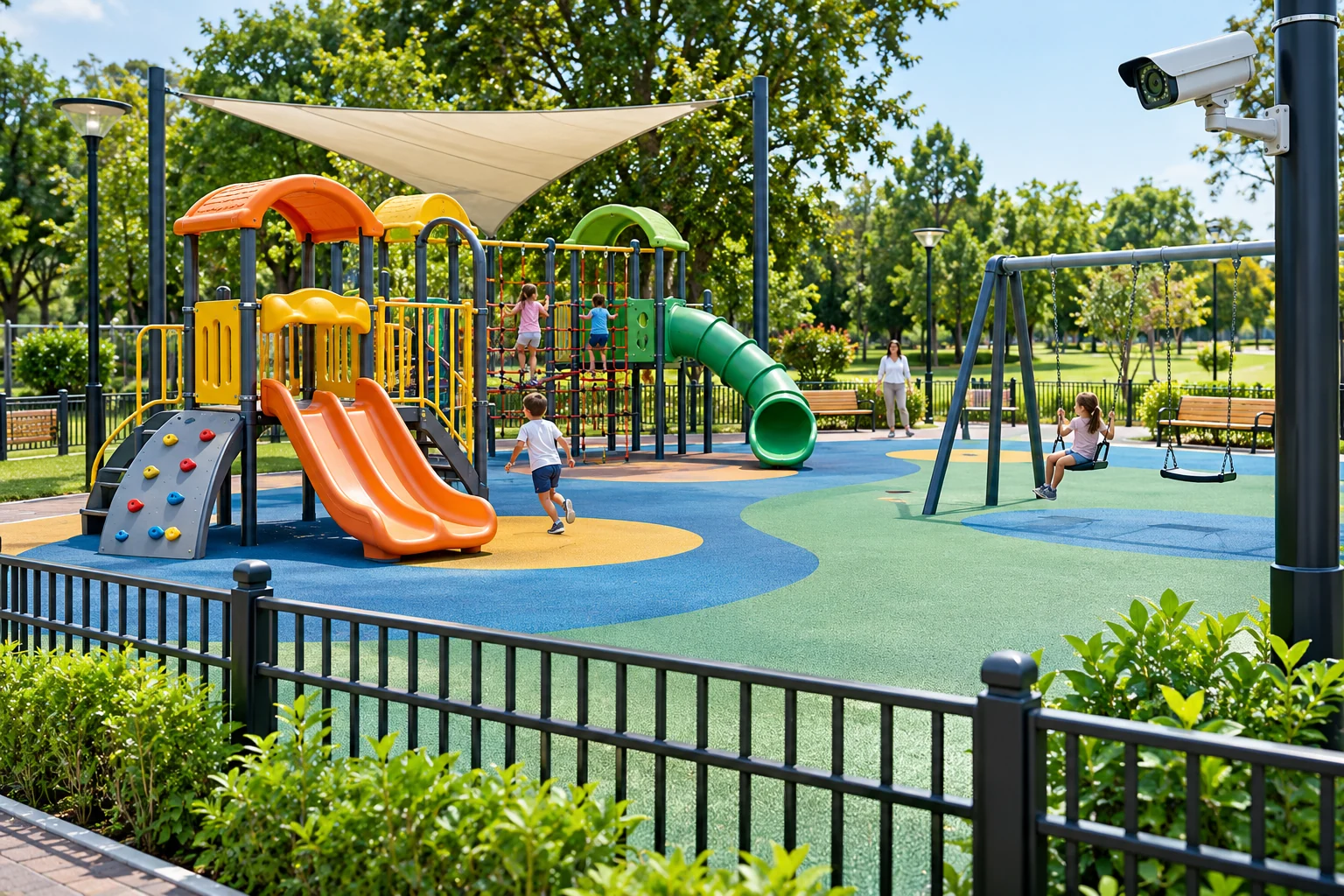
Child park safety comprises the integrated measures used to reduce physical hazards children may encounter while playing, ensure safe use of playground equipment, protect the park surroundings and prepare for potential emergencies. It can apply to playgrounds operated by municipalities, residential complexes, schoolyards and private businesses.
When people talk about safety in child parks, they usually think of security cameras, perimeter lighting or controlling park entrances. Yet among the most important factors affecting children’s safety are the mechanical condition of play equipment, fall heights, the impact-absorbing properties of surfaces, entrapment hazards and regular maintenance procedures.
For example, a loose swing connection, worn slide surface or unsuitable surfacing can cause serious injuries in a park under continuous camera surveillance. A camera system can help investigate such hazards after the fact, but it does not eliminate physical defects on its own.
A safe child park is a playground that is properly designed, installed in accordance with suitable standards, inspected regularly and, where necessary, supported by electronic security systems.
In this guide, we examine how to ensure safety in child parks, TS EN 1176 and EN 1177 standards, CCTV systems, AI-enabled video analytics, perimeter security, accessibility and periodic inspection requirements.
What Is Child Park Safety?
Child park safety is the full range of physical, technical and organizational measures taken to identify foreseeable hazards in playgrounds and reduce the risk of serious injuries.
Movement, running, climbing and encountering certain risks while playing are natural parts of children’s development.
For this reason, the aim of safe playground design is not to restrict all children’s movements or make the play environment entirely risk-free.
The real aim is to eliminate or reduce to an acceptable level serious hazards that children cannot recognize, assess or avoid.
Child park safety can be considered under five main headings:
Mechanical and structural safety of play equipment.
Fall zones and the impact-absorbing properties of surfaces.
Park landscaping, lighting and accessibility.
Security cameras and appropriate electronic security systems.
Periodic inspections, maintenance and emergency management.
Assessing these components together provides more comprehensive protection than approaches focused solely on the number of cameras or security staff.
The Most Common Safety Risks in Child Parks
Hazards in children’s play areas can arise from various sources.
Risk type | Example hazard | Priority safety approach |
|---|---|---|
Fall | Fall from a slide or climbing structure | Suitable fall zone and impact-absorbing surface |
Entrapment | Entrapment of the head, neck or fingers | Equipment compliance and technical inspection |
Mechanical failure | Loose connection or broken part | Regular inspection and maintenance |
Collision | Entering a swing’s path | Safe layout and use area |
Cuts | Sharp edge or broken metal | Taking damaged equipment out of service |
Environmental hazard | Broken glass, hole or standing water | Cleaning and site inspection |
Traffic risk | Uncontrolled access to a roadway | Appropriate landscaping |
Unauthorized use | Inappropriate activity outside opening hours | Risk-based perimeter security |
Emergency | Delay in responding after an injury | Communication, access and emergency response plan |
Physical and structural measures should be implemented first to reduce risks. Electronic security technologies should play a complementary role for risks where they are appropriate.
What Is the TS EN 1176 Standard?
TS EN 1176 refers to the Turkish counterparts of the standards family concerned with safety requirements for children’s playground equipment.
EN 1176 sets out general and equipment-specific safety requirements for permanently installed public playground equipment.
One of the principal current European texts of EN 1176-1 is the EN 1176-1:2017+A1:2023 edition.
The standard aims to provide an appropriate level of safety against serious hazards that children may not foresee during play.
EN 1176 Standard Parts
Standard | Scope |
|---|---|
EN 1176-1 | General safety requirements and test methods |
EN 1176-2 | Specific requirements for swings |
EN 1176-3 | Specific requirements for slides |
EN 1176-4 | Cableway rides |
EN 1176-5 | Roundabouts and rotating play equipment |
EN 1176-6 | Rocking and seesaw-type equipment |
EN 1176-7 | Installation, inspection, maintenance and operation handbook |
EN 1176-10 | Specific requirements for fully enclosed play equipment |
EN 1176-11 | Three-dimensional network play equipment |
The current national editions of the standards in this table should also be verified in the TSE catalogue before technical specifications are prepared or inspections conducted.
Is Certification of Play Equipment Enough?
No.
Manufacturing play equipment in accordance with the relevant technical standard does not guarantee that it will retain the same safety level if it is incorrectly installed in a park or not maintained.
Distances between equipment, fall zones, connections and surface characteristics are especially important aspects of site installation.
Safety should be assessed not solely on the basis of product certification, but across the entire completed playground.
EN 1177 Standard and Impact-Absorbing Surfaces
Surface characteristics are critical to reducing the risk of fall-related injuries in child parks.
EN 1177 is the European standard used to test the impact-absorbing performance of playground surfaces.
The EN 1177:2018+A1:2023 text covers assessment of how effectively a surface reduces impact effects using specified test methods.
In this context, Critical Fall Height (CFH), or critical fall height, is an important parameter.
What Is Critical Fall Height?
Critical fall height is associated with the height at which a surfacing system is determined to provide adequate impact attenuation under standard test conditions.
The equipment’s free fall height and the surface’s tested critical fall height should be assessed together.
For example, the surface in the impact area of equipment with a free fall height of 1.5 metres should not be considered safe merely because it is colourful or looks like rubber.
The surface’s impact-absorbing performance should be verified as suitable for this use condition.
Is Rubber Surfacing Always Safe?
No.
EPDM, SBR, rubber tiles or other resilient surfacing solutions may be used. However, surface safety does not depend solely on the material’s name.
The important criteria are:
Tested surfacing system and layer structure.
Actual installed thickness.
Sub-base and installation conditions.
The equipment’s free fall height.
The surface’s wear and deformation condition.
Drainage and environmental conditions.
On-site impact tests where required.
Under EN 1177, HIC (Head Injury Criterion) and peak acceleration.
However, compliance in a test report is not a guarantee that no injury will occur in every fall.
How Can Swing Safety Be Ensured?
Swings are widely used moving equipment in children’s playgrounds.
Safe swing use requires first assessing the swing’s movement area, supporting structure and connection points.
Key checks include:
The condition of swing connections and supporting components.
Wear on chains, connectors and suspension points.
Whether the swing seat is damaged.
Absence of fixed obstacles in the swing’s movement area.
The safety zone in front of and behind the equipment.
Selecting a seat appropriate to users’ ages and use characteristics.
Adequate impact-absorbing performance of the surface.
A bench, waste bin, lighting pole or other fixed obstacle in the swing’s path can increase the risk of collision.
Play equipment should therefore not be positioned in a park solely according to whatever vacant space is available.
How Can Slide Safety Be Ensured?
Slide safety requires examining the platform, stairs, side barriers, sliding surface and exit area together.
Slide Platform
The platform’s stability, the condition of its protective elements and the means of access should be assessed.
Sliding Surface
Broken, cracked or sharp-edged surfaces can pose a serious risk of injury.
Slide Exit
There should be an adequate safety zone where the child leaves the slide.
Hard obstacles should not be placed in the exit area.
Surface Temperature
Some metal and dark-coloured surfaces, particularly those exposed to sunlight, can reach high temperatures.
For this reason, the surface temperatures of playground equipment and the availability of shade should be assessed during summer.
Entrapment and Snagging Hazards in Child Parks
Some openings in play equipment can trap children’s heads, necks, fingers or clothing.
These risks are not always easy to identify with the naked eye.
For example, gaps between railings, joints between moving parts or damaged equipment surfaces can create specific entrapment hazards.
The following points are particularly important:
Risk of head and neck entrapment.
Finger entrapment.
Crushing in moving parts.
Clothing or accessories becoming snagged.
Sharp connectors.
Exposed screws and connections.
The manufacturer’s technical requirements and the relevant EN 1176 test methods should form the basis for assessing these hazards.
It should not be assumed that a visual inspection alone can reliably measure every entrapment risk.
Perimeter Security in Child Parks
The security of the park’s surroundings is as important as the safety of the play equipment.
Perimeter design should be planned carefully, particularly in areas near heavy traffic, in large open spaces or where uncontrolled access routes exist.
Physical Boundaries Around the Park
Where the park’s location and risks warrant it, suitable boundary solutions may be considered.
However, one should not assume a general requirement that every child park must be fully enclosed.
One of the main aims of landscaping is to make it harder for children to reach a roadway or hazardous area directly.
Park Entrances and Exits
The location of entrances and clear sightlines are important.
Separating pedestrian paths from vehicle areas can help reduce the risk of children entering traffic unsupervised.
Lighting
Appropriate lighting of children’s play areas, park entrances and pedestrian paths is important for perimeter security.
Lighting design should take account of:
Visibility of entrances and exits.
Safety of pedestrian paths.
Reducing poorly lit areas.
Avoiding glare.
Mechanical and electrical safety of lighting fixtures.
These factors should be assessed together.
Lighting can support cameras’ night-time images. However, excessively bright lighting across the entire park is not always necessary or appropriate.
Should Security Cameras Be Used in Child Parks?
Security cameras are supporting technologies that may be considered in child parks where there is a specific security need.
CCTV systems can help assess security incidents at park entrances, along perimeter lines or in certain shared areas.
However, continuous and detailed monitoring of parks where children are present should not automatically be considered necessary or proportionate.
Designing camera systems should begin with clearly defining the security purpose and the conditions for processing personal data.
Which Areas Should Park Cameras Cover?
Depending on the risk assessment, camera placement may take account of the following:
Park entrances and exits.
Boundaries intersecting with vehicle traffic.
Specific areas where security problems have previously occurred.
Points at risk of unauthorized use outside operating hours.
The general park perimeter where appropriate.
By contrast, high-detail monitoring of every play structure and children’s faces should not be the default design objective for all parks.
Camera selection should be intended to manage identified security risks proportionately, not to keep children under constant surveillance.
What Types of Cameras Can Be Used in Child Parks?
Camera type | Possible application | Important limitation |
|---|---|---|
Fixed IP camera | Entrances and designated perimeter points | Lens and field of view |
Dome or turret camera | Suitable buildings and park perimeter | Housing and mounting conditions |
Bullet camera | Specific outdoor perimeter areas | Camera angle and night-time imaging |
PTZ camera | Incident verification by an authorized operator | Other directions are not monitored simultaneously |
AI-enabled IP camera | Defined perimeter or time-based violations | False alarms and privacy |
Thermal camera | Special perimeter security requirements | Limited visual identification detail |
Not every park requires security cameras, PTZ or artificial intelligence.
If a system is installed, camera placement, maintenance, networking and recording infrastructure should be assessed as a whole.
AI-Enabled Video Analytics in Child Parks
AI-enabled video analytics can help detect predefined objects and events in suitable camera footage.
For example, in a controlled park area, it may be possible to analyse an entry across a designated boundary after closing hours or a vehicle entering a restricted service area.
However, there are important limitations to using these technologies.
Possible Use Cases
Entry alert for a designated area after closing hours.
Monitoring specific areas where vehicles must not enter.
Detection of unauthorized entry into a technical area.
Reviewing specific vandalism incidents after they occur.
Incident-based alerts to security staff.
Not every AI camera offers all of these functions.
Can AI Detect When Children Are Unsafe?
A camera’s ability to analyse running, falling or certain movements does not mean it can reliably determine that a child is actually in danger.
Children’s play movements are highly varied.
Therefore, automatically classifying children who are running or gathering as exhibiting dangerous behaviour may lead to incorrect results.
Moreover, a system detecting a child alone does not prove that the person responsible for their care is absent.
AI alerts do not replace adult supervision, on-site staff or emergency assessment.
Recognizing children’s faces, identifying them biometrically or building continuous behavioural profiles may involve more intrusive data processing and require specific legal assessment.
Security Cameras in Child Parks and KVKK
In Türkiye, images of identified or identifiable children may constitute personal data under Personal Data Protection Law No. 6698.
The fact that a park is open to the public does not mean that people’s images may be recorded or published without restriction.
The following matters are important for an institution or business using cameras:
Imaging must serve a specific and lawful purpose.
The applicable legal basis for processing personal data must be identified.
Unnecessary areas in the camera’s field of view must be restricted.
The applicable duty to inform must be fulfilled appropriately.
The retention period for recordings must be linked to the purpose.
Unauthorized access and sharing must be prevented.
Audio recording must be assessed separately.
Risks related to data processing and transfer must be examined where necessary.
Can Child Park Cameras Be Live-Streamed Online?
There is an important legal distinction.
The Personal Data Protection Authority on 23 June 2026 a public announcement concerning live broadcasts made by municipalities for tourism promotion purposes.
The announcement explained that live broadcasts from public spaces such as parks, squares and waterfronts constitute personal data processing when people’s faces or vehicle licence plates can be identified.
The Board stressed that such activities should be assessed separately from public surveillance conducted for security purposes.
Accordingly, making footage from a camera installed in a child park for security purposes available to everyone on a municipal website or social media requires a separate legal assessment from the camera’s closed-circuit security use.
Data minimization and privacy principles should take priority, especially when images of children are shared publicly.
Periodic Inspections and Maintenance in Child Parks
Child park safety cannot be ensured by a one-time installation check.
Equipment can be damaged over time by intensive use, weather, corrosion, wear or vandalism.
The EN 1176-7:2020 standard provides a framework to help park operators manage installation, inspection, maintenance and operation.
Types of Inspection
Inspection type | Primary purpose | General approach |
|---|---|---|
Post-installation inspection | Safety assessment before first use | Before the park opens to the public |
Routine visual inspection | Broken glass, damage and obvious hazards | According to intensity of use; daily in busy parks may be appropriate |
Operational inspection | Checks of function, stability and wear | Generally at intervals of 1–3 months or as directed by the manufacturer |
Annual main inspection | Comprehensive safety assessment of equipment, foundations and surfaces | One main inspection per year |
Post-incident inspection | Assessing the causes of an accident or serious damage | When required by the incident |
These intervals are general guidance based on the EN 1176-7 approach and relevant inspection practices. They should not be treated as a single, fixed legal inspection schedule applicable to every park in Türkiye.
Inspection frequency should be determined according to park usage, manufacturer instructions, equipment age, previous failures and risk assessment.
TSE Inspections of Children’s Playgrounds
The Turkish Standards Institution provides inspection and surveillance services for children’s playgrounds.
Official TSE service documents state that the following matters are examined during post-installation acceptance checks and annual inspections:
Sharp edges and hazardous points.
Impact areas.
Surface condition.
Fall clearances.
Material suitability.
Limb entrapment.
Equipment functionality.
These inspections are associated with TS EN 1176 standards.
The same document also states that TS EN 16630 is used for outdoor sports equipment.
Thus, outdoor exercise equipment intended for adults should not automatically be assessed under the same standard as children’s play equipment.
What Should Be Done If Unsafe Play Equipment Is Found?
When a defect posing a serious safety risk is found in a park, the priority is to prevent use of the equipment concerned.
A general process to follow:
Record the hazardous condition.
Safely take the relevant play equipment out of service.
Notify the authorized maintenance or technical department.
Carry out the necessary repairs or replacement.
Have the equipment reinspected by qualified personnel.
Return it to service once safe-use conditions have been met.
Posting a warning sign on damaged equipment alone may not provide sufficient protection, especially in environments used by young children.
Physical access may need to be prevented.
Accessibility and Inclusive Safety in Child Parks
Child parks should be designed for children of different ages and mobility levels.
Safety and accessibility are not separate issues.
For example, a wheelchair-using child’s ability to reach a play area does not depend solely on having a suitable gate at the park entrance.
Pedestrian paths, surface conditions, manoeuvring space and the usability of play equipment should be assessed together.
The Ministry of Family and Social Services of the Republic of Türkiye’s Accessibility Monitoring and Inspection Form for Open Spaces, including inspection items on barrier-free access from the park entrance to children’s play areas and on joint use by children with disabilities and other children.
Key Criteria for Safe, Accessible Parks
A safe, barrier-free pedestrian route.
Suitable approach and manoeuvring spaces.
Surface transitions that do not create tripping or fall hazards.
Inclusive play equipment options.
Suitable wayfinding for users with visual or mobility impairments.
Accessible assistance and evacuation routes in emergencies.
Physical changes made to improve accessibility should not adversely affect the safety performance of the play equipment itself.
Emergency Management in Child Parks
A prompt and appropriate response is important when a fall, entrapment, injury or other emergency occurs in a child park.
Emergency procedures should therefore be planned according to how the park is operated.
Emergency Information
The following information may be displayed at the park entrance or other suitable locations:
Park name.
Full address or identifiable location.
Responsible operator or municipal department.
How to report a fault or hazard.
Information on contacting 112 in an emergency.
Age or use restrictions for equipment.
This information should be tailored to the type of park and applicable obligations.
Emergency Response Access
Entrances and access routes should be assessed to ensure that emergency teams can reach the park.
Incident Records
Injuries and serious equipment failures should be handled through appropriate recording procedures.
However, children’s personal data should not be collected unnecessarily or disclosed publicly when preparing incident records.
The Role of Parents and Supervisors
Safe playground design does not eliminate the need for supervision appropriate to children’s ages.
Young children in particular may need adult supervision appropriate to their age and developmental level when using high play structures or areas with moving swings.
How Should a Child Park Security System Be Designed?
A professional park security project should begin by identifying site risks before purchasing devices.
1. Park Risk Analysis
The park’s size, usage intensity, age groups, traffic connections and history of incidents should be assessed.
2. Play Equipment Inventory
The types and manufacturers of swings, slides, climbing structures and other equipment, along with installation details and maintenance records, should be identified.
3. Surface and Fall-Zone Check
Free fall heights, impact areas and the surface’s impact-absorbing performance should be assessed.
4. Lighting and Landscaping
Pedestrian paths, vehicle access, park boundaries, dark areas and accessibility conditions should be examined.
5. Assessing the Need for Cameras
If there is a genuine security need, the purpose of camera use and fields of view should be defined.
Unnecessary imaging of children and broad surveillance systems should be avoided.
6. Alarm and Incident Management
Alarm scenarios may be developed for controlled areas where they are considered necessary.
However, electronic alarm systems do not replace physical inspection of play equipment.
7. Maintenance and Responsibility Plan
It should be determined who will conduct inspections, how often they will take place and how faults will be addressed.
8. Commissioning and Acceptance
Play equipment, surfaces and any electronic security devices should each be tested separately.
Technical Checklist for Child Park Safety
- Has a risk analysis of the park been conducted?
- Has an inventory of the play equipment been prepared?
- Have the relevant TS EN 1176 standards been assessed?
- Has a safety inspection been conducted after installation?
- Have the mechanical conditions of swings and slides been checked?
- Have head, neck and finger entrapment hazards been assessed?
- Have sharp edges and broken parts been checked?
- Have fall zones and safety distances been examined?
- Has the suitability of impact-absorbing surfaces been verified?
- Have surface wear, subsidence and standing water been checked?
- Has the park’s relationship to vehicle traffic been assessed?
- Have perimeter lighting and pedestrian paths been checked?
- Have accessible entrances and play-area conditions been examined?
- If required, has a clear security purpose been defined for the CCTV system?
- Have camera angles and KVKK requirements been assessed?
- If AI analytics are used, have false-alarm scenarios been tested?
- Has a plan for routine, operational and annual inspections been established?
- Is there a procedure for taking unsafe equipment out of service?
- Are emergency and fault-reporting details accessible?
- Are maintenance and inspections being recorded?
This list is intended for general technical assessment. Final playground design and inspections should be carried out in accordance with relevant standards, manufacturer documentation and local requirements.
Frequently Asked Questions About Child Park Safety
How is safety ensured in child parks?
It is ensured by assessing equipment compliance, impact-absorbing surfaces, regular maintenance, perimeter security, accessibility and, where necessary, electronic security systems together.
Which standards are used for child parks?
The TS EN 1176 standards family is a key technical reference for play equipment, while EN 1177 test requirements apply to impact-absorbing surfaces. Different standards may apply to outdoor sports equipment.
Is rubber surfacing mandatory in child parks?
There is no sound general rule that every park must use a single surfacing material. The surface’s impact-absorbing performance should be assessed for the fall height of the relevant equipment.
How often should child parks be inspected?
Under the EN 1176-7 framework, routine visual checks, operational inspections and annual main inspections serve different purposes. Frequency should be determined according to usage intensity, risks and manufacturer instructions.
Should municipalities inspect child parks?
The operator responsible for a park should manage safe-use and maintenance processes. TSE provides services for post-installation acceptance and annual inspections of children’s playgrounds. Applicable legal and contractual obligations should be assessed separately.
Can security cameras be installed in child parks?
Camera systems may be considered where there is a specific security need and appropriate legal conditions. Recording children’s images, the field of view, retention period and access permissions should be assessed under KVKK.
Can cameras in child parks be live-streamed online?
Closed-circuit monitoring for security purposes and live-streaming footage publicly are different data-processing activities. KVKK’s 2026 announcement on municipal live broadcasts should be taken into particular account.
Can AI cameras prevent accidents in parks?
Some systems can help detect certain events, but they cannot reliably prevent all accidents. Physical safety, maintenance and appropriate adult supervision remain fundamental measures.
Why is access for children with disabilities important in child parks?
Accessibility supports children with disabilities and other users in reaching play areas safely and, to the extent possible, sharing the play experience.
Can damaged play equipment remain in use?
Equipment posing a serious safety risk should be safely taken out of service, repaired by competent people and returned to service only after its suitability has been checked.
Conclusion: How Do You Create a Safe Child Park?
Child park safety cannot be achieved simply by installing a security camera, fence or lighting system.
First, the structural and mechanical safety of play equipment, the suitability of fall zones, surface performance and regular inspection procedures must be secured.
TS EN 1176 and EN 1177 standards provide important technical references for these processes. Security cameras and AI-enabled systems can play a complementary role where clearly defined security needs exist.
Protecting children’s privacy and ensuring park accessibility are also fundamental parts of safety design.
The safest child park is not the one monitored by the most cameras, but the one where risks are identified in advance, play equipment is inspected regularly, physical hazards are reduced and children can play freely.
For this reason, child parks should be managed through a comprehensive safety approach from initial design through operation and maintenance.