
Teknim Fire Detection Systems: Models, Technical Specifications and Solutions
Teknim fire detection systems comprise conventional and intelligent addressable fire alarm panels, TLPWAN wireless detectors, manual call points, sirens and Mosaic management software. We review the Teknim TFP-2211, TFP-2212, TFP-2214, TFP-3122 and TFP-4408 models in terms of loop capacities, EN 54 certification, wireless integration options and choosing the right system.
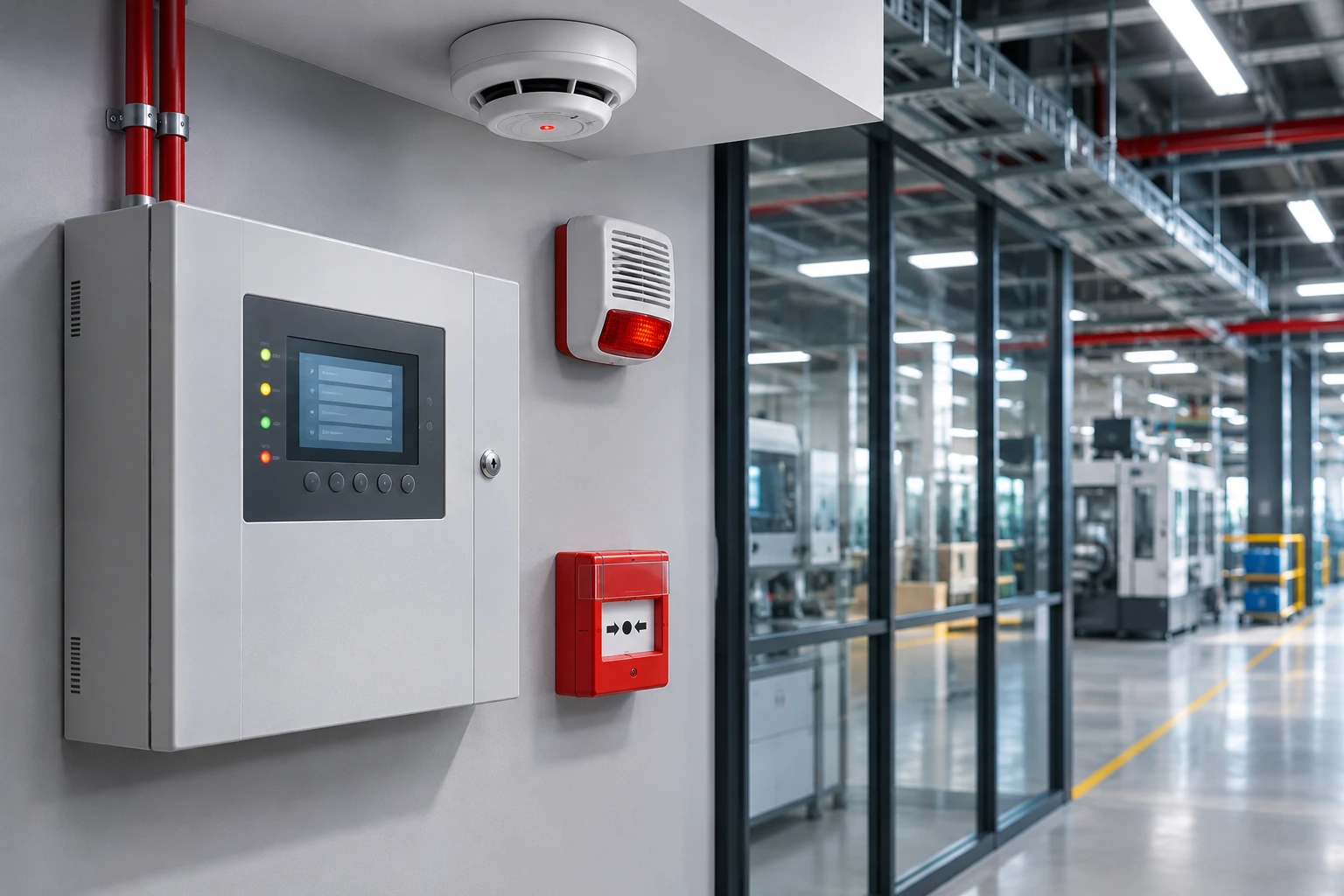
Teknim fire detection systems are electronic security solutions designed to monitor fire risks in homes, commercial buildings, hotels, industrial facilities and structures with various uses, and to provide early warning in the event of a fire. Türkiye-based Teknim Elektronik offers a broad product portfolio comprising conventional and intelligent addressable fire alarm panels, wireless detectors, manual call points, sirens, input/output modules and central monitoring software.
Teknim’s fire-safety product range prominently features TFP-series control panels, TLPWAN-based wireless fire detection technology and the Mosaic central management platform . These are
Although these solutions can be used in buildings of different sizes, a fire detection system should not be selected solely on the basis of the number of detectors supported by the panel. Fire risk, building use, detector technology, loop capacity, EN 54 compliance, communication reliability and maintenance requirements should be assessed together.
About Teknim Elektronik
Teknim is a Türkiye-based brand operating in fire detection and electronic security systems, with roots dating back to 1993.
In addition to fire detection systems, the company’s product portfolio includes intrusion alarm panels, motion detectors, communication modules and security management software.
Teknim’s fire detection products can be considered under three basic system architectures:
Conventional fire alarm systems: Solutions in which fire and fault information is monitored by zone.
Intelligent addressable fire alarm systems: Systems in which detectors and field modules can be individually identified by their device addresses.
Wireless and hybrid fire alarm systems: Solutions that connect radio-communicating devices to the system through compatible control panels and coordinators.
Teknim also offers Mosaic software for central monitoring and, in supported configurations, management of fire-safety systems.
How Do Teknim Fire Detection Systems Work?
The main purpose of fire detection systems is to detect physical signs associated with fire using suitable detectors and relay the relevant information to the fire alarm control panel.
For example, when an optical smoke detector senses smoke particles, the control panel can assess the signal and activate the programmed fire response.
The system’s main components are:
Fire alarm control panel: Assesses fire, fault and status information received from detectors and field modules.
Smoke detectors: Detect smoke particles using an appropriate detection principle.
Heat detectors: Monitor specified alarm conditions relating to temperature or a rise in temperature.
Multicriteria detectors: Can combine different detection principles, such as smoke and heat detection.
Manual fire call points: Allow users to trigger an alarm manually in the event of a fire.
Sirens and beacons: Help announce an alarm audibly or visually.
Input/output modules: Enable the fire system to communicate in a controlled manner with suitable external equipment.
Communication and management components: Provide central monitoring, event logging and remote notification functions in supported systems.
It is not enough for a fire alarm system merely to detect fire. Conditions such as broken cables, short circuits, power loss and device faults must also be monitored in accordance with the system’s technical requirements.
Teknim Conventional Fire Alarm Systems
In conventional fire detection systems, detectors are connected to designated fire alarm zones. When an alarm occurs, the control panel indicates the relevant zone.
These systems may be considered for projects with a limited number of detection zones. However, in a standard conventional architecture, the fact that each detector is not assigned an individual address can limit the ability to pinpoint the event location.
Teknim’s conventional panel range includes models such as TFP-3122, TFP-3124, TFP-4404 and TFP-4408.
Teknim TFP-3122 — 2-Zone Conventional Fire Panel
TFP-3122 is a conventional fire alarm control panel supporting two independent detection zones.
Key features stated by the manufacturer:
2 fire detection zones.
Support for up to 32 devices per zone.
Ability to distinguish between detector and manual call point alarms.
Fire and fault relay outputs.
24 V DC, 300 mA siren output.
External auxiliary power output.
Use of a 12 V / 7 Ah backup battery.
Remote access and notification options with a compatible Ethernet or LTE module.
EN 54-2 and EN 54-4 certification information.
TFP-3122 may be considered for projects with a small number of fire zones, provided it meets the technical requirements.
The manufacturer’s stated maximum number of devices per zone should not be interpreted as a guaranteed capacity that can be applied identically to every device type in every installation.
Teknim TFP-3124 — 4-Zone Conventional Fire Panel
TFP-3124 is a conventional fire control panel supporting four detection zones.
Key features:
4 fire detection zones.
Support for up to 32 detectors per zone.
Ability to distinguish between detector and manual call point alarms.
Monitoring of siren and zone circuits.
Zone-specific fault and alarm indicators.
Expansion using Ethernet and LTE communication modules.
EN 54-2 and EN 54-4 certification information.
TFP-3124 may be considered for applications requiring four separate sections to be defined as independent detection zones.
Teknim TFP-4404 and TFP-4408 Fire Panels
TFP-4404 and TFP-4408 are conventional fire alarm panels with 4 and 8 zones, respectively.
This product family is available with metal and plastic enclosures.
For the TFP-4408 model in particular, the manufacturer specifies the following features:
8 independent, monitored fire zones.
Connect up to 32 Teknim conventional detectors per zone.
Separate fire and fault indicators for each zone.
2 siren outputs, 500 mA each.
Fire and general fault relays.
Zone disablement.
Walk-test function.
Battery charging and power-supply monitoring.
EN 54-2 and EN 54-4 certification information.
The panel’s siren outputs and external power-supply capacity should be calculated alongside the total current consumption of the alarm devices in use.
Teknim Intelligent Addressable Fire Alarm Systems
In intelligent addressable fire detection systems, detectors, call points and suitable input/output modules can be identified by unique device addresses.
With this architecture, the control panel can identify which field device is associated with an alarm or fault.
Addressable systems can offer advantages for detailed event management in commercial buildings, hotels, business centers and industrial facilities with large numbers of detectors.
Teknim’s addressable fire alarm panels use the manufacturer’s FlashLink communication protocol . Both
Teknim TFP-2211 — 1-Loop Addressable Fire Panel
TFP-2211 is a fire alarm panel that operates with one addressable loop and can be expanded using an optional loop card.
The key technical specifications stated by the manufacturer are:
1 addressable loop.
240 devices per loop.
Expandable to up to 480 devices with an additional loop card.
72 programmable fire zones.
240 × 64-pixel graphic LCD display.
Network connection for up to 16 panels.
2 siren outputs, 500 mA each.
Fire and general fault relays.
IP30 protection rating.
EN 54-2, EN 54-4 and EN 54-21 certification information.
TFP-2211 may be considered for projects that start with a single-loop capacity but are planned to expand later.
Teknim TFP-2212 — 2-Loop Addressable Fire Panel
TFP-2212 is a fire alarm control panel operating through two addressable loops.
Key technical specifications:
2 addressable loops.
240 devices per loop.
Total capacity of 480 devices.
72 fire zones.
Network connection for up to 16 panels.
Graphic LCD display.
2 siren outputs, 500 mA each.
Central monitoring and supported remote management options.
EN 54-2, EN 54-4 and EN 54-21 certification information.
Using two loops can help ensure that cabling and field devices are distributed appropriately for the project.
However, the maximum number of devices per loop, cable length and power budget should be assessed together.
Teknim TFP-2214 — 4-Loop Addressable Fire Panel
TFP-2214 is a fire control panel supporting four addressable loops.
For this model, 127 devices per loop and 508 addressable devices are the stated capacities.
Key features:
4 addressable loops.
127 devices per loop.
Total capacity of 508 devices.
72 programmable fire zones.
Network connection for up to 16 control panels.
240 × 64 graphic LCD display.
Fire and fault relays.
Supported mobile and central monitoring options.
EN 54-2, EN 54-4 and EN 54-21 certification information.
Important technical distinction: The TFP-2211 and TFP-2212 models support 240 devices per loop, whereas the per-loop limit for the TFP-2214 model is 127 devices.
Therefore, do not assume that a four-loop panel supports 960 devices based on the calculation 4 × 240.
The manufacturer’s stated maximum total capacity for TFP-2214 is 508 devices.
Teknim TFP-211x and TFP-213x Series
Teknim’s addressable fire alarm products also include control panel options with zone indicators and built-in printers.
The TFP-2111, TFP-2112 and TFP-2114 models have zone LED indicators and are available with 1-, 2- and 4-loop options.
The TFP-2131, TFP-2132 and TFP-2134 models additionally feature a built-in thermal printer alongside the zone indicators.
A thermal printer may be considered for projects requiring physical printouts of alarm and event records.
However, having a printer does not replace digital event records or appropriate operational and maintenance documentation.
Technical Comparison of Teknim Addressable Fire Alarm Panels
Model | Loop | Maximum devices | Zone |
|---|---|---|---|
TFP-2211 | 1, expandable | 240 / 480 | 72 |
TFP-2212 | 2 | 480 | 72 |
TFP-2214 | 4 | 508 | 72 |
TFP-2111 | 1 | 240 | 72 |
TFP-2112 | 2 | 480 | 72 |
TFP-2114 | 4 | 508 | 72 |
TFP-2131 | 1 | 240 | 72 |
TFP-2132 | 2 | 480 | 72 |
TFP-2134 | 4 | 508 | 72 |
The table shows the nominal capacities stated by the manufacturer for each model family. For TFP-2211, the figure of 480 devices applies when an additional loop card is used.
The number of loops and device capacity are not the same thing. The actual number of devices that can be connected to a loop should be assessed alongside the panel’s technical limits, taking into account cable resistance, device current consumption, loop topology and the characteristics of the modules used.
Teknim Wireless Fire Detection Systems
Teknim’s wireless fire detection solutions were developed for use particularly in buildings where installing new cabling is difficult or costly.
These systems may be considered for historic buildings, hotels, existing commercial buildings, educational institutions and certain industrial facilities.
Teknim’s wireless fire detection products the communication technology known as TLPWAN (Teknim Low Power Wide Area Network) are used.
The TLPWAN architecture offers features such as low power consumption, two-way data communication, communication monitoring and extended coverage through repeaters.
The manufacturer states that it uses 868 MHz wireless communication, AES-128 encryption and a two-layer data-receipt acknowledgement mechanism.
Teknim TWM-1885 Wireless Addressable Coordinator
TWM-1885 is the coordinator that enables a connection between Teknim-compatible addressable fire alarm panels and wireless field devices.
Key technical features:
Integration with Teknim addressable fire panels.
868 MHz operating frequency.
Supports up to 31 wireless network devices per coordinator.
Limit of 26 end devices and 5 repeaters.
Specified communication range of up to 500 meters in open areas.
Programming and status display via an OLED screen.
Certification information for EN 54-17, EN 54-18 and EN 54-25.
TWM-1885 is powered via the addressable loop and, in compatible systems, allows wired and wireless detectors to be used together.
Teknim TWM-3885 Wireless Conventional Coordinator
TWM-3885 was developed to connect wireless fire detection devices to conventional fire alarm panels.
The manufacturer states that the device can be integrated with conventional panels from different brands using a suitable zone line and end-of-line resistor configuration.
Key features:
Connection to a conventional fire alarm panel.
868 MHz wireless communication.
Total network capacity of 31 devices.
Limit of 26 end devices and 5 repeaters.
Communication range of up to 500 meters in open areas.
External 18–35 V DC power supply.
Certification information for EN 54-18 and EN 54-25.
When integrating with conventional panels from different brands, field tests should verify that the panel correctly detects alarm and fault conditions.
Teknim TWM-1886 Wireless Repeater
TWM-1886 extends the communication area between the wireless coordinator and field devices.
It can help improve signal coverage in buildings with physical obstacles such as thick walls, metal shelving, large columns and similar barriers.
However, wireless communication range should not be determined solely by the open-area figures stated in the product datasheet.
In enclosed buildings, the actual communication range can be assessed only through on-site radio-signal measurements.
Teknim’s TWA-1891 wireless analysis kit can be used to check signal levels before installation.
Teknim Fire Detectors and Detection Technologies
One of the most important factors determining the performance of fire detection systems is the detection principle used by the detector.
Teknim’s product range includes optical smoke, fixed-temperature, rate-of-rise and multi-criteria detection technologies.
Teknim TFD-2350 Addressable Optical Smoke Detector
TFD-2350 is an optical smoke detector used in Teknim’s intelligent addressable fire systems.
The features stated by the manufacturer include:
Optical smoke detection.
Three sensitivity settings via the panel.
A detection algorithm adaptable to ambient conditions.
Monitoring of detector contamination status.
Cleanable smoke chamber.
Alarm and fault LED indicators.
Certification information for EN 54-7.
The detector’s ability to monitor its contamination status may help with maintenance planning. However, this feature does not replace regular cleaning and functional testing.
Teknim TFD-2351 Smoke Detector with Built-in Isolator
In addition to addressable optical smoke detection, TFD-2351 includes a built-in short-circuit isolator.
With a suitable loop topology, the isolator can help electrically isolate the faulty section if a short circuit occurs.
This feature may help reduce the risk of losing the entire loop because of a single short circuit.
However, the number and placement of isolators should be determined in accordance with the manufacturer’s design rules and relevant standards.
Teknim TFD-2360 and TFD-2370
TFD-2360 is an addressable detector designed for fixed-temperature detection.
TFD-2370, meanwhile, belongs to a multi-criteria detector family that combines optical smoke and heat detection.
Heat detectors may be considered in some environments where smoke detectors are unsuitable. However, in certain fire scenarios, heat-based detection may respond later than smoke detection.
Multi-criteria detectors also do not automatically perform better in every environment. The detection method and alarm logic should suit the characteristics of the environment.
Teknim TWD-1850 Wireless Multi-Criteria Detector
TWD-1850 is a smoke and heat detector in Teknim’s wireless fire detection product range.
Technical specifications:
Optical smoke, fixed-temperature and rate-of-rise detection options.
7 programmable detection methods.
868 MHz operating frequency.
Specified communication range of up to 500 meters in open areas.
2 CR123A batteries.
Specified battery life of up to 8 years under normal conditions.
Low-battery and detector-contamination alerts.
Certification information for EN 54-5, EN 54-7 and EN 54-25.
The battery life stated by the manufacturer depends on standard operating conditions. Radio communication conditions, ambient temperature and how often the device operates may affect actual battery life.
Comparison of Teknim Fire Detection Technologies
System type | Key feature | Points to consider |
|---|---|---|
Conventional | Zone-based alarm management | Limited identification of individual device locations |
Addressable | Alarm and fault information for each device | Loop design and protocol compatibility |
Wireless | Can reduce cabling requirements | Radio coverage, batteries and interference |
Hybrid | Wired and wireless devices used together | Coordinator and system compatibility |
None of these systems is categorically the best choice for every application.
Addressable systems can offer the advantage of detailed event management, particularly in large buildings, while wireless solutions can help reduce intervention in the fabric of historic buildings.
For more comprehensive information on assessing fire detection technologies for factory conditions, GüvenlikOnline’s How to Choose a Fire Detection System for Factories? guide can be consulted.
Teknim Mosaic Fire Alarm Monitoring and Management Software
Teknim offers the Mosaic software platform for centrally monitoring fire alarm systems and managing them in supported configurations.
The product range includes Mosaic Web, Mosaic Local and Mosaic Mobile.
Mosaic Web
Mosaic Web is a platform for web-based monitoring of compatible Teknim alarm systems.
The features stated by the manufacturer include:
Display of fire and fault events.
Alarm location shown on a layered map.
Review of event history.
Real-time notifications.
Central monitoring of multiple panels.
System management by authorised users.
Mosaic Web is available under different licensing options. Licence requirements should be assessed separately for projects involving multiple panels.
Mosaic Mobile
Mosaic Mobile provides mobile monitoring and management functions for supported fire alarm systems.
The manufacturer lists features such as viewing alarm events, certain system checks, detector contamination status, and monitoring battery and signal information for wireless devices.
Important: Remote monitoring software does not replace the fire control panel’s essential life-safety functions.
Fire detection and mandatory warning functions should be designed to meet relevant system requirements even if the internet or cloud connection is lost.
Building Automation Integration in Teknim Fire Alarm Systems
In suitable projects, fire detection systems can be linked to building automation systems, smoke-control equipment, access-control systems and other security infrastructure.
Teknim’s addressable product range includes input-output modules, repeater panels and network connection components.
For example, when a fire alarm occurs, relevant alarm outputs can be activated according to predesigned scenarios, or status information can be sent to other systems.
However, connections between a fire alarm and elevators, ventilation, door control or process equipment should be implemented only through appropriate engineering design and verified integration methods.
Supported addressable panels can be networked via Teknim’s TFC-1209 network module using RS-485 infrastructure.
The manufacturer specifies network connection capacity for up to 16 panels for this architecture.
This figure should not be treated as a capacity guaranteed for every project without verifying cable distance, topology and the interoperability of all models.
EN 54 Standards for Teknim Fire Detection Systems
One of the key regulatory sources used to assess fire detection and warning systems in Türkiye is the Regulation on Fire Protection of Buildings. ا
Article 74 of the Regulation requires fire detection systems and their components to be manufactured, designed, installed and operated in accordance with TS EN 54 standards.
The main standards that may be relevant when assessing Teknim’s product range include:
Standard | Relevant scope |
|---|---|
EN 54-2 | Fire control and indicating equipment |
EN 54-4 | Power supply equipment |
EN 54-5 | Point-type heat detectors |
EN 54-7 | Point-type smoke detectors |
EN 54-11 | Manual fire alarm call points |
EN 54-13 | Compatibility and connection assessment of system components |
EN 54-17 | Short-circuit isolators |
EN 54-18 | Input-output devices |
EN 54-25 | Components using radio links |
Certification information for certain Teknim control panels and detectors is published on the manufacturer’s official product pages.
However, the presence of a standards number on a product page does not mean that every component in the system to be installed is automatically compliant.
When checking a certificate, the product model, hardware version, scope of the document, issuing body and validity status should all be reviewed together.
The TS versions of the standards in force in Türkiye and the regulations applicable on the project date should be taken as the basis.
Where Can Teknim Fire Detection Systems Be Used?
Homes and Small Commercial Premises
Conventional fire alarm panels may be considered in buildings with a small number of detection zones and suitable technical requirements.
Hotels and Accommodation Facilities
In multi-storey buildings, addressable fire alarm systems may be useful for identifying the location of an event at device level.
Suitable wireless solutions may be considered in sections of existing buildings where cabling work needs to be limited.
Offices and Business Centers
In buildings with multiple floors, tenants, or business units, addressable fire alarm panels, network connectivity, and centralized monitoring options may be used.
Factories and Manufacturing Facilities
In industrial facilities, detector selection should be based on fire risk and environmental conditions.
Dust, temperature, airflow, high ceilings, and production processes can affect detection performance.
Teknim's standard smoke and heat detectors should not automatically be considered suitable for every industrial environment.
Different device families or complementary systems may be required, particularly in areas that require specialized detection technology.
Historic Buildings and Areas Requiring Architectural Preservation
Where cabling would require physical intervention in a building, suitable wireless fire detection technologies may be considered.
However, using a wireless system does not eliminate detector-placement requirements or other fire-safety requirements.
GüvenlikOnline's Fire Safety in Industrial Facilities article addresses the detection, suppression, evacuation, and maintenance aspects of fire safety together.
What Should You Consider When Choosing a Teknim Fire Alarm System?
1. Assessing the Building and Fire Risk
At the outset, the building's purpose, fire load, number of floors, areas of use, and required fire scenarios should be determined.
2. Conventional or Addressable Architecture
Conventional systems may be considered for projects with a limited number of detection zones.
Addressable architecture may offer advantages in buildings requiring device-level event information and detailed centralized monitoring.
3. Loop and Detector Capacity
In addition to the panel's total capacity, the device limit per loop should also be checked.
Cable resistance, loop current, and the field modules to be used should be included in the project calculations.
4. Wireless Communication Conditions
If a wireless or hybrid system is to be installed, coverage should be measured at the actual installation points.
Repeater placement, battery monitoring, radio interference, and device communication supervision should be assessed.
5. Certification and System Compatibility
Compliance of the fire control panel, detectors, alarm devices, and modules with applicable standards should be verified.
6. Power Supply and Battery Calculation
The length of time the system will operate during a mains power failure should be calculated.
Battery capacity should be determined with account taken of standby current, alarm current, and the applicable project requirements.
7. Integration and Management
Fire scenarios, associated outputs, centralized monitoring requirements, and access permissions should be defined during the design stage.
8. Maintenance and Technical Service
Regular testing of the system is as important as its installation.
Detector contamination, battery failures, cable faults, and the operational readiness of alarm scenarios should be documented.
Teknim Fire Detection System Installation Checklist
- Has the fire risk assessment been completed?
- Was the system architecture selected to suit the project?
- Have the panel's loop and zone capacities been verified?
- Are the detectors' detection technologies suitable for the environmental conditions?
- Has compatibility between the detectors and the control panel been checked?
- Have the relevant EN 54 conformity documents been verified?
- Have the loop cable and power budget been calculated?
- Have short-circuit isolators been appropriately planned?
- Have coverage and signal measurements been performed for wireless devices?
- Have the sirens and manual call points been tested?
- Have the battery capacity and power outage scenarios been verified?
- Has the transmission of fire and fault information to centralized monitoring been tested?
- Have the fire scenarios and integrations been verified?
- Have the maintenance plan and commissioning records been prepared?
This checklist is intended for preliminary assessment. The final project should be prepared by qualified personnel in accordance with the regulations in force and relevant standards.
Frequently Asked Questions About Teknim Fire Detection Systems
Are Teknim fire alarm systems manufactured domestically?
Teknim is an electronics security manufacturer based in Türkiye. The manufacturer's fire detection catalogue includes information indicating domestic production. However, if a domestic goods certificate and domestic contribution rate are required for a particular product, they should be verified for the specific model.
How many detectors does a Teknim addressable fire alarm panel support?
TFP-2211 supports 240 devices on a single loop and can accommodate 480 with the appropriate expansion. TFP-2212 has a total capacity of 480 devices, while TFP-2214 has a total capacity of 508 devices.
Does Teknim offer a wireless fire alarm system?
Yes. Teknim offers a TLPWAN-based wireless fire detection system. It can be used with addressable or conventional systems through compatible coordinators.
Can a Teknim fire alarm panel be monitored by phone?
Supported control panels can be monitored remotely through suitable communication modules and Mosaic software. This feature should not be assumed to be available on every panel without additional hardware and a licence.
How long do Teknim wireless detector batteries last?
For TWD-1850, the manufacturer specifies a battery life of up to 8 years under normal conditions when two CR123A batteries are used. Actual battery life depends on operating conditions.
Are Teknim fire detection systems EN 54 certified?
Certification information under EN 54 is available for certain Teknim control panels, detectors, and wireless products. Compliance should be verified based on the exact product model and the scope of its certification.
How Do You Determine the Right Solution for Teknim Fire Detection Systems?
Teknim's fire detection portfolio offers a range of options, from conventional systems to addressable panels with high device capacity and wireless communication solutions.
Conventional panels such as TFP-3122 and TFP-4408 may be considered where zone-based monitoring is required, while addressable panels such as TFP-2211, TFP-2212, and TFP-2214 may be considered for device-level monitoring and expandable system architectures.
The TLPWAN wireless product family may help reduce the need for new cabling in existing buildings.
The right fire detection system is not the panel that supports the most detectors or has the most features; it is a system that addresses the fire risks of the structure to be protected, has verified compliance with technical standards, and can be operated reliably over the long term.
For this reason, choosing a Teknim fire detection system should be considered alongside a technical survey, system design, product certification, correct detector placement, and commissioning tests.