
DMTech Fire Detection Systems: FP9000 Panels and Addressable Solutions
DMTech fire detection systems offer options for various buildings and facilities with FP9000 conventional panels, FP9000A addressable fire alarm systems, D9000 detectors, and FP9000E extinguishing control solutions. We examine DMTech's product families, EN 54 certifications, loop capacities, integration possibilities, and technical criteria to consider for correct system selection.
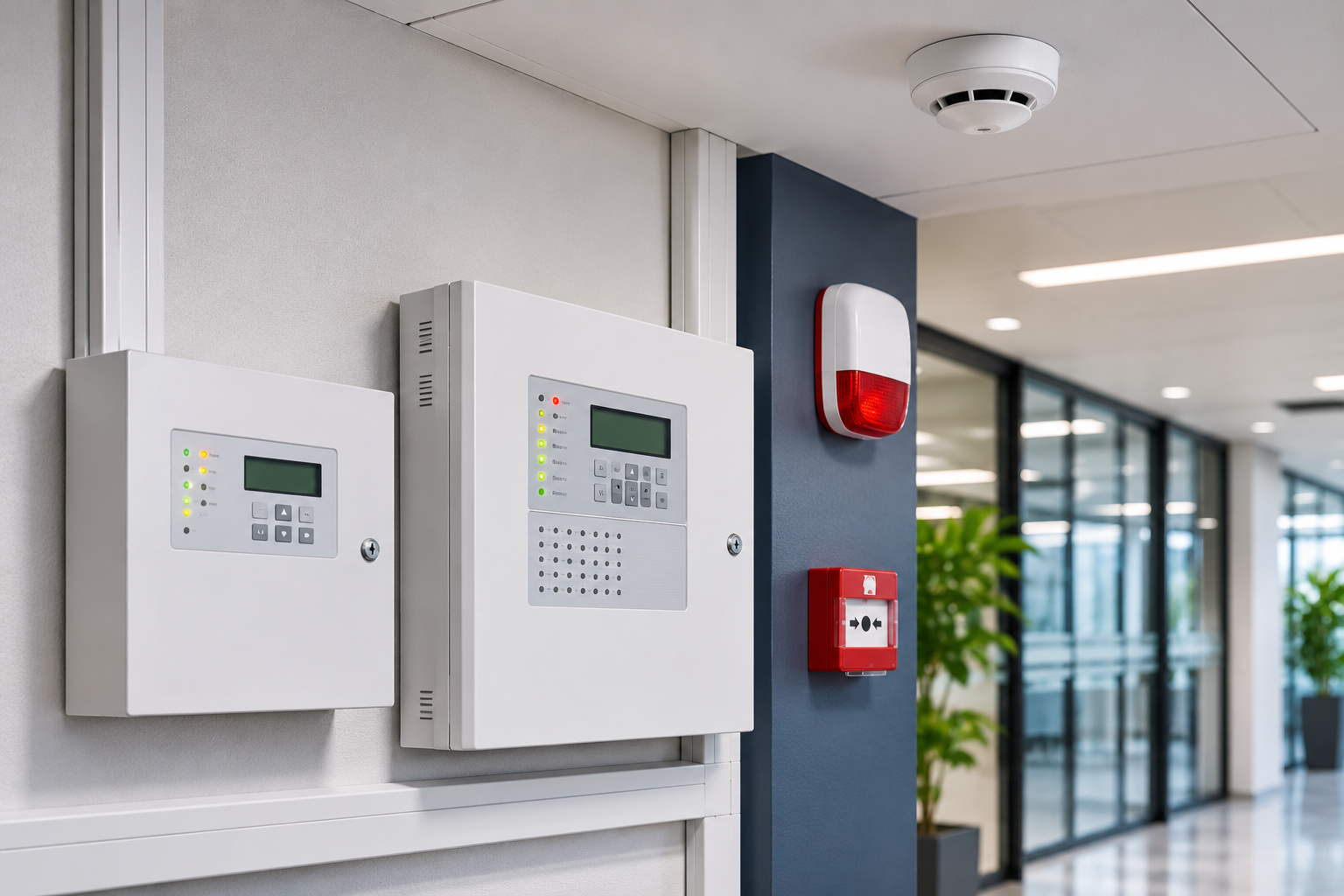
DMTech fire detection systems are electronic fire safety solutions developed to detect fire indications that may occur in buildings and facilities, manage alarm events, and initiate necessary safety scenarios. The manufacturer's product portfolio includes conventional and addressable fire alarm panels, smoke and heat detectors, manual fire alarm call points, sirens, input-output modules, and extinguishing control systems.
Bulgaria-based DMTech offers products for fire safety projects of different scales with FP9000 and FP9000L conventional fire alarm panels, FP9000A addressable systems, D9000 detectors, and the FP9000E extinguishing control panel.
DMTech's product family also includes D9000Flow aspirating smoke detection solutions, beam smoke detectors, and addressable control modules for building automation.
However, determining the correct fire detection system is not solely dependent on the panel's zone or loop capacity. Fire risk, detector technology, EN 54 compliance, device compatibility, cable infrastructure, backup power, and fire scenarios must be evaluated together.
What is DMTech?
DMTech Ltd., established in Bulgaria in 2011, is an electronic security manufacturer specializing in fire detection and alarm systems.
The company's official product portfolio includes fire alarm control panels, conventional and addressable detectors, manual call points, sirens, control modules, and devices for fire extinguishing management.
DMTech's product development approach emphasizes integrating fire detection, event management, and system integration functionalities for facilities of varying sizes.
The manufacturer's main solution families are:
FP9000L and FP9000: Conventional fire alarm panels.
FP9000A: Addressable fire detection and alarm panels.
D9000: Conventional smoke, heat, and combined detectors.
D9000A: Addressable fire detection devices.
M9000A: Addressable input, output, and control modules.
FP9000E: Fire extinguishing control panel.
D9000Flow: Aspirating smoke detection product family.
D9000 BEAM: Beam smoke detection solutions.
These products have different system architectures. For example, it should not be assumed that a conventional D9000 detector can be directly connected to any FP9000A addressable loop. The appropriate interface module and manufacturer compatibility must be evaluated.
DMTech Conventional Fire Detection Systems
In conventional fire detection systems, detectors are divided into specific areas, or zones.
When a detector generates an alarm, the panel indicates the relevant fire zone. However, it is not always possible to determine which specific detector on the same zone generated the alarm.
DMTech's main products in this category are the FP9000L and FP9000 series.
DMTech FP9000L Fire Alarm Panels
The FP9000L is a family of conventional fire alarm panels offered with 2, 4, and 8 zone options.
According to the manufacturer's official documents, this product family includes the following features:
EN 54-2 and EN 54-4 compliance.
2, 4, or 8 detection zones.
Monitoring of faults such as line breaks and short circuits.
Indication of fire and fault conditions via the panel.
Testing or disabling specific zones.
RS485 communication options with suitable expansion modules.
Programmable alarm and control outputs.
The FP9000L can be considered for facilities with a more limited number of detection zones, under appropriate building size and project conditions.
However, a building being small does not automatically mean that a conventional system is suitable. Fire scenarios, the required level of device addressing, and relevant regulations must be evaluated first.
DMTech FP9000-4 and FP9000-8 Fire Panels
The FP9000-4 and FP9000-8 are conventional control panels with four and eight fire detection lines, respectively.
Among the features specified by the manufacturer are:
Display of fire and fault information via LCD.
Six relay-type outputs.
Electrical supervision of detection lines.
Programmable alarm outputs.
Event memory up to 1,600 events.
Remote access and monitoring with optional communication modules.
Configuration of panel settings via software.
In these models, the correct physical separation of detection zones facilitates both fire location identification and maintenance work.
DMTech FP9000-16, FP9000-24, and FP9000-32
DMTech also offers FP9000-16, FP9000-24, and FP9000-32 panel options for projects requiring more conventional zones.
This product family offers 16, 24, and 32 fire detection lines, respectively.
The manufacturer states that there are 12, 16, or 20 relay-type outputs, depending on the model.
This structure helps manage alarm and fault information from different zones.
However, it should be remembered that a 32-zone conventional panel does not mean a system with 32 devices or 32 addresses. The number of zones and the total number of detectors are different technical parameters.
DMTech FP9000A Addressable Fire Detection Systems
In addressable fire detection systems, individual device addresses are assigned to compatible detectors and modules.
This allows the identity of the relevant device to be determined via the panel when a fire alarm or device fault occurs.
This approach can be particularly useful for maintenance, fault diagnosis, and fire event management in buildings with a large number of detectors.
DMTech's addressable product family is offered under the name FP9000A.
DMTech FP9000A-1 Addressable Fire Panel
The FP9000A-1 is a fire alarm control panel operating via one addressable loop.
According to the manufacturer's technical data, it includes:
1 addressable loop.
Up to 250 addressable devices per loop.
8 fire zones.
An additional conventional detection line.
Up to 32 suitable detectors on the conventional line.
1,024 event log capacity.
4 × 20 character LCD screen.
RS485 and USB communication interfaces.
DMTech configuration software support.
Backup power option via two 12 V batteries.
The FP9000A-1 can be considered for projects requiring device-based addressing and falling within the manufacturer's loop capacity.
However, the upper limit of 250 devices does not necessarily mean that 250 devices can be used in the project.
The actual loop capacity must be calculated based on device current consumption, cable length, cable cross-section, line resistance, loop architecture, and required fault tolerance.
DMTech FP9000A-2 Addressable Fire Panel
The FP9000A-2 product family offers an expandable architecture for larger addressable systems.
Features described in the manufacturer's FP9000A-2 (8) technical sheet include:
Technical parameter | Manufacturer's stated value |
|---|---|
Base loop count | 2 |
Expanded architecture | Up to 8 loops with additional equipment |
Max devices per loop | 250 |
Max total devices per panel | 1,500 |
Fire zones | 128 |
Event log capacity | 32,000 |
Display | 7 inch, 800 × 600 touchscreen |
Panel communication | RS485, USB, LAN |
Panel network structure | Up to 8 panels |
The manufacturer states that a total of 12,000 addressable devices can be managed via eight addressable panels in an appropriate network architecture.
Important technical distinction: The values of 250 devices per loop, 1,500 devices per panel, and 12,000 devices across the network are different capacity limits. It should not be assumed that eight loops directly create a usable panel capacity of 2,000 devices.
Furthermore, the requirements for expansion modules and network components must be verified according to the technical documentation of the selected FP9000A variant.
Comparison of DMTech Conventional and Addressable Fire Alarm Systems
Technical criterion | FP9000 / FP9000L | FP9000A |
|---|---|---|
System architecture | Conventional | Addressable |
Alarm location | Zone-based | Device address-based |
Detector communication | Conventional zone line | Addressable loop |
Device fault diagnosis | Line and zone level | Detailed for supported devices |
Expansion | Dependent on panel zone capacity | Dependent on loop and module capacity |
Control scenarios | With programmable outputs | With addressable input/output modules |
Prominent use | More limited and defined zone structures | Multi-device systems requiring detailed control |
It should not be concluded that a conventional system is always economical, or an addressable system is always safer.
Total system cost must be evaluated together with the number of detectors, cable infrastructure, automation scenarios, labor, maintenance, and future expansion requirements.
For general operating principles of fire alarm systems, GüvenlikOnline's article Fire Alarm Systems can be reviewed.
DMTech D9000 Fire Detectors and Features
DMTech's detector portfolio includes products for detecting various fire indications.
D9000 SR Optical Smoke Detector
The D9000 SR is a conventional detector operating on the principle of optical smoke detection.
It aims to detect fire indications by utilizing the change in light behavior caused by smoke particles in the optical detection chamber.
The manufacturer states that the model is certified according to EN 54-7 standard.
Ofisler, koridorlar, belirli teknik odalar ve temiz ortamlar gibi alanlarda değerlendirilebilir.
However, environmental conditions should be examined, as dust, steam, and other aerosols can increase the risk of false alarms.
D9000 T Heat Detector
The D9000 T is a family of conventional detectors developed for heat detection.
There are two main options described by the manufacturer:
D9000 T A1R: Rate-of-rise heat detector.
D9000 T A1S: Fixed temperature heat detector.
Both models are product options under EN 54-5.
Heat detectors can be considered in specific areas where smoke detectors are unsuitable due to environmental conditions.
However, it should not be assumed that the heat detection method will provide the same warning time as optical smoke detection for slow-developing fires that produce early smoke.
D9000 MSR Combined Smoke and Heat Detector
The D9000 MSR is a detector that combines optical smoke and heat detection features.
EN 54-5 and EN 54-7 compliance is declared by the manufacturer.
The purpose of combined detectors is to enable alarm evaluation by utilizing different fire indications.
However, the presence of two detection methods in the same device does not guarantee lower false alarms or faster detection in all environments.
D9000 FL Flame Detector
DMTech's D9000 FL product family includes a model for flame detection via infrared radiation.
The manufacturer states EN 54-10 Class 2 (IR) sensitivity information for the model.
Flame detectors can be considered in specific fire scenarios where direct flame formation can develop rapidly.
However, welding processes, hot equipment, solar radiation, line-of-sight obstructions, and other potential sources of false alarms should be examined separately.
The current product certification scope, official technical data, and conformity documents for D9000 FL must be verified separately.
DMTech D9000A Addressable Detectors
DMTech's addressable D9000A family consists of devices developed for use in the FP9000A system architecture.
Main products include:
D9000A SR: Addressable optical smoke detector.
D9000A T: Addressable heat detector.
D9000A MSR: Addressable combined optical smoke and heat detector.
D9000A MCP: Addressable manual call point.
S9000A: Addressable audible fire alarm device.
Certain models in the family have alternatives with short-circuit isolators.
Short-circuit isolators can help limit the impact of a line fault in appropriate loop designs.
However, merely using devices with isolators is not sufficient. Loop topology and isolator placement must be evaluated according to the manufacturer's design and application requirements.
DMTech M9000A Input and Output Modules
DMTech's technical announcement dated March 17, 2026, explains the use of M9000A addressable modules in building automation and fire safety scenarios.
Input and output modules can establish supervision and control connections between the fire detection system and various building security components.
Example products include:
M9000A IO 1/0: Module for monitoring a single input.
M9000A IO 3/0: Module for monitoring three inputs.
M9000A IO 0/4: Module for controlling four relay outputs.
M9000A IO 1/1: Module for managing one input and one output.
M9000A IO 2/2: Control module containing two inputs and two outputs.
M9000A ACZ: Module for monitoring a conventional detection line via a suitable addressable system.
These modules can be considered for establishing connections with smoke dampers, ventilation systems, specific door control functions, or other technical components in appropriate fire scenario designs.
However, the presence of a relay output on the module does not mean that any high-power device can be directly connected. Relay contact capacity, external power supply, line supervision, and the safe operating conditions of the relevant system must be examined.
Fire control scenarios must comply with applicable regulations and the approved fire safety project.
DMTech FP9000E Fire Extinguishing Control Panel
The FP9000E is a conventional extinguishing panel developed by DMTech for controlling automatic fire extinguishing processes.
The manufacturer states that the FP9000E is certified according to EN 54-2, EN 54-4, and EN 12094-1 standards.
The panel is designed to work with control components used in appropriate gaseous and other fixed extinguishing applications.
Main features:
Three conventional zones.
Extinguishing control logic via two automatic detection zones.
One additional fire detection zone.
Manual and automatic operating options.
Control of extinguishing outputs.
Monitored inputs and outputs.
1,600 event log capacity.
Operating architecture for a single extinguishing zone.
The FP9000E can be considered in specific applications where detection and extinguishing control need to be correlated.
Critical safety note: The triggering logic of extinguishing systems, evacuation warnings, delay times, and manual control operations must be designed by authorized experts in accordance with the approved extinguishing project.
It should not be assumed that the FP9000E is directly compatible with all gaseous, aerosol, or other extinguishing equipment. Compatibility of the extinguishing agent, valve, actuator, pressure supervision, and other equipment must be verified separately.
DMTech D9000Flow Aspirating Smoke Detection
DMTech's product portfolio also includes the D9000Flow-1/2/3/4 aspirating smoke detection product family.
Aspirating systems analyze smoke particles by drawing air samples from the protected area through a pipe network.
DMTech's D9000Flow for açıkladığı özellikler:
Options for up to four independent detection channels in a modular configuration.
Manufacturer's capacity statement for pipe networks up to 250 meters.
More than 50 sampling point options.
Automatic drift compensation.
Analysis of optical smoke aerosols.
RS485/Modbus, USB, and Wi-Fi communication interfaces.
Independent or integrated operation with suitable systems.
The manufacturer describes an optical analysis approach using blue and infrared light together in the system.
D9000Flow can be considered for specific technical rooms, data centers, warehouses, and facilities where early smoke detection is critical.
However, in aspirating systems, performance does not solely depend on the device's detection sensitivity. Pipe diameters, hole locations, airflow, sample transport time, filtration, and detection class must be calculated together.
The current EN 54-20 certificate and detection class for D9000Flow could not be definitively verified on the product page examined. Therefore, the relevant conformity document should be requested separately during project selection.
In Which Areas Can DMTech Fire Detection Systems Be Used?
DMTech's different product families can be considered in various applications depending on the building type and fire risk.
Offices and Commercial Buildings
Conventional or addressable fire alarm panels can be selected according to the fire detection needs of corridors, workspaces, technical rooms, and other premises.
Stores and Retail Businesses
Smoke, heat, and manual alarm devices can be considered for store sales areas, warehouses, and specific technical sections.
For stores within shopping malls, the requirements for installing an independent alarm system and integration with the shopping center's central fire system must be addressed together.
Factories and Industrial Facilities
In production areas, detector selection depends on conditions such as fire load, dust, steam, temperature, and airflow.
In industrial facilities, addressable systems can contribute to managing fire scenarios through appropriate modules.
However, selecting the correct detection technology in production environments is an engineering evaluation independent of the panel brand.
In this regard, GüvenlikOnline's guide How to Determine the Right Fire Detection Solution for Factories? can be reviewed.
Warehouses and Logistics Centers
In high-ceiling areas, smoke stratification, ventilation, and storage layout must be evaluated when selecting detector technology.
Beam-type or aspirating detection solutions may be considered in appropriate projects.
Hospitals and Educational Institutions
In buildings with numerous premises, addressable alarm systems can be considered for device-based event identification and maintenance management.
However, evacuation organization, building usage, and relevant regulations are priorities in the selection of a fire alarm system.
Data Centers and Technical Rooms
In areas with high electronic equipment density, early smoke detection and appropriate extinguishing control can become important.
In such applications, solutions like FP9000A, D9000Flow, and FP9000E should only be considered after verifying relevant product compatibilities and project scenarios.
EN 54 Standards and Certification in DMTech Fire Detection Systems
In fire detection systems, product certification and system design compliance are different matters.
DMTech's official documents and DEDAL – A&C certification body records show EN 54 compliance for various fire alarm products.
Main standards:
Standard | Scope |
|---|---|
EN 54-2 | Fire alarm control and indicating equipment |
EN 54-3 | Audible fire alarm devices |
EN 54-4 | Power supply equipment for fire alarm systems |
EN 54-5 | Point heat detectors |
EN 54-7 | Point smoke detectors |
EN 54-10 | Flame detectors |
EN 54-11 | Manual call points |
EN 54-13 | Compatibility and connectability of system components |
EN 54-17 | Short-circuit isolators |
EN 54-18 | Input/output devices |
EN 54-20 | Aspirating smoke detectors |
EN 12094-1 | Electrical control and delaying devices for gaseous extinguishing systems |
DEDAL certification records dated September 30, 2026, show valid compliance records for DMTech's FP9000 panels, FP9000A addressable panel, FP9000E extinguishing panel, and various D9000 detectors.
However, having an EN 54 compliance document for a product does not mean that every system installed with that product automatically complies with regulations.
Furthermore, the current editions and amendments of the standards, their TS EN equivalents in Turkey, and the validity of relevant product certificates must be verified during the project phase.
Legislation for Fire Detection Systems in Turkey
In Turkey, the Regulation on Fire Protection of Buildings is one of the fundamental regulations for the design, installation, and operation of fire detection and alarm systems.
Article 74 of the Regulation governs the design principles of fire alarm systems, and Article 75 regulates the requirements for detection and alarm systems.
The placement of fire detection devices must be based on the relevant TS EN 54 standards and the approved fire safety project.
Especially if delays are considered for alarm verification in industrial facilities, it should be noted that the regulation does not permit pre-warning applications for certain hazardous material processing and storage structures.
Software and Remote Monitoring in DMTech Fire Detection Systems
DMTech offers software tools for configuring and monitoring its control panels.
DMTech Setup Software
In the addressable FP9000A product family, loops, zones, devices, and specific system parameters can be configured using the manufacturer's setup software.
Loop Calculator
DMTech's Loop Calculator tool helps evaluate technical parameters such as the number of devices, cable length, and cable cross-section in addressable loop planning.
However, the results of such calculation tools do not replace an approved electrical or fire project on their own.
DMTech Remote Client and VNC
The manufacturer also offers remote configuration and status monitoring solutions for supported FP9000 panels.
In these systems, panel statuses can be reviewed or authorized operations can be performed with appropriate connection and software infrastructure.
Remote access increases the cybersecurity requirements for fire alarm systems. Management interfaces of critical security systems should not be left directly exposed to the internet; access authorization, secure connection, change logs, and network segmentation must be implemented.
What to Consider When Choosing a DMTech Fire Detection System?
The correct system selection should not be based solely on panel capacity.
1. Conventional or Addressable Architecture
Building size, number of detectors, the need for detailed event location identification, and future expansion plans must be considered.
2. Detector Technology
The suitability of smoke, heat, combined, flame, or aspirating detection technologies must be determined according to the fire scenario of the premises.
3. Panel and Loop Capacity
In addressable systems, in addition to the number of devices, loop current, cable resistance, and expansion modules must be checked.
In conventional systems, the number of zones, device capacity per line, and the physical arrangement of zones must be examined.
4. Compatibility of System Components
There must be manufacturer-verified compatibility between the panel, detector, module, siren, and other devices.
An EN 54 certified product does not mean it will work with all panels from different manufacturers.
5. Battery and Backup Power
The total energy consumption of the panel and connected equipment must be calculated.
Battery capacity must be determined according to relevant project requirements and standards for standby and alarm durations.
6. Fire Scenarios and Integration
Necessary connections with smoke control systems, doors, ventilation, elevators, and extinguishing systems must be defined.
7. Maintenance and Technical Support
Periyodik test yöntemleri, yedek parça temini, güncel yazılım ve Türkiye'deki teknik destek koşulları kontrol edilmelidir.
For details on maintenance and testing processes of fire alarm systems, the guide How to Perform Periodic Maintenance on Fire Detection Systems? can be utilized.
DMTech Fire Detection System Technical Checklist
The following checks must be performed before system design and commissioning:
Has the building's purpose and fire risks been determined?
Have the necessary detection zones and fire scenarios been defined?
Has the suitability of the FP9000 or FP9000A architecture been evaluated?
Have detector types been selected according to environmental conditions?
Have the current certificates of the panel and detectors been verified?
Have loop or zone capacities been calculated?
Have cable type, length, cross-section, and line supervision been checked?
Have isolator locations been evaluated in addressable systems?
Has the suitability of sirens and warning devices been checked?
Has battery and backup power calculation been performed?
Have building automation and extinguishing system connections been verified?
Have fire alarm scenarios been tested?
Have event and fault notifications from the panel been checked?
Have remote access and cybersecurity measures been determined?
Has a periodic maintenance and test plan been created?
Have as-built projects, device lists, and test reports been prepared?
This list is for technical preliminary evaluation purposes. Final system design and acceptance procedures must be carried out by authorized experts in accordance with relevant regulations and project requirements.
Frequently Asked Questions About DMTech Fire Detection Systems
Which country is DMTech a brand of?
DMTech is a Bulgarian-based manufacturer of fire detection and alarm systems. The company was founded in 2011.
Are DMTech fire panels addressable?
DMTech has both conventional and addressable fire alarm panels. FP9000 and FP9000L are conventional, while FP9000A is the addressable product family.
How many detectors does DMTech FP9000A support?
For FP9000A-1, the manufacturer specifies support for up to 250 devices on one addressable loop. In the larger FP9000A-2 architecture, the total panel capacity is stated to be up to 1,500 addressable devices. Actual usable capacity depends on loop calculation.
Does DMTech fire detection systems have EN 54 certification?
Yes. DMTech has certification records for EN 54 standards for specific panels and detectors. However, the certificate and validity of each device must be checked separately.
Can DMTech fire panel be monitored from a computer?
For supported FP9000 and FP9000A products, there are software options for configuration, status monitoring, and remote access in appropriate systems.
Do DMTech fire alarm panels work with other brands of detectors?
For conventional devices, appropriate electrical and functional compatibility must be verified. For addressable loops, the manufacturer's protocol and device compatibility are important. It should not be assumed that all detectors are directly compatible.
What is the purpose of DMTech FP9000E?
The FP9000E is a control panel developed for evaluating detection events and managing extinguishing control operations in suitable fixed fire extinguishing systems.
How are DMTech fire alarm system prices determined?
Prices depend on the panel model, number of detectors, zone or loop capacity, cabling, modules, sirens, software requirements, installation, and commissioning services.
How Should DMTech Fire Detection Systems Be Evaluated?
DMTech offers solutions for various fire safety needs, from conventional FP9000 products to addressable FP9000A systems, D9000 detectors, and the FP9000E extinguishing control panel.
Especially the addressable FP9000A family can be evaluated for device-based alarm identification, loop expansion, and managing different fire scenarios with input/output modules.
Solutions like FP9000E and D9000Flow can also provide alternatives for special applications under appropriate technical and regulatory conditions.
However, in the correct evaluation of DMTech systems, one should not focus solely on product capacity or brand preference.
Fire risk, EN 54 compliance documents, device compatibility, detector placement, loop calculations, alarm scenarios, commissioning, and maintenance processes must be considered together.
At the core of a successful fire detection system lies not only the right product selection but also design in accordance with standards and verified field performance.