
Dahua Fire Detection Systems: Panels, Detectors and AI Solutions
Dahua fire detection systems offer a broad product family comprising conventional and addressable fire alarm panels, smoke and flame detectors, aspirating detection solutions, and AI-powered fire cameras. We examine Dahua Wisualarm systems, HY-series control panels, their technical specifications, EN 54 compliance, and the criteria to consider when selecting the right system.
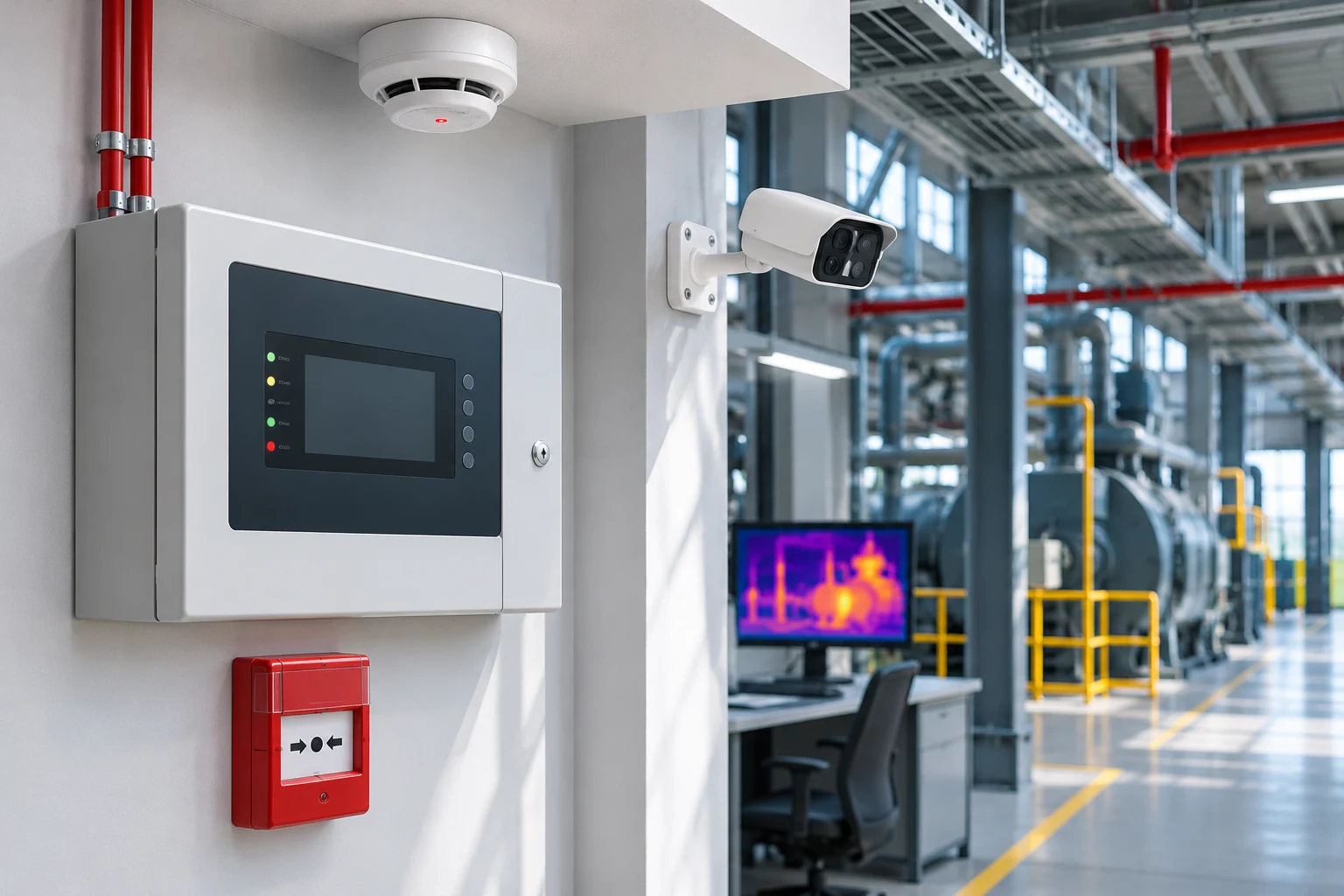
Dahua fire detection systems are electronic fire-safety solutions developed to detect signs of fire in buildings and industrial facilities, manage alarm information and support security operations. Dahua Technology, known for its IP cameras and video analytics technologies, also offers conventional and addressable fire alarm panels, smoke and heat detectors, aspirating smoke detection systems, flame detectors and image-based fire detection cameras.
Dahua's Wisualarm product family brings together traditional fire detection technologies with IP communications, centralized monitoring and, in supported products, video analytics.
However, selecting a fire detection system requires more than considering the brand or technological features alone. The control panel's capacity, detector operating principle, EN 54 compliance, building use, fire risk and integration requirements must all be assessed together.
Dahua Technology and Wisualarm Fire Safety Solutions
Dahua Technology is an international manufacturer developing video surveillance, image processing, artificial intelligence, IoT and electronic security technologies.
The company's fire-safety products are offered under the Dahua Fire Alarm and Wisualarm brands.
The manufacturer's official fire-safety portfolio comprises six main groups:
Residential smoke, heat, gas and carbon monoxide alarm devices.
Conventional fire detection systems.
Addressable fire detection systems.
Aspirating smoke detection systems.
Flame detectors.
Fire-safety cameras with smoke and flame detection capabilities.
These product families are designed for different security requirements. For example, a standalone residential smoke alarm and an addressable fire control panel do not perform the same system functions.
Similarly, a camera that detects smoke or flames using video analytics cannot be considered a direct substitute for a compliant fire detection system unless the product's required compliance and system design have been verified.
Dahua Conventional Fire Detection Systems
Conventional fire detection systems are a traditional fire alarm architecture in which detectors are connected to the control panel through defined detection zones.
When a fire alarm is triggered in a zone, the panel identifies the relevant zone. However, in a standard conventional architecture, it is not always possible to identify separately which specific detector triggered the alarm.
Dahua's conventional product family includes HY-CFP and HY-C series panels, as well as smoke, heat and multi-criteria detectors.
Dahua HY-CFP2002D Fire Alarm Panel
HY-CFP2002D is a 2-zone conventional fire alarm control panel developed for small-scale applications.
Technical specifications stated by the manufacturer:
2 conventional detection zones.
Capacity specified for up to 25 detectors per zone.
AC 100–240 V mains supply.
12 V / 2.5 Ah backup battery feature.
Relay outputs for fire alarm and fault.
Sounder circuit.
Declared compliance with EN 54-2 and EN 54-4 standards.
The panel may be considered for small commercial spaces, but the actual detector capacity, cable distances, current draw of alarm devices and backup power calculation must be verified separately.
Dahua HY-C102-6L Fire Alarm Panel
HY-C102-6L is a fire control panel with six conventional zones.
According to the manufacturer's datasheet, a capacity of 25 detectors per zone is specified.
Its technical specifications include a 100–240 V AC mains supply, the optional use of two 12 V / 7 Ah batteries, and a fire alarm output.
Conventional systems may be considered for projects that are small or have a limited number of detection zones. However, having fewer zones does not by itself mean that the system cost or installation will always be lower.
Dahua Addressable Fire Detection Systems
In addressable fire detection systems, detectors and compatible field modules are identified by unique addresses within the system.
When an alarm or fault occurs, the control panel can display not only general zone information but also the address of the relevant device and its programmed location description.
This feature makes it easier to locate an incident, particularly in multi-storey or multi-section buildings or facilities containing many detectors.
Dahua's addressable product family includes control panels with different capacities, such as HY-1022, HY-1025 and HY-AFP5010P.
Dahua HY-1022 and HY-1022R
The HY-1022 family comprises control panels for single-loop addressable fire detection systems.
Features stated by the manufacturer:
1 addressable loop.
Up to 254 addressable devices per loop.
4.3-inch LCD screen.
Two-wire communication connection.
RS-485 communication on supported hardware.
Fire and fault outputs.
Display of event logs.
One important difference between the HY-1022 and HY-1022R models is their loop topology.
The manufacturer specifies a Class B loop topology for HY-1022 and Class A for HY-1022R.
Class A and Class B refer to specific loop connection and fault-tolerance characteristics. However, a system's actual fault tolerance must be assessed in conjunction with its cabling topology and the isolators used.
Dahua HY-1025 and HY-1025R
The HY-1025 family comprises control panels that can be used in projects requiring two addressable loops.
Key technical specifications of the HY-1025R model:
2 addressable loops.
Capacity of 254 devices on each loop.
Total capacity of 508 addressable points.
4.3-inch LCD screen.
Class A loop topology.
Panel network connection via RS-485.
Cloud and local platform management options.
Fire and fault relay outputs.
The manufacturer specifies networking capacity for up to 128 panels for HY-1025R.
However, this figure does not mean that 128 panels will operate reliably on a single cable route in every project. Communication distance, topology, addressing, power infrastructure and software compatibility must be designed separately.
Dahua HY-AFP5010P Addressable Fire Alarm Panel
HY-AFP5010P is Dahua's addressable fire control panel for applications requiring higher loop capacity.
The main features stated by the manufacturer are:
10-inch touchscreen.
Modular expansion to up to 1–10 loops.
254 addressable points per loop.
Theoretical maximum capacity of up to 2,540 points with full expansion.
Class A and Class B connection topologies.
Programmable fire scenarios.
Monitoring of detector contamination.
Pre-alarm functions.
Ethernet and RS-485 communication interfaces.
Management options supported by the DSS Pro and Wisualarm platforms.
Important technical distinction: The HY-AFP5010P panel is available in configurations that do not include loop cards. Therefore, the capacity of 10 loops and 2,540 points represents the maximum capacity achievable by using the required loop cards and compatible system components.
This panel may be considered for projects requiring a large number of detection points, different fire scenarios and centralized monitoring.
Comparison of Dahua Fire Alarm Panels
Model | System type | Stated capacity |
|---|---|---|
HY-CFP2002D | Conventional | 2 zones |
HY-C102-6L | Conventional | 6 zones |
HY-1022R | Addressable | 1 loop, 254 points |
HY-1025R | Addressable | 2 loops, 508 points |
HY-AFP5010P | Addressable, modular | Up to 10 loops and 2,540 points |
The values shown in this table indicate the maximum technical capacities stated by the manufacturer.
The zone capacity of a conventional panel and the device capacity of an addressable panel are not the same engineering concept.
Furthermore, the maximum number of devices supported by a panel should not be treated as directly usable capacity without considering cable length, loop current, module consumption and the project's fire scenarios.
Dahua Smoke and Heat Detectors
The performance of a fire detection system depends not only on the control panel but also on the detectors that sense signs of fire.
Dahua's product family includes optical smoke detectors, heat detectors and multi-criteria detectors that combine smoke and heat detection.
HY-1301 Addressable Smoke Detector
HY-1301 is a two-wire smoke detector for addressable fire detection systems.
Technical specifications stated by the manufacturer:
24 V DC operating voltage.
Two-wire, polarity-insensitive connection.
Address range of 1–254.
Electronic addressing.
Alarm and fault status indicators.
Declared compliance with EN 54-7 standard.
This type of detector is used to monitor smoke development in a suitable system architecture.
HY-1310 Addressable Heat Detector
HY-1310 is an addressable detector designed for heat detection.
The manufacturer specifies class A2R and an alarm threshold range of 54–62 °C for this product.
Class A2R defines the response behaviour to temperature and temperature rise under the relevant standard.
Heat detectors may be considered for some environments where smoke detectors are unsuitable. However, detection time depends on how the fire develops and on ambient conditions.
HY-C135 Multi-Criteria Detector
HY-C135 is a conventional detector combining smoke and heat detection.
The manufacturer's product page lists EN 54-5 and EN 54-7 standards.
Multi-criteria detectors can enable the assessment of different fire indicators. However, this feature does not mean that false alarms will not occur in every environment.
For more information on comparing detector technologies and identifying the right detection method for industrial facilities, consult GüvenlikOnline's How to Choose the Right Fire Detection Solution for Factories? guide.
Dahua Aspirating Smoke Detection Systems
Aspirating smoke detection systems draw air samples through pipes from the area to be protected and analyse smoke particles.
This technology may be considered for specialized applications where early smoke detection is particularly important.
Dahua offers models in this product group such as HY-ASD420B and HY-ASD620B-P.
Dahua HY-ASD620B-P
HY-ASD620B-P is a smoke detection device that uses two air-sampling pipes.
According to the manufacturer's technical data:
2 sampling pipes.
A maximum length of 79 meters per pipe.
16 sampling holes per pipe.
Maximum coverage area specified as up to 1,422 m².
Sensitivity range of 0.001%–3 obs/m.
Multiple alarm levels.
Airflow monitoring sensors.
Ethernet, RS-485 and relay outputs.
IP66 protection rating.
The manufacturer specifies the VdS 2344:2022-10 standard for the product.
This information should not be interpreted to mean that the device automatically meets TS EN 54-20 requirements in every project in Türkiye. The relevant conformity documents should be checked separately.
The stated maximum coverage areas and pipe lengths for aspirating systems are not values that can be applied directly to an actual project. Pipe diameters, sampling-hole distribution, air-transport time and the manufacturer's design calculations must be taken into account.
Dahua AI-Powered Fire Detection Cameras
Dahua's experience in video analytics is also applied to fire-safety cameras.
Image-based fire detection systems rely on assessing signs of smoke or flame in images captured by a camera.
Solutions using thermal cameras can analyze temperature-related information based on the infrared emissions of objects.
However, these two technologies are based on different physical principles.
Dahua HY-SAV849HA-E Smoke Detection Camera
The HY-SAV849HA-E is an IP camera with 5 MP resolution that combines a smoke-detection component with video surveillance functions.
Notable product features include:
5 MP CMOS image sensor.
Photoelectric smoke-detection component.
Image-based flame-detection analytics.
Correlation of smoke alarms with video events.
H.265 video compression.
Built-in microphone and speaker.
Audio and visual alarm capabilities.
PoE or 12 V DC power supply.
Specified backup-battery support for the smoke-detection component.
An important feature of this camera is that it combines imaging with a physical smoke-detection component, rather than estimating smoke solely through image analysis.
This approach may make it easier to visually assess an alarm event.
However, having camera functionality does not mean that the device will be accepted as a standalone, code-compliant fire-detection system for every building.
Dahua HY-FT443MFP Flame Detection Camera
The HY-FT443MFP is a fire-safety camera that combines thermal imaging and visible-light imaging.
The manufacturer's technical specifications list the following features:
256 × 192 pixel thermal sensor.
Thermal spectral range of 8–14 µm.
Specified temperature-monitoring range from –10 °C to +500 °C.
Image-based smoke and flame analysis.
Hot-spot and cold-spot alarms.
Audio and light alerts.
Alarm outputs.
IP67 protection rating.
Options for network-based event notifications.
The manufacturer specifies a detection distance of 30 metres for reference smoke and flame targets of a certain size.
However, this performance depends on the specified test conditions and target size. It should not be interpreted to mean that every fire will be detected from 30 meters away.
Camera angle, mounting distance, obstructions in the field of view, ambient conditions and the way a fire develops can affect detection performance.
Can Dahua Thermal Cameras Detect a Fire in Advance?
Thermal cameras capable of measuring temperature can help monitor abnormal surface temperatures on certain equipment.
For example, temperature rises in electrical panels, conveyor components, motors and certain process equipment may indicate a risk that maintenance teams should assess.
However, a thermal camera cannot detect every fire before it starts. In addition, not every thermal camera performs radiometric temperature measurement.
Measurement accuracy is affected by the surface emissivity, distance, reflections, ambient temperature and sensor characteristics.
For a more comprehensive technical assessment of these technologies, see GüvenlikOnline's What Is an AI-Powered Fire Detection System? article.
Comparison of Dahua Fire Detection Technologies
Technology | Primary detection method | Main technical limitation |
|---|---|---|
Conventional system | Zone-based detector monitoring | Limited location detail at device level |
Addressable system | Monitoring of individually addressed detectors | Loop and device compatibility required |
Aspirating system | Air-sample analysis through pipes | Pipe design and maintenance are critical |
Video smoke/flame analysis | Signs of smoke or flame in the image | Field of view and ambient conditions |
Thermal monitoring | Infrared energy and temperature assessment | Measurement conditions and surface properties |
Standalone smoke alarm | Local smoke detection and alerting | Limited central-system functions |
These technologies are not equivalent solutions that can be used directly as substitutes for one another.
System selection should be based on the required fire-safety functions and compliance with the relevant standards.
Central Management of Dahua Fire Detection Systems
Dahua's fire-safety portfolio includes software and communication options for centrally monitoring supported addressable systems.
Among the management solutions specified by the manufacturer for some HY-series control panels are Wisualarm Cloud and DSS Pro are included.
In suitable configurations, these platforms can help centrally assess alarm conditions, device information and event logs.
However, it is not appropriate to design safety-critical fire-protection functions so that they depend solely on a cloud connection.
The fire control panel should be designed to maintain the necessary local safety functions during communication, server or network failures.
CCTV and Fire Alarm System Integration
Event-correlation and video-viewing scenarios can be configured through supported interfaces between Dahua CCTV infrastructure and a fire alarm system.
For example, directing an operator to the relevant camera feed when a fire alarm is triggered may make it easier to assess the event.
However, video-management software should not be treated as a replacement for the fire alarm panel, nor should a camera system be assumed to perform mandatory evacuation functions without a conformity assessment.
For detailed information on Dahua's camera technologies, see GüvenlikOnline's Dahua Camera Systems review.
EN 54 Standards for Dahua Fire Detection Systems
One of the principal regulatory sources governing the design of fire detection and alarm systems in Türkiye is the Regulation on the Protection of Buildings from Fireregulation.
Article 74 of the regulation requires fire alarm systems to be considered within the framework of TS EN 54 standards.
Some of the standard parts that are relevant when reviewing Dahua products include:
Standard | Relevant subject |
|---|---|
EN 54-2 | Fire alarm control and indicating equipment |
EN 54-4 | Power supply equipment |
EN 54-5 | Point-type heat detectors |
EN 54-7 | Point-type smoke detectors |
EN 54-20 | Aspirating smoke detectors |
EN 54-14 | Guidance on the planning, design, installation and use of systems |
For video-based fire detection technologies, ISO 7240-29:2024 and ISO/TS 7240-30:2022 are also relevant international references.
However, the fact that a camera has video analytics does not mean it has been tested or certified to these standards.
A manufacturer's technical datasheet stating the EN 54 standard is not the same as having a valid conformity document issued by an independent body.
In projects involving life safety in particular, product certificates, their scope and the match to the model should each be verified separately.
In addition, the current TS editions in force in Türkiye should be used as the basis for the applicable standards.
Where Can Dahua Fire Detection Systems Be Used?
Homes and Small Businesses
Standalone smoke alarms and, in suitable projects, conventional fire detection systems may be considered.
However, it should not be assumed that a residential smoke alarm can replace the mandatory centralized fire alarm system in a commercial building.
Offices and Commercial Buildings
Addressable systems may be considered for projects where devices on different floors, in technical rooms and in areas with different uses need to be monitored individually.
Shopping Centres and Stores
A store's fire-detection infrastructure should be designed to be compatible with the shopping centre's central fire-safety system.
Door control, ventilation and evacuation scenarios should also be included in the project for fire-alarm conditions.
Factories and Production Facilities
In industrial facilities, conditions such as temperature, dust, humidity, air movement and fire load affect detector selection.
Aspirating systems or special-purpose flame-detection solutions may be considered in some production areas. Thermal cameras can also help monitor temperature anomalies in certain equipment.
However, video analytics alone should not be relied on in an environment with a high fire risk.
Warehouses and Logistics Centres
High ceilings, rack layouts and air movement can affect whether smoke reaches a detection point.
Detector selection and installation should therefore be designed around the actual warehouse geometry and fire scenarios.
Data Centres and Technical Rooms
In areas with a high concentration of electronic equipment, early smoke detection, alarm notification and, where necessary, integration with a suppression system may become important.
Aspirating systems may be considered for these applications. However, detector sensitivity, airflow and suppression scenarios should be considered together.
What Should You Consider When Choosing a Dahua Fire Detection System?
1. Assessing the Fire Risk
The size and intended use of the protected area, its fire load and the expected pattern of fire development should be assessed.
2. Choosing a Conventional or Addressable System
Conventional systems may suit small projects, while an addressable architecture may offer advantages in projects requiring a large number of detection points and detailed event management.
However, the decision should not be based solely on building size.
3. Detector Technology
Smoke, heat, flame, aspirating or image-based detection options should be assessed in light of the ambient conditions.
4. Panel and Detector Compatibility
The fact that a manufacturer offers different product families under the same brand does not mean that all its devices are compatible with one another.
The addressable panel protocol, loop capacity and supported field devices should be checked.
5. Certification and Regulations
Valid product documents should be reviewed alongside the type of building in which the products will be used and the applicable standard requirements.
6. Power Backup
The power consumption of the control panel, sirens, field modules and communication equipment should be calculated.
Backup-battery capacity should be determined to meet the required standby and alarm operating times.
7. Fire Scenarios and Integration
Elevator control, fire doors, smoke extraction, ventilation and other emergency functions should be defined in the project.
8. Maintenance and Technical Service
Detector contamination, fault notifications, battery condition and alarm scenarios should be tested regularly.
Dahua Fire Detection System Installation Checklist
The following checks are recommended before installation and commissioning:
Have the fire-risk analysis and detection zones been defined?
Was the conventional or addressable system architecture selected correctly?
Has the compatibility of the panels and detectors to be used been verified?
Have the products' valid EN 54 conformity documents been checked?
Have loop capacity, current consumption and cable lengths been calculated?
Do the detector mounting locations comply with the design and relevant standards?
Are manual fire alarm call points and sirens correctly positioned?
Have the fire and fault circuits been inspected?
Has the backup power capacity been calculated?
Have the fire scenarios and relay outputs been tested?
If video or software integrations are in place, has event transmission been verified?
Has system behavior been tested during network outages and power failures?
Have user training, the maintenance plan and commissioning records been completed?
This list is intended for preliminary technical assessment. Final design must be carried out in accordance with applicable regulations and the manufacturer's current installation documentation.
Frequently Asked Questions About Dahua Fire Detection Systems
Does Dahua manufacture addressable fire alarm systems?
Yes. Dahua offers addressable fire alarm control panels with different loop capacities, such as HY-1022, HY-1025 and HY-AFP5010P.
Does Dahua offer a conventional fire alarm panel?
Yes. HY-CFP2002D and HY-C102-6L are examples of Dahua conventional fire alarm panels.
Can Dahua fire cameras detect smoke and flames?
Supported models can assess signs of smoke and flames using image analysis or integrated physical detection components. However, not every Dahua camera has these capabilities.
Can a Dahua thermal camera be used instead of a fire alarm panel?
Generally, no. The detection capability of a thermal camera alone does not demonstrate that it meets all the requirements of a fire alarm system compliant with applicable regulations.
Are Dahua fire alarm systems certified to EN 54?
The manufacturer publishes information on conformity with EN 54 standards for certain models. However, certification status may vary by model. The validity and scope of the applicable certificate should be verified separately.
Can Dahua fire alarm systems be integrated with CCTV?
Alarm events can be linked to video footage using supported panels and management platforms. The scope of integration depends on panel, software and firmware compatibility.
How to Choose the Right Solution for Dahua Fire Detection Systems
Dahua's fire detection product portfolio encompasses a range of technologies, including conventional and addressable alarm systems, aspirating detection, image-based smoke and flame analysis, and thermal monitoring.
This broad product family offers solution options for different security needs. However, technological variety is no substitute for proper system design.
The most suitable fire detection system is one that addresses the fire risks of the area to be protected, has verified compliance with the relevant standards, provides reliable alarm notification and can be maintained sustainably.
For this reason, the selection of Dahua fire detection systems should be assessed alongside a technical site survey, risk analysis, appropriate detector technology, panel capacity, certification checks and commissioning tests.