
Dahua Camera Systems
What are Dahua camera systems, what technologies do they offer, and how are they selected? We examine Dahua IP camera, HDCVI, NVR, XVR, WizSense, WizMind, TiOC, Full-color, and AI-powered video analytics features. A technical selection guide covering resolution, lens, DORI/PPM, night vision, recording capacity, cybersecurity, and installation criteria.
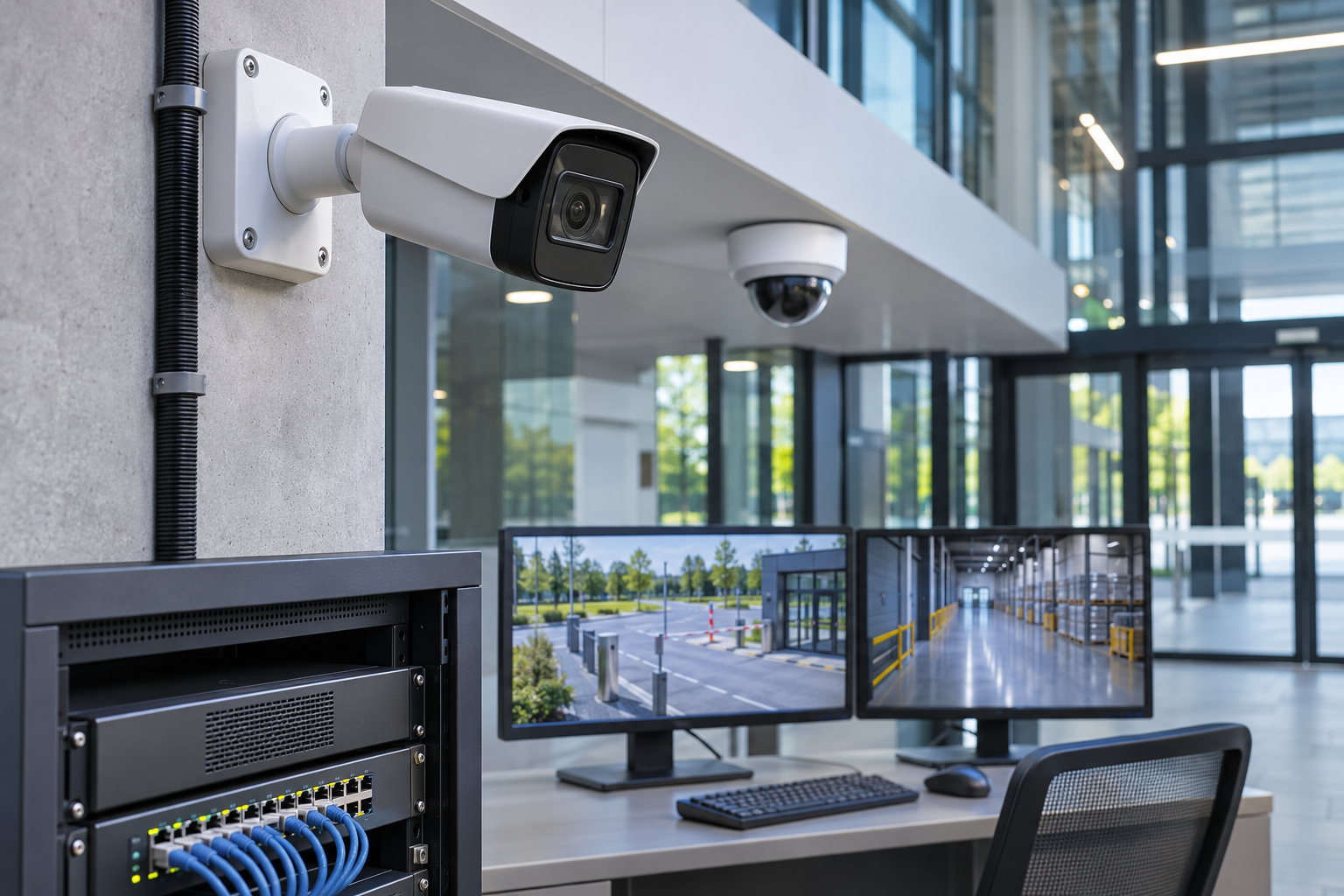
Security camera systems are electronic security solutions used in various areas, from residences to factories, shopping centers to critical infrastructure facilities. Dahua Technology, one of the manufacturers operating in this field, offers IP cameras, HDCVI camera systems, recording devices, and AI-powered video analytics technologies.
Dahua camera systems can be used in home, business, and professional security projects with product options featuring different resolutions, lenses, night vision, recording, and analytics capabilities.
Specifically, technology families such as WizSense, WizMind, TiOC, Full-color, and Smart Dual Light can offer applications like human and vehicle detection, perimeter security, active deterrence, and advanced video analytics, in addition to traditional viewing and recording functions.
However, the fact that a security camera is branded Dahua does not mean that all models have the same features or imaging performance.
For example, a wide-angle camera with 8-megapixel resolution may not show a person's face at a long distance with sufficient detail. Conversely, a lower-resolution camera selected with an appropriate lens can provide higher image detail at a specific security point.
Therefore, selecting the correct Dahua camera system requires a combined evaluation of camera resolution, lens, target distance, night vision, AI features, recording capacity, system compatibility, and cybersecurity.
So, what are Dahua camera systems, how do they work, what are the differences between WizSense and WizMind, and how do you choose the right Dahua camera for your needs?
What Are Dahua Camera Systems?
Dahua camera systems are video surveillance solutions consisting of cameras, recording devices, video management, and related security hardware developed or offered by Dahua Technology.
Dahua's product portfolio includes IP network cameras, HDCVI cameras, PTZ cameras, thermal imaging systems, NVR/XVR recording devices, and video management software.
Depending on the purpose of use in Dahua security systems, functions such as:
Live viewing and video recording.
Remote camera monitoring.
Human and vehicle detection.
Virtual line and zone intrusion analysis.
Active audio and visual deterrence in certain models.
Color night vision.
PTZ-enabled tracking of moving areas.
License plate recognition in compatible systems.
People counting and video analytics in specific products.
Multi-camera and multi-location management.
can be performed.
However, not all of these features are present in every Dahua camera model.
The actual capacity of the product must be verified with its model number and official technical documentation.
How Do Dahua Camera Systems Work?
The operating principle of Dahua camera systems varies depending on the camera technology and recording infrastructure used.
Fundamentally, two main structures can be mentioned: IP camera systems and HDCVI-based camera systems.
Dahua IP Camera Systems
Dahua IP cameras are cameras that transmit digital image data over a network connection.
Images obtained from the camera can be transferred to an NVR recording device or video management software via appropriate network infrastructure.
The system may consist of the following components:
IP security cameras.
PoE network switch.
Ethernet or fiber optic network.
NVR or video recording server.
Hard disk or suitable storage system.
Monitoring and management software.
UPS and other power components, if required.
Some IP cameras may also support local recording on a microSD card.
However, not every IP camera has the same storage, connectivity, or analytics features.
Dahua HDCVI Camera Systems
HDCVI (High Definition Composite Video Interface) is a technology for transmitting high-definition video over existing coaxial cable infrastructure.
Dahua developed HDCVI technology specifically for upgrading existing coaxial-based camera systems.
In HDCVI camera systems, images are typically transmitted over a coaxial line to a compatible XVR recording device.
This approach can allow existing analog camera infrastructure to be updated in certain projects without being completely replaced.
However, the physical condition of the existing cable, connection quality, distance, and the recording device's compatibility with camera features must be checked.
Differences Between Dahua IP Camera and HDCVI
| Technical Feature | Dahua IP Camera | Dahua HDCVI Camera |
|---|---|---|
| Core Infrastructure | Ethernet/IP network | Typically coaxial cable |
| Recording Device | NVR or compatible VMS | XVR |
| Power Supply | PoE or separate power supply depending on model | Separate power supply or compatible PoC options |
| Video Analytics | Can be on camera or recording device | Depends on compatible camera and XVR features |
| New Network Integrations | Generally more flexible | Depends on XVR and related integration capabilities |
| Utilizing Existing Coaxial Infrastructure | Converter or new network infrastructure may be required | Can provide direct advantage with suitable infrastructure |
| Typical Use | New and scalable IP projects | Modernization of existing coaxial CCTV systems |
This comparison shows general technical specifications. Exact compatibility must be verified according to the camera and recording device model.
When planning the CCTV infrastructure for a new facility, IP camera systems can be evaluated for flexibility and integration.
In facilities where existing coaxial cables are usable, HDCVI can offer modernization with lower infrastructure changes.
What Are Dahua Camera Types?
Dahua camera systems are divided into different product groups based on physical design and application purpose.
Dahua Bullet Cameras
Bullet cameras are security cameras with a distinct body and usually a fixed-direction design.
They can be used especially for building exteriors, parking lots, facility entrances, and perimeter security applications.
Depending on the model, IR night vision, color imaging, motorized lens, and AI features may be available.
Dahua Dome Cameras
Dome cameras stand out with their dome-shaped housings.
They can be widely used in offices, stores, corridors, and common areas.
Some dome models may have mechanical protection against vandalism.
However, a dome design does not automatically mean the device has IK10 impact resistance.
Dahua Turret Cameras
Turret or eyeball cameras offer an alternative to certain dome and bullet designs.
Especially in IR imaging, issues such as reducing reflections caused by the housing and adjusting the lens direction can provide project-specific advantages.
Dahua PTZ Cameras
PTZ (Pan-Tilt-Zoom) cameras support horizontal movement, vertical movement, and optical zoom functions.
They can be used for monitoring large areas, allowing security operators to examine specific distant targets, and in suitable automatic patrol applications.
However, a PTZ camera focusing on a specific target may cause another area to be out of view simultaneously.
Therefore, in critical perimeter security projects, PTZ cameras should not automatically be considered sufficient replacements for fixed cameras.
Dahua Panoramic Cameras
Panoramic or multi-sensor cameras can help monitor wide fields of view using fewer camera points.
However, a wide viewing angle can reduce pixel density at the target distance, so the required image detail must be evaluated separately.
Dahua Thermal Cameras
Thermal cameras, unlike visible light imaging, use detection technologies sensitive to the thermal emissions of objects.
In appropriate applications, they can be used for perimeter security, monitoring temperature anomalies, and assessing specific industrial risks.
However, not every thermal camera is suitable for temperature measurement or fire detection purposes.
Furthermore, thermal video analytics do not automatically replace certified fire detection systems required by regulations.
What is Dahua WizSense?
Dahua WizSense is a product family that encompasses AI-powered camera and recording device solutions, specifically focusing on human and vehicle detection.
According to Dahua's official technical descriptions, WizSense focuses on identifying targets such as humans and vehicles using deep learning algorithms and reducing unnecessary alarms caused by irrelevant movements.
Depending on the model, WizSense products may include the following functions:
Human and vehicle classification.
Smart motion detection.
Virtual line intrusion.
Zone entry and exit events.
Event-based video search.
Smart search functions similar to AcuPick or Quick Pick in certain models.
AI-supported image encoding in compatible devices.
What is SMD?
SMD (Smart Motion Detection) is a Dahua technology aimed at distinguishing specific target types in motion detection events.
In traditional motion detection systems, leaves, rain, insects, light changes, or other environmental movements can trigger alarms.
SMD-supported systems, depending on the model and version, can reduce certain types of unnecessary alarms by focusing on human and vehicle targets.
However, the use of SMD does not guarantee the complete elimination of false alarms.
Actual performance depends on camera placement, lighting, target sizes, and site conditions.
What is Dahua WizMind?
Dahua WizMind is a product and solution family focused on more comprehensive video analytics and project-specific AI functions.
The WizMind portfolio may include different components such as cameras, recording devices, intelligent video servers, and software platforms.
Suitable WizMind products may feature:
Advanced human and vehicle analytics.
Video metadata generation.
People counting.
Stereo analysis.
License plate recognition.
Personal protective equipment detection in specific areas.
Parking and vehicle management analytics.
Specific image processing features for privacy protection.
However, a camera being part of the WizMind family does not mean it supports all these functions.
Especially in facial recognition, biometric analysis, and people tracking applications, legal requirements must be evaluated alongside technical capabilities.
Differences Between Dahua WizSense and WizMind
| Comparison | WizSense | WizMind |
|---|---|---|
| Main Approach | Practical AI security functions focused on human/vehicle | Advanced and project-oriented AI applications |
| Analytics Scope | SMD, perimeter security, and smart search depending on model | Metadata, people counting, stereo analysis, and specialized analytics depending on model |
| System Scale | Home, business, and various commercial applications | Advanced enterprise and sectoral projects |
| Hardware Options | IP camera, NVR, XVR, and other compatible devices | IP camera, NVR, PTZ, intelligent server, and other products |
| Selection Approach | Meeting essential analytical function requirements | Meeting specific analytical and integration requirements |
WizSense and WizMind are technology and product families. The features of a specific model should be checked via the product datasheet and supported software version.
For projects requiring simple human-vehicle detection, suitable WizSense models may be sufficient.
For projects with more advanced analytical functions, relevant WizMind products can be considered.
What is Dahua TiOC?
TiOC is an abbreviation for Three-in-One Camera.
Dahua's TiOC approach combines three core features:
Color night vision or related smart illumination technologies.
Active audio and visual deterrence.
AI-powered target detection.
Suitable models with TiOC technology can generate light or sound alerts when specific security events occur.
For example, if a person enters a defined security zone around a warehouse, an alert can be generated via the camera if the system is configured appropriately.
Advantages of TiOC Cameras
Combination of imaging and event detection.
Active deterrence in supported models.
Filtering of certain unnecessary alarms.
Remote notification of events.
Evaluation of night events with color images.
However, using a TiOC-enabled camera does not guarantee that unauthorized entry will be definitively prevented.
Furthermore, audible alerts and lighting features should be used in residential, commercial, and public areas taking into account environmental impacts and relevant legal requirements.
Dahua Full-color and Smart Dual Light Technologies
Night imaging is an important criterion in the selection of security cameras.
Traditional IR cameras can produce black-and-white images in low-light conditions.
Dahua's Full-color technologies, on the other hand, aim to provide color night vision with appropriate image sensors, optical structures, and lighting conditions.
What is Full-color?
Full-color is a product term used for Dahua imaging technologies that aim to obtain color images in low-light environments.
Depending on the camera model, high light sensitivity and auxiliary lighting solutions may be used.
However, the absence of sufficient ambient light or inadequate illumination can affect color imaging performance.
What is Smart Dual Light?
In suitable cameras equipped with Smart Dual Light technology, IR and visible light illumination can be managed according to different operating scenarios.
For example, while the camera uses IR under normal conditions, it may attempt to obtain a color image of an event by activating visible light when a defined event is detected.
This approach can be considered in some areas where continuous use of visible light is not desired.
However, the lighting modes supported by the product and the transition behavior should be checked specifically for each model.
Common Mistake in Night Vision
The IR illumination distance stated in the camera's catalog does not mean that the faces of people or vehicle license plates at that distance can be viewed with sufficient detail.
For actual image performance, the lens, target distance, pixel density, and exposure settings must be evaluated together.
What to Consider When Choosing a Dahua Camera?
In a professional security camera project, it is necessary to correctly define the camera's task before selecting a brand.
1. Camera Resolution
Dahua products offer various megapixel options.
However, high resolution alone does not mean better security performance.
Resolution should be evaluated together with the target distance and the area viewed by the lens.
2. Lens and Field of View
Fixed, varifocal, or motorized lens options should be chosen according to the camera's position in the project and the target to be viewed.
For example, a wide-angle lens shows a larger area but may reduce image detail for distant targets.
3. DORI and PPM Analysis
PPM (Pixels Per Meter) refers to the number of horizontal pixels corresponding to each meter of image width at the target distance.
Basic calculation:
PPM = Horizontal image resolution / Field of view width at target distance
DORI is a historical classification approach used to evaluate the image detail obtained by the camera for operational purposes.
The IEC 62676-4:2025 standard has updated the image detail classification in video surveillance systems.
Therefore, performance criteria to be used in new projects should be determined considering the current version of the standard and the actual viewing need.
4. Night Vision Performance
Which of the IR, Full-color, or Smart Dual Light features is suitable depends on environmental conditions.
In outdoor security, not only the clarity of an empty scene but also the image quality of moving humans and vehicles should be evaluated.
5. WDR
WDR (Wide Dynamic Range) feature can help improve image balance between bright and dark areas.
However, the presence of WDR does not solve all imaging problems of a camera incorrectly positioned against sunlight.
6. IP and IK Protection Ratings
For outdoor cameras, the IP protection rating is important; for areas with a risk of physical impact, the IK rating is crucial.
IP66/IP67 and IK10 are different protection features.
The IP or IK values of the product must be verified from the model's technical documentation.
7. Artificial Intelligence Features
Features such as human detection, vehicle detection, license plate recognition, or people counting should be selected according to project needs.
Installing a higher-cost system for unnecessary analytical functions does not always provide an advantage.
8. NVR, Network, and Recording Infrastructure
The resolution, bit rate, recording capacity, and analytical functions supported by the camera and recording device must be checked together.
Dahua camera selection requires the evaluation of the entire CCTV system, not just the camera model.
What is the Difference Between Dahua NVR and XVR Recording Devices?
Dahua offers recording devices for different camera infrastructures.
Dahua NVR
NVR (Network Video Recorder) is used for recording and managing images in IP camera systems.
Depending on the model, it may feature:
Different numbers of IP camera channels.
Video reception over the network.
Hard disk storage.
Event recording and alarm management.
Video analytics support.
Remote viewing.
PoE connections in certain models.
Dahua XVR
XVR is a recording device used in coaxial camera infrastructures like HDCVI, and depending on the model, it can support different analog video formats or additional IP cameras.
However, the camera formats, channel numbers, resolutions, and additional IP capacity supported by every XVR are not the same.
Does AI Work on the Camera or the Recording Device?
In Dahua systems, some analytical functions can be performed on the camera, while others can be performed on the NVR/XVR.
In certain applications, the features of both devices can be used together.
Therefore, when choosing a camera and recording device, the scope of features like AI by Camera and AI by Recorder should be checked.
For example, a camera having human detection capability does not mean that the same analytics will be supported on all Dahua NVR models.
Hard Disk and Recording Duration Calculation in Dahua Camera Systems
Recording capacity is one of the most important technical requirements in CCTV projects.
Incorrectly calculated storage can lead to not achieving the targeted recording duration.
Example Dahua Camera Recording Calculation
For the following example, let's use these assumptions:
Number of cameras: 8.
Average video bit rate per camera: 4 Mbps.
Daily recording duration: 24 hours.
Storage target: 30 days.
Total video speed:
8 × 4 Mbps = 32 Mbps
Approximate raw video data for 30 days:
32 Mbps × 86,400 seconds × 30 days / 8 = 10.37 TB
In this case, it can be calculated that the system will require approximately 10.4 TB capacity for video data alone.
However, this value is not a definitive disk capacity recommendation.
Actual capacity may vary depending on:
Camera resolution.
Video compression method.
Frame rate.
Actual bit rate.
Movement and image complexity in the scene.
Audio recording.
File system and recording management space.
RAID or other storage configurations.
The use of H.265 or manufacturer-specific smart encoding technologies can reduce storage requirements; however, it is not guaranteed to provide a constant rate of savings in all scenes.
Recording duration should be verified not only by disk capacity calculation but also by checking that the oldest recordings are actually accessible while the system is operating.
How to Remotely Monitor Dahua Camera Systems?
Dahua offers mobile and central management solutions for projects of different scales.
Dahua DMSS
DMSS is an application for managing compatible Dahua security systems from mobile devices.
Depending on the supported devices and functions, features such as:
Live camera monitoring.
Viewing past recordings.
Alarm notifications.
PTZ control.
Intercom and two-way audio on certain devices.
can be used.
However, establishing a remote connection does not mean that images are automatically saved to the cloud.
Dahua DSS Professional
DSS Professional is a software platform offered for central video management and the integration of different security components in large-scale security systems.
It can be evaluated especially in multi-location businesses or projects requiring advanced security management.
However, software licenses, supported devices, server capacity, and integration features must be examined specifically for each project.
Are Dahua Cameras ONVIF Compatible?
Some Dahua cameras and recording devices may support ONVIF profiles.
ONVIF provides standard interfaces to facilitate interoperability among IP-based physical security products.
However, it should not be assumed that every Dahua camera model is automatically compatible with all ONVIF profiles.
ONVIF compatibility depends on the product's exact model, the profile it supports, and a specific firmware version.
For official compatibility assessment, ONVIF's Conformant Products database should be used.
Furthermore, while basic video transmission may work between cameras and VMS systems from different manufacturers, it does not guarantee that all analytical events and advanced features will be transmitted in the same way.
Therefore, actual integration tests should be performed in multi-brand projects.
Cybersecurity in Dahua Camera Systems
IP camera systems are electronic devices that communicate over computer networks.
Therefore, the protection of security cameras is not limited to physical installation alone.
Dahua's own security advisories have, at various times, disclosed software vulnerabilities and update requirements affecting certain products.
For example, Dahua published an advisory on June 10, 2026, regarding vulnerabilities CVE-2026-29114, CVE-2026-29115, and CVE-2026-29116 affecting some products.
Such advisories do not indicate that every Dahua model is affected by the respective vulnerability.
Risk assessment should be performed based on the affected device model and software version.
Recommendations for Dahua Camera Security
Default or weak passwords should not be used.
Access to administrator accounts should be restricted.
Camera and recording device firmware versions should be monitored.
Manufacturer's security advisories should be checked.
Unnecessary services should be disabled.
Whenever possible, the camera network should be managed in a separate VLAN or appropriate network zone.
Unnecessary ports directly exposed to the internet should be avoided.
Remote access methods should be evaluated for security.
A configuration backup and rollback plan should be prepared before updates.
In critical systems, event logs and unauthorized access attempts should be monitored.
The ability of a camera to connect to the internet does not mean it is safe to use it directly exposed to the internet.
Cybersecurity is as much a part of installation and operational processes as it is of device selection.
How Are Dahua Camera Systems Evaluated Under KVKK?
Recording images of specific or identifiable individuals with security cameras may constitute a personal data processing activity.
Therefore, regardless of whether Dahua or another brand of camera is used, personal data protection obligations in Turkey must be evaluated.
The Personal Data Protection Authority's statement on camera use in workplaces dated June 8, 2026, specifically emphasized:
Pre-determination of the camera's purpose of use.
Minimization of personal data.
Proportionality of camera angles.
Not imaging private living areas.
Fulfillment of the obligation to inform.
Prevention of unauthorized access.
Not retaining recordings longer than necessary.
Separate evaluation of more intrusive functions such as audio and biometric analysis.
Especially analytical features aimed at facial recognition or linking individuals to their identities can lead to different legal requirements than ordinary camera imaging.
Technical support for artificial intelligence features does not mean that these features can be legally used in every environment.
Where Are Dahua Camera Systems Used?
Home and Residential Security
Can be used for camera and alarm integrations at entrance doors, gardens, parking lots, and suitable private areas.
Offices and Workplaces
CCTV solutions can be considered at entry-exit points, specific common areas, and security-critical zones.
Stores and Retail
Imaging can be performed at store entrances, around cash registers, and in relevant security areas.
People counting or other retail analytics functions can also be used in suitable analytical models.
Factories and Industrial Facilities
Can be used for perimeter security, loading areas, warehouse entrances, and critical equipment zones.
However, in areas with special risks such as high temperatures, chemical environments, or explosive atmospheres, product-specific certifications and compliance conditions must be sought.
Residential Complexes and Mass Housing
Can be used at building entrances, parking lots, and other common areas, observing relevant legal conditions.
Warehouses and Logistics Centers
Can be evaluated at loading ramps, vehicle entrances, warehouse corridors, and specific security points where material movements are monitored.
Large and Multi-Location Facilities
With appropriate NVR, VMS, and central software solutions, it may be possible to monitor different sites under a single management structure.
Which Dahua Camera System Should Be Preferred?
| Application | Solution to Consider | Primary Criterion |
|---|---|---|
| Home and small business | Suitable Lite or WizSense IP camera | Image, night vision, recording, secure remote access |
| Store | WizSense or WizMind suitable for needs | Human detection, event search, recording |
| Factory perimeter | WizSense, TiOC, PTZ, or specialized solutions | Distance, false alarm control, illumination |
| Existing analog facility | HDCVI and compatible XVR | Coaxial cable and format compatibility |
| Large open area | Appropriate combination of fixed and PTZ cameras | Field of view, optical zoom, tracking |
| Advanced video analytics | Relevant WizMind solutions | Actual analytical features and integration |
| Industrial temperature monitoring | Suitable thermal camera | Measurement/detection scope and required certification |
| Multi-location business | NVR and appropriate DSS/VMS infrastructure | Scalability, licensing, network, and cybersecurity |
The table shows general application areas for product groups within the brand. For definitive model selection, a technical survey and product datasheet evaluation are required.
Common Mistakes in Dahua Camera Installation
Some of the technical problems encountered in Dahua camera systems may stem not from the camera model but from installation and configuration errors.
Common mistakes include:
Selecting the camera based solely on its megapixel value.
Failing to calculate lens and target distance.
Incorrect positioning of the camera angle.
Not testing night vision.
Disregarding IR illumination reflections.
Incorrect calculation of the PoE power budget.
Not checking the compatibility of NVR and camera analytical features.
Underestimating the required recording capacity.
Neglecting firmware and network security.
Not playing back past recordings after commissioning.
Especially in professional projects, after installation is complete, camera images, network connections, recording functions, and necessary video analytical events should be tested under real-world conditions.
Technical Checklist for Dahua Camera Systems
Is the camera's purpose of use and target viewing point determined?
Was the correct IP or HDCVI system selection made?
Are the camera resolution and lens features appropriate?
Was DORI/PPM or target image detail evaluated?
Was day and night image quality tested?
Was the need for IR, Full-color, or Smart Dual Light determined?
Was it confirmed that WizSense/WizMind functions are present in the model?
Were TiOC active deterrence features evaluated if required?
Was camera and NVR/XVR compatibility checked?
Were PoE, network, and power requirements calculated?
Was disk capacity and recording duration calculated?
Was playback of past recordings tested?
Was ONVIF or third-party VMS integration verified if required?
Were firmware and cybersecurity checks performed?
Were KVKK and privacy requirements evaluated?
Was the installation and commissioning report prepared?
Was a maintenance and software update plan created?
This list is prepared for general technical evaluation. It does not represent all features of a specific camera model or definitive engineering criteria to be applied in every facility.
Frequently Asked Questions
What are Dahua camera systems?
Dahua camera systems are video surveillance solutions consisting of cameras with IP, HDCVI, PTZ, and other imaging technologies, along with NVR/XVR recording devices and management software.
Are Dahua camera systems good?
Dahua offers a wide product portfolio for different needs and budgets. However, the suitability of a camera should be evaluated not by brand name, but by the model's image quality, reliability, supported features, cybersecurity status, and intended use.
What is the difference between a Dahua IP camera and an HDCVI camera?
IP cameras transmit images over a network, while HDCVI cameras typically use coaxial infrastructure. Recording device and integration requirements also differ.
What is Dahua WizSense?
WizSense is a Dahua product family focused on AI-powered security functions such as human and vehicle detection.
What is Dahua WizMind?
WizMind is a Dahua solution family offering more comprehensive and project-oriented video analytics applications. Supported features depend on the product model.
What does a Dahua TiOC camera do?
TiOC combines AI-powered target detection, color night vision, and active audio/visual deterrence features in suitable models.
Do Dahua cameras provide color images at night?
Some models with Full-color or suitable Smart Dual Light features can produce color images at night. However, performance depends on ambient light, camera features, and lighting conditions.
Can Dahua cameras work without internet?
Suitable IP or HDCVI camera systems can operate without internet using local connectivity and recording infrastructure. Functions like remote mobile access may require the relevant communication connection.
Can Dahua cameras be monitored via phone?
Compatible devices can be viewed via DMSS when appropriate configuration and necessary connection conditions are met.
Can Dahua cameras work with other brand NVRs?
Some Dahua models can work with third-party recording devices via ONVIF or other supported interfaces. However, full compatibility depends on the model, firmware version, and functions used.
How many days is the Dahua camera recording duration?
There is no single fixed recording duration. Storage duration is determined by the number of cameras, average bit rate, recording plan, disk capacity, and any specific regulatory obligations.
What determines Dahua camera prices?
Prices can vary based on camera resolution, lens, sensor, night vision, AI features, housing protection, recording device, storage, and other system components. When comparing, not only the unit price of the camera but also the total cost of ownership should be considered.
Conclusion: Correct Product and Proper Project Planning are Important in Dahua Camera Systems
Dahua camera systems offer a broad portfolio of solutions that can be evaluated in various security projects, from basic imaging needs to advanced video analytics applications.
While IP and HDCVI technologies can meet different infrastructure needs, WizSense and WizMind product families provide AI-powered functions at different levels.
Technologies such as TiOC, Full-color, and Smart Dual Light can support event detection and night imaging performance in specific security scenarios.
However, the success of a professional CCTV project does not depend solely on the brand used.
The right camera, the right lens, correct installation, sufficient recording capacity, secure network infrastructure, and verified video analytics performance must be evaluated together.
Especially in factories, shopping malls, stores, warehouses, and large-scale facilities, it is important to conduct a technical survey and define the system's actual viewing objectives before camera selection.
The correct choice in Dahua camera systems is not to select the product with the highest megapixels or the most AI features; rather, it is to create a system architecture that meets security needs in a measurable, reliable, and sustainable way.