
Dahua DVR Recorders: Models, Features and Comparison Guide
Dahua DVR and XVR recorders offer different channel and storage options and can manage analog and IP cameras in the same system. We compare the Cooper-I, WizSense, 4K, PoC and S-XVR series in terms of the technical specifications of 4-, 8-, 16- and 32-channel models, H.265 recording technology, AI analytics, HDD capacity and use cases.
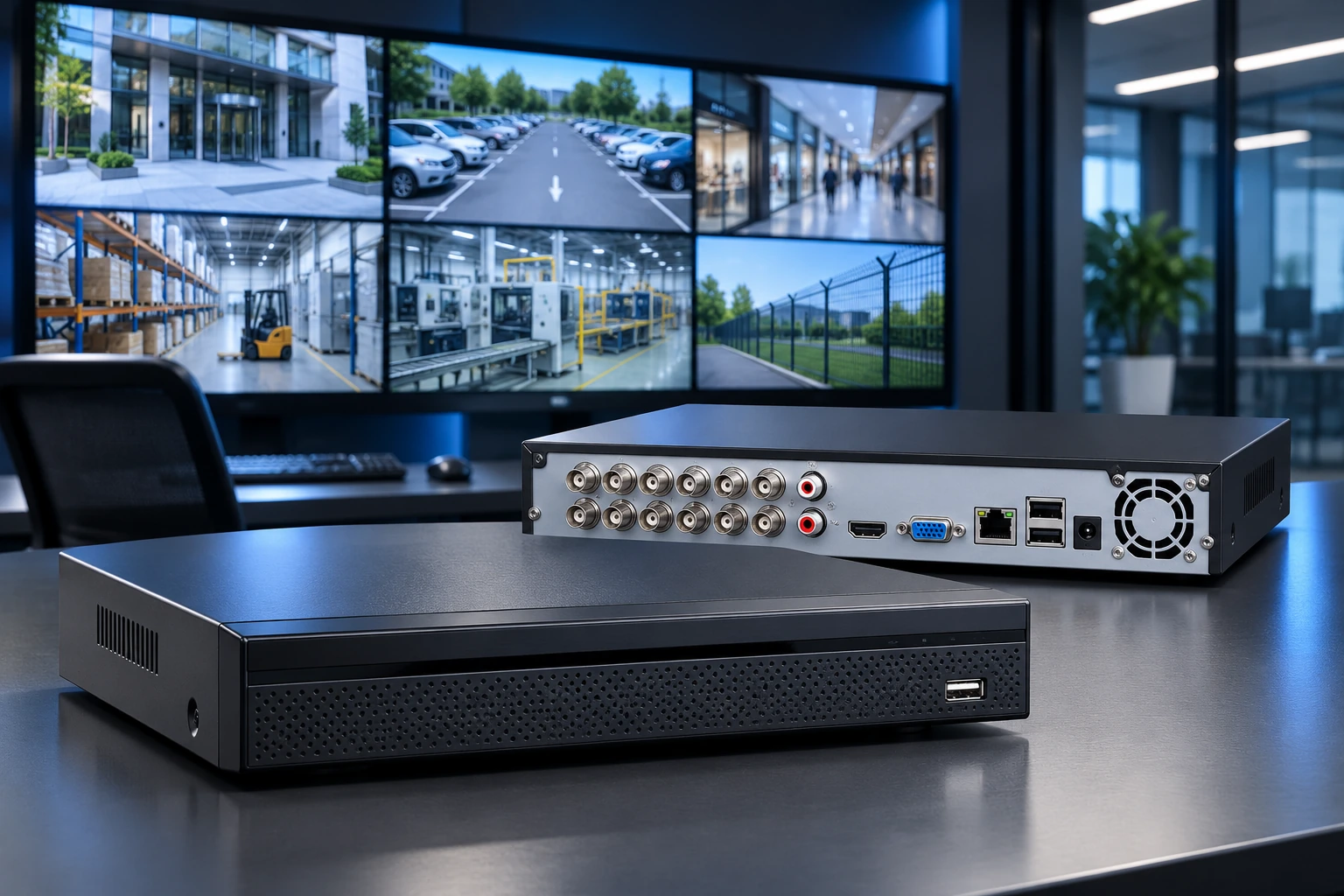
Dahua DVR recorders are video recording systems designed to record, view and manage footage from analog security cameras. In Dahua Technology’s current product portfolio, XVR models that extend DVR functionality are prominent. With hybrid recording architectures supporting HDCVI, AHD, TVI, CVBS and IP camera technologies, these devices can be used across a range of CCTV infrastructures.
The Dahua DVR and XVR product family includes 4-, 8-, 16- and 32-channel models, various hard-drive capacities, H.265 video compression technologies and AI-powered video analytics options. The Cooper-I series focuses on more economical recording needs, while WizSense-equipped models can offer human and vehicle classification, perimeter protection and advanced event search functions.
However, two Dahua DVR devices with the same number of channels may not offer the same recording resolution, frame rate, storage capacity or AI performance. Therefore, when selecting a recorder, users should consider not only the number of channels but also the device’s actual video encoding capacity, supported camera technologies and the system’s total recording requirements.
What Is a Dahua DVR Recorder?
A DVR (Digital Video Recorder) is a video recording device that converts analog camera footage into digital form and records it.
In traditional DVR systems, cameras are generally connected to the recorder via coaxial cables and BNC connectors. The DVR processes incoming video signals and records them to a hard drive using an appropriate compression technology.
Dahua’s XVR devices expand on the traditional DVR approach, allowing different camera technologies to be used in the same recording system.
What Is the Difference Between Dahua DVR and XVR?
Dahua products sometimes use the terms DVR and XVR together. Technically, however, XVR refers to hybrid recorders that support multiple video input technologies.
Supported Dahua XVR models may feature five different video input technologies:
HDCVI: Dahua’s high-definition video transmission technology over coaxial infrastructure.
AHD: Analog High Definition video technology.
TVI: A high-definition video transmission standard over coaxial infrastructure.
CVBS: Traditional standard-definition composite analog video.
IP: Network cameras that transmit images over an Ethernet network.
This configuration is called by Dahua Penta-brid .״? NO
XVR devices can be an important option, particularly for projects that need to modernize an existing analog camera infrastructure without replacing it entirely.
For the key differences between DVR, XVR and NVR technologies, see GüvenlikOnline’s Camera Recorders article.
What Are the Dahua DVR Recorder Series?
Dahua’s official HDCVI recorder portfolio consists of product families designed for different resolutions and use cases.
1. Dahua Cooper-I Series DVR Models
The Cooper-I series is Dahua’s XVR product family focused on economical, basic video-recording requirements.
This series may be suitable for small businesses, homes, offices, and projects using a limited number of analog cameras.
Example models:
XVR1B04-I/T — 4-channel XVR.
XVR1B08-I/T — 8-channel XVR.
The XVR1B04-I/T model has four analog BNC inputs and one SATA disk connection. The manufacturer’s technical specifications state support for up to 6 TB per disk.
The XVR1B08-I/T model offers eight analog camera inputs, two additional IP camera channels by default, and one SATA connection.
Both models include SMD Plus analysis focused on people and vehicles.
The main limitation to consider in the Cooper-I series is that the supported analog camera input resolution may differ from the actual recording resolution. For example, the XVR1B08-I/T model supports 1080p camera input, while its main-stream recording options may be limited to values such as 1080N/720p.
Therefore, for applications requiring a high level of detail, checking only the camera input resolution is not sufficient.
2. Dahua WizSense DVR Models
WizSense is a technology family from Dahua focused on AI-powered security functions, such as human and vehicle classification.
In addition to conventional video recording, XVR devices with WizSense can analyze specific events and make them easier to find.
Example models:
XVR5108HS-I3/T — 8 channels.
XVR5116HS-I3/T — 16 channels.
XVR5216AN-I3/T — 16 channels, two SATA ports.
XVR5232AN-I3/T — 32 channels, two SATA ports.
Depending on the supported configuration, these models may include functions such as SMD Plus, perimeter protection, face detection, face comparison, and AcuPick.
For example, the official product specifications for XVR5108HS-I3/T list eight-channel SMD Plus, four-channel perimeter protection, and two-channel AcuPick analysis.
Important technical detail: The number of channels allocated to AI analysis may differ from the device’s total number of camera channels.
In addition, whether certain analyses can be used simultaneously and whether specific IP expansion modes can be enabled are subject to different technical limitations.
3. Dahua 4K DVR Recorders
Dahua’s 4K series is designed for projects that require recording high-resolution images from analog cameras.
Example model: XVR5108HS-4KL-I3/T
This model has eight analog BNC inputs, 4K video input support, one SATA drive interface, and WizSense features.
However, 4K support does not mean that continuous 4K recording at 25 FPS is possible on every camera channel.
For example, the technical documentation for the XVR5108HS-4KL-I3/T model specifies recording rates of 15 FPS at 4K resolution on the first channel and up to 7 FPS on certain other channels, using the standard encoding configuration.
Therefore, 4K camera support, 4K HDMI output, and actual 4K recording performance should be evaluated separately.
4. Dahua PoC-Compatible DVR Models
PoC (Power over Coax) is a technology for transmitting power and video signals over coaxial cabling in compatible systems.
With Dahua’s PoC-compatible XVR products, the need for separate power cabling can be reduced when used with suitable PoC cameras.
The XVR5216AN-I3-16P, an example model, is one of the 16-channel PoC-focused DVR options.
When installing a PoC system, check compatibility between the camera and recorder, cable specifications, distance, total power capacity, and connection equipment.
Do not assume that every HDCVI camera or standard XVR device supports PoC.
5. Dahua S-XVR Series
The S-XVR product family includes recording solutions offered with SSD-based storage architecture in certain models.
Products in this series may be available with different SSD storage options, such as 256 GB, 512 GB, and 1 TB.
For example, XVR5108HS-I3(1T) is an eight-channel model with a 1 TB SSD storage option.
SSD-based storage may offer advantages under certain operating conditions because it has no moving mechanical components. However, continuous video-recording workload, write endurance, and capacity cost should be assessed separately.
Using an SSD does not mean that it will last longer than a conventional surveillance HDD under all conditions.
Comparison of Dahua DVR Model Specifications
The table below compares selected model variants listed on Dahua’s official product pages.
Dahua DVR model | Analog channels | Default additional IP | SATA | Drive capacity |
|---|---|---|---|---|
XVR1B04-I/T | 4 | 1 | 1 | 6 TB |
XVR1B08-I/T | 8 | 2 | 1 | 6 TB |
XVR5108HS-I3/T | 8 | 4 | 1 | 16 TB |
XVR5108HS-4KL-I3/T | 8 | 8 | 1 | 16 TB |
XVR5116HS-I3/T | 16 | 8 | 1 | 16 TB |
XVR5216AN-I3/T | 16 | 8 | 2 | 2 × 16 TB |
XVR5232AN-I3/T | 32 | 16 | 2 | 2 × 16 TB |
The drive capacities in the table are the maximum supported values stated by the manufacturer. Conditions such as drive compatibility and ambient temperature may affect these limits.
Important note about the number of IP channels: The IP counts shown in the table are the IP channels available in the default configuration in addition to the analog BNC inputs. On some models, analog channels can be converted to IP channels to connect a larger number of IP cameras. However, this may reduce the available analog capacity and disable some AI functions.
Key Technical Differences Between the Models
Model | Recording class | Key feature |
|---|---|---|
XVR1B04-I/T | 1080N/720p | Economical 4-channel recording, SMD Plus |
XVR1B08-I/T | 1080N/720p | Economical 8-channel recording, SMD Plus |
XVR5108HS-I3/T | 5M-N/1080p | AcuPick, SMD Plus, AI Coding |
XVR5108HS-4KL-I3/T | 4K/5MP | High-resolution camera input |
XVR5116HS-I3/T | 5M-N/1080p | 16-channel, single-drive configuration |
XVR5216AN-I3/T | 5M-N/1080p | 16-channel, dual-drive configuration |
XVR5232AN-I3/T | 5M-N/1080p | 32 channels, high IP expansion capacity |
The recording classes here refer to the resolution options offered by the relevant product family. They do not mean that every channel can record at the same resolution and frame rate.
What Is the Recording Resolution of a Dahua DVR?
One of the most important criteria determining a DVR device’s recording quality is video encoding resolution.
Dahua DVR models offer various options, including 720p, 1080N, 1080p, 5M-N, 5MP, and 4K on certain models.
Difference Between 1080N and 1080p
1080p typically refers to a resolution of 1920 × 1080 pixels.
1080N is a recording mode used in DVR products in which horizontal sampling resolution is generally reduced. It should not be assumed to provide the same actual image detail.
1080N recording may require less data under certain conditions. However, its ability to preserve fine image details differs from that of full 1080p recording.
Is 5M-N the Same as 5MP?
No. 5M-N is a reduced-sampling resolution class used in certain XVR devices.
5MP refers to an image resolution of approximately five million pixels.
A recorder’s ability to accept a 5MP camera signal does not mean that it can record at full 5MP resolution and a high frame rate on every channel.
Especially when making a technical selection, the manufacturer’s Camera Input and Encoding Capacity sections should be examined separately.
H.265 and AI Coding Technologies in Dahua DVR Devices
Supported Dahua XVR models offer various video compression options, including H.264, H.265, Smart H.264+, Smart H.265+, and AI Coding.
H.265 is a video coding standard that can provide more efficient compression than H.264 for suitable video content.
Smart H.265+ is Dahua’s technology for optimizing the amount of video data according to the scene.
On supported devices, AI Coding can offer an encoding approach that prioritizes preserving image details of important targets, such as people and vehicles.
However, compression performance is not constant.
Factors affecting recording duration include camera resolution, FPS, the amount of motion in the image, night-time noise, bit rate, and compression settings.
Therefore, storage-saving rates stated by the manufacturer should not be treated as guaranteed results achievable in every project.
Dahua DVR AI Features
What Is SMD Plus?
SMD Plus (Smart Motion Detection Plus) is a video analytics technology that helps classify motion events as human or vehicle events on supported Dahua recorders.
It can help reduce some unwanted motion alerts caused by rain, moving leaves, changes in lighting, or animals.
However, detection accuracy depends on image quality, mounting angle, target size, and environmental conditions.
What Is Perimeter Protection?
On supported systems, perimeter protection analytics can be used to analyze events such as virtual line crossings or entry into designated areas.
This feature can be used to monitor facility perimeters, warehouse entrances, and designated security zones.
The model’s technical documentation specifies how many channels can perform the analytics.
What Is AcuPick?
AcuPick is an AI-powered video search technology designed to facilitate searching for and matching target objects on supported Dahua recording systems.
It can help locate specific person- or vehicle-related events in recordings more quickly.
However, AcuPick support does not mean that the same search performance will be achieved with all cameras and under all recording conditions.
Technical limitation: On some Dahua XVR models, enabling IP channel expansion or advanced encoding modes may disable certain AI functions, such as AcuPick, facial recognition, or perimeter protection. Before installation, verify that all selected features can operate together.
How Is Dahua DVR HDD Capacity Determined?
When selecting a DVR recorder, the number of drive bays and drive capacity directly affect the desired recording-retention period.
For example, in a system where each of 16 cameras generates an average video stream of 2 Mbps and records continuously for 30 days:
Total video bit rate: 16 × 2 Mbps = 32 Mbps
Approximate raw video data for 30 days: 10.4 TB
This calculation is only an example capacity estimate. Actual storage requirements vary according to video bit-rate fluctuations, audio recordings, the file system, system reserves, and recording policy.
Models such as XVR5216AN-I3/T, which have two SATA connections, may allow greater storage capacity to be planned than single-drive models.
However, having two drive bays does not mean that the device automatically provides RAID or redundancy against drive failure.
Detailed information on HDD selection, CMR/SMR technologies, and continuous-recording workloads in security camera systems is available in GüvenlikOnline’s Video Surveillance Hard Drives: HDD Selection Guide for CCTV and NVR article.
What to Consider When Choosing a Dahua DVR Recorder
1. Channel count and future expansion
In addition to the current number of cameras, consider any cameras that may be added later.
For example, although a 16-channel DVR may be sufficient for a 14-camera project, a 32-channel system may need to be considered to accommodate future growth.
2. Actual recording resolution and FPS
The presence of “5MP” or “4K” in a product description is not enough on its own.
Check the resolution and FPS at which each channel can record.
At facilities where moving targets are monitored in particular, low FPS values can lead to the loss of important image detail.
3. Number of HDDs and recording duration
Storage capacity can differ significantly between devices with one SATA bay and models supporting two or more drives.
For systems requiring long-term recording, storage capacity, recording policy, and protection of recordings in the event of a failure should be planned together.
4. Camera technology compatibility
Even if HDCVI, AHD, TVI, and CVBS are supported, do not assume that every camera resolution and frame rate is supported.
Analog and IP cameras from different manufacturers should be tested with the recorder model.
5. AI channel capacity
Determine which channels will run functions such as SMD Plus, perimeter protection, and face analysis.
Analytics performed on the camera may have different hardware limitations from analytics performed on the DVR.
6. Cybersecurity and remote access
Evaluate the recorder’s software version, user permissions, password security, and remote-access method.
Restricting unnecessary internet access and applying current security patches are important when operating professional CCTV systems.
Which Projects Can Use Dahua DVR Models?
Application area | Models to consider | Selection priority |
|---|---|---|
Residential | XVR1B04-I/T | Basic recording, cost-effective solution |
Small shop | XVR1B08-I/T | 8 cameras, SMD Plus |
Office and business | XVR5108HS-I3/T | AI analytics and image quality |
High-resolution requirements | XVR5108HS-4KL-I3/T | 4K input and encoding capacity |
Medium-sized facility | XVR5116HS-I3/T | 16 channels, single drive |
Warehouse and factory | XVR5216AN-I3/T | 16 channels, expanded storage |
Multi-camera business | XVR5232AN-I3/T | 32 channels and expansion |
This table is intended as a preliminary assessment based on use cases. A model’s suitability for a particular project should be verified through a site survey and assessment of camera specifications, cabling, and recording requirements.
Technical Checklist for Dahua DVR Installation
- Have the current number of cameras and expansion needs been determined?
- Has compatibility with HDCVI, AHD, TVI, or CVBS cameras been verified?
- Have the cameras’ actual recording resolutions been checked?
- Have the target FPS and bit rate been determined for each channel?
- Has the HDD capacity been calculated based on the required recording duration?
- Have the maximum supported drive capacities been checked?
- Have the channel limits of the AI features to be used been verified?
- Has the simultaneous operation of IP expansion and AI features been tested?
- Have the coaxial cables and BNC connections been checked?
- Have user permissions and security settings been configured?
- Have recording, live view, playback, and backup been tested?
Completing these checks before implementation can help reduce capacity and compatibility issues caused by choosing the wrong device.
Frequently Asked Questions About Dahua DVR Recorders
How many channels do Dahua DVR models have?
Dahua’s product range includes XVR models with 4, 8, 16, and 32 analog camera inputs. Some devices also support IP camera channels in addition to analog inputs.
Can IP cameras be connected to Dahua DVR devices?
Yes. Compatible IP cameras can also be used with Dahua’s Penta-brid XVR models. However, IP channel capacity, supported resolution, and AI functions vary by model.
Do Dahua DVR devices support H.265?
Supported models offer compression options such as H.265, Smart H.265+, and AI Coding. The actual encoding options should be checked, particularly on budget models.
Can Dahua DVR record in 4K?
Certain XVR models support 4K recording. However, not every model can record all 4K inputs simultaneously at 25 or 30 FPS.
How long can a Dahua DVR record?
Recording duration depends on the number of cameras, resolution, bit rate, compression method, recording mode, and HDD capacity. It cannot be determined from the device’s channel count alone.
Can Dahua DVR devices detect people and vehicles?
Models that support SMD Plus can perform motion classification focused on people and vehicles. The scope, channel count, and accuracy of the analytics vary according to the model used and image conditions.
Can a Dahua DVR work without internet?
Yes. A properly configured local DVR/XVR system can record without an internet connection. However, remote mobile access and online services may require a suitable network connection.
Which should you choose: Dahua DVR or NVR?
DVR/XVR may be considered for projects where the existing coaxial camera infrastructure is to be retained, while NVR may be suitable for new IP-based systems that can be expanded over a network.
For detailed technical selection criteria for IP systems, How to Choose an NVR the guide can be consulted.
Conclusion: How to Choose the Right Dahua DVR Model
Dahua DVR and XVR recorders offer options for a range of needs, from cost-effective analog camera systems to AI-powered hybrid recording infrastructure.
The Cooper-I series focuses on meeting basic recording needs, while WizSense models can enhance event management with functions such as person and vehicle analytics. The 4K series can be considered for high-resolution camera applications, PoC models for suitable coaxial infrastructures, and S-XVR solutions for specific SSD-based recording needs.
However, the choice of the right recorder is fundamentally based on the combined assessment of channel count, actual recording resolution, FPS performance, video compression capacity, HDD requirements, camera compatibility, and AI channel limits together.
For more information about Dahua’s other camera and video surveillance technologies, consult GüvenlikOnline’s Dahua Camera Systems and Technologies Guide guide.
Sources
Technical model specifications and product-family information have been compiled from Dahua Technology’s official product pages.