
Bullet-Resistant Glass Applications: EN 1063, Classes and Installation
Ballistic-resistant glass, commonly known as bulletproof glass, is used in banks, jewellers, currency exchange offices and high-security buildings to protect against specific firearm threats. We examine EN 1063 BR1–BR7 and SG1–SG2 classes, the S/NS distinction, EN 1522/1523 frame requirements, laminated glass construction, applications and safe installation criteria.
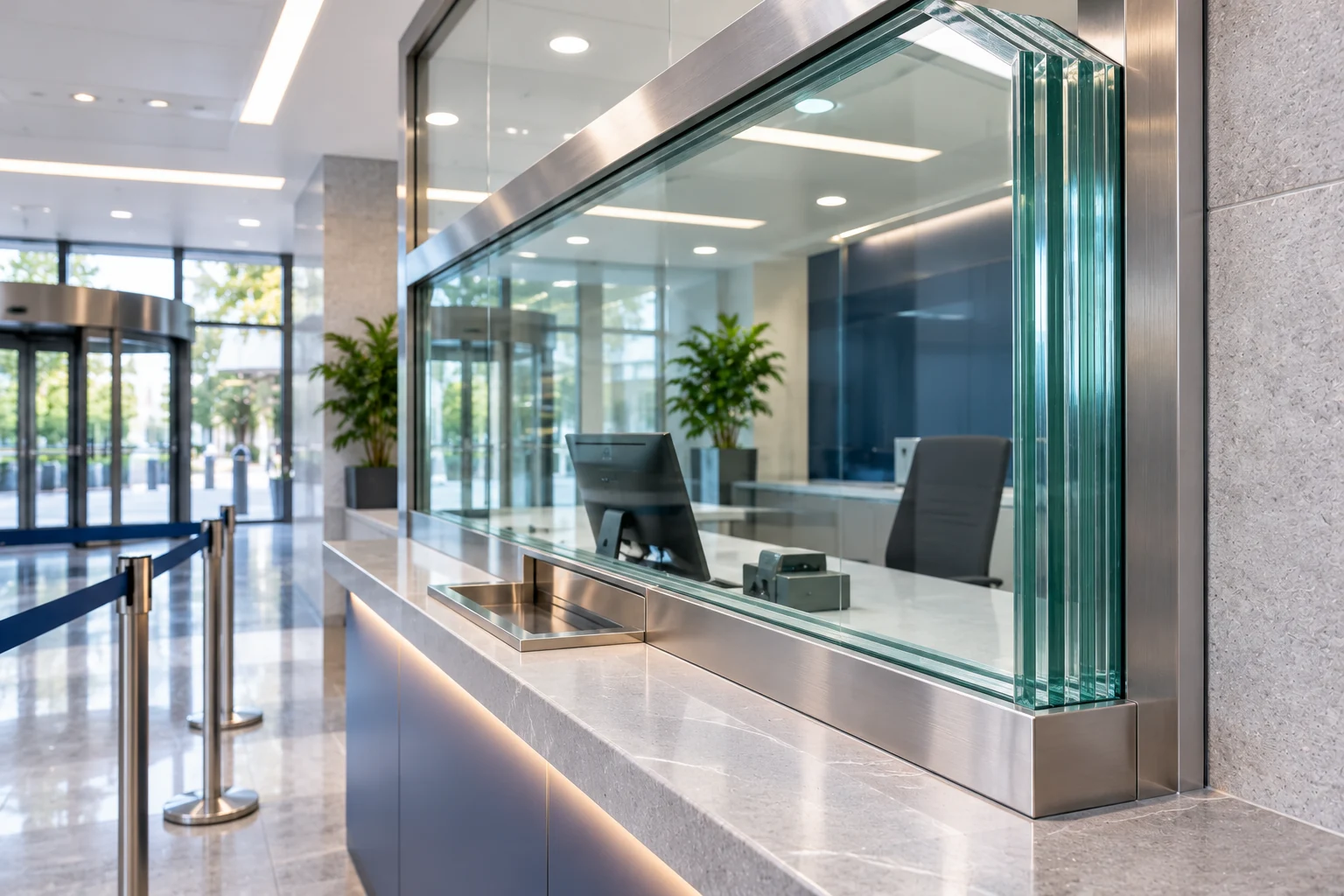
Bullet-resistant glass applications are physical security solutions that help protect people and valuable assets in buildings exposed to armed-attack risks. Used in banks, jewellers, currency exchange offices, security checkpoints and facilities requiring high security, these systems consist of specialized glass compositions tested against specific ballistic threats.
In everyday usage, products called “bulletproof glass” are technically known as ballistic-resistant glass (bullet-resistant glass) or ballistic protective glass. This terminology matters because
no glass product can be considered to provide unlimited resistance against every type of weapon and ammunition. Ballistic protection performance depends on the standard under which the product was assessed, the test conditions and its resistance class.
The primary standard used to assess the ballistic resistance of building glass in Europe is EN 1063. However, in a reliable application, the performance of the window or transaction-counter frame, the supporting structure and the building connections is just as important as the glass itself.
For this reason, a bullet-resistant glass installation is not simply a matter of fitting thick glass; it is an engineering project involving risk analysis, selection of certified products, integrated system design and controlled installation processes.
What Is Bullet-Resistant Glass?
Bullet-resistant glass is specialized security glazing designed to withstand specified firearm ammunition and subjected to standardized ballistic tests.
Unlike conventional window glass, it can be made by combining multiple glass layers with suitable interlayer materials.
Materials that may be used include:
Glass layers.
PVB (polyvinyl butyral) interlayers.
Polyurethane-based interlayers.
Polycarbonate layers.
Other transparent composite materials, depending on the product.
are used.
These compositions are intended to provide resistance to specific ballistic impacts and, in suitable designs, limit fragment spall on the protected side.
However, not all laminated glass is ballistic-resistant.
A glass product being multilayered, tempered or very thick does not prove that it meets a particular ballistic class under EN 1063.
How Does Bullet-Resistant Glass Work?
Ballistic-resistant glass has a composite structure in which multiple layers work together.
During a ballistic impact, glass layers may break or crack. This alone does not mean the product has failed to perform its protective function.
What matters is that the glass delivers the required resistance performance under the specified test conditions.
Multilayer Laminated Construction
In ballistic protective glass, multiple glass layers are bonded using suitable interlayers.
This construction can distribute the energy of specific impacts across different layers.
Polycarbonate-Supported Constructions
Some products use combinations of glass and polycarbonate.
In certain ballistic classes, these systems may offer advantages such as lower weight or reduced fragment formation on the protected side.
However, this performance depends not so much on the material itself as on the complete glass composition as tested .»? Sorry
Identifying the Protected Side
Some ballistic glass is manufactured with an asymmetric construction.
For these products, it is important to know which surface should face the expected direction of threat.
Changing the installation orientation specified by the manufacturer may result in an installation that differs from the tested configuration.
Therefore, it should not be assumed that both sides of the glass always provide the same protection.
What Is the EN 1063 Standard?
EN 1063 is a European standard established to test and classify the resistance of security glazing used in buildings against firearm attacks.
The standard’s international reference title is:
EN 1063:1999 — Glass in Building — Security Glazing — Testing and Classification of Resistance Against Bullet Attack
Its UK counterpart was published as BS EN 1063:2000.
The standard sets out ballistic resistance classes based on defined test conditions for specific weapon categories, such as handguns, rifles and shotguns.
Under EN 1063, products are intended to be assessed against specific threat levels.
The standard does not guarantee absolute protection against every possible attack scenario.
EN 1063 Ballistic Resistance Classes BR1–BR7
Under EN 1063, there are seven basic ballistic resistance classes, from BR1 to BR7.
The classes correspond to different test ammunition and conditions.
EN 1063 class | Reference ammunition | General threat category |
|---|---|---|
BR1 | .22 LR | Low-energy rifle ammunition |
BR2 | 9 mm Luger | Handgun ammunition |
BR3 | .357 Magnum | Handgun ammunition |
BR4 | .44 Magnum | Higher-energy handgun ammunition |
BR5 | 5.56 × 45 mm | Specified rifle ammunition |
BR6 | 7.62 × 51 mm | Specified rifle ammunition |
BR7 | 7.62 × 51 mm, armour-piercing type | Specific ballistic test threat |
The ammunition information in the table is intended for a general comparison of the classes.
Calibre information alone is not sufficient. The ammunition construction, test conditions and classification requirements defined by the standard must be considered together.
For example, a glass product tested to class BR4 is not necessarily suitable against every firearm threat or different ammunition type.
Furthermore, the level of ballistic protection should not be determined simply by choosing a higher class. The required performance should be defined through the facility’s security risk analysis.
What Are SG1 and SG2?
Alongside the BR classes, EN 1063 also includes SG classes for shotgun ammunition.
SG1: A class based on a single-shot test using specified 12-gauge shotgun ammunition.
SG2: A class based on multiple-shot requirements using the relevant test ammunition.
SG classes are not simply a continuation of the BR classes.
For example, a product classified as BR6 should not be taken to meet class SG2 unless this is separately confirmed in its technical documentation.
What Do S and NS Mean in EN 1063?
One of the most important technical distinctions when selecting ballistic glass is S and NS classification.
These designations concern the behaviour of fragments that may form on the protected side of the glass.
Classification | Description | Assessment |
|---|---|---|
S | Splinters | Fragment formation on the protected side may occur under the test conditions |
NS | No Splinters | Meets the standard’s requirement that no fragments form on the protected side under the test conditions |
For example:
BR4-S: Glass with ballistic test class BR4 and S fragment classification.
BR4-NS: Glass with ballistic test class BR4 and NS fragment classification.
NS classification can be an important selection criterion, particularly in areas where people are positioned behind the glass.
However, NS means that the product meets the requirement defined in the relevant standard test. It is not an unlimited guarantee that no physical fragments will form in every possible impact scenario.
The Difference Between EN 1063, EN 1522 and EN 1523
One of the most common mistakes in ballistic-resistant glass applications is to assume that an entire window or counter system is secure based solely on the glass certificate.
The glass, however, is not a structural element on its own.
A counter or security window may consist of the following components:
Ballistic-resistant glass.
The frame supporting the glass.
Gaskets and suitable fasteners.
Supporting metal structure.
Connections to the building.
Opening elements and hardware.
Transaction trays and communication units, where required.
EN 1063 assesses the ballistic resistance of glass.
EN 1522 covers ballistic resistance requirements and classification for windows, doors, shutters and similar products, including their frames.
EN 1523 covers the ballistic resistance test methods for these products.
Are BR and FB Classes the Same?
For glass, BR classes are used under EN 1063.
For systems such as windows and doors, FB classes are set out under EN 1522.
For example, using glass certified to BR4-NS does not automatically mean that the completed window is classified as FB4-NS.
Separate valid test and conformity documents are required for the frame and completed system.
It should also not be assumed that EN 1522/1523 standards automatically test every condition of the connection between the frame and the wall.
The security of the building connection should therefore also be assessed through expert engineering design.
Are Bullet-Resistant Glass and Burglary-Resistant Glass the Same?
No.
Building security glazing can be tested against different threats.
Standard | Main scope | Example classes |
|---|---|---|
EN 1063 | Ballistic resistance | BR1–BR7, SG1–SG2 |
EN 1522/1523 | Ballistic-resistant window and door systems | FB1–FB7 |
EN 356 | Resistance to manual attacks | P1A–P8B |
EN 13541 | Resistance to blast pressure | ER1–ER4 |
What Is EN 356?
EN 356 classifies the resistance performance of security glazing against manual attacks.
Classifications such as P1A–P5A and P6B–P8B are used under this standard.
However, meeting class EN 356 does not mean that the glass has a ballistic resistance certificate.
What Is EN 13541?
EN 13541 covers the testing and classification of glass resistance to blast pressure.
Marketing glass as bullet-resistant does not prove that it also provides equivalent protection against blast pressure.
Accordingly, where an application involves more than one type of threat, each performance requirement should be defined and verified separately.
How Many Millimetres Thick Is Bullet-Resistant Glass?
There is no single standard thickness for ballistic-resistant glass.
Glass thickness depends on the required resistance class, the manufacturer’s material composition and the tested product construction.
For example, the UK National Protective Security Authority (NPSA) explains that traditional glass-heavy products and glass-polycarbonate products can differ considerably in thickness and weight.
Does Thickness Alone Determine the Protection Class?
No.
Two panes of the same thickness may have different material compositions and ballistic performance.
Therefore, the class met by glass that is 30 mm, 40 mm or thicker cannot be determined by thickness alone.
The correct assessment should be based on a valid test report and classification certificate corresponding to the product code.
How Is the Weight of Bullet-Resistant Glass Assessed?
Areal weight is an important design parameter for ballistic-resistant glass.
The total weight of the glass directly affects the supporting frame and building structure.
For example, approximate reference tables published by the NPSA list values such as 77 kg/m² for BR4 and 152 kg/m² for BR6 for conventional glass compositions.
These are example values for specific product compositions; they are not mandatory thickness or weight limits set by the standards.
Example load calculation
Glass dimensions
1.20 × 1.50 m
Glass area
1.80 m²
Assumed areal weight
77 kg/m²
Approximate glass weight only
138.6 kg
This calculation does not include the weight of the frame, fixing components or other structural elements.
For an actual installation, the glass manufacturer’s product data for the specific dimensions should be used, and the supporting system should be verified through appropriate engineering calculations.
Where Is Bullet-Resistant Glass Used?
Ballistic-resistant glass can be used in facilities with varying physical security requirements.
Bullet-Resistant Glass in Banks
Ballistic-resistant glass systems may be considered in bank branches, cash transaction points and certain areas requiring high security.
In such applications, the counter structure, access control, CCTV, robbery alarms and security procedures should be considered together with the glass.
The presence of ballistic-resistant glass does not eliminate the need for other security measures.
Bullet-Resistant Glass at Jewellers
Jewellers and jewellery businesses are commercial premises containing high-value goods.
Ballistic-resistant glass may be considered for specific counters, customer-staff separation areas and security points, based on risk analysis.
However, the primary threat to jewellery-shop display windows may not always be a firearm attack.
For manual attacks, forced entry and product loss, other performance requirements, such as EN 356, may also be important.
The security requirements for glass used in display windows should therefore be assessed separately.
GüvenlikOnline’s AI-Powered Security Systems for Jewellers guide addresses electronic and physical protection measures together.
Ballistic Glass in Currency Exchange Offices
Currency exchange offices are businesses that conduct high-value cash transactions.
Ballistic-resistant glass systems may be used at transaction counters and in certain staff work areas, subject to risk assessment.
However, selecting ballistic glass alone does not mean that all the security obligations of a currency exchange office have been met.
The entire security infrastructure, including camera and alarm systems, should be assessed together.
For related electronic security applications, AI-Powered Camera Systems in Currency Exchange Offices article.
Security Booths and Control Cabins
Ballistic-resistant window systems can be used at building entrance checkpoints, security booths at industrial facilities and certain critical areas.
In these applications, the security approach for the glass, door, enclosure and supporting connections should be complementary.
Public Buildings and Critical Facilities
Ballistic-resistant glass solutions may be considered, following relevant risk analysis, in certain public service points, consulates and facilities requiring high security.
The technical class for such applications should be determined by authorized security and project specialists.
Buildings Requiring Special Protection
Ballistic-resistant glass may also be used in certain homes, offices or other private buildings, depending on the risk assessment.
However, ballistic glass may not be necessary or cost-effective for every building.
Bullet-Resistant Counter Systems
One important application for ballistic protective glass is secure transaction counters.
In these applications, the entire counter structure—not just the glass—should be assessed.
Key components include:
Certified ballistic-resistant glass.
A suitable supporting frame.
A supporting counter structure.
A secure transaction tray, where required.
A suitable communication system for customer-staff interaction.
Door and access-control components.
Emergency procedures.
An intercom may be used for voice communication at ballistic-resistant counters.
However, when an intercom, transaction tray or other accessory is added, whether the system continues to meet its security requirements should be assessed separately.
What Should Be Considered When Installing Bullet-Resistant Glass?
The primary aim of ballistic glass installation is to preserve the product’s tested performance.
Installation should not be reduced to the aesthetic and sealing requirements of conventional glazing work.
1. Select a Certified Product
The required ballistic class should be verified against a valid laboratory report linked to the product’s full code.
2. Verify the Glass Orientation
For asymmetric products, check the protected side and threat direction specified by the manufacturer.
3. Frame Performance
The window, door or counter frame that will support the glass should have appropriate performance documentation.
4. Supporting Structure
The high weight of the glass may require engineering calculations for the frame and structural connections.
5. Install in Accordance with the Manufacturer’s Requirements
The glass should be positioned, supported and fixed in accordance with certified system details or details approved by the manufacturer.
6. Protect the Glass Edges
Edge conditions in laminated glass, unsuitable material contact and environmental effects can affect long-term performance.
7. Outdoor Conditions
For exterior applications, rain, sunlight, temperature changes and other physical requirements of the building should be assessed.
8. Use and Maintenance
Glass surfaces, frames and sealing components should be inspected using the methods specified by the manufacturer.
Drilling holes, cutting the glass later or carrying out work that changes its technical characteristics may invalidate the tested product configuration. No such modification should be made without the manufacturer’s approval.
How Do You Check a Bullet-Resistant Glass Certificate?
When purchasing ballistic-resistant glass, do not rely solely on catalogue descriptions or verbal claims by the seller.
The technical file should include the following information:
Document or information | Purpose of check |
|---|---|
Manufacturer name and product code | Match the glass supplied to the product tested |
EN 1063 class | Verify BR or SG performance |
S/NS classification | Determine the fragment condition on the protected side |
Laboratory test report | Review test conditions and results |
Laboratory competence | Assess appropriate accreditation and test scope |
Glass dimensions and construction | Check that the supplied product matches the documented configuration |
Installation orientation | Ensure positioning complies with the manufacturer’s instructions |
Frame and system documentation | Assess the performance of the completed system |
Installation and maintenance instructions | Determine appropriate conditions of use after installation |
A product’s CE marking or description as general safety glazing does not, on its own, verify ballistic resistance under EN 1063.
Similarly, having a test report for the glass alone does not prove that a completed counter or window system provides the same level of protection.
What Determines the Price of Bullet-Resistant Glass?
Assessing the cost of ballistic-resistant glass applications solely by price per square metre can be misleading.
The main factors affecting total cost include:
The required EN 1063 resistance class.
S or NS requirement.
Glass dimensions and tested product composition.
Properties of glass and polycarbonate materials.
Additional requirements such as thermal or sound insulation.
Supporting frame system.
Installation and transport conditions.
Need for structural reinforcement.
Integration of doors, counters or transaction trays.
Scope of certification and technical documentation.
Production, transport and maintenance conditions.
Is the Price per Square Metre Enough?
No.
Two panes in the same ballistic class may differ in material construction, weight, size limits or additional features.
Moreover, in a complete security counter, the glass accounts for only part of the total project cost.
For this reason, quotations should be compared not only on price, but also on documented ballistic performance and the scope of the completed system .»? are
Technical Checklist for Bullet-Resistant Glass Applications
- Has the facility’s security risk assessment been carried out?
- Has the required ballistic resistance class been defined?
- Have the BR or SG class been correctly identified?
- Has the S/NS requirement been assessed?
- Have the glass manufacturer and full product code been verified?
- Has the EN 1063 test report been reviewed?
- Have the product dimensions and configuration been checked against the documentation?
- Has the glass installation orientation been checked against the manufacturer’s instructions?
- Have the frame and completed system been checked for conformity?
- Have the building connection and supporting system been assessed from an engineering perspective?
- Have the actual glass weight and handling conditions been calculated?
- Have counter or window accessories been assessed?
- Where required, have EN 356 or EN 13541 performance been verified separately?
- Have environmental and thermal insulation conditions been reviewed?
- Have fire safety and evacuation requirements been assessed?
- Have installation, handover and maintenance documents been prepared?
- Have the manufacturer’s warranty and technical support conditions been verified?
This list is intended for preliminary technical assessment. Ballistic security applications should be implemented in accordance with relevant standards and specialist engineering design.
Frequently Asked Questions About Bullet-Resistant Glass
What is bullet-resistant glass?
Bullet-resistant glass is ballistic-resistant security glazing developed to withstand specified firearm ammunition in standardized tests.
Is bullet-resistant glass really bulletproof?
It can provide resistance to specific ballistic threats under specified test conditions. However, it does not offer unlimited protection against every type of weapon and ammunition.
What is EN 1063?
EN 1063 is a European standard governing the testing and classification of the resistance of ballistic security glazing used in buildings to specific firearm threats.
What is the difference between BR4 and BR6 glass?
BR4 and BR6 are classes based on different test ammunition and ballistic conditions. The required class should be determined by the facility’s risk assessment.
What does BR4-NS mean?
BR4 denotes the ballistic resistance class and glass that meets the standard’s NS test requirement concerning the absence of fragment formation on the protected side.
How many millimetres thick is bullet-resistant glass?
There is no single thickness value. Thickness depends on the manufacturer’s tested product composition and the target ballistic class.
Is tempered glass bullet-resistant?
The fact that glass is tempered does not mean it has a ballistic resistance certificate. The relevant standard tests are required to establish ballistic performance.
Is laminated glass bullet-resistant?
Not all laminated glass is bullet-resistant. Ballistic resistance is verified through a tested, specialized layer construction and product classification.
Is bullet-resistant glass blast-resistant?
Not automatically. Resistance to blast pressure is assessed against separate performance requirements and standards such as EN 13541.
Does bullet-resistant glass crack?
Yes. Glass layers may crack during a ballistic impact. What matters is that the product provides the specified protection under the tested conditions.
Can bullet-resistant glass be cut later?
Bullet-resistant glass should not be modified after manufacture without the manufacturer’s approval and an appropriate technical process. Such work may affect the validity and performance of the tested product.
If the glass has EN 1063 certification, is the frame secure too?
No. The frame and the completed window or door system should be assessed separately. EN 1522/1523 standards are important in this assessment.
Where is bullet-resistant glass used?
It may be used, subject to risk analysis, in banks, currency exchange offices, jewellers, security booths, certain public facilities and parts of buildings requiring high security.
Conclusion: The Right Security Approach to Ballistic Glass Applications
Bullet-resistant glass applications are engineering solutions used to protect against specific ballistic threats at facilities with stringent physical security requirements.
A ballistic class documented under EN 1063 forms the basis for selecting the right product. However, a reliable application cannot rely on the glass certificate alone.
The frame, supporting structure, building connections, accessories, installation method and long-term maintenance conditions should all be considered together.
A properly designed ballistic glass application integrates a certified product suited to the threat assessment with a documented frame and supporting system, using a specialist engineering approach.
Accordingly, when selecting ballistic-resistant glass for a counter, security window or building entrance, the performance of the completed system should be considered alongside product certification.