
Axis Video Recorder Models and Features: NVR and Recording Server Guide
A comparison of Axis Communications video recorders. The S21, S22 Mk II, S30, S4000 and S12 series: 8–150 verified video channels, PoE, HDD/RAID, recording bandwidth, AXIS Camera Station Pro and NVR selection criteria.
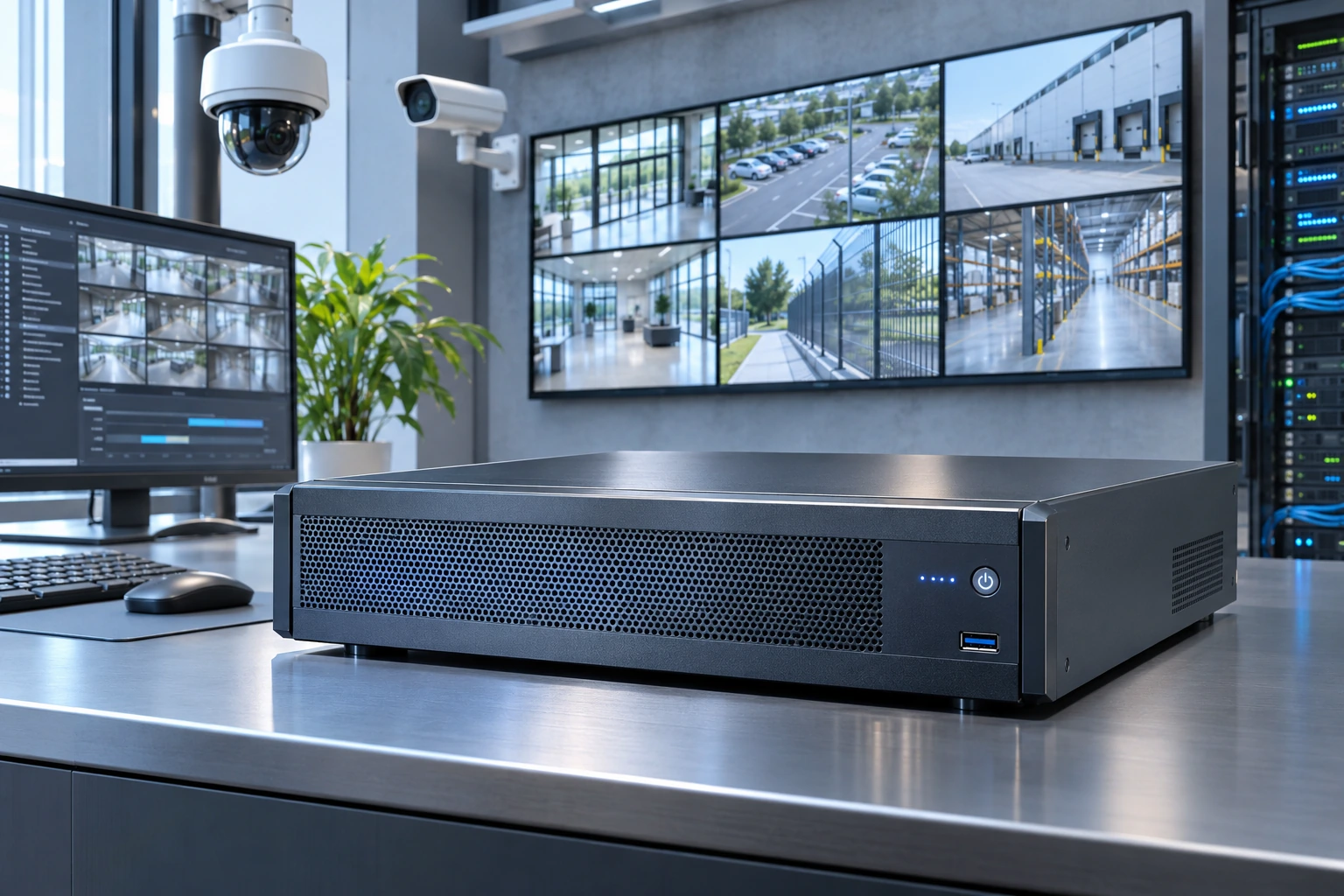
Axis Communications video recorders are professional network video recording solutions designed to record, store, view and manage footage from IP security cameras, either centrally or in a distributed configuration. Axis's recorder portfolio includes NVR systems with integrated PoE switches, compact recorders, ready-to-deploy video management servers and large-scale enterprise recording platforms.
These products, used with the Axis Camera Station ecosystem, can serve retail stores, offices, factories, shopping malls, logistics facilities, hotels, hospitals and critical infrastructure projects.
In the 2026 product portfolio, the AXIS S2108, S22 Mk II, S3008 Mk II, S3016, S4000 and S12 product families stand out. Options for channel capacity, recording bandwidth, storage, RAID, PoE and software licensing vary according to camera count and system architecture.
However, when selecting an Axis video recorder, considering only the camera count or HDD capacity is not enough. The recorder's verified video channel count, sustainable recording bit rate, camera resolutions, video management software, licensing model, RAID configuration, PoE budget and future expansion requirements must all be considered together.
What Is an Axis Video Recorder?
An Axis video recorder is a system that receives video streams generated by IP cameras over a network, stores them and manages them using suitable software.
Unlike DVR systems, Axis's current recording solutions are designed primarily to work with IP network cameras.
Key functions:
IP camera connectivity and management.
Continuous or event-based video recording.
Live viewing.
Searching and playing back recordings.
Exporting recordings.
User and access-rights management.
PoE camera power, on supported systems.
RAID-supported storage.
Centralized and multi-site management.
Video analytics and event integration.
System health and fault monitoring.
Not all models provide all these functions to the same extent.
What Are the Axis Video Recorder Series?
Axis offers recording systems in five main product families for projects of different scales.
AXIS S21 – Compact All-in-One Recorder
The S21 family includes the AXIS S2108 model.
This product combines a recording server, video management software and PoE switch for small-scale security installations.
AXIS S22 Mk II – Ready-to-Deploy NVR Systems with Integrated PoE Switches
The S22 Mk II family includes:
AXIS S2208 Mk II.
AXIS S2212 Mk II.
AXIS S2216 Mk II.
AXIS S2224 Mk II.
models.
These are all-in-one recording solutions supplied with AXIS Camera Station Pro software and an integrated PoE switch.
AXIS S30 – Recording Units with PoE Switches
The S30 family includes:
AXIS S3008 Mk II.
AXIS S3016.
models.
These devices are used particularly in AXIS Camera Station Edge-based systems, or to add a recording point to a centralized AXIS Camera Station architecture.
AXIS S40 – Distributed Recording and Storage
AXIS S4000 is a recording device offered in a 1U rack form factor.
It stands out for RAID-supported storage and distributed recording architectures.
AXIS S12 – Enterprise Recording Servers
The S12 family is intended for systems requiring higher camera counts, recording bandwidth and storage capacity.
This family includes tower and rack server options.
Axis Video Recorder Model Comparison
Model | Verified video capacity | Storage | Form factor |
|---|---|---|---|
S2108 | 8 channels | 2 TB | All-in-one |
S2208 Mk II | 8 channels | 4 TB | 8-port PoE NVR |
S2212 Mk II | 12 channels | 6 TB | 12-port PoE NVR |
S2216 Mk II | 16 channels | 8 TB | 16-port rack-mount PoE NVR |
S2224 Mk II | 24 channels | 12 TB | 24-port rack-mount PoE NVR |
S3008 Mk II | 8-channel class | 2 / 4 / 8 TB | Compact PoE recording unit |
S3016 | 16-channel class | 8 / 16 / 32 TB | Rack-mount PoE recording unit |
S4000 | 16 verified channels | 8 / 16 / 32 TB | RAID recording unit |
S1216 Tower Mk II | 32 verified channels | 8 TB | Enterprise server |
S1224 Rack | 32 verified channels | 12 TB | Enterprise rack server |
S1228 AI-Optimized | 32 verified channels | 12 TB | AI-search-focused server |
S1232 Rack | 64 verified channels | 16 / 32 TB | Enterprise server |
S1232 Tower | 64 verified channels | 32 TB | Tower server |
S1264 Rack | 96 verified channels | 24 / 64 / 144 TB | Large system |
S1296 Rack | 150 verified channels | 96 / 192 TB | Large-scale system |
Table note: The verified video channel count represents the system capacity under specific manufacturer test conditions. It is not always the same as the number of included software licenses. Storage figures are the nominal system capacity for the hardware variant purchased; usable capacity may differ after RAID.
AXIS S2108 – 8-Camera All-in-One Recorder
AXIS S2108 is a recorder designed for small-scale IP camera systems.
Technical Specifications
Verified system capacity for 8 cameras.
8 AXIS Camera Station Pro licenses.
Integrated 8-port PoE switch.
2 TB system storage.
Single HDD bay.
Windows 11 IoT Enterprise LTSC 2024.
Video management client and server software.
Compact device design.
Which Projects Is It Suitable For?
Small retail stores.
Offices.
Residential and apartment security.
Small businesses.
IP security systems suitable for up to eight cameras.
S2108 is intended for straightforward installations that combine PoE connectivity and recording management in one device.
However, its single-drive configuration does not provide RAID redundancy against disk failure.
AXIS S2208 Mk II – 8-Channel PoE NVR
AXIS S2208 Mk II is an all-in-one recorder based on AXIS Camera Station Pro, designed for eight cameras.
Technical Specifications
8 verified video channels.
8 AXIS Camera Station Pro licenses.
8 PoE+ ports.
135 W total PoE budget.
4 TB system storage.
2 HDD bays.
1 HDD in the factory configuration.
128 Mbps verified recording bit rate.
Windows 11 IoT Enterprise LTSC 2024.
Integrated video management software.
Difference Between S2108 and S2208 Mk II
Both models are designed for systems with eight cameras.
Key advantages of the S2208 Mk II include greater storage capacity and a professionally manageable PoE switch.
However, the S2208 Mk II having two HDD bays does not mean that the manufacturer provides RAID support on this model.
AXIS S2212 Mk II – 12-Channel PoE NVR
AXIS S2212 Mk II is a recorder with an integrated PoE switch, designed for 12 cameras.
Technical Specifications
12 verified video channels.
12 AXIS Camera Station Pro licenses.
12 PoE+ ports.
135 W total PoE budget.
6 TB system storage.
2 HDD bays.
1 HDD in the factory configuration.
192 Mbps verified recording bit rate.
Windows 11 IoT Enterprise LTSC 2024.
Why Does the PoE Budget Matter for 12 Cameras?
Having 12 PoE ports on a device does not mean that the maximum PoE+ power can be used on all ports simultaneously.
AXIS S2216 Mk II – 16-Channel Rack NVR
AXIS S2216 Mk II is a 1U rack recorder suitable for medium-scale professional security projects.
Technical Specifications
16 verified video channels.
16 AXIS Camera Station Pro licenses.
16 PoE+ ports.
260 W total PoE budget.
8 TB system storage.
4 HDD bays.
2 HDDs in the factory configuration.
RAID 0, 1 and 10 support.
RAID is not enabled in the default configuration.
256 Mbps verified recording bit rate.
Rack mounting.
RAID Support
S2216 Mk II offers RAID 0, RAID 1 and RAID 10 options.
However, the manufacturer does not enable RAID in the default configuration.
Therefore, if redundancy against disk failure is required, the number of drives and the RAID configuration should be determined during the project planning stage.
AXIS S2224 Mk II – 24-Channel Rack NVR
AXIS S2224 Mk II is the 24-camera model in the S22 family.
Technical Specifications
24 verified video channels.
24 AXIS Camera Station Pro licenses.
24 PoE+ ports.
260 W total PoE budget.
12 TB system storage.
4 HDD bays.
2 HDDs in the factory configuration.
RAID 0, 1 and 10 support.
RAID is not enabled in the default configuration.
384 Mbps verified recording bit rate.
1U rack chassis.
24 PoE Ports and Total Power
Having 24 PoE ports does not mean that 30 W of power can be supplied to each of the 24 cameras.
Therefore, when high-power cameras are used, an additional PoE switch or a suitable power solution may be required.
AXIS S30 Series – Compact and Distributed NVR
The AXIS S30 family comprises recording devices that combine camera connectivity and storage functions.
When used particularly with AXIS Camera Station Edge, these products can offer an architecture that reduces the need for a central server.
AXIS S3008 Mk II
8-channel recording unit.
Integrated 8-port PoE switch.
2, 4, or 8 TB storage options.
AXIS OS.
Compact installation.
No RAID support.
AXIS S3016
16-channel recording unit.
Integrated 16-port PoE switch.
8, 16, or 32 TB storage options.
RAID 0, 1, 5, 6, and 10.
Default RAID 5 configuration.
AXIS OS.
Rack-mount installation.
Difference between S3008 Mk II and S3016
Feature | S3008 Mk II | S3016 |
|---|---|---|
Recording class | 8 channels | 16 channels |
PoE switch | Integrated | Integrated |
Storage options | 2/4/8 TB | 8/16/32 TB |
RAID | None | 0/1/5/6/10 |
Default RAID | None | RAID 5 |
Operating system | AXIS OS | AXIS OS |
Design | Compact | Rack |
Can the S30 Series Operate on Its Own?
The answer depends on the AXIS Camera Station software architecture in use.
S30 devices can be used as the primary recording unit in AXIS Camera Station Edge systems.
In AXIS Camera Station Pro systems, they can be used as distributed recording units connected to a central server.
Therefore, S30 should not be regarded as a Windows-based all-in-one device that independently provides all the functions of an AXIS Camera Station Pro server.
AXIS S4000 – RAID-Capable Rack Recording Device
AXIS S4000 is a rack-mount recording device designed for distributed recording and increased storage capacity.
Technical Specifications
1U rack design.
8, 16, or 32 TB of system storage.
4 HDD bays.
4 HDDs in the factory configuration.
RAID 0/1/5/6/10.
Default RAID 5.
16 validated video channels.
Validated recording bitrate of 256 Mbps.
AXIS OS.
AXIS Camera Station Edge support.
Distributed recording integration with AXIS Camera Station Pro.
Is S4000 a Standalone NVR?
S4000 can be used as a recording component in an AXIS Camera Station Edge environment.
However, it does not replace a standalone Windows-based VMS server in an AXIS Camera Station Pro installation. In this architecture, it must operate alongside a Windows-based recording/management server.
S4000 Use Cases
Multi-site businesses.
Retail chains.
Centrally managed facilities.
Security infrastructures requiring distributed recording.
Projects where storage capacity needs to be separated from the existing system.
AXIS S12 Series – Enterprise Recording Servers
The AXIS Camera Station S12 family comprises professional recording servers ready to run AXIS Camera Station Pro.
These products are designed for projects requiring a high camera count, large data volumes, and centralized video management.
S12 Model Comparison
Model | Included Pro licenses | Validated video channels | Validated recording rate |
|---|---|---|---|
S1216 Tower Mk II | 16 | 32 | 256 Mbps |
S1224 Rack | 24 | 32 | 256 Mbps |
S1228 AI-Optimized | 28 | 32 | 256 Mbps |
S1232 Rack | 32 | 64 | 500 Mbps |
S1232 Tower | 32 | 64 | 500 Mbps |
S1264 Rack | 64 | 96 | 850 Mbps |
S1296 Rack | 96 | 150 | 1,500 Mbps |
Important: The number of included licenses differs from the device’s validated video-channel capacity. For example, the S1296 Rack is supplied with 96 AXIS Camera Station Pro licenses, while the manufacturer has validated it for 150 video channels. Connecting more devices depends on appropriate licensing and performance conditions.
AXIS S1216 Tower Mk II
16 AXIS Camera Station Pro licenses.
32 validated video channels.
Validated recording rate of 256 Mbps.
8 TB storage.
2 HDD bays.
RAID 0/1 support.
AXIS S1224 Rack
24 AXIS Camera Station Pro licenses.
32 validated video channels.
256 Mbps recording capacity.
12 TB storage.
2 HDD bays.
RAID 0/1/10 support.
AXIS S1228 AI-Optimized Server
28 AXIS Camera Station Pro licenses.
32 validated video channels.
256 Mbps recording capacity.
12 TB storage.
Server optimized for AI-powered video search scenarios.
This model is positioned to meet next-generation analytics requirements, such as free-text searches in AXIS Camera Station Pro Smart Search functions.
However, the availability of the AI search feature depends on the camera model, metadata, software version, and applicable license terms.
AXIS S1232 Rack and Tower
The S1232 family offers 64 validated video channels and 500 Mbps recording capacity.
The Rack model is available with 16/32 TB storage, while the Tower model offers 32 TB storage.
These products may be considered for medium- and large-scale systems.
AXIS S1264 Rack
64 included AXIS Camera Station Pro licenses.
96 validated video channels.
Validated recording bitrate of 850 Mbps.
24/64/144 TB storage options.
12 HDD bays.
RAID 0/1/5/6/10 support.
AXIS S1296 Rack
96 included AXIS Camera Station Pro licenses.
150 validated video channels.
Validated recording bitrate of 1,500 Mbps.
96/192 TB storage.
12 HDD bays.
Default RAID 6.
Enterprise recording server architecture.
S1296 is intended for projects requiring a high camera count and substantial recording bandwidth.
However, a validated capacity of 150 channels does not mean that 150 cameras, each operating simultaneously at maximum resolution and maximum bitrate, can be used without performance limits.
Differences Between Axis S21, S22, S30, S40, and S12
Series | Operating system | Integrated PoE | Software approach | Primary use |
|---|---|---|---|---|
S21 | Windows IoT | Yes | Camera Station Pro | Small system |
S22 Mk II | Windows IoT | Yes | Camera Station Pro | All-in-one NVR |
S30 | AXIS OS | Yes | Edge or Pro integration | Distributed recording |
S40 | AXIS OS | No | Edge or Pro integration | RAID recording/storage |
S12 | Windows IoT | External switch | Camera Station Pro | Enterprise recording server |
This distinction is particularly important in project proposals.
For example, S3016 and S2216 Mk II may offer a similar number of PoE camera connections. However, their operating systems, software licenses, RAID configurations, and recording architectures differ.
Difference Between AXIS Camera Station Edge and Pro
AXIS Camera Station Edge
This software approach is used to manage viewing and recording on Axis devices in smaller or distributed systems.
It can be used with AXIS OS-based recording devices such as S30 and S4000.
AXIS Camera Station Pro
This platform is designed for more comprehensive video management, centralized recording, enterprise use, and integration requirements.
The S21, S22, and S12 recording solutions are offered within the AXIS Camera Station Pro ecosystem.
Key distinction: The absence of AXIS Camera Station Pro licenses on a recording device compatible with AXIS Camera Station Edge does not mean the device cannot record at all. Licensing and software requirements should be assessed according to the architecture in use.
What Is RAID in Axis Recording Devices?
RAID is a storage technology that allows multiple disks to be arranged in specific configurations for performance or data resilience.
RAID 0
It is used for disk performance and capacity, but provides no redundancy against disk failure.
RAID 1
It protects against certain disk failures by mirroring data across disks.
RAID 5
It uses distributed parity data across at least three disks and, with a suitable configuration, can tolerate a single disk failure.
RAID 6
It requires at least four disks and, with a suitable configuration, can tolerate two disk failures.
RAID 10
It combines disk mirroring and striping, providing performance and fault tolerance.
Is RAID a Backup?
No.
RAID helps the recording system continue operating in the event of certain disk failures.
However:
User error.
Cyberattack.
Physical device loss.
Fire.
Accidental deletion of recordings.
it is not, on its own, a backup solution for situations such as these.
Camera Channel and License Differences in Axis Recording Devices
In Axis systems, the following three figures should be distinguished:
PoE port count: Physical network connections the device can power directly.
Validated video channel: Video capacity tested by the manufacturer under specific conditions.
Included software license: Device entitlements available under the license terms.
For example, the AXIS S1216 Tower Mk II comes with 16 Pro licenses but is validated for 32 video channels.
Therefore, whether additional licenses are required to use all 32 cameras should be examined based on the project configuration.
In addition, licensing policies may differ for multisensor cameras, audio devices, and different types of Axis devices.
Bandwidth in Axis Recording Devices
A recording device’s performance cannot be determined solely by the number of cameras.
For example, if each of 16 4K cameras produces an average recording stream of 8 Mbps: Total 128 Mbps
This figure represents only the cameras’ hypothetical total recording traffic.
In actual network and system design, the following should also be considered:
Number of video streams.
Resolution.
Frame rate.
Audio.
Metadata.
Camera analytics.
Live-view clients.
Uplink capacity.
Other network traffic.
must also be taken into account.
The manufacturer's verified recording bitrate does not mean that the system can perform unlimited live viewing and video exports simultaneously in every combination.
Axis Recording Duration and HDD Capacity Calculation
To determine recording capacity, calculate the number of cameras, average bitrate, and retention period.
Why Are Nominal HDD Capacity and Usable Capacity Different?
For example, a 32 TB nominal system consisting of 4 × 8 TB drives may provide approximately 24 TB of nominal usable block capacity when RAID 5 is used.
The space actually available may be lower because of file system and device reserves.
Therefore, 32 TB of system storage should not be considered 32 TB of net video recording space in every RAID configuration.
H.264, H.265, and AV1 in Axis Recording Devices
Axis camera products offer H.264 and H.265 compression options, as well as AV1 in certain newer-generation models.
However, a camera producing AV1 does not mean that the recording device and AXIS Camera Station version support this codec with all functions.
Items to check:
Recording the video stream.
Live decoding capacity.
Recording playback.
Video export.
Multiple monitors.
Third-party software compatibility.
The camera codec, recording device, client software, and export format should be tested together.
AI Video Analytics on Axis Recording Devices
Axis recording solutions can use AI events and metadata from compatible Axis cameras.
Examples:
Person and vehicle detection.
Line crossing.
Intrusion detection in an area.
Smart recording search.
Event filtering.
Certain free-text search functions.
However, the recording server's high processing capacity does not mean that it performs all AI analyses itself.
Many Axis cameras run AI analytics directly on the device.
The VMS and server can be used to manage events, metadata, and recordings.
Cybersecurity on Axis Recording Devices
Video recording devices are critical system components because they store footage from security cameras.
Recommended checks:
Up-to-date AXIS OS and operating system.
Secure administrator accounts.
Separation of user permissions.
Segmentation of camera and recording networks.
Secure remote access.
Recording encryption features.
Regular software updates.
Disk health monitoring.
Event and system logs.
Secure export of critical recordings.
Physical server security.
The update and maintenance processes for Windows-based S12/S22 devices differ from those for AXIS OS-based S30/S40 devices.
Common Issues with Axis Recording Devices
Camera Image Is Visible, but There Is No Recording
Check the recording schedule.
Verify the disk status.
Check the storage destination.
Review the license status.
Verify the camera time.
Test the recording service and network connection.
Recording Duration Is Shorter Than Expected
Measure the actual average bitrate.
Check the resolution and FPS settings.
Verify the available capacity after RAID.
Review the difference between continuous and event-based recording.
PoE Camera Does Not Power On
Check the total PoE budget.
Verify the port's power class.
Test the cables and connectors.
Review the maximum power consumption of the IR and heater loads.
Live Video Freezes
Check the VMS client's decoding capacity.
Review the resolution of the stream sent to the client.
Test the network uplink capacity.
Assess recording and live-view performance separately.
RAID Warning
Identify the faulty disk.
Follow the manufacturer's disk replacement procedure.
Monitor the rebuild process.
Assess the risk of an additional disk failure until the system has fully recovered.
Where Are Axis Video Recording Devices Used?
Stores and Chain Retail
For small locations, S21/S22 may be considered; for centralized and distributed setups, systems based on S30/S40 and S12 may be evaluated.
Shopping Malls
S12 servers can be used to record, analyze, and centrally manage a large number of cameras.
Factories
NVR or server solutions of a suitable scale can be used for indoor and outdoor camera systems, event recordings, and facility security.
Logistics Centers
A suitable server architecture can be considered for high-resolution camera recordings, multiple sites, and long-term storage requirements.
Hotels
Depending on the number of cameras and their distribution across floors, S22 or larger Camera Station systems can be used.
Corporate Offices
S21/S22 devices can be considered for suitable systems with between eight and 24 cameras.
Critical Infrastructure
S12 servers can be planned as part of distributed recording, RAID, user management, and centralized video operations.
Axis Video Recording Device Selection Checklist
Technical criterion | What to check |
|---|---|
Product family | S21, S22, S30, S40, S12 |
System architecture | Edge, Pro, distributed, or centralized |
Number of cameras | License and verified capacity |
Recording bitrate | Total Mbps |
PoE port | Physical camera connections |
PoE budget | Maximum total power |
HDD | Nominal and usable capacity |
RAID | Level and default configuration |
Recording duration | Days and actual average bitrate |
Video codec | H.264, H.265, and AV1 compatibility |
AI metadata | VMS search and event support |
Network | Uplink, VLAN, and connection architecture |
Cybersecurity | Operating system and updates |
License | Pro/Edge and device entitlements |
Growth | New cameras and locations |
Maintenance | Disk and system health monitoring |
Acceptance testing | Live view, recording, playback, and alarms |
Common Mistakes When Choosing an Axis Video Recording Device
1. Mistaking the Number of PoE Ports for a Software License
Physical camera connections and license entitlements are different parameters.
2. Confusing Verified Video Channels with the Number of Included Licenses
Some S12 models are supplied with fewer licenses despite having higher verified capacity.
3. Mistaking S30 and S40 Devices for AXIS Camera Station Pro Servers
The software architecture and usage of these products differ from those of S12/S22 systems.
4. Treating Nominal HDD Capacity as Net Capacity After RAID
The RAID configuration can affect the available disk space.
5. Assuming Maximum Power Can Be Drawn from Every PoE Port
The total PoE budget may be a limiting factor.
6. Using Camera Count as the Sole Performance Criterion
Total recording bitrate, resolution, and stream count are also important.
7. Mistaking RAID for a Backup
RAID provides resilience against certain disk failures; it does not replace an independent backup.
8. Failing to Account for Channel and License Usage by Multisensor Cameras
A single physical device can produce multiple video streams.
9. Equating Live-View Performance with Recording Capacity
Recording video and decoding multiple 4K views impose different hardware loads.
Frequently Asked Questions About Axis Video Recording Devices
What is an Axis video recording device?
It is a network video recording system that records footage from IP security cameras and manages it using compatible software.
Which Axis NVR models are available?
S2108, S2208 Mk II, S2212 Mk II, S2216 Mk II, S2224 Mk II, S3008 Mk II, S3016, and S4000 are among the key models.
Does Axis offer an 8-channel recording device?
Yes. S2108, S2208 Mk II, and S3008 Mk II can be considered for systems with eight cameras.
Which Axis 16-channel NVR models are available?
S2216 Mk II and S3016 are the main options.
Is there an Axis 24-channel NVR?
Yes. AXIS S2224 Mk II offers 24 verified video channels and 24 PoE+ ports.
Does Axis S2216 Mk II support RAID?
Yes. It supports RAID 0, 1, and 10; however, RAID is not enabled in the default configuration.
What is the capacity in TB of Axis S3016?
System storage options of 8, 16, and 32 TB are available.
What is the capacity in TB of Axis S4000?
Variants of 8, 16, and 32 TB are available.
How many cameras do Axis S12 recording servers support?
Depending on the model, verified capacity ranges from 32 to 150 video channels.
At what bitrate in Mbps can Axis S1296 record?
The manufacturer's verified recording performance is 1,500 Mbps.
Is an Axis Camera Station Pro license required?
It depends on the product and system architecture in use. S21/S22/S12 products are supplied with included licenses, while the Edge and Pro usage models for S30/S40 devices differ.
Do Axis recording devices work with third-party IP cameras?
Certain third-party IP cameras can be used if the appropriate protocol and software integration are available. Video, recording, and analytics features should be verified for each model.
How much do Axis recording devices cost?
Prices vary according to camera capacity, HDD, PoE, software license, RAID, and server hardware. Current prices should be obtained for each model.
Conclusion
Axis Communications video recording solutions offer products for a range of scales, from small businesses to large enterprise security systems.
The S21 and S22 Mk II families provide a ready-to-use recording solution with integrated PoE and AXIS Camera Station Pro, while the S30/S40 series stands out in distributed recording and storage architectures.
The S12 series is designed for projects requiring high recording bandwidth, larger storage systems, and comprehensive video management.
However, the most important criterion when choosing a professional Axis recording device is not camera count alone; recording bitrate, software licensing, storage/RAID, PoE budget, and future expansion needs must all be addressed together.
To select the right system, determine the camera inventory, recording duration, network traffic, and software requirements; then verify device performance through commissioning and acceptance tests.