
Xiaomi Security Cameras
Xiaomi security cameras offer smart IP cameras for indoor and outdoor use, AI-powered detection, and mobile monitoring solutions. We technically examine Xiaomi Smart Camera C701, C500 Pro, C400, C301, dual-lens models, Wi-Fi connectivity, night vision, microSD/NAS/cloud recording, ONVIF compatibility, and secure camera selection.
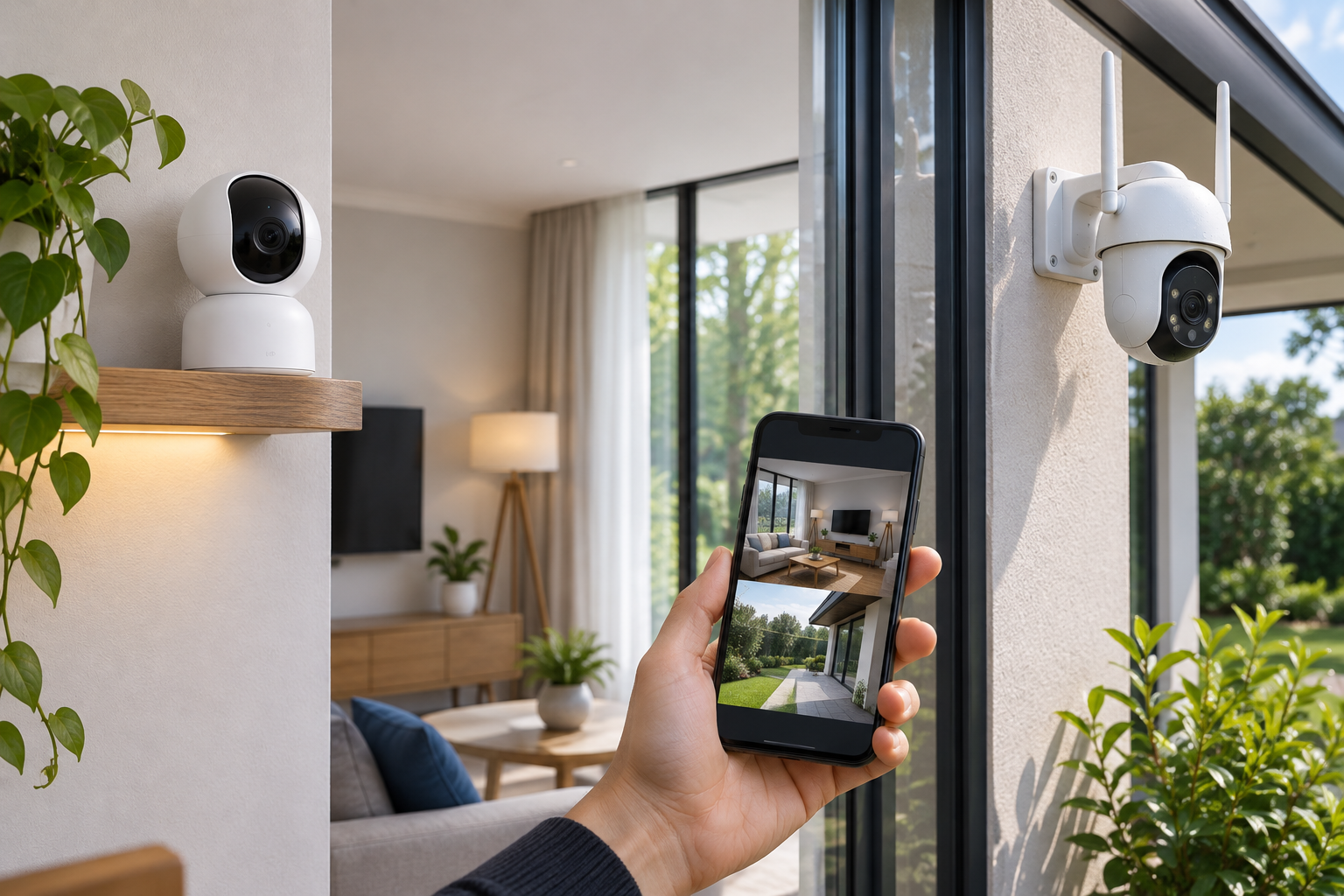
The use of IP camera systems in home and workplace security has significantly advanced with wireless network technologies and smart home platforms. Today, security cameras not only record images; they can detect human movements, send mobile notifications for specific events, and provide remote monitoring via appropriate connections.
Xiaomi security cameras consist of smart camera products developed for video surveillance in indoor and outdoor environments, manageable with the Xiaomi Home application.
While the Xiaomi Smart Camera series generally focuses on residential indoor use, motorized camera movements, and smart event detection, the Xiaomi Outdoor Camera series offers body structures suitable for outdoor conditions, different power options, and applications for monitoring gardens, building entrances, or open areas.
The product family includes cameras with various resolutions such as Full HD, 2K, 2.5K, 3K, and 4K; features like human and pet detection, night vision, two-way audio communication, microSD card, NAS, and cloud storage.
However, choosing the right security camera does not solely depend on resolution, AI, or mobile app features. Image detail, mounting location, recording continuity, network connectivity, compatibility with third-party systems, and data security must be evaluated together.
What Are Xiaomi Security Cameras?
Xiaomi security cameras are smart video surveillance devices that combine IP-based imaging and connected home security functions.
Products are typically configured and managed via the Xiaomi Home application.
Depending on the suitable model and service conditions, functions such as:
Live camera view monitoring.
Moving the camera horizontally and vertically.
Detecting human movements.
Phone notifications for specific events.
Night viewing.
Two-way audio communication.
Video recording to microSD card.
NAS storage.
Accessing event recordings via the cloud.
Supported smart home automations.
can be used.
However, not all of these features are available on all Xiaomi camera models.
For example, some models offer a motorized movement mechanism, while others operate with a fixed viewing angle. The recording behavior of battery-powered cameras may also differ from cameras powered continuously.
Therefore, the technical specifications of Xiaomi camera systems should be evaluated based on the full model code, not just the brand name.
What Are Xiaomi Camera Models?
Xiaomi's official security camera product catalog in Turkey includes different models for indoor, outdoor, dual-lens, and battery-powered use.
The main product groups are:
Xiaomi Smart Camera — Indoor Cameras
This is a family of smart cameras developed for residential and suitable indoor applications.
This category includes models such as Xiaomi Smart Camera C301, C400, C500 Pro, C701, C300 Dual, and C500 Dual.
Xiaomi Outdoor Camera — Outdoor Cameras
These products are developed for monitoring gardens, terraces, building entrances, and suitable open areas.
CW300, CW500 Dual, and BW300 are example models in this product group.
Xiaomi Dual-Lens Cameras
These products offer two separate imaging modules on a single device.
In some models, one lens monitors a fixed area while the other lens can be moved motorically.
Xiaomi Battery-Powered Cameras
These products can be considered for locations where electrical connection is limited or wiring is difficult.
However, the use of battery-powered cameras does not necessarily mean continuous 24/7 recording is possible.
Xiaomi Smart Camera C301 Features
The Xiaomi Smart Camera C301 is a 3 MP resolution camera developed for indoor video monitoring and specific smart detection needs.
The manufacturer's technical document for Turkey states a 2304 × 1296 pixel image resolution for the device.
Key features:
3 MP imaging.
2K class image quality.
Motorized horizontal and vertical movement.
AI-powered human detection.
Infrared night vision.
Physical lens masking function.
MJA1 security chipset.
microSD card and supported cloud recording options.
Xiaomi Home application.
2.4 GHz Wi-Fi connectivity.
The official technical data for the C301 specifies 8–256 GB microSD card support.
Who is Xiaomi C301 Suitable For?
It can be considered for general indoor area monitoring, indoor spaces near entrances, or suitable small office environments.
However, due to the C301's indoor use design, it should not be assumed that it can be used outdoors under rain, direct sun, or excessive humidity.
Xiaomi Smart Camera C400 Features
The Xiaomi Smart Camera C400 is a smart indoor camera with 4 MP resolution and dual-band Wi-Fi connectivity.
Technical specifications in the Turkey product catalog:
Technical specification | Xiaomi Smart Camera C400 |
|---|---|
Image resolution | 2560 × 1440 |
Camera class | 4 MP |
Wi-Fi | 2.4 GHz and 5 GHz |
Power supply | 5 V / 2 A |
microSD support | Up to 256 GB |
Camera movement | Motorized horizontal/vertical control |
Smart detection | Human detection |
Mobile management | Xiaomi Home |
The C400 distinguishes itself from some basic models that only use 2.4 GHz by supporting both 2.4 GHz and 5 GHz wireless networks.
However, it should not be assumed that 5 GHz connectivity will provide better coverage in every environment.
While the 5 GHz band can offer higher data transfer capacity under suitable conditions, it can be more affected by walls and other obstacles.
Difference Between Xiaomi C301 and C400
The C301 offers 3 MP resolution and 2.4 GHz Wi-Fi.
The C400, on the other hand, differentiates itself with 4 MP resolution and dual-band Wi-Fi connectivity.
However, higher resolution does not always mean better night vision or more successful human detection under all conditions.
The image sensor, lens, and software features should be evaluated together.
Xiaomi Smart Camera C500 Pro Features
The Xiaomi Smart Camera C500 Pro is a smart indoor camera with 5 MP resolution, HDR imaging, and advanced privacy functions.
Features announced by the manufacturer:
5 MP image sensor.
Up to 3K image at 2960 × 1666 pixels.
HDR imaging.
Color imaging in low light.
Motorized horizontal/vertical movement.
Human and pet detection.
Supported functions such as baby crying and loud sound detection.
MJA1 security chipset.
Physical lens masking.
2.4 GHz and 5 GHz Wi-Fi.
microSD, supported NAS, and cloud storage.
What is Physical Lens Protection?
The C500 Pro can physically conceal its camera lens by rotating it inwards into the body in supported privacy mode.
This feature helps to block the camera's field of view when it is not in use.
However, concealing the camera lens is not the same as shutting down all electronic and network components of the device.
In applications with high privacy requirements, microphone behavior, user access, and the device's network connection should also be evaluated separately.
Difference Between Xiaomi C500 Pro and C400
The C500 Pro distinguishes itself from the C400 with features such as higher resolution, HDR, and physical lens concealment.
However, before making a purchase decision, the required image quality and features for the actual use case should be evaluated.
Xiaomi Smart Camera C701 — 4K Security Camera
The Xiaomi Smart Camera C701 is one of Xiaomi's 4K resolution smart indoor cameras available in its Turkey product catalog.
Technical specifications announced by the manufacturer:
Feature | Xiaomi Smart Camera C701 |
|---|---|
Image resolution | 3840 × 2160 |
Image sensor | 8 MP |
Image class | 4K UHD |
Wi-Fi | 2.4 / 5 GHz, Wi-Fi 6 |
Night vision | 940 nm infrared |
Motorized movement | Horizontal and vertical |
microSD support | 8–256 GB |
AI features | Human, pet, and supported audio events |
Application | Xiaomi Home |
The C701 product also features:
HDR imaging.
MJA1 security chipset.
Physical lens concealment.
Two-way audio communication.
Supported local AI processing features.
Is a 4K Camera More Secure?
4K resolution can provide more detail under suitable lens and imaging conditions.
However, high resolution alone does not mean better security.
For example, a wide-angle 4K camera can image a large living room. But it may not provide sufficient pixel density to reliably distinguish a person's face from a distance.
Therefore, resolution should be evaluated together with viewing distance and lens field of view.
Xiaomi Dual-Lens Security Cameras
Xiaomi's dual-lens camera series aims to monitor two different fields of view with a single device.
Xiaomi Smart Camera C300 Dual
The C300 Dual has two 3 MP imaging modules.
The manufacturer describes the following features for this model:
Fixed wide-angle lens.
Motorized steerable second lens.
Two separate cameras with 2304 × 1296 resolution.
Linked human tracking.
Monitoring two images via the application.
Local human and sound detection.
H.265 video compression.
microSD, supported NAS, and cloud storage.
While the fixed lens continues to monitor a specific area, the movable lens can be turned in different directions.
Xiaomi Smart Camera C500 Dual
The C500 Dual is another dual-lens model that uses two 4 MP imaging modules.
Key technical features:
Dual 2560 × 1440 imaging.
Fixed and motorized imaging modules.
Dual-band Wi-Fi 6.
Relevant smart detection features.
MJA1 security chipset.
16–256 GB microSD support.
Supported NAS and cloud storage.
Can a Dual-Lens Camera Replace Two Cameras?
Not always.
A dual-lens device can provide greater viewing flexibility in certain areas. However, it does not guarantee the same coverage as two cameras placed at two different physical points.
Especially corners of corridors, walls, and furniture can obstruct the view.
Having two lenses does not mean the same security coverage as two independent camera installations.
Xiaomi Outdoor Security Cameras
Xiaomi's outdoor camera family includes products for monitoring building entrances, gardens, terraces, and suitable open areas.
Xiaomi Outdoor Camera CW300
The Xiaomi Outdoor Camera CW300 is a 4 MP resolution motorized outdoor security camera.
Key features:
2560 × 1440 resolution.
H.265 video encoding.
Motorized horizontal and vertical movement.
Human detection and tracking.
IR and white light supported night vision.
Audio and light warning.
Two-way audio.
IP66 dust and water protection.
2.4 GHz Wi-Fi and Ethernet connectivity.
microSD and supported cloud storage.
The power input for the CW300 is specified as 12 V / 1 A.
The presence of an Ethernet connection on this model does not mean the camera is powered by PoE.
Xiaomi Outdoor Camera CW500 Dual
The CW500 Dual is an outdoor camera solution with dual 4 MP lenses.
Key features of the model:
Fixed and motorized second camera.
Two separate 2560 × 1440 images.
2.4 / 5 GHz Wi-Fi 6.
Ethernet connectivity.
IP66 protection.
Human and vehicle detection.
Smart color night vision.
Audio and light warnings.
microSD, NAS, and Xiaomi Cloud storage options.
This system can be considered for monitoring specific garden and open areas from two different angles using the same device.
However, the outdoor protection of the power adapter is not the same as the IP66 rating of the camera body.
The manufacturer states that the adapter should be used in a suitably protected environment.
Xiaomi Outdoor Camera BW300
The BW300 is a battery-powered outdoor security camera.
In Turkey's technical documents, the following features are specified:
3 MP class 2K imaging.
4900 mAh battery.
130° field of view.
IP67 protection.
Supported smart detection and night vision.
The battery-powered design can provide ease of installation in some locations.
However, battery capacity is not the same as actual usage time.
Frequency of motion, video recording duration, temperature, Wi-Fi connectivity, and notification intensity can affect power consumption.
Battery-powered cameras may not have the same recording behavior as continuously powered IP cameras that record constantly.
Xiaomi Security Camera Comparison
Model | Resolution | Usage | Distinguishing feature |
|---|---|---|---|
C301 | 3 MP | Indoor | Basic smart monitoring, 2.4 GHz Wi-Fi |
C400 | 4 MP | Indoor | Dual-band Wi-Fi, motorized movement |
C500 Pro | 5 MP | Indoor | 3K, HDR, physical lens protection |
C701 | 8 MP | Indoor | 4K, Wi-Fi 6, advanced AI |
C300 Dual | Dual 3 MP | Indoor | Fixed + motorized dual lens |
C500 Dual | Dual 4 MP | Indoor | Dual lens, Wi-Fi 6 |
CW300 | 4 MP | Outdoor | IP66, motorized tracking |
CW500 Dual | Dual 4 MP | Outdoor | Dual lens, IP66, Wi-Fi 6 |
BW300 | 3 MP | Outdoor | Battery-powered, IP67 |
The features in the table are based on Xiaomi Turkey's official product descriptions. Model, region, and hardware version differences should be checked.
What is the Xiaomi Home App?
Xiaomi Home (Mi Home) is a mobile application used for setting up and managing supported Xiaomi smart home devices.
With Xiaomi security cameras, the following can be performed via the application:
Introducing the camera to the network.
Accessing live view.
PTZ control on supported cameras.
Motion detection settings.
Configuring event notifications.
Monitoring microSD recordings.
Managing cloud services.
Editing camera sharing permissions.
Supported smart home automations.
However, specific functions of the application may depend on the country, server region, camera model, and software version.
How to Set Up a Xiaomi Camera with a Phone?
Typical setup consists of the following stages:
Install the Xiaomi Home application.
Connect the camera to a suitable power source.
Put the device into setup mode if necessary.
Add the camera within Xiaomi Home.
Select the appropriate Wi-Fi network.
Pair the camera with the application.
Configure necessary security and recording settings.
Test live monitoring, event detection, and recording playback.
Some models may offer QR code or Bluetooth-assisted setup options.
Setup steps should be performed according to the model's official user manual.
AI Features in Xiaomi Cameras
Certain Xiaomi smart cameras include AI-powered event detection functions.
The purpose of these systems is to evaluate specific types of events rather than just detecting general image motion.
Human Detection
Supported cameras can use algorithms to detect the presence or movement of humans within the image.
This feature can help reduce some unnecessary notifications that might occur due to curtain movement or certain environmental changes.
However, the presence of human detection does not mean the camera can identify a person with their identity information.
Human Tracking
Suitable motorized Xiaomi cameras can change the camera angle according to the movement direction of the detected person.
This feature can be used especially in large rooms or areas like gardens.
However, if a motorized camera turns in another direction while tracking a person, it may prevent simultaneous viewing of events in the previous field of view.
Pet Detection
Supported models like the C500 Pro and C701 include pet detection features.
These functions can help detect specific animal movements and generate relevant notifications.
However, it should not be assumed that every animal species or all movements are detected with the same accuracy.
Baby Crying and Sound Detection
Certain Xiaomi indoor cameras offer features for detecting events such as loud sounds or baby crying.
These functions can be considered for home surveillance.
However, the baby crying detection feature is not a substitute for medical monitoring or a professional life safety system.
Facial Recognition
Some products and cloud services within the Xiaomi ecosystem may include features related to facial recognition.
However, human detection and facial recognition are not the same function.
Furthermore, facial recognition capability may depend on the camera model and the activated service.
Therefore, it should not be assumed that all Xiaomi-branded cameras have facial recognition.
Does AI Really Improve Security?
Properly configured event detection can help detect security-related movements more quickly.
However, AI-powered detection:
Can generate false alarms.
May miss some events.
May perform differently in the dark.
May not detect people whose view is obstructed.
May show low accuracy for distant targets.
Therefore, smart event detection should not be considered the sole verification method for a security system.
How Does Night Vision Work in Xiaomi Cameras?
Xiaomi security cameras use infrared or color night imaging methods depending on the model.
IR Night Vision
IR night vision helps create images in low-light areas thanks to suitable infrared illumination.
Some Xiaomi models use 940 nm infrared illumination.
This wavelength can help reduce the red glow noticed by the human eye under certain conditions.
However, IR imaging typically produces black-and-white images.
Color Night Vision
In suitable Xiaomi models, color night vision can be generated with sensitive image sensors and white light support.
For example, the CW300 offers night imaging features that can activate white light when a human is detected.
This method can be useful for evaluating certain details such as clothing or vehicle color.
However, the activation of white light creates visible illumination in the camera's environment.
What to Consider in Night Vision?
The camera's actual target distance.
The ambient light level.
The lens aperture.
Blurriness in moving subjects.
Reflection of infrared light from glass.
The effect of white light on the surroundings.
Image noise and compression.
The camera's mounting direction.
Especially in an IR camera placed behind glass, infrared reflections can negatively affect night vision.
The night vision distance stated in the catalog does not mean that face or license plate details can be read at that distance under all conditions.
How to Record with Xiaomi Security Cameras?
Recording options for Xiaomi cameras vary by model.
Main methods:
Local recording to a microSD card.
Recording transfer to a supported NAS device.
Cloud event recording via Xiaomi Home Secure.
The operation of these methods differs from each other.
Local Recording with microSD Card
Suitable Xiaomi cameras, can perform local recording via a microSD card.
Card capacity varies by model.
For example, microSD support up to 256 GB is specified for C400, C500 Pro, and C701 models.
Available options for local recording can be continuous recording or event-based recording, depending on the device's software.
When the card is full, some devices can perform cyclical recording by overwriting the oldest recordings.
Therefore, important recordings should be regularly transferred to a secure storage area.
Xiaomi Home Secure Cloud Recording
Xiaomi Home Secure is a cloud-based video recording and event history service for supported cameras.
According to the manufacturer's official statements, the service can create and upload video recordings to the cloud when a suitable event is detected.
Certain subscriptions offer 7 or 30-day cyclical event history options.
However:
A 7 or 30-day cloud event history does not mean the camera recorded video continuously during this period.
Xiaomi's official support document explains that Xiaomi Home Secure service records detected motion events; it does not create continuous video during periods of no motion.
For actual 24/7 recording needs, the continuous microSD recording method supported by the relevant camera should be evaluated separately.
NAS Storage in Xiaomi Cameras
NAS (Network Attached Storage) is a storage system accessible over a network.
Certain Xiaomi models, such as the C500 Pro and C500 Dual, support NAS storage.
The manufacturer's NAS support guide describes the process for transferring recordings from the microSD card to NAS storage for suitable models.
In this method:
The camera and NAS must be on the same suitable local network.
Supported NAS/SMB functions must be provided.
The microSD card may need to function correctly in relevant models.
Storage management is configured via Xiaomi Home.
However, this feature does not mean the camera directly sends a standard video stream to every NAS or NVR device.
Recording transfer from microSD to NAS and continuous image transfer to a professional NVR via ONVIF/RTSP are different technical methods.
Does Xiaomi Camera Record Without Internet?
Some Xiaomi cameras, if properly set up initially, with a microSD card prepared and continuously powered, can continue local recording even if the internet connection is lost.
However, this is not guaranteed for all models.
Xiaomi's official support statement specifically makes the following distinction:
If the power continues even if the network connection is lost, suitable local recording may continue.
Cloud recording cannot be performed without an internet connection.
Restarting the device or resetting to factory settings while the network connection is lost may prevent the recording function from continuing in some models.
Therefore, a Xiaomi camera's ability to record without internet does not mean it will behave the same in scenarios of internet outage and power outage.
If recording continuity is important, it should be verified with actual field tests.
Do Xiaomi Cameras Support ONVIF and RTSP?
This topic is critically important for users planning integration between Xiaomi security cameras and professional CCTV systems.
ONVIF offers standardized communication interfaces between IP-based cameras, NVRs, and video management systems.
RTSP is a protocol used for accessing suitable video streams and managing media streaming sessions.
It should not be assumed that these functions are present in all models of Xiaomi's smart home camera products.
Does Xiaomi C300 Support ONVIF?
Xiaomi Turkey's official technical support statement indicates that the Xiaomi Smart Camera C300 model does not support ONVIF.
The relevant support page also contains the term “RSTP”.
However, RSTP is a protocol associated with Spanning Tree in networks; it is not the same as the RTSP video streaming protocol.
Therefore, a definitive conclusion about the camera's RTSP support should not be drawn from the RSTP explanation in the said support document.
RTSP compatibility should be verified separately.
Can Xiaomi Cameras Connect to Hikvision or Dahua NVRs?
It cannot be said that every Xiaomi camera model can directly connect to a Hikvision, Dahua, or other brand NVR.
The following conditions should be evaluated for integration:
Presence of RTSP or ONVIF support in the camera.
The relevant feature being active in the current firmware version.
Video encoding format supported by the NVR.
User authentication method.
Main and sub-streams.
Network access.
Continuous recording requirement.
Event notification and playback compatibility.
Furthermore, the ability to view the image in the Xiaomi Home application does not mean that a third-party NVR can access the same stream.
Recording transfer from microSD to NAS and continuous image transfer to a professional NVR via ONVIF/RTSP are different technical methods.
Key Difference from Professional CCTV Systems
Feature | Xiaomi smart home cameras | Professional IP CCTV systems |
|---|---|---|
Mobile application | Xiaomi Home | Manufacturer's mobile/VMS platform |
Local recording | microSD depending on model | Typically central NVR/VMS |
NAS | In supported models | Direct recording or archive depending on system |
ONVIF | Must be verified per model | Supported in numerous models |
RTSP | Must be verified per model | Common in suitable systems |
PoE | Not a default feature | Common in numerous professional cameras |
User permissions | Dependent on application features | Typically detailed role management |
Central recording capacity | Dependent on product and service | Designed according to NVR/VMS capacity |
Corporate integration | Model and ecosystem limits exist | Expandable based on protocol/API support |
This comparison shows the general product approach. Both categories may include products offering different technical specifications.
For detailed information, the What is ONVIF? What Does It Do in IP Camera and NVR Systems? guide on GüvenlikOnline can be reviewed.
How Many Days Does a Xiaomi Camera SD Card Record?
Recording duration does not solely depend on microSD card capacity.
Camera resolution, video bitrate, frame rate, compression technology, and recording method also affect storage needs.
Simplified calculation:
Average bitrate | Approximate continuous recording time |
|---|---|
2 Mbps | 11.9 days |
4 Mbps | 5.9 days |
8 Mbps | 3.0 days |
Calculations are hypothetical; 256 GB decimal capacity and constant average bitrate are assumed. File system, audio recording, management data, and other overheads are excluded.
For example, at an average bitrate of 4 Mbps, a 256 GB card can theoretically provide approximately six days of continuous recording capacity.
However, the actual duration may vary depending on camera encoding settings and the amount of motion in the scene.
When event-based recording is used, the total recording duration may extend; however, in this case, not all images between events may be recorded.
Does H.265 Provide Storage Savings?
H.265 can provide more efficient compression compared to H.264 under suitable conditions.
However, the savings achieved are not constant.
When determining recording capacity, the actual or reliably predicted bitrate should be used as the basis.
Image Quality and DORI Analysis in Xiaomi Security Cameras
Image quality in a security camera does not solely depend on the megapixel value.
What is important is that the camera can provide sufficient detail at the targeted distance.
For example, the 4K Xiaomi C701 produces a 3840 × 2160 pixel image.
However, if the camera is viewing a large room, the face of a person at a distant point may not have enough detail for identification.
Wi-Fi and Network Infrastructure in Xiaomi Security Cameras
Many of Xiaomi's smart camera models operate via wireless connection.
This structure can provide installation flexibility in home and small-scale applications.
However, the use of Wi-Fi connectivity does not mean that all features of a professional wired network infrastructure are available.
Difference Between 2.4 GHz and 5 GHz
2.4 GHz: Can provide wider coverage under certain conditions; however, it can be affected by interference in crowded wireless environments.
5 GHz: Can provide high transmission capacity at suitable distances; however, it can be more affected by obstacles and walls.
More up-to-date wireless connectivity features are available in Wi-Fi 6 supported C701 and some dual-lens models.
However, using Wi-Fi 6 does not guarantee uninterrupted operation of the camera in every environment.
Things to Consider in Wi-Fi Connectivity
Actual signal level at the camera point.
Bandwidth of high-resolution stream.
Wireless channel density.
Wall and floor obstructions.
Modem and access point capacity.
Continuity of internet connection.
Behavior during power outage.
Application and cloud service access.
Especially in projects with high-resolution or numerous Wi-Fi cameras, wireless network capacity should be evaluated beforehand.
Cybersecurity and Privacy in Xiaomi Cameras
Internet-connected cameras can process sensitive information such as images and audio in homes and businesses.
Therefore, the cybersecurity features of the devices are important.
Xiaomi's certain products include features such as the MJA1 security chipset and encrypted data transfer.
However, the use of encryption technology does not mean that all cybersecurity risks are eliminated.
Recommendations for Secure Use
A strong and unique password should be used for the Xiaomi account.
Supported additional account verification methods should be enabled.
Camera and application updates should be followed.
Camera access should only be shared with authorized users.
Unnecessary device sharing permissions should be removed.
The Wi-Fi network should be protected with current security methods.
Using a separate network or IoT network for the camera should be considered.
Unnecessary ports should not be opened on the modem.
Unused cloud and recording features should be reviewed.
Before selling or transferring the device, account linkage and local recordings should be properly removed.
Is Physical Lens Protection Sufficient?
Certain models like the C500 Pro, C301, and C701 feature physical lens concealment.
This feature helps protect privacy.
However, a closed camera lens does not mean that all communication and recording functions of the device are disabled.
Users should also check microphone, cloud services, and sharing permissions.
Xiaomi Security Cameras and KVKK (Personal Data Protection Law)
The use of Xiaomi cameras in commercial businesses or common areas should be evaluated separately in terms of personal data protection.
The presence of recognizable individuals in camera footage may constitute personal data processing activity.
The Personal Data Protection Authority (KVKK) states that security cameras in workplaces should be used in a purpose-limited and proportionate manner.
Privacy in Camera Placement
The actual security need for the camera should be determined.
The field of view should not cover unnecessary private areas.
Cameras should not be placed in intimate areas such as toilets, changing rooms, and similar spaces.
Audio recording should be evaluated separately.
Appropriate illumination should be provided for relevant individuals.
Recordings should only be viewed by authorized personnel.
Retention and destruction periods should be determined.
Conditions for cloud and international data transfer should be evaluated.
Is Human Detection and Facial Recognition the Same?
No.
Human detection may aim to assess whether a human is present in the image.
Facial recognition, on the other hand, may use different data processing methods to identify or verify individuals.
Therefore, it is incorrect to consider the human detection features in some Xiaomi models as direct biometric facial recognition.
If biometric data processing is involved, special personal data provisions should be examined separately.
Where Are Xiaomi Security Cameras Used?
Homes and Apartments
The Xiaomi Smart Camera series can be considered for monitoring living rooms, hallways, and suitable indoor spaces.
Detached Houses
Suitable outdoor models can be used for gardens, terraces, and building entrances.
Small Offices
Smart camera solutions can be considered for entrances and certain common areas, provided the business's legal obligations are met.
Small Stores
Suitable models can assist with store security.
However, more comprehensive CCTV systems may be required for needs such as cash register recordings, multi-camera continuous archiving, and professional alarm integration.
Summer Houses and Second Homes
Suitable models offering remote monitoring and event notifications can be preferred.
However, internet and power continuity should be planned separately for properties not used for long periods.
Gardens and Open Areas
CW300, CW500 Dual, or suitable battery-powered outdoor models can be used.
Nevertheless, mounting location, environmental protection, and power supply conditions should be verified.
What to Consider When Choosing a Xiaomi Security Camera?
The purpose of use should be prioritized when determining the correct Xiaomi camera model.
Selection criterion | Topic to evaluate |
|---|---|
Usage area | Indoor or outdoor |
Resolution | 3, 4, 5, or 8 MP requirement |
Field of view | Fixed, motorized, or dual-lens |
Night imaging | IR and color night vision |
Artificial intelligence | Human, pet, and event detection |
Wi-Fi | 2.4 GHz, 5 GHz, or Wi-Fi 6 |
Power | Adapter or battery |
Local recording | microSD capacity and continuous recording |
NAS | Model-based NAS functions |
Cloud | Xiaomi Home Secure service and subscription conditions |
NVR integration | Verified ONVIF/RTSP support |
Privacy | Lens protection, data access, KVKK |
Security | Firmware and account security |
Maintenance | Remote status monitoring and recording control |
Especially in a professional security project, the ability to view images in the Xiaomi Home application alone is not a sufficient system acceptance criterion.
Recording integrity, access permissions, archiving, and post-event review requirements should be evaluated separately.
Technical Checklist for Xiaomi Camera Systems
The following checks should be performed during purchasing, installation, and commissioning processes:
- Is the camera's purpose of use determined?
- Is indoor or outdoor suitability verified?
- Is the full model and hardware version checked?
- Are the camera's field of view and target distance evaluated?
- Is the required image detail and resolution determined?
- Is day and night vision tested?
- Is the Wi-Fi signal level measured?
- Is the power source and outage behavior checked?
- Are the microSD card capacity and recording mode determined?
- Is the distinction between continuous recording and event-based recording made?
- Is the model compatibility of NAS or cloud service verified?
- If NVR is required, is ONVIF/RTSP support checked?
- Are AI event detection functions tested?
- Is it verified that notifications are received under real conditions?
- Are camera account and sharing permissions restricted?
- Are current security updates checked?
- Are KVKK and privacy requirements evaluated?
- Is recording playback and post-event image retrieval tested?
- Is a camera and network maintenance plan created?
This list is a technical pre-assessment tool. It does not replace the manufacturer's installation instructions or project-specific acceptance tests.
Frequently Asked Questions About Xiaomi Security Cameras
Which country's brand are Xiaomi security cameras?
Xiaomi is an international technology brand based in China. It offers products in different categories such as smartphones, networked devices, smart home products, and security cameras.
Are Xiaomi camera systems good?
Xiaomi offers models with different resolutions, recording, and AI features for residential and certain small-scale security applications. However, suitability depends on the model's technical specifications, recording requirements, network reliability, and purpose of use.
Do Xiaomi cameras work without internet?
Suitable models can perform local recording to a microSD card as long as power continues after initial setup is complete. However, internet outage, device restart, and cloud recording behaviors may differ by model.
Does a Xiaomi camera record continuously?
In models with continuous recording support, 24/7 local recording can be done with a suitable microSD card and recording settings. Cloud event recording is not the same as continuous recording.
Can Xiaomi cameras connect to NVR?
There is no general compatibility guarantee for all models. ONVIF/RTSP support must be verified per model and firmware. The NAS recording transfer feature also does not directly imply NVR compatibility.
What is the difference between Xiaomi C400 and C500 Pro?
The C400 is a 4 MP resolution dual-band Wi-Fi camera. The C500 Pro offers additional features such as 5 MP/3K imaging, HDR, and physical lens protection.
How many megapixels is Xiaomi C701?
The Xiaomi Smart Camera C701 has an 8 MP sensor and 3840 × 2160 pixel 4K UHD resolution.
Do Xiaomi cameras provide color images at night?
Supported models can offer color images in low light. Some outdoor models use white light when necessary. Color image performance in complete darkness depends on the model and lighting conditions.
Is cloud recording in Xiaomi security cameras paid?
Cloud services like Xiaomi Home Secure may include free trials or limited services and paid subscriptions. Availability depends on the device, country, and service policy.
How many days does a Xiaomi camera SD card record?
It varies depending on camera bitrate, card capacity, and recording method. For example, a 256 GB card can theoretically hold approximately six days of continuous video data at a constant average bitrate of 4 Mbps.
Do Xiaomi cameras support PoE?
PoE support is not a standard feature of all Xiaomi cameras. Many models with Wi-Fi or Ethernet connectivity are also powered by an adapter. The exact technical value of the power input should be checked when purchasing a camera.
Do Xiaomi cameras count people with AI?
Human detection and tracking functions are not the same as professional two-way people counting or visitor traffic analytics. For such measurements, the model's relevant counting function and field accuracy should be demonstrated separately.
Are Xiaomi cameras compliant with KVKK?
Legal compliance depends on the system's purpose of use, processed data, recording area, and implemented technical/administrative measures. The product offering encrypted communication does not automatically mean that all KVKK obligations are met.
Conclusion: How to Choose the Right Model in Xiaomi Security Camera Systems?
Xiaomi security cameras consist of products that combine smart monitoring for indoor and outdoor environments, AI-powered event detection, night vision, mobile access, and various video storage options.
Models like the C301 and C400 offer options for basic indoor needs, while the C500 Pro and C701 stand out with higher image resolution and different smart functions. Dual-lens models can provide flexibility for wide-area monitoring. Outdoor products like the CW300, CW500 Dual, and BW300 are alternatives for different environmental and power requirements.
However, high resolution, wireless connectivity, and AI features alone do not constitute a professional security camera system.
Especially in projects requiring continuous recording, third-party NVR integration, multi-camera central management, and long-term recording storage, the technical limitations of the products should be carefully evaluated.
Choosing the right Xiaomi security camera should be done by evaluating the imaging purpose, mounting conditions, connection infrastructure, storage method, data security, and actual field performance together.