
What is a Smart Bulb Security Camera? Are E27 Wi-Fi Cameras Worth Buying?
Wi-Fi security cameras operating via a bulb socket stand out with their practical installation that requires no additional camera cabling. However, E27 compatibility, image quality, 360-degree monitoring, recording options, and data security should be evaluated before purchase. So, can bulb cameras replace classic IP security cameras?
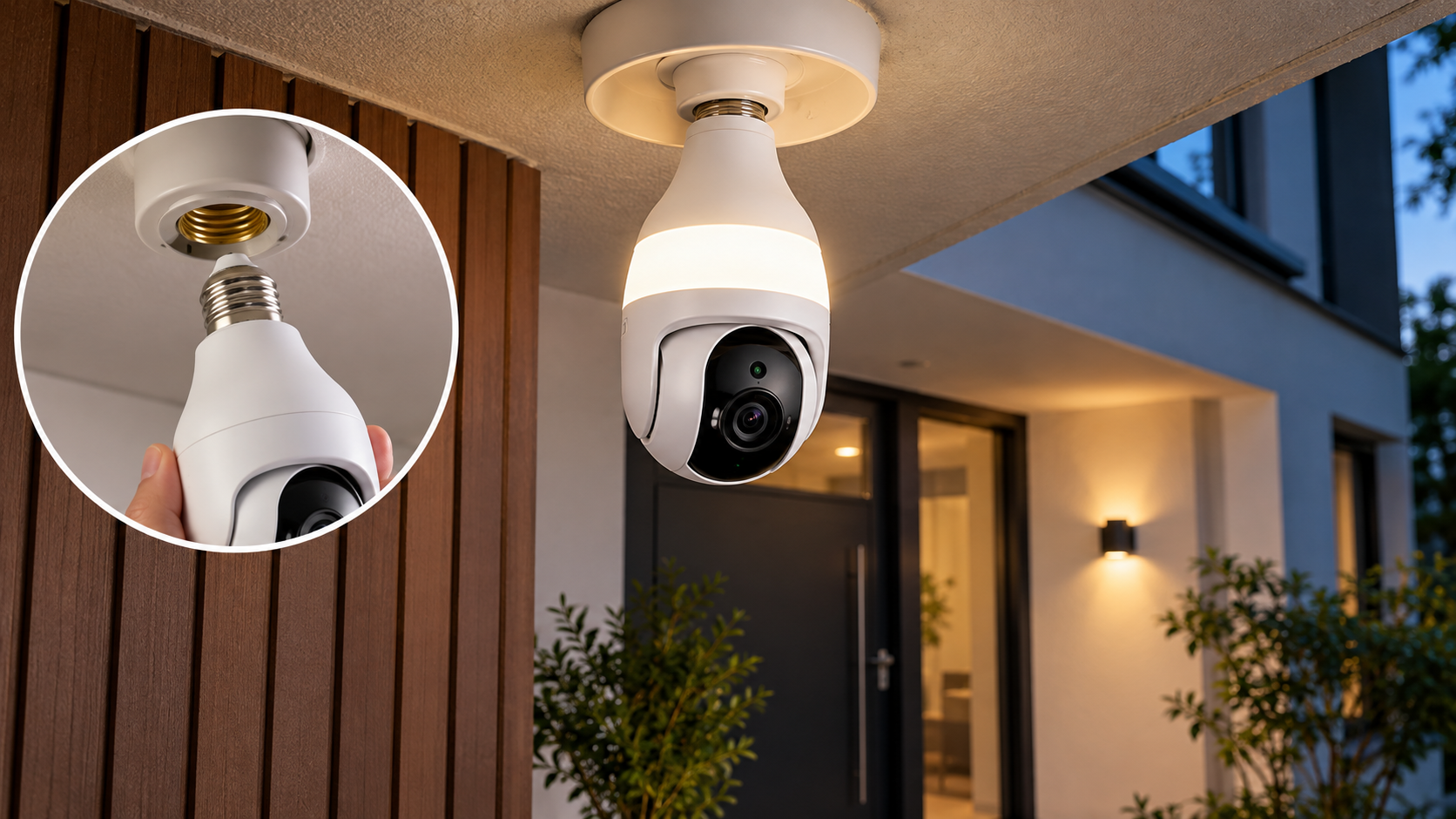
Is it possible to use a security camera by installing it into an existing light bulb socket? Bulb-type security cameras offer a practical answer to this question. These devices, which reduce the need for separate power connections and some cabling typically encountered in traditional security camera installations, particularly appeal to home users.
However, easy installation does not always equate to sufficient security. The stability of the Wi-Fi connection, where recordings are stored, manufacturer's software support, and the actual field of view of the camera directly influence the purchasing decision.
Therefore, when evaluating bulb cameras, it's essential to consider the entire use case scenario, not just resolution or the "360-degree" claim.
What is a Smart Bulb Security Camera?
A bulb security camera is a type of compact IP camera that draws power from a suitable lighting socket and typically transmits video via Wi-Fi.
Some of these devices integrate LED lighting and the camera within the same housing. Other models, despite having a bulb-shaped casing, primarily focus on camera functionality.
Depending on the model, products may include the following features:
Live video viewing from a mobile application.
Motorized camera movement in horizontal and vertical directions (pan/tilt).
Notifications based on motion or human detection.
Infrared or color night vision.
Two-way audio via microphone and speaker.
Recording via microSD card, NVR, or cloud.
Lighting control by schedule or motion.
However, not all these functions are present in every bulb camera. It should be examined on a product-by-product basis whether recording and smart detection features require a subscription.
How Does an E27 Bulb Camera Work?
E27 refers to the connection type of the commonly used screw-in light bulb socket. Many homes in Turkey have this type of socket.
A suitable E27 camera can be installed into the socket after removing the existing bulb. The device draws the necessary electricity from this connection; initial configuration is typically done via the manufacturer's mobile application.
For example, the Imou Bulb Cam 2C states that it can be installed with an E27 connection and supports motorized horizontal-vertical camera movement.
However, merely having an E27 connection on the purchased camera is not sufficient. The device's supported mains voltage and installation environment must also be suitable.
Can Every Bulb Camera Be Used in Turkey?
No. Different socket types and electrical standards exist in the international market.
For instance, the technical document for Wyze Bulb Cam published for the USA specifies an E26 socket and 120 V AC power supply. It cannot be assumed that this model is directly compatible with Turkey's standard electrical infrastructure.
In contrast, the manufacturer's technical specifications for the Imou Bulb Cam include an input range of 100–240 V.
Therefore, before purchasing, the product's full model number, connection type, and electrical specifications must be checked. Attempting to use an unsuitable product solely with a physical socket converter may not be a safe solution.
Does a 360-Degree Bulb Camera Really See Everywhere?
One of the most common claims in bulb camera promotions is the 360-degree monitoring feature.
However, being able to rotate 360 degrees and being able to record a 360-degree area simultaneously are different things.
A motorized camera can rotate horizontally to view different points. However, when the camera is looking in a specific direction, an event occurring at another point outside its field of view may not be captured at that moment.
For example, for a specific 3 MP version of the Imou Bulb Cam, the manufacturer reports a horizontal movement range of 0–340 degrees and a vertical range of 0–90 degrees. Different movement ranges are specified for the Bulb Cam 2C.
These values define the motor's movement capacity; they do not mean that the entire surroundings are viewed simultaneously.
When choosing a camera, three features should be distinguished:
Field of View (FoV): The area a camera can view when stationary in one direction.
Pan/Tilt: The camera's capacity to move horizontally and vertically.
Auto-tracking: In supported models, the ability to follow a detected target with camera movement.
In areas where multiple directions need to be continuously recorded, a system supported by fixed cameras might be more suitable.
What Determines Image Quality in Bulb Cameras?
Product boxes may display resolution statements like 2K, 3 MP, 5 MP, or similar. These provide important information regarding image detail but do not solely explain actual performance.
Sensor, lens, image processing, compression, and lighting conditions also influence image quality.
For example, high resolution in a wide-angle camera does not necessarily mean that a distant face or license plate can be distinguished.
How is Night Vision Evaluated?
Bulb camera models may offer infrared night vision and color image options supported by LED illumination.
However, the night vision distance stated by the manufacturer may be based on specific test conditions. Actual performance varies depending on ambient lighting, camera placement, surface reflections, and characteristics of moving targets.
Especially in areas like entrance doors or parking lots, night performance should not be evaluated solely by catalog distance.
Does a Bulb Camera Record if the Wi-Fi Connection is Lost?
The answer to this question depends on the product's recording architecture.
Some bulb cameras transmit images directly to a cloud service. Some include a microSD card. In suitable models, an NVR connection can also be established via the local network.
For example, the technical document for Imou Bulb Cam includes microSD card support and ONVIF connectivity. However, the presence of ONVIF support for a camera does not mean that all features will work seamlessly with every recording device.
Whether local recording to a card continues when Wi-Fi is disconnected depends on recording settings, device firmware, and the model's offline operation features.
Furthermore, it should be investigated before purchase which features continue to function when a cloud subscription ends.
Does the Camera Work if the Light Switch is Turned Off?
This is one of the most significant practical limitations of a bulb camera.
Since the device draws its power from the socket, if the electricity to the socket is cut off, the camera will also stop working. In this case, live monitoring and recording functions may be interrupted.
If lighting needs to be controlled independently of the camera, it should be examined whether the relevant model can manage the light separately via the application.
Solutions requiring changes to the electrical installation should be implemented by competent personnel.
Can Bulb Cameras Be Used Outdoors?
Not every bulb camera is suitable for outdoor environments.
For a model to be used outdoors, its water and dust resistance, operating temperature, and mounting conditions must be evaluated.
For example, while Wyze specifies an IP65 protection class for its Bulb Cam product, it also clarifies that the socket connection should not be exposed to water.
Therefore, the camera body being suitable for outdoor use does not mean that the socket or connection accessory it is attached to also has the same level of protection.
Open areas exposed to rain, inappropriate mounting angles, and unprotected electrical connections can pose risks.
Are There Cybersecurity Risks with Cheap Bulb Cameras?
A bulb camera is a network device. Therefore, its security should be evaluated not only by image quality but also by its software and connection architecture.
Risk assessment becomes difficult for devices with an unknown manufacturer, an undisclosed security update policy, or unclear data processing methods for recordings.
The U.S. Federal Trade Commission (FTC) emphasizes the importance of strong passwords, software updates, encrypted connections, and, where appropriate, two-factor authentication for internet-connected security cameras.
Applicable measures for home users include:
Choosing a reputable manufacturer and official mobile application.
Avoiding default or reused passwords.
Keeping camera firmware and mobile applications updated.
Enabling two-factor authentication for the account if supported.
Separating the camera network from personal computers and other critical devices whenever possible.
Checking the retention period and access permissions for cloud recordings.
An affordable camera does not directly imply it is insecure. However, a low price is not a sufficient justification to forgo essential security features.
Bulb Camera vs. Classic IP Security Camera?
The advantages of the two systems emerge in different use cases.
A bulb camera can be practical in small areas where an existing socket is suitable and quick installation without additional cabling is a priority.
A fixed IP camera may be preferred in projects requiring continuous monitoring of a specific area, different lens options, and a more comprehensive recording infrastructure.
A professional PTZ camera, on the other hand, offers functions such as operator control, motorized movement, and optical zoom in large areas. The infrastructure and project design required for these cameras are generally more extensive.
While a bulb camera might be considered sufficient for an apartment entrance, it may not be a suitable standalone solution for a large warehouse, commercial facility, or critical area.
Those wishing to compare products with different installation types can review professional camera classes via GüvenlikOnline's IP Camera Catalog.
Things to Check Before Buying a Bulb Security Camera
When selecting a product, the answers to the following questions should be sought:
Is the socket type E27, and is the input voltage compatible with the Turkish mains?
Does the camera offer actual LED illumination?
Does the camera have motorized movement, or does it have a fixed field of view?
Can local recording continue if the internet connection is lost?
What are the microSD card support and recording limits?
Is the cloud service paid?
Is the night vision suitable for the intended use area?
Is the necessary protection class for outdoor use available?
Is the manufacturer's firmware update and technical support policy clear?
Are the application access, account security, and data retention options sufficient?
The answers to these questions provide a healthier purchasing evaluation than merely comparing product prices.
Frequently Asked Questions
Does a Bulb Camera Work Without Internet?
Some models can maintain local recording features without internet. However, remote monitoring and cloud functions generally require an internet connection. The exact behavior should be checked from the model's technical documentation.
Does a Bulb Camera Record Continuously?
Some models offer continuous recording options, while others may only record during events. The recording type, storage capacity, and subscription requirements should be checked.
Does a Bulb Camera Work During a Power Outage?
Generally no. Cameras powered by the socket stop working during a power outage. If a separate battery or backup power solution is available, this feature should be evaluated separately.
Are Bulb Cameras Reliable?
Reliability depends on the manufacturer, model, installation conditions, software support, and network security. Being bulb-shaped does not automatically mean the device is secure or insecure.
Conclusion: Should You Buy a Bulb Camera?
Bulb cameras can meet the need for quick installation and basic remote monitoring in areas with suitable electrical connections.
However, the success of a security system does not solely depend on its ease of installation. It is also important that the camera accurately views the area, recordings are reliably stored, remote access is protected, and the device is supported long-term.
The most appropriate approach when purchasing a bulb camera is to evaluate not its practicality, but which security need it can truly fulfill.