
What is a PTZ Camera? How Does It Work, Where Is It Used?
PTZ cameras combine horizontal and vertical movement with optical zoom, enabling the monitoring of large areas and detailed examination of distant points. So, how does a PTZ camera work, what is its difference from fixed IP cameras, and what do 20x or 30x optical zoom mean? We examine PTZ technology, automatic tracking features, and the right camera selection.
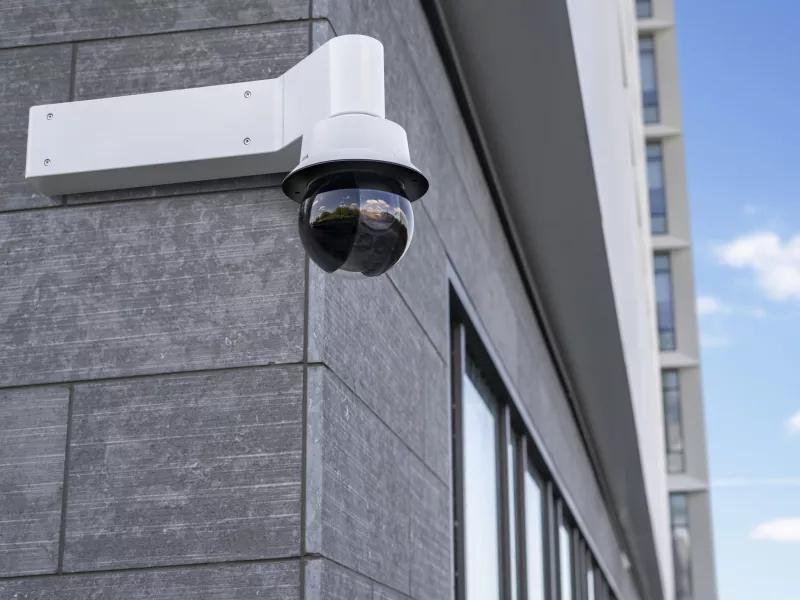
Instead of a security camera only viewing a fixed area, its ability to be turned in different directions by an operator and optically zoom in on a distant point can provide significant advantages in wide-area security.
PTZ cameras are movable camera systems developed to meet this need. They are used in various areas, from parking lots to industrial facilities, logistics sites to city surveillance applications.
However, the mobility offered by PTZ technology does not mean that better results will be achieved than with fixed cameras in every project. The right choice depends on the size of the area to be monitored, the desired image detail, operator needs, and the recording scenario.
What is a PTZ camera?
PTZ stands for Pan–Tilt–Zoom.
This concept refers to a camera's ability to move horizontally and vertically and zoom in on an image.
PTZ cameras have three basic functions:
Pan (Horizontal movement): The camera's ability to turn left and right.
Tilt (Vertical movement): The camera's ability to be directed up and down.
Zoom (Magnification): The detailed examination of a specific area within the camera's view.
These movements can be controlled from computer software, a video management system (VMS), an NVR interface, or a suitable mobile application, depending on the supported model.
Professional PTZ cameras provide operators with a movable vantage point for examining large areas.
How does a PTZ camera work?
The viewing direction of a traditional fixed IP camera is determined by its mounting and lens settings.
In PTZ cameras, a motorized mechanism can change the camera's direction. In compatible models, the lens system also performs optical zoom.
For example, while an operator is examining the general view of a large parking lot, they can turn to the area where a specific vehicle is located and try to get a more detailed image using the lens's zoom feature.
This process can be performed manually, or it can be automated in some PTZ cameras through predefined movements or event triggers.
The technical capacity of PTZ systems varies from model to model. Not all PTZ cameras have the same rotation angle, zoom power, autofocus, or tracking capability.
What is the difference between optical zoom and digital zoom in PTZ cameras?
One of the most frequently encountered technical specifications during PTZ camera selection is the zoom value.
Manufacturers may express this value with ratios such as 10x, 20x, 30x, or similar.
However, optical and digital zoom are not the same.
Optical Zoom
Optical zoom magnifies the viewed area by changing the focal length in the camera's lens system.
This process is not solely based on digitally enlarging the existing image.
For example, for the Axis Q8685-E PTZ camera, the manufacturer specifies 30x optical zoom.
This value represents the ratio between the shortest and longest focal lengths of the lens. It does not, by itself, mean that the camera can recognize a specific object from a distance of 30 meters or 300 meters.
Sensor resolution, field of view, lens quality, lighting, and atmospheric conditions are also important for long-distance image performance.
Digital Zoom
Digital zoom is the electronic magnification of a specific part of an image.
This method can provide the user with a magnified image but does not create new optical detail.
Especially in low-resolution or poorly lit images, using high digital zoom can make the loss of detail more apparent.
When selecting a camera for long-distance monitoring, optical features should be examined before high digital zoom figures.
Does a PTZ camera provide 360-degree viewing?
Some PTZ cameras can perform 360-degree or continuous horizontal rotation around their own axis.
However, there is an important technical distinction here.
A 360-degree rotation capability does not mean that the entire surroundings are recorded simultaneously.
When the camera is looking in a specific direction, areas outside the lens's field of view may not be visible at that moment.
For example, if the camera turns north in a parking lot to track a vehicle, there is a possibility that the same camera might miss an event occurring on the south side.
Therefore, while PTZ cameras can provide movable monitoring in large areas, it may be more appropriate to use them in conjunction with fixed cameras at critical points requiring continuous recording.
In projects requiring multi-directional simultaneous viewing, panoramic or multi-sensor cameras can also be considered.
What are preset, patrol, and auto-tracking in PTZ cameras?
In modern PTZ systems, not only operator control but also pre-programmed movements can be used.
Preset: Predefined camera position
A preset is a saved setting for directing the camera to a specific pan-tilt position and zoom level.
For example, a factory's main entrance gate, shipping area, and parking lot can be defined as different preset points.
The operator can select one of these positions to turn the camera to the corresponding view.
Patrol: Predefined tour
Patrol allows the camera to move between multiple preset positions in a defined sequence.
In suitable models, transition speed and dwell times between positions can be adjusted.
This method can be useful for regular area scanning. However, it should be remembered that when the camera is directed to one position, other points are not monitored simultaneously.
Auto Tracking: Automatic target tracking
The auto-tracking feature enables a supported PTZ camera to attempt to follow a detected person or vehicle with camera movement.
This function may rely on in-camera video analytics in some products, or on data from radar or other detection systems in some integrated solutions.
For example, Axis's Radar Autotracking for PTZ solution can control the direction and zoom level of compatible PTZ cameras using radar data.
However, target tracking can be limited by field of view, number of targets, environmental conditions, and software capabilities.
The presence of auto-tracking does not guarantee continuous tracking of the target under all conditions.
Differences between PTZ cameras and fixed IP cameras
Although PTZ and fixed IP cameras serve the same basic video surveillance purpose, they meet different operational needs.
| Criterion | PTZ Camera | Fixed IP Camera |
|---|---|---|
| Camera direction | Remotely changeable | Generally fixed |
| Zoom | Motorized optical zoom depending on model | Fixed or varifocal lens options |
| Area tracking | Manual and automatic in some models | Continuous monitoring of a fixed field of view |
| Operator requirement | May be higher in manual monitoring scenarios | Less control may be required for continuous monitoring |
| Moving mechanism | Contains motorized components | Generally fewer moving components |
| Project cost | Depends on features and infrastructure | Depends on features and number of cameras |
This comparison is not a ranking of absolute superiority.
A PTZ camera can view different points sequentially. A fixed camera, on the other hand, can provide an advantage for continuously monitoring a defined field of view.
Therefore, in protecting large sites, the main question is often not “PTZ or fixed camera?” but rather, how the two technologies can be used together.
Where are PTZ cameras used?
Factories and industrial facilities
They can be used for remote examination of different points in large production sites, open stock areas, facility perimeters, and shipping zones.
When working in conjunction with fixed perimeter security cameras, a PTZ camera can help the operator evaluate a detected event in more detail.
Parking lots and logistics centers
In large parking lots, loading areas, and sites with high vehicle traffic, they can support incident investigation by focusing on specific areas.
However, for specialized tasks such as license plate reading, high optical zoom alone is not sufficient. Appropriate viewing angle, lighting, shutter settings, and, if necessary, specialized license plate recognition cameras are important.
Ports and large open areas
In facilities where long distances need to be monitored, PTZ cameras with powerful optical zoom can be considered.
However, wind, vibration, salty air, low light, and long-distance viewing conditions play an important role in product selection.
Campuses and large commercial facilities
In campuses consisting of multiple buildings, PTZ cameras can help central security operations examine a specific event from different angles.
What to consider when buying a PTZ camera?
The right PTZ camera selection should not be based solely on resolution or zoom ratio.
1. Actual viewing objective
The expected task of the camera must be determined in advance.
Detecting movement, observing an event, recognizing a person, and distinguishing identity create different image detail requirements.
Therefore, mounting distance, target size, and lens features should be evaluated together.
2. Optical zoom and field of view
In addition to values like 20x or 30x, the lens's focal length range and horizontal field of view should be examined.
High optical zoom can be valuable for examining distant details, but as zoom increases, the visible area narrows.
3. Night vision and low-light performance
The lighting conditions of the usage area are decisive for camera performance.
Infrared illumination, low-light imaging, sensor characteristics, and image clarity for moving targets should be evaluated together.
It should not be assumed that the IR distance stated by the manufacturer will provide the same image detail in every environment.
4. Power and network infrastructure
PTZ cameras may have different power requirements depending on their model.
While some models can be powered via PoE classes, devices with high-power motors, heaters, or IR illumination may require different power supply options.
Before installation, the power budget, cable distance, network capacity, and connection methods supported by the manufacturer should be checked.
5. Outdoor durability
For outdoor models, the IP protection class, temperature range, mechanical impact resistance, and mounting conditions should be examined.
In coastal facilities or industrial environments, additional environmental conditions such as corrosion and vibration may also be considered.
6. VMS, NVR, and ONVIF compatibility
It is important for professional PTZ cameras to be able to work with existing video management systems.
ONVIF offers profiles and technical specifications that support interoperability between IP-based video surveillance devices.
However, it should not be assumed that every camera stated to be ONVIF compliant can use all PTZ, audio, alarm, or smart analytics features with every VMS.
For example, PTZ control under ONVIF Profile S is among the conditional functions dependent on the capabilities of the supported devices and clients.
Therefore, product and software compatibility should be additionally verified, especially for auto-tracking, preset management, and alarm integrations.
GüvenlikOnline's PTZ Camera Catalog can be used to compare the technical specifications of models from different manufacturers.
Why is cybersecurity important for PTZ cameras?
PTZ cameras, like other IP-based security devices, are managed over a network.
Therefore, user permissions, remote access, password security, update support, and network segmentation are important.
Furthermore, PTZ control authority should be evaluated differently from mere image viewing authority.
A user being authorized to view camera footage does not mean they should also have the authority to change the camera's direction or manage recording policies.
Especially in critical facilities, separating administrator, operator, and viewer roles can increase the auditability of security operations.
Common mistakes in PTZ camera selection
Looking only at the zoom ratio: The optical zoom value alone does not determine image quality or target recognition distance.
Assuming a single PTZ camera will continuously monitor every point: A movable field of view allows for examining different points but may not record all directions simultaneously.
Assuming auto-tracking is present in all models: Auto Tracking is not a standard feature in every PTZ camera.
Ignoring power consumption: Due to motorized movement and powerful illumination, power supply requirements can vary by model.
Not testing compatibility: Even if the camera and NVR/VMS operate on the same network, support for all advanced functions is not guaranteed.
Frequently Asked Questions
What does PTZ stand for?
PTZ is an acronym for Pan–Tilt–Zoom. It refers to the camera's ability to move horizontally and vertically and zoom in on an image.
Does a PTZ camera rotate continuously?
While some PTZ cameras support continuous horizontal rotation, some models have mechanical movement limits. Movement ranges should be checked from the technical data sheet.
Can a PTZ camera read license plates?
License plate details can be viewed under suitable imaging conditions. However, for reliable license plate recognition, lens, angle, lighting, motion, and specialized software requirements should be evaluated separately.
Can a PTZ camera work without internet?
In suitable systems operating over a local network, viewing and recording may be possible without internet. However, remote access may require an internet connection or a dedicated communication infrastructure.
Can two fixed cameras be used instead of a PTZ camera?
In some projects, yes. Fixed cameras can provide an advantage for continuously recording different areas simultaneously. PTZ, on the other hand, excels when there is a need for movable monitoring and zooming. The correct architecture depends on the project's security objectives.
Conclusion: For which projects is a PTZ camera the right choice?
PTZ cameras can be a valuable solution for projects requiring the monitoring of large areas, detailed evaluation of specific events, and tracking of moving targets.
However, a successful PTZ installation is not merely about purchasing the device with the highest zoom value.
Monitoring distance, field of view, low-light performance, motion control, network infrastructure, and integration with existing security systems should be evaluated together.
The biggest advantage of a PTZ camera is not seeing everything simultaneously, but rather its ability to provide more detailed images by focusing on the required point.
Therefore, in professional security projects, PTZ cameras should be used in a complementary architecture with fixed cameras and, if necessary, other detection technologies.
For different camera types, GüvenlikOnline's IP Cameras category and Axis brand catalog can be examined.