
Reolink Camera Systems: IP Cameras, Artificial Intelligence, and NVR Solutions
Reolink camera systems offer options for various security needs with PoE IP cameras, Wi-Fi and 4G LTE models, battery-powered security cameras, and NVR recording solutions. We examine Reolink's AI-powered detection technologies, product families, recording methods, ONVIF integration, and technical criteria to consider for correct system selection.
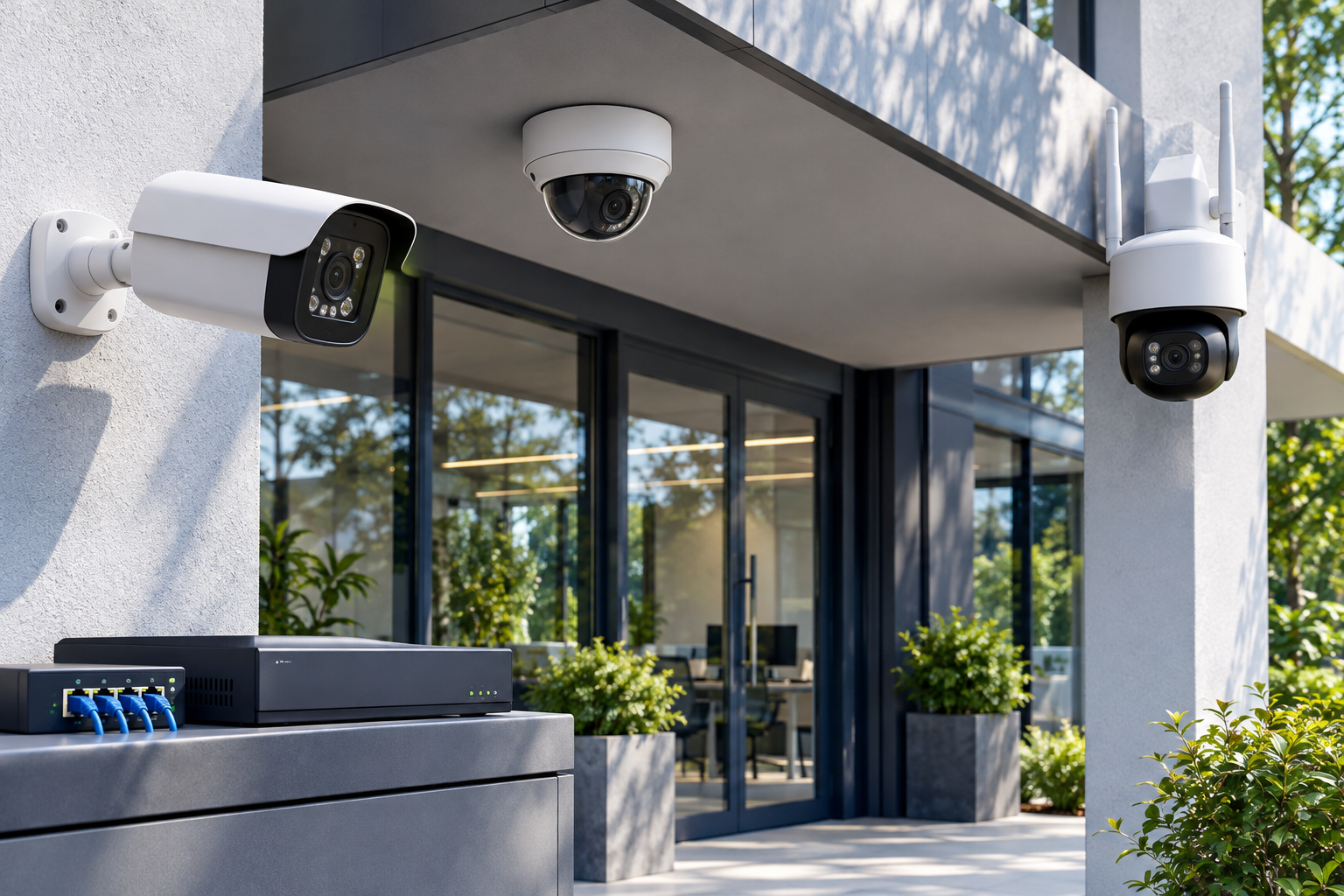
Reolink camera systems are security solutions that offer IP-based video surveillance technologies with various connection and power options. The brand's product portfolio includes wired PoE cameras, Wi-Fi models, battery-powered and solar-powered cameras, systems operating via 4G LTE, panoramic cameras, and network video recorders (NVRs).
Reolink develops various solutions, especially for residences, small and medium-sized businesses, offices, stores, and areas requiring remote monitoring. However, determining the correct camera system depends not only on image resolution but also on connection infrastructure, recording continuity, viewing distance, integration requirements, and environmental conditions.
What is Reolink?
Reolink is a brand that develops IP security cameras and video surveillance solutions. Its product family consists of standalone cameras, devices managed via mobile applications, and multi-camera systems with centralized recording infrastructure.
The technologies offered by the brand include high-resolution imaging, smart motion detection, color night vision, panoramic viewing, automatic object tracking, and local video storage options.
One of Reolink's important features is offering connection alternatives for different usage scenarios. While PoE cameras can be preferred in areas with electrical and network cabling, Wi-Fi, battery-powered, or cellular-connected models can be considered in locations where cabling is difficult.
However, not all Reolink cameras support the same features. Technical capabilities may vary depending on the model, hardware revision, and firmware version.
Reolink Camera Systems and Product Families
Reolink PoE IP Cameras
PoE (Power over Ethernet) allows both data communication and power supply to be provided over a suitable Ethernet cable.
The Reolink PoE camera family includes various options, from fixed-lens models to motorized optical zoom and PTZ-enabled cameras.
The main features of these systems are:
Power and data transmission over a single Ethernet connection.
Continuous 24/7 video recording on supported models.
Centralized viewing and storage via NVR.
Smart analytics features such as human, vehicle, and animal detection.
Different night vision and optical zoom options depending on the model.
For example, Reolink RLC-843A offers 4K/8 MP resolution, 5× optical zoom, IP67 environmental protection, and IK10 impact resistance, according to the manufacturer's technical data. These features make the device suitable for evaluation in entrance and outdoor perimeter applications where certain physical risks are present.
Reolink Duo 3 PoE, with its dual-lens architecture, offers 16 MP panoramic imaging and a 180-degree horizontal field of view. This structure provides an alternative for viewing large areas from a single camera position.
However, the wide field of view of panoramic cameras does not mean that the same level of detail will be obtained in all areas of the image.
Reolink Wi-Fi Cameras
Reolink Wi-Fi cameras enable video data transmission over a wireless network. E1, Lumus, TrackMix, and certain outdoor models offer different features in this category.
Wi-Fi cameras can be particularly useful in residential, office, and small business applications where existing Ethernet infrastructure is not available.
Wi-Fi connectivity does not necessarily mean the camera operates on wireless power. Most non-battery Wi-Fi cameras require a separate power supply.
When selecting a Wi-Fi camera, signal strength, access point capacity, the effect of walls and structural elements, wireless network density, and continuous recording requirements should be evaluated together.
Reolink Battery-Powered and Solar Cameras
Reolink's Argus and Altas product families can operate with rechargeable batteries and, in certain models, with solar panel support.
These cameras offer an alternative for gardens, detached houses, temporary monitoring points, and areas without electrical infrastructure.
A significant technical difference of battery-powered systems is their ability to enter standby mode for energy saving.
In many battery-powered models, recording is initiated by motion or the detection of specific events. Therefore, a battery-powered camera should not be evaluated in the same functional class as a PoE system that records continuously.
Important exception: Certain models in Reolink's Altas series offer continuous recording support under conditions specified by the manufacturer. However, this feature cannot be generalized to all battery-powered Reolink cameras.
In systems using solar panels, the energy balance depends on sunlight duration, ambient temperature, recording intensity, and the device's power consumption.
Reolink 4G LTE Cameras
Reolink's Go and certain TrackMix LTE models can transmit video over a mobile operator's cellular data network.
These cameras can be used particularly in field, farm, construction site, rural land, and remote facility applications where fixed internet access is unavailable.
4G LTE cameras require a suitable SIM card, mobile data plan, and sufficient operator coverage to operate.
When evaluating the system, not only the camera's resolution but also mobile data consumption, connection latency, network stability, and remote access behavior are important.
Reolink Artificial Intelligence and Smart Video Analytics Features
Supported Reolink models include object classification features such as human, vehicle, and animal detection.
These technologies can help differentiate specific events compared to traditional pixel-change-based motion detection.
Smart Motion Detection
Suitable models can evaluate whether detected motion in the image is associated with object classes such as humans, vehicles, or animals.
This allows users to create notification and recording scenarios based on specific event types.
However, the false alarm rate varies depending on weather conditions, camera angle, object size in the image, lighting, and the algorithm used.
Automatic Object Tracking
Certain Reolink PTZ and TrackMix cameras can automatically track supported objects within the image area.
In some dual-lens models, a wide-angle image is used together with a zoomed-in image.
Automatic tracking can facilitate operators in monitoring events. However, limitations such as the inability to monitor the previously viewed area while the PTZ camera is moving should be considered.
Technical distinction: It should not be assumed that a camera with human or vehicle detection automatically performs facial recognition, people counting, reliable person re-identification (RE-ID), or license plate recognition. Each of these functions requires separate technical verification.
Reolink Night Vision Technologies
The Reolink camera family includes different night imaging methods.
Infrared Night Vision (IR)
IR cameras obtain images using infrared illumination in environments where visible light is insufficient.
While this technology is useful for monitoring dark areas, reflective surfaces, glass, fog, heavy precipitation, and incorrect mounting positions can affect image quality.
Color Night Vision
Some models with spotlights can generate color images at night under supported conditions.
Reolink cameras using ColorX technology offer optical and image processing features for obtaining color images in low light.
However, the success of color night vision is directly related to the amount of light present in the environment. The night vision distance specified by the manufacturer does not guarantee face or license plate identification at a certain distance.
Reolink NVR and Video Recording Solutions
Recording management in Reolink camera systems can be performed using multiple methods.
Recording options in supported products include microSD card, Reolink NVR, Home Hub, local recording to a computer, and cloud storage in certain regions.
Reolink NVR Systems
Reolink NVR devices are developed for centralized viewing, recording, and management of compatible cameras.
Motion-based or continuous recording scenarios can be created according to system configuration.
When selecting an NVR, the number of cameras, supported resolution, total recording bandwidth, disk capacity, and compatibility with connected camera models should be evaluated together.
Reolink Home Hub
The Home Hub product family offers centralized management and local storage capabilities for supported Reolink cameras.
It can be particularly useful in applications where compatible wireless or battery-powered camera systems are used together.
It should not be assumed that all Reolink cameras are unconditionally compatible with Home Hub. The manufacturer's model, hardware revision, and firmware compatibility list should be checked.
Reolink Cloud Recording Support
Reolink's local recording solutions can operate without a mandatory cloud subscription in supported configurations.
However, the availability of cloud storage service depends on the country, subscription plan, and camera model.
Therefore, Reolink Cloud support should not be considered a standard feature for every model and every country.
Reolink Camera Systems: PoE, Wi-Fi, Battery-Powered, and 4G Comparison
Technical criterion | PoE camera | Wi-Fi camera | Battery-powered / Solar | 4G LTE camera |
|---|---|---|---|---|
Data connection | Ethernet | Wireless local network | Wi-Fi depending on model | Mobile operator network |
Power | PoE or supported power input | Usually adapter | Battery / suitable solar panel | Battery or external power depending on model |
Continuous recording | On supported models | On supported models | Model-dependent, limited in most | Depends on model and power conditions |
Centralized recording | Compatible NVR | Compatible NVR or Hub | Compatibility check required | Limited standard NVR integration |
Main advantage | Stable wired infrastructure | Flexible positioning | Options not requiring power cable | Independent access from fixed internet |
Important limitation | Cabling requirement | Signal and bandwidth | Energy budget | Coverage and mobile data cost |
This table generally compares connection architectures. Technical specifications must be verified separately for each Reolink model.
Do Reolink Cameras Support ONVIF and RTSP?
ONVIF and RTSP support is an important selection criterion for integrating Reolink camera systems with NVRs and video management software from different manufacturers.
RTSP is used to transmit supported video streams to third-party software. ONVIF aims for standardized interoperability of video and certain control functions between devices.
Many of Reolink's wired IP cameras support these protocols. However, not all products have the same level of support.
There are significant differences, especially in battery-powered and cellular models:
Many standalone battery-powered cameras do not directly support ONVIF/RTSP connection.
Some battery-powered cameras can access third-party protocols via a compatible Reolink Home Hub or NVR.
Many of Reolink's 4G LTE models do not have direct ONVIF/RTSP support.
Even on supported models, not all smart notifications, audio, PTZ, or manufacturer-specific features may be available via a third-party NVR.
Therefore, before connecting a Reolink camera to a recording system from a different brand, the exact model and firmware version should be checked, and the necessary video stream and alarm functions should be tested in a real environment.
For technical details on this topic, the GüvenlikOnline guide What is ONVIF? What Does It Do in IP Camera and NVR Systems? can be reviewed.
What to Consider When Choosing a Reolink Camera System?
1. Camera Resolution and Viewing Distance
A high megapixel value does not always mean better security performance.
The image detail the camera needs to provide at the target distance, the lens's field of view, and pixel density should be evaluated together.
Especially in applications requiring image acquisition for facial recognition, person identification, or examination of events at long distances, DORI analysis and PPM calculation are important.
2. Lens and Field of View
The choice of fixed lens, motorized zoom, or panoramic camera should be made according to the geometry of the area to be monitored.
While wide-angle cameras can view larger areas, objects at long distances may be represented with fewer pixels.
3. Recording Continuity
It should be determined beforehand whether the system will perform 24/7 continuous recording or only event-based recording.
This distinction is particularly important for battery-powered systems.
4. Storage Capacity
When determining NVR or microSD capacity, not only the number of cameras should be considered.
Resolution, video bit rate, compression method, daily recording duration, and required retention period should be calculated together.
For legal retention requirements of recordings, the article How Many Days Should Security Camera Recordings Be Stored? can also be reviewed.
5. Environmental Protection
For outdoor cameras, the IP protection class should be evaluated; for areas with a risk of physical intervention, appropriate IK impact resistance should be considered.
Values like IP67 and IK10 should only be used for models where these features are specified by the manufacturer.
6. Cybersecurity and Remote Access
IP cameras are network-enabled devices. Therefore, when setting up the system, strong passwords, up-to-date firmware, access limitation, and network security should be implemented.
Disabling unnecessary services, restricting direct internet access, and appropriate network segmentation should also be considered.
In Which Areas Can Reolink Camera Systems Be Used?
Reolink solutions can be evaluated in different areas depending on device features and project requirements.
Residential and detached houses: Monitoring gardens, entrance doors, garages, and living areas.
Offices and small businesses: Video surveillance in entrance areas, common sections, warehouses, and workspaces.
Stores and retail businesses: Monitoring store entrances, cash register areas, and specific operational areas for security purposes.
Farms and rural areas: Remote monitoring with 4G LTE or solar-powered cameras in locations with adequate operator coverage.
Construction sites and temporary facilities: Suitable mobile camera solutions in locations with limited fixed communication infrastructure.
However, for high-security facilities, critical infrastructures, or projects requiring extensive centralized VMS integration, the products' cybersecurity, scalability, accessibility, and integration capabilities should be evaluated separately.
Technical Advantages and Limitations of Reolink Camera Systems
Reolink's prominent aspects are its diverse connection options, broad product family, user-centric mobile access, and local recording alternatives.
However, the following limitations should not be overlooked in a professional camera system evaluation:
AI features are not the same across all products.
Battery-powered cameras may not always meet continuous recording expectations.
Third-party NVR/VMS integration is model and firmware dependent.
Wide-angle or panoramic cameras do not provide the same image detail at every point.
Operating costs of mobile-connected cameras vary depending on data usage.
Local recording alone does not mean recordings are fully protected against loss or unauthorized access.
Manufacturer-declared features do not substitute for independent verification of actual field performance.
Frequently Asked Questions About Reolink Camera Systems
Do Reolink cameras work without internet?
Suitable models can perform image transmission and recording over a local network. Connectivity may be required for remote access, cloud services, or internet-based notifications. Some 4G LTE devices operate differently.
Do Reolink cameras record continuously?
Many PoE and externally powered Wi-Fi models support continuous recording. Most battery-powered models use event-based recording; some Altas series models may be an exception.
Can Reolink cameras be connected to NVR devices of other brands?
They can work with certain third-party devices via supported ONVIF or RTSP interfaces. However, compatibility is not guaranteed for all models and all features.
Is a monthly subscription mandatory for Reolink camera systems?
Generally, there is no mandatory cloud storage subscription for using supported local recording options. However, optional cloud services and mobile data connections may incur additional costs.
Can Reolink cameras be used in professional security projects?
Models that meet project requirements can be used in certain commercial applications. However, corporate VMS integration, recording continuity, cybersecurity, service, and operational requirements must be verified on a project-by-project basis.
How to Make the Right Choice in Reolink Camera Systems?
Reolink offers IP camera and recording solutions for different connection infrastructures and usage scenarios. PoE cameras can be considered in areas with wired infrastructure, Wi-Fi models for flexible installation requirements, battery-powered systems in locations where power connection is difficult, and 4G LTE cameras in areas without fixed internet.
However, the correct security camera selection should not be based solely on brand or megapixel value.
Viewing purpose, DORI/PPM analysis, lens selection, night vision, recording duration, connection stability, cybersecurity, and integration requirements should be considered together.
Technically accurate evaluation of Reolink products is possible by reviewing the manufacturer's model-specific documentation and verifying the necessary functions under actual installation conditions.