
What to Consider When Choosing an AI-Powered Fire Detection System?
When choosing an AI-powered fire detection system, it's not enough to only look at camera resolution or software features. Detection accuracy, response time, false alarm risk, field of view, standard compliance, and integration with the fire alarm panel must be evaluated together. We examine the technical criteria for selecting the right AI fire detection solution for industrial facilities.
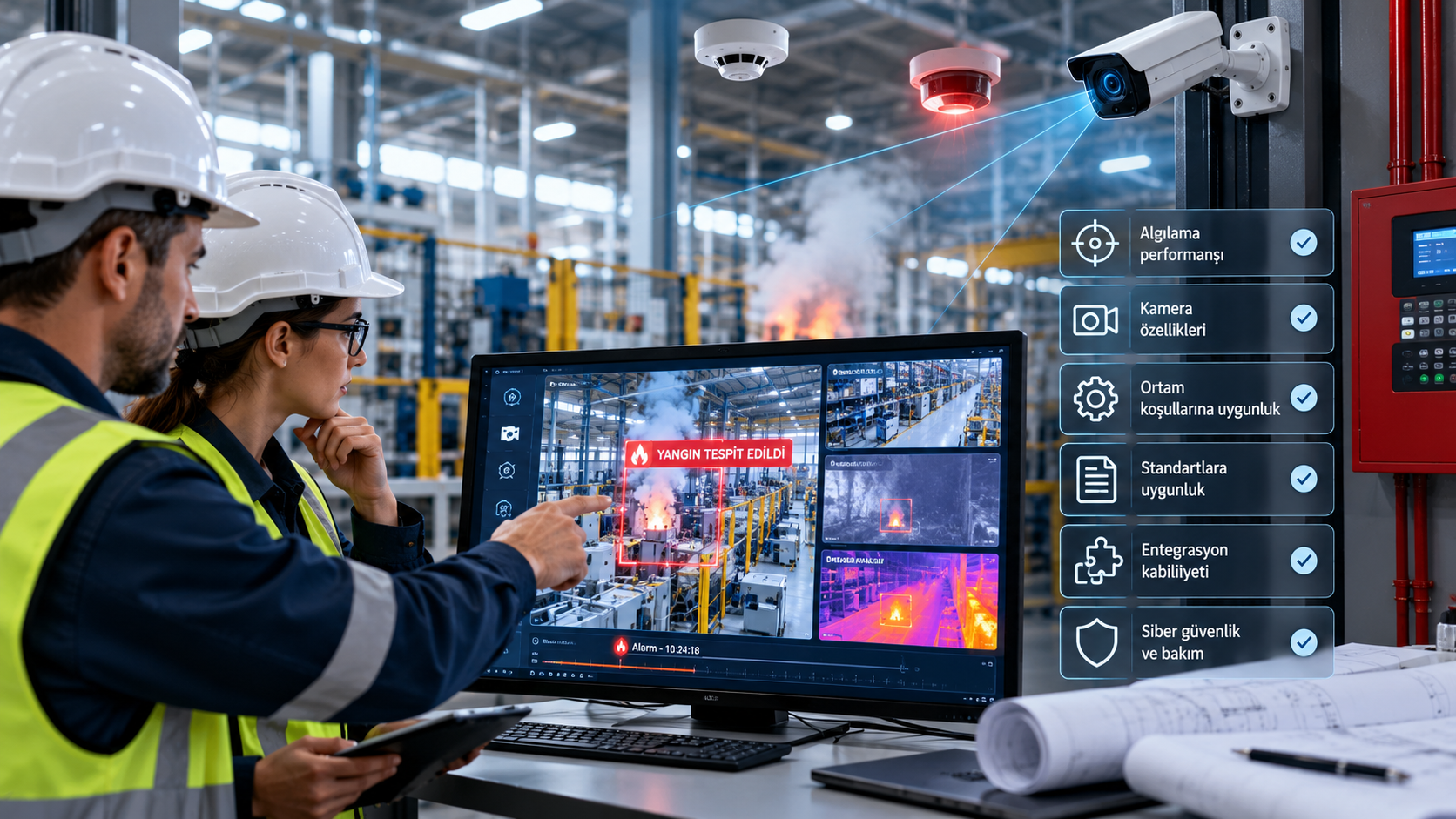
AI-powered fire detection systems offer new possibilities in industrial fire safety thanks to advanced image analysis and data processing technologies. However, the true performance of these systems depends not only on the sophistication of the algorithm used but also on camera features, environmental conditions, detection criteria, and the correct project design of the system.
Especially in factories, warehouses, energy facilities, and large production areas, there are important technical criteria to consider when choosing an AI-powered fire detection system.
The main goal of selecting the right system is not just to have a technology that detects fire; it is to create a solution that can reliably detect real fire indicators in a timely manner while minimizing unnecessary alarms.
So, what technical specifications should be examined when choosing an AI-powered fire detection system?
1. Detection Technology and Purpose of Use Must Be Correctly Determined
AI-powered fire detection systems can use different detection methods. Therefore, it must first be determined which fire indicators the system is developed to detect.
Video-Based Smoke Detection
Video smoke detection systems analyze smoke formation and spread characteristics in camera images to identify potential fire indicators.
They can be evaluated especially in large volume areas and applications where smoke is visible to the camera.
However, dust, steam, lighting changes, and other visual effects can increase the risk of false alarms.
Video-Based Flame Detection
Video flame detection systems analyze flame indicators in images.
In these systems, the visual characteristics of the flame and its time-dependent changes can be evaluated.
While it is a technology that can be used in some production areas with flammable materials, line of sight and ambient light conditions can affect performance.
Thermal Imaging and Temperature Analysis
Thermal cameras can monitor temperature changes by analyzing infrared energy emitted from surfaces.
They can be used to evaluate unusual heating in electrical equipment, motors, conveyors, and certain production machines.
However, thermal monitoring is not the same function as fire detection compliant with standards.
It must be clearly defined whether the selected system detects smoke, flame, temperature, or specific combinations thereof.
2. Detection Accuracy and False Alarm Performance Must Be Examined
One of the most important evaluation criteria for AI-powered fire detection systems is the system's performance in detecting real fire indicators.
However, decisions should not be made solely based on the high accuracy rates declared by the manufacturer.
For example, a manufacturer may state that its system achieved high accuracy in specific test images. This result is not guaranteed to be replicated with the same performance in a real factory.
How should detection performance be evaluated?
It is useful to request the following information from the manufacturer:
Success in detecting real fire indicators.
Detection time and test conditions.
False alarm and missed event results.
Test scenarios and environmental conditions used.
Effect of image quality and detection distance on performance.
Independent test and conformity documents.
Especially when evaluating the accuracy rate, the structure of the test data set is important.
An algorithm may produce successful results in images where no fire is present, while missing some real fire events.
Therefore, the detection rate, missed events, and false alarm rate should be examined together.
The false alarm results should also be explained in terms of the time interval, number of cameras, and test conditions under which they were measured.
3. Detection Time and Early Warning Performance Must Be Evaluated
The purpose of fire detection systems is to detect fire indicators early enough to allow for necessary safety interventions.
AI-powered image analysis, in some applications, can detect visual indicators without waiting for smoke to reach ceiling detectors.
However, detection time is not a fixed value.
The main factors affecting the time are:
Size and development characteristics of the fire.
Visibility of smoke or flame by the camera.
Distance between the camera and the event.
Image resolution and processing capacity.
Algorithm evaluation process.
Communication and alarm transmission delays.
The conditions under which the manufacturer's stated detection time was measured should be examined.
For example, the results obtained in a controlled laboratory environment are not the same as the conditions in a real factory with production machines, dust, and variable lighting.
Detection performance should be evaluated not only on the device itself but also considering the entire process until the alarm reaches the relevant control system.
4. Camera Features and Detection Distance Must Be Correctly Calculated
In video-based fire detection systems, camera features can directly affect detection performance.
However, using a camera with a high megapixel value alone does not guarantee high detection success.
Resolution and Image Quality
Camera resolution should ensure that fire indicators in the protected area are represented with sufficient detail in the image.
Low resolution or intense image compression can make it difficult to analyze small smoke and flame indicators.
However, increasing the resolution does not automatically enable a detection distance not supported by the algorithm.
Lens and Field of View
Wide-angle lenses can image a larger area. However, at the same resolution, the number of pixels occupied by distant objects in the image may decrease.
Narrow-angle lenses can image a specific area in more detail while limiting the total field of view.
Therefore, lens selection should be made in conjunction with the geometry of the area to be protected and the detection conditions validated by the manufacturer.
Active Detection Area
The area viewed by the camera and the area where it can reliably detect fire indicators may not be the same.
Some parts of the image may have been excluded from evaluation by the algorithm. Additionally, machines, high shelves, and structural obstacles can limit the field of view.
Therefore, not only the camera's field of view but also the active detection area and validated operating distance should be requested from the manufacturer.
5. Suitability for Environmental Conditions Must Be Checked
In industrial facilities, fire detection systems can operate under very different conditions than standard office environments.
The following factors, in particular, should be evaluated:
Environmental condition | Possible effect | Criterion to be evaluated |
|---|---|---|
Heavy dust | Image degradation, false alarm | Camera position, protection class, cleaning and analysis performance |
Steam | Images that can be mistaken for smoke | Algorithm's behavior against steam |
Low lighting | Difficulty in detecting visual indicators | Minimum illumination and supported night operation conditions |
Welding operations | Flame-like visual effects | False alarm tests |
Vibration | Image instability | Mounting structure and image processing resilience |
High temperature | Exceeding device operating conditions | Operating temperature and appropriate protective equipment |
This table is a general evaluation framework. The stated effects do not manifest in the same way for every product.
Especially in facilities with welding, cutting, and high-temperature production activities, it is important how the system interprets normal process conditions.
6. Compliance with Standards and Regulations Must Be Verified
One of the most important issues when choosing AI-powered fire detection systems is the product's suitability in terms of relevant applications and standards.
In Turkey, one of the main regulations for fire detection and alarm systems is the Regulation on Fire Protection of Buildings.
Article 74 of the Regulation contains provisions regarding the compliance of fire detection systems and their components with TS EN 54 requirements.
Two international documents are particularly important for video-based detection systems.
ISO 7240-29:2024
Covers performance requirements and test methods for video fire detectors operating in the visible spectrum.
However, the same suitability should not be assumed for special product functions or different detection principles that fall outside the scope of the standard.
ISO/TS 7240-30:2022
Addresses technical requirements for the design, installation, commissioning, and servicing of video-based fire detection systems.
This document covers applications where video fire detection systems can be used independently or in conjunction with fire detection and alarm systems.
However, compliance with an international standard does not automatically mean legal acceptance in every project in Turkey.
Important: The product's compliance with relevant standards, independent test documents, national regulatory requirements, and the purpose of use in the project must be verified separately.
Adding AI software to a general-purpose CCTV camera does not automatically turn the camera into an approved fire detection device.
7. Integration with Existing Fire Alarm Systems Must Be Examined
When choosing an AI-powered fire detection solution in industrial facilities, integration capability is critically important.
It is not enough for the system to generate an alarm. How this alarm is transmitted to the relevant fire safety infrastructure and what control functions it can trigger must also be evaluated.
The following information should be requested from the manufacturer:
Connection method with the fire alarm panel.
Ability to monitor alarm and fault information separately.
System behavior during communication interruptions.
Power loss and restart scenarios.
Required input/output and interface modules.
Central monitoring and event logging capabilities.
Security measures against unauthorized access.
The presence of IP-based communication, relay connection, or a software interface alone does not indicate suitable integration.
What is important is that the interoperability of the relevant systems is verified with manufacturer documents and field tests.
Mandatory emergency control functions during a fire should not be solely dependent on the operation of a general-purpose software platform.
8. Field Performance of the AI Algorithm Must Be Tested
One of the most common risks in product selection is basing the purchasing decision solely on product presentations or controlled demo images.
However, the real operating environment may differ from the algorithm's training and test conditions.
Therefore, it is important to evaluate the system under real facility conditions whenever possible.
What should be examined in field tests?
The following scenarios can be evaluated in the test plan:
Normal operating conditions of the production area.
Low and high lighting levels.
Normal process effects such as dust, steam, and similar.
Activities that could generate false alarms, such as welding or hot work.
Partial obstruction of the field of view.
Camera or network connection failures.
Verification of detection functions using safe fire test methods approved by the manufacturer.
Real fire trials should not be conducted in an uncontrolled manner. Tests should be carried out by competent personnel with appropriate safety measures and manufacturer procedures.
In field tests, not only whether an alarm is generated but also the alarm duration, event logs, false alarm behavior, and fault notifications should be examined.
9. Software, Cybersecurity, and Long-Term Maintenance Must Be Evaluated
AI-powered fire detection solutions, unlike classic detection equipment, can use additional software and IT infrastructures.
Whether the algorithm runs on the camera, a local server, or a remote platform can affect the system's capacity, latency, and fault behavior.
Before purchasing, the following questions should be answered:
Does the analysis occur on the device, a local server, or in the cloud?
Does detection continue if the internet connection is lost?
How do software updates affect system performance?
Can algorithm versions and change logs be tracked?
How are user access and network security managed?
How are camera or processor failures reported?
What are the software licenses and long-term maintenance costs?
If image recording and personal data processing are involved, relevant data protection obligations should also be evaluated.
Especially for critical functions in fire safety, the risks posed by software or communication failures should be addressed at the project stage.
10. How to Compare Different Fire Detection Solutions?
When choosing an AI-powered system, it should not be assumed that different technologies will perform the same task.
Technology | Core function | Consideration for selection |
|---|---|---|
AI-powered video fire detection | Analyzing smoke or flame indicators in images | Algorithm performance, field of view, verified compliance |
Traditional video fire detection | Evaluating fire indicators using image processing methods | Detection criteria, field tests, false alarm behavior |
Thermal monitoring | Evaluating surface temperatures | Measurement conditions, purpose of use, suitability for fire detection |
Multi-criteria point detector | Evaluating multiple physical fire indicators | Relevant EN 54 scope, installation and environmental conditions |
Aspirating smoke detection | Detecting smoke via air samples | Sample pipe design, sensitivity, and maintenance |
These technologies are not direct equivalents of each other. Each has a different detection principle. Selection should be made based on the facility's risks and required fire safety functions.
The use of artificial intelligence alone is not independent proof of superiority. The real benefit of the algorithm must be demonstrated through verified system performance.
Technical Checklist for AI-Powered Fire Detection System Selection
The following checklist can be used during procurement and project evaluation:
- Are the fire indicators to be detected and risk scenarios determined?
- Is the product's detection distance and active field of view verified?
- Is the detection time and false alarm performance documented?
- Is product compliance and standard scope checked?
- Is a field test planned in a real factory environment?
- Is fire alarm panel integration verified?
- Are power and communication interruption scenarios evaluated?
- Are software updates and cybersecurity requirements examined?
- Are maintenance, technical support, and license costs calculated?
- Are commissioning and periodic verification processes determined?
This checklist is prepared to support the technical procurement process. It does not replace the implementation project and relevant regulatory obligations.
Frequently Asked Questions
Is camera resolution important in an AI-powered fire detection system?
Yes. Image quality and resolution can affect the detail of smoke or flame indicators to be analyzed in the image. However, camera resolution alone does not determine detection performance.
Do AI-powered fire detection systems give false alarms?
Yes. Dust, steam, light changes, and production activities can cause false alarms in some systems. Advanced algorithms can help reduce this risk but cannot eliminate it entirely.
Can every IP camera be used for fire detection purposes?
No. The camera must have suitable image characteristics, work compatibly with analysis software, and the system must be validated for fire detection purposes.
Which standard is important in AI-powered systems?
ISO 7240-29:2024 for video fire detectors operating in the visible spectrum and ISO/TS 7240-30:2022 for the design, installation, and service processes of these systems are important resources. For use in Turkey, relevant legislation and product suitability must be evaluated separately.
Can an AI-powered fire detection system be connected to an existing fire panel?
With appropriate interfaces and validated system architectures, this is possible for some products. However, the connection method, alarm transmission, fault conditions, and system behavior must be checked within the scope of the project.
Conclusion: How to Choose the Right AI Fire Detection System?
AI-powered fire detection systems offer significant opportunities in fire safety through image analysis and advanced data processing technologies.
However, selecting the right product cannot rely solely on the presence of an AI algorithm or the performance values declared by the manufacturer.
Detection accuracy, response time, false alarm behavior, camera and lens features, environmental conditions, standard compliance, and integration capability must be evaluated together.
Especially in industrial applications, it is important to test the system under real field conditions and plan long-term maintenance processes.
The foundation of a successful investment is not choosing the product with the most features, but identifying a system whose suitability for the facility's fire risks has been verified and that can be operated sustainably.
Those who wish to examine different product groups can evaluate GüvenlikOnline's Fire Detectors and Fire Alarm Systems categories.