
What is Periodic Maintenance? Why is it Necessary in Security Systems?
What is periodic maintenance, why is it necessary, and how often should it be performed? We examine maintenance processes in CCTV camera, fire detection, intruder alarm, access control, and low current systems, including preventive maintenance, functional tests, fault detection, maintenance contracts, and technical reporting criteria.
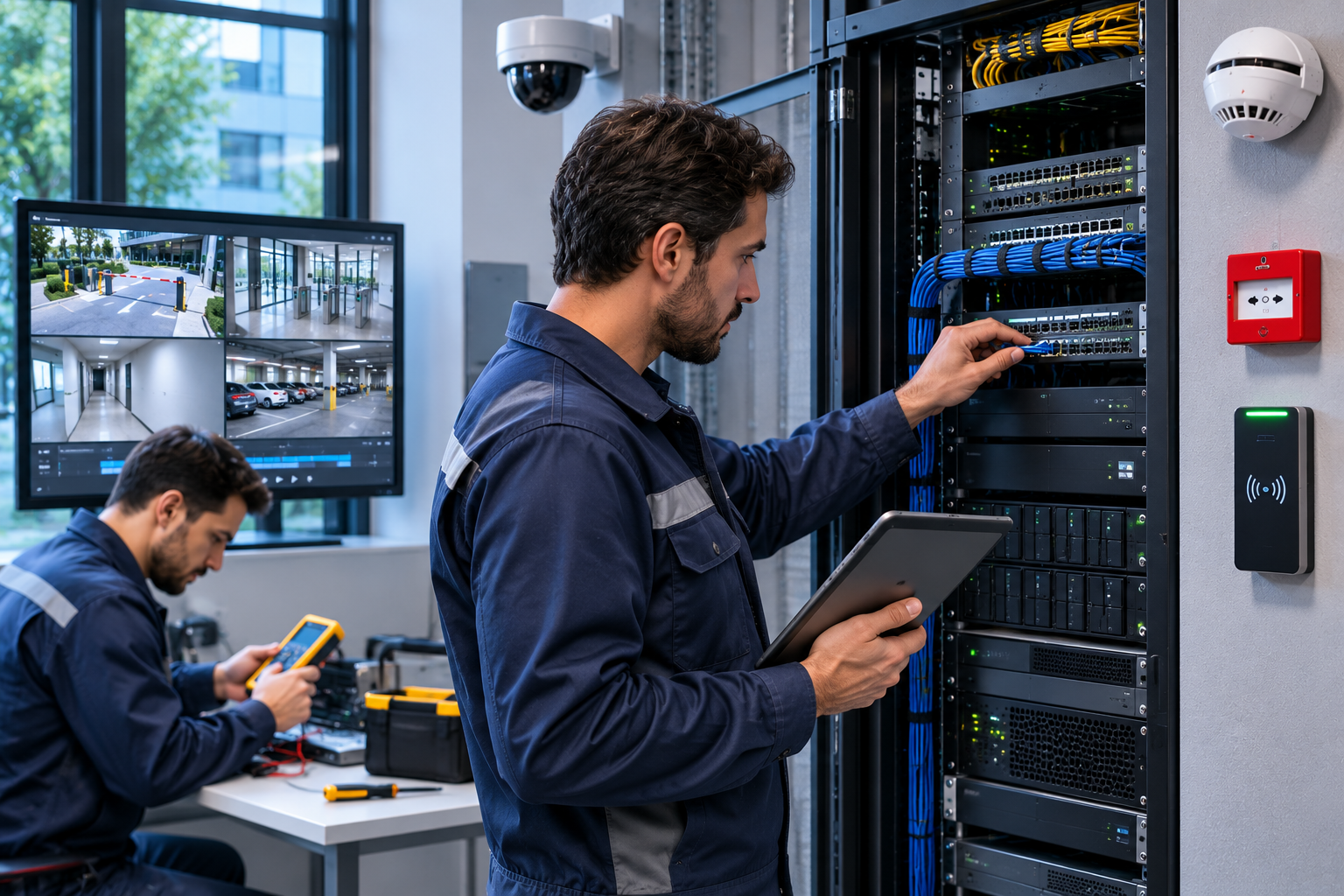
The installation of electronic security systems is one of the crucial steps taken to ensure the safety of a building or facility. However, security cameras, fire detection systems, intruder alarms, and access control devices require regular checks to maintain their initial performance.
Over time, environmental factors, wear and tear of electronic components, software issues, power supply failures, and incorrect system settings can negatively impact the performance of the security infrastructure.
For example, a security camera might be providing live footage. However, it may only be discovered after an incident that the images were not actually recorded due to a hard disk failure in the recording device.
Similarly, while a fire detection panel may appear to be in normal operation, a specific detector might not perform as expected due to contamination, incorrect positioning, or another technical issue.
Therefore, periodic maintenance aims not only to keep security systems operational but also to regularly verify that they can sustain their designed functions.
So, what is periodic maintenance, why is it necessary, what operations does it cover, and how often should electronic security systems be maintained?
What is Periodic Maintenance?
Periodic maintenance is the entirety of inspection, cleaning, functional testing, necessary adjustments, and preventive intervention activities carried out at predetermined intervals to ensure a system or equipment reliably sustains its functions.
The primary goal is to prevent failures as much as possible, identify existing problems at an early stage, and support the system's operation at appropriate performance throughout its lifespan.
In electronic security systems, periodic maintenance may cover the following activities:
Inspection of physical and environmental conditions of devices.
Examination of power supply and connections.
Testing of sensor, detector, and camera functions.
Verification of recording and data storage systems.
Testing of alarm and notification scenarios.
Checking network connections and device communication.
Performing necessary cleaning and technical adjustments.
Identification of faulty or end-of-life components.
Documentation of maintenance results with a technical report.
However, the maintenance procedures to be performed vary according to the system type, manufacturer instructions, operating conditions, and relevant legislation.
Why is Periodic Maintenance Important?
1. Enables Early Detection of Faults
In electronic security systems, some faults may not be immediately noticed by the user.
For example, a camera's field of view might have shifted, one of the disks in the recording device might have failed, or the alarm system's backup battery might have lost capacity.
Regular maintenance helps identify such problems before they escalate into security incidents.
2. Increases System Reliability
The most crucial characteristic of security systems is their ability to perform their duties when needed.
In unmaintained systems, the risk of failure can increase, and critical security functions may be affected.
3. Supports Equipment Lifespan
Appropriate operating temperature, clean connections, correct power supply, and maintenance in accordance with manufacturer recommendations can help prevent premature wear of some components.
However, performing maintenance does not definitively mean that the lifespan of all electronic components will be extended.
4. Can Reduce Unexpected Operating Costs
Through planned maintenance, some problems can be resolved before they escalate.
This can contribute to reducing the need for emergency service intervention, unexpected system downtime, and extensive repairs.
5. Supports Regulatory and Operational Obligations
Especially in fire detection and emergency systems, periodic testing and maintenance are also part of relevant regulations.
However, it should not be assumed that the same legal maintenance period applies to every electronic security system.
Differences Between Periodic Maintenance, Fault Maintenance, and Periodic Inspection
These three concepts can be confused in daily use.
However, their purposes and application conditions differ.
| Type of Operation | Primary Purpose | When is it performed? |
|---|---|---|
| Periodic / Preventive Maintenance | To prevent failures and maintain performance | At planned intervals |
| Corrective Maintenance / Fault Intervention | To rectify an existing fault | When a fault is detected |
| Predictive Maintenance | To foresee potential failures by analyzing condition data | Based on monitoring results |
| Functional Test | To verify that a specific function is working | During maintenance, commissioning, or special testing |
| Periodic Inspection under Legislation | To verify specified legal and technical compliance criteria | At times and intervals stipulated in relevant legislation |
Important distinction: A service report issued by a maintenance company does not automatically replace the official periodic inspection report that must be prepared by an authorized person as required by legislation.
Periodic Maintenance in Security Camera Systems
CCTV and IP camera systems are among the electronic security infrastructures where periodic maintenance is crucial.
During the maintenance of a camera system, it should not be checked only whether the cameras are providing images.
Image quality, recording reliability, network connectivity, and storage performance should be evaluated together.
Camera and Lens Checks
The following procedures may be applied during maintenance:
Inspection of camera body and mounting connections.
Cleaning of lens and protective glass surfaces using appropriate methods.
Checking the camera's field of view.
Verification of image clarity and focus adjustment.
Evaluation of IR illumination and night vision.
Examination of the physical condition of outdoor enclosures.
Checking for blind spots in the camera's view.
Especially, changes in camera position over time can lead to the inability to meet the imaging objectives defined at the beginning of the project.
Image Quality and DORI/PPM Verification
In professional CCTV projects, camera footage should not be evaluated solely based on general clarity.
It can also be examined whether the image detail obtained at critical points meets the initially targeted operational requirements.
For example, changing the camera lens, widening the field of view, or altering the camera's direction can affect the pixel density in the target area.
Therefore, in necessary applications, the image evaluation approach in the current IEC 62676-4:2025 standard should be considered.
NVR, DVR, and Recording Checks
Recording devices should also be evaluated during camera maintenance.
Important checks include:
Hard disk health status.
Continuous recording generation.
Accuracy of recording date and time information.
Meeting the desired retention period.
Recording device event and error logs.
Status of RAID or other storage protection systems.
Playback of recordings from specific date ranges.
Ability to export necessary recordings.
A camera providing live footage does not prove that past images have been fully recorded.
Actual playback of recordings is one of the important verification steps in the maintenance process.
For more detailed information on securely storing and exporting camera recordings, GüvenlikOnline's article titled Camera Recording Backup can be reviewed.
Periodic Maintenance in Fire Detection Systems
Periodic maintenance in fire detection and alarm systems is critically important for life and property safety.
In Turkey, Article 84 of the Regulation on Fire Protection of Buildings stipulates that fire detection, warning, emergency lighting, and directional systems must be subjected to periodic inspection, testing, and maintenance in accordance with relevant standards.
Maintenance in these systems should be planned according to the characteristics of the products and installation.
What is Checked During Fire Detection System Maintenance?
General status of the fire alarm panel.
Fault, alarm, and disablement notifications on the panel.
Physical condition of detectors and signs of contamination.
Functional tests of detectors according to manufacturer specifications.
Manual fire alarm call points.
Audible and visual warning devices.
Main power and backup power supplies.
Accuracy of zone and address definitions.
Alarm transmission and monitoring connections.
Operation of appropriate integration scenarios.
Especially in applications where the fire panel is linked to access control, elevator, or smoke control systems, the necessary cause-and-effect scenarios should be tested in coordination with relevant experts.
How Should Fire Detectors Be Tested?
Detector checks should be performed with test equipment appropriate for the detector type and manufacturer instructions.
Test methods for smoke, heat, flame, and other detection technologies differ.
Especially in fire alarm systems, uncontrolled testing can lead to consequences such as unnecessary evacuation, false alarm transmission, or unintended operation of connected equipment.
Therefore, relevant units should be informed before testing, necessary safety precautions should be taken, and it should be verified that the system has returned to normal operation after the test.
For more detailed information on the technical selection of fire detection technologies, the article How to Determine the Right Fire Detection Solution for Factories? can be reviewed.
Periodic Maintenance in Intruder Alarm Systems
In intruder alarm systems, detectors, the alarm panel, and the communication infrastructure must function correctly.
During periodic maintenance:
Detection functions of motion detectors.
Door and window magnetic contacts.
Alarm panel error logs.
Siren and notification functions.
Wired or wireless device communication.
Backup battery status.
Alarm communication channels.
Alarm arming and disarming scenarios.
can be checked.
Especially in wireless systems, battery status and the reliability of radio communication should be evaluated.
In facilities with a high number of false alarms, the source of the problem should be investigated instead of merely reducing detector sensitivity.
Periodic Maintenance in Access Control Systems
Card access, electronic lock, turnstile, and barrier systems are other important security components that require regular maintenance.
Card Reader and Control Panel
The operation of RFID readers, control panels, and communication connections should be checked.
Electronic Locks
Locking and unlocking operations, the mechanical movement of the door, and necessary access scenarios should be examined.
Turnstiles and Barriers
Mechanical movement, security sensors, reader integrations, and security functions specified by the manufacturer should be evaluated.
Fire and Emergency Evacuation Integration
It must be verified that the access control system does not impede safe exit during emergencies.
These tests should be performed in accordance with relevant fire safety scenarios and system specifications.
In access control maintenance, it is not sufficient for the system to grant access only when a card is presented. The actual movement of the door and necessary alarm events should also be evaluated.
Maintenance in Structured Cabling and Network Systems
Cable and network infrastructure play a significant role in the reliable operation of low current systems.
In network and structured cabling maintenance:
Patch panel and connection arrangement.
Cable connectors.
Fiber optic connections.
Operating status of network switches.
PoE power consumption and power budget.
Cabinet ventilation and temperature.
UPS and power supply statuses.
Network connection errors.
System warning and error logs.
can be evaluated.
However, it should not be assumed that recertification testing is required for all cables during every maintenance.
Re-measurement of cable performance should be planned according to relevant technical findings, facility changes, or project requirements.
How Often Should Periodic Maintenance Be Performed?
The frequency of periodic maintenance should be determined by considering the system's purpose of use, manufacturer instructions, environmental conditions, risk level, and any legal obligations.
For example, a camera in a dusty factory might not have the same maintenance needs as a camera in a clean office.
Similarly, a fire detection system used for life safety and a camera system used for basic surveillance have different inspection processes.
Sample Maintenance and Inspection Plan
| Inspection Frequency | Sample Activity |
|---|---|
| Daily | Monitoring the alarm, fault, and operational status of critical systems |
| Weekly | Reviewing recording and backup results, and important system alerts |
| Monthly | Selected functional tests, checking disk and battery health indicators |
| Quarterly | More comprehensive technical inspection based on risk and manufacturer instructions |
| Semi-annually | Planned field maintenance, connection, and performance verification |
| Annually | Overall system evaluation, maintenance history, and analysis of renewal needs |
This table is an example operational plan; it does not indicate maintenance frequencies mandated by legislation for all security systems.
Especially for fire systems, the procedures and intervals specified by applicable standards and legislation must be followed.
How Should Periodic Maintenance Be Performed?
Professional maintenance work should not be completed solely by physically inspecting the equipment.
1. System Inventory Must Be Prepared
The model, serial number, installation location, software version, and maintenance history of devices should be recorded.
2. Risks and Critical Equipment Must Be Identified
Components critical for life safety, recording continuity, and physical access should be prioritized.
3. A Maintenance Plan Must Be Created
Inspection and testing procedures should be determined according to manufacturer instructions, relevant standards, and operating conditions.
4. Functional Tests Must Be Performed
Necessary tests should be conducted with appropriate equipment and methods.
Especially in fire and access control systems, how tests will affect other connected systems should be evaluated beforehand.
5. Necessary Preventive Actions Must Be Taken
Appropriate cleaning, technical adjustments, and manufacturer-recommended maintenance procedures can be applied.
Software updates, however, should not be performed uncontrollably without evaluating compatibility and a rollback plan.
6. Maintenance Results Must Be Verified
After the maintenance operation, it should be checked that the relevant system performs its expected functions.
7. A Technical Maintenance Report Must Be Prepared
Identified findings, applied procedures, unresolved issues, and recommended corrective actions should be recorded.
What Information Should Be Included in a Periodic Maintenance Report?
A professional maintenance report should ensure the traceability of performed operations.
The report may include the following information:
Company and facility information.
Date and time of maintenance.
List of systems and devices maintained.
Technical personnel who performed the maintenance.
Controls and tests performed.
Test results and identified non-conformities.
Faulty or risky equipment.
Maintenance and repair operations performed.
Replaced components.
Unfinished operations and recommendations.
Status of systems after maintenance.
Approvals of responsible persons.
Especially in critical security systems, failed test results should be clearly stated in the report, and the necessary corrective actions should be followed up.
The preparation of a maintenance report alone does not prove that the system is functioning correctly. The results of technical tests and unresolved non-conformities must also be documented.
What Should a Periodic Maintenance Contract Cover?
In professional electronic security projects, maintenance contracts can support the regular monitoring of systems.
It is important that the following issues are clearly defined in the contract:
Devices and systems covered by maintenance.
Frequency of planned maintenance.
Controls and tests to be performed.
Fault notification method.
Intervention and resolution times.
Remote support and on-site service conditions.
Scope of spare parts and consumables.
Software update responsibilities.
Technical reporting and documentation.
Prioritization of critical security faults.
Additional obligations specific to relevant legislation.
Especially for businesses operating in multiple locations, central monitoring of maintenance processes can provide operational advantages.
However, a maintenance contract does not replace independent controls or audits mandated by relevant legislation.
Is Periodic Maintenance Legally Mandatory?
The answer to this question depends on the type of system to be maintained and the applicable legislation.
Fire Detection Systems
Article 84 of the Regulation on Fire Protection of Buildings contains obligations regarding the periodic testing, inspection, and maintenance of relevant fire detection, warning, emergency lighting, and directional systems.
The maintenance frequency and procedures for the system should be evaluated together with relevant standards and system requirements.
Periodic Inspection of Work Equipment
Within the scope of the Regulation on Health and Safety Conditions in the Use of Work Equipment, periodic inspections to be carried out by authorized persons are regulated, especially for work equipment specified in Annex-III tables.
With the amendment dated December 23, 2025, the provisions regarding this scope and inspection processes have been updated.
Such official periodic inspection procedures and routine technical service maintenance of electronic security systems should be evaluated differently.
CCTV and Other Electronic Security Systems
It cannot be said that there is a single general legal maintenance period applicable to all CCTV, intruder alarm, or access control systems.
However, private sector regulations, project specifications, manufacturer instructions, contracts, or security obligations may create maintenance and inspection requirements.
For example, there are specific obligations for camera systems in currency exchange offices.
For more information on this topic, GüvenlikOnline's guide titled How to Retain 2 Years of Camera Recordings in Currency Exchange Offices? can be reviewed.
Remote Monitoring and Predictive Maintenance Systems
Modern electronic security systems can allow for remote monitoring of specific fault and status information.
With appropriate software and device support:
Camera connection interruptions.
NVR recording errors.
Disk health warnings.
Network connection issues.
Alarm panel fault notifications.
Battery and power supply statuses.
Device temperature and system events.
can be centrally monitored.
Predictive maintenance aims to make prior assessments about potential failures by analyzing this status data.
However, not every status monitoring software truly performs predictive maintenance.
Generating automatic alerts and having an analytical model that can predict when a fault will occur are different capabilities.
Furthermore, remote monitoring does not replace all necessary physical maintenance and testing procedures.
Common Mistakes in Periodic Maintenance
Some common maintenance mistakes encountered in electronic security systems include:
Considering maintenance solely as device cleaning.
Assuming the recording system is problem-free just because there is a camera image.
Not testing the playback of recordings.
Only checking the normal status indicator on the fire alarm panel.
Not evaluating backup batteries and power supplies.
Ignoring emergency evacuation scenarios in door and turnstile systems.
Performing software updates without a plan.
Closing the maintenance report as complete without resolving faults.
Not keeping maintenance history and device inventory.
Not creating a maintenance program appropriate for the system's risk level.
Standard checklists, technical reporting, and regular functional tests are important in reducing these errors.
Technical Checklist for Periodic Maintenance
Is the system and device inventory up to date?
Is the maintenance plan compliant with manufacturer and project requirements?
Have camera images and necessary fields of view been verified?
Has the continuity of NVR/DVR recordings been checked?
Have sample recordings been verified by playback?
Have disk health and storage alerts been checked?
Has the fire alarm system undergone necessary tests?
Have alarm and access control functions been verified?
Have battery, UPS, and power supplies been checked?
Have network connections and communication errors been examined?
Have necessary cybersecurity checks been performed?
Have inter-system integration scenarios been verified?
Have non-conformities and recommended corrective actions been documented?
Has the system's normal operating status been verified after maintenance?
This list is a general assessment tool. It does not solely cover all necessary checks or regulatory obligations for every facility.
Frequently Asked Questions
What is periodic maintenance?
Periodic maintenance refers to inspection, testing, cleaning, and necessary preventive technical procedures carried out at predetermined intervals to support the reliable operation of systems and and equipment.
Is periodic maintenance necessary for security camera systems?
Regular maintenance supports the reliability of imaging and recording functions. However, maintenance frequency should be determined according to system conditions, manufacturer instructions, and any specific regulatory requirements.
How often is periodic maintenance performed?
There is no single maintenance period applicable to all electronic security systems. Daily monitoring, monthly checks, or more comprehensive planned maintenance activities can be applied based on operating conditions and risk assessment. In specialized areas like fire safety, relevant standard and regulatory provisions must be followed.
Are periodic maintenance and periodic inspection the same thing?
No. Periodic maintenance covers technical procedures aimed at preserving equipment performance. Periodic inspection under legislation, on the other hand, is an examination or testing procedure carried out for relevant equipment according to specified legal procedures and authorization conditions.
Are recordings deleted during camera maintenance?
Normal maintenance procedures do not require the deletion of recordings. However, storage changes, formatting, or certain system interventions can pose a risk of data loss. Therefore, operations should not be performed without taking necessary backup and protection measures.
Why is a periodic maintenance report important?
A maintenance report ensures the documentation of performed checks, test results, faults, and corrective actions. It contributes to future maintenance planning and technical fault analysis.
Is a maintenance contract mandatory?
There is no general obligation for a maintenance contract for all electronic security systems. However, some sectors, specific regulatory provisions, or operational contracts may impose different obligations.
Conclusion: Periodic Maintenance in Security Systems is Part of Sustainable Security
Periodic maintenance is an important technical process that supports the reliable and manageable long-term operation of electronic security systems.
CCTV, fire detection, alarm, access control, and low current systems should not be evaluated solely by their performance at the time of installation.
Identifying potential faults over time, performing necessary functional tests, and documenting maintenance results are crucial for system reliability.
A successful periodic maintenance program consists of planned inspections, technical verification, necessary preventive actions, fault management, and traceable reporting.
In professional electronic security management, the goal is not merely to repair a faulty device, but to ensure that systems can perform their designed security functions when needed.
Resources
T.C. Ministry of Justice – Regulation on Fire Protection of Buildings
IEC – IEC 62676-4:2025, Application Guidelines for Video Surveillance Systems
IEC – IEC 60839-11-2:2014, Application Guidelines for Electronic Access Control Systems
NBN – CEN/TS 54-14:2018, Use and Maintenance of Fire Detection Systems
GüvenlikOnline – 2 Years of Camera Recording in Currency Exchange Offices
GüvenlikOnline – How to Determine the Right Fire Detection Solution for Factories?