
Intruder Alarm System Periodic Maintenance Standards: EN 50131 and Technical Inspection Guide
What are the periodic maintenance standards for intruder alarm systems? We examine alarm panels, PIR and magnetic contact detectors, panic buttons, sirens, batteries, and wired and wireless communication tests under EN 50131 and EN 50136. A comprehensive guide to maintenance intervals, alarm monitoring center connections, false alarm management, technical acceptance criteria, and professional maintenance reports.
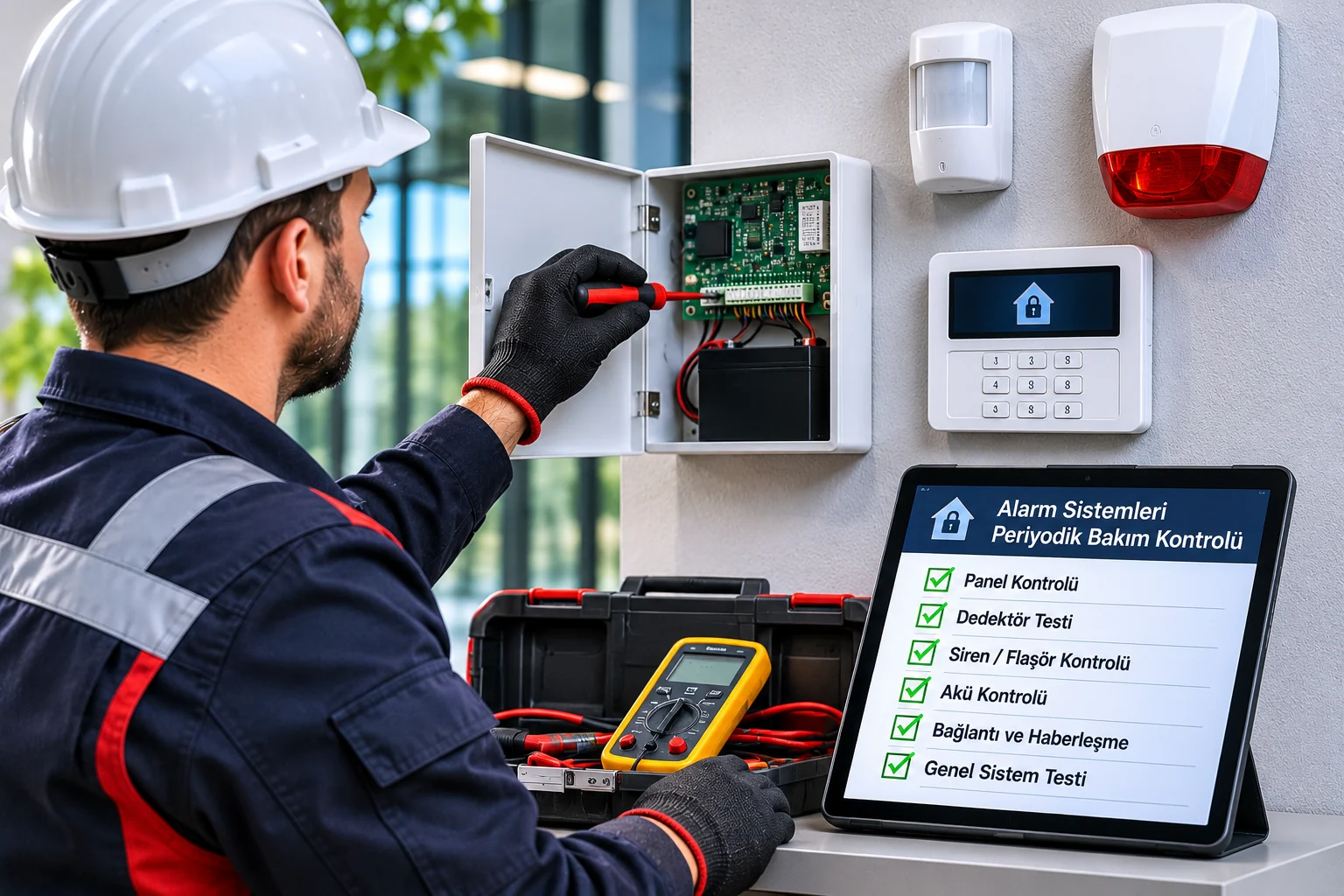
Alarm system periodic maintenance standards cover the technical inspection, testing, and maintenance requirements applied to preserve the reliability of intruder and unauthorized-entry detection systems, reduce false alarm risks, and ensure that security events are transmitted correctly.
Intruder alarm systems may consist of control panels, PIR motion detectors, magnetic contacts, glass-break detectors, panic buttons, sirens, power supplies, and alarm communication modules. Even if these components work correctly during initial installation, they may lose performance over time for physical, electrical, or software-related reasons.
For example, the absence of a fault warning on an alarm panel does not guarantee that all motion detectors correctly cover the actual security area. Similarly, a working alarm siren does not mean that the alarm information has successfully reached the security monitoring center.
In particular, in commercial businesses, shops, jewelry stores, banks, warehouses, and industrial facilities, the maintenance condition of the alarm system can directly affect security continuity.
The purpose of professional periodic alarm system maintenance is not merely to check that devices are operational; it is to verify that all detection, warning, communication, and backup power functions continue to deliver the designed security performance.
In this guide, we examine EN 50131 and EN 50136 standards, alarm system maintenance intervals, detector testing, battery and communication checks, false alarm management, and technical maintenance reporting in detail.
What Is Periodic Maintenance of Alarm Systems?
Periodic alarm system maintenance is the inspection and testing of an installed security system at defined intervals, the application of necessary preventive measures, and the recording of performance results.
A professional maintenance program should cover the following objectives:
Preserving unauthorized-entry detection functions.
Verifying that detectors detect correctly.
Reviewing fault and event logs on the alarm panel.
Testing siren and panic alarm functions.
Assessing backup batteries and power supplies.
Verifying alarm transmission paths.
Checking the communication health of wireless devices.
Identifying the causes of false alarms.
Conducting remote-access and cybersecurity checks.
Reporting outstanding nonconformities.
Difference Between Preventive and Corrective Maintenance
Maintenance type | Purpose | Example |
|---|---|---|
Preventive maintenance | Identify potential problems early | Battery and detector tests |
Corrective maintenance | Rectify a fault that has occurred | Replacing a faulty contact |
Function test | Verify a specific function | PIR motion detection test |
Communication test | Verify that the alarm reaches its intended recipient | Event check at the alarm monitoring center |
Revalidation | Check performance after a change | Area test after replacing a detector |
Remote health monitoring | Track system status | Offline and low-battery warnings |
These activities complement one another. A successful remote system check does not demonstrate that the necessary physical site tests have been completed.
Which Standards Are Used for Alarm Systems?
The most important standards family for burglary and robbery alarm systems EN 50131is EN 50131.
This family of standards addresses system security grades, control equipment, detectors, power supplies, and other components.
Standard | Technical scope | Significance for maintenance |
|---|---|---|
EN 50131-1:2006+A3:2020 | System requirements and security grades | System performance that must be maintained |
CLC/TS 50131-7:2010 | Design, installation, operation, and maintenance guide | Maintenance and repair procedures |
EN 50131-3:2026 | Control and indicating equipment | Verification of panel functions |
EN 50131-2-2:2021 | PIR motion detectors | Motion detection performance |
EN 50131-2-6 | Magnetic opening contacts | Door and window detection |
EN 50131-4:2019 | Warning devices | Siren and alarm notification |
EN 50131-6:2017+A1:2021 | Power supplies | Battery and continuity of power |
EN 50136-1:2012+A1:2018 | Alarm transmission systems | Communication reliability |
EN 50518 | Alarm monitoring and receiving centers | Monitoring center service infrastructure |
BS 9263:2016 | Commissioning, maintenance, and remote support | Additional maintenance application guide |
IEC TS 62642-7:2011 | Intruder and hold-up alarm applications | International application guide |
These standards address different functions. It should not be assumed that each applies to all alarm systems to the same extent.
In addition, for a standard to be used in Türkiye, its TS EN or TS CLC/TS equivalent, valid TSE registration, and the project's contractual requirements must be verified separately.
What Is the CLC/TS 50131-7 Alarm System Maintenance Standard?
CLC/TS 50131-7:2010 is a European technical specification concerning the application processes for intruder and hold-up alarm systems.
This document provides guidance for various stages of alarm systems, from design through operation and maintenance.
Maintenance and repair are addressed in particular in Section 13.
The Standard’s Maintenance Approach
The basic approach is to preserve the security performance specified during the system’s initial design.
For this reason, maintenance should assess not only device faults but also:
changes in the security scope,
the system’s level of protection,
false alarm history,
user operations,
disabled areas,
power and communication reliability
as well.
The relevant guide adopts an approach under which the maintenance plan is decided after installation is completed and the work performed is retained in the system records.
Should the Alarm Monitoring Center Be Notified Before Tests?
For systems connected to an alarm monitoring center, arrangements should be made in advance for how reports generated during testing will be handled.
False reports during panic and hold-up alarm tests in particular can have serious operational consequences.
Therefore, uncontrolled alarms should not be generated outside an authorized testing procedure.
If alarm transmission is temporarily restricted for testing, normal transmission must be confirmed as restored at the end of the test.
EN 50131 Security Grades: Grade 1, 2, 3, and 4
EN 50131-1 defines four security grades for intruder and hold-up alarm systems.
These grades are associated with the anticipated risk and the capability of the threat.
Security grade | General risk level | Maintenance priority |
|---|---|---|
Grade 1 | Low | Basic detection and system functions |
Grade 2 | Low to medium | Detection, tamper, and communication checks |
Grade 3 | Medium to high | More comprehensive protection and fault assessment |
Grade 4 | High | Detailed verification of high-security requirements |
The security grade alone does not indicate that maintenance visits must always take place at a particular fixed interval.
For example, it should not be concluded that maintenance performed every six months in a Grade 3 system is mandatory for all projects.
The maintenance program should take account of the system’s grade, as well as manufacturer instructions, environmental conditions, the protected area, and the relevant contract.
Important: A system being designed as Grade 3 does not depend solely on the presence of the words “Grade 3” on the panel. The relevant components, connections, and system architecture must meet the required conditions as a whole.
How Often Should Alarm Systems Be Serviced?
It is not appropriate to set one general interval that can be applied to all intruder alarm systems for periodic maintenance.
The alarm system’s risk grade, intensity of use, environmental conditions, manufacturer recommendations, insurance conditions, and maintenance contract should be assessed.
Example Alarm System Maintenance Schedule
Interval | Recommended activity |
|---|---|
Daily | Check critical faults, offline devices, and alarm status |
Weekly | Review operating records and outstanding warnings |
Monthly | Basic user tests in accordance with the manufacturer’s procedure |
Quarterly | Remote health, communication, and battery status assessment |
Six-monthly | Comprehensive site inspection and function tests if warranted by risk |
Annually | Detailed system-wide performance, inventory, and maintenance audit |
After an incident | Additional inspection after a genuine alarm, tampering, fault, or significant change |
This table is an example of a risk-based maintenance plan.
Not all rows should be regarded as fixed, universally mandatory requirements under EN 50131.
For example, alarm transmission paths may need to be verified more frequently in a high-security jewelry store, while a different maintenance plan may be used in a low-risk small business.
How Is Periodic Alarm Panel Maintenance Performed?
The alarm control panel is the central equipment that evaluates signals received from detectors and other security components in the system.
During maintenance, it is not enough for the panel merely to be powered on.
What to Check on an Alarm Panel
Check | Assessment |
|---|---|
Normal operating status | Open fault and tamper warnings |
Zone definitions | Match with actual location |
Alarm event history | Unusual and recurring events |
Arming/disarming operations | Defined user permissions |
Entry/exit delays | Compliance with the approved design |
Disabled zones | Authorized and temporary use |
Communication | Status of relevant transmission paths |
Battery and charging | Power system health |
Panel software | Support and update status |
Tampering | Cover and other defined detection functions |
What Happens If an Alarm Zone Is Incorrectly Labeled?
Incorrectly labeling an alarm zone on the panel can make it harder to assess an alarm event.
For example, if a detector at a warehouse entrance is shown on the panel as being in the sales area, the security response may be directed to the wrong location.
For this reason, zone names should be compared with field devices and current design plans.
PIR Motion Detector Maintenance Standards
PIR (Passive Infrared) detectors are used to detect movement by evaluating changes in infrared radiation in their surroundings.
The primary purpose of maintenance is to verify that the detector continues to perform as expected within its designated detection area.
Items to Check on PIR Detectors
The detector’s physical condition.
Mounting orientation and stability.
Condition of the lens surface.
Obstructions in the detection area.
New furniture affecting the field of view.
Heating, ventilation and other environmental changes.
Motion detection using the authorized test method.
Activation of the correct zone on the panel.
Status of the tamper function.
What Is a Walk Test?
A walk test is a functional test used to assess a motion detector’s detection behavior in the area it is intended to protect.
Authorized personnel carry out designated movement scenarios using the test method and appropriate test mode specified by the manufacturer.
The purpose of the test is to check whether the detector detects the required movements under real-world operating conditions.
The fact that a PIR detector’s LED indicator lights up does not prove that the entire actual coverage area is being detected appropriately.
Any detection gaps found during the walk test should be assessed in terms of the detector’s installation and configuration.
Periodic Maintenance of Magnetic Contacts
Magnetic contacts used on doors and windows are designed to detect specific opening movements.
What to Check
Physical mounting of the contact.
The closed position of the door or window.
Alignment of the magnet and sensor.
Integrity of the cable and connections.
Tamper function, if present.
Display of the correct zone on the panel.
Generation of the expected event when the door is opened.
Mechanical adjustments can change over time, particularly on shop and warehouse doors.
Changes to a door’s hinges or locking mechanism can affect the detection behavior of the magnetic contact.
For this reason, actual door operating conditions should be assessed during maintenance.
Maintenance of Glass-Break and Shock Detectors
Glass-break and shock detectors may use different detection technologies.
Acoustic Glass-Break Detectors
These detectors analyze specific characteristics of the sound of breaking glass.
Maintenance tests should use the special equipment and procedures recommended by the manufacturer.
Creating a loud noise at random does not prove that the system works correctly under all detection conditions.
Shock or Vibration Detectors
They may be used to detect specific impact movements on doors, windows or other protected surfaces.
For these devices, the physical installation, detection area and manufacturer-supported test method should be assessed.
Random impacts or test methods that could damage the device should not be used.
Periodic Maintenance of Wireless Alarm Systems
Reliable communication between the detector and the panel is important in wireless alarm systems.
However, it should not be assumed that all wireless systems use the same radio technology and battery management.
Items to Check on Wireless Detectors
Signal level and connection status.
The device’s supervision communication.
Low-battery warnings.
The detector’s mounting location.
New metal shelving or physical obstructions.
Changes in the radio environment.
Supported tamper-detection functions.
Delivery of the alarm event to the panel.
Why Is Signal Testing Important?
A detector being registered with the system does not guarantee that it can communicate reliably in every condition at its location.
For example, new metal shelving, partition walls or technical equipment can change wireless communication conditions.
For this reason, the signal and communication tests supported by the system should be carried out at the actual installation locations.
When Should Wireless Detector Batteries Be Replaced?
There is no single universal replacement interval.
Battery life depends on factors such as:
Device model.
Battery type.
Operating temperature.
Detection frequency.
Wireless communication conditions.
The manufacturer’s power management.
and other factors.
Battery replacement should be planned in light of the manufacturer’s recommended interval and the battery-status indicators in the system.
Waiting for a low-battery warning may not, by itself, be an adequate maintenance strategy for critical security applications.
Alarm System Battery and Power Supply Maintenance
The ability of an alarm panel to operate for a specified period during a mains power outage depends on the condition of its backup power supply.
EN 50131-6 addresses the performance requirements for power supplies used in intruder and hold-up alarm systems.
What Should Be Checked When Inspecting a Battery?
Check | Purpose |
|---|---|
Battery physical condition | Swelling, leakage and damage |
Connections | Loosening and corrosion |
Charging system | Appropriate charging behavior |
Voltage | Manufacturer limits |
Battery capacity | Required backup performance |
Battery age | Manufacturer’s replacement recommendation |
Power failure | Operation of the fault notification |
Power restoration | System returning to normal operation |
Is a Panel with Normal Battery Voltage in Good Condition?
Not always.
A suitable open-circuit battery voltage does not guarantee that it can provide sufficient capacity under an actual load.
For example, an aged battery may show a normal charging voltage but fail to power the system for the specified period during a power outage.
Battery testing should therefore be carried out in accordance with the manufacturer’s instructions and safe capacity-assessment methods.
How Many Hours of Backup Are Required?
There is no single duration that applies to all intruder alarm systems.
The system security grade, type of power supply used, alarm transmission architecture and applicable requirements of the relevant standard should be taken into account.
During maintenance, assess not only the Ah rating on the battery label but also the actual load of the installed equipment and the battery’s condition.
Periodic Maintenance of Alarm Sirens and Strobes
Sirens perform the local warning function of an alarm system.
Some systems may include indoor sirens, outdoor sirens and visual warning devices.
Siren Checks
Physical enclosure integrity.
Secure mounting.
Tamper protection.
Supported battery status.
Wired or wireless connection.
Warning during an alarm condition.
Required alarm duration and behavior.
Strobe function.
Correct display of the event on the panel.
A siren sounding does not, in every case, show that the warning requirements in the design have been met.
When maintaining outdoor sirens in particular, environmental conditions, enclosure integrity and the manufacturer’s operating requirements should be taken into account.
Panic Button and Hold-Up Alarm Maintenance
Panic and hold-up alarm systems can enable a user to call for help in response to a specific threat.
Because accidental activation of these systems can cause serious operational problems, maintenance should be conducted under controlled conditions.
What Should Be Tested When Maintaining a Panic Alarm?
The button’s physical condition.
Authorized operating position.
The relevant wired or wireless connection.
Delivery of the alarm event to the panel.
Generation of the correct event type.
Correct receipt of the alarm by the monitoring center, if there is one.
The system’s normal operating status after the test.
Before testing a panic button, it is important to notify the relevant alarm monitoring center and follow the authorized test procedure.
These functions should be assessed as a separate priority, particularly in jewelry stores, currency exchange offices and high-security commercial businesses.
How Is the Alarm Monitoring Center Connection Tested?
One of the most important maintenance considerations for alarm systems is ensuring that an alarm event reaches the correct recipient.
A detector generating an alarm and the alarm being transmitted to a monitoring center are two separate functions.
EN 50136-1 addresses requirements for the performance, reliability and security characteristics of alarm transmission systems.
Stages to Check in an Alarm Transmission Test
Stage | Information to verify in the test |
|---|---|
1. Detector | Was the actual test event detected? |
2. Control panel | Were the correct zone and event generated? |
3. Communication device | Was the event taken into the transmission process? |
4. Communication channel | Did the required connection work? |
5. Monitoring center | Was the event actually received? |
6. Event information | Are the subscriber, zone and event type correct? |
7. Operations | Was the process completed appropriately under the authorized test procedure? |
Is a Mobile Notification Enough?
No.
An alarm notification arriving in a mobile app does not automatically prove that the event in question successfully reached a professional alarm monitoring center.
Therefore, for systems with a monitoring-center subscription, it should also be verified that the event was received and correctly processed at the center.
Dual Communication Channels
Some alarm systems may use different transmission paths, such as Ethernet/IP and cellular communication.
In this architecture, the following should be tested during maintenance:
Normal communication.
Availability of the alternative channel.
Supported fault notifications.
Connection recovery behavior.
in accordance with project requirements.
Rather than testing by interrupting communication on a live system without control, the approved procedures of the manufacturer and alarm monitoring center should be followed.
Alarm Monitoring Centers and Regulations in Türkiye
Alarm monitoring center services are regulated under Law No. 5188 on Private Security Services and the relevant implementing regulation.
The Regulation on the Implementation of the Law on Private Security Services’ Article 23 contains provisions concerning the certificate of qualification issued by the governor’s office for establishing and operating an alarm monitoring center.
The installation of an alarm panel, technical maintenance of an alarm system and operation of an alarm monitoring center should therefore be treated as distinct activities.
Maintenance contracts for systems connected to an alarm monitoring center should clearly specify which functions they cover.
For example, a company providing technical service only for the alarm panel is not automatically considered to have assumed responsibility for monitoring-center services as well.
Causes of False Alarms in Alarm Systems
False or unwanted alarms can affect the reliability and operating processes of alarm systems.
Common Causes of False Alarms
Cause | What to assess during maintenance |
|---|---|
Incorrect positioning of the PIR detector | Detection area and environmental effects |
Loose magnetic contact | Mounting and door alignment |
Low battery | Battery and communication health |
User error | Arming/disarming procedures and training |
Incorrect zone configuration | Panel settings |
Environmental changes | New sources of heat, airflow, or movement |
Cable connection problem | Physical and electrical inspection |
Wireless communication problem | Signal and device supervision logs |
Faulty detector | Functional test and replacement if necessary |
False alarm problems should not be addressed solely by reducing detector sensitivity.
This approach may increase the risk of actual intrusion events going undetected.
The correct approach is to identify the cause of the false alarm, take the necessary corrective action, and re-verify actual detection performance.
Cybersecurity Maintenance for Alarm Systems
Modern alarm systems can operate through IP networks, mobile applications, and remote management platforms.
Accordingly, maintenance should assess the cybersecurity configuration as well as the physical condition of the devices.
Key checks:
No unauthorized user accounts.
User permissions are up to date.
Default passwords are not in use.
Multi-factor authentication, if supported.
Software and firmware support status.
Secure remote service access.
Unnecessary network services are disabled.
Event and transaction logs are protected.
Authorized mobile devices are checked.
Configuration backups are stored securely.
Before a firmware update, compatibility with the device and system should be verified.
After an update, it is not enough for the panel merely to be online. Detection, alarm transmission, and relevant user functions must be retested.
Is Periodic Alarm System Maintenance Legally Required?
It cannot be said that there is a single general periodic maintenance interval in Türkiye for burglar alarm systems used in all homes and workplaces.
However, maintenance requirements may arise from the following sources:
The business's security obligations.
Sector-specific legislation.
Insurance contracts.
Installation and technical specifications.
Manufacturer maintenance instructions.
Alarm monitoring center contracts.
The business's risk assessment.
Are the Maintenance Obligations for Fire Alarms and Burglar Alarms the Same?
No.
Article 84 of the Regulation on the Protection of Buildings from Fire, the periodic inspection, testing, and maintenance of the relevant fire detection and warning systems.
This provision does not mean that the same maintenance interval automatically applies to all burglar alarm panels, PIR detectors, and magnetic contact systems.
Fire detection and burglar alarm systems may be present at the same facility, but their technical standards and legal obligations differ.
Technical Acceptance Criteria for Alarm System Maintenance
A professional maintenance report should not simply state “inspected.”
A specific acceptance criterion should be defined for every test.
Check | Sample acceptance criterion |
|---|---|
Alarm panel | No active critical faults |
PIR detector | Detects the specified test movements |
Magnetic contact | Correctly reports a door/window event |
Glass-break detector | Produces the expected event when tested appropriately |
Panic button | Produces the correct alarm event in an authorized test |
Siren | Performs the defined warning function |
Backup power | Meets the performance requirement specified in the project |
Wireless communication | Connection in accordance with manufacturer criteria |
Alarm transmission system | The event reaches the intended receiver correctly |
Tampering | Correct reporting of supported tamper events |
User permissions | Unauthorized actions are prevented |
System status | Returns to normal armed protection after testing |
These criteria are examples. Actual acceptance thresholds should be determined according to the project's security grade, the applicable standard, and the manufacturer's instructions.
How to Prepare an Alarm System Maintenance Report
A professional maintenance report should make the tests performed traceable and auditable.
Sample Alarm System Maintenance Report
Report field | Sample information |
|---|---|
Facility | Sample Store A |
Alarm panel | Model and serial number |
System security grade | Grade specified in the project |
Maintenance date | Actual maintenance date |
PIR detectors | Devices tested and results |
Magnetic contacts | Devices tested and results |
Siren | Pass / fail |
Panic alarm | Authorized test result |
Battery | Test and assessment result |
Communication | IP/cellular test results |
Alarm center | Event received / not received / not applicable |
False alarm history | Findings |
Nonconformity | Open fault and description |
Corrective action | Action taken |
Final status | Pass / fail / partially completed |
Technical personnel | Authorized service provider details |
This table is not an exact copy of an official EN 50131 form. It is a sample template prepared for technical service reporting.
How Should Nonconformities Be Classified in a Maintenance Report?
Status | Description |
|---|---|
Conforming | Specified criterion met |
Nonconforming | Required function not met |
Unable to test | Test could not be completed |
Out of scope | Function not present in the system |
Corrected | Fault remedied and retested |
Open critical nonconformity | Important security function not yet corrected |
In particular, if a critical detector or alarm transmission function is not working, an unconditional conformity report should not be issued for the entire system until the problem has been remedied.
SLA and Response Times for Alarm Systems
Defining service levels in maintenance contracts can help maintain operational security.
SLA (Service Level Agreement), is a service level agreement.
Sample Fault Prioritization Matrix
Priority | Sample fault | Response approach |
|---|---|---|
P1 — Critical | System completely out of service; no alarm transmission | Emergency response |
P2 — High | Critical entrance detector not working | Priority response |
P3 — Medium | Recurring false alarm in a secondary zone | Expedited scheduled service |
P4 — Low | Non-urgent indicator or reporting problem | Scheduled maintenance |
For example, a target for the initial response to critical faults can be set at within four hours.
However, this period is not a universal response time required by EN 50131 for all projects. It should be defined through the contract and risk assessment.
The response time and the time required to fully remedy the fault should be specified separately.
What to Do Before and After Periodic Alarm System Maintenance
Before Maintenance
Review the system and device inventory.
Assess risks in the protected area.
Review open faults and false alarm records.
Prepare a test plan.
Coordinate as necessary with the alarm monitoring center, if there is one.
Inform users and facility managers.
During Maintenance
Check the panel and power supplies.
Test detectors using appropriate methods.
Verify alarm and panic button functions.
Check sirens and warning devices.
Test the relevant communication paths.
Perform the necessary cybersecurity checks.
Record any nonconformities found.
After Maintenance
Revert temporary changes made for testing.
Check the disabled zones.
Return the alarm transmission system to normal operation.
Assess open faults and residual risks.
Inform the facility manager of the maintenance results.
Deliver the technical report and the next maintenance plan.
The most important final check: After maintenance is complete, verify that the alarm system is genuinely providing protection again in all required security zones and that alarm transmission is operating normally.
Periodic Alarm System Maintenance Technical Checklist
- Is the system inventory up to date?
- Has the relevant EN 50131 security grade been verified?
- Have the maintenance plan and manufacturer instructions been reviewed?
- Has the alarm panel fault history been checked?
- Do the panel zone names match the actual location information?
- Have the PIR detectors been verified using a Walk Test?
- Have the magnetic contacts been physically and functionally checked?
- Have the glass-break and impact detectors been tested using an appropriate method?
- Has the condition of the wired lines been assessed?
- Have the signal and supervision status of wireless devices been checked?
- Have detector battery levels been checked?
- Have the alarm panel battery and charging system been checked?
- Has mains power failure reporting been verified?
- Have the sirens and flashers been tested?
- Has the panic alarm been tested using an authorized procedure?
- Have the supported tamper functions been verified?
- Have IP/cellular alarm transmission paths been assessed?
- Has it been verified that the correct events reach the monitoring center?
- Has the false alarm history been reviewed?
- Have user permissions been reviewed?
- Have the firmware and cybersecurity status been checked?
- Have zones disabled for testing been re-enabled?
- Has the system's normal status after maintenance been verified?
- Have nonconformities and corrective actions been reported?
- Has the technical maintenance report been delivered to the facility manager?
This checklist is a starting template. It does not replace the applicable standard, manufacturer instructions, or project specification.
Frequently Asked Questions About Periodic Maintenance Standards for Alarm Systems
What is the main maintenance standard for alarm systems?
One of the main implementation references for intrusion and hold-up alarm systems is CLC/TS 50131-7:2010. Other parts of the EN 50131 series set out requirements for system components.
What is EN 50131 in alarm systems?
It is a European standards family covering the security grades, system functions, power supplies, detectors, and other components of intrusion and hold-up alarm systems.
How often should an alarm system be serviced?
There is no single interval that applies to all systems. Maintenance frequency should be determined according to risk, manufacturer instructions, security grade and the maintenance contract.
Is annual maintenance mandatory for intruder alarm systems?
A general, unconditional legal requirement for annual maintenance of all residential and commercial intruder alarm systems could not be verified. However, specific sector, insurance and contractual conditions may impose additional obligations.
Do wireless alarm systems require maintenance?
Yes. Detector battery status, wireless connectivity, installation conditions and alarm transmission should be assessed regularly.
What is a Walk Test for alarm detectors?
It is a functional test that assesses a detector’s actual detection behavior using specific movement scenarios.
Is maintenance necessary if there are no faults on the alarm panel?
Yes. The absence of faults on the panel does not prove that all detectors, sirens and communication functions are working correctly.
How many years should pass before an alarm system battery is replaced?
This depends on the battery type, ambient temperature, operating conditions and the manufacturer’s recommendation. A single replacement interval should not be specified for all alarm panels.
Are panic buttons tested during maintenance?
Yes. The required functions should be verified using an authorized test procedure. For systems connected to an alarm receiving centre, coordination should take place in advance to prevent false alarms.
How is the connection to the alarm centre verified?
A test event must be generated at the panel, and it must be confirmed that the relevant monitoring centre received it with the correct subscriber, zone and event information.
Does a mobile app notification show that the alarm centre is working?
No. A mobile notification and the professional transmission of an event to an alarm receiving centre are different functions.
How can false alarms in alarm systems be reduced?
The causes of false alarms should be investigated, faulty installations or configurations corrected, and the required detection performance retested.
Is a maintenance report required for alarm systems?
Professional maintenance work should include reporting test results, changes and non-conformities. Contractual and specific regulatory requirements may affect the scope of documentation.
What is the difference between EN 50131 and EN 54?
EN 50131 concerns intruder and hold-up alarm systems, while EN 54 concerns components of fire detection and fire alarm systems.
Conclusion: Alarm System Maintenance Must Verify Real-World Security Performance
Periodic maintenance standards for alarm systems provide a systematic approach to ensuring that security infrastructure continues to perform the protective functions defined at initial installation.
While the EN 50131 standard defines requirements for security systems and components, CLC/TS 50131-7 provides guidance on maintenance and operational practices. EN 50136 is important for the reliable transmission of alarms to an authorized monitoring system.
Professional maintenance should assess PIR and magnetic contact detectors, the alarm panel, sirens, panic buttons, batteries, wireless communication and remote alarm transmission functions together.
In particular, the system’s ability to detect a real alarm event and notify the relevant people or monitoring centre correctly is among the most important maintenance performance criteria.
Successful periodic maintenance of an alarm system is not merely the completion of device checks; it involves verifying through testing that the system performs its defined security functions and managing any outstanding non-conformities.
Professional alarm maintenance services should therefore be based on standards-driven test procedures, risk-based maintenance intervals, measurable acceptance criteria and detailed technical service reports.