
What Is Artificial Intelligence? How It Works, Its Types, Applications and Future
What is artificial intelligence (AI), how does it work, and where is it used? We explain machine learning, deep learning, generative AI, computer vision, security cameras, benefits, risks and the future of artificial intelligence in detail.
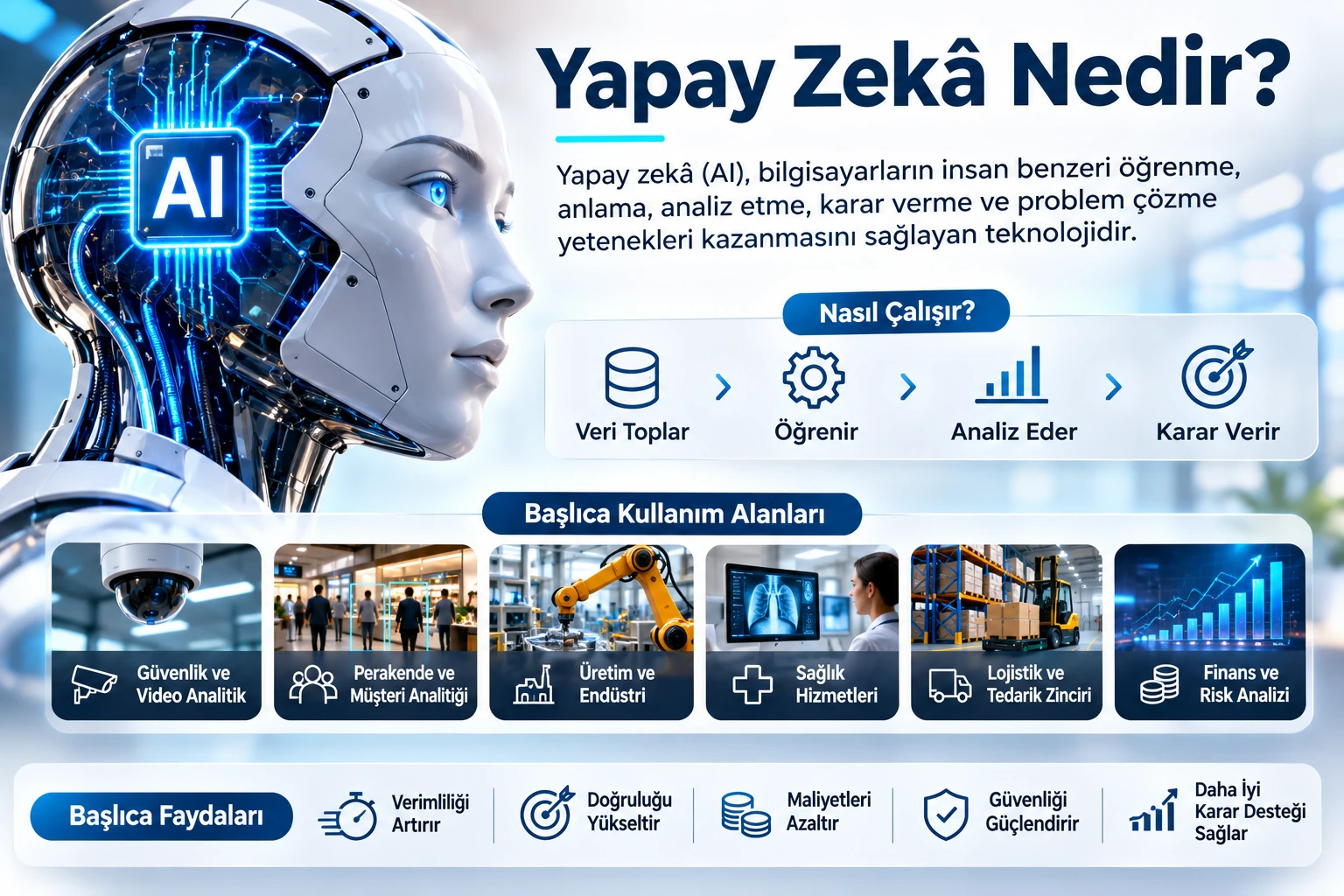
Artificial intelligence is among today’s fastest-developing technologies. Used in many fields—from smartphones and cars to healthcare and industrial production, and from security cameras to retail analytics—AI technologies are changing how businesses operate and how people interact with digital systems.
So, what is artificial intelligence, how does it work, and how does it differ from traditional computer software?
Artificial intelligence (Artificial Intelligence – AI) is a general term for technologies that enable computer systems to analyze data toward specific goals and produce outputs such as predictions, classifications, recommendations, content or decisions.
AI systems can analyze images, process human language, transcribe speech, identify patterns in data and support the automation of specific tasks.
However, AI should not be assumed to be conscious like a human, to produce correct results in every situation or to require no human oversight. Its capabilities depend on its design and training, the data used and the conditions in which it is deployed.
What Is Artificial Intelligence?
Artificial intelligence is a scientific and technological field concerned with enabling computers and other machine-based systems to perform tasks normally associated with cognitive processes such as perception, learning, reasoning or decision-making.
In English, it is called Artificial Intelligence and is known by the abbreviation AI.
The concept of artificial intelligence is not limited to chat applications that can talk to people.
For example:
A security camera distinguishing people from vehicles
An email system classifying unwanted messages
A banking system flagging unusual transactions
Detecting defective products from images on a production line
A navigation system predicting traffic conditions
Software generating text, images or code
are examples of artificial intelligence applications.
The Organisation for Economic Co-operation and Development (OECD) defines AI systems as machine-based systems that can operate with varying levels of autonomy and produce predictions, content, recommendations or decisions from the inputs they receive.
An important aspect of this definition is that AI is not merely software that imitates human behavior.
How Does Artificial Intelligence Work?
How AI systems work varies according to the technology used. Data, algorithms and computing infrastructure are fundamental components, particularly in machine-learning-based systems.
1. Data Collection
First, suitable data for the task the system is intended to perform is identified.
Data may come from the following sources:
Camera footage
Sensor measurements
Text documents
Audio recordings
Sales transactions
Production data
Machine operating records
For example, suitably prepared image data can be used to develop an algorithm for a security camera that detects people and vehicles.
2. Data Preparation
The collected data is organized for analysis or model training.
At this stage, erroneous, missing or inconsistent records may be reviewed.
Where necessary, data is labeled.
For example, objects in an image can be labeled as a person, car or truck.
Data quality and representativeness can directly affect the performance of the model being developed.
3. Model Training
In machine-learning methods, the algorithm attempts to learn relationships and patterns in the training data.
For example, a model trained on thousands of images of different vehicles may learn features that enable it to classify vehicles in new images.
However, a model’s success on its training data does not mean it will perform equally well under real-world conditions.
4. Model Testing
The trained model is evaluated using suitable test data that was not used during training.
At this stage, accuracy, false positives, false negatives and other performance indicators can be measured.
5. Inference
Once training is complete, the model analyzes new data and produces an output.
For example, detecting a person in footage from an IP camera is an inference performed by a trained model.
6. Monitoring and Updating
The performance of AI systems operating in real-world environments can change over time.
Changes in camera angle, the use of new products or variations in environmental conditions can affect a model’s performance.
Systems therefore need to be monitored and tested regularly and updated when necessary.
What Is the Difference Between AI and Traditional Software?
In traditional software, operations are generally carried out according to rules explicitly defined by a programmer.
In machine-learning-based AI systems, specific decision rules can instead be learned from data.
Feature | Traditional software | Machine-learning-based AI |
|---|---|---|
Operating principle | Explicitly defined rules | Relationships learned from data |
Adaptation to new situations | Rules may need to be updated | Can generalize based on learned patterns |
Data requirements | Depends on the application | Suitable training data is required |
Output | Usually deterministic | May be probabilistic |
Types of errors | Logic and implementation errors | Model, data and generalization errors |
Explainability | Easier in some systems | Can be more difficult depending on the model |
However, not all AI systems rely on machine learning. Rule-based expert systems may also fall within the historical and technical scope of artificial intelligence.
What Are the Types of Artificial Intelligence?
Artificial intelligence can be classified using different approaches.
One of the most common distinctions is based on the scope of systems’ capabilities, while another is based on the technical methods used.
Narrow Artificial Intelligence (Artificial Narrow Intelligence – ANI)
Narrow AI refers to systems developed for specific tasks.
For example:
License plate recognition
Human detection
Speech recognition
Product recommendations
Image classification
People counting
are narrow AI applications.
Most AI solutions in use today have been developed for specific tasks or groups of tasks.
General Artificial Intelligence (Artificial General Intelligence – AGI)
General AI is a concept used for systems capable of demonstrating human-level abilities, or similarly broad capabilities, across a wide range of cognitive tasks.
There is no scientific consensus on the criteria by which AGI should be defined or when it could be achieved.
The fact that current AI models perform well on many tasks does not show that they possess all of the human cognitive abilities.
Artificial Superintelligence (Artificial Superintelligence – ASI)
Superintelligent AI refers to hypothetical systems that surpass human cognitive performance across a very broad range of fields.
Unlike commercial AI systems in use today, this concept is the subject of theoretical discussions about the future.
What Is Machine Learning?
Machine learning comprises AI methods that enable computers to learn patterns from data and make predictions or classifications for specific tasks.
The main approaches to machine learning are:
Supervised Learning
The model is trained on examples for which the correct answers or target values are known.
For example, an object-classification model can be developed using images labeled as people and vehicles.
Unsupervised Learning
The model searches for structures or similarities in data without predetermined target labels.
For example, particular patterns in customer purchasing data can be analyzed.
Reinforcement Learning
A system can learn specific behavioral strategies by interacting with an environment and evaluating the reward signals it receives.
It can be used in robotics, control and optimization applications.
What Is Deep Learning?
Deep learning is a machine-learning approach that uses multilayer artificial neural networks.
It has significant applications, particularly in image, speech and natural language processing.
Deep-learning algorithms can:
Detect objects in images.
Convert speech into text.
Analyze relationships between texts.
Learn complex data patterns.
Generate new content under certain conditions.
However, the success of deep-learning systems depends on data quality, model architecture, computing resources and evaluation methods.
What Is Generative Artificial Intelligence (Generative AI)?
Generative AI refers to models and systems that can create new content by drawing on patterns in the data they have learned from.
This content can take the form of:
Text
Images
Audio
Video
Software code
Designs
Synthetic data
formats.
For example, large language models (Large Language Models – LLMs) can be used for tasks such as text generation, summarization, translation and answering questions.
However, generative AI systems can produce false information, fabricated sources or inaccurate technical explanations.
Information generated in fields such as law, healthcare, engineering and security must therefore be verified.
The Difference Between Artificial Intelligence, Machine Learning and Deep Learning
These terms are often used interchangeably, but they do not mean the same thing.
Artificial Intelligence (AI)
The broadest field of technology and research
Machine Learning (ML)
Methods that learn from data
Deep Learning (DL)
Multilayer artificial neural networks
What Is Computer Vision?
Computer vision is one of AI’s important application areas, focused on analyzing image and video data.
Computer-vision systems can analyze objects, regions and specific movement patterns within images.
Key applications:
Object detection
Image classification
Object tracking
Image segmentation
Optical character recognition
Human and vehicle detection
Industrial quality control
Video analytics
In particular, in the electronic security industry, computer vision is one of the core technologies behind AI-enabled CCTV systems.
Where Is Artificial Intelligence Used?
Healthcare
AI can be used to analyze certain medical images, in clinical decision-support systems and to plan healthcare operations.
However, AI outputs should be assessed in accordance with relevant medical standards and human oversight.
Finance and Banking
It can be used for anomaly analysis in financial transactions, identifying fraud risks and automating operations.
Industry and Manufacturing
AI can support quality control on production lines, failure prediction, equipment monitoring and production optimization.
Logistics and Transportation
AI applications are used in vehicle movement analysis, route optimization, traffic prediction and warehouse operations.
Retail
AI can be used for store traffic, inventory analysis, sales forecasting, product recommendations and certain loss-prevention applications.
Education
It can be used to prepare learning materials, improve content accessibility and support certain educational applications.
However, the protection of student data and the effects of automated decisions must also be assessed.
Electronic Security
AI-enabled security cameras can be used for applications such as alarm verification, perimeter security and incident analysis.
This is one of the important applications of computer-vision technologies.
How Is Artificial Intelligence Used in Security Cameras?
Traditional CCTV systems mainly perform imaging and recording functions.
AI-enabled video analytics solutions, by contrast, can extract information about specific objects and events from images.
Human and Vehicle Detection
AI algorithms can distinguish people and vehicles in an image according to the supported classes.
This can reduce unnecessary motion alerts in certain alarm scenarios.
Intrusion and Perimeter Security
Entry into defined areas can be detected using virtual-line or zone-breach analytics.
However, the algorithm cannot determine on its own whether a person is actually unauthorized.
AI-Powered Object Tracking
The movement of people or vehicles across consecutive video frames can be analyzed.
More advanced systems may include functions such as multi-object tracking and cross-camera re-identification.
License Plate Recognition Systems
Vehicle license plates can be read using image-processing and character-recognition technologies.
License plate reading performance depends on camera angle, image quality, lighting and vehicle movement.
Facial Recognition Systems
Facial recognition systems can verify or identify a person’s identity using biometric features.
These applications may entail requirements for processing special-category personal data.
AI-Powered Fire Detection
Some AI video-analytics solutions can provide early warnings by detecting smoke- or flame-like patterns in camera footage.
However, these systems do not automatically replace fire-detection systems designed to applicable standards and meeting the required certification conditions.
Suspicious Incident Analysis
Concrete events such as lingering in a particular area, entering a restricted zone or leaving an object can be analyzed.
However, AI cannot reliably determine a person’s intention to commit a crime or their dangerousness.
The Difference Between Edge AI and Cloud AI
AI processing can be performed on different hardware architectures.
Edge AI
Edge AI means performing AI inference on devices close to where the data is generated.
For example, a camera performing human detection on its own processor is an Edge AI application.
Cloud AI
In cloud AI systems, analysis or model services can be performed using remote data-center infrastructure.
Comparison
Criterion | Edge AI | Cloud AI |
|---|---|---|
Processing location | Local device | Remote server |
Internet dependency | Low in some applications | Varies by service |
Latency | Local processing may offer an advantage | May be affected by network conditions |
Processing capacity | Limited by device hardware | May be scalable |
Centralized management | Additional infrastructure may be required | Can generally be facilitated |
Data protection | Local processing may offer an advantage | Transfer and hosting should be assessed |
Cost | Hardware and maintenance | Usage, subscription and data transfer |
In hybrid architectures, some processing can take place on local devices and other processing on a central server or in the cloud.
What Are the Benefits of Artificial Intelligence?
When applied correctly, AI technologies can provide businesses with various benefits.
Operational Efficiency
Automating repetitive analysis and classification tasks can reduce employees’ workloads.
Big Data Analysis
Patterns can be identified in large datasets that are difficult for people to review manually.
Early Warning
Certain anomalies or events may be detected early.
Decision Support
Forecasting and analysis results can support managers’ decision-making processes.
Continuity
With suitable infrastructure, systems can perform certain tasks continuously.
Measurable Performance
Well-designed systems can have performance indicators established for specific processes.
However, achieving these benefits depends on validating the AI system under real-world conditions.
What Are the Risks and Disadvantages of Artificial Intelligence?
Incorrect Results
AI systems can make incorrect predictions or classifications.
Data Quality Problems
Incomplete, erroneous or unrepresentative data can adversely affect model performance.
Algorithmic Bias
Some systems may show systematic performance differences across different groups of people or data.
Personal Data and Privacy
Processing facial images, location information and other personal data may entail data-protection obligations.
Cybersecurity
AI infrastructure may face risks such as data leaks, unauthorized access and manipulation.
Explainability
It can be difficult to explain why a particular output was produced, especially with complex deep-learning models.
Excessive Automation
Where human oversight is inadequate, the impact of erroneous decisions can increase.
Appropriate human oversight, testing and appeal mechanisms are therefore important in critical applications.
How Is Accuracy Measured in AI Systems?
AI performance is evaluated using different metrics depending on the type of application.
For example, the human-detection performance of a security camera and the text-generation quality of a language model are not measured using the same methods.
Precision
Precision = TP / (TP + FP)
Measures how many of the results labeled positive are correct.
Recall
Recall = TP / (TP + FN)
Shows how many of the actual target events were detected.
F1-Score
The harmonic mean of Precision and Recall.
Depending on the application:
Accuracy
mAP
MAE
RMSE
False alarm rate
Processing latency
System availability
and other metrics.
The key is not merely to achieve a high accuracy percentage, but to set performance criteria suited to the real-world use case.
How Should AI Systems Be Selected?
Before investing in AI, businesses should clearly define the problem they want to solve.
1. Define the Purpose of Use
The problem to be solved and the required output should be identified.
2. Assess the Data
The quality and accessibility of the data required by the system, as well as the legal conditions for processing it, should be reviewed.
3. Verify the Algorithm’s Capabilities
The supplier’s stated functions and technical limitations should be documented.
4. Review Integration
Compatibility with existing software, cameras, sensors and other systems should be assessed.
5. Conduct a Pilot
A limited-scope test should be conducted in a real-world environment.
6. Measure Performance
Accuracy, false alarms, latency and operational benefits should be measured.
7. Check Data Security
Personal-data protection and cybersecurity requirements should be assessed.
8. Calculate Total Cost
Hardware, licensing, integration, training, maintenance and update costs should be assessed together.
Artificial Intelligence and the KVKK
When AI systems process personal data, relevant obligations may arise in Türkiye under the Personal Data Protection Law No. 6698.
The purpose and legal basis of processing should be carefully assessed, particularly in applications involving image analysis, facial recognition, employee monitoring and customer profiling.
Key principles include:
Compliance with the law and rules of good faith
Specific, explicit and legitimate purposes
Data use that is relevant, limited and proportionate to the purpose of processing
Retention only for the necessary period
Data security
Protection of data subjects’ rights
are among them.
The use of AI does not, by itself, make personal-data processing lawful.
What Is the European Union Artificial Intelligence Act (AI Act)?
The European Union Artificial Intelligence Act is a legal framework that sets obligations addressing specific risks posed by AI systems.
The regulation addresses different use cases according to their risks.
For example, some AI applications have been prohibited, while more extensive requirements have been set for certain high-risk systems.
The primary aim of this approach is to support safety and the protection of fundamental rights in the use of AI.
However, not every AI system is subject to the same obligations. Applicable rules should be assessed according to the system’s intended purpose, the parties’ roles and the implementation timetable.
The Future of Artificial Intelligence
The development of AI technologies continues to create new fields of application across different sectors.
Prominent areas of research and development include:
Multimodal AI
Models that can process different data types, such as text, images, audio and video, together.
Edge AI
Performing AI processing in cameras, sensors and local devices.
AI Agents
Software systems capable of performing multistep tasks by using tools to achieve specific goals.
Physical AI
The use of AI in robotics and systems that interact with the physical environment.
Explainable AI
Methods aimed at improving understanding and evaluation of the results produced by systems.
Trustworthy AI
Developing features such as safety, robustness, privacy, human oversight and measurable performance.
How quickly these technologies become widespread and how they are used in different sectors depend on technical, economic and legal conditions.
Frequently Asked Questions
What is artificial intelligence, briefly?
Artificial intelligence is a general term for technologies that enable computer systems to analyze data and produce predictions, classifications, recommendations, decisions or content.
What is the English term for yapay zekâ?
The English term for artificial intelligence is Artificial Intelligence, abbreviated as AI.
How does artificial intelligence learn?
Machine-learning-based systems update model parameters by analyzing patterns in training data. However, not all AI systems use the same learning method.
Are artificial intelligence and machine learning the same thing?
No. Machine learning is one of the methods used in the field of artificial intelligence.
Is ChatGPT artificial intelligence?
Yes. ChatGPT is a generative AI application that uses large language models.
Can artificial intelligence think like a human?
AI can perform some reasoning and problem-solving tasks. However, these abilities should not be considered equivalent to human consciousness or thought.
How is artificial intelligence used in security cameras?
It can be used for functions such as human and vehicle detection, object tracking, detecting specific security incidents and analytical searches in video recordings.
Does artificial intelligence always produce correct results?
No. It can produce incorrect results depending on data quality, the algorithm and the conditions of use.
Will artificial intelligence replace jobs?
Some tasks may be automated. However, how jobs change depends on the sector, task structure, technology and economic conditions.
Is artificial intelligence safe?
The safety of AI systems depends on their design and intended use, testing processes, and the technical and organizational measures taken.
Conclusion
Artificial intelligence is a broad field of technology that enables the production of meaningful outputs from data and the automation of specific tasks.
Methods such as machine learning, deep learning, generative AI and computer vision offer new application opportunities across different sectors.
In the electronic security industry in particular, AI plays an important role in applications such as human and vehicle detection, object tracking, perimeter security, license plate recognition and video analytics.
However, a successful AI project is about more than simply having an advanced algorithm.
Suitable data, appropriate hardware, reliable integration, performance testing, cybersecurity and personal-data protection should all be considered together.
The real value of AI is determined less by how advanced the technology is than by how reliably, measurably and responsibly it can solve a particular problem.