
Security in Metro Stations: Cameras, Artificial Intelligence and Emergency Systems
Security in metro stations requires the coordinated management of CCTV cameras, AI video analytics, platform screen doors, fire detection, emergency evacuation and access control systems. We examine passenger-density analysis, centralized security monitoring, NVR/VMS recording infrastructure, cybersecurity, KVKK and international rail standards from a technical perspective.
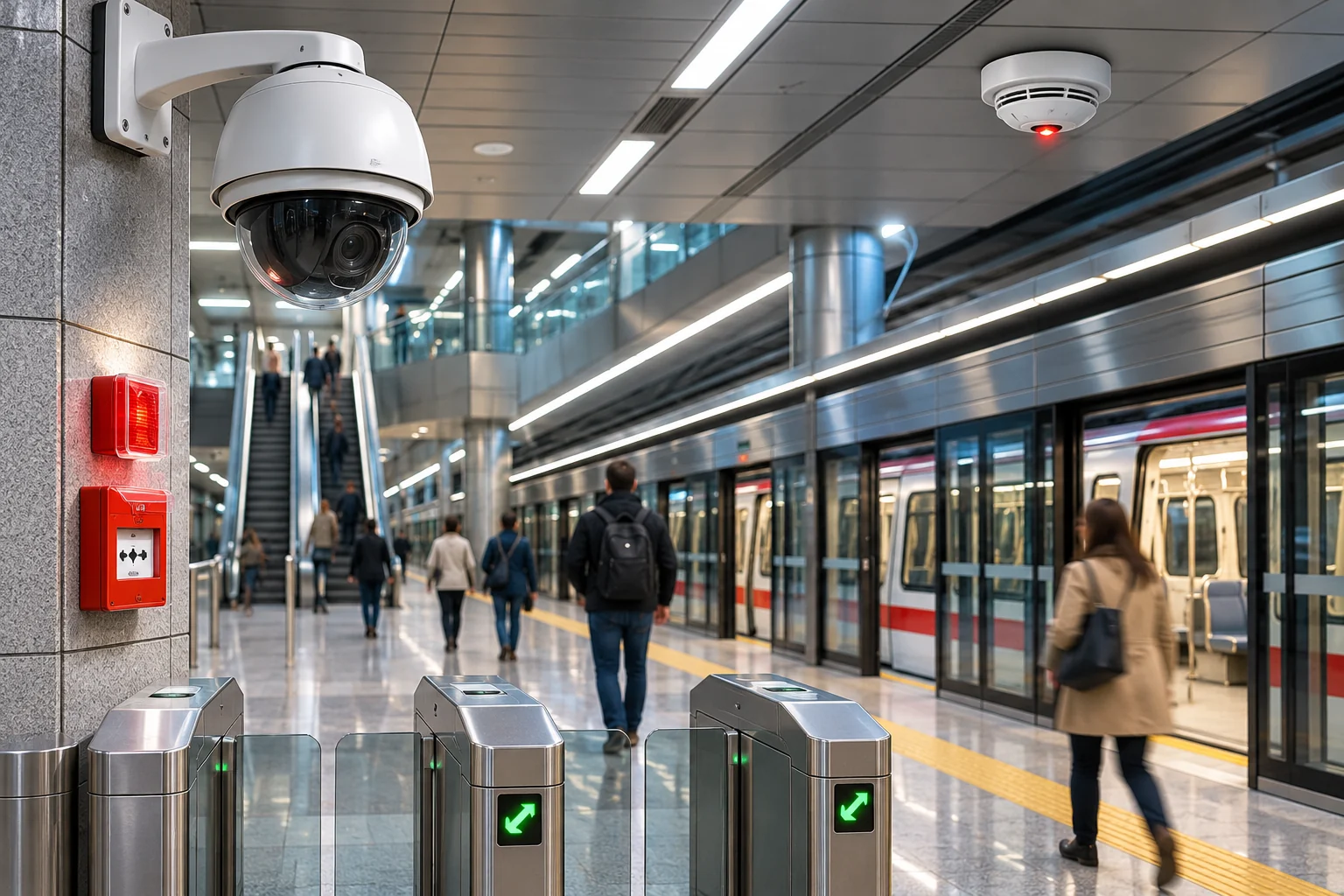
Security in metro stations encompasses the physical, electronic and operational measures that protect life safety, public order, operational continuity and critical technical infrastructure in rail transit facilities used daily by large numbers of passengers. Security cameras, platform screen doors, fire detection systems, emergency communications, access-control technologies and centralized security management software are among its core components.
Metro stations have security requirements that differ from those of conventional commercial buildings. Train movements, risks between platforms and tracks, high passenger density, deep underground structures, escalators, tunnels and continuously operating electromechanical infrastructure directly affect security design.
Managing passenger movement, detecting unusual incidents early and maintaining conditions for emergency evacuation are especially important during peak hours.
However, metro station security is not simply a matter of increasing the number of cameras or continuously monitoring every area. The primary objective is to prevent physical hazards, assess security incidents accurately and ensure that systems operate reliably.
This guide covers metro security cameras, AI-enabled video analytics, platform security, fire detection and evacuation systems, turnstiles and access control, cybersecurity, and criteria for selecting professional systems.
What Is Security in Metro Stations?
Security in metro stations covers two core areas that complement one another.
Operational safety (Safety): Protecting passengers and employees from accidents, fire, falls, equipment failures and similar hazards.
Physical and organizational security (Security): Implementing measures against unauthorized access, attacks, theft, vandalism and similar security threats.
Although these two areas have different responsibilities, they need to work together in practice.
For example, an object falling onto the tracks is a matter of operational safety, while unauthorized entry into a technical area may be a physical security issue.
Both incidents can be captured by the camera system. However, the required response and the personnel authorized to act may differ.
Key Security Risks in Metro Stations
Risk | Area affected | Priority security approach |
|---|---|---|
Passenger falling onto the tracks | Platform | Platform screen doors, appropriate detection, emergency response |
Excessive passenger density | Turnstiles, platforms and stairways | Passenger-flow management |
Fire and smoke | Stations and tunnels | Fire detection, smoke control, evacuation |
Unauthorized entry | Technical rooms and service areas | Electronic access control |
Suspicious object or incident | Public areas | Security personnel, CCTV, incident procedures |
Escalator accident | Vertical circulation areas | Equipment safety, inspection and response |
Power or communications failure | Critical systems | Redundancy and fault monitoring |
Cybersecurity incident | Network and management infrastructure | Segmentation, access control and monitoring |
Not all these risks can be addressed through security cameras. Metro operators need to apply appropriate technical, operational and organizational measures together.
CCTV Camera Systems in Metro Stations
CCTV systems are one of the core video-surveillance components of metro stations’ electronic security infrastructure.
In suitable systems, IP security cameras can be used for live viewing, incident review and recording.
Metro Istanbul’s passenger-safety information states that camera systems at stations are monitored both from local points and through the central control infrastructure.
Its 2024 Sustainability Report describes a security-monitoring infrastructure comprising 235 stations and 10,662 cameras.
These figures relate to the 2024 reporting period and do not indicate that all cameras have identical technical specifications.
Camera Placement in Metro Stations
Camera placement should be determined according to risk assessments and surveillance objectives.
Station area | Surveillance purpose | Technical consideration |
|---|---|---|
Entrances and exits | General security and incident surveillance | Backlighting, facial detail |
Turnstile areas | Passage and crowd incidents | Obstructed views, crowds |
Ticket sales areas | Reviewing security incidents | Privacy and viewing angle |
Escalators | Assessing specific accidents | Moving area, suitable framing |
Elevator entrances | Access and incident surveillance | Lighting, privacy |
Platforms | Passenger movement and incident tracking | Long viewing distance, train obstruction |
Corridors | General passage security | Blind spots |
Technical-room entrances | Assessing unauthorized entry | Access-control integration |
Station surroundings | Defined external security risks | Lighting and environmental durability |
In extensive areas such as metro stations, a single camera should not be expected to meet every surveillance objective.
For example, a wide-angle camera providing an overall view of a long platform may not show specific incidents at its far end in sufficient detail.
Camera resolution, lens and mounting position should therefore be selected together.
DORI and PPM Analysis in Metro Camera Systems
In professional CCTV design, megapixel count alone is not enough.
The level of detail with which a target is represented in the image matters.
PPM (Pixels Per Meter) indicates how many pixels correspond to a horizontal one-metre span on a specified target plane.
PPM = Horizontal pixel count / Horizontal field of view on the target plane
For example, if a camera with 2,560 horizontal pixels captures a 16-metre-wide area at a given distance:
2,560 / 16 = 160 PPM
is the result.
This is the theoretical horizontal pixel density.
However, it alone does not guarantee that a person’s identity can be reliably established from the image or that an AI algorithm will detect the person correctly.
Factors affecting actual performance include:
Sensor and lens quality.
Distance between the target and camera.
Viewing angle.
Lighting.
Motion blur.
Video compression.
The camera’s dynamic-range performance.
IEC 62676-4:2025 is the current international application standard for the planning, design, installation, testing, commissioning and maintenance of video-surveillance systems for security purposes.
Imaging tasks in new metro CCTV projects should be assessed in line with the standard’s current approach.
For technical details, consult GüvenlikOnline’s DORI Analysis in Camera Systems guide.
AI-Enabled Video Analytics in Metro Stations
AI-enabled video analytics systems can be used to assess specific objects, movements and incidents in security-camera footage.
Potential applications in metro stations include:
Assessing passenger density in designated areas.
Detecting entry into a designated restricted area.
Detecting incidents on designated platforms or in corridors.
Alerting operators to objects that may have been left unattended.
Detecting people in enclosed technical areas.
Analyzing specific movement patterns within the station.
These applications are available.
However, it should not be assumed that every AI camera supports every function.
Fall Detection on Platforms
Suitable video analytics systems or dedicated sensors can be considered for generating alerts about specific incidents, such as a fall onto the tracks.
However, a camera’s ability to detect a fall is not, by itself, sufficient for safety.
Where necessary, actions affecting train movement should be carried out through authorized systems compatible with the rail system’s safety-assessed control infrastructure.
A standard AI camera alert does not replace a certified train-protection or emergency-stop system.
Suspicious-Object Detection
Video analytics systems can be configured to detect objects that remain stationary for extended periods in designated areas.
However, a bag on the floor does not, by itself, mean there is a security threat.
In these systems:
Detecting the object.
Tracking it for a specified period.
Generating the relevant incident.
Assessment by an operator.
are distinct stages.
The final security assessment of a suspicious object should be carried out by authorized personnel in accordance with applicable procedures.
Crowd and Passenger-Density Analysis in Metro Stations
Passenger density is an important parameter affecting operational safety in metro stations.
High passenger flows can occur at turnstiles, on escalators, in interchange corridors and on platforms, especially during the morning and evening peaks.
AI-enabled image analysis, people counting and suitable density-measurement technologies can help assess passenger movement at specific locations.
People Counting and Area Occupancy Analysis
People-counting systems can measure the movement of people passing through a designated entrance or passage point.
Area occupancy analysis can produce an estimate of the number of people present in an area at the same time.
These two metrics are not the same.
For example, 800 people entering a particular platform within 10 minutes does not mean 800 people are on the platform at the same time. During that period, passengers may have boarded trains or left the area.
Crowd-Density Calculation Example
Suppose a platform has 400 m² of usable waiting space and 600 people are present at a given moment.
Passenger density = Number of people / Usable area
600 / 400 = 1.5 people/m²
This value represents the platform’s average density at that moment.
However, density may be higher in one part of the platform and lower in another.
Therefore, the average people-per-square-metre calculation alone is not sufficient to determine whether safe capacity has been exceeded.
Human movement, exit capacity, train frequency, platform geometry and the operator’s safety criteria should all be assessed together.
Turnstile Throughput
Actual passenger flow through turnstiles depends on the equipment’s characteristics, passenger behaviour, payment processes and accessible-passage requirements.
Published in 2025, Crowd Management at Turnstiles in Metro Stations the study shows that the number and placement of turnstiles are important variables in passenger movement and crowd management.
However, increasing turnstile capacity does not remove the need to assess escape routes and emergency-evacuation requirements.
How Is Safety Ensured on Metro Platforms?
Metro platforms are the station areas where passengers are closest to moving trains.
Platform safety therefore requires the combined assessment of physical separation, guidance, detection and emergency-response functions.
Platform Screen Door Systems (PAKS)
Platform Screen Door Systems are called Platform Screen Doors (PSD) in English.
These systems provide physical separation between the platform and track area on certain metro lines.
Where suitable, they can reduce passenger access to track areas when no train is present and enable synchronized door management with train doors.
Key objectives include:
Reducing the risk of unintended entry onto the tracks.
Providing physical separation between the platform and train.
Contributing to airflow and energy management on some lines.
Regulating passenger boarding and alighting in designated areas.
However, PAKS systems are not installed in the same design at every metro station.
Different full-height or half-height platform-door systems may be used.
Are PAKS Mandatory at Every Metro Station?
It would be inaccurate to make a general claim that the same platform-door architecture is mandatory on every metro line under all conditions.
The need for these systems should be determined according to line design, train operations, safety assessments and applicable project standards.
At stations without PAKS, platform safety lines, tactile surfaces, warning signs, operating procedures and other suitable safety measures are important.
Emergency Stop Systems
Some metro systems have platform or centralized emergency-stop functions.
Academic studies examining security practices at Istanbul metro stations have addressed PESB/CESB (Platform Emergency Stop Button / Central Emergency Stop Button) functions.
The function of this equipment and how it is used depend on the line concerned and the operator’s procedures.
Emergency-stop functions should not be linked in an uncontrolled manner to AI cameras or general-purpose security software.
Fire Detection and Smoke Control in Metro Stations
Fire safety is particularly critical in metro stations, especially underground structures.
Because of large passenger volumes, underground corridors, tunnels, technical rooms and complex ventilation conditions, fire scenarios should be assessed comprehensively.
Metro fire-safety infrastructure may include:
Automatic fire detection.
Manual fire-alarm call points.
Suitable automatic fire-suppression systems.
Emergency public-address announcements and voice evacuation.
Smoke control and ventilation.
Emergency lighting and signage.
Fire-safety control and monitoring infrastructure.
Emergency evacuation routes.
Smoke Control Systems
Smoke-control systems are used to manage smoke movement and evacuation conditions during fire scenarios.
Ventilation and smoke control in metro stations may have requirements different from those of ordinary comfort ventilation.
These systems should be assessed as part of the relevant fire scenarios and engineering design.
What Is NFPA 130?
NFPA 130 is an international reference standard covering fire protection and life-safety requirements for fixed-guideway transit and passenger rail systems.
According to NFPA’s official listing, the current edition is NFPA 130:2026.»« is the current edition.
The standard addresses fire and life-safety issues in underground, at-grade and elevated rail transit systems.
However, it should not be assumed that NFPA 130 is directly and solely mandatory for every metro project in Türkiye.
Fire Regulations in Türkiye
In Türkiye, the Regulation on the Protection of Buildings from Fire is an important national regulation.
For special structures such as metro systems and tunnels, the regulation includes provisions for applying relevant Turkish standards and, where these are unavailable, European standards and international standards under certain conditions.
Technical requirements for metro fire-safety projects should therefore be verified against current regulations and project-specific standards.
Important: Camera-based flame or smoke analytics do not automatically replace the required certified fire-detection infrastructure.
For more information, consult the Fire Alarm Systems article.
Emergency Evacuation Systems in Metro Stations
Emergency evacuation is one of the most important operational processes in metro safety.
In the event of fire, smoke, power loss or another emergency, passengers must be guided along safe routes.
Evacuation systems should consider:
Visual guidance.
Public-address announcements.
Emergency lighting.
Appropriate door control.
Safe escape routes.
Accessible evacuation arrangements.
Coordination of assigned personnel.
All of these should be considered together.
How Should Turnstiles Behave in an Emergency?
The behaviour of metro turnstiles in emergency scenarios should be determined in accordance with the safety requirements and project design of the relevant system.
How turnstiles or access gates behave during a power outage or emergency should not be left solely to the manufacturer’s default settings.
Fire-safety and access-safety requirements should take priority, especially at passage points that could affect passenger evacuation.
Access Control and Unauthorized-Entry Security in Metro Stations
Public passenger areas in metro stations should be separated from technical and operational areas.
For example, some stations may require authorized access to:
Electrical rooms.
Communications rooms.
Areas containing signalling equipment.
Technical maintenance areas.
Staff areas.
Administrative and security-management areas.
Authorized access may be required for these areas.
Metro Istanbul’s passenger-safety information states that magnetic-card access control is used in certain areas closed to the public.
Electronic Access Control
Suitable systems can manage access permissions for designated areas and record incidents.
Components that may be used include:
Card and identity-verification readers.
Door controllers.
Electric locks.
Door-position sensors.
Authorization software.
Incident and alarm management.
However, door-control systems must not obstruct emergency exits or fire-safety requirements.
In metro projects, the integration of access control with other systems should be assessed within the relevant safety-engineering framework.
For information about the relevant technology, consult the What Are Access Control Systems? guide.
Centralized Monitoring and VMS in Metro Security
In large metro networks, managing security systems separately at each station may be operationally inadequate.
Suitable centralized video management systems (VMS), alarm management and security operations centres can therefore be used.
Central Security Monitoring Platform
A suitable central platform can display together:
Live camera feeds.
Recording search and playback.
Station-specific alarm incidents.
Access-control alerts.
Device connection and fault status.
Operator permissions.
Maps and station plans.
Incident-management records.
These can be viewed together.
However, it should not be assumed that video-management software can manage the entire rail-system infrastructure on its own.
In particular, signalling, train movement and safety-critical control systems have engineering and verification requirements different from those of general-purpose security VMS software.
Integration in Metro Security Systems
In suitable, authorized architectures, the following can exchange designated data:
VMS.
Alarm management.
Access-control systems.
Passenger information.
Station management.
Building automation.
Maintenance and fault monitoring.
Defined data exchanges can be established between these systems.
However, the ability to transfer data between systems does not mean that each system should directly control the others.
Security-related functions, particularly those affecting operational safety, should be managed through clearly defined interfaces and engineering verification.
NVR and Storage Capacity in Metro Camera Systems
As the number of cameras increases in metro CCTV projects, so do recording bandwidth and storage requirements.
Key factors determining storage capacity include:
Number of cameras.
Average video bit rate.
Video resolution.
FPS.
Continuous or event-based recording.
H.264/H.265 encoding characteristics.
Recording retention period.
Storage-system redundancy method.
Example: A Metro Station with 120 Cameras
Suppose a station has 120 cameras, each generating an average of 3 Mbps, and records continuously for 30 days.
Parameter | Value |
|---|---|
Number of cameras | 120 |
Average bit rate per camera | 3 Mbps |
Total average video traffic | 360 Mbps |
Theoretical daily data | 3.888 TB |
Theoretical video data for 30 days | 116.64 TB |
Calculation:
120 × 3 × 10,8 × 30 = 116640 GB
Approximately 116.64 TB of theoretical recording capacity is required.
This value is only the calculated quantity of video data.
In an actual system, disk redundancy, the file system, recording metadata, performance headroom and failure scenarios should also be assessed.
The 30-day period is also only a technical assumption for this example. It does not mean that a single, general CCTV retention period applies to all metro stations in Türkiye.
Continuous Operation of Metro Security Systems
Continuity of security infrastructure is important in metro stations.
Nevertheless, 100% uninterrupted operation by using only a backup power supply or two network connections.
System reliability depends on multiple components:
Power distribution.
UPS and suitable backup power.
Network switches.
Recording servers.
Storage systems.
Management software.
Communication links.
Device monitoring and fault management.
Maintenance and spare parts.
Fault Monitoring
Professional security infrastructure should monitor not only loss of camera images, but also recording failures and storage capacity reaching critical levels.
For example:
Camera offline.
Video stream interrupted.
Recording stopped.
Disk failure.
Network connection failure.
Device clock is out of sync.
Storage capacity has reached a critical level.
Events such as these can be linked to central maintenance processes.
However, a device appearing online in the VMS does not guarantee that the camera is actually producing good-quality images or that past recordings are complete.
Periodic image-quality and recording-verification tests are therefore necessary.
Rail Standards for Metro Security
The standards used in metro systems vary according to infrastructure type, technical functions and the project’s contractual requirements.
EN 50126 — RAMS
The EN 50126 standard concerns, in rail systems:
Reliability.
Availability.
Maintainability.
Safety.
the concepts covered by the RAMS approach.
EN 50126-1:2017 and the related A1:2024 amendment provide a technical framework for RAMS management throughout the life cycle of rail systems.
This standard is not, by itself, a certification standard for all security cameras.
IEC 62676-4:2025 — CCTV
It is one of the key application references for planning, installing, testing and maintaining video-surveillance systems.
NFPA 130:2026 — Fire and Life Safety
It addresses fire protection and life-safety issues for fixed-guideway rail transit systems.
IEC 62443 — Industrial Cybersecurity
It concerns cybersecurity requirements for industrial automation and control systems.
However, it should not be assumed that all these standards apply with the same scope or are directly mandatory in every metro project.
The final technical specification should take account of applicable regulations in Türkiye and the project’s valid list of standards.
Cybersecurity in Metro Stations
In modern metro systems, the network connectivity of cameras, access control, communications and operational technologies increases the need for cybersecurity.
In particular, the Information Technology / Operational Technology(IT and OT) infrastructures should be separated.
Key Cybersecurity Measures
Network segmentation.
Separate management and user permissions.
Secure authentication.
Disabling unnecessary services.
Protecting recording and management servers.
Firmware and software update management.
Centralized security-event logs.
Backup and recovery plans.
Authorized remote-maintenance connections.
Restricting supplier access.
In systems that could affect rail operational safety, cybersecurity changes should be made in coordination with the relevant technical and safety processes.
Having a CCTV network for security purposes does not require unrestricted access to the train-signalling infrastructure.
Accessibility and Passenger Safety in Metro Stations
Access for passengers with disabilities and users with different mobility needs is also important to security in metro stations.
Metro Istanbul’s accessibility information includes:
Elevators.
Suitable ramps.
Tactile surfaces.
Guidance paths.
Audio and visual information.
Braille signage.
These and similar measures.
These solutions matter not only for convenience, but also for safe travel and wayfinding.
Warning surfaces near platforms, emergency announcements and accessible escape arrangements must work effectively.
Accessibility requirements should be assessed not only when a station first opens, but also during maintenance and operations.
KVKK and Camera Recordings in Metro Stations
Camera footage from metro stations may contain data relating to identified or identifiable individuals.
In such cases, Personal Data Protection Law No. 6698 and the relevant data-protection obligations should be considered.
The applicable legal basis for a camera system is determined by the nature of the data controller and the actual processing activity.
Key Principles for Camera Use
The purpose of processing should be clear.
Camera fields of view should be limited to what is necessary.
Applicable information obligations should be fulfilled.
Access to recordings should be restricted by authorization.
Retention periods should be defined.
Unnecessary copying of recordings should be prevented.
Exported recordings should be managed securely.
Audio recording and biometric recognition should be assessed separately.
The Personal Data Protection Authority’s 2026 notice on workplace camera systems emphasizes purpose limitation, proportionality and the intrusive nature of audio recording, especially when employees are monitored.
For metro stations, the relevant categories of individuals, public areas and workplaces used by operational staff may also need to be assessed under different conditions.
For example, measuring general passenger density using anonymized statistics is not the same data-processing activity as identifying specific people from images.
How Are Security Systems Designed for Metro Stations?
A professional metro security project should involve more than selecting products and devices.
1. Risk Analysis
The station’s architecture, platform layout, passenger numbers, interchange points and critical technical areas are assessed.
2. Defining Security Functions
The distinct functions of CCTV, access control, fire detection, platform safety and passenger-density analysis are defined.
3. Camera Placement and Imaging Objectives
Camera positions, lenses, target distances and image detail are calculated.
4. Critical-System Interfaces
Interfaces between security software and systems affecting operational safety are addressed through authorized engineering processes.
5. Network and Recording Design
Video bandwidth, storage capacity, network redundancy and authorization requirements are determined.
6. Cybersecurity
IT/OT separation, network segmentation, user access and maintenance connections are assessed.
7. FAT and SAT Testing
Factory Acceptance Test (Factory Acceptance Test) and Site Acceptance Test (Site Acceptance Test) verify the relevant system functions.
8. Commissioning and Integration
Alarm events, camera images, management systems and relevant communications interfaces are tested.
9. Training and Operations
Suitable operating and response procedures are established for security personnel and maintenance teams.
10. Periodic Maintenance
Ongoing inspections and maintenance are planned for cameras, recording devices, software and other components.
Technical Checklist for Security Systems in Metro Stations
- Has the station’s risk analysis been completed?
- Have Safety and Security functions been separated?
- Have platform and track risks been assessed?
- Has a camera placement plan been created?
- Have camera lenses and image detail been calculated?
- Have camera images been tested in daytime and nighttime conditions?
- Have obstructions to visibility at turnstiles and in crowded areas been assessed?
- Has field validation been carried out for AI analytics?
- Have false-alarm and missed-incident performance been measured?
- Has the independence of PAKS and related safety systems been preserved?
- Have fire and emergency interfaces been verified?
- Have public-address and guidance systems been tested?
- Has access control for technical areas been configured?
- Has video-recording capacity been calculated?
- Have camera and recording network capacities been checked?
- Has backup power been planned for critical equipment?
- Have camera and recording-device fault notifications been tested?
- Have IT/OT cybersecurity requirements been assessed?
- Have user permissions and access to recordings been restricted?
- Have KVKK and data-retention requirements been assessed?
- Have accessibility and emergency-evacuation requirements been checked?
- Have FAT/SAT and system-acceptance records been completed?
- Has a periodic maintenance and field-validation plan been created?
Frequently Asked Questions About Security in Metro Stations
How is security ensured in metro stations?
It is ensured by applying CCTV cameras, security personnel, access-control systems, platform safety, fire detection, emergency communications and suitable operating procedures together.
Are security cameras installed in metro stations?
Yes. Metro Istanbul’s official statements indicate that stations have security cameras monitored centrally and locally.
Is artificial intelligence used in metro stations?
In suitable projects, AI-enabled systems can be used to assess specific video incidents, passenger density or entry into unauthorized areas. However, it should not be assumed that all metro lines have the same analytical capabilities.
Can falls be detected on metro platforms?
Specific falls can be detected using dedicated sensors or suitable video analytics systems. However, these functions should be assessed in accordance with the rail system’s safety-critical infrastructure.
What is a Platform Screen Door System?
PAKS is a system that provides physical separation between the platform and track area on suitable metro lines.
How is fire safety ensured in metro stations?
Fire detection, suitable suppression and smoke-control systems, emergency announcements, lighting, evacuation routes and staff procedures should be designed together.
Who should be notified about a suspicious situation in the metro?
According to Metro Istanbul’s passenger rules, emergencies can be reported to station staff or through the intercoms provided. Emergency equipment should be used in accordance with the operator’s instructions.
How many days are metro camera recordings retained?
There is no single general period that can be said to apply to every metro station. Retention periods should be determined according to applicable regulations, the purpose of processing and the data controller’s obligations.
Do metro cameras record audio?
Some camera and recording systems may technically support audio. However, recording ambient sound requires a separate legal assessment from video recording.
Why is people counting important in metro stations?
People counting and density analysis can help assess passenger movement at specific passage points and support operational planning. However, neither alone determines safe capacity.
Which standards are most important for metro security systems?
Depending on the project scope, standards such as IEC 62676-4, EN 50126, NFPA 130 and IEC 62443 may be important technical references. Applicable mandatory standards should be verified for each project.
Conclusion: Security in Metro Stations Requires a Multilayered System
Security in metro stations is a specialized field that requires managing extensive passenger movements and critical rail infrastructure together.
While IP security cameras and AI-enabled video analytics help detect and investigate specific incidents, platform screen doors, fire-safety systems and emergency-evacuation arrangements perform different safety functions.
Centralized security management, authorized personnel, cybersecurity and periodic maintenance help systems operate sustainably.
However, successful technological integration depends on more than devices communicating with one another. The independence of safety-critical functions, system reliability and real-world field performance must also be verified.
Successful metro station security is an integrated system that assesses risks in advance, supports safe passenger movement, enables timely incident response and has technical infrastructure that is tested regularly.
Metro security projects should therefore prioritize defined functions, technical engineering, system integration, validation and long-term maintenance planning over device count.