
What is an AI-Powered Fire Detection System?
AI-powered fire detection systems aim to evaluate fire indicators earlier and more meaningfully through video analysis, multi-criteria sensor data, and advanced software algorithms. In this article, we examine the operating principles, application areas, advantages, and technical limitations of these systems.
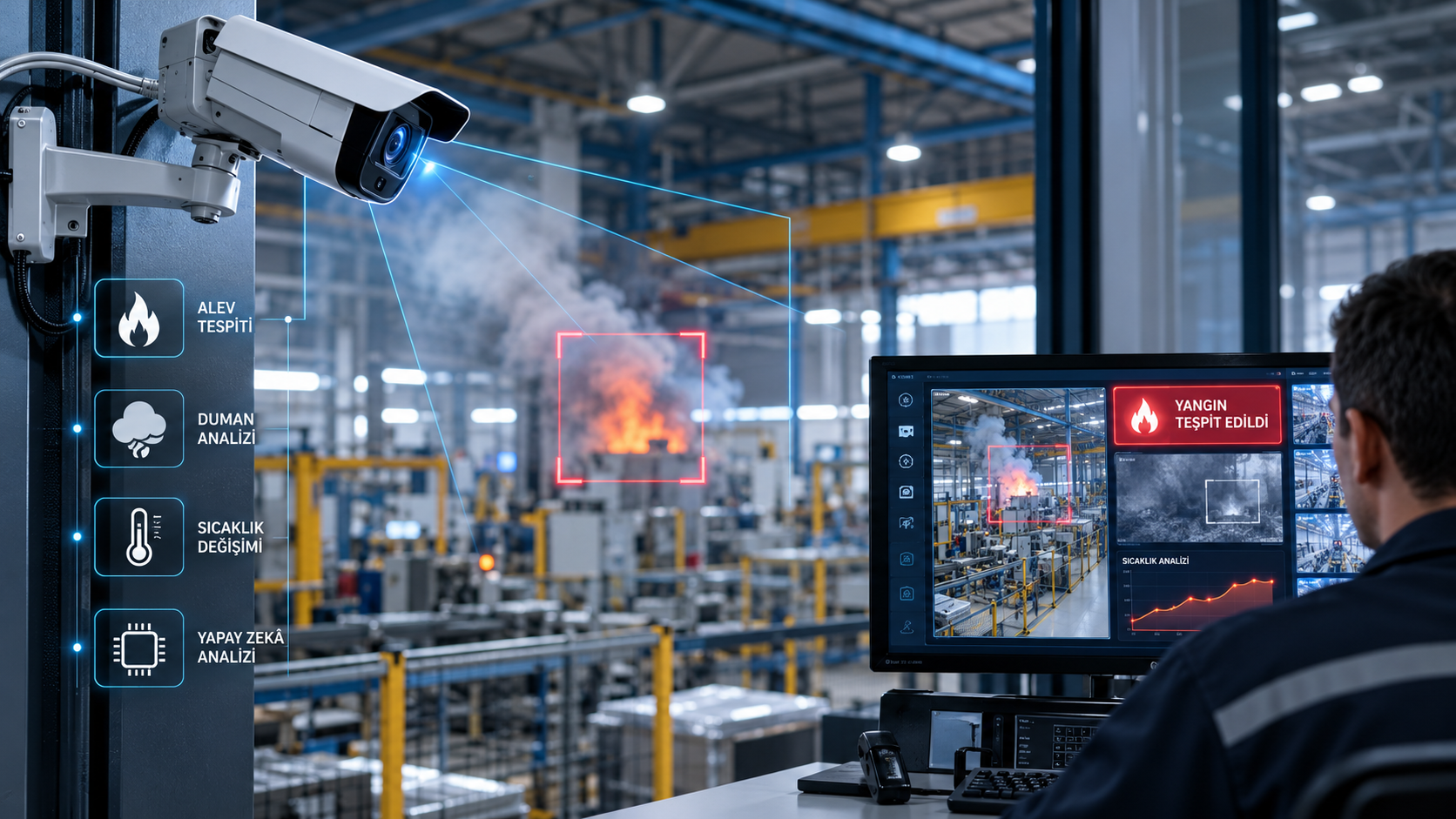
In industrial facilities, fire detection technologies are no longer limited to traditional systems that detect only smoke, heat, or flame individually. Thanks to advanced software, image analysis, and multi-sensor evaluation, some systems aim to detect fire indicators earlier, better distinguish sources of false alarms, and provide more information to maintenance teams.
One of the most prominent examples of this approach is AI-powered fire detection systems.
However, the actual capabilities of an AI-powered system depend on the technology used and the application conditions. Just as not every advanced detector uses AI, not every device that uses AI can automatically be considered a standard-compliant fire detector.
What is an AI-Powered Fire Detection System?
An AI-powered fire detection system is a security technology that attempts to detect and interpret fire-related indicators using image analysis, machine learning, or similar data evaluation methods.
The algorithms used in these systems, with appropriate sensor and software infrastructure, can evaluate the following indicators:
Movement and spread characteristics of smoke in the image.
Visual behavior and time-dependent changes of flame.
Abnormal temperature changes occurring in specific areas.
Data from multiple detection sources.
Events deviating from normal operating conditions.
However, not all of these features are present in every system.
The primary contribution of artificial intelligence is its attempt to identify fire-related patterns within the acquired data and distinguish misleading environmental effects.
How reliably this can be achieved depends on the characteristics of the model used, the sensors, the training data, and the application environment.
How Do AI-Powered Fire Detection Systems Work?
The operating principle of AI-powered systems varies according to the hardware and software architecture used.
Some solutions process camera images directly, while others enable the combined evaluation of data obtained from different sensors.
1. Video-Based Fire Detection
Video-based fire detection systems attempt to detect smoke or flame indicators by analyzing camera images.
Image analysis algorithms can evaluate smoke movement, time-dependent visual changes, flame flicker characteristics, and specific image patterns.
This technology can be used particularly in large-volume industrial areas and applications with a clear line of sight.
For example, visible smoke in a high-ceiling production hall can be detected by a camera under suitable viewing conditions.
One of the significant advantages of this approach is that it allows for the evaluation of visual indicators in some fire scenarios without waiting for smoke to reach a ceiling-mounted detector.
However, detection success is affected by camera position, resolution, lighting, viewing angle, and environmental conditions.
2. Multi-Criteria Detectors and Sensor Analysis
Multi-criteria fire detectors can combine more than one detection principle within the same device.
For example, a detector using smoke and heat sensors together can help determine a fire condition by evaluating different physical indicators.
This approach can offer advantages, especially in reducing some sources of false alarms.
However, multi-criteria detection and artificial intelligence are not the same concept. A detector may use advanced signal processing technology but may not include machine learning algorithms.
The performance requirements for point multi-criteria detectors combining smoke and heat sensors are covered under the EN 54-29 standard.
3. Integration of Image Analysis with Fire Alarm Systems
Video-based fire detection systems can be integrated into existing fire safety infrastructure with appropriate design and components.
This integration allows for the sharing of alarm and status information between systems.
For example, a fire indicator analyzed by a camera can be transmitted to a central monitoring system via supported interfaces.
However, the reliability of such integrations does not depend solely on software connectivity.
Alarm transmission, fault conditions, communication interruptions, and necessary control functions must also be evaluated within the scope of the project.
ISO/TS 7240-30:2022 addresses the technical requirements for the design, installation, commissioning, and servicing of video fire detection systems.
Advantages of AI-Powered Fire Detection Systems
Early Detection of Fire Indicators
Some systems using video analysis can evaluate visual indicators of fire at an early stage under suitable viewing conditions.
This feature can be advantageous, especially in large areas with high ceilings, where it may take time for smoke to reach the detector level.
However, early detection performance is not the same for every type of fire and every environment.
Contribution to Reducing False Alarms
In traditional fire detection systems, dust, steam, light changes, and production activities can sometimes cause unnecessary alarms.
AI-powered analysis algorithms, when properly designed, can help distinguish between some misleading environmental effects and actual fire indicators.
However, it is not possible to completely eliminate false alarms.
Filtering, threshold, and verification mechanisms used to reduce false alarms should be evaluated in a way that does not delay the detection of actual fires.
Visual Evaluation of Events
Video-based detection systems can provide visual information regarding the area where the alarm occurred.
This feature can help authorized personnel assess the nature of the event and initiate the appropriate response process.
Understanding which area an event is developing in is operationally important, especially in large industrial facilities.
Central Monitoring and Event Management
Solutions with appropriate software and system architecture can enable the tracking of alarm events through a central platform.
Depending on the system's features, alarm logs, device statuses, communication errors, and maintenance notifications can be monitored.
This data can contribute to planning maintenance processes and analyzing recurring issues.
Limitations of AI-Powered Fire Detection Systems
It should not be assumed that a system using artificial intelligence will operate with high accuracy in every environment.
Especially in image-based detection, the following conditions can affect performance:
Insufficient or variable lighting.
Steam, dust, and production-related aerosols.
Objects obstructing the camera's field of view.
Camera vibrations and image quality degradations.
Lens contamination.
Events not sufficiently represented in the algorithm's training data.
Failures in image transmission or processing infrastructure.
For example, in a production line generating steam, image analysis might interpret steam as a smoke-like event.
Similarly, light and flame-like images generated in a welding industrial environment can pose an unwanted alarm risk in some detection methods.
Therefore, systems should be evaluated not only based on laboratory performance but also on their behavior in the actual application environment.
In Which Areas Are AI-Powered Fire Detection Systems Used?
These systems can be particularly evaluated in the following applications:
Factories and Production Facilities
Early detection and event tracking are important due to large production areas, high-ceiling structures, and continuously operating machinery.
AI-powered image analysis can contribute to monitoring production areas under suitable conditions.
Warehouses and Logistics Centers
In large-volume storage areas, high shelving, wide openings, and variable air movements can affect the design of detection systems.
Video-based fire detection can be evaluated in such areas. However, it is important that the field of view is not obstructed and that fire indicators are visible.
Energy and Electrical Facilities
Different detection technologies can be used together for monitoring electrical equipment and critical infrastructure.
Thermal cameras, in particular, can enable the monitoring of unusual surface temperatures in some equipment.
However, thermal temperature monitoring and standard-compliant fire detection functions should be evaluated separately.
Industrial Process Areas
Special detection technologies may be preferred in some process areas where flammable materials are used or where there are risks of rapidly developing fires.
In these areas, AI-powered image analysis can constitute a supplementary solution, depending on risk assessment and product suitability.
For information on the holistic planning of fire safety in industrial facilities, the article titled The Most Effective Way to Improve Fire Safety in Industrial Facilities can be reviewed.
Can AI-Powered Fire Detection Systems Replace Traditional Detectors?
The answer to this question depends on the technical specifications of the product used, the application area, and relevant regulations.
There are international standards for video-based fire detection systems.
For example, ISO 7240-29:2024 defines performance and test requirements for video fire detectors operating in the visible spectrum.
ISO/TS 7240-30:2022 addresses applications where video fire detection systems can be used as standalone systems or in conjunction with other fire detection systems.
However, a system being associated with one of these standards does not mean it can be used in all cases to replace the mandatory fire detection infrastructure in Turkey.
In applications in Turkey, the Regulation on Fire Protection of Buildings and relevant TS EN 54 requirements must be taken as a basis.
It should not be assumed that AI-powered image analysis can directly replace an existing fire alarm system.
The product's conformity documents, intended use, design conditions, and relevant regulatory requirements must also be verified.
What to Consider When Choosing an AI-Powered Fire Detection System?
The following technical questions should be answered during the procurement or project design phase:
What fire indicators does the system detect: smoke, flame, heat, or a combination thereof?
Under what test conditions was the performance declared by the manufacturer achieved?
Which standards or test reports support the product's conformity?
Are there dust, steam, vibrations, or variable lighting in the environment?
Has the system's compatibility with the existing fire alarm panel been verified?
How does the system behave in case of communication interruption or device failure?
How will false alarm and delayed alarm risks be evaluated on-site?
How will software updates, maintenance, and technical support processes be managed?
These questions help prevent product selection from being based solely on the AI feature or manufacturer's promotion.
Those wishing to explore different detection technologies can access product groups from GüvenlikOnline's Fire Detectors and Fire Alarm Systems categories.
Frequently Asked Questions
How does an AI-powered fire detection system work?
AI-powered systems analyze camera images or other detection data to identify fire-related indicators. The algorithms used can leverage methods such as image classification, pattern recognition, or the combined evaluation of different data, depending on the system's architecture.
Can every security camera detect fire with AI?
No. For camera images to be used for fire detection, appropriate analysis software, sufficient image quality, and verified system performance are required. Adding software to a standard camera does not automatically mean that a regulation-compliant fire detector has been obtained.
Can AI detect fire before it starts?
Some monitoring technologies can help detect risk indicators such as unusual temperature changes that may occur before a fire. However, it cannot be claimed that every fire can be detected beforehand or definitively prevented.
Do AI-powered fire detection systems give false alarms?
Yes. False alarms can occur due to environmental conditions, image quality, and algorithm limitations. Advanced analysis methods can reduce this risk in some applications but cannot eliminate it entirely.
Conclusion: What Value Does AI Offer in Fire Safety?
AI-powered fire detection systems bring new possibilities to industrial fire safety through image analysis, advanced data evaluation, and central event management.
Under suitable operating conditions, they can provide benefits in terms of early detection of fire indicators, evaluation of events, and reduction of some false alarm sources.
However, the success of the system does not depend solely on the sophistication of the algorithm used.
Accurate risk analysis, appropriate detection technology, standard-compliant system design, reliable integration, and regular maintenance remain fundamental requirements.
Artificial intelligence is not a standalone solution that replaces fire safety; it is a technology that can enhance the capabilities of fire detection infrastructure when correctly implemented.