
Fire Detection System Periodic Maintenance Standards: TS EN 54 and Legal Inspection Guide
What are the periodic maintenance standards for fire detection systems? We examine Article 84 of the Regulation on the Protection of Buildings from Fire, the Regulation on Work Equipment, TS CEN/TS 54-14, EN 54 product standards and ZPKK04 periodic inspection criteria. A comprehensive guide to fire alarm panels, smoke and heat detectors, batteries, manual call points, sirens, fire scenarios, maintenance intervals, authorized inspections and technical reporting.
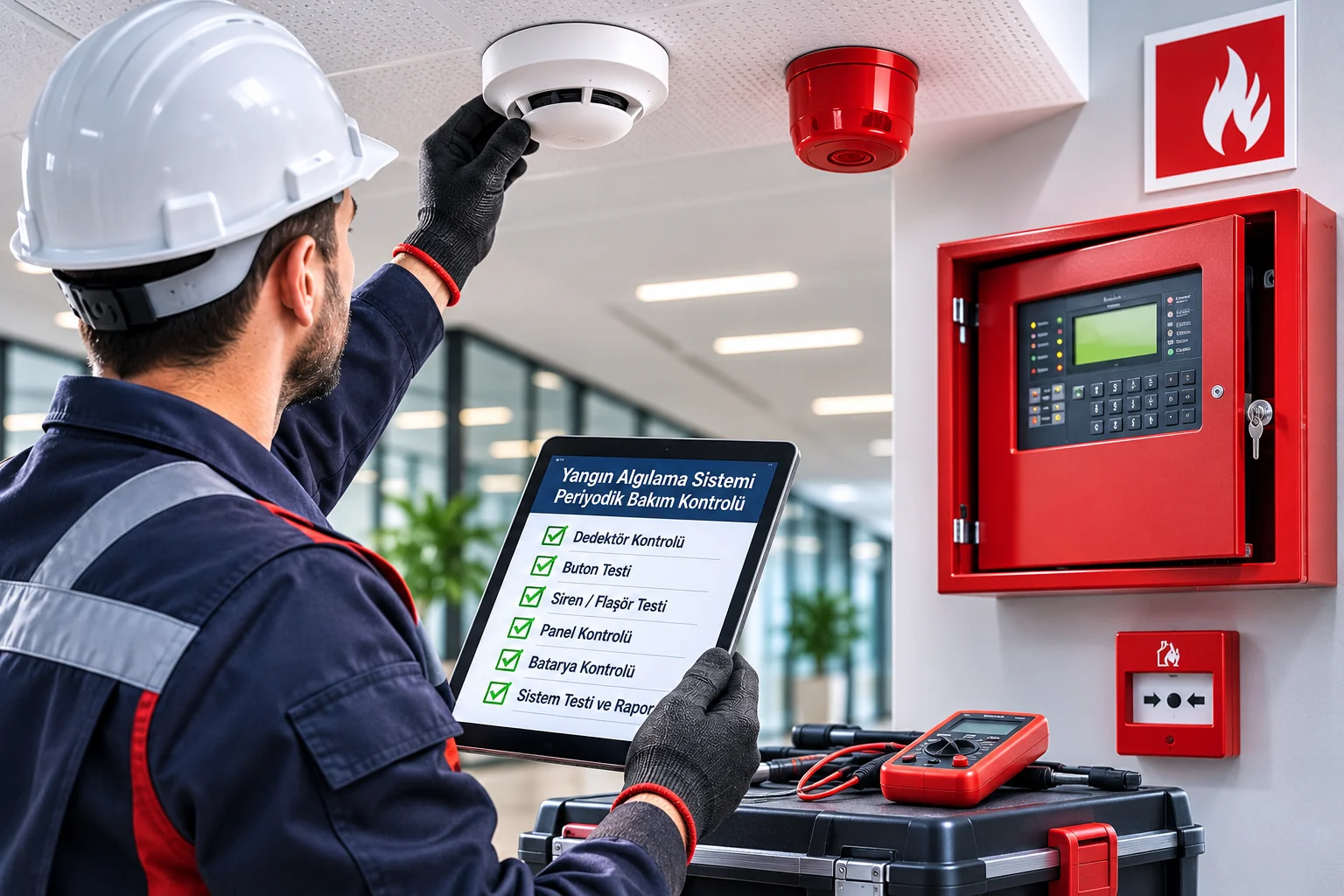
Periodic maintenance standards for fire detection systems cover the inspection, testing, maintenance and technical oversight requirements needed to preserve the reliability of fire detection and alarm systems used in buildings and industrial facilities. Fire alarm control panels, smoke and heat detectors, manual fire call points, sirens, visual alarm devices, power supplies and other equipment associated with the fire scenario are assessed during this process.
The fact that a fire detection system has been installed and commissioned does not mean it will operate with the same reliability throughout its service life. Detector contamination, electronic component failures, reduced battery capacity, cable connection problems or changes in how the building is used can affect detection performance.
For example, while the fire alarm panel shows normal operating status, a detector's smoke inlets may be blocked. Similarly, a fire alarm may appear correctly on the panel, while the sirens on a particular floor or the smoke control system fail to perform as expected under the prescribed scenario.
Therefore, the purpose of periodic maintenance is not merely to check that the devices are working; it is to verify that the fire detection system continues to perform the life-safety functions specified in its design.
The main regulations and references in this field in Türkiye include the Regulation on the Protection of Buildings from Fire, the Regulation on Health and Safety Conditions in the Use of Work Equipment, and the technical reference TS CEN/TS 54-14.
This guide examines maintenance standards for fire detection systems, statutory periodic inspection obligations, detector and panel tests, verification of fire scenarios, and technical reporting criteria.
What Is Periodic Maintenance of Fire Detection Systems?
Periodic maintenance consists of technical activities performed at planned intervals to maintain the specified operating conditions of a fire detection and alarm system.
These activities may include physical inspection, functional testing, cleaning as required, adjustment, component replacement, fault rectification and documentation of test results.
However, periodic maintenance, statutory periodic inspection and initial commissioning tests are not the same thing.
Activity | Primary purpose | Who carries it out? |
|---|---|---|
Routine user checks | Monitor panel status and faults | Trained facility staff |
Planned technical maintenance | Maintain system functions and reliability | Competent technical service provider |
Corrective maintenance | Rectify a detected fault | Competent technical service provider |
Statutory periodic inspection | Assess compliance with regulations, the project and applicable standards | Inspection personnel authorized under the regulations |
Commissioning and acceptance | Verify the design objectives of a new or modified system | Relevant authorized project teams |
Particularly in workplaces covered by regulations, a service form issued by a maintenance company should not automatically be deemed equivalent to an authorized periodic inspection report.
Is Periodic Maintenance of Fire Detection Systems Mandatory?
Yes. Turkish legislation includes provisions requiring relevant fire detection and alarm systems to undergo periodic inspection, testing and maintenance.
Article 84 of the Regulation on the Protection of Buildings from Fire
The Regulation's Article 84, which requires fire detection and alarm systems to be subject to the inspection, testing and maintenance requirements specified in the relevant standards.
Responsibility rests with the building owner, manager or building representative to whom responsibility has been formally delegated in writing, as specified in the regulation.
The Ministry of Environment, Urbanization and Climate Change's Fire Regulation Guide, updated in May 2026, emphasizes that systems must be kept operational and fit for their installation purpose throughout their period of use.
Therefore, simply having a fire detection system in a business is not enough. Its operability must be maintained and maintenance activities documented.
Regulation on Health and Safety Conditions in the Use of Work Equipment
Fire detection and alarm systems are also assessed under the periodic inspection provisions for work equipment applicable to relevant workplaces.
In Annex III of the Regulation, for fire detection and alarm systems, a periodic inspection interval of one year, unless a different period is specified in the relevant standards, is prescribed.
Under this regulation, inspections are to be carried out in accordance with project criteria and the TSE CEN/TS 54-14 standard.
There is, however, an important distinction:
A formal annual periodic inspection interval does not mean the system requires no other technical maintenance or user checks during the year.
Routine monitoring, planned maintenance and statutory periodic inspection are complementary activities.
Which Standards Are Used for Fire Detection Systems?
Technical requirements for devices and requirements for system design, installation and maintenance are addressed in different standards for fire detection systems.
Standard | Scope |
|---|---|
TS CEN/TS 54-14 | Guidance on planning, design, installation, commissioning, use and maintenance of fire detection and alarm systems |
EN 54-2 | Fire alarm control and indicating equipment |
EN 54-3 | Audible fire alarm devices |
EN 54-4 | Power supply equipment |
EN 54-5 | Point-type heat detectors |
EN 54-7 | Point-type smoke detectors |
EN 54-10 | Flame detectors |
EN 54-11 | Manual fire call points |
EN 54-12 | Optical beam smoke detectors |
EN 54-13 | Assessment of compatibility and connectability of system components |
EN 54-17 | Short-circuit isolators |
EN 54-18 | Input/output devices |
EN 54-20 | Aspirating smoke detectors |
EN 54-23 | Visual fire alarm devices |
EN 54-25 | System components using radio links |
This table shows the main areas of application of the standards; it does not include the current edition number or every amendment to each standard.
Is an EN 54 Certificate a Maintenance Record?
No.
Compliance of a detector with the relevant EN 54 product standard does not prove that it has been maintained or that it operates correctly where it is installed.
Product compliance, installation compliance and technical performance during operation must be assessed separately.
For example, a smoke detector covered by EN 54-7 may become contaminated over time. The product's initial compliance does not eliminate the need for regular maintenance.
What Is the TS CEN/TS 54-14 Standard?
TS CEN/TS 54-14 is a technical reference providing guidance on the planning, design, installation, commissioning, use and maintenance of fire detection and fire alarm systems.
The guide makes clear that fire detection systems consist of more than devices alone; they must be considered alongside project, operation, testing and maintenance processes.
Status of the 2018 and 2026 Editions
The periodic inspection criteria published in Türkiye include a reference to TS CEN/TS 54-14:2018 .»? nope
Meanwhile, the Portuguese Institute for Quality (IPQ) CEN/TS 54-14:2026 has published a current national standards record for the document.
This indicates that new editions of European standards are being developed and published.
However, publication of the 2026 edition by a national body in Europe does not mean that the 2018 edition has automatically been withdrawn in Türkiye or that TSE has revised it on the same date.
Legal periodic inspection reports and technical specifications prepared in Türkiye should be based on the applicable TSE standard, current Ministry criteria and the project requirements that apply.
Alternative International References
The British BS 5839-1:2025 standard addresses the design, installation, commissioning and maintenance of fire detection and alarm systems in non-residential buildings.
The American NFPA 72:2025 covers inspection, testing and maintenance requirements for fire alarm, signaling and emergency communications systems.
However, application intervals specified in these standards should not be assumed to be directly mandatory by law at every facility in Türkiye.
How Often Should a Fire Detection System Be Maintained?
When setting maintenance frequency, the statutory periodic inspection interval must be distinguished from daily operational checks and technical maintenance visits.
Sample Fire Detection System Maintenance Schedule
Interval | Sample inspection activity | Responsibility |
|---|---|---|
Daily | Check that the panel is operating normally and check for faults and disabled conditions | Trained building staff |
Weekly | Routine alarm and notification check as specified in the operating plan | Trained building staff |
Monthly | Review of event history, outstanding faults, batteries and system status | Operations and technical team |
Quarterly | Planned functional and integration checks | Competent maintenance personnel |
Every six months | Comprehensive on-site maintenance, device and scenario tests | Competent maintenance company |
Annually | Comprehensive periodic inspection in accordance with relevant regulations and standards | Authorized periodic inspection personnel |
This schedule has been prepared to organize technical maintenance services as a sample plan.»? nope
This does not mean every line is mandatory in the same way for every facility. In particular, the statutory periodic inspection interval must be determined according to the periods prescribed by the applicable regulations and standards.
Examples of areas that may require more frequent maintenance include factories with heavy dust, high-ceiling warehouses, facilities with high levels of steam and critical-use areas.
What Are the 2025 ZPKK04 Periodic Inspection Criteria?
One important current document for fire detection systems is the document entitled ZPKK04 — Periodic Inspection Criteria for Fire Detection and Alarm Systems .»? nope
Document details:
Field | Information |
|---|---|
Document code | ZPKK04 |
Publication date | 18 July 2025 |
Effective date | 1 September 2025 |
Scope | Fire detection, alarm and related emergency lighting/signage inspections |
Main references | Fire Regulation, TS CEN/TS 54-14 and related regulations |
The ZPKK04 criteria help systematically assess the project, panel, devices, addressing, alarms, power supply, fire scenario and inspection reporting.
Key Checks Under ZPKK04
Review the approved project for the facility.
Identify the persons responsible for fire safety.
Check the status of trained and authorized personnel.
Assess the fire panel and indicator functions.
Review the system log and maintenance records.
Compare detector and call-point addresses with the project.
Check that appropriate notifications are provided for detectors in concealed spaces.
Cable and loop fault-monitoring functions.
Alarm device and fire-scenario tests.
Assessment of integration with other connected fire safety systems.
Should All Detectors Be Tested?
In the notes to the ZPKK04 document, it is stated that fire detection, alarm and related equipment covered by periodic inspection must be inspected and tested without sampling as required.
This is particularly important at facilities with a large number of detectors.
For example, testing only 25 detectors at a facility with 500 detectors is not equivalent to carrying out all device inspections required under ZPKK04.
However, routine operating checks or specific scheduled maintenance visits must be distinguished from the periodic inspection required by regulations.
The scope required for a statutory periodic inspection should not be left solely to a maintenance contractor’s sampling-based service program.
Fire Alarm Control Panel Periodic Inspection Standards
The fire alarm control panel is the system’s central control and indicating equipment.
During maintenance and inspection, it is not enough for the panel merely to be powered on.
Functions That Must Be Checked
Check | Assessment criterion |
|---|---|
Normal operating status | Open fault and disabled-point information must be reviewed |
Panel indicators | Display, LEDs and required indicating functions must work |
Zones and addresses | Must match the project |
Alarm history | Event records must be accessible |
Fault monitoring | Supported line and device faults must be displayed |
Control functions | Authorized test and control functions must work |
Time and date | Must be correct for event records |
System configuration | Must comply with the approved project and operating scenario |
Particularly in addressable fire alarm systems, displaying the correct detector address with the wrong room name can adversely affect emergency response.
Therefore, the display of the correct location on the panel must be checked, as well as whether the device raises an alarm.
How Should Smoke Detectors Be Tested?
Periodic inspection of optical smoke detectors should be carried out using suitable methods that can assess the detector’s actual detection function.
The required procedures include:
Checking physical condition and contamination.
Assessing obstructions around the detector.
Functional testing with test equipment suitable for the manufacturer’s requirements.
Checking the correct address or zone information on the panel.
Checking sensitivity or contamination values when necessary.
Verifying normal operation after testing.
are included.
Random aerosol products, uncontrolled creation of a real fire, or methods contrary to the manufacturer’s instructions should not be used to test detectors.
If a Detector’s LED Is On, Is It Working?
The LED indicator may show certain status information about the device.
However, the LED being on does not by itself prove that the detector can detect smoke at the correct sensitivity.
A functional test must also be performed.
Maintenance Standards for Heat Detectors
Heat detectors may use different detection methods based on fixed temperature or the rate of temperature rise.
Therefore, tests must take the device’s actual operating principle into account.
For heat detectors:
Use a suitable temperature test device.
Check the detection response.
Verify the correct address or zone on the panel.
Confirm that the device returns to its normal state after testing.
Unsuitable thermal loads must not be applied.
Single-use sensing elements or those using different technology should not be tested in the same way as standard reusable detectors.
Beam Detectors and Aspirating Smoke Detection Systems
Different fire detection technologies may be used in high-ceiling warehouses, factories and specialized technical spaces.
Technology | Maintenance check | Key issue |
|---|---|---|
Beam smoke detector | Optical alignment, contamination and suitable functional test | Obstructions in the beam path |
ASD aspirating smoke detection system | Filter, airflow, pipework and detection test | Blockage and sample transport |
Flame detector | Optical surface, field of view, specialized test equipment | Testing suited to the detection technology |
Linear heat detection | Line integrity and suitable test procedure | Type of sensing element |
Multisensor detector | Verification of supported detection channels | Differences in function between sensors |
Particularly in ASD systems, the absence of an airflow fault does not by itself prove that the smoke sample will reach the detection unit within the required time.
In applicable projects, sample transport and alarm-generation behavior should also be tested.
Periodic Inspection of Manual Fire Alarm Call Points
Manual fire alarm call points enable people who discover a fire to activate the alarm system by hand.
The inspection should cover:
Visibility of the call point.
Whether there are any obstructions in front of it.
Mechanical condition.
Test mechanism suitable for the manufacturer’s requirements.
Correct address or zone information on the panel.
Transmission of the alarm signal to the relevant system.
Return to normal after testing
must be assessed.
The call point’s mounting location may become unsuitable because of building renovations or changes in use.
Therefore, accessibility and compliance with the project should be reviewed, not just electrical function.
Fire Alarm Sounder and Beacon Maintenance Standards
In fire warning systems, audible and visual notifications must be effective in the relevant areas of use.
During maintenance, verify that the sounder or beacon operates.
However, a sounder producing sound does not automatically show that adequate warning is provided throughout all areas of use.
Points to Consider in Audible Warning Tests
Sounders activating in the required alarm scenario.
Correct operation of alarm zones.
Physical condition of warning devices.
Whether changes have been made to the building’s use.
Measuring sound level with suitable equipment if required.
The acceptance criterion for sound level should be determined according to the project’s applicable standard and the environmental conditions.
Visual Warning Tests
Check that beacons and other visual warning devices operate, that warnings are perceptible where required, and that they are linked to the correct scenario.
Fire Alarm System Battery Inspection
Backup power infrastructure is important in fire alarm systems to ensure that the system continues to perform its specified functions during a loss of the main power supply.
The basic product standard for power supplies EN 54-4is.
What Values Should Be Checked During Battery Maintenance?
Inspection item | Assessment |
|---|---|
Battery physical condition | Bulging, leakage, damage |
Connections | Looseness, corrosion |
Charging system | Proper charging function |
Battery voltage | Manufacturer’s limits |
Backup capacity | Ability to meet project requirements |
Battery age | Manufacturer’s service-life and replacement recommendations |
Main power failure | Alarm and fault notification behavior |
Important: A normal-looking battery voltage does not mean that it can provide the required backup time.
For example, an appropriate voltage reading for a 24 V nominal battery bank may not prove that old or degraded-capacity batteries will operate for long enough under an actual load.
Therefore, suitable test methods recommended by the manufacturer should be used to assess capacity.
Scenario Testing in Fire Detection Systems
One of the most critical functions of fire alarm systems is carrying out defined interactions with other safety systems when a fire is detected.
These should be assessed through the cause-and-effect matrix (Cause & Effect Matrix) included in the facility’s approved project.
Example Fire Scenario Test Matrix
Triggering event | Expected function | Acceptance approach |
|---|---|---|
Smoke detector alarm | Correct zone alarm on the panel | Address and zone are correct |
Manual call point | Relevant alarm scenario | Required warnings are active |
Fire alarm | Emergency public address | Message or check appropriate to the project |
Fire alarm | Smoke control system | Defined command and feedback |
Fire alarm | Access-controlled doors | Safe behavior specified in the project |
Fire alarm | Elevator control interface | Relevant elevator safety scenario |
Suppression system information | Relevant alarm/fault on the panel | Correct location and event information |
Line fault | Fault notification on the fire panel | The relevant fault is identified |
This table is a general example. Not every building needs to have every scenario.
Safety Precautions for Fire Scenario Tests
Fire alarm tests may affect elevators, doors, smoke control or automatic suppression systems.
Accidental discharge of an extinguishing agent can cause serious safety and operational problems, particularly in gaseous suppression systems.
Therefore, tests must be:
Prepared in accordance with an approved test plan.
Communicated to the relevant operating units in advance.
Conducted in coordination with the authorized disciplines.
Carried out with the necessary safety measures in place.
All functions must be returned to normal at the end of the test.
Life-safety functions temporarily disabled for testing must not be left in an uncontrolled state.
Who Can Carry Out the Statutory Periodic Inspection?
The statutory periodic inspection of fire detection systems must be carried out by persons holding the titles and authorizations specified in the relevant regulations.
In its statement on the Ministry of Labour and Social Security’s regulation of 23 December 2025, the ministry refers to provisions on periodic inspections of fire detection and alarm systems by authorized electrical, electrical-electronics and electronics engineers, as well as other eligible professional titles specified in the regulation.
When assessing authorization, not only the diploma title but also the other registration and authorization requirements stipulated by the regulations must be taken into account.
İSG-KATİP and Periodic Inspection
For periodic inspection services covered by the relevant regulations, the required contract and registration procedures must be in place between the person authorized to perform the inspection and the employer.
The 2025 regulation also includes a provision requiring this agreement to be issued and approved via İSG-KATİP no later than one day before the periodic inspection service.
A technical service company’s maintenance of the fire panel does not, by itself, mean that the authorized periodic inspection has been completed.
Why Is an Approved Project Necessary for Periodic Inspection?
Current statements by the Ministry of Labour and Social Security indicate that the installation project must be checked during periodic inspections of fire detection and alarm systems.
Any discrepancies between the approved project and the actual installation must be identified.
For example:
New partition walls may have been built.
Warehouse shelf heights may have been changed.
Detectors may have been removed.
New rooms may have been created.
Fire-zone information may not have been updated.
The fire scenario may no longer reflect changes to the building.
In this case, it is not enough for the devices merely to sound an alarm.
The conformity of the project and the installation must also be examined.
The ZPKK04 criteria also explain that establishing the existing condition when no approved project is available does not remove the requirement for a compliant project.
How to Prepare a Periodic Inspection Report for a Fire Detection System?
A periodic inspection report required under the regulations serves a certification purpose distinct from that of an ordinary technical service form.
Published for the relevant inspection procedures, the ZPKR04 Periodic Inspection Report for Fire Detection and Alarm Systems format must be taken into account.
Key Information to Include in the Report
Report field | Information to be recorded |
|---|---|
Facility details | Business, address and relevant facility records |
Inspection details | Date, start and end times |
System description | Panel, loops, zones and equipment |
Project information | Approved project and as-built documents |
Inspection method | Standards and criteria applied |
Functional tests | Results by device and zone |
Integration tests | Fire scenario results |
Power supply | Assessment of batteries and power supply |
Nonconformities | Defects identified |
Result | Conformity assessment |
Details of authorized personnel | Records and signatures required by the regulations |
Next inspection | Scheduled periodic inspection date |
The required official report format and authorization conditions must be used. This table alone does not replace an official report.
Distinguishing Minor and Major Defects
The Ministry's current periodic inspection regulations contain provisions for classifying nonconformities covered by the relevant criteria documents as minor or major defects.
For work equipment found to have a major defect, the regulations provide that it must not be operated until the defect has been remedied.
However, for installations critical to life safety, such as fire detection systems, the handling of a nonconformity should not be treated merely as a general device shutdown.
Compensatory safety measures for the area requiring protection, urgent corrective actions and the obligations of the relevant facility managers must be assessed together.
Maintenance Acceptance Criteria for Fire Detection Systems
Rather than reporting maintenance activities simply as completed, function-based acceptance criteria should be used.
Sample Technical Acceptance Matrix
Check | Sample acceptance criterion |
|---|---|
Panel | No unidentified active fault or disabled condition |
Detector | Triggers an alarm when tested using an appropriate method |
Addressing | The correct location is displayed on the panel |
Manual call point | Proper mechanical and functional operation |
Sounder/beacon | Operates in accordance with the warning scenario in the project |
Power supply | Meets the relevant backup and fault-monitoring requirements |
Cable/loop | Required fault-monitoring functions operate |
Fire scenario | The cause-and-effect matrix is satisfied |
Remote alarm transmission | Alarm and required fault notification reach the designated recipient |
Final condition | Test settings are removed and the system returns to a safe operating condition |
These criteria are examples of technical assessments. For final acceptance, the relevant standard, approved project, Ministry criteria and manufacturer instructions must all be taken into account.
Most Common Nonconformities Found During Maintenance
Nonconformity | Possible effect |
|---|---|
Contaminated smoke detector | Degraded detection performance or false alarm |
Detector covered | Fire may go undetected |
Reduced battery capacity | Reduced operating time during a power outage |
Incorrect addressing | Incorrect location information during a response |
Disabled zone | A specific area left unprotected |
Loop fault | Loss of access to some devices |
Inoperative sounder | Insufficient or incomplete fire warning |
Incorrect fire scenario | Connected system fails to perform its expected function |
Outdated project | Inspections do not reflect the actual installation |
Incomplete maintenance record | Loss of technical traceability |
Leaving zones that have been disabled inactive for an extended period poses a serious risk to life safety.
Under Article 74 of the Regulation on the Protection of Buildings from Fire, if the fire warning system is out of service, additional safety monitoring must be provided and the necessary precautions taken for the areas left unprotected.
Periodic Inspection Checklist for Fire Detection Systems
This checklist is a sample field inspection tool; it does not replace official ZPKK04/ZPKR04 documents.
Inspection progress
0/19
Documentation and regulations
Panel and detection devices
Warning, power and integration
Handover and reporting
Frequently Asked Questions
Is periodic maintenance of fire detection systems mandatory?
Yes. Article 84 of the Regulation on the Protection of Buildings from Fire sets out the obligations for periodic inspection, testing and maintenance of the relevant fire detection and alarm systems.
What is the periodic inspection interval for fire alarm systems, in years?
For fire detection and alarm systems covered by the Regulation on Health and Safety Conditions in the Use of Work Equipment, if standards do not specify a different interval, one year is used as the interval.
Must fire detection systems be maintained every six months?
Planned technical maintenance may be carried out more frequently, depending on the facility’s risks and the applicable standards. A six-month maintenance schedule may be used, but it cannot be said to constitute a general statutory maintenance interval applicable throughout Türkiye on its own.
What is the TS CEN/TS 54-14 standard?
It is technical guidance for the planning, design, installation, commissioning, use and maintenance of fire detection and alarm systems.
What is ZPKK04?
It is a technical inspection criteria document used for periodic inspections of fire detection and alarm systems.
What is ZPKR04?
It is the periodic inspection report format used for fire detection and alarm systems.
Can a maintenance company issue a statutory periodic inspection report?
Being a maintenance company alone is not sufficient. The person carrying out the inspection must meet the authorization, professional title and registration requirements specified in the relevant regulations.
Is it necessary to test all fire detectors?
The ZPKK04 periodic inspection criteria require all relevant equipment to be inspected and tested without sampling. The scope of planned maintenance visits must be distinguished from this statutory inspection requirement.
Is the system sound if there is no fault on the fire alarm panel?
No. A normal panel display does not guarantee that all detectors are detecting correctly or that the fire scenarios are operating fully.
How can you tell whether a fire alarm battery is in good condition?
Charge, physical condition and required capacity should be assessed using test methods appropriate to the manufacturer's recommendations. Measuring voltage alone is not sufficient.
Is scenario testing mandatory for a fire alarm?
The functions between the fire alarm and other systems specified in the approved project must be verified as part of the relevant inspection and testing requirements.
What happens if the project is unavailable during a periodic inspection?
Current regulations require a project for fire detection installations. If the project is missing, the obligation to prepare a project in compliance with the regulations should be assessed. Establishing the existing condition alone does not remove the project requirement.
What should be done if a periodic inspection report identifies a major defect?
The provisions on major defects in the relevant regulations and the protective measures required for life safety must be implemented. The process of remedying the nonconformity and reassessing it must be managed by authorized personnel.
Conclusion: Maintenance and Statutory Inspection of Fire Detection Systems Must Be Managed Separately
Fire detection systems are critical safety infrastructure used to protect life and property.
The reliability of these systems cannot be ensured by testing them only at initial installation.
The technical approach of TS CEN/TS 54-14, the Regulation on the Protection of Buildings from Fire and the Regulation on Work Equipment highlight the importance of inspecting, testing and maintaining fire detection systems throughout their service life.
In particular, the ZPKK04 criteria dated 2025 increase the importance of device-based testing, project conformity and documented technical assessment in periodic inspections.
The right approach is to manage routine operational checks, planned technical service maintenance and authorized periodic inspections compliant with regulations as three separate but complementary processes.
A successful fire detection system maintenance program should verify the reliability of detectors, the panel, batteries, warning devices and fire scenarios; clearly report identified nonconformities; and follow up on necessary corrective actions.