
What is a Store People Counter? How Does It Work and How to Choose One?
What is a store people counter and how does it work? We examine 3D people counting sensors, AI-powered visitor counting, entry-exit analysis, customer conversion rates, and retail traffic measurement. A comprehensive technical guide on correct sensor selection, mounting height, counting accuracy, calibration, and store performance reporting.
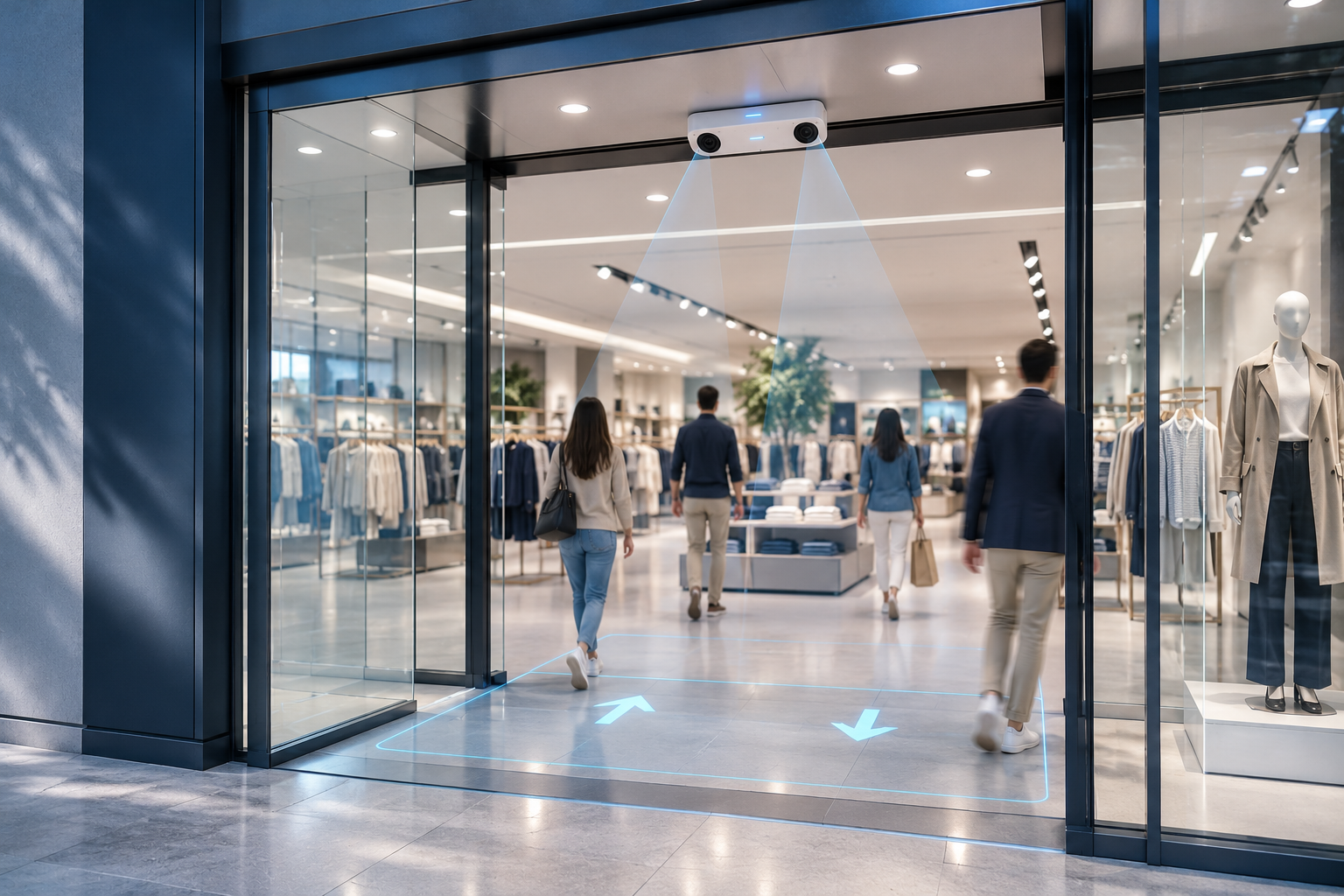
To accurately evaluate store performance in the retail sector, knowing only sales figures is not enough. The number of people entering a store, the times when visitor traffic is most intense, and the proportion of visitors who make a purchase are also important performance indicators.
This is where a store people counter stands out as a technological solution that helps businesses make more informed decisions by measuring visitor movements in physical stores.
Today, people counting systems can operate using various methods, from traditional infrared sensors to 3D stereoscopic imaging and AI-powered video analytics technologies.
However, simply placing a people counting sensor at a store's entrance does not automatically guarantee reliable customer data.
Incorrect sensor selection, inappropriate mounting height, door movements, heavy visitor traffic, or faulty counting line settings can affect measurement results.
Therefore, a correct store people counting system requires a combined evaluation of appropriate technology selection, proper installation, on-site validation, and a reliable reporting infrastructure.
So, what is a store people counter, how does it work, what technologies are used, and how should the right people counting system be chosen?
What is a Store People Counter?
A store people counter is an electronic sensor and software system that automatically counts people passing through a store's entry and exit points.
These technologies are referred to in international literature as People Counter, Footfall Counter, Store Traffic Counter, or Retail People Counting System.
The primary purpose of people counting systems is to convert store visitor traffic into measurable data.
Depending on the system's features, the following information can be obtained:
Number of people entering the store.
Number of people exiting the store.
Hourly, daily, and monthly visitor traffic.
Peak visitor hours.
Estimated real-time occupancy inside the store.
Visitor distribution across different entrances.
Traffic comparisons between branches.
Regional density and visit duration information in suitable analytical systems.
There is an important technical distinction:
A store people counter counts visitors entering the store. This does not mean that all these individuals made a purchase or are unique customers.
For example, if the same person enters the store twice, once in the morning and once in the evening, a standard entry counting system might record this as two separate visits.
Therefore, number of visits, number of unique visitors, and number of purchasing customers are different indicators.
How Does a Store People Counter Work?
The operating principle of people counting systems depends on the sensor technology used.
In modern 3D and AI-powered systems, the process generally consists of the following stages:
1. Detection of the Entry Area
A sensor, appropriately positioned at the store's entrance, detects human movements within the defined area.
In ceiling-mounted systems, visitors are typically viewed from above or detected using depth information.
2. Separation of Individuals
Advanced sensors, with appropriate algorithms, attempt to separate individuals when multiple people pass simultaneously.
This feature is particularly important in busy store entrances.
3. Determination of Movement Direction
The system tracks a person's movement in the counting zone to determine whether they are entering or exiting the store.
This process is typically carried out using virtual counting lines and tracking zones in most systems.
4. Generation of Entry and Exit Counts
When the defined conditions are met, the relevant event is added to the entry or exit counter.
For example:
Store entry: IN +1
Store exit: OUT +1
5. Transfer of Data to the Reporting System
The obtained counting data can be transferred to local software, a central server, or a suitable cloud reporting platform.
This allows store managers to analyze visitor traffic over different time intervals.
The true value of a people counter is not just in generating entry and exit numbers, but in the provable accuracy of this data and its usability in business decisions.
What Technologies Do Store People Counting Systems Use?
The market offers people counting solutions with different technologies and performance characteristics.
1. Infrared (IR) Beam People Counter
Traditional infrared counters can count passage events by detecting the interruption of a specific light beam.
Some models can determine the direction of movement by using multiple beams.
This technology can meet simple counting needs in suitable narrow passages.
However, people walking side-by-side, shopping carts, or certain complex passage movements can affect counting performance.
2. Thermal People Counting Sensors
Thermal people counting systems can detect human movements by utilizing the heat energy emitted by people or infrared temperature differences.
These systems may not require detailed facial image generation.
However, factors such as ambient temperature, proximity of targets, and the resolution of the sensor used can affect performance.
3. People Counting with 2D Video Analytics
2D video-based systems use image processing algorithms to detect people and track their movements on camera footage.
With appropriate hardware and software, existing IP cameras can also be used in certain people counting applications.
However, the presence of AI features in a standard security camera does not mean that it can perform high-accuracy store counting in all situations.
Especially crowded passages, people obscuring each other, and inappropriate camera angles can affect performance.
4. 3D Stereoscopic People Counter
3D stereoscopic people counting systems generate depth information from two different optical perspectives.
This allows not only the position of people in the image but also the depth structure of the scene to be evaluated.
In some applications, 3D data can facilitate:
Separation of people walking side-by-side.
Tracking individuals in crowded entrances.
Distinguishing objects like shopping carts from people.
Determining entry-exit direction.
Managing U-turns.
However, not all 3D sensors achieve these features with the same success. The manufacturer's algorithm and actual field conditions are important.
5. ToF (Time of Flight) Sensors
ToF technology performs depth measurement by utilizing time or phase information related to light traveling to a target and returning.
This technology can be used in certain people counting applications.
However, external ambient light, the sensor's measurement range, viewing geometry, and other optical conditions must be considered.
The use of ToF alone does not indicate higher accuracy than all stereo or other 3D technologies.
6. AI-Powered People Counter
AI-powered people counting solutions evaluate camera or sensor data through specific learned models.
This approach can be used for functions such as human detection, tracking, object separation, and analytical event generation, depending on the system used.
Some advanced systems also process stereo depth data in conjunction with AI.
Therefore, 3D counting and AI-powered counting do not necessarily have to be alternatives. Both technologies can be used together in the same device.
Comparison of Store People Counting Technologies
| Technology | Advantages | Technical Limitations |
|---|---|---|
| IR beam counter | Simple structure, economical application in certain narrow entrances | Limitations in side-by-side passage and object separation |
| Thermal sensor | Thermal detection, certain privacy advantages | Performance dependent on ambient temperature and sensor resolution |
| 2D video analytics | Ability to utilize existing camera infrastructure | Occlusion, perspective, and lighting effects |
| 3D stereoscopic sensor | Depth information and crowded passage analysis | Mounting geometry, optical conditions, and device coverage |
| ToF depth sensor | Direct depth measurement | Range, reflection, and ambient light conditions |
| Multi-sensor + AI | Possibility to evaluate different data together | Integration, cost, and validation requirements |
This comparison describes the general characteristics of the technologies. It should not be assumed that a particular technology will provide the most accurate results in all projects.
What Do Store People Counters Offer Businesses?
The most significant contribution of store people counting systems is the ability to measure visitor traffic and correlate it with business performance.
Measuring Visitor Traffic
The number of visits to the store can be tracked daily, weekly, and monthly.
This allows for examining the relationship between changes in sales volume and visitor numbers.
Identifying Peak Hours
Hourly visitor data can indicate when the store is busiest during the day.
This information can help in planning staff shifts and customer service capacity.
Evaluating Marketing Campaigns
Visitor traffic before and after advertising or promotional periods can be compared.
However, it cannot be definitively stated that a campaign caused an increase by only looking at traffic growth.
Seasonality, holidays, weather conditions, and other factors should also be considered.
Inter-Store Performance Comparison
In chain stores, traffic data from different locations can be consolidated into a common reporting infrastructure.
However, differences in store size, location, operating hours, and visitor profiles must be taken into account.
Analyzing Sales Conversion
When people counting data is linked with sales transactions, the extent to which the store converts visitor traffic into sales can be examined.
This indicator is an important KPI in retail analytics.
How to Calculate Store Customer Conversion Rate?
One of the frequently used indicators in evaluating store performance is the sales conversion rate.
In practice, the following calculation is commonly used:
Transaction-based conversion rate (%) = Number of sales transactions / Number of store entries × 100
Example Conversion Rate Calculation
Let's consider the daily data of a clothing store:
| Indicator | Daily Value |
|---|---|
| Number of store entries | 2,000 |
| Number of sales transactions | 120 |
| Sales turnover | 180,000 TL |
| Transaction-based conversion rate | %6 |
| Average sale per transaction | 1,500 TL |
Conversion rate = 120 / 2,000 × 100 = %6
Average transaction amount = 180,000 / 120 = 1,500 TL
There is an important distinction here.
This 6% value is the ratio of the number of sales transactions to the number of store entries. It does not definitively mean that 6% of visitors made a purchase.
Because:
A visitor can make multiple transactions.
A single transaction may include items belonging to multiple people.
The same person can enter the store multiple times.
Staff or other visitor types may be included in the counting data.
Therefore, this KPI is a useful business indicator as long as data definitions and counting rules are consistent.
The figures in the example are representative calculations; they do not represent the actual performance of a specific store.
Why is Accuracy Important in Store People Counters?
If the data produced by a people counting system is to be used for sales and operational decisions, counting accuracy becomes critical.
For example, if the system records 900 entries despite 1,000 actual entries into the store, the visitor count appears lower than it is.
In this case, the conversion rate calculated with the number of sales transactions might appear higher than it is.
Thus, a counting error can affect not only the visitor report but also other dependent performance indicators.
How to Calculate People Counting Accuracy?
A simplified total counting accuracy indicator:
Counting accuracy (%) = [1 − |System count − Reference count| / Reference count] × 100
For example, in a specific test interval:
Manual reference entry count: 500
Sensor entry count: 485
Counting accuracy = [1 − 15/500] × 100 = %97
This value is calculated based on the total counting difference in the relevant test interval.
However, a low total difference does not prove that the system correctly evaluated all passages.
For example, if the system missed 10 people and overcounted another 10, even if the total number appears correct, 20 events might have been processed incorrectly.
Therefore, in professional validation, not only the total counting difference but also missed passages, overcounts, and wrong-direction events should be evaluated.
Entry and Exit Accuracy Should Be Measured Separately
The performance of entry and exit directions in a people counting system can differ.
Therefore, IN and OUT counts should be tested separately.
Especially in narrow entrances, during crowded hours, or when people are standing at the store entrance, counting behavior can change.
Is the Manufacturer's Accuracy Statement Sufficient?
Manufacturers may declare accuracy rates of 95%, 98%, or higher under specific laboratory or field conditions.
However, laboratory performance is not the same as performance in a real store environment.
Mounting height, entrance width, human density, lighting, and other factors can affect actual results.
Therefore, the purchasing decision should be based not only on the accuracy percentage in the catalog but also on the validation report obtained in the store where it will be installed.
Why Do Counting Errors Occur in Store People Counters?
Incorrect Mounting Height
Mounting the sensor outside the manufacturer's recommended operating range can reduce human detection and tracking performance.
Wide Store Entrances
If the entrance width exceeds the coverage area of a single sensor, some passages may not be detected.
In this case, multiple sensors may be required.
Visitors Walking Side-by-Side
Passages made by crowded families or groups can create counting difficulties, especially in certain two-dimensional or simple beam systems.
Door Movements
The movement of automatic or swing doors can obscure the counting area or cause unwanted detection in some systems.
U-Turns
A visitor approaching the counting line and turning back without fully entering the store can generate an incorrect count.
Advanced tracking algorithms can reduce such events; however, settings need to be validated on-site.
Staff Movements
Store employees entering and exiting throughout the day can affect visitor counting.
Therefore, how staff movements will be handled in customer traffic reports should be determined in advance.
Children and Strollers
The detection of children walking very close to adults or the separation of strollers depends on the characteristics of the sensor used.
Incorrect Counting Line
Positioning the virtual line too close to the door or at the edge of the tracking zone can prevent the system from tracking a person's movement for a sufficient duration.
Where Should a Store People Counter Be Mounted?
The mounting position of a store people counter is one of the most important technical criteria affecting data accuracy.
3D stereoscopic sensors are mostly mounted above the store entrance, positioned to view the passage area from above.
However, each sensor has different permitted mounting heights and fields of view.
Mounting Height
The mounting height specified in the sensor manufacturer's technical documentation should be used.
For example, certain FootfallCam 3D systems consider application conditions within the 2.3–4.5 meter range.
However, this value is not a universal mounting range applicable to all brands and models.
Entrance Width
The store's entrance width should be compared with the area the sensor can cover at a specific height.
If multiple sensors are used for wide entrances, the coverage areas and counting lines of the devices should be planned together.
Door and Architectural Obstacles
Factors that may affect the sensor's field of view should be examined:
Automatic or swing doors.
Air curtains and the effect of airflow on sensor technology.
Suspended ceiling elements.
Lighting fixtures.
Decorative items at the entrance.
Mannequins and product displays.
Cash registers or waiting areas near the entrance.
Especially changes in the product display arrangement at the store entrance can affect the sensor's detection conditions.
Counting Line and Tracking Area
The virtual counting line should be positioned to accurately represent actual entry and exit events of people.
It is important to have sufficient tracking area on both sides of the line.
After installation is complete, tests should be conducted based on actual visitor movements.
How to Perform Calibration and Validation in Store People Counters?
Calibration and validation in people counting systems are important for data reliability.
However, these concepts do not refer to the same process.
Calibration and Configuration
In people counting applications, the term calibration is often used to refer to adjusting the sensor and analysis parameters according to field conditions.
During this process:
Mounting height.
Counting line.
Entry and exit directions.
Detection and tracking zone.
Manufacturer-permitted filtering and tracking parameters.
can be checked.
This process does not imply that a metrologically traceable calibration of a measuring device is performed.
Validation
Validation is the assessment of whether the system provides the expected performance for its defined purpose through appropriate field tests.
For example, manually counted entries and exits during specific time intervals are compared with the data reported by the sensor.
In validation tests:
Normal visitor traffic is evaluated.
Samples are taken from peak hours.
Side-by-side and opposite-direction passages are examined.
Entry and exit counts are compared separately.
Staff movements and U-turns are tested if necessary.
Causes of errors are identified.
Tests are re-conducted after adjustments are made.
The test duration and sample size should be determined based on the store's traffic volume and the targeted confidence level.
It should not be assumed that there is a single test duration valid for every store or a universally mandatory accuracy percentage for all projects.
Especially in large retail chains, standardizing the validation method can increase the comparability of data across branches.
How to Separate Staff Passages from Customer Counts?
Store employees are an important data quality issue in customer traffic analysis.
For example, in a store where employees constantly move between the warehouse and the sales area, a wrongly positioned counter might show a higher actual customer entry count than it is.
Therefore, different methods can be considered:
Using a separate entry route for staff.
Correct positioning of entry and counting zones.
Using authorized staff separation functions in supported systems.
Data filtering in accordance with operational rules.
Utilizing time and attendance (PDKS) or access control system data when necessary.
However, it should not be assumed that all people counters can automatically distinguish staff.
Especially if a people counting sensor is to be used together with an RFID card or another staff identification system, integration capability, accuracy, and personal data processing conditions should be evaluated separately.
How to Calculate Store Real-time Occupancy?
Entry and exit counting data can be used to estimate the number of people inside the store under appropriate conditions.
Basic calculation:
Real-time occupancy = Initial number of people + Total entries − Total exits
For example, let's assume there are 10 people in the store initially.
During the day:
Number of entries: 250
Number of exits: 180
Calculated real-time occupancy:
10 + 250 − 180 = 80 people
However, this calculation assumes that the initial count is correct and that all entry-exit points are measured completely.
Counting errors can accumulate over time, leading to deviations in occupancy estimation.
Therefore, real-time occupancy should be evaluated together with the accuracy and data integrity conditions of the system used.
Real-time occupancy is also not the same as the store's legal or safe maximum capacity.
What is RE-ID in People Counting Systems?
RE-ID (Re-Identification) is a technology in some advanced analytical systems that aims to evaluate whether observations from different camera images or time intervals can be associated with the same person.
However, RE-ID and standard people counting are not the same function.
A standard store people counter primarily counts entry and exit events.
Some RE-ID supported systems, under appropriate conditions, may attempt to analyze movement relationships between different areas or repeat visit patterns.
Does RE-ID Provide the Exact Number of Unique Visitors?
No.
The performance of RE-ID technology depends on the type of data used, the algorithm, camera conditions, matching thresholds, and the time window.
For example, if a person leaves the store and returns an hour later, the system's ability to associate this as the same person is not automatically guaranteed.
Furthermore, if RE-ID applications result in tracking or associating individuals, the personal data processing aspect must be evaluated separately.
Therefore, people counting, unique visitor estimation, and RE-ID analyses should be treated as functions with separate technical and legal requirements.
Can a Store People Counter Be Integrated with POS and ERP Systems?
Yes. Suitable people counting software can be integrated with point-of-sale (POS) or enterprise resource planning (ERP) systems.
This allows visitor traffic and sales data to be evaluated together.
For example:
Number of store entries.
Number of sales transactions.
Total sales amount.
Average sale per transaction.
Hourly conversion rate.
Inter-branch traffic performance.
can be examined on a common reporting platform.
However, consistent data definitions are required for successful integration.
What to Consider in Integration?
Store codes and location matching.
Date and time synchronization.
Definition of operating hours.
Reporting logic for cancellations and returns.
Separation of number of sales transactions from number of items sold.
Visitor categories included in the entry count.
API and data transfer security.
Data loss and re-transfer scenarios.
For example, if the sales report measures the number of transactions and the people counter measures entry events, it should be clearly stated that the conversion rate is calculated based on these definitions.
Does a Store People Counter Fall Under KVKK Scope?
The answer to this question depends on what data the technology processes.
A system that only generates anonymous and aggregated people counts does not have the same data processing characteristics as a system that records images of individuals or tracks device identifiers.
For example, some 3D counting systems may only use depth data and total passage counts.
In contrast, different systems may record images for validation purposes, process device identifiers, or associate visit movements.
Therefore, the issues to be evaluated are:
Whether personal data is processed.
Whether images are recorded.
Whether the visitor is identifiable.
The purpose for which the data is used.
Whether data is transferred to third-party software or the cloud.
Storage and destruction periods.
Informing data subjects.
Prevention of unauthorized access.
The absence of facial recognition does not automatically mean that a system is outside the scope of KVKK.
According to the Personal Data Protection Authority's (KVKK) statements, for data to be considered anonymized, it must be rendered impossible to re-associate with the relevant natural person.
Therefore, the data architecture and purpose of use of each people counting system should be evaluated separately.
What Factors Determine Store People Counter Prices?
The cost of store people counting systems is not solely comprised of the sensor's purchase price.
Key factors affecting the total cost include:
Sensor technology.
Number and width of store entrances.
Required number of sensors.
Mounting and cabling infrastructure.
PoE or other power requirements.
Cloud or local software license.
Reporting features.
POS and ERP integration.
Validation and calibration services.
Technical service and maintenance.
Data storage and security infrastructure.
For example, a single sensor might suffice for a small store with one entrance, while a large store with multiple entrances may require multiple sensors and a central data management infrastructure.
Therefore, when evaluating prices, not only the device cost but also the total cost of ownership and verifiable data quality should be considered.
Furthermore, it should be checked under what field conditions the high accuracy claim is provided and whether the validation service is included in the scope of sale.
What to Consider When Choosing a Store People Counter?
In a professional people counting system, the right product should be selected according to the store's actual traffic and reporting needs.
1. Entrance Width and Mounting Height
The sensor's actual coverage area must be compatible with the store's architectural conditions.
2. Entry and Exit Counting
It must be verified that the system can count both directions independently.
3. Crowded Passage Performance
The sensor should be tested under actual density conditions that may be observed in the store.
4. Staff and Object Separation
Staff or object separation functions compatible with the customer traffic definition should be evaluated.
5. Documentation of Counting Accuracy
Separate from the manufacturer's accuracy statement, the on-site validation method and acceptance criteria should be determined.
6. Reporting and Software
It should be examined whether hourly, daily, monthly, and branch-based reports meet the business's needs.
7. Network and Data Integrity
It should be checked how counting data is stored when the internet connection is lost and how it is transferred when the connection is re-established.
8. Integration Support
Required API features for data exchange with POS, ERP, BI, or other reporting platforms should be evaluated.
9. Personal Data Security
The data processing characteristics of the technology used should be examined in terms of KVKK compliance.
10. Technical Service and Maintenance
How the sensor's accuracy will be monitored after installation, how malfunctions will be detected, and the scope of maintenance support should be determined.
Common Mistakes in Store People Counter Installation
Significant implementation errors encountered in people counting projects include:
Mounting the sensor outside the manufacturer's operating range.
Selecting a coverage area unsuitable for the entrance width.
Incorrect positioning of the counting line.
Not considering door movements and people standing at the entrance.
Incorrect definition of entry and exit directions.
Overlapping or leaving gaps in sensor coverage areas in wide entrances.
Not separating staff passages from customer traffic.
Not performing accuracy tests during crowded hours.
Not checking the data loss scenario during internet outages.
Delivering the system after installation by only checking if the device is working.
Especially after store renovations, door changes, and alterations to product display arrangements at the entrance, counting performance should be re-evaluated.
Store People Counter Technical Checklist
Are store entry and exit points determined?
Are entrance width and ceiling height measured?
Is the sensor's coverage area verified?
Is the mounting position compliant with manufacturer instructions?
Are door movements and environmental obstacles evaluated?
Are entry and exit directions correctly defined?
Are crowded passages tested?
Are U-turns and incorrect passage events evaluated?
Is the reporting method for staff passages determined?
Is entry accuracy measured with manual reference counts?
Is exit accuracy tested separately?
Are counting errors and corrective actions reported?
Is data behavior during network and power outages verified?
If POS and ERP integration is required, is it tested?
Are personal data processing and KVKK conditions evaluated?
Is a technical service and periodic validation plan prepared?
This list is for general technical selection and commissioning evaluation. Additional requirements specific to the product and actual store usage conditions may exist.
Frequently Asked Questions
What is a store people counter?
A store people counter is an electronic system that automatically counts human passages at a store's entry and exit points, generating visitor traffic data.
How does a store people counter work?
Depending on the technology used, it counts entry and exit movements via infrared beam, thermal detection, 2D camera, 3D stereoscopic imaging, or AI-powered analysis.
What is the difference between a 3D people counter and a normal people counter?
3D sensors can utilize depth information. This feature can facilitate person separation in certain crowded or overlapping conditions. However, performance depends on the device's algorithm and installation conditions.
How accurate is a store people counter?
There is no single accuracy rate applicable to all systems. Actual accuracy varies depending on sensor technology, installation, visitor density, and environmental conditions. On-site validation tests should be performed.
Does a store people counter also count staff?
Some systems include staff passages in the visitor count. Suitable models may have staff separation or data filtering functions.
Does a store people counter work without internet?
Some devices can perform local counting and temporarily store data without an internet connection. This feature depends on the product's hardware and software architecture.
How many people counting sensors are needed for a single store?
The required number of sensors depends on the width and number of entrances, ceiling height, and the coverage area of the selected device. It cannot be assumed that a single sensor is sufficient for every store.
Does a store people counter increase sales?
A people counter alone does not increase sales. However, by providing traffic, conversion, and occupancy data, it can help improve decisions regarding staff, campaigns, and store operations.
Can conversion rate be calculated with a store people counter?
Yes. Transaction-based conversion rate can be calculated by using visitor entry counts and POS sales transaction data together. This indicator should not be interpreted directly as the unique purchasing customer rate.
What determines the price of a store people counter?
The price depends on sensor technology, number of devices, installation conditions, software, reporting, integration, validation, and maintenance services.
Is RE-ID necessary in people counting systems?
RE-ID is not mandatory for basic entry and exit counting. It can be considered for advanced applications such as unique visitor estimation or associating visitor movements in different areas.
Conclusion: Accurate People Counting is the Foundation of Reliable Retail Analytics
Store people counting systems are important technologies that help physical retail businesses measure visitor traffic and base their operational decisions on data.
3D stereoscopic sensors, AI-powered analytics, and central reporting platforms can offer more comprehensive analysis capabilities compared to traditional people counting methods.
However, a successful people counting project is not completed merely by purchasing an advanced sensor.
Correct technology selection, appropriate mounting height, coverage planning according to entrance width, entry-exit validation, and regular data quality control must be evaluated together.
When visitor traffic is correlated with sales data, stores' conversion performance, peak hours, and operational needs can be better understood.
The true value of a store people counter comes not from telling how many people entered, but from providing measurable data that the business can trust, helping it make more accurate decisions.