
What Are AI-Powered Object Tracking Systems? AI Object Tracking Technologies and Applications
How do AI-powered object tracking systems work? We examine AI Object Tracking, Multi-Object Tracking, RE-ID, PTZ Auto Tracking, human and vehicle tracking, multi-camera analysis, tracking accuracy, and field validation from a technical perspective.
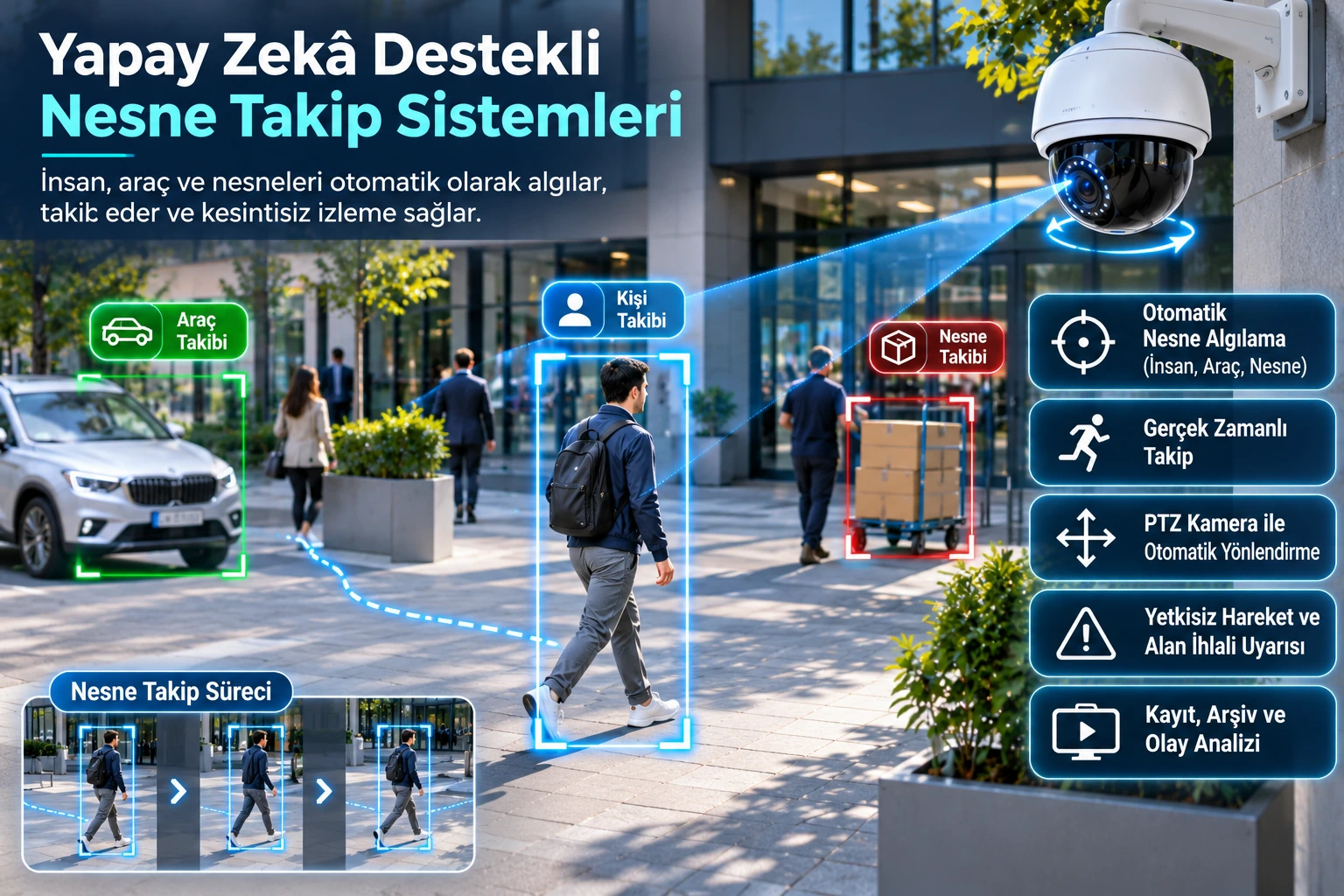
AI-powered object tracking systems are computer vision technologies designed to automatically monitor the movements of people, vehicles, and specific objects in footage captured by security cameras. Whereas operators in traditional CCTV systems must manually track objects through camera footage, advanced video analytics solutions can automate certain stages of this process.
AI-powered object tracking, known as AI Object Tracking, aims to associate an object detected in an image with the same object across successive video frames. More advanced systems can track multiple objects simultaneously, analyze their directions of movement, and generate automatic alerts for specific events.
These technologies are used in a range of fields, including perimeter security, smart-city applications, traffic management, logistics facilities, industrial security, shopping centers, and retail visitor analytics.
However, object detection, object tracking, identification, and re-identification across cameras are distinct technical processes. A camera detecting a person or vehicle does not mean it can track the same object continuously or recognize it again on another camera.
What Is an AI-Powered Object Tracking System?
An AI-powered object tracking system is a hardware and software solution that associates the positions of objects detected in camera footage over time and analyzes their movements.
International technical literature uses several terms related to object tracking:
Object Detection: Detecting objects
Object Tracking: Tracking objects
Single Object Tracking (SOT): Tracking a single object
Multi-Object Tracking (MOT): Tracking multiple objects
Multi-Camera Tracking (MCT): Tracking across multiple cameras
Re-Identification (RE-ID): Re-matching an object
PTZ Auto Tracking: Automatic tracking with a moving camera
Trajectory Analysis: Analysis of movement paths
These technologies do not serve the same purpose. The algorithm to be used should be selected according to the object type, camera infrastructure, and tracking scenario.
How Does AI-Powered Object Tracking Work?
1. Capturing Camera Footage
First, footage is obtained from an IP security camera or another suitable video source.
Image quality forms the foundation of object tracking.
Resolution, lens, frame rate, exposure, camera angle, and lighting conditions can affect tracking performance.
2. Object Detection
The AI algorithm identifies the supported objects in the image.
For example:
Person
Car
Truck
Motorcycle
Bicycle
Forklift
Specific industrial equipment
object classes can be detected.
However, not every algorithm supports every object type. Additional model training may be required, particularly for classes such as forklifts, pallets, or custom-made equipment.
3. Assigning a Temporary Tracking ID to the Object
The system may assign a temporary tracking number to a detected object to associate its movement within the image.
For example:
Track ID 101: Person
Track ID 102: Car
Track ID 103: Forklift
These numbers help the algorithm distinguish objects from one another in the image.
A Track ID is not a person's real identity or a vehicle's registration identity. Nor is it guaranteed that the same number will refer to the same object in different camera sessions.
4. Matching the Object Across Successive Frames
The tracking algorithm evaluates the object's position and appearance in new video frames.
Depending on the method used, it may draw on the following information:
The object's previous position
Direction of movement
Estimated speed
Size in the image
Appearance features
Continuity of movement
Relationship to other objects
The aim is to determine whether the object seen in successive frames is the same as the one in the previous frame.
5. Generating a Movement Trajectory
A movement trail can be created by combining the tracked object's positions in the image over time.
This information can be used to perform specific analyses:
Direction of entry and exit
Time spent in a given area
Movement trajectory
Virtual line crossing
Entry into a specific area
Object density
Changes in direction of movement
Appropriate camera calibration and geometric transformation may be required to calculate real-world distance or speed from image coordinates.
6. Event Analysis and Alerts
Tracking results can be compared with defined security or operational rules.
For example, if a forklift enters a designated pedestrian safety zone, a suitable system can notify an operator.
However, the algorithm detecting an event does not necessarily mean that the event is dangerous or unlawful.
The Difference Between Object Detection and Object Tracking
Object detection and object tracking are often confused with each other.
Object detection attempts to determine where an object is located in a particular video frame and which class it belongs to.
Object tracking, in contrast, aims to associate an object's movement across multiple frames.
Feature | Object detection | Object tracking |
|---|---|---|
Primary purpose | Locate the object | Track its movement |
Temporal relationship | Can be performed on a single frame | Requires multiple frames |
Temporary tracking ID | Not required | Commonly used |
Movement trajectory | Does not generate one on its own | Can generate one |
Dwell time | Cannot measure it on its own | Can measure it |
When the object disappears | Can detect it again | May lose the tracking ID |
Multi-camera matching | Does not provide it on its own | May be possible with additional methods |
A system having Object Detection functionality does not mean that it supports Multi-Object Tracking or RE-ID.
What Is Single Object Tracking (SOT)?
Single Object Tracking aims to track a single target selected at the outset throughout a video.
In this approach, the object to be tracked can be selected initially by an operator or another algorithm.
For example, when a security operator selects a particular vehicle, suitable software may try to track its movement in the footage.
SOT systems can be used especially in applications where tracking a specific target is important.
However, tracking can become difficult if the target leaves the field of view entirely, is occluded by other objects for an extended period, or undergoes a substantial change in appearance.
What Is Multi-Object Tracking (MOT)?
Multi-Object Tracking is the simultaneous tracking of multiple objects in the same video.
For example, at a logistics center:
Three forklifts
Five workers
Two trucks
can be detected and tracked simultaneously.
MOT algorithms try to preserve tracking IDs when objects approach one another or occlude each other.
Methods Used in MOT Algorithms
In advanced systems, object detection results can be combined with motion prediction and data-association methods.
Examples of methods used for this purpose in technical literature include:
Kalman filters
Matching with the Hungarian algorithm
SORT
Deep SORT
ByteTrack
BoT-SORT
are examples.
The performance of these methods depends on the object detection model, dataset, and application conditions.
For example, the ByteTrack approach aims to improve tracking continuity by also using certain detection results with low confidence scores.
However, an algorithm performing well on an academic dataset does not mean it will deliver the same performance in every CCTV project.
How Is Object Tracking Across Cameras Performed?
Object tracking on a single camera and tracking across multiple cameras have different technical requirements.
Single-Camera Tracking
The object is tracked for as long as it remains within the same camera's field of view.
Tracking may end when the object leaves the field of view.
Multi-Camera Tracking
When an object leaves one camera's view and appears again on another, the aim is to match it as the same object.
For this, the system may need to assess camera transitions and object features.
For example, a logistics facility may want to track a truck's transition from an entrance camera to a warehouse camera.
However, differences in viewing angle, lighting, and resolution between cameras affect matching performance.
Overlapping Camera Fields of View
With cameras whose fields of view overlap, an object's transition can be associated using specific geometric and temporal information.
Tracking with Non-Overlapping Cameras
If the cameras' fields of view are completely separate, re-matching becomes more complex.
In this case, appearance features, time interval, possible route, and other contextual information can be used.
However, the risk of incorrect matching in such systems must be assessed in particular.
What Is RE-ID Technology?
RE-ID is an abbreviation for Re-Identification.
In object tracking, RE-ID refers to techniques for re-matching an object seen previously at a different time or on a different camera.
RE-ID algorithms can use appearance features in supported applications.
For example, in person tracking, features such as clothing color and appearance can be assessed.
For vehicle tracking, vehicle class, color, shape, or other visible features can be used.
However, RE-ID is not the same as biometric identity recognition.
Limitations of RE-ID Systems
People wearing similar clothing may be confused with one another.
A person changing clothes can make matching more difficult.
Changes in camera angle and lighting can affect performance.
Incorrect matching may occur in crowded areas.
Over long time intervals, appearance similarity may decrease.
Differences in image quality between cameras can affect matching.
In addition, a system's ability to re-match the same person after 30 minutes or 1 hour does not depend solely on having the RE-ID feature.
The time window, feature-retention period, matching threshold, camera-transition rules, and the algorithm's real-world performance should be assessed together.
If an RE-ID result can be linked to a person, risks related to personal data processing and profiling should also be examined.
What Is PTZ Auto Tracking?
PTZ Auto Tracking is a technology that enables moving security cameras to track specific targets automatically.
PTZ cameras support:
Pan: Horizontal movement
Tilt: Vertical movement
Zoom: Optical magnification
functions.
In suitable auto-tracking systems, the camera can change its direction and zoom level according to the movement of the detected target.
How Does PTZ Auto Tracking Work?
The camera or external software detects the target.
The tracking algorithm determines the target’s position in the image.
The camera’s motion control attempts to keep the target within the field of view.
Pan and tilt commands are applied according to the target’s movement.
The zoom level can be adjusted on supported systems.
When tracking ends, the camera may return to a predefined position.
However, having an auto-tracking feature does not mean that a PTZ camera supports every object class or every movement scenario.
Limitations of PTZ Auto-Tracking Systems
Fast-moving targets, obstructions, sudden changes in direction, and similar-looking objects can cause tracking loss.
In addition, while a PTZ camera is tracking one target, it may be unable to view another area it was monitoring initially.
For this reason, critical security projects can combine general-area surveillance with fixed cameras and target tracking with PTZ cameras.
Where Is AI Object Tracking Used?
Perimeter Security
The movement of people or vehicles entering designated areas can be analyzed at factories, energy facilities, logistics centers, and critical infrastructure sites.
Object tracking can help an operator monitor a target’s movement after an area-intrusion alarm.
Factories and Industrial Facilities
The movement of people, forklifts, and other supported object classes can be assessed.
For example, proximity events can be analyzed in areas where pedestrian and forklift routes intersect.
However, video-analytics-based alerts do not automatically replace protective systems designed in accordance with relevant occupational safety standards.
Logistics and Warehousing
The movement of trucks, forklifts, and specific equipment can be analyzed.
With suitable calibration and integration, dwell times or movement routes in designated areas can be reported.
Smart Traffic Systems
Vehicle travel directions, lane changes, and traffic density can be assessed.
Vehicle tracking can support the generation of traffic-flow statistics.
Shopping Malls
Visitor movement, crowd density, and dwell times in designated areas can be analyzed.
However, creating an individual visitor route can entail different personal-data risks from anonymous density measurement.
Retail Stores
In-store movement patterns and area-specific crowd densities can be analyzed.
Some systems may offer customer-journey and repeat-visit analytics.
However, people counting, movement tracking, and RE-ID applications have different accuracy and data-protection requirements.
Parking Lots
Vehicle entry, exit, and movement in designated areas can be analyzed.
Reading a vehicle’s license plate or matching a particular vehicle to an identity requires separate technical processes.
Edge AI, Server, and Cloud Architectures in Object Tracking Systems
Architecture | Core feature | Advantage | Limitation |
|---|---|---|---|
Edge AI camera | Analytics on the camera | Local processing | Processing power and model capacity |
Edge AI device | Local analytics unit | Integration with existing cameras | Device and stream capacity |
Central AI server | Multi-camera analytics | Advanced computing capabilities | GPU, network, and maintenance requirements |
Cloud analytics | Remote processing and management | Centralized reporting | Connectivity, cost, and data protection |
Hybrid architecture | Local and central analytics | Flexible system design | Integration complexity |
A centralized processing infrastructure can offer advantages in multi-camera RE-ID applications. However, this does not mean that all multi-camera tracking systems require the cloud or a central server.
Choosing Cameras for Object Tracking Systems
Resolution and Target Pixel Size
The object to be tracked must be visible in the image with sufficient detail.
In some scenarios, high resolution can make it easier to detect small or distant targets.
However, tracking performance cannot be determined solely by megapixel count.
Lens and Field of View
Wide-angle lenses can capture large areas.
By contrast, distant objects may occupy fewer pixels in the image.
Narrow-angle lenses can provide more detail for specific targets, but may limit coverage.
Frame Rate (FPS)
Frame rate matters when tracking fast-moving objects.
At a low frame rate, an object’s position may change more between consecutive frames, making matching more difficult.
However, a higher FPS alone does not guarantee greater tracking accuracy.
Exposure and Motion Blur
The exposure time must be configured appropriately to capture moving objects clearly.
Motion blur can affect analytics performance, particularly when tracking vehicles and forklifts.
Camera Mounting Angle
The camera angle affects how objects appear and the extent to which they occlude one another.
For example, a high-angle view can reduce object occlusion; however, it may also eliminate details needed by some appearance-based RE-ID algorithms.
Night Vision
Infrared imaging and low-light performance should be assessed.
An RE-ID algorithm that performs well with daytime color images may not deliver the same performance with black-and-white images at night.
How Is Performance Measured in AI Object Tracking?
Measuring object-detection accuracy alone is not sufficient for object tracking systems.
Track ID retention, incorrect matching, and tracking continuity should also be assessed.
MOTA (Multiple Object Tracking Accuracy)
MOTA is a traditional performance metric for multi-object tracking systems that jointly evaluates missed objects, false positives, and identity switches.
Even when the MOTA score is high, identity-matching quality should be examined separately.
IDF1
IDF1 is a metric used to evaluate the identity-matching performance of tracked objects.
It is particularly important for determining whether an object remains associated with the same temporary identity throughout tracking.
HOTA
HOTA is a multi-object tracking metric designed to assess object-detection and association quality together.
This metric can be used to analyze tracking-algorithm performance from different perspectives.
ID Switch (Identity Switch)
This occurs when an object is mistaken for another during tracking or its tracking ID is incorrectly changed.
For example, confusing the tracking numbers of two forklifts moving close to each other can constitute an identity switch.
Track Fragmentation
This occurs when tracking is interrupted and then resumes, even though the object should have been tracked continuously.
For example, if a person is lost briefly because of an occlusion and detected again under a new Track ID, this can cause track fragmentation.
Which Metrics Are Used to Measure RE-ID Performance?
Inter-camera RE-ID performance should be evaluated separately from object tracking.
Common metrics include:
Rank-1 matching performance
Mean Average Precision (mAP)
Precision and Recall
False matching rate
Matching latency
Performance by time window
can be found.
However, Rank-1 or mAP results calculated on closed datasets may not directly represent open-ended matching performance in a real store or facility.
The system should also be tested to ensure that it does not make incorrect matches, particularly in scenarios where the same object is not seen again.
Why Does Incorrect Matching Occur in Object Tracking?
Objects Occluding One Another
In crowded scenes, people or vehicles can occlude one another.
In such cases, the system may lose the temporary tracking ID.
Similar Appearance
Vehicles of the same color and model, or people wearing similar clothing, can be confused with one another.
Changes in Camera Angle
An object viewed from the front, side, or rear can exhibit different visual features.
Lighting Differences
Daylight, nighttime, and different camera lighting conditions can make appearance matching more difficult.
Low Frame Rate
A larger difference in movement between consecutive frames can make object association more difficult.
Camera Shake
Movement in footage from a fixed camera can affect how the tracking algorithm assesses object movement.
Prolonged Loss of View
When an object remains outside the image for an extended period, matching it again as the same object can become difficult.
ONVIF and VMS Integration in Object Tracking Systems
In AI object tracking systems, it is important not only to receive video streams but also to transfer tracking data to other systems.
ONVIF Profile M provides interfaces for transferring supported analytics metadata and event information between systems.
Object classification, specific analytics metadata, and event notifications may be supported in this context.
However, ONVIF Profile M compliance does not guarantee that every manufacturer’s tracking algorithms or RE-ID features will work automatically in different software.
The following points should therefore be verified separately:
Camera and VMS compatibility
Analytics metadata transfer
Transmission of Track ID information
Alarm and event interfaces
Camera time synchronization
Support for RE-ID metadata
APIs and manufacturer-specific integrations
Associating events with video recordings
Field Validation of AI Object Tracking Systems
Field validation is necessary in professional object tracking systems to assess whether the algorithm delivers the expected performance under real operating conditions.
Example process:
The object classes to be tracked are identified.
Camera placement and fields of view are examined.
Object movement scenarios are defined.
Tracking duration and acceptance criteria are established.
Controlled reference images are created.
Detection and tracking results are compared.
Identity switches are measured.
Track fragmentation is assessed.
Inter-camera matching is tested.
If PTZ auto-tracking is used, target loss and reacquisition are tested.
Daytime, nighttime, and heavy-traffic conditions are assessed.
The results are reported and compared with the acceptance criteria.
It is not sufficient to conduct tests only under calm, ideal image conditions.
Scenarios involving crowds, occlusion, sudden changes in direction, and similar-looking objects should be examined separately.
AI Object Tracking Systems and KVKK
If object tracking systems monitor people or vehicles that can be associated with individuals, personal-data processing may take place.
In Türkiye, the system’s purpose of use, legal basis, and scope of data processing should be assessed under Personal Data Protection Law No. 6698.
Does Object Tracking Always Process Personal Data?
No. For example, depending on the features of the application, analyzing the movement of industrial equipment that cannot be associated with identifiable individuals may not constitute personal-data processing.
However, processing people’s movement routes, vehicle license plates, or information about repeat visits may fall within the scope of personal data.
Is a Track ID Anonymized Data?
Assigning a temporary tracking number to an object does not automatically mean that the data is anonymous.
If a Track ID can be associated with a specific person using image, time, and location information, processing of personal data may be involved.
RE-ID and Personal Data
Matching people again across footage from different cameras may enable their movements to be tracked and profiles to be created.
For this reason, data minimization, legal basis, retention period, and proportionality must be carefully assessed in RE-ID applications.
Difference Between Facial Recognition and RE-ID
Not all RE-ID systems use facial recognition.
However, if the method used is intended to identify or verify a person’s identity through biometric characteristics, provisions governing special-category personal data may apply.
Data Retention and Access
A retention policy should be established for tracking data, footage, and event logs.
Unnecessary personal data should not be collected, access permissions should be restricted, and operations such as cloud transfers should be assessed separately.
What Should You Consider When Choosing an AI Object Tracking System?
Criterion | What to Check |
|---|---|
Object class | Support for people, vehicles, or specialized equipment |
Tracking type | SOT, MOT, or multi-camera tracking |
RE-ID | Re-identification capability and limitations |
Camera | Lens, resolution, FPS, and field of view |
Night performance | Tracking performance in low light |
Tracking accuracy | MOTA, IDF1, HOTA, and identity switches |
Integration | VMS, ONVIF, and API support |
PTZ | Automatic tracking and target reacquisition |
Hardware | CPU, GPU, and analytics capacity |
Data protection | KVKK, retention, and access control |
Validation | Real-world field performance |
Technical Checklist
- Have the object classes to be tracked been defined?
- Have SOT, MOT, and RE-ID requirements been distinguished?
- Have camera placement and fields of view been verified?
- Has the targets’ pixel size in the image been assessed?
- Have FPS and motion blur been checked?
- Has performance been tested during the day and at night?
- Have occlusion and similar-object scenarios been assessed?
- Have tracking identity switches been measured?
- If cross-camera matching is required, has it been tested?
- If PTZ automatic tracking is used, have target-loss scenarios been examined?
- Have ONVIF, VMS, and API integrations been verified?
- Have CPU, GPU, and network capacity been calculated?
- Have KVKK and data retention requirements been assessed?
- Have field validation and acceptance tests been completed?
Frequently Asked Questions
What is AI-powered object tracking?
It is a computer vision technology that automatically tracks people, vehicles, or specific objects in camera footage across successive video frames.
What is the difference between Object Detection and Object Tracking?
Object Detection attempts to locate an object in an image and determine its position. Object Tracking associates an object’s movement across multiple frames.
What is Multi-Object Tracking?
It is a technology that tracks multiple objects simultaneously in the same video footage.
Can AI cameras track people?
With suitable algorithms, people’s movements within an image can be tracked. However, this does not mean that the person’s real identity is determined.
Is RE-ID the same as object tracking?
No. Object tracking aims to follow movement across successive frames, whereas RE-ID aims to match an object seen earlier again at a different time or on a different camera.
What is PTZ Auto Tracking?
It is when a PTZ camera changes its direction and, on systems that support it, its zoom level to track a specific target automatically.
Can object tracking be performed with existing IP cameras?
Some object tracking solutions can be used with existing IP cameras if a suitable video stream, analytics software, and processing capacity are available.
How is object tracking accuracy measured?
Metrics such as MOTA, IDF1, and HOTA can be used by comparing object detection results, identity switches, tracking continuity, and reference movement data.
Do object tracking systems comply with KVKK?
Compliance depends on the data the system processes, its purpose of use, its legal basis, and the data security measures in place. Human tracking and RE-ID applications in particular should be assessed separately.
Conclusion
AI-powered object tracking systems enable security cameras to go beyond merely detecting people, vehicles, and specific objects, allowing them to analyze their movements over time.
Technologies such as Single Object Tracking, Multi-Object Tracking, RE-ID, Multi-Camera Tracking, and PTZ Auto Tracking offer solutions for different security and operational needs.
However, advanced AI algorithms alone are not the foundation of a successful object tracking system.
Camera placement, image quality, target pixel size, frame rate, algorithm selection, integration, and field validation should all be assessed together.
In multi-camera tracking and RE-ID applications in particular, identity switches, false matches, and personal data protection requirements are critical.
The success of a professional object tracking system should be judged not only by its ability to detect objects, but also by its ability to track their movements with measurable accuracy, manage identity confusion, and produce validated results under real-world field conditions.