
What Are AI-Powered Facial Recognition Systems? Technologies, Accuracy and KVKK Guide
How do AI-powered facial recognition systems work? We examine 1:1 facial verification, 1:N identification, liveness detection, AI cameras, access-control integration, NIST accuracy criteria and KVKK requirements from a technical perspective.
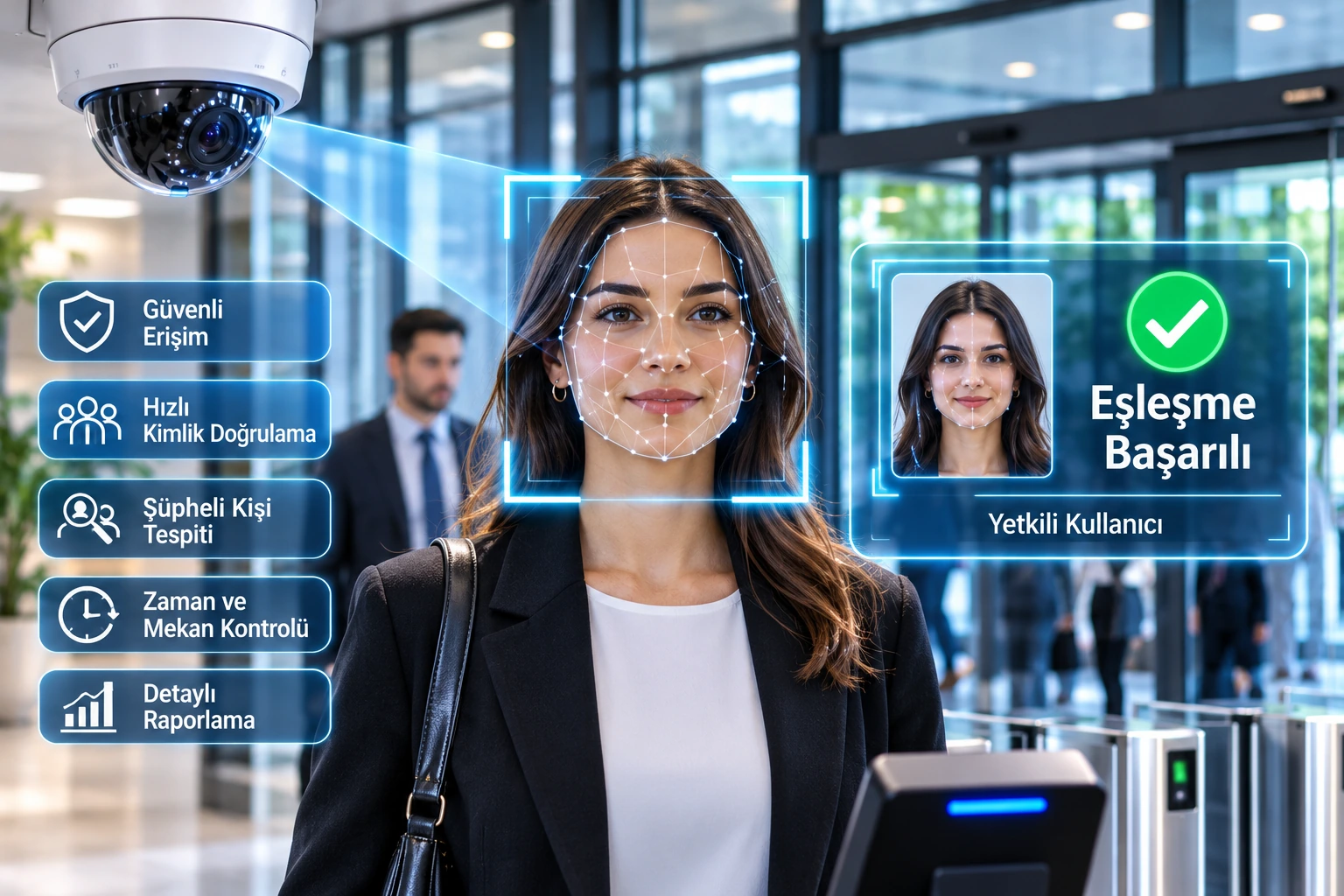
AI-powered facial recognition systems analyse specific biometric characteristics of the human face to verify a person’s identity or match them against people on record. Using deep learning and computer vision algorithms, these systems are used for access control, identity verification, access to high-security areas and certain security applications.
In conventional card-based access systems, a user’s identity is verified using a physical card, PIN or similar credentials; facial recognition technology instead uses characteristics derived from the person’s face for comparison.
However, the technical performance of facial recognition systems depends on more than the sophistication of the algorithm. Camera placement, lighting, image quality, biometric matching thresholds, liveness checks, data security and legal compliance must all be assessed together.
Facial recognition technology may involve processing biometric data to identify people uniquely. Accordingly, particularly in applications such as employee monitoring, store security and public-space surveillance, careful assessment is required under Personal Data Protection Law No. 6698.
What Is an AI-Powered Facial Recognition System?
An AI-powered facial recognition system is a hardware and software solution that represents distinguishing features extracted from facial images numerically to perform identity verification or identification.
The following terms are used in international technical terminology:
Face Detection: detecting a face
Face Recognition: facial recognition
Face Verification: facial verification
Face Identification: identifying a person from their face
Face Embedding: numerical representation of facial features
Face Matching: facial matching
Presentation Attack Detection (PAD): detection of spoofing attempts
Face Quality Assessment: assessment of facial image quality
These terms do not all mean the same thing.
For example, a security camera detecting a face in an image does not mean it can identify the person.
How Does AI Facial Recognition Work?
Although the algorithms used in facial recognition systems may differ, their basic processing stages are similar.
1. Capturing the Facial Image
The system captures the person’s facial image through a camera or suitable imaging device.
At this stage, image resolution, lighting, face angle and motion blur matter.
2. Face Detection
A computer vision algorithm identifies the area of the image containing the face.
If an image contains multiple faces, the system may detect them separately, depending on its supported capacity.
3. Face Alignment and Quality Control
Some systems normalize the face’s position and angle.
The face image can be prepared for analysis using the eyes, nose and other reference points.
Images of insufficient quality may be rejected, or the system may request a new capture.
4. Biometric Feature Extraction
A deep learning model can generate a numerical feature vector from the facial image.
This representation is generally called a face embedding.
Although face embedding data is not a photograph directly readable by a person, it may qualify as biometric data when used to identify someone uniquely.
5. Biometric Matching
The generated feature vector is compared with reference biometric data.
Depending on the algorithm used, the system may calculate a similarity score or distance value.
6. Decision Making
The matching result is compared with a predefined decision threshold.
For example, in an access-control application, a match may trigger an access decision.
However, a matching score does not express absolute certainty about a person’s identity.
The Difference Between 1:1 Facial Verification and 1:N Facial Recognition
One of the most important technical distinctions in facial recognition systems is the difference between verification and identification.
1:1 Face Verification — Facial Verification
In 1:1 facial verification, a person claims a specific identity, and the system compares the facial image with the record associated with that identity.
For example, a user first scans a card or enters a user number. The facial image is then compared only with the biometric data registered for that user.
This process essentially seeks to answer the question:
“Is this person who they claim to be?”
1:N Face Identification — Identifying a Person from Their Face
In 1:N systems, the captured facial image is compared with multiple registered biometric references.
The system assesses whether a possible match exists in the database.
This process seeks to answer the question:
“Which registered person might this face belong to?”
Depending on database size and threshold values, 1:N matching can create different false-match risks.
Technical Comparison
Feature | 1:1 facial verification | 1:N facial recognition |
|---|---|---|
Primary purpose | Verify an identity claim | Search records for an identity |
Comparison | One reference | Multiple references |
Typical application | User verification | Searching for a registered person |
Key error metrics | FMR, FNMR | FPIR, FNIR |
Database impact | More limited | Scale and search method matter |
Legal assessment | Biometric data processing | Biometric data processing and additional surveillance risks |
These two approaches can coexist in the same system. However, it should not be assumed that every device supports both 1:1 and 1:N functions.
The Difference Between Facial Recognition and Face Detection
Face detection is the process of determining whether a human face is present in an image.
Facial recognition, by contrast, involves comparing a particular face with registered biometric references.
For example, a store camera detecting five faces in an image does not mean it knows the identities of those five people.
Similarly, age estimation or facial-expression analysis is not automatically identity recognition.
However, obligations concerning personal-data processing may still arise when facial images are processed.
Technologies Used in AI Facial Recognition Systems
Deep Learning Algorithms
Modern facial recognition systems can use deep neural networks to extract distinguishing features from facial images.
These methods can improve matching performance across different face angles and image conditions.
However, algorithm performance depends on the model, training data and application conditions.
RGB Camera Systems
RGB cameras produce colour images in the visible-light spectrum.
They can be used for face detection and matching when image quality is suitable.
However, insufficient light, strong backlighting and motion blur can affect performance.
Infrared (IR) Imaging
Some facial verification terminals use infrared illumination or an IR camera.
This approach can make image capture easier under certain lighting conditions.
However, the presence of an IR camera alone does not prove that a device provides sufficient protection against spoofing attacks.
3D Depth Sensing
Some biometric terminals can use depth sensors to obtain data about the face’s three-dimensional geometry.
This technology can help distinguish certain spoofing attempts.
However, 3D sensing alone does not guarantee security against every type of attack.
Edge AI Processing
In Edge AI systems, biometric analysis can be performed directly on the terminal or local device.
This architecture can reduce dependence on a central server.
However, biometric data on the device must be stored, updated and deleted securely.
Server-Based Facial Recognition
In centralized systems, facial images or feature data can be processed on a server.
This approach can simplify the management of multiple terminals.
However, a centralized biometric database can pose significant security risks involving unauthorized access and data breaches.
What Is Liveness Detection in Facial Recognition Systems?
Liveness detection refers to checks designed to detect the use of spoofing methods such as photographs, screen images, masks or similar presentations instead of a real human face during biometric verification.
In technical literature, this field is commonly called Presentation Attack Detection (PAD).
Photo Spoofing
An attempt to fool a verification system by showing the camera a photograph of someone’s face.
Screen-Based Spoofing
Using a face displayed on a phone or tablet screen for biometric verification.
Masks and Three-Dimensional Objects
Spoofing attempts made using physical objects designed to resemble a real human face.
How Is PAD Performance Measured?
The ISO/IEC 30107 series provides terminology and evaluation methods for detecting biometric presentation attacks.
Metrics such as APCER and BPCER may be used in this field.
APCER: The error rate at which attack presentations are accepted as genuine users.
BPCER: The error rate at which genuine-user presentations are classified as attacks.
These metrics measure a security dimension different from the identity accuracy of a facial matching algorithm.
Where Are AI Facial Recognition Systems Used?
Access-Control Systems
Where appropriate legal and technical conditions are met, biometric facial verification can be used for controlled door and turnstile access.
However, it should be assessed whether less intrusive alternatives, such as card access or PINs, would be sufficient.
Data Centres and Critical Facilities
In certain areas with high security requirements, biometric verification can form part of a multifactor authentication architecture.
Nevertheless, facial recognition alone does not eliminate all access risks.
Banking and Digital Identity Verification
Face-matching technologies can be used in remote customer onboarding and identity verification processes.
In these applications, relevant sectoral regulations, identity-document verification and fraud-prevention checks are important.
Hospitals and Healthcare Facilities
Staff access verification may be considered in certain controlled areas.
However, the necessary legal conditions for processing biometric data must be met.
Hotels and Accommodation Facilities
Certain access-verification scenarios may be considered where appropriate legal conditions are met.
However, collecting guests’ biometric data should not be treated as a mandatory or default condition of service.
Retail Stores
Although facial recognition technology can be implemented technically in retail settings, identifying customers from images poses much greater privacy risks than ordinary people counting or anonymous crowd-density analysis.
In particular, placing customers on biometric watchlists without their knowledge, automatically labelling them as suspicious, or tracking them across stores can raise serious legal and ethical concerns.
Retail security should therefore first consider video analytics and incident-detection solutions that do not require biometric identification.
Difference Between a Facial Recognition Camera and a Facial Recognition Terminal
Feature | Facial recognition camera | Facial recognition terminal |
|---|---|---|
Typical use | Video imaging and supported biometric analysis | User verification |
Camera placement | According to the surveillance area | According to the controlled verification point |
Access control | Additional integration may be required | Built in on some models |
User interaction | Product-dependent | Usually a specific verification process |
Liveness check | Model-dependent | Model-dependent |
Database | Local or central | Local or central |
Legal risk | Depends on purpose of use | Depends on purpose of use |
A camera’s facial recognition feature does not show that it is suitable for high-security biometric access control.
Camera Placement in Facial Recognition Systems
Face Angle
The position of a person’s face relative to the camera affects matching performance.
Frontal images or images captured at a suitable angle can provide more consistent results with many algorithms.
Camera Height
Camera height should be set to allow users of different heights to be imaged from a suitable angle.
Lighting
Insufficient lighting and strong backlighting can make facial features difficult to capture.
Pixel Density
In facial recognition applications, the pixel dimensions occupied by the face in the image matter, not just the camera’s megapixel rating.
Motion Blur
A long exposure time can reduce image sharpness for people in motion.
Image Quality
NIST evaluations show that poor image quality can increase facial matching errors.
Camera selection and field testing should therefore not rely solely on ideal-condition figures in the manufacturer’s catalogue.
How Is Accuracy Measured in AI Facial Recognition Systems?
A single overall accuracy percentage is not sufficient for facial recognition systems.
In particular, false acceptance and false rejection errors must be assessed separately.
FMR — False Match Rate
FMR is the rate at which comparisons involving different people are incorrectly accepted as matches.
For example, in 1:1 verification, accepting another person’s face as matching the registered user can create a security risk.
FNMR — False Non-Match Rate
FNMR is the rate at which two biometric samples from the same person are incorrectly judged not to match.
This can prevent a genuine user from accessing the system.
FPIR — False Positive Identification Rate
In 1:N search systems, this is the error rate for returning a false identity match when the target person is not in the search database.
FNIR — False Negative Identification Rate
In 1:N search systems, this is the error rate for failing to identify the person sought even though they are in the database.
Decision Threshold and Security Trade-Off
Changing the decision threshold in biometric matching systems can affect false acceptance and false rejection rates.
Stricter matching conditions may reduce certain false-acceptance risks while increasing the likelihood of rejecting genuine users.
The threshold should therefore be set according to the application’s security requirements and validated through field testing.
Why Are NIST Facial Recognition Tests Important?
The US National Institute of Standards and Technology (NIST) tests facial recognition algorithms through independent evaluation programmes.
Two important areas in the current evaluation framework are:
FRTE — Face Recognition Technology Evaluation: evaluation of facial verification and identification algorithms.
FATE — Face Analysis Technology Evaluation: evaluation of age estimation, image quality and specific facial-analysis functions.
NIST evaluations allow the performance of different algorithms to be compared.
However, an algorithm’s success in a NIST test does not guarantee that every commercial device claimed to use it will deliver the same performance.
The camera, software version, threshold settings and actual operating conditions must be assessed separately.
Demographic Performance Differences in Facial Recognition Systems
Facial recognition algorithms’ error rates can vary across different user groups.
NIST research shows that image quality and algorithm characteristics can affect false-match and false-rejection rates across different demographic groups.
For example, lighting that fails to produce suitable image quality across different skin tones may increase error rates for some groups.
Similarly, differences in representation in algorithm training data can also affect performance.
Professional assessments should therefore examine not only overall accuracy but also error rates across user groups and systematic performance differences.
Cybersecurity in Facial Recognition Systems
Security in biometric facial recognition systems is about more than algorithm accuracy.
Biometric Data Security
Facial templates and other biometric data must be protected against unauthorized access.
Encryption
Appropriate cryptographic safeguards should be used when data is transmitted and stored.
Access Permissions
Access to the biometric database and management interfaces should be restricted.
Secure Updates
Updates to device software and analysis algorithms should be managed securely.
Data Deletion
When a user record is deleted, it should be verified how the associated biometric data is removed from every system component.
Alternative Authentication
A secure and accessible alternative should be defined for use if biometric verification fails.
KVKK and Biometric Data in Facial Recognition Systems
In Turkey, Personal Data Protection Law No. 6698 is one of the principal regulations governing the legal assessment of facial recognition systems.
Under the Law, biometric data is classified as special-category personal data.
However, not every facial photograph is automatically considered biometric data. Whether the photograph undergoes specific technical processing to identify the person uniquely or verify their identity is decisive in this assessment.
Use of Facial Recognition in Workplaces
In its decision dated 4 August 2022, No. 2022/797, the Personal Data Protection Board considered the use of facial recognition to monitor entry to and exit from a workplace.
The necessity of biometric data processing, alternative methods, data-processing conditions and retention procedures were among the key matters considered in the decision.
Accordingly, whether a facial recognition system can be used to track employees’ arrivals and departures does not depend solely on technical feasibility or the product being available on the market.
Explicit Consent and Other Processing Conditions
The conditions set out in Article 6 of KVKK must be assessed when processing special-category personal data.
Where an application relies on explicit consent, it is important that consent be given freely.
The validity of explicit consent should be examined carefully, particularly in employer–employee relationships.
Proportionality and Alternative Methods
If the same security objective can be achieved using card access, a PIN or another less intrusive method, the necessity of facial recognition should be questioned separately.
Retention Period
Retention periods should be set for facial images, biometric templates and matching records.
Cross-Border Data Transfers
If personal data is transferred abroad through cloud-based biometric systems, the relevant provisions of KVKK must also be assessed.
Important: Marketing a facial recognition product as “KVKK-compliant” does not, by itself, prove that biometric data processing at a particular organisation is lawful.
The European Union AI Act and Facial Recognition Systems
The European Union Artificial Intelligence Act subjects biometric identification systems to different rules according to their purpose and risks.
Very strict restrictions and specific exceptions apply in particular to real-time remote biometric identification systems used for law enforcement in public spaces.
Certain remote biometric identification systems are also treated as high-risk AI applications.
However, not every 1:1 biometric verification system automatically falls into the same risk class.
Manufacturers, integrators and user organisations operating in the EU market must assess the applicable provisions according to the system’s purpose of use.
What to Consider When Choosing a Facial Recognition System
Selection criterion | What to check |
|---|---|
Purpose of use | 1:1 verification or 1:N search? |
Legal compliance | KVKK processing conditions and proportionality |
Algorithm | Independent performance evaluation |
Accuracy | FMR, FNMR, FPIR, FNIR |
Liveness check | PAD tests and attack scenarios |
Camera | Face pixel size, angle and lighting |
Database | Capacity and data security |
Processing architecture | Edge, local server or cloud |
Integration | Access control, VMS and API |
Cybersecurity | Encryption, authorization and updates |
Alternative method | Card, PIN or other verification |
Field validation | Testing under actual operating conditions |
Field Validation of Facial Recognition Systems
In a professional facial recognition project, showing only that the device works is not enough.
The system must be assessed to determine whether it operates reliably, securely and lawfully under real-world conditions.
Example validation process:
Define the purpose of use and legal basis.
Assess non-biometric alternatives.
Choose a 1:1 or 1:N architecture.
Validate camera placement and image quality.
Test the process for creating reference biometric records.
Run genuine-user verification scenarios.
Measure false acceptance and false rejection rates.
Assess liveness checks using authorised test procedures.
Examine different lighting and user conditions.
Test access-control integration.
Validate data retention, access and deletion processes.
Report results against the acceptance criteria.
Tests must be conducted using lawful methods and with the required data-protection safeguards.
Technical Checklist
- Has the purpose of facial recognition use been clearly defined?
- Have non-biometric alternatives been assessed?
- Has a legal basis been identified under KVKK?
- Have 1:1 and 1:N requirements been distinguished?
- Have the algorithm’s independent performance results been reviewed?
- Have FMR and FNMR values been assessed?
- Have FPIR and FNIR been measured in 1:N systems?
- Have liveness checks and PAD performance been validated?
- Have camera angle and image quality been tested?
- Has performance across different user groups been examined?
- Is biometric data stored securely?
- Have risks of unauthorised access and data breaches been assessed?
- Have user deletion and retention policies been prepared?
- Has an alternative authentication method been established?
- Has field validation been completed?
Frequently Asked Questions
What is an AI-powered facial recognition system?
It is a technology that analyses biometric features derived from the human face to verify identity or match someone against registered people.
Are facial recognition and face detection the same thing?
No. Face detection identifies the presence of a face in an image, while facial recognition involves matching the face against registered biometric references.
What is the difference between 1:1 and 1:N facial recognition?
1:1 verification checks a single identity claim. 1:N identification searches for the face among multiple registered references.
Do facial recognition systems work with 100 percent accuracy?
No. False acceptance and false rejection errors can occur. Performance depends on the algorithm, image quality, threshold settings and operating conditions.
Why is liveness detection necessary?
It is used to help detect spoofing attempts involving photographs, screens or masks.
Do facial recognition systems work at night?
They can operate in certain low-light conditions with suitable camera and lighting technologies. Actual performance depends on the product and field conditions.
Can facial recognition be performed with existing IP cameras?
It may be technically possible if image quality and software support are suitable. However, the purpose of use, data-protection requirements and performance requirements must be assessed separately.
Can a facial recognition system be used to track employees’ arrivals and departures?
Although technically possible, a separate legal assessment is required in Turkey concerning biometric data-processing conditions, necessity, proportionality and alternative methods.
Do facial recognition systems comply with KVKK?
A general and unconditional compliance claim for the product itself is not sufficient. Compliance depends on the purpose and legal basis of the specific data-processing activity, security measures and other obligations.
Conclusion
AI-powered facial recognition systems use advanced computer vision technologies for biometric identity verification and identification.
Technologies such as 1:1 facial verification, 1:N identification, deep-learning-based facial matching and liveness checks can offer solutions for different security needs.
However, algorithmic matching performance alone is not enough to assess a successful facial recognition system.
False acceptance and rejection rates, resistance to spoofing attacks, camera placement, cybersecurity, personal-data protection and field validation must all be considered together.
When biometric data is processed, necessity, proportionality and the assessment of less intrusive alternatives are particularly critical.
The success of a professional facial recognition system should be judged not merely by its ability to recognise people, but by whether it does so with measurable accuracy, strong data security and a lawful operating model.