
What Are AI-Powered Demographic Analysis Systems in Stores? Technologies and Selection Guide
How does AI-powered demographic analysis work in stores? We examine estimated age and gender analysis using AI cameras, people-counting integration, visitor profiles, accuracy measurement, retail KPIs, and KVKK requirements from a technical perspective.
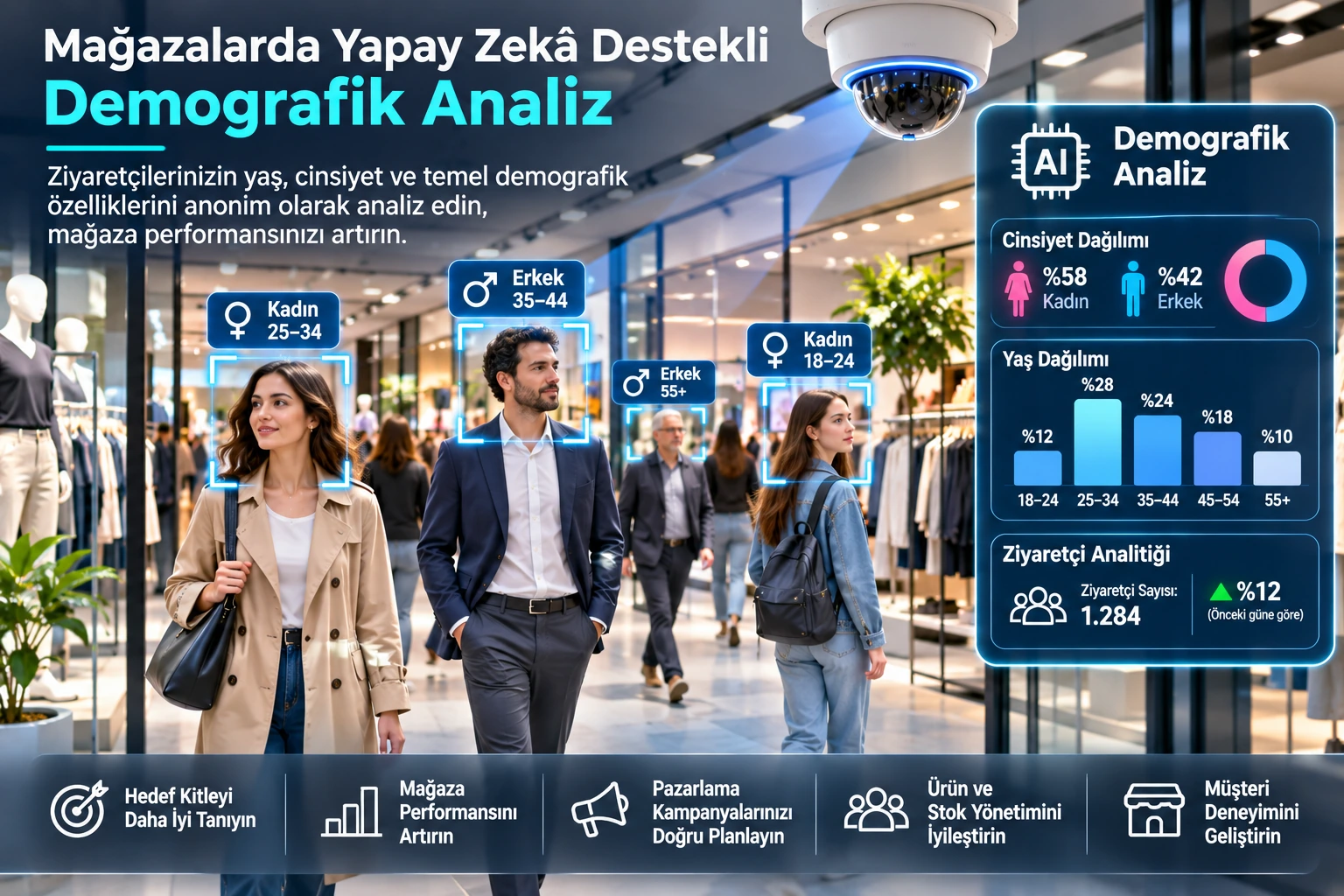
Measuring customer traffic is an important part of evaluating store performance in the retail sector. However, simply knowing how many people entered a store is not always enough for businesses. Visitor-group characteristics, traffic distribution at different times, and which customer groups campaigns reach are also among the information that can support business decisions.
AI-powered demographic analysis systems are technologies designed to use suitable cameras and computer-vision algorithms to classify visible visitor characteristics—for example, by estimated age range—and turn these results into statistical reports.
When used alongside people-counting and retail visitor-analytics solutions, these systems can provide store management with additional indicators of customer-group distribution.
However, demographic analysis results have an important limitation: an age or gender category estimated from camera footage does not definitively establish a person’s actual age, gender identity, or other personal characteristics.
In addition, estimating personal characteristics from images cannot automatically be considered outside the scope of KVKK merely because the output is a statistical report.
What Is AI-Powered Demographic Analysis?
Demographic analysis examines how a particular visitor group is distributed according to characteristics such as age group.
AI-powered video demographic analysis attempts to estimate some of this information from camera footage.
Depending on the product’s capabilities, systems used in retail may provide the following outputs:
Estimated age-group distribution
Appearance-based gender classification
Estimated demographic distribution by hour or day
Aggregated analyses for specific store areas
Visitor statistics associated with people-counting data
Comparisons of visitor distribution before and after campaigns
Not every device includes all these features. Age and gender estimates in particular may contain errors depending on the algorithm’s training data and field conditions.
How Do Demographic Analysis Systems Work in Stores?
1. Capturing Camera Footage
The demographic analysis system receives footage from a supported camera.
Camera placement should ensure that faces or other visible features to be analyzed appear in the image with sufficient detail.
Image quality, lighting, and the person’s orientation relative to the camera affect estimation performance.
2. Detecting a Person or Face Region
The software can detect a person or face region in the image.
However, person detection, face detection, and facial recognition are different processes.
Face detection aims to determine whether a face is present in an image.
Facial recognition may compare data to verify or determine a person’s identity.
Demographic estimation attempts to infer characteristics such as age range from an image.
These processes should not be treated as interchangeable, either technically or legally.
3. Classification Using Artificial Intelligence
The algorithm evaluates specific features in the image to generate estimates for the categories it supports.
For example, a system may place a visitor in a particular age range.
This does not measure the person’s actual age.
Appearance-based gender classification does not determine a person’s gender identity, and systems using binary classification may not accurately represent human diversity.
4. Generating Statistical Data
Estimated results can be aggregated by hour, day, or a specified period.
For example, store management can examine the estimated age-group distribution of visitors analyzed during a particular period.
Whether this distribution represents all store visitors depends on the coverage rate and the algorithm’s performance.
5. Reporting and Business Decisions
Aggregated analyses can be assessed alongside store traffic and sales data.
This approach can provide supporting indicators for marketing and store planning.
Nevertheless, demographic estimates alone do not indicate customers’ purchase intent or individual preferences.
How Is Age Analyzed Using AI?
Age-estimation algorithms can use specific visual features of a face in suitable images to produce an estimate of a person’s age.
Some systems provide a single numerical age, while others provide an age range.
For example:
18–24
25–34
35–44
45–54
55 and older
These categories are examples only. The actual categories may vary according to the manufacturer’s algorithm.
Sources of Error in Age Estimation
Age estimates can be affected by the following conditions:
Low resolution
Insufficient or uneven lighting
Face angle relative to the camera
Partial obstruction of the face
Image compression
The algorithm’s training dataset
Performance variations across different age groups
For example, a visitor who is actually 34 may be classified by the system in the 35–44 age range.
Reports should therefore present estimated age-group statistics, not definitive age data.
What Is AI-Powered Gender Analysis?
Some video-analytics solutions attempt to classify gender based on faces or visible physical characteristics.
However, an important technical distinction applies here.
A classification generated by an algorithm from appearance does not reliably determine a person’s stated gender identity or biological characteristics.
Such outputs should therefore not be interpreted as actual demographic identity information.
Systems using binary classification may produce inaccurate and exclusionary results in particular.
Professional retail analytics should assess whether this feature is genuinely needed and, where possible, favor less intrusive methods of collecting voluntary, aggregated data.
The Difference Between Demographic Analysis and People Counting
People counting and demographic analysis are different technologies.
Feature | People counting | AI demographic analysis |
|---|---|---|
Primary purpose | Measure visitor numbers | Estimate the distribution of specific characteristics |
Main output | Entry and exit counts | Estimated age group, etc. |
Need for face images | Generally not required | Required for some methods |
3D depth sensor | Usable | Does not provide age estimates on its own |
Data-protection risk | Depends on the architecture | May be higher depending on the image and type of inference |
Performance measurement | Counting error | Classification and coverage error |
POS integration | Conversion KPIs | Additional statistical comparisons |
Important: Having a 3D people-counting device does not mean that the same device can analyze age or gender. A different sensor, image-processing capability, or additional software may be required for this.
Demographic Analysis Technologies Used in Stores
AI IP Cameras
Some IP cameras can run demographic-estimation algorithms on images with suitable hardware and software.
With this architecture, analysis can be performed on the camera itself.
However, a camera’s ability to detect people does not mean it supports demographic analysis.
Edge AI Analytics Devices
In Edge AI systems, analysis can be performed on the camera or on a local processing device inside the store.
In certain architectures, this approach can reduce the need to transfer images to a central server.
However, processing data locally does not, by itself, eliminate personal-data processing obligations.
Server-Based Video Analytics
Footage from existing IP cameras can be processed on a central analytics server.
With this architecture, processing capacity, camera count, licensing, and network infrastructure should be assessed.
Cloud-Based Analytics
Cloud systems can provide reporting across multiple locations and centralized management.
However, if images or personal data are transferred to the cloud, data processing, security, and conditions for international transfers should be reviewed separately.
What Can Demographic Analysis Bring to Stores?
Examining Visitor-Group Distribution
Visitor distribution during specific periods can be assessed using aggregated, sufficiently reliable data.
However, estimated demographic distribution should not be treated as identical to the actual customer profile.
Evaluating Campaign Performance
Visitor traffic and estimated distributions can be compared before and after store campaigns.
For example, the proportion of estimates for a particular age group may change after a campaign.
However, further analysis is needed to conclude that the change was caused solely by the campaign.
Comparing Stores and Branches
Visitor statistics for different stores can be compared.
However, direct comparisons between branches with different camera placements, algorithm versions, and coverage rates may be misleading.
Product Category and Space Planning
Demographic estimates can be examined alongside product-area visit intensity and sales data.
However, a visitor’s demographic estimate should not be used to infer that individual’s purchasing preferences from a visit to a product area.
In-Store Digital Displays
Some systems provide estimates of visitor numbers and visible characteristics around digital displays.
Nevertheless, individual ad targeting based on face images, inference of personal characteristics, and behavioral profiling can pose serious data-protection risks.
These applications should also undergo legal assessment and analysis of alternative methods.
How Are Demographic Analysis Data Combined with POS and Retail Analytics?
Demographic analysis reports can be displayed on the same reporting platform as people-counting and sales data.
For example, a store’s daily report may include:
Total visitor count
Number of visitors who could be analyzed
Estimated age-group distribution
Hourly visitor traffic
Number of sales transactions
Total sales amount
and similar indicators may appear together.
However, if only aggregated demographic estimates and total POS data are available, the sales conversion rate for a particular age group cannot be calculated directly.
This requires reliable and lawful data that can be linked to the same visitor group. Matching individual camera footage with sales records, however, can create additional personal-data processing risks.
The Most Important KPIs in Demographic Analysis Systems
KPI | Calculation / assessment | Importance |
|---|---|---|
Analysis coverage rate | Analyzable visitors / reference visitor count | Representativeness |
Age-group classification success | Comparison with reference groups | Estimate reliability |
Age-estimation MAE | Mean absolute age error | Numerical age-estimation performance |
Error differences by group | Performance comparison between groups | Systematic bias |
Missing data | Missing analysis period / total period | Report integrity |
Camera availability | Uptime / total time | Operational continuity |
Comparability between branches | Measurement using the same methods and conditions | Reliability of management reports |
In demographic analyses, it is necessary to measure not only prediction accuracy but also which visitors can be analyzed.
For example, analyzing visitors facing the camera while excluding others may prevent the report from representing all visitors.
How Is Demographic Analysis Accuracy Measured?
MAE for Age Estimation
Mean Absolute Error (MAE) can be used for numerical age estimation.
For example, an MAE value of 5 years does not mean that the system makes an error of at most 5 years for each person.
Age-Group Classification Performance
For systems that output age ranges, classification results can be compared with appropriate reference data.
However, looking only at the overall accuracy rate is not enough.
Rates of confusion between neighboring age groups and the distribution of errors across different groups should also be examined.
Coverage Rate
High accuracy on faces that are easy to analyze does not mean that a system can produce reliable reports for all visitors.
For this reason, the number of visitors included in the analysis and the number who could not be analyzed should be reported.
Performance Differences Between Groups
Algorithms may not perform equally under different imaging conditions or across different groups of people.
It is therefore important to examine performance differences using appropriate, lawful, and voluntary reference data.
Do Demographic Analysis Systems in Stores Comply with KVKK?
One of the most important areas to consider with these technologies is the protection of personal data.
Using AI to estimate age or gender does not mean that anonymous data is being processed in every case.
Processing Images
If camera footage contains people who are identified or identifiable, personal data may be being processed.
The fact that images are not permanently recorded does not automatically mean that temporary processing falls outside the scope of KVKK.
Demographic Estimation vs. Biometric Identification
Not every facial analysis is automatically biometric identity verification.
However, if the system creates face templates, recognizes people again, or processes data for identification purposes, provisions governing special-category personal data may apply.
The nature of the data processed and the legal assessment should be determined according to how the system actually operates.
Explicit Consent Is Not Always the Only Solution
An appropriate legal basis must be established for personal data processing activities.
Where explicit consent is required, it must be freely given, relate to a specific matter, and be informed.
However, simply entering a store does not automatically constitute explicit consent to facial analysis.
Data Minimization
If store management needs only the total number of visitors, estimating age or gender from facial images may not be necessary or proportionate.
Less intrusive alternatives should be considered first.
Retention and Access
A data retention policy should be established for images, extracted features, estimation results, and reports.
Unnecessary retention of personal data should be avoided, and access permissions should be restricted.
Anonymization
Aggregated statistics anonymized irreversibly may not qualify as personal data.
However, how personal data is processed before these statistics are generated should be assessed separately.
In conclusion, marketing a product as “KVKK-compliant demographic analysis” does not, by itself, prove that the specific implementation is lawful.
Demographic Analysis Under the European Union AI Act
The European Union Artificial Intelligence Regulation (AI Act) establishes specific rules for biometric categorization and certain applications that infer personal characteristics.
Not every age-estimation application is automatically considered prohibited or high-risk. However, the system’s purpose, the data used, the characteristics inferred, and the context of use are decisive.
Certain biometric categorization applications based on sensitive personal characteristics have been prohibited, while some biometric systems are regulated as high-risk applications.
Businesses operating in the EU or offering services to the EU market should separately assess whether the relevant obligations apply to them.
Technical Limitations of Demographic Analysis Systems
Camera Angle and Face Visibility
While ceiling-mounted 3D people-counting sensors may be suitable for counting entries, they may not provide sufficient image quality for demographic estimates based on facial-feature analysis.
Lighting and Backlighting
Glass facades, sunlight, and variations in lighting at store entrances can affect estimation performance.
Duplicate Counting
A person leaving and re-entering a store, or passing through the same analysis zone more than once, may be counted multiple times in reports.
RE-ID technologies used for unique-visitor analysis, in turn, require additional technical and data-protection assessment.
Dataset Bias
Limited training data for an algorithm may cause systematic estimation errors across different visitor groups.
Classification Categories
The age ranges and gender categories used by an algorithm may not fully correspond to a store’s reporting needs or to people’s actual characteristics.
What to Consider When Choosing a Demographic Analysis System
Define the business need. Determine whether age-group estimation is genuinely necessary.
Compare alternatives. Consider less intrusive methods such as anonymous people counting, voluntary surveys, and aggregated sales analysis.
Examine the algorithm’s output. Verify whether it provides numerical ages, age groups, or other classifications.
Measure the coverage rate. Determine what proportion of visitors the system can analyze.
Test accuracy. Verify the manufacturer’s claims under real store conditions.
Examine the data flow. Determine where images are processed, stored, and transferred.
Conduct a KVKK assessment. Review the legal basis, proportionality, and transparency requirements.
Check reporting integration. Verify the level of integration possible with people-counting and POS data.
Assess cybersecurity. Review access controls, encryption, and update processes.
Run a pilot. Measure the system’s real-world value through limited-scope, lawful tests.
Technical Checklist for Demographic Analysis in Stores
- Have the need for demographic data and its purpose of use been defined?
- Have less intrusive alternatives been considered?
- Have the classification categories used been reviewed?
- Have camera and algorithm compatibility been verified?
- Have viewing angle, lighting, and image quality been tested?
- Has the analysis coverage rate been measured?
- Have age-estimation and classification errors been assessed?
- Have systematic performance differences between groups been examined?
- Have duplicate counting and data integrity been checked?
- Has it been verified whether images are stored?
- Have KVKK and relevant data-protection obligations been assessed?
- Have the limitations of POS and people-counting reports been defined?
- Has a periodic calibration and validation plan been established?
Frequently Asked Questions
What is a demographic analysis system in stores?
It is an AI-powered analysis system designed to analyze certain visible characteristics in camera footage and generate statistics such as estimated age group.
Can AI accurately determine customers’ ages?
AI can estimate age but cannot determine a person’s actual age with certainty. Results vary according to the algorithm, image quality, and testing conditions.
Are demographic analysis and people counting the same thing?
No. People counting measures the number of visitors, whereas demographic analysis produces estimates about specific characteristics.
Do 3D people-counting sensors perform demographic analysis?
Not always. Many people-counting sensors that operate only on depth data do not estimate age or gender.
Can demographic analysis be performed using existing IP cameras?
It may be technically possible if suitable camera footage and analysis software are available. However, image quality, algorithm performance, and legal requirements must be assessed separately.
Is facial recognition required for demographic analysis?
Facial recognition for identification is not always necessary. However, face detection or inference from facial features may still fall within the scope of personal data processing.
Does demographic analysis in stores comply with KVKK?
Compliance depends on how the system processes data, its purpose, its legal basis, and proportionality. It cannot be said that every product or implementation automatically complies with KVKK.
Does demographic analysis increase sales?
It does not guarantee a direct increase in sales. Reliable and lawful data may support certain planning and marketing decisions.
Conclusion
AI-powered demographic analysis systems in stores can add estimated age groups and other statistics on visible characteristics to retail visitor analytics.
When assessed alongside people-counting and sales reports under appropriate conditions, these data can provide a more comprehensive view of the visitor population’s composition.
However, demographic estimation technologies may have different technical limitations and more extensive personal data protection risks than conventional people-counting systems.
Algorithm accuracy, analysis coverage, performance differences between groups, data minimization, and legal compliance should be assessed together.
The primary goal of professional retail analytics is not to estimate as many personal characteristics about visitors as possible, but to make better business decisions using data that is genuinely necessary, reliable, and lawful.