
3D People Counting Systems: What Are They and How Do They Work? Technologies and Selection Guide
What are 3D people counting systems, how do they work, and how do they differ from 2D systems? We examine stereo vision, depth maps, ToF and AI technologies; entrance and exit counting, mounting height, calibration, accuracy validation, choosing a people-counting sensor, shopping mall and retail analytics, RE-ID, and KVKK.
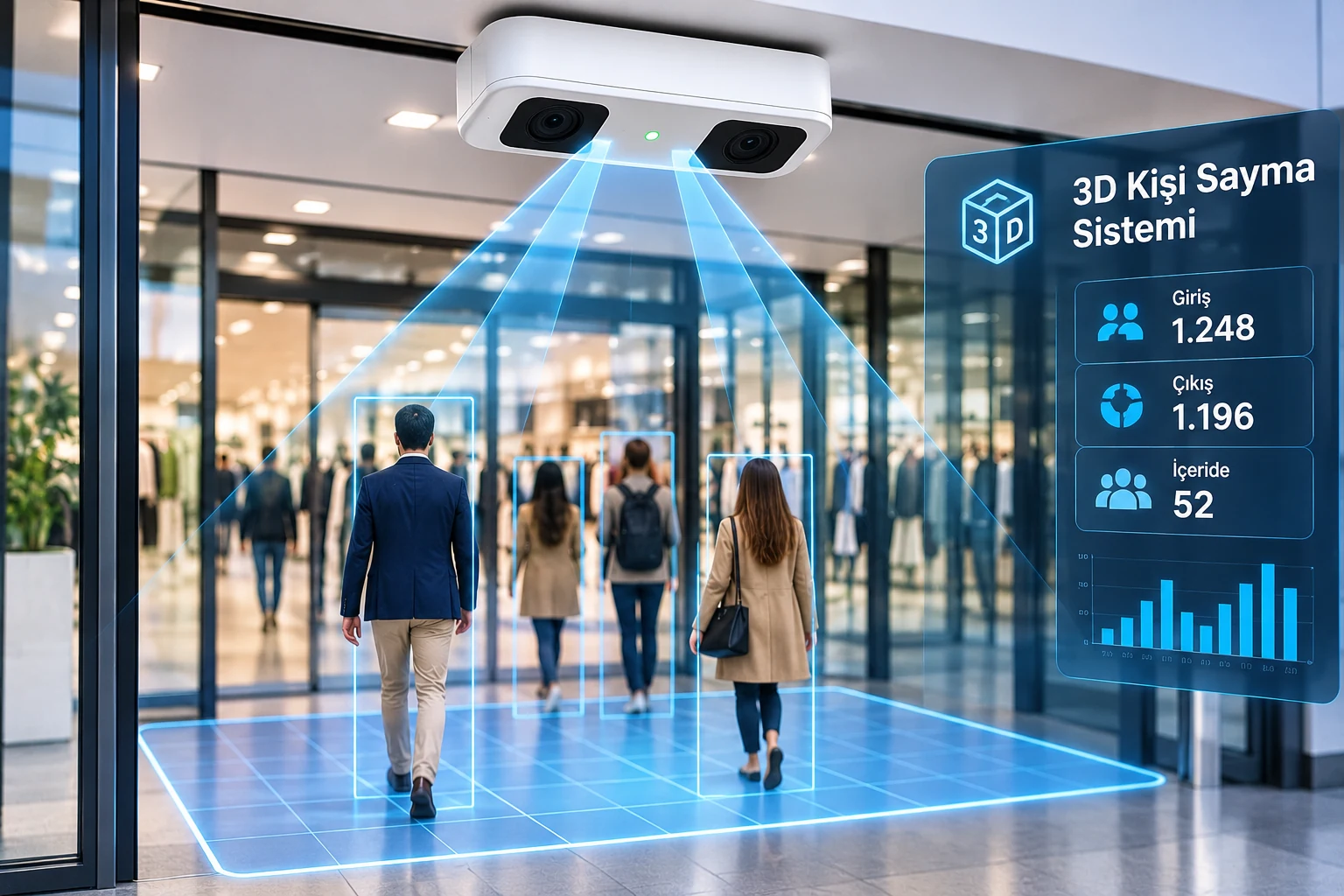
3D people counting systems are electronic visitor analytics solutions that use three-dimensional sensing technologies to measure the number of people entering and leaving stores, shopping malls, airports, and other commercial spaces. Typically ceiling-mounted 3D people-counting sensors analyze people’s movements as they pass, drawing on stereoscopic imaging, depth maps, and AI-powered object-tracking algorithms.
Unlike traditional people-counting methods, 3D systems, with suitable hardware and algorithms, can assess not only people’s positions in an image but also depth or height information within the sensing area. This capability may offer an advantage in distinguishing people walking side by side, measuring crowded entrances, and filtering out some non-human objects.
However, the fact that a sensor uses 3D technology does not mean it will count flawlessly in every environment. Mounting height, entrance width, lighting, the sensor’s field of view, calibration, and visitor movement patterns all affect real-world performance.
A professional 3D people counting system should bring together suitable sensor technology, correct on-site installation, validated counting performance, and a reliable reporting infrastructure.
In this guide, we take an in-depth look at how 3D people-counting technology works, how it differs from 2D systems, where it is used, the technical selection criteria, and correct implementation methods.
What Is a 3D People Counting System?
A 3D people counting system consists of sensors, software, and reporting components designed to determine the number of people passing through a specified point using three-dimensional sensing data.
Its primary function is to measure separately the movement of people entering and leaving an area.
Depending on the system, the following data may be generated:
Number of people entering.
Number of people leaving.
Hourly and daily visitor traffic.
Real-time or calculated occupancy.
Usage intensity of specific entrances.
Zone visits, on supported systems.
Queue and waiting-time analytics, on supported systems.
Distinguishing staff movements using specific methods.
Centralized visitor reporting data.
Not every 3D sensor offers all of these capabilities.
For example, it should not be assumed that a 3D sensor that measures traffic through a single doorway can also automatically calculate customers’ dwell times in every department of a store.
How Do 3D People Counting Systems Work?
The operating principle of 3D people counting systems depends on the sensor technology used. One common method is stereoscopic imaging.
1. Creating Stereo Images
In stereoscopic systems, two image sensors positioned a specific distance apart observe the same area from different angles.
This setup uses a principle similar to the way human vision perceives depth from two different viewpoints.
2. Calculating the Depth Map
Depth information can be calculated from the positional differences between corresponding points in the two images.
This allows the system to assess not only the horizontal positions of objects in the sensing area but also their distances from the camera.
3. Detecting People
Using depth data and suitable image-processing algorithms, candidate objects corresponding to people in the detection area are identified.
Some algorithms use the head and shoulder regions, while others draw on body geometry or other object features.
4. Tracking Movement
The detected objects’ movements are tracked over short periods.
This allows the system to determine where a person entered the detection area and which direction they moved in.
5. Crossing the Virtual Counting Line
When a person crosses a defined counting line or zone under specified conditions, an entry or exit event is generated.
In some systems, merely touching the line is not enough to trigger a count; the person must complete a defined movement within the tracking zone.
6. Reporting Data
Counting results can be collected on the device or in centralized reporting software.
These data can be analyzed across different dimensions, such as store, entrance, day, and time.
What Is the Difference Between 3D Stereo Vision and ToF?
3D people counting systems are not limited to dual-lens stereo technology.
Some devices use active depth-measurement methods.
Stereo Vision
It calculates depth using geometric differences derived from two separate images.
Active Stereo
It can augment stereo vision with methods such as suitable active illumination or a structured pattern.
This approach may help calculate depth in some low-light or low-texture scenes.
ToF — Time of Flight
ToF systems use an active depth-measurement principle in which distance is calculated from the reflection of emitted light.
Detection behavior varies according to the hardware and implementation used.
Technology Comparison
Criterion | 3D stereo | Active stereo | ToF |
|---|---|---|---|
Underlying method | Depth from two images | Stereo depth with support | Depth from time of flight of light |
Active illumination | Not required | Available | Generally required |
Low-light performance | Depends on model and scene | Can be supported by active illumination | Depends on device and environmental conditions |
Crowd counting | Depends on algorithm and coverage | Depends on algorithm and coverage | Depends on algorithm and coverage |
Typical mounting | Ceiling-mounted | Ceiling-mounted | Ceiling-mounted |
Performance limitation | Image texture, occlusion, light | Active illumination and scene conditions | Surface reflections and environmental conditions |
It cannot be said that a single depth technology delivers the highest accuracy in every environment. The right assessment must be based on the sensor model’s actual field results.
Difference Between 3D and 2D People Counting Systems
2D people-counting solutions generally use positions, movement, and object features in the image.
3D systems, by contrast, can also assess depth information when equipped with suitable hardware.
Feature | 2D people counting | 3D people counting |
|---|---|---|
Primary detection | Two-dimensional image analysis | Image and depth analysis |
Depth information | May not be directly available | May be a core component |
People passing side by side | Depends on the algorithm | Depth separation may offer an advantage |
Partial occlusion | Can be challenging | May be distinguished better in some cases |
Object filtering | Depends on visual features | Height/depth may provide additional information |
Hardware cost | Varies by application | May require a specialized sensor |
Effect of lighting | Depends on the camera | Depends on the selected 3D technology |
Accuracy | Not necessarily low | Not necessarily high |
It should not be assumed that a modern AI-based 2D solution performs worse than all 3D sensors.
Accuracy comparisons should be tested in the same passage area, using the same traffic scenarios and the same reference counting method.
What Are the Advantages of 3D People Counting Systems?
Measuring Crowded Entrances
Using depth information may help distinguish people passing close together more effectively under certain conditions.
This capability is particularly important at wide store entrances and during peak visitor hours.
Distinguishing Entry and Exit Directions
Suitable sensors can record entries and exits through the same detection area as separate events.
However, incorrectly configured direction settings can cause results to be reported in reverse.
Filtering Non-Human Objects
Some 3D algorithms can attempt to distinguish shopping carts and other objects from people by assessing object height or geometry.
This function is not error-free in every scenario.
In particular, tests should check that children and wheelchair users are not incorrectly filtered out.
Managing Reversing Movements
People who approach the counting zone but turn back before completing the passage may not be counted as valid entries by suitable tracking algorithms.
However, not all devices handle return movements and recounting in the same way.
Centralized Reporting
Counts from multiple sensors can be consolidated on the same reporting platform.
This makes it possible for businesses with multiple branches to compare visitor traffic by branch, day, and time.
Where Are 3D People Counting Systems Used?
Retail stores
Customer entries and exits, peak hours, and sales performance indicators
Shopping malls
Doorway traffic, area occupancy, and multi-entrance analysis
Airports
Passenger flow, passage counts, and operational congestion
Museums and exhibition spaces
Visitor entries, section usage intensity, and exhibition evaluation
3D people counting systems can also be considered for supermarkets, office buildings, hospitals, exhibition venues, libraries, and similar facilities.
However, it should not be assumed that the same sensor is suitable for every facility that needs visitor counting.
How Should 3D People Counting Sensors Be Mounted?
Mounting is one of the most important factors determining system accuracy.
No matter how advanced a sensor’s technical specifications are, incorrect positioning can adversely affect measurement performance.
1. Mounting Height
The mounting-height range specified by the manufacturer should be followed.
2. Entrance Width
The sensor’s field of view should cover the actual passage area.
For example, whether a single sensor is sufficient for a store entrance 6 meters wide depends on the device’s lens and mounting height.
If the entrance width exceeds the sensor’s capacity, multiple devices can be used.
3. Vertical Mounting Angle
The ceiling-mount geometry recommended by the manufacturer should be maintained.
An unsuitable tilt can affect the sensor’s depth measurement and tracking zone.
4. Doors and Moving Objects
Door panels, moving advertising displays, and other objects can affect the detection area.
People may be partially obscured, particularly as the entrance door opens and closes, which can cause problems.
5. Air Curtains and Lighting
An air curtain does not automatically obstruct counting for every 3D sensor.
However, objects moved by airflow, door geometry, or the optical conditions of the device in question can affect detection.
Similarly, spot lighting, reflections from glass, and strong backlighting can affect the performance of some sensor technologies.
Therefore, no single fixed mounting distance that applies to all manufacturers should be specified for air curtains, EXIT signs, and lighting fixtures.
The mounting point should be determined with due regard to the manufacturer’s technical documentation and the actual field of view.
6. Dual-Sensor Entrances
When multiple sensors cover the same passage area, double counting must be prevented in overlapping zones.
Some manufacturers manage this issue through dedicated tracking-zone settings or centralized count-merging methods.
However, mounting sensors side by side does not, by itself, solve the double-counting problem.
What Is Calibration in 3D People Counting Systems?
Depending on the technology used, calibration may refer to configuring the sensor’s detection geometry and counting parameters to suit the actual installation conditions.
For 3D sensors, this process generally includes:
Defining the mounting height.
Performing depth or geometric calibration.
Defining entry and exit directions.
Positioning the counting line.
Configuring the tracking zone.
Configuring any required filters.
These steps are included.
Important: On-site adjustment or geometric calibration alone does not prove that the sensor achieves the target accuracy. Separate validation is required for that.
How Is the Accuracy Rate of 3D People Counting Systems Measured?
The accuracy of 3D people counting systems can be evaluated by comparing automated count data with reliable reference counts.
However, the method used to calculate accuracy must be clearly stated.
Example Calculation of Counting Accuracy
Suppose a manual count at a store entrance over a given period is 500 people.
Suppose the 3D sensor recorded 488 entries over the same period.
Absolute counting error = |488 − 500| = 12 people
Percentage error = 12 / 500 × 100 = 2.4%
Total count agreement = 97.6%
This result is a performance indicator based on the total counting difference for the period in question.
However, it does not mean that the system correctly detected every actual passage.
Some actual passages may have been missed, while some false passages may have been added.
Therefore, where possible, false counts and missed counts should also be examined on an event-by-event basis.
Entry and Exit Should Be Measured Separately
Measurement | Manual reference | 3D sensor | Absolute error | Total count agreement |
|---|---|---|---|---|
Entry | 500 | 488 | 12 | %97.6 |
Exit | 450 | 458 | 8 | %98.22 |
Reporting entry and exit figures separately makes it possible to identify direction-specific errors in the system.
Do 3D People Counting Sensors Deliver 99 Percent Accuracy?
Some manufacturers publish accuracy results of 95%, 98%, or 99% for their products.
However, there are important limitations when comparing these figures:
Sensor model tested.
Software version used.
Mounting height.
Entrance width.
Traffic volume.
Lighting.
Sample size.
Accuracy formula used.
Whether the test was conducted in a laboratory or in the field.
A manufacturer’s published claim of 99% accuracy does not mean that a 99% result is guaranteed in every store and under all conditions.
In professional projects, the accuracy target should be defined in the contract and measured on site after commissioning.
How Is Validation Performed for 3D People Counting Systems?
Validation is the process of verifying whether the system achieves the target counting performance under actual operating conditions.
A sample on-site validation may consist of the following steps:
Check the counting area and entry and exit directions.
Set a test period for the manual reference count.
Select low- and high-traffic scenarios.
Examine single-person, group, and two-way passages.
Record entry and exit counts separately.
Compare sensor results with the manual reference.
Identify error types and their causes.
Make the necessary adjustments.
Repeat the test under the same conditions.
Prepare an accuracy report.
Passage Scenarios Recommended for Testing
Scenario | Validation objective |
|---|---|
Single-person passage | Basic counting |
Two people walking side by side | Separating individuals |
Crowded group | Occlusion and tracking |
Simultaneous entry and exit | Direction classification |
Turning back at the entrance | Preventing a false entry count |
Waiting in the counting zone | Repeat-count check |
Stroller | Object filtering |
Shopping cart | Detecting non-human objects |
Family with children | Detecting people of different heights |
Wheelchair | Coverage of target user groups |
Results from these tests should be evaluated in light of the device’s intended use and the contractual scope.
What Data Do 3D People Counting Systems Report?
Basic people counting systems provide entry and exit counts.
With suitable software infrastructure, these data can be converted into various business indicators.
Visitor Traffic
Daily, weekly, and monthly entry counts can be monitored.
Peak-Hour Analysis
The time periods with the heaviest visitor traffic can be identified.
Occupancy Analysis
Entry and exit data can be used to estimate the number of people in a given area.
Basic formula:
Current occupancy = Starting occupancy + Entries − Exits
However, occupancy estimates may be inaccurate if the starting value is wrong, some doors are not counted, or entry and exit errors accumulate.
Comparisons Between Stores
Visitor traffic profiles can be compared across stores in multi-branch businesses.
However, entry counts from different stores must be produced using the same measurement definition and equivalent data quality.
Checkout and Staffing Planning
Peak traffic hours can be used to assess checkout capacity and staffing plans.
Nevertheless, a high entry count does not always mean high sales demand.
3D People Counting Systems and the Sales Conversion Rate
In retail analytics, visitor traffic can be assessed alongside POS data to produce indicators of sales performance.
Example
At a store, per day:
2,000 visitor entries.
300 sales transactions.
Suppose these figures were recorded.
Transaction / entry ratio = 300 / 2,000 × 100 = 15%
This result is the ratio of the number of sales transactions to the number of visitor entries.
Because one person may make more than one purchase, or enter the store again on the same day, this figure should not be treated directly as the unique-customer conversion rate.
To measure the conversion rate of actual unique visitors, the measurement definition and required data sources must be specified separately.
Can 3D People Counting Be Used for Heat Maps and Zone Analysis?
Some 3D people counting sensors and their associated analytics platforms can measure human movement and density in specific areas.
However, entry-exit counting and an in-store heat map are not the same function.
For example, if a single sensor above the door can see only the entrance, it cannot measure the density of shoppers in the aisles at the back of the store.
Heat maps or dwell-time analysis in specific aisles require:
Required area coverage.
Suitable sensor positioning.
Time-based tracking data.
Analytics software support.
Measurement definition.
These are required.
Measurable Indicators in Zone Analytics
In suitable systems:
Number of entries into a zone.
Density of people in a specific zone.
Time spent in a zone.
Flow between specific areas.
Number of people in a queue.
Indicators such as these can be generated.
However, it should not be assumed that every 3D people counting device offers these functions.
What Is RE-ID in 3D People Counting Systems?
RE-ID (Re-Identification) is a technology designed to associate different observations, using specific technical methods, to determine whether they relate to the same person.
However, 3D people counting and RE-ID are not the same thing.
A standard 3D sensor can track a person briefly within its field of view and register a single passage event.
This does not mean that the person will be recognized as the same individual if they return an hour after leaving the store.
Key Parameters for RE-ID
Matching technology used.
Matching time window.
Type of data stored.
False-match rate.
Missed repeat visits.
Support for matching across multiple sensors.
Data protection and retention policy.
For example, Xovis states in its 3D sensor and data privacy information that its standard sensors are not designed to recognize people who leave their field of view and later return using persistent identity information.
Therefore, when purchasing, the functions “3D tracking,” “multi-sensor tracking,” and “repeat-visit RE-ID” should be queried separately.
Do 3D People Counting Systems Comply with KVKK?
The assessment of 3D people counting systems in relation to personal data depends on the actual data-processing methods of the sensor and software used.
Some devices process images only on the device and send aggregated count data to a central system.
Others may store images for verification purposes or associate people’s movements over specific periods.
Therefore, the fact that a product is 3D does not automatically mean that it does not process personal data.
Questions to Consider
Are raw images generated or stored?
Are images transferred outside the device?
Can individuals be re-identified?
Are individual tracking IDs used?
Can these IDs be linked to other data?
How long are records retained?
What data can the central system access?
Is data transferred abroad via cloud infrastructure?
Systems that genuinely produce anonymous aggregate statistics should be assessed differently from systems that process images or tracking data relating to identifiable individuals.
For a detailed legal assessment, the guide on GüvenlikOnline KVKK-Compliant People Counting Systems can be consulted.
Which Manufacturers Offer 3D People Counting Systems?
Various manufacturers around the world develop 3D people counting solutions.
Current product note: Axis’s P8815-2 3D people-counting device has been discontinued. The manufacturer lists AXIS Object Analytics solutions as alternatives. However, the new software should not be assumed to be identical in every technical specification to the previous dedicated stereo sensor.
Before selecting a product, verify the manufacturer’s current support and the model’s actual counting capabilities.
What to Consider When Choosing a 3D People-Counting System?
For a professional purchasing assessment, it is not enough to consider only the sensor’s catalog accuracy or price.
Technical Selection Criteria
Criterion | Question to ask |
|---|---|
Detection technology | Stereo, active stereo, or ToF? |
Mounting height | Is it suitable for the actual ceiling height? |
Entrance width | Is one sensor enough? |
Traffic density | Has it been tested in crowds and with two-way traffic? |
Counting accuracy | How is it measured in the field? |
Staff exclusion | What is the actual method? |
Detection of children and objects | Which scenarios are supported? |
Calibration | Which method is used? |
Multiple sensors | How are overlap and double counting handled? |
Data security | What image and tracking data are processed? |
Integration | What API and data-transfer options are available? |
Behavior during outages | Are local data storage and subsequent transfer available? |
Reporting | Can analysis be performed by branch and entrance? |
Licensing | Is there an annual fee in addition to the hardware cost? |
Maintenance | Is remote monitoring and revalidation support available? |
Especially in chain-store projects, the long-term cost of the reporting software should be assessed alongside sensor selection.
One Sensor or Multiple Sensors?
The decision should not be based solely on the width of the doorway.
Mounting height, the sensor’s coverage geometry, visitors’ direction of movement, and entrance design are also important.
If multiple sensors are used, the prevention of double counting, data collection, and central reporting functions should also be tested.
Why Can 3D People-Counting Systems Count Incorrectly?
Counting errors are not caused solely by the sensor hardware.
Problem | Possible effect |
|---|---|
Incorrect mounting height | Depth and target-detection errors |
Incorrect sensor angle | Disruption of the tracking zone |
Door leaf obstructing the view | Missed person crossings |
People waiting at the entrance | Incorrect or duplicate counts |
Very dense group movement | Errors in distinguishing individuals |
Low light or reflections | Detection loss depending on the technology |
Incorrect counting line | Errors in entry and exit direction |
Sensor overlap | Double counting |
Firmware change | Change in algorithm behavior |
Network or server outage | Incomplete reporting data |
Restarting the sensor alone may not be enough to resolve these issues.
Where necessary, the physical installation, algorithm configuration, and data-transfer chain should be examined together.
Periodic Maintenance of 3D People-Counting Systems
The purpose of periodic maintenance for people-counting systems is not merely to keep the sensor operational.
The maintenance process should cover three core areas:
1. Hardware and system health: Checks of the sensor, network, power, software, and communications.
2. Counting accuracy: Comparing entry and exit performance against reference counts.
3. Data integrity: Ensuring that the counts generated are correctly transferred to the central reporting system.
Revalidation should be considered, particularly after store renovations, changes to entrance design, sensor replacement, or major software updates.
Detailed maintenance procedures should be determined according to the sensor model, operational risk, and service agreement.
How Are the Costs of 3D People-Counting Systems Calculated?
The total investment cost is not limited to the sensor price.
Main cost items:
3D sensor hardware.
Number of sensors required per entrance.
Installation and cabling.
PoE or other power infrastructure.
Setup and calibration.
Accuracy validation.
Software license or subscription.
Data transfer and integration.
Cloud or on-premises server infrastructure.
Technical service and periodic maintenance.
For example, the same make and model may be used in two stores, but if entrance widths, ceiling heights, and integration requirements differ, the total project cost may also vary.
Therefore, rather than the unit price of the device, the total cost of ownership (TCO) and measurement reliability should be assessed together.
Technical Checklist for 3D People-Counting Systems
- Has the data to be measured been clearly defined?
- Has the 3D technology to be used been identified?
- Is the mounting height within the manufacturer’s limits?
- Have the entrance width and sensor coverage been calculated?
- Is sensor placement affected by door movement?
- Have the EXIT sign and lighting obstructions been assessed?
- Have the effects of air curtains and moving objects been checked?
- If there is more than one sensor, has overlap been managed?
- Have the entry and exit directions been configured correctly?
- Does the counting line represent the actual crossing?
- Has calibration been completed in accordance with the manufacturer’s procedure?
- Have individual and group crossings been tested?
- Has the simultaneous entry-and-exit scenario been verified?
- Have return movements and waiting movements been tested?
- Have scenarios involving children and non-human objects been assessed?
- Has a manual reference count been performed?
- Have entry and exit errors been reported separately?
- Have the accuracy target and calculation method been defined?
- If staff-exclusion functionality is available, has it been tested?
- Have the need for RE-ID and its support status been assessed separately?
- Has data consistency between the sensor and reporting system been checked?
- Has data transfer after a network outage been verified?
- Have KVKK and personal data processing requirements been assessed?
- Have the firmware and manufacturer support period been checked?
- Has a periodic maintenance and revalidation plan been prepared?
- Have the technical acceptance report and test results been delivered?
Frequently Asked Questions About 3D People-Counting Systems
What is a 3D people-counting system?
It is a sensor-and-software system that uses depth-sensing methods to measure the number of people passing through designated areas.
How does a 3D people-counting system work?
Depending on the technology used, it analyzes data obtained from stereo images or active depth measurement, tracks human movement, and generates entry and exit events in a defined crossing zone.
What is the difference between 3D and 2D people counting?
3D systems can use depth information. 2D systems primarily use position and movement characteristics in the image. With both technologies, actual accuracy depends on the model and field conditions.
Do 3D people-counting systems count with 100 percent accuracy?
100 percent accuracy cannot be guaranteed in every environment. Performance should be assessed through real-world field tests.
At what height can 3D people-counting sensors be installed?
It varies according to the manufacturer and lens model. Some products operate at approximately 2.5–6 meters, while other products may offer lower or higher mounting options.
How wide an entrance can a single 3D sensor count?
There is no fixed value. The coverage width is determined by the sensor model, lens, and mounting height.
Does 3D people counting work in the dark?
Some devices using active depth or suitable illumination technology can operate in low light. It should not be assumed that all stereo sensors deliver the same performance in complete darkness.
Can 3D people counting detect children?
Some systems may offer features designed to distinguish children from adults. However, height, object filtering, and counting rules should be tested under real-world field conditions.
Do 3D people-counting systems count shopping carts as people?
Suitable models can filter out non-human objects using object geometry and depth information. However, this feature is not error-free in every situation.
Does a 3D people-counting system count someone who turns back?
If a person turns back before completing the crossing, some tracking algorithms may exclude that movement from the count. If the person leaves the area and re-enters later, a new entry event may be generated.
Are 3D people counting and RE-ID the same?
No. Short-term movement tracking does not mean that the same person can be recognized again at different times.
Do 3D people-counting sensors record images?
Some devices transmit only counts and anonymous statistics; others may include image processing and storage for verification or other analytics purposes. This should be checked for each model.
Do 3D people-counting systems measure sales conversion?
They can provide visitor entry data. Measuring sales conversion requires suitable linkage to POS data and a clearly defined metric.
Is a dedicated recorder required for 3D people counting?
Not always. Some sensors run analytics on the device and send numerical data directly to central software. System architecture varies by manufacturer.
Do 3D people-counting systems need calibration?
It is important to configure settings appropriately for installation and operating conditions. The calibration method depends on the sensor model, and accuracy should be validated afterward.
What is the most important criterion when choosing a 3D people-counting system?
No single criterion is sufficient. Real-world field accuracy, entrance coverage, mounting conditions, data quality, software integration, KVKK, and total cost of ownership should all be assessed together.
Conclusion: The Right Technology and Reliable Data in 3D People-Counting Systems
3D people-counting systems are advanced analytics solutions that use depth-sensing technologies to measure visitor traffic.
Especially in stores, shopping centers, and facilities with busy entrances, they can support direction-based measurement of human movement and the generation of visitor traffic data.
However, having 3D technology alone is not enough for a sensor.
Mounting height, coverage area, crossing behavior, correct configuration, data transfer, and field validation determine the system’s actual performance.
It should also not be assumed that advanced functions such as RE-ID, heat maps, staff exclusion, and in-store behavioral analytics are automatically available in every 3D sensor.
The right 3D people-counting system is not merely a device that detects people; it measures specified visitor movements with validated performance and reports the data in a form that can be used reliably for business decisions.
Therefore, in professional projects, rather than the device’s catalog accuracy, actual field performance, technical acceptance criteria, data integrity, and sustainable maintenance should be the basis.