
Security Systems in Pharmacies: A Guide to Cameras, Alarms, and Medication Protection
How should security systems be selected for pharmacies? We examine IP cameras and NVRs, burglar alarms, medication and inventory security, access to restricted areas, cold-chain temperature and humidity monitoring, early warning, fire detection, and KVKK requirements. An integrated security guide for pharmacies, featuring camera placement that protects patient privacy, a sample recording-capacity calculation, and a technical checklist.
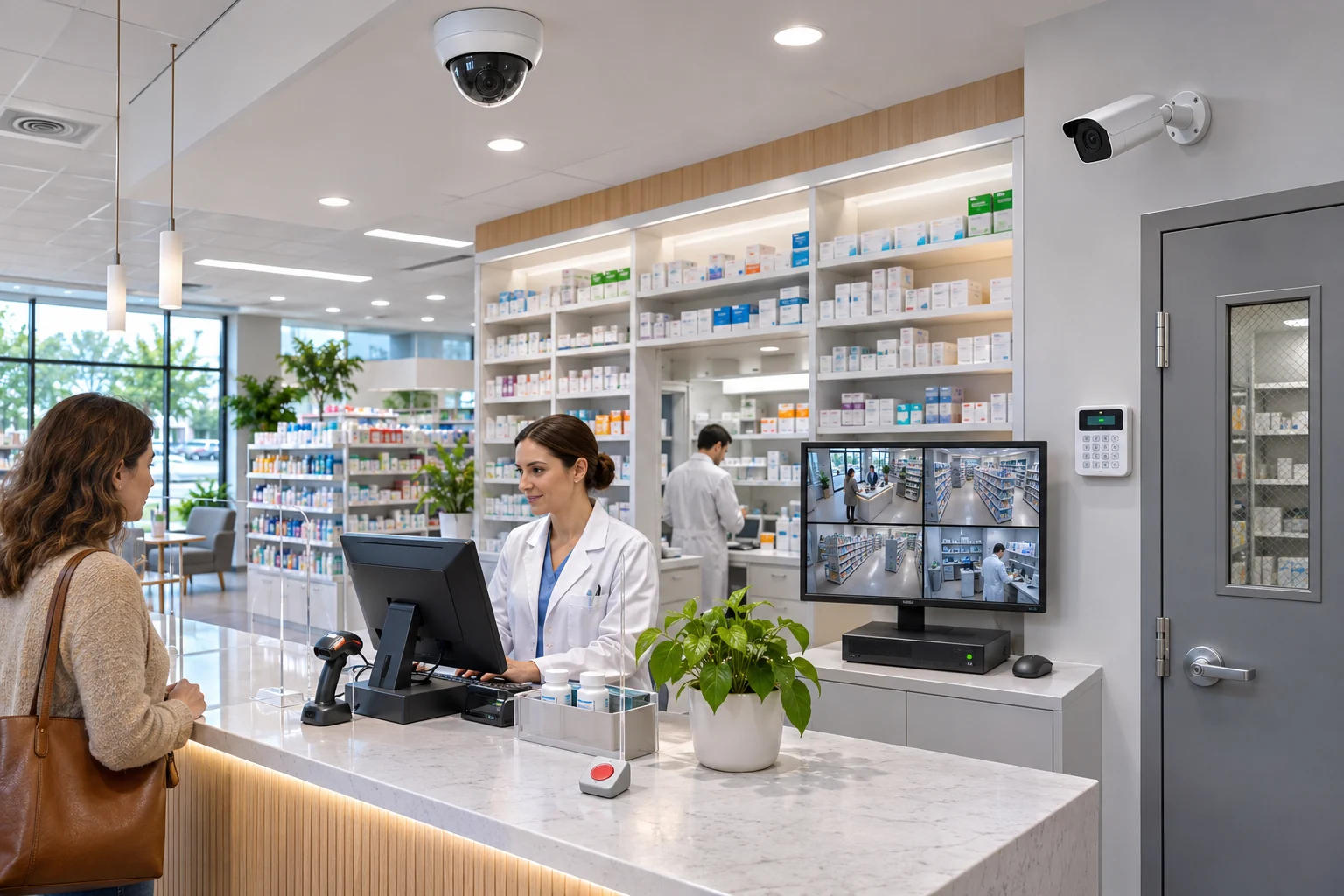
Pharmacy security systems comprise the physical and electronic solutions used to protect medicines and other products, ensure the safety of employees and visitors, prevent unauthorized entry, monitor the cold chain, and detect potential emergencies early. IP security cameras, burglar alarm systems, electronic access control, temperature and humidity monitoring devices, fire detection systems, and remote notification technologies are the main components of this security infrastructure.
Pharmacies have security requirements that differ from those of traditional retail stores. Keeping medicines under appropriate conditions, preventing unauthorized people from accessing certain areas, and protecting patients’ sensitive information directly affect security-system design.
For example, a security camera installed in a pharmacy may help investigate theft incidents. However, camera footage cannot reliably measure temperature changes in a cold-chain refrigerator or prove that a medicine has been stored under appropriate conditions.
Similarly, a burglar alarm can detect unauthorized entry while the pharmacy is closed, but it cannot replace cybersecurity measures that control access to patients’ prescriptions.
Effective pharmacy security should be based on a multilayered approach that manages physical protection, electronic security, monitoring of medication storage conditions, and patient privacy together.
What Is a Pharmacy Security System?
A pharmacy security system is a collection of security components designed to protect the pharmacy’s physical premises, medication stocks, employees, and certain operational processes against defined risks.
The main objectives are:
Reducing the risk of theft and unauthorized entry.
Recording security incidents in the cash register and entrance/exit areas.
Protecting storerooms and medication storage areas.
Reporting critical conditions relating to the cold chain and ambient temperature.
Assessing fire, water-leak, and other technical risks.
Identifying power or communications outages.
Restricting access to records and security systems.
Protecting the privacy of patients and employees.
The scope of the system may vary according to the pharmacy’s size, location, entry points, and medication-storage infrastructure.
Key Security Risks in Pharmacies
Pharmacies’ security needs are not limited to the risk of theft.
Risk | Affected area | Priority security solution |
|---|---|---|
Business premises theft | Entrance, sales area | Physical lock, alarm, CCTV |
Unauthorized storeroom access | Medication storeroom | Lock, contact sensor, and suitable access control |
Cash-register security incident | Payment counter | Carefully positioned cameras, alarm |
Cold-chain temperature deviation | Medication refrigerator | Calibrated temperature monitoring and early warning |
Power outage | Critical devices | Power-loss detection and appropriate backup |
Fire | Pharmacy and technical areas | Suitable fire detection and evacuation arrangements |
Water leak | Storeroom, utility room | Water-leak sensor |
Unauthorized data access | Prescription and computer systems | Access permissions, network, and data security |
Privacy breach | Consultation and prescription areas | Limited camera field of view and privacy safeguards |
It is not necessary to install every system at the same level in every pharmacy. The right solution should be determined through a risk assessment and in light of applicable obligations.
Security Camera Systems in Pharmacies
Security cameras can help capture specific incidents in pharmacies and, when necessary, review past recordings.
Fixed IP cameras, suitable NVR recorders, and video management software can be used depending on requirements.
However, when installing cameras in a pharmacy, it should be remembered that they may capture patients and employees as well as products.
Where Should Pharmacy Cameras Be Placed?
Camera placement should be planned by considering the security purpose and privacy requirements together.
Area | Possible monitoring purpose | Important limitation |
|---|---|---|
Main pharmacy entrance | Entrance/exit security | Unnecessary footage of the street and neighboring areas |
General sales area | Investigating security incidents | Continuous, detailed monitoring of patients |
Around the cash register | Payment-area security | Exposure of PINs and sensitive information |
Storeroom entrance | Investigating unauthorized access | Capturing only the necessary area |
Goods-receiving point | Product delivery and acceptance incidents | Exposure of personal information on documents |
Rear or service door | Unauthorized entry | Camera angle and lighting |
This table does not mean that every area must necessarily be monitored by a camera.
Camera Use in Prescription and Consultation Areas
Prescriptions, medication information, and treatment-related documents may be present in pharmacies.
Such data may contain information about people’s health.
Therefore, it is important that the camera’s field of view does not unnecessarily capture:
personal information on prescriptions,
patients’ health records,
prescription and reimbursement screens on computers,
documents used during medication consultations
in an unnecessary manner.
If cameras need to be used near consultation areas in particular, less intrusive placements and privacy-masking options should be considered.
In pharmacy security, a camera system must not become a means of recording patients’ health information.
Which Security Camera Should You Choose for a Pharmacy?
Megapixel rating alone is not enough when selecting a camera.
Field of view, lighting conditions, actual image detail, and recorder compatibility should all be assessed together.
Dome and Turret IP Cameras
They can be used at designated security points inside a pharmacy.
When mounting cameras, blind spots created by shelving and the position of counters should be taken into account.
Varifocal-Lens Cameras
They may be considered when a particular entrance or area around the cash register needs to be monitored with a suitable field of view.
WDR-Enabled Cameras
In pharmacies with glass façades, strong light from outside can affect image quality at the entrance.
Suitable wide dynamic range (WDR) can be useful in such scenes.
However, a high WDR rating alone does not guarantee that it will solve all image problems.
Night-Vision Cameras
Low-light performance may become important if the area around the entrance needs to be monitored after closing hours.
The camera’s stated IR range in a catalogue does not mean that every person can be reliably identified at that distance.
DORI and PPM Analysis for Pharmacy Camera Systems
In professional camera placement, the required image detail should be assessed according to the target distance.
PPM (Pixels Per Meter) indicates how many horizontal pixels correspond to a one-meter area on the target plane.
PPM = Horizontal image pixels / Horizontal field width on the target plane
For example, if a camera with 2560 horizontal pixels views an area 8 meters wide at a pharmacy entrance:
2560 / 8 = 320 PPM
is the theoretical pixel density obtained.
However, the PPM value alone does not prove the success of identification.
Lens quality, motion blur, lighting, compression, and camera angle also affect image quality.
IEC 62676-4:2025, is an international code of practice for the planning, design, installation, testing, and maintenance of CCTV systems.
Imaging tasks in pharmacy camera systems should be assessed using these kinds of engineering methods.
Burglar Alarm Systems in Pharmacies
Burglar alarm systems can be used to generate alerts for events such as the opening of specific doors or motion detected in protected areas.
They may be considered particularly for security outside business hours in pharmacies.
The main alarm components are:
Alarm control panel.
Magnetic door and window contacts.
PIR motion detectors.
Suitable glass-break detectors.
Siren.
Keypad.
IP or cellular communications module.
Backup battery.
Alarm Zones in Pharmacies
A sample alarm-zone layout for a small or medium-sized pharmacy could be as follows:
Alarm zone | Protected area | Example function |
|---|---|---|
Zone 1 | Main entrance | Door-opening detection |
Zone 2 | Rear/service door | Unauthorized-entry detection |
Zone 3 | Sales area | After-hours motion detection |
Zone 4 | Medication storeroom | Restricted-area breach |
Zone 5 | Suitable window or glass area | Glass-break or opening detection |
Separate technical monitoring | Cold chain and power | Critical-condition alerts |
This is an example and does not define a mandatory number of alarm zones for all pharmacies.
Also, even if temperature alerts and burglar alarms can be managed through the same panel, their operating conditions and priorities differ.
Using Panic Buttons in Pharmacies
Suitable panic-button solutions may be considered so that staff can trigger a specific alarm event in response to a threat or need for emergency assistance.
Panic buttons may be wired or, in systems that support it, wireless.
However, having a button does not mean that help will arrive automatically.
For genuine security, the following should be defined in advance:
which recipient the alarm will be sent to,
whether communications are working,
the false-alarm procedure,
how authorized people will respond,
and periodic tests
must be established in advance.
Use of the panic alarm should be planned in a way that does not put staff safety at risk.
Medication and Inventory Security in Pharmacies
Product security in pharmacies is not limited to monitoring shelves and cash-register areas.
Medication receiving, storage, counting, and delivery processes are also important.
Protecting Restricted Areas
Access to certain storerooms and storage areas in a pharmacy may be restricted according to the business’s needs.
Suitable physical locks, key management, or electronic access control can be used.
Medicines Subject to Special Controls
Storage, record-keeping and dispensing requirements for medicines subject to specific regulations should be assessed in accordance with their respective rules.
Security cameras or electronic locks do not replace the records that must be kept for medicines or the professional obligations involved.
Tracking Stock Movements
Suitable inventory management systems can help manage product receipt, sales and inventory movements.
However, if plans involve matching inventory-system data with camera footage, care should be taken to avoid unnecessary processing of patients’ health information.
For example, adding prescription details directly to security footage could result in more sensitive data processing than an ordinary cash-register security measure.
Cold-Chain Security in Pharmacies
One of the most critical technical risks in pharmacies is that medicines requiring special storage conditions may be kept outside the appropriate temperature range.
Paragraph seven of Article 20 of the Regulation on Pharmacists and Pharmacies governs the acceptance, storage, and provision to patients under appropriate conditions of medicines requiring special storage conditions.
The relevant regulation also sets out requirements for:
Keeping a refrigerator for cold-chain medicines.
Monitoring temperature and humidity in the refrigerator and inside the pharmacy.
Maintaining records regularly.
An early-warning system that issues alerts in critical situations.
A thermometer with a retrospective memory log.
Regular inspection and calibration of the relevant devices.
These requirements are included in the regulation.
These provisions make temperature-monitoring systems particularly important in pharmacy security infrastructure.
How Does a Temperature-Monitoring System Work?
In a suitable system, a temperature sensor can record measurements at specified intervals.
If a defined lower or upper alarm threshold is exceeded, the system can issue a local alert or send a remote notification through a supported communications method.
However, sending a temperature alarm does not mean that the medicines are automatically protected.
After an alarm, an authorized person must assess the situation and intervene if necessary.
Temperature Thresholds in the Cold Chain
In the TİTCK Guide to Inspections of Community Pharmacies, for the refrigerator early-warning system, 3–7 °C, and for the pharmacy environment, 16–24 °C the lower and upper alarm limits are specified.
These values are the alarm thresholds used in the relevant inspection approach.
Nevertheless, the actual storage temperature for medicines should be assessed against the conditions stated in the product’s summary of product characteristics and on its label. It should not be assumed that all medicines require the same temperature.
What Events Should Be Monitored in a Cold-Chain Alarm System?
Exceeding the specified temperature limit.
Loss of the sensor connection.
A halt in measurement logging.
A critical power outage.
The device going offline.
The refrigerator door remaining open for an extended period, in systems that support this feature.
Not every temperature-logging device has all of these features. The product’s technical specifications should be verified individually.
Can a Security Camera Replace Cold-Chain Monitoring?
No.
A camera can show certain visual events, such as a refrigerator door being left open. However, it cannot determine the actual temperature of products inside the refrigerator with the accuracy of a suitable measuring device.
Suitable calibrated sensors and logging systems should be used for the cold chain.
Likewise, a temperature value written onto an NVR is not, by itself, sufficient evidence of measurement accuracy or valid calibration.
The key performance criteria for cold-chain systems are not image quality, but reliable temperature measurement, data logging, alarm transmission and the provision of any necessary response.
Power Outages and Backup Power in Pharmacies
A power outage can affect several security functions in pharmacies.
In particular:
Alarm panel.
Security cameras.
NVR recording device.
Network devices.
Temperature-monitoring system.
Internet connection.
Cold-chain refrigerator.
have different electrical and backup-power requirements.
Using a UPS
When properly sized, a UPS can reduce the impact of short power outages on certain electronic devices.
However, it should not be assumed that the UPS used for cameras and an NVR can also power a medicine refrigerator for an adequate period.
Cooling equipment may have different characteristics, such as power requirements and starting current.
Therefore, cold-chain power continuity should be designed separately from CCTV backup power.
Will the Alarm Work if the Internet Goes Down?
Suitable alarm and temperature-monitoring systems may have alternative communication channels, such as cellular communications.
However, cellular communication support does not mean that an alert is guaranteed to be delivered during every outage.
Alarm transmission should be tested under actual site conditions.
Fire Detection Systems in Pharmacies
Pharmacy security also includes assessing fire and other emergency risks.
Appropriate fire-safety solutions for pharmacies should be determined in line with the building’s characteristics and applicable regulations.
Depending on requirements:
Smoke detection.
Manual fire alarm.
Audible alert.
Suitable fire-extinguishing equipment.
Emergency lighting.
Electrical-panel safety.
Fire evacuation arrangements.
may be assessed.
However, one should not conclude generally that every independent pharmacy is required to install an addressable fire alarm panel of the same scope.
The building’s use, size and applicable fire-safety requirements should be examined separately.
In addition, AI-powered smoke or flame detection in CCTV cameras does not automatically replace the required fire-safety systems.
KVKK and Patient Privacy in Pharmacies
The protection of personal data is particularly important when security cameras are used in pharmacies.
This is because pharmacies may process not only image data but also sensitive prescription and health-related information in the course of providing pharmaceutical services.
Under Personal Data Protection Law No. 6698, health data special-category personal data among the categories.
Conversely, the mere fact that someone has entered a pharmacy does not necessarily mean that health data are being processed in every case. The nature of the data being processed and whether it is linked to other information should be assessed separately.
KVKK Requirements for Security Cameras
The Personal Data Protection Authority’s 8 June 2026 notice on workplace security cameras, dated, highlights the following principles:
The purpose of surveillance should be clearly defined.
The legal basis for processing personal data should be assessed.
Camera placement and field of view should be proportionate.
Unnecessary and extensive surveillance should be avoided.
Private areas should be kept outside the camera’s field of view.
Employees and other relevant individuals should be informed as required.
Records should not be retained longer than necessary.
Only authorized persons should have access to the records.
Audio recording should be assessed separately.
The Istanbul Chamber of Pharmacists also publishes notices and informational materials for pharmacies on security cameras under the KVKK.
Can Pharmacy Cameras Record Audio?
Some IP cameras and NVR devices technically support audio recording.
However, the presence of a microphone on a camera does not mean that conversations between patients and employees in a pharmacy can be recorded continuously.
Information discussed during medication counselling and patient consultations may be particularly sensitive.
For this reason, continuous recording of ambient audio may pose a serious legal risk.
Unless there is a valid and clearly justified need, leaving general ambient audio recording disabled is a less intrusive design approach.
Can Security Cameras Be Used to Monitor Employee Performance?
The KVKK’s 2026 notice sets out significant restrictions on using workplace cameras to continuously monitor employees’ productivity, attendance or general behaviour.
Accordingly, cameras used for security purposes in a pharmacy should not be turned into a means of constantly monitoring employees’ every move.
How Many Days Should Pharmacy Camera Recordings Be Retained?
I have not been able to verify a general period requiring all independent pharmacies in Türkiye to retain CCTV recordings for a specified number of days.
Under the KVKK, the retention period should be determined in accordance with the relevant data-processing purpose, applicable legislation, and the principles of necessity and proportionality.
For example, having the technical capacity to record for 15, 20 or 30 days does not show that these periods are automatically lawful for every pharmacy.
HDD Calculation for a Six-Camera Pharmacy
For illustration only, let us use the following values:
Parameter | Assumed value |
|---|---|
Number of cameras | 6 |
Average bitrate per camera | 3 Mbps |
Total video stream | 18 Mbps |
Recording method | Continuous, 24/7 |
Daily video data | 194.4 GB |
20-day recording | 3.89 TB |
30-day recording | 5.83 TB |
Formula:
Total recording (TB) = Number of cameras × Mbps × 10.8 × Days / 1,000
For example, data for 20 days:
6 × 3 × 10.8 × 20 / 1000 = 3.888 TB
This value is only the theoretical video volume.
The recorder’s own storage use, variable bitrate, file system and, if necessary, storage redundancy should be calculated separately.
Important: The 20- and 30-day periods in this example are a technical capacity comparison; they are not legally prescribed retention periods for pharmacies.
Cybersecurity in Pharmacy Security Systems
Security cameras, NVR devices, alarm systems and other network-connected equipment in pharmacies should be assessed from a cybersecurity perspective.
Network architecture is important, particularly because sensitive data are processed in prescription and pharmacy management systems.
Key measures:
Changing default passwords on cameras and NVR devices.
Using strong, unique passwords.
Using multi-factor authentication for accounts where needed.
Firmware and software updates.
Appropriately segregating the CCTV network from pharmacy business applications.
Closing unnecessary port-forwarding rules.
Providing remote access through secure methods.
Restricting recording and management privileges.
Keeping logs of user access and actions.
Establishing backup and recovery procedures.
Should a CCTV System Access Prescription Information?
A general CCTV system does not need direct access to prescription, diagnosis or treatment information in order to record security footage.
Therefore, data connections between the security camera system and pharmacy automation system should be restricted according to necessity.
In particular, combining camera footage with an individual’s medicine and prescription records could create more sensitive data-protection risks.
AI-Powered Security Systems in Pharmacies
AI-powered camera systems can be used to assess specific objects and events.
In suitable systems:
Detecting people outside business hours.
An alert when someone enters a designated storage area.
Movement analysis defined for the area around the entrance.
Video verification of specific alarm events
may be considered as functions.
However, it should not be assumed that a customer’s intention to steal can be reliably determined from camera footage.
Similarly, more intrusive methods, such as facial recognition or linking individuals to their previous visits, require different legal assessments from standard motion detection.
Continuous biometric identity analysis for general security purposes in pharmacies should not be adopted as a default practice.
Example Security System for Pharmacies
For a small or medium-sized pharmacy with one entrance, a sales area and a separate medicine storeroom, the following example architecture may be considered.
System | Example solution | Primary purpose |
|---|---|---|
CCTV | 4–6 suitable IP cameras | Security footage of the areas that need it |
Recording | NVR/HDD with calculated capacity | Purpose-limited video retention |
Intruder alarm | Alarm panel and appropriate sensors | Detection of unauthorized entry |
Panic alarm | Panic button as needed | Emergency assistance notification |
Cold chain | Temperature logging and early-warning device | Monitoring medicine storage conditions |
Environmental monitoring | Appropriate temperature/humidity measurement | Assessment of the pharmacy environment |
Power and communications | Suitable UPS and alternative communications | Mitigation of the effects of outages |
Fire safety | Detection and precautions suitable for the building | Managing fire risk |
This configuration is not a definitive product list prepared for a specific pharmacy.
The number of cameras, type of alarm, refrigerator-monitoring infrastructure and other components should be determined through an actual site survey.
How Are Pharmacy Security Systems Designed?
1. Risk Analysis
The pharmacy’s location, architectural layout, entry points and operating hours are assessed.
2. Medicine Storage Requirements
Requirements for a cold-chain refrigerator, ambient temperature and humidity monitoring, and an early-warning system are determined.
3. Camera Placement
Surveillance objectives are defined for the entrance, cash register and any other necessary areas. Protecting patient privacy is given priority.
4. Intruder Alarm
Door and window contacts, motion detection and the necessary communications infrastructure are identified.
5. Recording System
NVR channel capacity, video bit rate and the legally appropriate retention period are assessed.
6. Power and Communications
The behavior of CCTV, alarm, temperature-monitoring and cooling equipment during outages is examined separately for each.
7. Data Security
Access permissions for the camera network and pharmacy business applications are defined.
8. Commissioning and Testing
Camera, alarm, temperature-alert and recording functions are verified under actual site conditions.
9. User Training
Pharmacy staff are instructed on alarm notifications, access to recordings and the steps to take after a temperature alarm.
10. Periodic Maintenance
CCTV recording health, alarm sensors, communications infrastructure and temperature-measuring devices are checked regularly.
Technical Security Checklist for Pharmacies
- Have the pharmacy’s physical security risks been assessed?
- Have the main entrance and any other access points been inspected?
- Have door, lock and window security been checked?
- Has the purpose of camera use been clearly defined?
- Do camera viewing angles protect patient privacy?
- Has unnecessary capture of prescriptions, health data and computer screens been prevented?
- Is sensitive payment information around the cash register protected?
- Have camera and NVR compatibility been verified?
- Has the retention period been determined according to legal requirements?
- Have camera footage and past recordings been tested?
- Have intruder-alarm zones been set up?
- Are alarm notifications reaching the intended recipients?
- Has the need for a panic alarm been assessed?
- Have storeroom access and medicine security been checked?
- Is the temperature of the cold-chain refrigerator being monitored?
- Are historical temperature records accessible?
- Has the critical-temperature alarm been tested?
- Have ambient temperature and humidity monitoring been assessed?
- Have calibration records for sensors and measuring devices been checked?
- Has a response plan been prepared for a power outage?
- Have fire and water-leak risks been assessed?
- Has unnecessary data access between CCTV and prescription systems been prevented?
- Have KVKK notification and access obligations been assessed?
- Has a periodic maintenance and recording-verification plan been established?
Frequently Asked Questions About Pharmacy Security Systems
Are security cameras mandatory in pharmacies?
No general provision requiring all pharmacies to install a specified number of CCTV cameras could be verified in the general legislation on community pharmacies reviewed. However, obligations may apply to a business, building or particular circumstances, so each specific case should be examined separately.
How many security cameras should pharmacies have?
There is no fixed number of cameras. The need should be determined according to the pharmacy’s size, entry points and proportionate surveillance requirements.
For how many days should pharmacy camera recordings be retained?
No single general CCTV retention period applicable to all community pharmacies could be verified. The period should be determined according to any specific regulations that apply and the purpose of use under KVKK.
Can audio be recorded in pharmacies?
Audio recording requires a separate legal assessment from video recording. Continuous recording of conversations between patients and staff, in particular, may pose a serious privacy risk.
Is an intruder alarm necessary in a pharmacy?
It may be considered in light of the security risk. Unlike a camera system, it can detect certain unauthorized entries and generate an alert.
Are cold-chain alarms mandatory in pharmacies?
The relevant provisions of the Regulation on Pharmacists and Pharmacies include requirements for refrigerator and ambient monitoring, recordkeeping, and an early-warning system for critical situations. Current inspection requirements should be assessed through the TİTCK and the relevant provincial health directorate.
Can cold-chain monitoring be carried out with a security camera?
A camera cannot replace a device that directly measures temperature with suitable accuracy. Appropriate temperature sensors and recording systems should be used for the cold chain.
Will a pharmacy security system work during a power outage?
That depends on the batteries, UPS and other backup power solutions in use. The power requirements of the cameras, alarm and medicine refrigerator should be assessed separately.
Can AI cameras be used in a pharmacy?
They may be considered for suitable needs. However, functions such as biometric identification, tracking individuals and linking them to patient data require a separate legal assessment.
What does the cost of a pharmacy security system depend on?
The number of cameras and alarms, recording capacity, temperature-monitoring infrastructure, communications, backup power, installation and maintenance requirements all affect the cost.
Conclusion: Integrated Protection for Pharmacy Security
Security systems in pharmacies are a specialized application area that extends beyond product and business-premises security.
While IP security cameras and intruder-alarm systems help reduce physical security risks, temperature logging and early-warning systems support the storage of medicines under appropriate conditions.
Fire safety, controlled storeroom access, continuity of power and cybersecurity are also important parts of this architecture.
At the same time, patient privacy and the protection of health data must be considered from the outset of a security project in a pharmacy.
The right pharmacy security system supports medicine security, protects employees and physical spaces, reports critical situations in a timely manner and operates without violating patient privacy.
For this reason, investment in pharmacy security should be assessed not only in terms of the number of cameras or equipment price, but also in terms of regulations, risk analysis, technical verification and sustainable maintenance.