
Hotel Camera Systems: A Guide to Security, KVKK and Technical Selection
How should hotel camera systems be selected, and where should they be installed? We take an in-depth look at IP camera placement in lobbies, reception areas, floor corridors, car parks, restaurants and service areas; AI video analytics; NVR/VMS recording calculations; access-control integration; KVKK; and guest privacy.
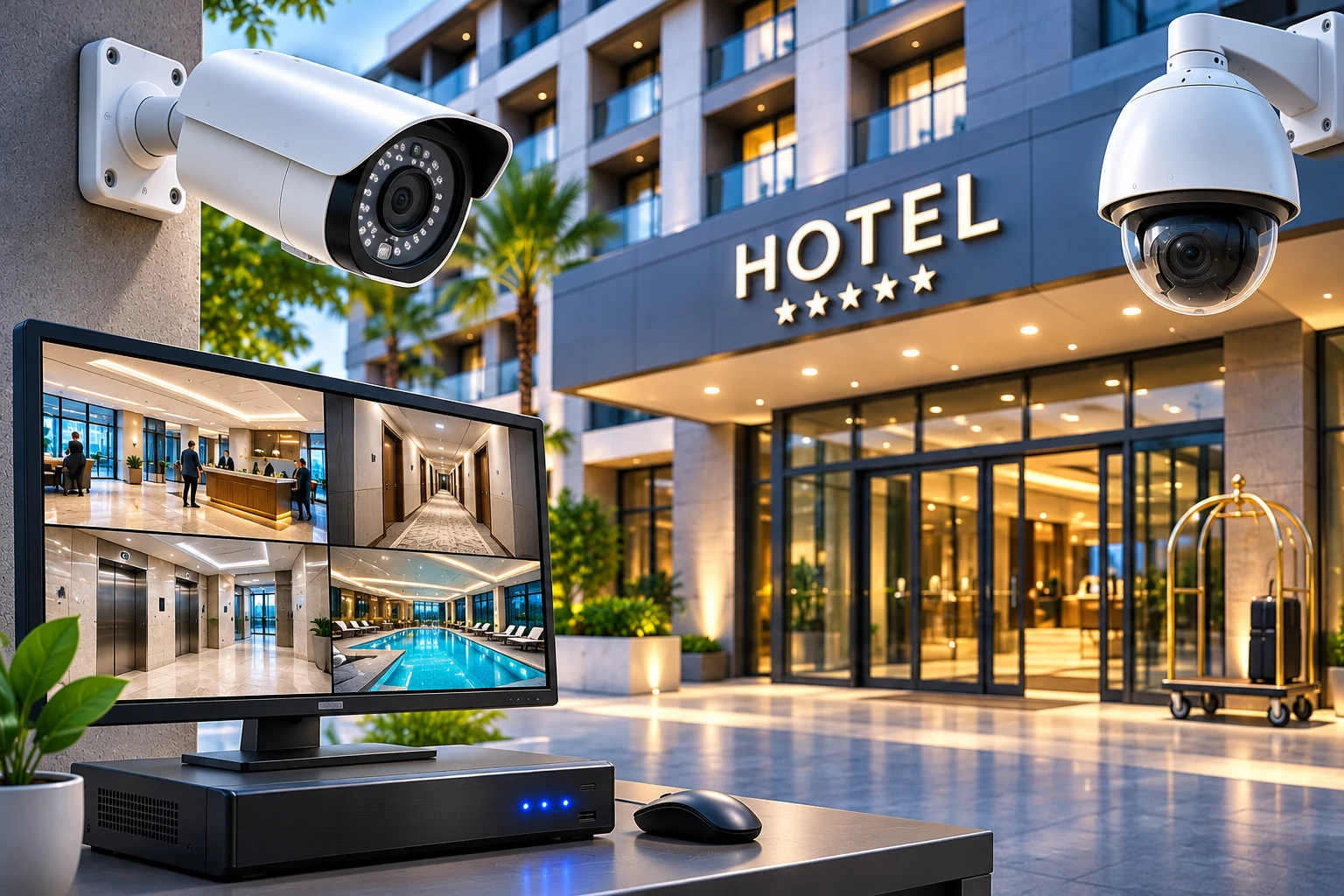
Hotel camera systems are professional CCTV solutions used to monitor the entrances and exits, shared spaces, car parks, certain technical areas and security-sensitive locations of accommodation facilities. IP security cameras, NVR recording devices, video management software, network infrastructure and, where needed, AI-powered video analytics form the core components of these systems.
Hotels have different requirements from residential properties, offices, and retail stores when it comes to security system design. Their operating 24 hours a day, the large number of guests using the premises, the presence of multiple entrances and exits, and the fact that accommodation areas are private living spaces directly affect camera placement.
For example, a camera in a hotel lobby can contribute to entrance security. However, it is not appropriate for the same camera to capture the inside of guest rooms or details related to people’s private lives.
Similarly, car-park cameras can help review vehicle movements in and out, while a corridor camera that captures the inside of a room when its door opens can raise serious privacy concerns.
A sound hotel camera system is CCTV infrastructure that monitors areas where surveillance is necessary for security at adequate image quality, protects guest privacy, and has verified recording reliability and system continuity.
In this guide, we examine camera placement in hotels, IP camera selection, NVR and VMS systems, recording capacity, AI video analytics, access-control integration and KVKK requirements in Türkiye.
What Is a Hotel Camera System?
A hotel camera system is an electronic video-surveillance infrastructure that helps detect and investigate specific security incidents at accommodation facilities.
In suitable projects, the system can support the following purposes:
Securing hotel entrances and exits.
Protecting reception areas and designated cash-handling areas.
Reviewing incidents in shared spaces.
Monitoring car parks and vehicle entrances and exits.
Assessing unauthorized access to storage and service areas.
Detecting specific security incidents around the perimeter.
Supporting centralized security operations.
Enabling authorized personnel to review recordings securely.
Monitoring faults in camera and recording infrastructure.
However, CCTV alone does not meet every security need in a hotel.
Electronic room locks, access control, burglar alarms, fire detection and emergency systems serve different functions.
Where Should Security Cameras Be Placed in Hotels?
The first step in hotel camera placement is identifying the points that need to be monitored.
Rather than designing cameras to monitor the entire property in as much detail as possible, fields of view should be designed to address specific risks.
Hotel area | Purpose of camera use | Technical and legal considerations |
|---|---|---|
Main entrance | Security of the entrance and approach area | Backlighting, facial detail |
Reception | Specific security incidents | Protecting identity and payment information |
Lobby | Shared-area security | Restricted field of view |
Elevator lobbies | Incidents related to floor access | Avoiding views into room interiors |
Floor corridors | Specific corridor security incidents | Room doors and privacy |
Car park | Vehicle and pedestrian movements | Night vision, licence-plate data |
Restaurant entrance | Entrances and related security incidents | Unnecessary monitoring of tables/conversations |
Goods-receiving area | Delivery and service security | Load movements, obstructions to the view |
Storage and plant-room entrances | Unauthorized access | Access-control integration |
Hotel perimeter | Specific perimeter-security risks | Avoiding views of neighboring properties |
This table does not mean that cameras must be installed in every area.
The hotel’s architecture, risks, security procedures and personal-data processing requirements should be assessed together.
Hotel Lobby and Reception Camera Systems
Lobbies and reception areas are among the busiest parts of a hotel.
Guest arrivals and departures, visitors, staff and certain service activities all take place here.
Reception Cameras
The primary purpose of reception cameras is to provide suitable footage of specified security incidents.
However, at the reception desk there may be:
identity documents,
passports,
payment cards,
reservation details,
computer screens
so the camera angle must be chosen carefully.
The camera system should not record this information unnecessarily or in excessive detail.
For example, an angle that supports the security of the receptionist and the area approaching the desk may be more appropriate than one that makes all guest information on a computer screen legible.
Lobby Cameras
Wide-area coverage can be important for lobby cameras.
However, wide-angle cameras may not provide enough image detail at long distances.
WDR performance and changing lighting conditions should be tested, particularly in hotels with glass façades.
Using Cameras in Hotel Floor Corridors
Floor corridors are areas where privacy requires particularly careful consideration in hotel security.
Corridor cameras can support the investigation of specific security incidents.
However, hotel rooms are private spaces.
Therefore, when positioning cameras:
Ensure that opening a room door does not expose the interior to the camera.
Do not directly monitor people inside rooms.
Avoid unnecessary facial close-ups.
Restrict the field of view to the specified corridor-security purpose.
Use privacy masking where supported by the model.
measures such as these should be considered.
The fact that a hotel corridor is a shared space does not justify filming room interiors or guests’ private lives.
A risk assessment should also determine whether continuous monitoring of all corridors is genuinely necessary.
Areas Where Cameras Should Not Be Installed in Hotels
The most important boundary in hotel security is respect for the private lives of guests and employees.
Security cameras should not be installed in the following areas:
Inside guest rooms.
Bathrooms and toilets.
Shower areas.
Changing rooms.
SPA and massage cabins.
Staff changing areas.
Areas where expectations of personal rest and privacy are high.
Camera Use in SPA, Pool and Beach Areas
Security needs around SPAs and swimming pools should be assessed separately.
For example, monitoring a specific security point at the general entrance to the SPA is not the same as filming a changing or massage area.
In outdoor pool or beach areas, consideration should also be given to guests’ privacy expectations, the presence of children and whether surveillance is necessary.
Moreover, the presence of a standard CCTV camera does not mean that a system is in place that can reliably detect when someone is in danger in the water or perform a lifeguard’s duties.
If dedicated pool-safety analytics are used, their actual detection performance, false alarms, latency and human-intervention requirements should be verified separately.
Which Security Cameras Should Hotels Use?
Professional hotel projects can consider different types of IP cameras according to the area of use.
Dome and Turret Cameras
They can be used in lobbies, reception entrances and designated shared areas.
Lens, image quality, installation and maintenance features matter more than the camera housing.
Varifocal-Lens Cameras
They can be considered when a more suitable viewing angle is needed for a specific entrance or target area.
Bullet Cameras
They can be used around the hotel perimeter, on service roads and at suitable points in car parks.
The required IP protection rating, mechanical strength and installation conditions for outdoor use should be verified.
PTZ Cameras
In large outdoor areas, an authorized operator can use them to inspect specific points.
However, bear in mind that other areas may not be monitored simultaneously while a PTZ camera changes direction.
Licence-Plate Recognition Cameras
If licence-plate data is genuinely needed at vehicle entrances and exits, suitable LPR/ANPR solutions can be considered.
The personal-data processing implications and retention conditions of licence-plate recognition should be addressed separately.
DORI and PPM Analysis in Hotel Camera Systems
Having 4 MP or 8 MP resolution alone is not enough for a hotel camera.
The image detail required depends on the target’s distance from the camera and the lens’s field of view.
PPM (Pixels Per Meter) indicates how many horizontal pixels correspond to one metre on a specified target plane.
PPM = Image horizontal pixel count / Horizontal field width at the target plane
For example, if a camera with 2560 horizontal pixels covers an area 10 metres wide at a hotel entrance:
2560 / 10 = 256 PPM
is the theoretical pixel density obtained.
However, a value of 256 PPM alone does not show that a face can be reliably identified under all conditions.
Actual image performance is affected by:
Lens quality.
The target’s distance from the camera.
Mounting angle.
Motion blur.
Lighting.
Image compression.
Camera-sensor performance.
These factors affect it.
IEC 62676-4:2025 is the current international best-practice guide for planning, installing, testing and maintaining video-surveillance systems.
For hotel projects, the surveillance purpose of each camera should be defined separately and verified through on-site tests after installation.
For more detailed information, What to Consider When Choosing a Security Camera? the guide can be consulted.
Should Hotels Choose NVR or VMS?
Different recording architectures can be used depending on the size of the hotel camera system.
NVR-Based System
Suitable NVR devices can be used in small and medium-sized hotels.
Camera-channel count, incoming bandwidth, recording performance and HDD capacity should be assessed together.
VMS-Based System
Server-based VMS architectures can be considered in large hotels, resorts and facilities comprising multiple buildings.
This architecture can make centralized management of cameras and recording servers easier.
Centralized and Distributed Recording
At facilities with multiple buildings or hotel blocks, options include keeping recordings fully centralized or distributing them across designated locations.
However, the effect of the selected architecture on recording continuity during a network outage should be tested.
Criterion | NVR | Server-based VMS |
|---|---|---|
Camera management | Depends on device capacity | Depends on licensing and server capacity |
Recording storage | Local or compatible external infrastructure | Centralized/distributed architecture |
Multi-building management | Depends on the model | May be more comprehensive |
System expansion | Depends on hardware limits | Depends on the architecture |
Centralized operator management | Depends on the product | May be comprehensive |
Licensing and maintenance | Depends on the device | Software and server costs |
Redundancy | Depends on the model and infrastructure | Depends on the system design |
The size of the hotel alone does not determine whether to choose an NVR or VMS.
The key factors are recording capacity, management requirements and actual system performance.
How Many Days Should Hotel Camera Footage Be Retained?
It cannot be said that there is a single general period requiring all hotels in Türkiye to retain CCTV footage unconditionally for 15, 30, 60 or 90 days.
For personal data protection purposes, recordings should be retained only for as long as necessary for the stated purpose.
Any special permit conditions applicable to the hotel, contractual obligations and any specific regulations should also be reviewed separately.
Are the Identity Notification Act No. 1774 and CCTV the Same Thing?
No.
The Identity Notification Act No. 1774, governs obligations such as recording and reporting individuals’ identity, arrival and departure information at accommodation facilities.
These regulations do not automatically require all hotel security-camera footage to be retained for the same period.
Accommodation records, CCTV footage and electronic room-access records are separate data-processing activities.
The legal basis and retention policy for each should be assessed separately.
2025 KVKK Principle Decision
The Personal Data Protection Board’s principle decision dated 6 November 2025, numbered 2025/2120, concerns the photocopying of identity documents at hotels.
The Board distinguished between processing guests’ identity information where necessary conditions are met and retaining photocopies of identity documents.
The decision states that the practice of recording photocopies of Turkish Republic identity cards should be discontinued.
This decision does not directly set the number of CCTV cameras or the video-retention period.
However, it clearly shows that hotels should not collect excessive personal data . clearly.
How Is Hotel Camera Recording Capacity Calculated?
Camera recording capacity is calculated according to each camera’s average video bit rate and the target retention period.
Basic Formula
For continuous recording 24 hours a day:
Total recording (TB) = Number of cameras × Average bit rate (Mbps) × 10.8 × Days / 1,000
Example: Hotel with 48 Cameras
Suppose a hypothetical 100-room hotel has 48 IP cameras.
This figure is for an example calculation only; it is not the recommended number of cameras for all 100-room hotels.
Parameter | Hypothetical value |
|---|---|
Number of cameras | 48 |
Average video per camera | 3 Mbps |
Total average video traffic | 144 Mbps |
Daily video data | 1.56 TB |
15-day recording | 23.33 TB |
30-day recording | 46.66 TB |
Capacity with a 20% reserve for 30 days | 55.99 TB |
30-day calculation:
48 × 3 × 10.8 × 30 / 1000 = 46.656 TB
With a 20% planning allowance:
46.656 × 1.2 = 55.9872 TB
In this case, a usable recording capacity of approximately 56 TB could be targeted.
However, this figure is not the total labeled capacity of the drives to be purchased.
RAID configuration, the file system, recording-server reserves and actual video bit rates should also be taken into account.
Also, a 30-day recording period is only an engineering example; it is not a general legal retention requirement for hotels.
For more on this, How Many Days Should Security Camera Footage Be Retained? guide.
How Is Bandwidth Determined for Hotel Camera Systems?
As the number of cameras increases, so does the data demand on the recording device and network infrastructure.
In the 48-camera system above, the average incoming video traffic is:
48 × 3 Mbps = 144 Mbps
as follows.
For example, if a 25% planning reserve is added:
144 × 1.25 = 180 Mbps
can be set as the capacity target.
The following should be assessed when making this calculation:
NVR incoming bandwidth.
Recording write capacity.
Decoding capacity for live viewing.
Remote-viewing traffic.
Actual port capacities of network switches.
Variations in video bit rate.
should be assessed separately.
Having 64 channels on an NVR does not automatically guarantee uninterrupted recording from all cameras at the desired bit rate.
Use of Artificial Intelligence in Hotel Camera Systems
AI-powered video analytics systems can help detect specific events in footage.
In suitable projects, functions such as the following can be used:
Detecting people or vehicles in the perimeter.
Unauthorized entry into a designated technical area.
Movement in service areas outside working hours.
Counting people at designated entrances.
Measuring queue congestion at reception.
Assessing parking-lot entrances and exits.
among other functions.
However, it should not be assumed that every AI camera supports all these features.
Moreover, AI cannot determine with certainty from guests’ behavior whether they intend to commit a crime or what their personal characteristics are.
People Counting and Visitor Analytics in Hotels
Visitor-traffic analysis can be considered at hotel entrances, restaurant entrances and designated event areas.
However, the hotel’s total number of staying guests and the number of people passing through the main entrance are not the same metric.
A guest may leave and re-enter the hotel several times during the day.
Therefore, entry counts cannot be used directly to calculate the number of unique guests.
It should also be assessed technically and legally how the people-counting system distinguishes between employees, guests and visitors.
Crowd-Density Analysis in Restaurants and Breakfast Rooms
Suitable people-counting systems can statistically measure the movement of people passing through a restaurant entrance.
This data can be used for:
Peak breakfast hours.
Staff planning.
Frequency of use of specific areas.
Queue formation.
Assessing service capacity.
and similar matters.
However, rather than continuously capturing detailed images of dining tables and guests, less intrusive digital analytics methods should be preferred wherever possible.
Can Hotel Cameras Be Integrated with Electronic Door Locks?
Electronic room-door locks and certain staff access systems are widely used in hotels.
Integrating access control with a camera system, however, is a separate project-design matter.
For example, an alarm for unauthorized entry into a technical room can be linked to camera footage covering the area around the relevant door.
For these types of integrations, the following should be assessed:
Matching the event date and time.
Door or reader identity.
Authorized access records.
User permissions.
Data-retention periods.
Network security.
should be assessed.
PMS and Room-Lock Integration
PMS (Property Management System) refers to the software infrastructure associated with a hotel’s reservation and accommodation operations.
Combining PMS data with CCTV footage may result in the processing of additional personal data about guests.
Therefore, for general security purposes, the hotel camera system should not need access to all reservation, accommodation and room-use data.
Not every integration that is technically possible is necessary for security or legally appropriate.
Integration of Fire Detection and CCTV in Hotels
Hotel security is not limited to the risks of theft and unauthorized entry.
Fire safety is vital, particularly in multi-storey hotels and large tourism facilities.
Required fire detection, alarm, emergency public-address and evacuation systems should be designed in accordance with applicable fire regulations and technical standards.
CCTV systems can support incident assessment by showing the relevant area to an authorized operator during specific fire-alarm events.
However, standard CCTV footage or AI smoke analytics does not replace compliant fire-detection and evacuation systems.
If cameras are integrated with a fire alarm, the functions of security systems and life-safety-critical systems should be clearly separated.
ONVIF Compatibility in Hotel Camera Systems
Interoperability between IP cameras, NVRs and VMS systems from different manufacturers is important.
ONVIF Profile T, provides standardized interfaces for advanced IP video streaming, H.264/H.265 encoding and specific event functions.
However, ONVIF compatibility does not guarantee that all camera features will work seamlessly with recording systems from other brands.
The following functions should be tested separately in particular:
Main video stream.
Substream.
H.264/H.265 compatibility.
Live single- and multi-screen display.
Recording and playback.
PTZ control.
Alarm events.
Analytics metadata.
Time synchronization.
Camera disconnection and reconnection.
GüvenlikOnline’s ONVIF Technical Guide, details how the relevant profiles are used.
KVKK and Guest Privacy in Hotel Camera Systems
In Türkiye, hotel camera use should be assessed under the Personal Data Protection Law No. 6698 when images are used to process data relating to identified or identifiable individuals.
The Personal Data Protection Authority’s workplace security-camera announcement dated 8 June 2026, highlights the importance of using security cameras for specific, necessary and proportionate purposes.
Key Principles for Camera Use
The purpose of camera use should be clearly defined.
A valid condition for processing personal data should be established.
The applicable obligation to inform individuals should be fulfilled.
Camera placement and fields of view should be proportionate.
Guest rooms and other private areas should be kept outside camera coverage.
Continuous performance monitoring of employees should be avoided.
The retention period for recordings should be linked to the purpose.
Access permissions for recordings should be restricted.
Unnecessary audio recording should not take place.
Cloud services and any potential cross-border data transfers should be assessed separately.
Use of Cameras with Audio in Hotels
Some IP cameras may support built-in microphones or audio-recording features.
However, this technical feature does not automatically make the continuous recording of guests’ conversations in hotel lobbies and reception areas lawful.
KVKK’s 2026 announcement considers recording ambient sound in workplaces to be an extremely intrusive measure.
For this reason, audio recording requires a legal assessment separate from video recording.
Facial Recognition and Biometric Systems
Facial recognition can identify or verify a person based on their facial features.
This technology differs from general CCTV or anonymous people-counting functionality.
Continuous analysis of hotel guests’ faces requires special consideration regarding biometric data processing conditions and personal data security.
Guests’ presence at a hotel for accommodation does not automatically constitute permission for biometric surveillance or continuous tracking of individuals.
Cybersecurity in Hotel Camera Systems
Cybersecurity in hotel camera systems is important both for protecting recordings and for safeguarding guest information.
Especially in hotels:
Guest Wi-Fi network.
Corporate management network.
PMS and reservation system.
Electronic lock management.
CCTV network.
Other building automation systems.
may be present.
It is not advisable for all these infrastructures to operate on the same network with unrestricted communication privileges.
Recommended Cybersecurity Measures
The CCTV network should be appropriately segmented.
Default camera passwords should be changed.
Users should be given access only to the cameras they need.
NVR/VMS software should be kept up to date.
Remote access should be carried out using secure methods.
Unnecessary network services should be disabled.
Permissions to export recordings should be restricted.
Access and activity logs should be maintained.
Backups of system configurations should be protected.
The manufacturer’s security support period should be monitored.
Making a camera system accessible over the internet does not mean that all recordings are protected against unauthorized access.
Remote maintenance and manufacturer support connections in particular should be managed securely.
Power and Recording Continuity in Hotel Camera Systems
Because hotels operate 24 hours a day, how the camera infrastructure responds to outages is important.
However, connecting a UPS only to the NVR may not ensure uninterrupted operation of the entire video surveillance system.
For example, if a PoE switch loses power, camera feeds may be interrupted even if the NVR remains on.
Therefore:
IP cameras.
PoE switches.
Network distribution equipment.
NVRs and recording servers.
Storage systems.
Necessary communications equipment.
should be assessed together.
How Should Recording System Health Be Monitored?
In a professional hotel CCTV system, it may be useful to monitor for the following faults:
Camera offline.
Recording stream has stopped.
HDD failure.
RAID failure.
Storage capacity at a critical level.
NVR/VMS service is not running.
Camera view is obstructed.
System clock is not synchronized.
The availability of a live view does not mean that historical recordings are complete.
For this reason, periodic maintenance should test not only camera images but also recording playback and archive access.
How Is a Hotel Camera System Designed?
1. Facility Risk Analysis
The hotel’s room count, building layout, entry points, parking area and service areas are assessed.
2. Defining Monitoring Objectives
A specific security task is defined for each camera.
3. Privacy Assessment
Guest rooms and private areas are excluded. Corridor and lobby fields of view are assessed carefully.
4. Camera Placement and Lens Calculation
Target distances, field of view, image detail and lighting conditions are calculated.
5. NVR/VMS Architecture
The number of cameras, bandwidth, server capacity and recording system capacity are determined.
6. Storage Design
HDD capacity is calculated based on the legally appropriate retention period and the actual video bit rate.
7. Integration
Interfaces for access control, alarms and other systems are assessed as needed.
8. Network and Cybersecurity
The camera network, user permissions and secure management connections are configured.
9. Commissioning and Acceptance
Cameras are tested under actual daytime and nighttime conditions, together with recording and playback functions.
10. Periodic Maintenance
A regular maintenance plan is established for camera, network, recording, storage and alarm functions.
Common Mistakes in Installing Hotel Camera Systems
Mistake | Possible result | Correct approach |
|---|---|---|
Determining the number of cameras based only on the number of rooms | Incorrect capacity and blind spots | Survey based on risk and area |
Corridor camera captures the inside of a room | Privacy violation | Field-of-view adjustment and masking |
Recording identity screens at reception | Unnecessary processing of personal data | Restricting the camera angle |
Focusing only on 4K resolution | Insufficient detail at a distant target | Lens and PPM analysis |
Considering only the NVR channel count | Recording or live-view capacity problems | Bandwidth and decoding checks |
Failing to calculate HDD capacity | Failure to meet the required recording period | Calculation based on the actual bit rate |
Uncontrolled integration of CCTV with the guest network | Cybersecurity risk | Network segmentation |
Automatically enabling the audio feature | Legal and privacy risk | Separate assessment of requirements |
Failing to test recordings | Footage unavailable after an incident | Periodic playback checks |
Relying on an AI camera alone for fire safety | A life-safety gap | An appropriate fire safety system |
Technical Checklist for Hotel Camera Systems
- Has a facility risk analysis been carried out?
- Have the building, parking area and service areas been assessed?
- Has a monitoring objective been defined for each camera?
- Are guest rooms and private areas excluded from camera coverage?
- Have corridor cameras been prevented from capturing room interiors?
- Do reception camera angles protect identity and payment information?
- Has lens selection for the lobby, entrance and parking area been verified?
- Has image performance been tested in daytime and at night?
- Have the number of cameras and recording bandwidth been calculated?
- Is NVR/VMS recording and decoding capacity sufficient?
- Have HDD capacity and the required recording period been calculated?
- Has camera/NVR ONVIF compatibility been verified?
- Have recording and live viewing been tested separately?
- Has the need for license plate recognition in the parking area been assessed?
- If AI analytics are used, has real-world performance been measured?
- If access control integration is required, has it been tested?
- Have access to CCTV and PMS data been restricted?
- Have the camera network and guest Wi-Fi network been appropriately separated?
- Have UPS and power outage scenarios been tested?
- Have camera and recording fault notifications been configured?
- Have KVKK and privacy-notice requirements been assessed?
- Has audio recording been checked as a default setting?
- Have permissions for accessing and exporting recordings been defined?
- Has a periodic maintenance and recording validation plan been established?
Frequently Asked Questions About Hotel Camera Systems
Are security cameras mandatory in hotels?
The obligations applicable to hotels may vary according to the type of facility, security conditions and relevant regulations. No single general provision requiring all hotels to install a specified number of CCTV cameras could be verified. The permits and security requirements specific to each facility should be examined separately.
Where can cameras be installed in hotels?
Where there is an identified security need and a legal basis, cameras may be considered at entrances, in lobbies and reception areas, in parking areas and in certain common areas. Fields of view should be proportionate.
Can security cameras be installed in hotel rooms?
Guest rooms are private spaces. Cameras should not be installed inside guest rooms for security purposes.
Can cameras be installed in hotel corridors?
This may be considered based on security needs. However, camera fields of view must not capture room interiors and must protect guests’ privacy.
How many days should hotel camera recordings be retained?
There is no single general CCTV retention period applicable to all hotels. The retention policy should be determined in light of applicable legislation and KVKK principles.
How many cameras are needed in a 100-room hotel?
There is no fixed number. The number of cameras depends less on the number of rooms than on the building’s layout, entrances, corridors, parking area, external perimeter and other security areas.
Which is more suitable for a hotel camera system: NVR or VMS?
Suitable NVR systems may be used in small projects. VMS architecture may be considered for large or multi-building facilities, or where centralized management is required. The decision should be based on actual technical capacity.
Can facial recognition systems be used in hotels?
Biometric identification may entail more sensitive legal requirements than general CCTV use. It should not be used without assessing a specific legal basis and necessity.
Can hotel cameras record audio?
Some devices technically support audio recording. However, continuous recording of ambient sound inside a hotel requires a separate legal assessment.
Can hotel camera systems be used to monitor staff?
Using cameras installed for security to continuously monitor employees’ performance poses serious risks in terms of KVKK’s purpose-limitation and proportionality principles.
Can AI cameras be used in hotels?
They may be used for appropriate functions that are legally justified. Examples include people/vehicle detection, certain entry violations and suitable occupancy analysis. Actual performance should be verified through field testing.
How is the price of a hotel camera system determined?
The number of cameras, resolution, lenses, cabling, NVR/VMS, disk capacity, software licences, installation, network infrastructure and maintenance requirements affect the cost.
Conclusion: Balancing Security and Privacy in Hotel Camera Systems
Hotel camera systems are important technological infrastructure that helps monitor and assess security incidents at accommodation facilities.
However, hotels are businesses where guests have high expectations of privacy.
For this reason, clear boundaries should exist between CCTV applications considered for lobbies, entrances, parking areas and certain common areas, and guest rooms and other private areas.
In professional camera system design, selecting the right lens, recording capacity, ONVIF compatibility, cybersecurity and periodic maintenance are as important as resolution and camera count.
AI, people counting and access control integrations should be planned according to actual needs and applicable data protection requirements.
The right hotel camera system is not the one with the most cameras, but one that performs the monitoring tasks needed for security without collecting unnecessary personal data, and whose recording reliability and technical performance have been verified.
Therefore, hotel security projects should be developed through site surveys, technical engineering, privacy assessments, system testing, and a sustainable maintenance approach.