
Security Camera Installation and Commissioning Standards: A Technical Guide
What are the standards for security camera installation and commissioning? Explore IEC 62676-4:2025, CCTV design, DORI/PPM, IP camera mounting, Cat6 and fiber cabling, PoE, NVR/VMS, ONVIF, FAT/SAT testing, image verification, and system acceptance criteria. A technical checklist and sample commissioning protocol for professional CCTV installations.
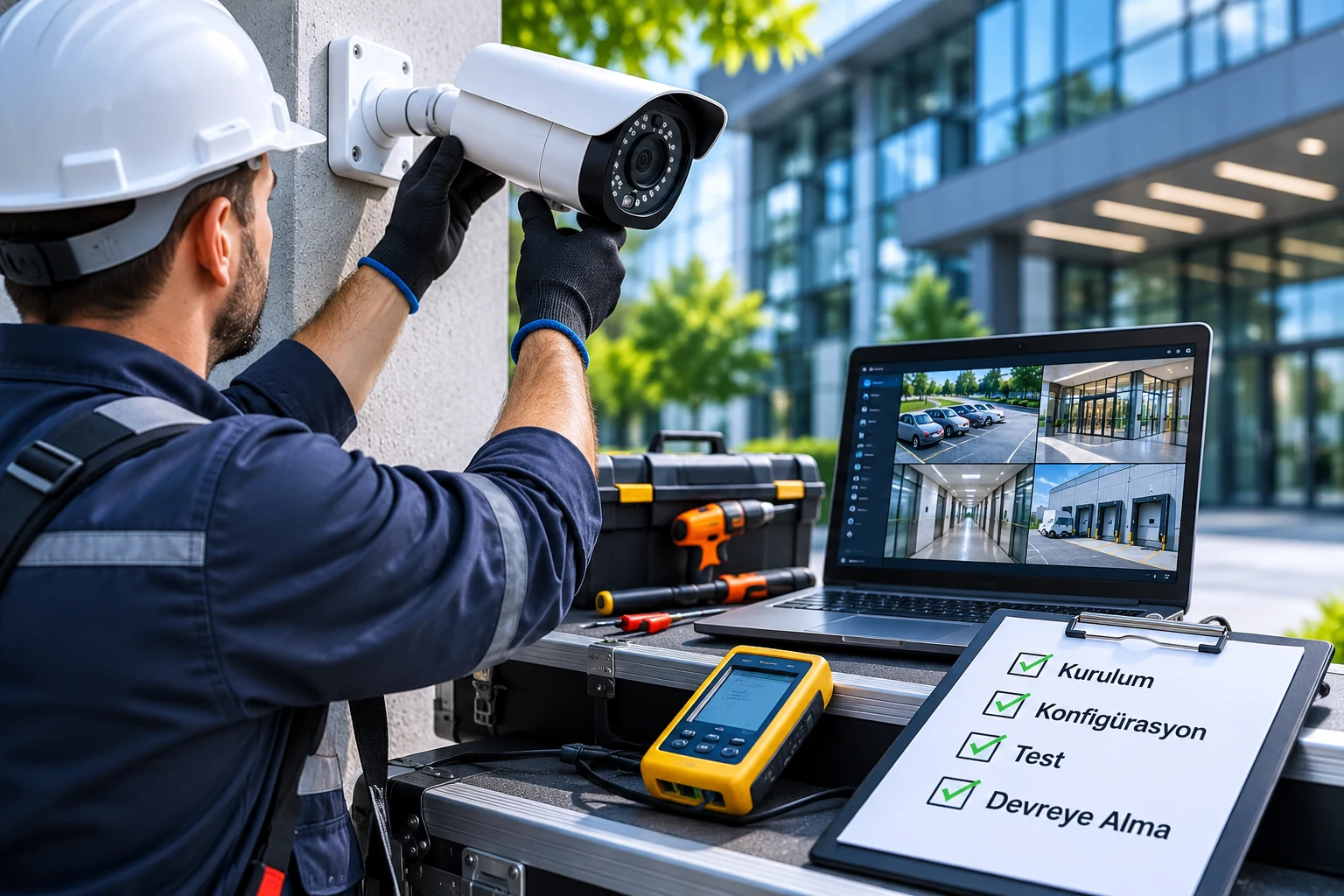
Security camera installation and commissioning standards are engineering rules that ensure CCTV systems are designed correctly, installed reliably, tested for imaging performance, and verified against technical requirements before being put into operation.
IP security cameras, NVR and DVR recorders, video management software (VMS), PoE network equipment, and data storage infrastructure are the core components of a professional video surveillance system. However, physically installing these devices and obtaining a live image alone does not show that the system has been installed correctly.
For example, an IP camera may produce an image but fail to provide sufficient detail at the target distance because the wrong lens was selected. Similarly, an NVR may show cameras as online while recorded footage from earlier periods is incomplete because of an incorrect storage configuration.
For this reason, camera placement, cabling, power, networking, image quality, recording continuity, and cybersecurity must be evaluated separately in professional CCTV projects.
A successful security camera installation is not merely the delivery of working devices; it means measuring and documenting that predefined security tasks are performed under actual site conditions.
Among the current international application guides, IEC 62676-4:2025, is an important technical reference covering the planning, design, installation, testing, commissioning, and maintenance of video surveillance systems.
This article covers international standards for camera systems, installation stages, the new image-density criteria, FAT and SAT testing, recording verification, and professional handover documentation.
What Are Security Camera Installation Standards?
Security camera installation standards are the technical requirements and practices used to design, install, and assess a video surveillance system in line with its defined security purpose.
These standards cover a range of areas:
The security purpose and operational requirements of the camera system.
Selection of cameras, lenses, and mounting locations.
Image quality and pixel density.
Network and video transmission infrastructure.
Cabling and electrical safety.
NVR/VMS recording and storage requirements.
Physical and cybersecurity.
Functional and performance testing.
Commissioning, acceptance, and documentation.
Periodic maintenance and operational continuity.
No single standard governs every CCTV installation on its own.
For example, IEC 62676-4 addresses video surveillance applications, ISO/IEC 11801 concerns cabling infrastructure, IEC 60529 covers environmental protection for equipment enclosures, and ONVIF deals with interoperability among IP devices.
International Standards Used in Security Camera Systems
Standard / technology | Relevant subject | Use in a CCTV project |
|---|---|---|
IEC 62676-4:2025 | Video surveillance applications | Planning, installation, testing, and commissioning |
IEC 62676 series | Video surveillance systems | System, transmission, and interface requirements |
ISO/IEC 11801-1:2017 | Structured cabling | Copper and fiber network infrastructure |
EN 50174-2:2018 | Indoor cabling | Cable routing and installation practices |
IEC 60364-5-52 | Electrical installations | Cable and electrical installation safety |
IEEE 802.3af/at/bt | Power over Ethernet | IP camera power supply |
IEC 60529 | IP protection ratings | Protection of enclosures against dust and water |
IEC 62262 | IK impact protection | Mechanical impact resistance |
IEC 62305 series | Lightning protection | Appropriate surge protection |
ONVIF Profile T/G/M | IP device interoperability | Camera, NVR/VMS, and analytics integration |
Each of these standards should be assessed according to the project scope and the applicable edition.
Important: The publication of an international standard does not automatically mean that it is legally mandatory for every camera installation in Türkiye. The applicable TS/EN adoption, current TSE edition, contract, and sector-specific regulations must be checked separately.
What Is the IEC 62676-4:2025 Standard?
IEC 62676-4:2025, the international standard that sets out the implementation requirements for video surveillance systems used for security purposes.
The second edition, published on 9 October 2025, replaced the 2014 edition and introduced significant technical changes.
The main topics covered by the standard include:
Developing a security concept.
Risk analysis and determining security levels.
Defining operational requirements.
Camera and lens selection.
Image detail and performance criteria.
Recording and video transmission systems.
Acceptance testing.
Commissioning and handover.
System operation and maintenance.
What Has Changed with IEC 62676-4:2025?
Three major developments stand out in the new edition.
1. Security concept: Instead of merely listing risks, a broader planning framework has been adopted, incorporating security objectives and the protection approach to be applied.
2. Pixel-density classification: The previous image-detail categories have been reorganized to create the seven-level O2DCPVS system.
3. Testing and operational approach: Test plans, acceptance processes, system documentation, and operational requirements are addressed more comprehensively.
These changes make it important for CCTV projects to assess not only device performance but also how well the system performs under real-world operating conditions.
How Is a Security Concept Prepared for CCTV Projects?
Before installation begins, the security tasks the system is expected to perform must be defined.
For example, the following tasks may entail different engineering requirements for a factory camera system:
Detecting human movement along the perimeter.
Obtaining sufficient image detail at the personnel entrance.
Recording specific events at vehicle entrances.
Monitoring general activity in warehouse areas.
Monitoring access to critical technical rooms.
These tasks do not have to be met with a single image-quality target.
Operational Requirements Specification (ORS)
Operational Requirements Specification (ORS)is a document that defines the functions expected of the security system.
The ORS should answer the following questions:
Question | Example requirement |
|---|---|
Which area will be protected? | Warehouse loading door |
Which event will be viewed? | Movement of vehicles and goods |
What level of detail is required? | Sufficient image detail on the designated target plane |
Under what conditions will it operate? | Day and night |
Is recording required? | Yes, for a specified period |
Will an alarm be generated? | When a defined area is breached |
Who will monitor it? | Authorized security operator |
How will acceptance be conducted? | Through image, recording, and alarm tests |
Selecting cameras before preparing an ORS risks focusing on device specifications instead of security objectives.
DORI, PPM, and the New IEC 62676-4:2025 Criteria in Camera Placement
Pixel density is an important parameter when assessing image detail in camera systems.
PPM (Pixels Per Meter) indicates how many image pixels represent a one-meter horizontal area on a given target plane.
Basic formula:
PPM = Horizontal image pixels / Horizontal field of view on the target plane
For example, if a camera with 2560 horizontal pixels views an area 12 meters wide at the target distance:
2560 / 12 = 213.3 PPM
This is a theoretical pixel density.
IEC 62676-4:2025 O2DCPVS Levels
The 2025 edition uses the following seven levels for image detail.
New level | Reference pixel density |
|---|---|
Overview | 20 PPM |
Outline | 40 PPM |
Discern | 80 PPM |
Perceive | 125 PPM |
Characterize | 250 PPM |
Validate | 500 PPM |
Scrutinize | 1,500 PPM |
These levels are grouped into two categories:
LPDO (Low Pixel Density Object): Overview, Outline, and Discern.
HPDO (High Pixel Density Object): Perceive, Characterize, Validate, and Scrutinize.
Can the Old DORI Values Still Be Used?
Older CCTV specifications may use DORI calculations based on the Detection, Observation, Recognition, and Identification classes.
However, IEC 62676-4:2025 has changed the image-detail classification.
For example, 250 PPM in the old DORI approach Identification value and 250 PPM in the new classification Characterize level should not be treated as the same operational task.
For new projects, the applicable edition of the standard should be specified and the viewing task classified correctly.
Important: PPM is an indicator of image geometry. Having sufficient PPM does not guarantee that identification or object details will be successfully captured in the actual image under all conditions.
The lens, lighting, motion blur, compression, and recording chain must also be tested.
For more detailed information, see the article DORI Analysis in Camera Systems .»? The article can be consulted.
How Is the Mounting Height of Security Cameras Determined?
Camera mounting height should be determined according to the viewing purpose and physical conditions.
There is no single ideal mounting height that applies to every camera.
The following factors should be assessed during installation:
The distance from the camera to the target.
The required image detail.
The lens field of view.
The viewing angle toward the target.
The load-bearing capacity of the mounting surface.
The risk of physical tampering.
Ease of access for maintenance.
Lighting.
Cable routing.
For example, a camera mounted at a high point may cover a wide area. However, if it captures a person's face from above at a steep angle, it may not provide the required detail.
For the same reason, it is not always appropriate to position every entrance camera directly above the door.
What to Check During Mechanical Installation
Suitability of the supporting surface.
Fasteners suitable for the camera's weight and environmental loads.
Strength of the connection points.
Protection of cable entries.
Correct closure of the enclosure.
Risks of water accumulation and moisture.
Sources of reflection on the lens or dome surface.
Wind load and vibration should be assessed, particularly for outdoor and pole-mounted installations.
IP and IK Protection Ratings for IP Camera Installation
The enclosure characteristics of cameras intended for outdoor use or areas at risk of physical tampering are important.
IEC 60529 — IP Protection Rating
IEC 60529 classifies the levels of protection provided by electrical equipment enclosures against solid objects and water ingress.
Ratings such as IP66 and IP67 indicate different test conditions.
Therefore, it should not be assumed that a camera bearing the IP67 rating will be protected in all outdoor conditions, even if installed incorrectly.
The integrity of the cable entry, seal, cable gland and junction box is also important.
IEC 62262 — IK Impact Protection
IEC 62262 defines the degrees of protection provided by electrical equipment enclosures against external mechanical impacts.
For example, IK10 denotes a specified, standardized level of mechanical impact resistance.
However, an IK10 housing does not mean the camera will be undamaged by every kind of vandalism attempt.
The mounting point, cable protection and connection hardware should also be assessed.
IP Camera Cabling Standards
Copper and fiber-optic cabling used for IP security cameras affects network performance and system reliability.
In cabling infrastructure, ISO/IEC 11801-1 and EN 50174-2 are important technical references.
These standards address structured cabling and in-building cable installation practices.
Use of Cat6 and Cat6A
Under suitable conditions, Cat6 or Cat6A cabling can be used in IP camera projects.
However, cable category alone is not sufficient.
The following should be considered when selecting cable:
Actual data rate.
Line length.
PoE power requirements.
Cable conductor material.
Cable cross-section.
Ambient temperature.
Density of cable bundles.
Electromagnetic environment.
Route and fire safety.
should be assessed.
How Long Can an Ethernet Camera Cable Run Be?
For common copper Ethernet channel designs, a total channel length of 100 meters is used as a reference. A typical structured-cabling model uses a 90-meter permanent link, with an additional allowance for patch cords.
However, the actual limit depends on the Ethernet technology, cable category, connection components and system design.
The manufacturer may offer specific long-range PoE features; these should not be considered equivalent to standard Ethernet performance.
How Should Cable Testing Be Performed?
In a professional installation, the following should be checked using appropriate test equipment:
Correct termination of cable pairs.
Conductor continuity.
Cable length.
Connection quality.
Category performance required by the project.
Suitable PoE power delivery.
should be checked.
A basic cable tester reporting “connectivity” does not prove that Cat6 channel performance meets all requirements.
Where required, suitable certification test equipment should be used.
When Is Fiber-Optic Cabling Needed?
Fiber-optic infrastructure may be considered at large campuses, factory sites, outdoor locations and for long-distance camera connections.
Fiber-optic systems can be particularly useful for:
Long-distance data transmission.
Connections between buildings.
Immunity to electromagnetic interference.
High bandwidth requirements.
Distributed camera locations.
in these respects.
However, fiber-optic cable does not carry electrical power.
Power for remote camera locations must be addressed separately.
Fiber-Optic Cable Acceptance Tests
Depending on project requirements, the following checks may be performed:
Cleaning of fiber ends.
Connections and splice points.
Optical loss measurement.
OTDR measurement where appropriate.
SFP module compatibility.
Actual connection speed.
Operation of backup links.
The fact that fiber infrastructure provides connectivity does not, by itself, guarantee that the optical power budget and line quality are adequate.
IEEE 802.3 Standards in PoE Camera Systems
PoE (Power over Ethernet), the technology that enables IP cameras to receive data and electrical power over a suitable Ethernet cable.
Common PoE standards:
Standard | Maximum power at the power-sourcing device | Typical use |
|---|---|---|
IEEE 802.3af | 15.4 W | Low-power cameras |
IEEE 802.3at | 30 W | Higher power requirements |
IEEE 802.3bt | 60 W or 90 W, depending on the class | Equipment requiring high power |
These values are upper limits for the PoE power-sourcing side. The usable power reaching the camera may be lower because of losses in the cable.
Calculating the PoE Power Budget
For example:
12 fixed cameras × 8 W = 96 W
4 high-consumption cameras × 18 W = 72 W
Total camera load:
96 + 72 = 168 W
For example, if a 25% planning margin is added:
168 × 1.25 = 210 W
The required PoE power-sourcing capacity should then be selected based on the cameras’ actual power classes and cable losses.
Important: Having a 16-port PoE switch does not mean that all 16 ports can operate simultaneously at their maximum power rating.
Electrical Safety and Lightning Protection for Security Cameras
Power supply and lightning protection are important factors affecting the reliability of a CCTV installation.
IEC 60364-5-52, which concerns the selection and installation of cable systems in low-voltage electrical installations.
IEC 62305-4:2024 addresses the protection of electrical and electronic systems within structures against lightning-induced electromagnetic effects.
Where appropriate, the following should be assessed together:
Grounding.
Equipotential bonding.
Surge protection devices.
Camera poles.
Outdoor cable routes.
Protection of power and data lines.
UPS and power distribution.
should be assessed together.
Installing an Ethernet surge protector alone does not mean that an adequate lightning protection design has been completed.
The protection device must be selected and installed, and its grounding connections made, by qualified personnel in accordance with the project.
How Should NVR and VMS Systems Be Configured?
Once camera installation is complete, the recording system must be configured appropriately.
During NVR or VMS commissioning, the following should be checked:
Camera channels.
Main and sub video streams.
Resolution.
FPS.
H.264/H.265 settings.
Bit rate.
Recording schedule.
Disk and RAID configuration.
Event recordings.
User permissions.
Remote access.
Time synchronization.
should be checked.
NVR Bandwidth Calculation
In a sample system:
Number of cameras: 16
Average bit rate per camera: 4 Mbps
Total average video load:
16 × 4 = 64 Mbps
For example, if a 25% planning margin is used:
64 × 1.25 = 80 Mbps
of input capacity can be targeted.
However, this calculation represents only the average video stream.
The NVR’s actual recording write capacity, simultaneous live viewing, playback and remote-user traffic should be assessed separately.
Recording Duration and HDD Calculation
Assuming the same 16 cameras record continuously for 30 days:
Recording (TB) = Number of cameras × Mbps × 10.8 × Days / 1,000
16 × 4 × 10.8 × 30 / 1000 = 20.736 TB
This produces approximately 20.74 TB of theoretical video data.
However, RAID, the file system, recording metadata, variable bit rate and capacity reserve should be assessed separately.
The 30-day period is only a calculation example; it is not a general legal retention period for all CCTV projects.
How Should ONVIF Compatibility Be Tested During Commissioning?
ONVIF provides standardized interfaces to enable interoperability among IP-based physical security devices.
Integration testing is particularly important in systems combining cameras from different brands with NVR/VMS.
Key ONVIF Profiles
ONVIF profile | Primary use |
|---|---|
Profile T | IP video streaming and related functions |
Profile G | Edge recording and recording access |
Profile M | Analytics metadata and events |
However, ONVIF support alone does not guarantee that all functions are compatible.
The product’s exact model code and firmware version should be checked in ONVIF’s official database of conformant products.
ONVIF Tests During Commissioning
Camera connection.
Main-stream video.
Sub-stream video.
H.264/H.265 compatibility.
Live single and multi-screen viewing.
Recording and playback.
PTZ functions, if supported.
Alarm events.
Metadata transfer.
Reconnection after a network outage.
Especially in projects involving different manufacturers, receiving a live image alone should not be considered sufficient.
Cybersecurity Commissioning Criteria for Security Cameras
IP security cameras and recording devices are network-connected systems.
Therefore, cybersecurity checks should also be carried out during commissioning.
Basic Checks
Changing default passwords.
Strong user authentication.
Separating administrator and operator permissions.
Reviewing firmware versions.
Disabling unnecessary services.
Secure remote access.
Appropriate VLANs and network segmentation.
Device and user event logs.
Time synchronization.
Protecting configuration backups.
Directly exposing the NVR to the internet through port forwarding should not be preferred without an appropriate security assessment.
Also, a device’s ONVIF compatibility does not automatically mean that it is secure from a cybersecurity perspective.
What Is Security Camera Commissioning?
Commissioning, the process of checking, configuring, testing and documenting that an installed CCTV system operates in accordance with design and operational requirements.
This stage is not merely a matter of powering on the cameras or obtaining an image on the NVR.
During commissioning, the entire imaging and recording chain should be assessed.
CCTV PROJECT LIFECYCLE
1. ORS and security concept
Security purpose, surveillance tasks and performance targets
2. Design and installation
Camera, lens, network, power, mounting and recording infrastructure
3. FAT and technical preliminary checks
Factory or integration-environment tests for systems where required
4. SAT and field performance verification
Image, recording, alarm, network, power, and fault tests
5. User acceptance and handover
Closure of non-conformities, documentation, and training
6. Operation and periodic maintenance
Record verification, performance checks, and change management
The Difference Between FAT, SAT, and User Acceptance Testing
Professional security camera projects may involve different testing stages.
FAT — Factory Acceptance Test
FAT is the factory acceptance test.
It may involve evaluating system components and related functions in a suitable test environment before on-site installation.
Particularly in large VMS and integration projects:
Camera and VMS communications.
Recording and playback.
Software functions.
Alarm integrations.
User authorization.
Reporting.
Functions such as these may be evaluated.
Conducting FAT does not mean that the system’s performance under actual field conditions has been verified.
SAT — Site Acceptance Test
SAT is the site acceptance test.
It enables the installed system to be tested under actual operating conditions.
For example:
Camera field of view.
Daytime and nighttime image quality.
Recording continuity.
Network and PoE performance.
Alarm notifications.
Behavior during power outages.
User access functions.
are evaluated on site.
UAT — User Acceptance Test
User acceptance testing evaluates whether the system meets the end user’s defined operational needs.
For example, a user acceptance scenario could involve a security operator finding a recording of a specific incident and exporting it within the scope of their authorization.
FAT, SAT, and user acceptance testing complement one another.
However, it should not be assumed that every small CCTV project requires a separate FAT organized to the same scope.
The test scope should be determined according to the project’s scale, contract, and applicable standard.
How Is Image Quality Tested in CCTV Systems?
One of the key stages in commissioning a camera is verifying imaging performance under real-world conditions.
Daytime Image Test
Is the target area in view?
Is the required level of detail achieved?
Is the lens focus appropriate?
Is there backlighting or glare?
Are there obstructions or blind spots in the image?
Nighttime Image Test
Is the IR illumination sufficient?
Are reflections occurring on the lens or housing?
Is there overexposure?
Are moving targets captured with sufficient clarity?
Is the imaging task met under nighttime conditions?
Moving Target Test
In some CCTV applications, image detail for moving people or vehicles is important.
Therefore, under defined motion scenarios, the following should be evaluated:
FPS.
Exposure time.
Motion blur.
Recording compression.
The length of time the target remains in the image.
should be evaluated.
IEC 62676-4:2025 also addresses the testing approach for imaging performance and target motion.
Capturing a stationary test target clearly does not guarantee the same performance with moving targets.
Camera-by-Camera Commissioning and Image Verification Form
It is useful to create a separate test record for each critical camera.
Sample form:
Inspection field | Information to record |
|---|---|
Camera ID | CAM-01 |
Installation location | Main entrance |
Model / firmware | Actual device information |
IP address | Address in the network configuration |
Lens | Model and settings |
Imaging purpose | Task defined in the project |
Target distance | Measured distance |
Field-of-view width | Width at the target plane |
Calculated PPM | Measurement result |
Acceptance target | Selected image detail level |
Daytime test | Pass / fail |
Nighttime test | Pass / fail |
Live view | Pass / fail |
Recording and playback | Pass / fail |
Alarm / AI test | Test result, if applicable |
Non-conformity | Description and correction |
Test conducted by | Authorized person |
Test date | Date |
This form is an example engineering document; it is not an exact official IEC form.
Where required, the relevant test protocols in the standard and the approved project specification should be followed.
How Are NVR Recording and Playback Tests Performed?
Receiving a live image in a CCTV project does not prove that the recording system is working correctly.
Therefore, the recording chain should be tested separately during commissioning.
Recording Test
Verify that each camera is producing video according to its defined recording schedule.
Playback Test
Recordings from specific time intervals should be opened and checked to ensure that the actual footage can be played back.
Simultaneous Recording Test
Recording performance should be evaluated while all cameras are operating under the project’s normal load.
Recording Export Test
Verify that authorized users can export a specific recording and open it with a suitable player.
Disk Failure Test
If appropriate for the project and system architecture, disk or RAID failure scenarios should be evaluated under controlled test conditions.
Tests that could damage actual production data should not be performed without controls on a live system.
Time Synchronization
The time information for the camera, NVR/VMS, and other relevant security systems should be consistent.
Time discrepancies can cause significant problems, particularly when correlating incidents across different systems.
Therefore, the appropriate NTP infrastructure and time zone settings should be verified.
CCTV Alarm and AI Analytics Commissioning Tests
Installing AI-enabled cameras or VMS analytics does not mean that accurate detection is achieved.
In particular:
Virtual line crossing.
Entry into an area.
Human and vehicle detection.
People counting.
License plate reading.
Detection of specific signs of smoke or fire.
Applications such as these require dedicated field tests.
How Is an AI Acceptance Test Conducted?
First, the actual detection task should be defined.
Then, test scenarios should be prepared and measurable performance criteria defined.
For example, in perimeter security:
Actual intrusion events tested.
Number of events correctly detected.
Missed events.
False alarms.
Alarm delay.
Whether the notification reaches the relevant operator.
can be measured.
The false alarm rate and the correct detection rate should be assessed together.
The AI function stated in the manufacturer’s technical documentation does not prove that the required accuracy is achieved at the project site.
People-counting systems, in particular, should be calibrated and validated against manual reference counts.
CCTV System Outage and Fault Scenario Tests
During commissioning, not only normal operation but also defined fault conditions should be evaluated.
Sample tests:
Test scenario | Expected behavior |
|---|---|
Camera network connection is lost | The system reports the fault within the specified time |
Camera connection is restored | The appropriate video and recording functions resume |
NVR network connection is lost | The specified fault notification is generated |
A disk failure occurs | The supported health/RAID alert is triggered |
Power is lost | Devices covered by backup power operate as planned |
UPS runtime approaches its end | The supported notification or safe shutdown occurs |
Recording storage approaches capacity | The specified capacity warning is generated |
The video image is obstructed | Supported tamper detection is tested |
Time and performance thresholds for these tests should be set before the project begins.
For example, reporting a camera connection in five seconds or thirty seconds is not automatically a general IEC requirement applicable to all CCTV projects.
The acceptable response time should be defined according to the security task and technical specification.
Pass and Fail Criteria in CCTV Acceptance Tests
The acceptance process should include measurable criteria.
For example:
Test subject | Sample acceptance approach |
|---|---|
Camera coverage | The target areas in the approved camera plan should be visible |
Image detail | The defined operational imaging task should be met |
Cabling | The cabling class and tests specified in the project should be met |
PoE | Sufficient power should be provided under normal and relevant maximum operating loads |
Recording | All specified cameras should produce recordings |
Playback | Selected recordings should play back successfully |
Remote access | A secure connection should be established using an authorized user account |
User permissions | Unauthorized access should be blocked |
Alarm | Defined events should be delivered to the correct recipient |
Backup power | The duration and functions specified in the project should be met |
Documentation | Approved as-built documents should be handed over |
The acceptance criteria in this table are illustrative.
Project-specific numerical thresholds should be defined in the ORS and test plan before installation begins.
What Documents Should Be Handed Over After CCTV System Commissioning?
Documentation is critical to the handover of a professional system.
1. As-Built Project
As-built drawings showing the camera, cable, and device locations as installed.
2. Camera Inventory
Camera ID, model, serial number, location, and technical specifications.
3. Network Documentation
IP addresses, VLAN structure, network connections, and relevant topology information.
4. Cabling Test Reports
Test results required by the project for copper and fiber connections.
5. Commissioning Report
Results demonstrating that camera and recording functions have been tested.
6. Image Quality Verification Report
Records showing whether the specified imaging tasks are met in the actual field.
7. Recording and Storage Calculations
Camera bitrates, recording duration, disk capacity, and required redundancy information.
8. User Authorization and Operations Document
User roles, access procedures, incident review, and recording export methods.
9. Fault and Maintenance Plan
Periodic inspection, servicing, and response procedures.
10. User Training and Handover Record
Recording operator training, acceptance results, any open nonconformities, and responsibilities.
Confidential passwords, recovery keys, and other sensitive credentials should not be shared in plain text in the general project file.
KVKK Requirements for Security Camera Installation
When security camera systems process images of identified or identifiable individuals, personal data protection obligations may arise.
The Personal Data Protection Authority's announcement of June 8, 2026, on workplace camera systems highlights the principles of purpose limitation, proportionality, and privacy in camera use.
During installation and acceptance:
The purpose of camera use should be verified.
It should be checked that private areas are not being filmed.
Fields of view should be limited to the necessary scope.
Applicable lighting obligations should be assessed.
The recording retention period should be determined.
User access permissions should be restricted.
Audio recording should be subject to a separate legal assessment.
Appropriate procedures should be in place for deleting and destroying recordings.
The fact that a camera system operates correctly from a technical standpoint does not automatically mean that its personal data processing is lawful.
Technical acceptance and legal compliance checks should therefore complement each other.
Periodic Maintenance and Revalidation of Security Cameras
After CCTV systems are commissioned, image quality and recording performance may change over time.
Main causes:
A change in camera direction.
Dirt on the lens or dome surface.
Changes in lighting conditions.
New physical obstructions.
Network or disk failures.
Firmware updates.
Camera replacement.
NVR or VMS configuration changes.
For this reason, initial acceptance tests should be used as a reference for comparison during maintenance.
For example, when a camera is replaced, it should not be considered sufficient merely for the new device to produce an image.
It should be verified again that the previous operational imaging task is achieved with the new lens and image settings.
For periodic maintenance, the Periodic Maintenance in Camera Systems article.
Security Camera Installation and Commissioning Checklist
- Has the security concept and risk analysis been prepared?
- Have the operational requirements been defined?
- Have the applicable editions of the standards been identified?
- Has the camera layout and field-of-view plan been approved?
- Have lens and target-distance calculations been performed?
- Have the required PPM and image-detail levels been determined?
- Have the cabling class and test method been defined?
- Have copper and fiber connections been tested?
- Has the PoE power budget been calculated?
- Have electrical supply, UPS, and surge protection been assessed?
- Have the cameras been securely mounted mechanically?
- Have the IP/IK requirements been met?
- Has daytime image quality been verified?
- Has image performance at night and in low light been tested?
- Have moving-target scenarios been assessed?
- Has interoperability between the camera and NVR/VMS been tested?
- Have live single-camera and multi-camera viewing been verified?
- Have recording and playback been tested for every camera?
- Have HDD capacity and recording duration been calculated?
- Has the recording export function been tested?
- Has time synchronization been checked?
- Have alarm and AI scenarios been tested?
- Have connection loss and reconnection been tested?
- Have the UPS and relevant fault scenarios been assessed?
- Has the cybersecurity configuration been checked?
- Have KVKK and privacy requirements been assessed?
- Have FAT/SAT or project-appropriate acceptance tests been documented?
- Have camera-specific commissioning records been prepared?
- Have the as-built project documents and system inventory been delivered?
- Has user training been conducted?
- Has a periodic maintenance and revalidation plan been established?
Frequently Asked Questions About Security Camera Installation and Commissioning
Which standard applies to security camera installation?
One of the fundamental international practice standards for security video surveillance systems is IEC 62676-4:2025. Relevant standards for cabling, electrical systems, and other infrastructure functions should also be assessed separately.
What does IEC 62676-4:2025 cover?
It covers the planning, design, installation, testing, commissioning, and maintenance of video surveillance systems.
Is commissioning mandatory for CCTV systems?
Commissioning is a fundamental engineering process for verifying the functional and technical performance of a professional system. However, which tests are legally or contractually mandatory depends on the project and applicable regulations.
What is the difference between FAT and SAT?
FAT refers to acceptance tests performed at a factory or integration facility; SAT refers to acceptance tests for the system at its actual installation site.
What should the camera mounting height be, in meters?
There is no single height suitable for all camera applications. Mounting height should be determined according to target distance, image detail, security, and maintenance conditions.
What are the new PPM criteria in CCTV?
Under IEC 62676-4:2025, the levels are Overview, Outline, Discern, Perceive, Characterize, Validate, and Scrutinize. Each level has a different reference pixel density.
Is Cat6 cable sufficient for a security camera?
Suitable Cat6 cabling can be used in many IP camera applications. However, line length, PoE power requirements, electromagnetic conditions, and project requirements should be assessed separately.
Is PoE testing necessary when installing an IP camera?
For projects using PoE, it is important to verify both the power per port and the total power budget. The required PoE standard should be checked particularly for cameras with high power requirements.
Is commissioning complete if the NVR provides live video?
No. In addition to live video, recording, playback, storage, fault, power, and authorization functions should also be verified.
Do ONVIF-compliant devices work entirely without issues?
ONVIF provides interoperability for specific functions. However, it should not be assumed that every feature will work fully across systems from different brands, and the necessary integration tests should be performed.
What should a CCTV system acceptance report contain?
It should include the camera inventory, project information, test plan, image verification, recording tests, alarm tests, nonconformities, corrective actions, and authorized acceptance records.
Is revalidation required when a camera is replaced?
Since camera replacement may affect the imaging task, it is recommended that the relevant performance checks be repeated.
Conclusion: Professional CCTV Installation Should Be Measurable and Documentable
The success of security camera systems depends not only on whether the devices work or produce high-resolution images.
The right security concept, suitable camera and lens selection, standards-compliant cabling, and reliable power and recording infrastructure all affect the performance of the system as a whole.
The IEC 62676-4:2025 standard provides an important framework for practice covering the life cycle of video surveillance systems. In particular, its updated image-detail classification and testing approach support more systematic performance evaluation in CCTV projects.
FAT, SAT, and user acceptance tests help verify installation quality against defined requirements.
A properly installed security camera system is one in which it has been demonstrated that the security tasks expected of the system—not merely the camera images—are successfully fulfilled under actual site conditions.
For this reason, professional CCTV projects should treat site surveys, design, installation, testing, commissioning, and periodic maintenance not as disconnected tasks, but as stages of the same engineering process.