
What is PDKS? How Does a Personnel Attendance Control System Work?
PDKS (Personnel Attendance Control System) is a system that enables digital tracking of employee entry-exit times, shifts, leaves, and working hours. We examine card-based PDKS, RFID, mobile personnel tracking, timesheet, and payroll integration, along with its operating principles, advantages, technical selection criteria, and current KVKK regulations.
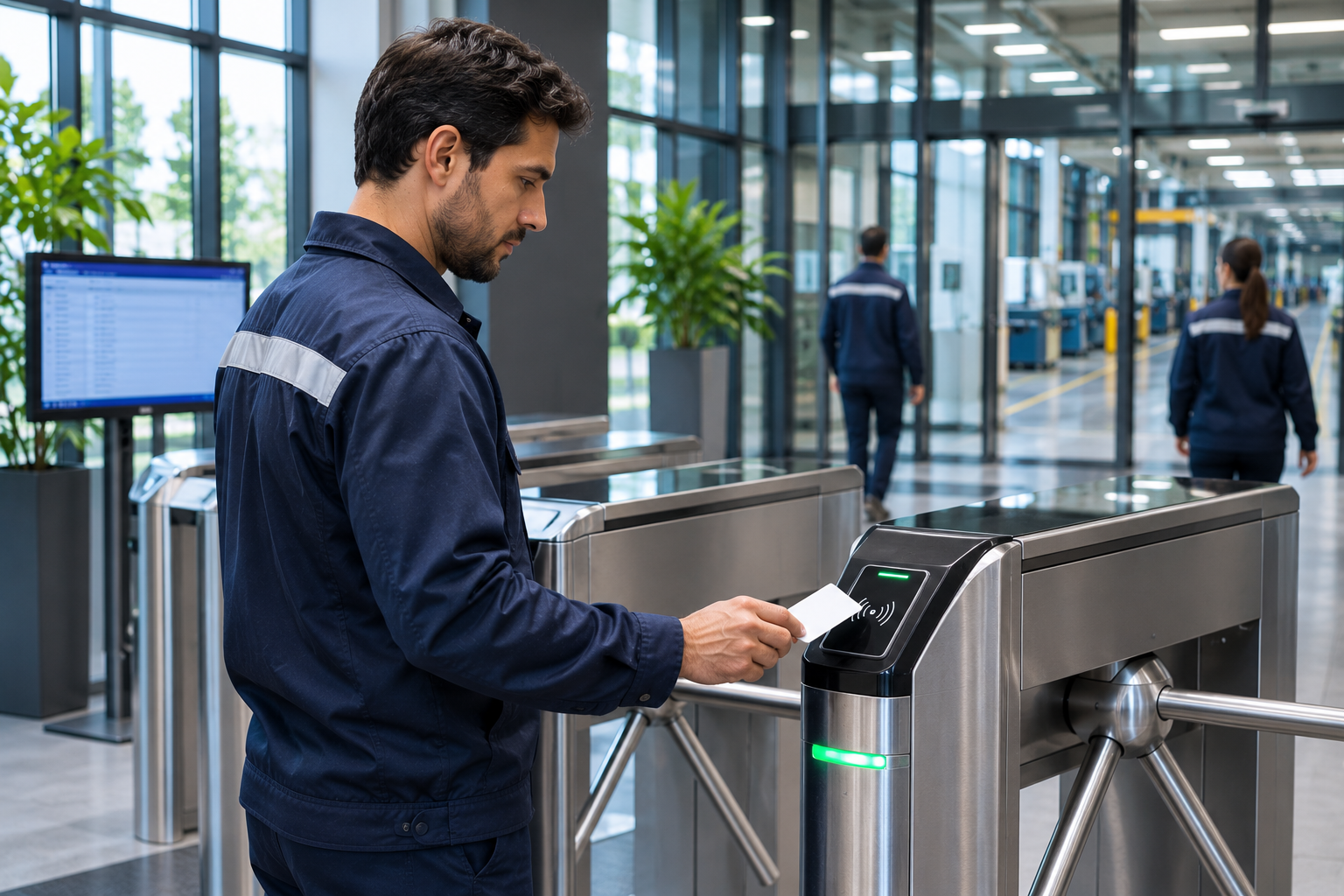
Accurate tracking of employee entry and exit times, shifts, leaves, and working hours in businesses is one of the crucial processes of human resources management.
Especially in factories, production facilities, logistics centers, hotels, hospitals, and businesses with a large number of personnel, manual personnel tracking can be time-consuming and lead to calculation errors.
To meet this need, the PDKS (Personnel Attendance Control System) is a hardware and software infrastructure that enables digital recording of employee attendance information, calculation of working hours, and management of timesheet processes.
Modern PDKS solutions can work with RFID cards, PIN codes, mobile applications, turnstile systems, and central personnel management software.
However, a successful PDKS implementation is not merely about employees swiping cards or recording entry times. Shift rules, break durations, overtime calculations, data security, payroll integration, and relevant labor legislation must be evaluated together.
So, what is PDKS, how does it work, what technologies does it use, and how should businesses choose the right personnel attendance control system?
What is PDKS?
PDKS is the abbreviation for Personnel Attendance Control System.
It is an electronic personnel tracking system that records employee entry and exit times, allowing this information to be used in shift, attendance, absenteeism, leave, and timesheet processes.
In English, similar solutions are referred to as Time and Attendance Systems.
Key functions of PDKS systems include:
Recording personnel entry and exit times.
Managing shifts and work schedules.
Reporting late arrivals and early departures.
Tracking absenteeism information.
Evaluating leave and holiday records.
Assisting in the calculation of working hours.
Evaluating overtime information according to relevant rules.
Transferring data to timesheet and payroll systems.
The primary goal of PDKS is to maintain employee attendance information in a reliable, traceable, and manageable manner within the business.
PDKS is not merely a card reader or a turnstile device. Its main function is to process collected entry-exit data according to correct working rules.
How Does a PDKS System Work?
Personnel attendance control systems can be set up with different architectures depending on the hardware and software used. However, the basic operating process is similar.
1. Personnel Identification
A personnel record is created in the system for each employee.
Depending on the technology to be used, an RFID card, digital credentials, or a PIN code can be assigned to personnel.
2. Recording Entry and Exit Information
Personnel swipe their cards or use other supported verification methods at entry and exit points.
The system records the date and time information along with the relevant personnel ID.
3. Data Transfer to PDKS Software
Entry and exit events can be transmitted over the network to the central PDKS software.
Some terminals can store events in their memory when the network connection is lost and transfer them when the connection is re-established.
However, this feature is not available on all devices.
4. Calculation of Working Hours
The PDKS software compares entry and exit records with the personnel's shift plan.
According to the business rules defined in the system, working hours, late arrivals, missing records, and potential overtime situations can be evaluated.
5. Timesheet and Reporting
Collected data can be converted into daily, weekly, or monthly reports.
Information checked and approved by the relevant authority can be transferred to payroll or human resources software if appropriate integration exists.
There is an important technical distinction in this process:
The hours an employee enters and exits through a turnstile do not always directly indicate the legally required working time. Break times, the nature of the work, shift rules, and other situations considered as working time must also be taken into account.
What Components Do PDKS Systems Consist Of?
A professional PDKS system is created by the collaborative operation of hardware and software components.
Personnel Tracking Terminals
These are devices that generate entry-exit events by reading employees' identification or access information.
Card readers, PIN terminals, or suitable mobile access interfaces can be used.
Turnstile and Access Control Hardware
Turnstiles can be used to physically regulate pedestrian traffic at specific entry points.
When integrated with PDKS, personnel passage events can be used for attendance tracking.
However, using a turnstile is not mandatory in every PDKS project.
Central PDKS Software
This is the software that manages personnel records, work plans, entry-exit events, and timesheet calculations.
It is one of the most important components of the system.
Database and Server Infrastructure
It ensures the storage of personnel information, shift definitions, and passage records.
Depending on the software's architecture, a local server or cloud-based infrastructure can be used.
Reporting and Integration Modules
It helps transfer timesheet information to human resources, leave, and payroll systems.
The scope of integration depends on the API or other data transfer methods supported by the software used.
What Technologies Are Used in PDKS Systems?
Card-Based PDKS Systems
Card-based PDKS solutions work by employees swiping their assigned cards on appropriate readers.
RFID or NFC-based card technologies can be used.
Card-based personnel tracking is a common solution in factories, offices, warehouses, and businesses with a large number of personnel.
The ability to revoke access information and assign new cards if cards are lost is a significant advantage.
However, risks such as the card being used by another person must also be considered.
The security features of card technology can vary between older methods that only use a fixed card number and modern methods that offer cryptographic verification.
PIN-Based PDKS Systems
In PIN-based systems, an employee creates an entry or exit record using the code assigned to them.
It may not require carrying a card.
However, risks such as passwords being shared, easily guessed, or seen by third parties must be evaluated.
Mobile PDKS Systems
Mobile PDKS solutions can enable attendance records to be created from smartphones with appropriate applications and authentication infrastructure.
Some solutions may use QR codes, Bluetooth, or other methods.
Mobile systems can be considered especially for:
Personnel working in multiple branches,
Field teams,
Technical service employees,
Teams on mobile assignments
However, it should not be assumed that the use of a mobile device necessitates continuous monitoring of employee location.
If location data is to be used, the necessity, proportionality, and legal basis of this processing activity must be evaluated separately.
Biometric PDKS Systems
In the past, some PDKS systems used fingerprint, facial recognition, or other biometric verification methods.
However, the legal framework regarding the processing of biometric data for employee attendance tracking in Turkey has been clarified by the Personal Data Protection Board's Principle Decision No. 2026/921.
This issue should be given special consideration in product selection.
PDKS Technologies Comparison
| Technology | Advantage | Points to Consider |
|---|---|---|
| RFID/NFC card | Fast reading and central management | Card sharing, copying risk, secure card technology |
| PIN terminal | Does not require a physical card | Password sharing and user verification |
| Mobile PDKS | Multi-location and field personnel support | Phone compatibility, connectivity, data minimization |
| QR code | Flexible authentication in suitable applications | Risks of code sharing and reuse |
| Biometric method | Potential for unique personal verification | Legal limitations determined by KVKK's Principle Decision No. 2026/921 for attendance tracking |
This table is prepared for general technical comparison purposes. The legal compliance and security performance of each technology should be evaluated on a case-by-case basis.
What is the Difference Between PDKS and an Access Control System?
PDKS and access control systems are often considered the same system.
However, the primary purpose of these two technologies is different.
PDKS: Focuses on managing personnel attendance information, working hours, and timesheet processes.
Access control system: Manages the access of authorized individuals to specific doors or security zones.
For example, an employee in a factory can enter the production building with their card.
The access control system evaluates whether the personnel have authorization to pass through the relevant door.
The PDKS software, on the other hand, helps calculate what this event means in terms of the personnel's work schedule.
However, granting access permission does not always prove that the person physically passed through the door.
In applications where passage needs to be verified, turnstile sensors or other appropriate hardware can be considered.
The two systems can work together; however, the presence of one does not mean that all functions of the other are automatically provided.
GüvenlikOnline's Card Access Systems product category offers examples of relevant hardware types.
What is the Relationship Between PDKS and Timesheet?
Timesheet is the process of evaluating personnel's working and attendance information over a specific period.
PDKS systems provide the time records and calculation tools that may be necessary for this process.
The following data can be used in timesheet operations:
Normal working days and hours.
Entry and exit records.
Break times.
Leaves.
Public holidays.
Absences.
Night and shift work information.
Appropriately evaluated overtime hours.
However, raw entry-exit records generated by the system should not be directly and uncontrollably converted into salary calculations.
Situations such as incomplete card swipes, incorrect shift assignments, assignments, and leaves can affect the timesheet result.
How Does PDKS Calculate Working Hours?
Let's evaluate with an example.
Let's assume an employee starts work at 09:00 in the morning and leaves work at 18:00 in the evening.
<text>Entry time: 09:00</text><text>Exit time: 18:00</text>
<text>Duration between two times: 9 hours</text>
<text>Default break time: 1 hour</text>
<text>Example calculated working time: 8 hours</text>
In this calculation, it is assumed that the break time was actually used and there are no other situations requiring it to be counted as working time.
In accordance with Labor Law No. 4857 and the relevant Regulation on Working Hours, situations legally considered as working time and break times must be taken into account.
The difference between two hours recorded by a PDKS device alone is not a definitive working time or overtime calculation.
PDKS Calculation for Shift Personnel
Calculations can be more complex in businesses with shift workers.
Especially:
Shifts extending past midnight.
Variable working hours.
Rotational shift plans.
Breaks taken at different times.
Public holidays.
Weekly rest days.
Compensation practices
must be appropriately handled in the PDKS software's rule engine.
The system's working hour calculations must be compatible with legislation and the legally valid working arrangements of the business.
Can PDKS Automatically Calculate Overtime?
Appropriate software can calculate potential overtime hours according to defined working rules.
However, every late departure does not automatically mean overtime that must be paid.
In Labor Law No. 4857, overtime, work exceeding normal hours, compensation, and related exceptions are subject to different provisions.
For example, as a general rule, work exceeding 45 hours per week is considered overtime. However, lower weekly working hours determined by contract, compensation, and other legal conditions must also be taken into account.
Therefore, it is important that overtime information to be transferred by the PDKS system to payroll is checked by the relevant manager or authorized unit.
PDKS is an information system that assists in the evaluation of working time; it does not replace the decision and approval mechanisms required by labor law.
Is PDKS Use Legally Mandatory in Turkey?
There is no general regulation in Turkey that mandates all employers to use electronic or card-based PDKS devices.
However, employers have an obligation regarding the documentation of working hours.
According to Article 9 of the Regulation on Working Hours Pertaining to the Labor Law, employers are obliged to document employees' working hours by appropriate means.
This obligation does not necessarily mean that PDKS must be used.
Appropriate electronic records, attendance sheets, and other legally compliant documentation methods can be considered.
PDKS, on the other hand, can facilitate the digital management of this process, especially in businesses with many personnel, shifts, and multiple locations.
Are Fingerprint and Facial Recognition PDKS Systems Compliant with KVKK?
One of the most important current issues in PDKS selection is the processing of biometric data.
The Personal Data Protection Board's Principle Decision No. 2026/921 dated April 29, 2026, on "Processing Biometric Data for Attendance Tracking Purposes" was published in the Official Gazette dated June 2, 2026.
The Board evaluated that the processing of biometric data for employee attendance tracking, even with valid explicit consent, would not meet the principle of proportionality.
In this context, it was stated that less intrusive methods should be used for attendance tracking.
Alternatives include:
Card-based personnel tracking systems.
RFID/NFC identification cards.
PIN-based systems.
Traditional attendance and signature sheets.
Other methods suitable for the relevant conditions
Are Biometric Access Control and Biometric PDKS the Same?
No.
In KVKK's supplementary statement dated August 27, 2026, it was stated that biometric data processing activities other than attendance tracking should be evaluated separately.
For example, a biometric system used for access control to a specific security zone of a critical facility may not be evaluated under the same purpose as a system that only tracks personnel attendance.
However, this does not mean that the use of biometric data is automatically permitted in every high-security area.
The processing purpose, legal basis, necessity, proportionality, and sufficiency of alternative methods must be examined according to the specific application.
Therefore, as of 2026, it is important to prioritize card-based, PIN, and other non-biometric methods in PDKS investments.
Data Security and Retention Period in PDKS Systems
Data security is important because PDKS systems process employee identity and time records.
In this context:
User permissions should be restricted.
Transaction and change records should be kept.
Database and backups should be stored securely.
Protection against unauthorized access should be provided.
Secure data transfer should be used when necessary.
Data retention periods should be determined considering legal obligations and purpose.
Unnecessary collection of personal data should be avoided.
Access permissions and record retention processes should be managed when personnel leave.
It should not be assumed that there is a single general retention period for all PDKS records.
Different obligations may exist regarding the documentation of working hours, labor disputes, wage records, and personal data protection.
Therefore, the data retention policy should be determined according to the employer's specific legal obligations.
Cloud-Based PDKS or On-Premise PDKS?
PDKS software can run on a local server or as a cloud service.
On-Premise Server-Based PDKS
Personnel data can be kept within the business's own IT infrastructure.
This approach can provide advantages in terms of system control and existing integration requirements for some organizations.
However, server maintenance, database security, backup, and business continuity responsibilities must also be planned separately.
Cloud-Based PDKS
Cloud-based solutions can facilitate the central management of personnel records in different locations.
However, internet connectivity, service continuity, data security, contract terms, and data transfer requirements are important.
The use of a cloud service does not eliminate personal data security and legal compliance responsibilities.
In Which Sectors Are PDKS Systems Used?
Factories and Production Facilities
Can be used for managing entry-exit information of shift workers and production shifts.
Offices and Plazas
Personnel attendance records, different work schedules, and leave processes can be tracked.
Hospitals and Healthcare Institutions
Work schedules and attendance records of personnel working in different shifts can be managed.
Hotels and Tourism Facilities
Appropriate personnel attendance tracking can be done for variable shifts, weekend, and holiday work arrangements.
Logistics Centers and Warehouses
Attendance records of shift operation teams, warehouse personnel, and different work areas can be managed.
Chain Stores and Retail
Personnel entry-exit information from multiple branches can be evaluated together with a central human resources infrastructure.
Construction Sites and Field Services
In suitable systems, attendance records at different work points can be created using digital methods.
What Should Be Considered When Choosing a PDKS System?
When determining the right PDKS solution, not only device price or reader technology should be considered.
Personnel and Terminal Capacity
The number of employees, number of terminals, record capacity, and future growth needs should be evaluated.
Shift and Timesheet Features
How the software manages different shift types, leaves, breaks, and working hour calculations should be examined.
Payroll and HR Integration
It should be checked whether reliable data transfer to existing payroll or human resources software is provided.
Offline Operation
It must be verified whether the terminal securely stores records when the network connection is lost and can transfer them later.
Record Integrity
Incomplete swipes, manual corrections, and manager approvals must be traceable.
Time Synchronization
Consistent terminal and server times are important, especially in night shift and multi-location applications.
KVKK Compliance
The compliance of the verification method used and the personal data processing process with current KVKK decisions should be checked.
Technical Support and Operating Cost
Hardware, software license, integration, maintenance, update, and support costs should be evaluated together.
Common Mistakes Made in PDKS Installation
Considering personnel attendance tracking and physical access control as the same function.
Starting software installation without clarifying shift rules.
Not correctly configuring break times and night shifts.
Not creating an approval procedure for incomplete card swipe events.
Transferring incorrect or unapproved data to the payroll system.
Not synchronizing terminal and server times.
Not testing how records are protected during connection interruptions.
Not restricting user access permissions.
Ignoring current KVKK decisions when using biometric PDKS.
Deploying the system without validating it with real shift and timesheet scenarios.
Coordination among human resources, IT, and the system integrator is crucial in preventing these errors.
Technical Checklist for PDKS Installation
Are the number of personnel and work locations determined?
Are shift types and work schedules defined?
Is the entry-exit recording method determined?
Are appropriate non-biometric verification methods evaluated?
Are terminal and software capacities sufficient?
Are night shifts and break times calculated correctly?
Can leave and absenteeism records be managed?
Are manual corrections and approvals traceable?
Is payroll and human resources integration tested?
Is the operational behavior during network and power outages verified?
Are database backup and restore processes planned?
Are user permissions and KVKK requirements evaluated?
Is a pilot test conducted with real personnel scenarios?
Is a technical maintenance and software support plan prepared?
This checklist is for general technical evaluation purposes. It does not supersede specific labor law, personal data protection, and information security requirements of the business.
Frequently Asked Questions
What does PDKS mean?
PDKS stands for Personnel Attendance Control System. It is used to digitally manage employee entry and exit times, work schedules, and attendance information.
What is PDKS used for?
It collects personnel entry-exit records; helps manage shift, leave, absenteeism, and timesheet processes. Payroll integration can also be provided with appropriate software.
How does card-based PDKS work?
A date and time record is created when personnel swipe their assigned card on the reader. This data is evaluated in the PDKS software according to relevant working rules.
Is using PDKS mandatory?
There is no general obligation for all employers to use electronic PDKS. However, working hours must be documented by appropriate means.
Is using fingerprint PDKS legal?
KVKK's Principle Decision No. 2026/921 contains evaluations regarding the illegality of processing biometric data for employee attendance tracking. Less intrusive methods such as card-based or PIN systems should be preferred for attendance tracking.
Are PDKS and payroll the same thing?
No. PDKS focuses on managing attendance and working time information, while the payroll system performs salary and related financial calculations. Appropriate software can be integrated with each other.
Does PDKS work without internet?
Some PDKS terminals can operate via a local network or with an internal recording feature when the connection is lost. This feature depends on the device and software used.
Does the PDKS system calculate overtime?
Appropriate software can generate calculation data for overtime from work records. However, the results must be evaluated in terms of labor legislation, working conditions, and necessary approval processes.
Conclusion: PDKS is the Digital Infrastructure for Personnel Attendance and Timesheet Management
Personnel Attendance Control Systems are important solutions that ensure the regular recording of employee entry and exit information and the use of this data in business processes.
Thanks to card-based personnel tracking, mobile applications, shift management, and timesheet software, attendance management can be made more traceable, especially in businesses with many personnel.
However, a reliable PDKS implementation is not created merely by purchasing the correct terminal.
A correct PDKS system must collectively meet the requirements of a reliable recording infrastructure, appropriate working hour calculations, traceable timesheet approvals, software integration, and personal data protection.
Especially considering the KVKK principle decision published in 2026, the legal compliance of the verification technology in PDKS projects is also an important part of the purchasing decision.
The goal of a successful PDKS project is not just to see when personnel entered, but to ensure that working and attendance information is managed accurately, reliably, sustainably, and in compliance with legislation.
Resources
T.C. Ministry of Labor and Social Security – Regulation on Working Hours Pertaining to the Labor Law
T.C. Ministry of Labor and Social Security – Labor Law Frequently Asked Questions
KVKK – Principle Decision No. 2026/921 on Processing Biometric Data for Attendance Tracking Purposes
IEC – IEC 60839-11-1:2013, Electronic Access Control Systems