
Periodic Maintenance Standards for Access Control Systems: IEC 60839 Guide
What are the periodic maintenance standards for access control systems? We examine card readers, control panels, electronic locks, magnetic contacts, turnstiles, PDKS, OSDP, UPS systems and software checks under IEC 60839-11-1, IEC 60839-11-2 and EN 16763. A comprehensive practical guide covering fire alarm and emergency evacuation tests, KVKK, maintenance intervals, technical acceptance criteria and a sample maintenance report.
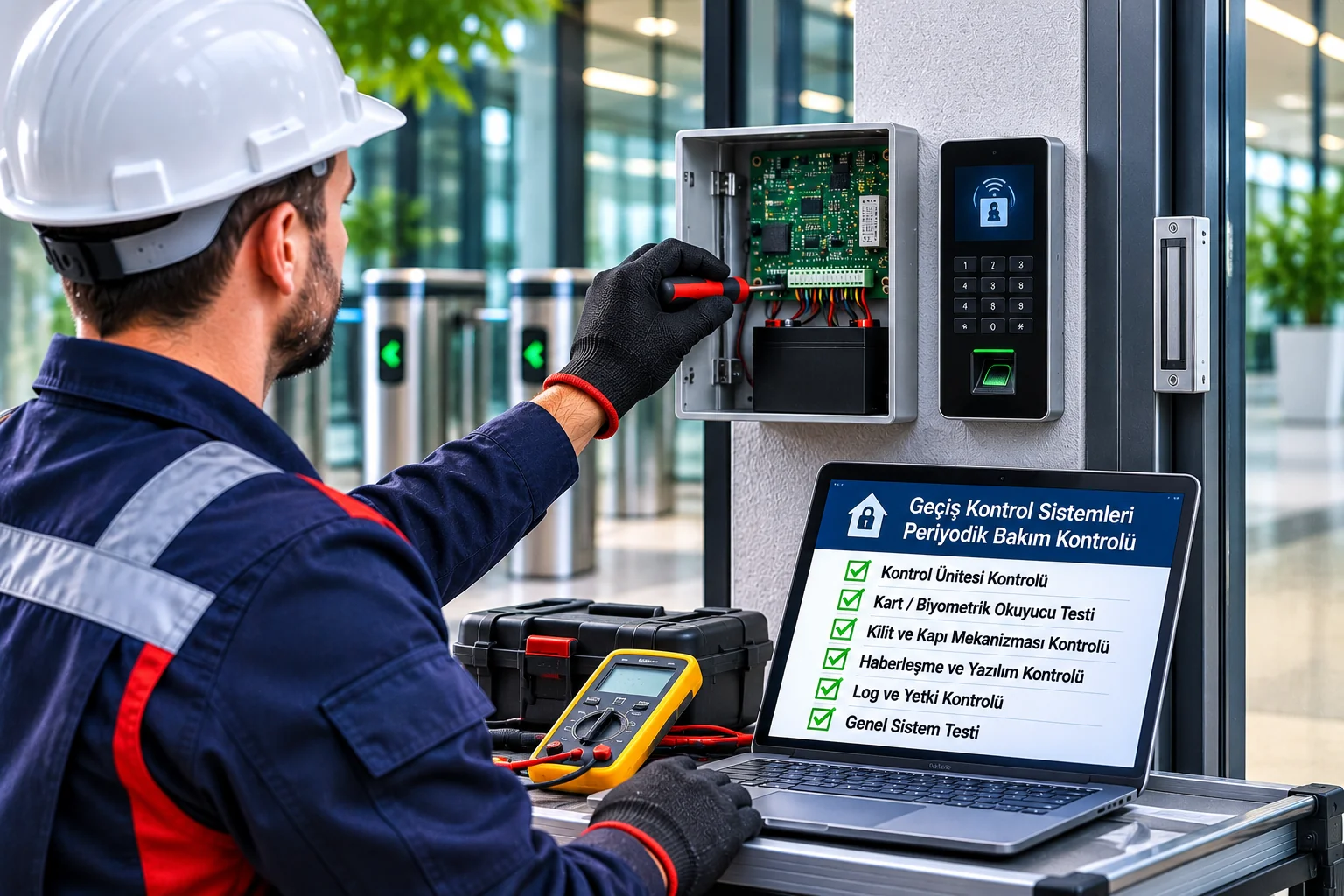
Periodic maintenance standards for access control systems cover the technical inspection, testing and maintenance requirements applied to preserve the security, reliability, availability and emergency performance of electronic access-control infrastructure used in buildings and facilities. Card readers, electronic locks, magnetic door contacts, control panels, turnstiles, vehicle barriers and centralized access-management software are among the core components of these systems.
Electronic access control systems enable authorized users to enter designated areas while restricting unauthorized entry. However, correct operation at initial installation does not mean the system will deliver the same performance throughout its service life.
For example, an RFID card reader may correctly identify a user, but access may still fail because the electric door lock is mechanically jammed. Similarly, the control software may indicate that a door is closed, while a faulty door contact causes it to report the actual door status incorrectly.
In a more critical situation, an electric lock or turnstile may perform its normal security function but fail to provide the required evacuation behavior during a fire alarm.
Therefore, professional maintenance of an access control system; a comprehensive engineering process that jointly verifies authorization, physical passage, door status, power, communications, emergency evacuation and data security must be.
The principal international references for electronic access control systems include the IEC 60839-11-1 and IEC 60839-11-2 standards. They provide a technical framework for system-component performance, implementation processes and maintenance.
What Is Periodic Maintenance for Access Control Systems?
Periodic maintenance of access control systems is the process of inspecting physical and electronic components at set intervals, carrying out the necessary tests, correcting faults and documenting the results.
The main objectives of a maintenance program are:
Making correct decisions on authorized and unauthorized access.
Ensuring the reliable operation of electronic locks.
Correctly detecting door opening and closing status.
Ensuring the safe movement of turnstiles and barriers.
Preserving fire and emergency procedures.
Maintaining continuity of communication between the control panel and readers.
Ensuring the adequacy of backup power sources.
Maintaining the integrity of access logs.
Keeping users and access permissions up to date.
Ensuring secure operation of system software.
Periodic maintenance covers not only the replacement of faulty parts but also the early identification of issues that have not yet developed into failures.
The Difference Between Maintenance, Inspection and Testing
Activity | Purpose | Example |
|---|---|---|
Routine inspection | Monitor system status | Review offline-door alerts |
Preventive maintenance | Reduce the likelihood of failure | Inspect the door mechanism |
Function test | Verify a defined function | Pass through using an authorized card |
Security test | Verify access restrictions | Reject an unauthorized card |
Emergency test | Verify safe evacuation | Exit procedure linked to the fire alarm |
Corrective maintenance | Resolve a detected fault | Replace a faulty door contact |
Revalidation | Verify performance after a correction | Test all doors after lock replacement |
Each of these checks serves a different purpose. For example, testing a card reader does not replace an emergency evacuation test.
Which Standards Are Used for Access Control Systems?
A number of international standards and technical references are used in electronic access-control applications.
Standard | Scope | Importance for maintenance |
|---|---|---|
IEC 60839-11-1:2013 | Electronic access control systems and components | Functional and performance requirements |
IEC 60839-11-2:2014 | Access control implementation guide | Installation, operation, maintenance and documentation |
IEC 60839-11-5:2020 | OSDP communications protocol | Reader-to-panel communications |
EN 16763:2017 | Security systems services | Service provider and personnel competence |
EN 13637:2015 | Electrically controlled exit systems on escape routes | Safe exit functions for relevant doors |
EN 179 / EN 1125 | Emergency exit and panic exit hardware | Suitability of relevant door hardware |
ISO/IEC 27001:2022 | Information security management | Protection of access data and management infrastructure |
Manufacturer maintenance instructions | Device-specific maintenance requirements | Mechanical, electrical and software procedures |
These standards address different technical subjects.
Important: The publication of IEC and EN standards does not mean that each one is a direct legal requirement for every access control application in Türkiye. Applicable TSE adoptions, building fire-safety regulations, contracts and sector-specific obligations should be assessed separately.
What Is the IEC 60839-11-1 Standard?
IEC 60839-11-1:2013, is the international standard that defines the basic functions, performance requirements and test methods for electronic access control systems and components.
The standard covers the electronic management of physical entry to and exit from buildings and protected areas.
Key Topics Related to System Performance
Credential assessment.
User access authorization.
Access control.
Event logs.
Functions of system components.
Security and performance assessment.
For periodic maintenance, the key is to preserve throughout the service life the functions provided at initial installation.
For example, if access to a door is prohibited outside specified hours, maintenance should verify that this time restriction still works.
Are Access Authorization and Physical Passage the Same Thing?
No.
In access control software, the “access granted” event does not always prove that the person actually passed through the door.
Door contacts, passage sensors or turnstile position data may be needed to verify physical movement.
This distinction is particularly important during maintenance.
A successful response from a card reader alone does not show that the door lock has released, that the door has actually opened, or that it subsequently closed securely.
Why Is IEC 60839-11-2:2014 Important for Maintenance?
IEC 60839-11-2:2014, is the international guide to the implementation of electronic access control systems.
The standard covers requirements for planning, installation, commissioning, operation, maintenance and documentation.
The fundamental maintenance approach is to assess the system not only device by device, but also in relation to the security functions of the access points where it is deployed.
The System Life Cycle in Maintenance
The life cycle of an access control system consists of the following stages:
Identifying the security need.
Designing access points.
Selecting and installing equipment.
Commissioning and site acceptance testing.
Operation and user management.
Periodic maintenance.
Fault resolution and system changes.
Revalidation of performance when required.
For example, if an office storeroom is later converted into a critical data-center area, the existing access permissions and door security may no longer be adequate.
For this reason, changes in facility use should also be assessed during maintenance.
What Does EN 16763 Provide for Security Systems Maintenance Services?
EN 16763:2017, is a European standard addressing the delivery of services for fire safety and electronic security systems.
The standard concerns the qualifications of organizations and personnel responsible for planning, installation, commissioning, verification, handover and maintenance services.
Access control systems are among the security applications covered by the standard.
What Qualifications Matter in a Technical Service Company?
Knowledge of access control architecture.
Competence in electronic locks and door hardware.
Knowledge of control panels and software.
Electrical and network security.
Knowledge of fire evacuation integration.
Access to manufacturer service procedures.
Use of test equipment.
Technical records and reporting.
Relevant personal-data and cybersecurity obligations.
A maintenance company's ability to replace a card reader alone does not demonstrate that it is qualified to assess the security and evacuation functions of an entire access control system.
How Often Should Access Control Systems Be Serviced?
There is no single general maintenance interval that applies to all card-access, turnstile and electronic lock systems.
Maintenance frequency should be determined according to the following factors:
Daily usage intensity of the door or turnstile.
Security risk.
Manufacturer maintenance instructions.
Mechanical wear.
Environmental conditions.
Emergency exit function.
System fault history.
Operational and contractual obligations.
Sample Periodic Maintenance Schedule
Interval | Recommended check |
|---|---|
Daily | Critical doors, turnstiles and system fault conditions |
Weekly | Door-held-open and unauthorized-entry alarm logs |
Monthly | Sample authorized/unauthorized card tests, log and access checks |
Quarterly | Reader, door lock, contact, panel and communications checks |
Six-month | Comprehensive mechanical and electronic field maintenance |
Annually | System-wide audit of performance, authorization, emergency evacuation and documentation |
After an incident | Additional testing after a fire, mechanical failure, power outage or significant change |
This program is an example of a risk-based maintenance plan.
The intervals shown in the table should not be interpreted as being mandatory for all access control systems under IEC 60839-11-2.
For example, the mechanical maintenance needs of busy shopping-mall turnstiles differ from those of a technical-room door that is opened infrequently.
For doors with an emergency evacuation function, applicable fire-safety obligations and manufacturer procedures also take priority.
Periodic Maintenance of Card Readers
Card readers are the core components that capture user credentials in an access control system.
RFID, NFC, PIN and mobile-access readers may operate on different principles.
What Should Be Checked When Maintaining a Card Reader?
Physical housing and mounting.
Reader connections.
Card-reading behavior.
Authorized card operation.
Rejection of unauthorized cards.
Correct operation of PIN entry.
Mobile-access operations, if available.
Reader light and sound indicators.
Communication with the control panel.
Tamper-detection function.
Firmware and configuration status.
How Should Reader Range Be Evaluated?
Card-reading range depends on the card technology, antenna design, mounting surface, and environmental conditions.
Mounting on metal surfaces or having electronic equipment nearby can affect reading performance in some systems.
However, maintenance should not focus solely on achieving the maximum reading range stated in the catalog.
Verify that the reader operates reliably under the conditions specified for its intended use in the project.
Why Is an Unauthorized Card Test Necessary?
During maintenance, it is not enough to verify that the door opens with an authorized card.
Also verify that the system denies access when tested with a card that has no access permission.
This test should be performed using controlled test credentials created through appropriate authorization management.
Periodic Maintenance of Electronic Locks
Electronic locks are important components that perform the physical security function of an access control system.
The main types of locks are:
Electromagnetic locks.
Electric strikes.
Motorized locks.
Solenoid-based locks.
Suitable electronic door-lock mechanisms.
These locks differ in how they operate and behave during a power outage.
Electric Lock Inspection Table
Check | Expected result |
|---|---|
Locking | The door should lock securely in the specified state. |
Unlocking | It should unlock in response to an authorized command. |
Door alignment | There should be no mechanical jamming or strain. |
Power connection | It should meet the manufacturer's operating conditions. |
Door closure | The lock and door should return to the correct position. |
Mechanical wear | There should be no critical loosening or damage. |
Fire/emergency | The applicable evacuation scenario should be supported. |
Fault reporting | Supported monitoring functions should operate correctly. |
Electromagnetic Lock Maintenance
For electromagnetic locks, inspect:
The lock body.
The armature plate.
Mounting connections.
Door alignment.
Power supply.
Authorized release function.
Applicable emergency-exit arrangement
should be checked.
Misalignment between the lock and the armature plate can affect reliable holding performance.
However, do not assume that the electromagnetic lock achieves its catalog-rated holding force in the field without taking appropriate measurements.
Electric Strike Maintenance
On doors fitted with an electric strike, the latch and locking mechanism must operate correctly.
In particular, assess friction as the door closes, mechanical alignment, and the power supply.
Do not assume that an electric strike and an electromagnetic lock behave identically during a power outage.
What Are Fail-Safe and Fail-Secure?
In access control systems, how a lock behaves during a power outage is an important design feature.
Fail-safe: The relevant locking mechanism is designed to release the lock when power is lost.
Fail-secure: The relevant locking mechanism is designed to remain locked from the secure side when power is lost.
However, these definitions alone do not prove that a door is safe for emergency evacuation.
For example, even when a fail-secure electric strike is used, an independent and suitable mechanical means of escape may be available from inside.
Conversely, the presence of a lock that releases when power is lost does not mean that the door meets all evacuation requirements.
Lock selection and maintenance should be assessed in conjunction with the door's role on the escape route, the fire-safety design, and applicable regulations.
Fire Alarm and Emergency Evacuation Testing in Access Control Systems
The most critical issue in access control maintenance is the safe operation of designated emergency exits.
In Türkiye, Article 30 of the Regulation on the Protection of Buildings from Fire requires escape routes to remain available for use, free of obstructions.
Article 47 sets out basic requirements, including that escape-route doors must not be kept locked and must be capable of being opened by hand.
Article 82 addresses the necessary emergency-control functions for doors and turnstiles kept locked for security reasons during a fire.
Therefore, fire-scenario integration should also be assessed as part of access control maintenance.
What Should Be Tested in Fire Integration?
Test item | Expected approach |
|---|---|
Fire alarm activation | The relevant emergency scenario should operate. |
Escape door | Safe exit should not be obstructed. |
Turnstile | The emergency-passage behavior specified in the design should occur. |
Electronic lock | The door should retain its designed safe behavior. |
Power outage | Evacuation requirements should be met. |
Network/server outage | Critical exit functions should not be affected. |
Fire alarm reset | The system should return to normal operation in accordance with the approved procedure. |
Can Turnstiles Be Used as Emergency Exit Doors?
Article 47 of the Regulation on the Protection of Buildings from Fire provides that revolving doors and turnstiles may not be used as exit doors as an exit-door requirement.
Therefore, switching a turnstile to free-passage mode in an emergency does not automatically make it a legally compliant required escape door.
The building's actual escape route and adequate exit capacity must also be maintained.
The Importance of the EN 13637 Standard
EN 13637:2015 covers requirements and test methods for electrically controlled exit systems used on escape routes.
However, one should not assume that every card-access door is subject to the same standard.
This standard should be considered for relevant door and exit-hardware applications.
Emergency evacuation tests should be conducted only with coordination by authorized teams and using approved scenarios. It is not appropriate to disable critical exits without control during a test or to create a risk of people being trapped inside.
Periodic Maintenance of Door Magnetic Contacts
Door contacts are used in access control systems to monitor whether a door is open or closed.
Door Contact Checks
Physical condition of the sensor and magnet.
Correct event information when the door is closed.
Correct status reporting when the door is opened.
Cable and connection integrity.
Door alignment.
Correct door name in the event log.
Supported door-held-open alarm.
What Is a Door-Held-Open Alarm?
Door Held Open is an alert generated when the door does not return to its normal position within the specified time.
However, this time does not have to be the same for every access point.
For example, the normal open times for a staff door and a loading-bay door may differ.
During maintenance, compare the thresholds with the actual intended use.
What Is a Forced-Door Alarm?
Door Forced Open can be generated when a door opens without an authorized opening event, under conditions supported by the system.
When assessing this function, the relationship between the door contact, lock status, and control-panel events is important.
One should not assume that every system can detect all forced-entry scenarios using only a single magnetic contact.
Periodic Maintenance of Turnstile Systems
Turnstile systems comprise both electronic and mechanical moving components.
Mechanical wear can occur, particularly at busy entrances because of high usage levels.
What to Check on Turnstiles
Housing and fasteners.
Rotating mechanism or barrier-arm movement.
Motor and drive condition.
Operation of the relevant sensors.
Card-reader connection.
Passage direction and locking.
Passage-completion detection.
Jamming or abnormal movement.
Emergency behavior.
Supported fault and event logs.
Is Maintenance the Same for Tripod and Speed-Gate Turnstiles?
No.
Tripod turnstiles and motorized glass-wing speed gates may use different mechanical and control architectures.
Therefore, the following should be inspected:
Motor maintenance requirements.
Mechanical connections.
Motion sensors.
Anti-entrapment functions.
Opening and closing behavior.
Emergency scenarios.
according to the product-specific maintenance instructions.
Are Turnstile Passage Counts the Same as User Counts?
Not always.
A turnstile system can record certain passage events. However, because of multiple passages, returns, and anti-passback policies, these events do not directly represent the number of unique users.
During maintenance, verify that the passage sensor records the actual event.
Periodic Maintenance of Vehicle Barriers
Automatic barriers used for vehicle access control are motorized moving equipment.
As part of access control maintenance, assess:
Mechanical housing.
Barrier arm.
Motor and transmission.
Opening and closing movement.
Vehicle detection sensors.
Safety photocells or relevant safety devices.
Emergency-opening methods.
Control and access-control integration.
should be assessed.
Opening a vehicle barrier in response to a license-plate or RFID authorization command does not prove that all its mechanical and safety functions are operating correctly.
In particular, maintenance of moving systems that affect vehicle and pedestrian safety should be carried out in conjunction with applicable machinery and product-safety requirements.
Periodic Maintenance of Access Control Panels
The access control panel evaluates information from readers and other components to make authorization decisions and issue the necessary output commands.
Functions to Check on the Panel
Check | Assessment |
|---|---|
Panel accessibility | Normal connection and service status |
Door definitions | Match with actual access points |
User permissions | Correct permission groups |
Schedules | Day and time rules |
Event logs | Correct date, time, and door |
Relay/output functions | Execution of authorized commands |
Door inputs | Contacts and other required signals |
Network communication | Connection reliability |
Local memory | Event and user capacity |
Power | Normal and required backup supply |
Firmware | Support and security status |
Do Doors Work When the Server Connection Is Lost?
Some access control panels can continue operating using authorization information stored in local memory.
However, not all systems support the same offline operating capability.
The following should be checked during maintenance:
Whether existing permissions can be used offline.
How new permission changes are processed.
Local event logging.
Memory capacity.
Data synchronization when connectivity is restored.
Potential duplicate or missing records.
Offline operation tests should be carried out under a controlled test plan that does not disrupt actual security or evacuation functions.
OSDP Maintenance in Access Control Systems
OSDP (Open Supervised Device Protocol), is the protocol used for communication between peripherals such as readers and access control units.
IEC 60839-11-5:2020, addresses the OSDP protocol as part of an international standard.
What to Check During OSDP Maintenance
Reader-to-control-panel communication.
Address and device configuration.
Communication errors.
Supported supervision messages.
Firmware compatibility.
Secure Channel configuration.
Secure management of encryption keys.
Behavior during connection loss and recovery.
What Is OSDP Secure Channel?
On devices that support it, OSDP Secure Channel provides authenticated and encrypted communication between the reader and the control panel.
However, it is not correct to assume that Secure Channel is automatically enabled between two OSDP-compatible devices.
During maintenance, verify that the secure channel has actually been configured and is working, using the manufacturer's appropriate management tools.
Maintenance of Wiegand Systems
At facilities with older readers that use Wiegand communication, cabling and functional compatibility should be checked.
However, the security features of traditional unencrypted Wiegand connections are not the same as those of a properly configured OSDP Secure Channel.
This difference may be taken into account in the risk assessment when planning system modernization.
Access Control Power Supply and UPS Maintenance
Electronic access control may include components that depend on electrical power.
Failures in power supplies can affect the operation of locks or control panels.
Power Supply Checklist
Supply voltage.
Power supply operating limits.
Condition of connections and terminals.
Battery or UPS condition.
Charging system.
Overload and fault indicators.
Relevant power outage notification.
Behavior when power is restored.
Required emergency evacuation functions.
Is a UPS Required at Every Door?
It cannot be said that all access control systems must have the same UPS arrangement.
The need for backup power depends on the system's security and operational objectives.
However, the behavior of locks and evacuation mechanisms during a power outage must be defined as part of the project.
A UPS keeping a door locked during a power outage is not automatically an appropriate solution for emergency evacuation.
Power continuity and escape safety should be assessed together.
Access Control Software and Server Maintenance
Access control software can manage users, access groups, doors, event logs and certain integrations.
For centralized access control software, simply opening the program is not enough during maintenance.
Software Maintenance Checks
Server and service status.
Database health.
User and role management.
Doors and access groups.
Schedules.
System clocks and NTP synchronization.
Event log integrity.
Backup and restore procedures.
License and support status.
Software security updates.
Integration services.
Why Might Access Records Be Missing?
In some systems:
Control panel connection issue.
Database error.
Local memory full.
Time discrepancy.
Synchronization issue.
Incorrect event filters.
These may result in missing or incorrectly timed records.
For this reason, sample test events should be generated during maintenance, and it should be verified that the corresponding records appear in the management software with the correct door and time information.
Periodic Maintenance of PDKS Systems
PDKS (Personnel Attendance Control System), can manage employees' entry, exit and attendance records.
However, PDKS and physical access control are not the same function.
A person may create a record at a PDKS terminal without passing through a turnstile, or security-focused door control may operate independently of employee attendance tracking.
What to Check During PDKS Maintenance
User and employee mappings.
Terminal event records.
Date and time accuracy.
Shift and work schedules.
Data transfer.
Duplicate or missing events.
Device-server synchronization.
User permissions.
Reporting and export functions.
Should Time and Attendance Calculations Also Be Checked During Maintenance?
If PDKS software is within the maintenance scope, sample shift and overtime scenarios calculated according to defined rules can be verified.
However, it should not be assumed that the technical service provider automatically takes responsibility for all labor law and payroll calculations.
Software functionality should be assessed alongside the company's authorized human resources and payroll processes.
KVKK and Maintenance of Biometric Access Control Systems
Biometric access control systems can verify identity using fingerprints, facial recognition or other biometric methods.
Biometric data falls within the category of special-category personal data under Law No. 6698.
KVKK Principle Decision No. 2026/921
The Personal Data Protection Board's decision dated 29 April 2026, numbered 2026/921, introduced significant restrictions on processing biometric data for the purpose of tracking employees' working hours.
The decision was published in the Official Gazette dated 2 June 2026.
The Board stated that cards, PINs and less intrusive alternatives should be preferred over fingerprints or similar biometric methods for tracking working hours.
Also, in its announcement dated 27 August 2026, KVKK stated that security of access to critical areas and the purpose of tracking working hours should not be assessed in the same way.
Therefore, in a system with biometric access control, the following should be assessed together:
Purpose of use.
Legal basis for data processing.
Alternative methods.
Necessity and proportionality.
Retention and deletion conditions.
Risks of unauthorized access.
should be considered together.
Points to Consider When Maintaining Biometric Terminals
Maintenance of sensors or optical surfaces in accordance with the manufacturer's instructions.
Defined verification tests.
Device communications.
User-matching functions.
Software and security updates.
Record and database security.
Authorized service access.
Biometric templates should not be unnecessarily exported or copied to personal service computers for maintenance purposes.
Cybersecurity Maintenance in Access Control Systems
Access control systems are infrastructure where physical security and information security directly intersect.
An unauthorized software operation can affect physical door access.
For this reason, the following cybersecurity checks should be carried out during maintenance:
Review of administrator accounts.
Removing unnecessary users or revoking their permissions.
Strong authentication.
Supported multi-factor authentication.
Network segmentation.
Disabling unnecessary services.
Checking software and firmware support status.
Secure remote service access.
Protection of event logs.
Configuration backups.
Security of the database and access records.
Should Firmware Be Updated at Every Maintenance Visit?
No.
The manufacturer's security advisories, bug fixes and version compatibility should be reviewed.
In particular, there may be version dependencies between the control panel, reader and management software.
After an update:
Authorized access.
Denial of unauthorized access.
Door contact.
Event logs.
Communication.
Emergency exit behavior.
must be tested again.
How Is Availability Measured in Access Control Systems?
The number of service visits alone is not enough to assess the performance of periodic maintenance services.
Door operating times and fault records can also be measured.
Door Availability Rate
Availability (%) = (Planned operating time − Measured functional downtime) / Planned operating time × 100
Example Calculation
Suppose uninterrupted operation of 40 access points is targeted over 30 days.
Total planned operating time:
40 × 30 × 24 = 28,800 door-hours
If a total of 24 door-hours of functional downtime occurred during this period:
(28800 − 24) / 28800 × 100 = %99.92
an approximate availability result is obtained.
However, there is an important limitation here:
A door being accessible does not mean it is operating correctly from a security and evacuation perspective.
For example, a door that remains open may appear available, but it may not be performing its function of preventing unauthorized access.
For this reason, access control KPIs should assess security and life-safety performance separately.
Maintenance KPIs for Access Control Systems
KPI | Performance being measured |
|---|---|
Door functional availability | The access point continuing to perform its function |
Authorization accuracy | Correct application of defined permissions |
Record integrity | Accurate storage of access events |
System fault detection time | When the problem was detected |
Technical response time | When the service provider began responding |
Fault resolution time | Permanent resolution of the problem |
Recurring faults | Recurrences involving the same door or component |
Emergency test success | Successful execution of defined evacuation scenarios |
Open critical nonconformities | Number of significant unresolved faults |
SLA and KPI targets should be set according to the criticality of the relevant project.
It should not be assumed that the same availability or response time is mandatory for all access control systems.
How Should an SLA Be Defined in an Access Control Maintenance Contract?
The maintenance contract should clearly specify fault priorities and the scope of service.
Sample Fault Priority Matrix
Priority | Sample issue | Response approach |
|---|---|---|
P1 — Critical | Lock failure obstructing an emergency exit | Immediate safety measures and emergency response |
P1 — Critical | Serious loss of security function at the main entrance | Urgent assessment |
P2 — High | Failure of access to a critical technical room | Priority response |
P3 — Medium | Failure of a secondary card reader | Scheduled rapid service |
P4 — Low | Non-urgent reporting issue | Scheduled maintenance |
The contract should define separate targets for beginning a response and resolving a fault.
For example, even if a four-hour service response target has been set for a critical door failure, the emergency exit cannot be obstructed during that period.
Life-safety measures that take priority should be assessed independently of the technical service contract.
Sample Technical Acceptance Tests for Access Control Systems
The following tests may be carried out during professional maintenance.
Test | Expected result |
|---|---|
Authorized card test | The defined access permission is applied |
Unauthorized card test | Access is denied |
Time restriction | Access is denied at the wrong time |
Door opening | The actual door status is detected |
Door closing | The required secure position is verified |
Door-held-open alarm | An alarm is triggered under the defined condition |
Forced-door alarm | An event is triggered in the supported scenario |
Event log | The correct user, door and time are recorded |
Offline operation | The behavior specified in the project is verified |
Power failure | The designed safe behavior is maintained |
Fire alarm | Required evacuation functions operate |
System returns to normal | Correct operating status is restored after the test |
These are sample acceptance criteria. The actual test scope should be prepared in accordance with the system's security requirements, applicable regulations and approved design.
How to Prepare a Periodic Maintenance Report
A maintenance report for an access control system should contain testable results rather than a generic statement that the devices have been checked.
Sample Door-by-Door Maintenance Report
Field | Sample entry |
|---|---|
Facility | Corporate Building A |
Door ID | ACS-014 |
Location | Second-floor technical room |
Control panel | Actual model and serial number |
Reader | Actual model information |
Lock type | Electric strike |
Door contact | Compliant |
Authorized card test | Successful |
Unauthorized card test | Successful |
Lock opening and closing | Compliant |
Event logs | Compliant |
Offline operation | Tested against project requirements |
Fire scenario | Not applicable / tested |
Issue identified | Delay in the door-closing mechanism |
Corrective action | Adjusted |
Retest | Successful |
Final status | Compliant |
Maintenance performed by | Authorized technical personnel |
Maintenance date | Actual date |
This report is a sample technical service form; it is not the verbatim official reporting format of an IEC standard.
Possible Maintenance Report Outcomes
Compliant: The specified criterion was met.
Non-compliant: The criterion was not met.
Corrected: The issue was resolved and retested.
Unable to test: The test could not be completed for a valid reason.
Out of scope: The relevant function is not present in the system.
Open critical non-compliance: A significant security or evacuation issue has not yet been resolved.
If a critical evacuation or access control issue exists, the system should not be reported as fully compliant merely because the other tests were successful.
Periodic Maintenance Checklist for Access Control Systems
- Has the current inventory of doors, panels and readers been checked?
- Have the applicable standards and project criteria been verified?
- Have authorized and unauthorized card tests been conducted?
- Has the physical condition of the card readers been checked?
- Have mobile access and PIN functions been tested, if required?
- Have the installation and operation of the electronic locks been inspected?
- Have the doors been verified to close and lock?
- Have the door contacts been tested?
- Has the door-held-open alarm been checked?
- Has the forced-door alarm been tested?
- Have turnstile mechanisms and safety sensors been inspected?
- Have barrier and vehicle-access safety functions been checked?
- Has the fire alarm integration been tested?
- Has safe evacuation through emergency exit doors been verified?
- Have power failure scenarios been assessed?
- Have the UPS and power supplies been checked?
- Have OSDP or other reader communications been verified?
- If a secure channel is used, has its configuration been checked?
- Has the control panel's offline operation been assessed?
- Have user and authorization groups been updated?
- Have the access permissions of departed personnel been checked?
- Have event logs and time synchronization been verified?
- If there is PDKS integration, have the records been compared?
- Have the software and database health been inspected?
- Have backup and recovery procedures been assessed?
- Have the firmware and cybersecurity status been checked?
- Have KVKK and biometric data processing requirements been reviewed?
- Have temporary settings made for maintenance been reverted?
- Have open non-compliances and corrective actions been reported?
- Have the maintenance results and necessary documents been handed over to the facility operator?
Frequently Asked Questions About Periodic Maintenance of Access Control Systems
Which standard applies to periodic maintenance of access control systems?
For electronic access control systems, IEC 60839-11-1:2013 and IEC 60839-11-2:2014 are key international references. EN 16763:2017 is also important for security system services and personnel competence.
What does the IEC 60839-11-2 standard cover?
It covers implementation requirements for the planning, installation, commissioning, operation, maintenance and documentation of electronic access control systems.
Do access control systems have to be serviced every six months?
A single general legal requirement for six-monthly maintenance of all access control systems could not be confirmed. The maintenance interval should be determined according to the project, manufacturer instructions, risk and any applicable specific obligations.
How is periodic maintenance of card readers carried out?
Physical installation, card reading, authorized and unauthorized access, panel communications and event logs are checked.
Is maintenance of electronic locks necessary?
Yes. Locking, unlocking, mechanical alignment and any required emergency behavior should be assessed.
What is the difference between fail-safe and fail-secure?
A fail-safe mechanism can be designed to release the lock on loss of power, while a fail-secure mechanism can be designed to remain locked on a specified side. The door's evacuation safety should be assessed separately from this feature.
Must an access control system be integrated with the fire alarm?
This requirement depends on the door's function, the building design and applicable regulations. Relevant door and turnstile functions that affect safe evacuation must be assessed.
Is periodic maintenance necessary for turnstile systems?
Yes. It is especially important to check the movement, safety sensors and emergency functions of heavily used mechanical and motorized turnstiles.
Should OSDP Secure Channel be checked during maintenance?
Yes. If this feature is available in the system being used, the security of communications and the communication status of the devices should be verified.
Does an access control system work when the server connection is lost?
Some control panels can operate offline using local authorization data. This behavior depends on the model and configuration and should be tested.
Is maintenance of an access control system the same as maintenance of PDKS?
Not entirely. Physical access and security are assessed in access control, while personnel attendance data and software records are assessed separately in PDKS.
Can fingerprints be used to track working hours?
In Türkiye, the use of biometric data to track employees' working hours is subject to significant legal restrictions under KVKK principle decision No. 2026/921. Less intrusive alternatives should be used.
What should an access control maintenance report include?
It should include the door and device inventory, test results, lock and reader checks, emergency functions, software status, identified non-compliances and corrective actions.
Who should perform access control system maintenance?
It should be carried out by competent technical personnel able to assess the system's electrical, mechanical and software features and, where necessary, its fire-safety features. Any specific authorization or certification requirement in the regulations must be followed.
Conclusion: Maintenance of Access Control Systems Must Verify Security and Evacuation Performance Together
Access control systems are among the important components of modern building and facility security.
However, electronic access control is not limited to the operation of card readers, control panels and electric locks.
User authorization, physical door movement, electronic communications, event logs, power continuity and emergency evacuation safety are complementary functions.
The IEC 60839-11-1 and IEC 60839-11-2 standards provide important international references for the technical requirements and implementation processes of electronic access control systems.
EN 16763, in turn, provides guidance on the systematic delivery of maintenance and service by competent personnel.
Successful periodic maintenance of an access control system is a process that uses real tests to verify that the right person can access an authorized area at the right time, unauthorized access is restricted, and safe evacuation is not obstructed in an emergency.
For this reason, professional security projects should be based on standards-based maintenance plans, technical checklists, measurable acceptance criteria, clear fault management and documented service reports.