
People Counting System Periodic Maintenance Standards: A Guide to Calibration and Accuracy
What are the periodic maintenance standards for people counting systems? We examine maintenance, calibration, and accuracy validation through manual reference counts for 3D stereo, ToF, AI cameras, and other sensors. A professional implementation guide covering the ISO/IEC 25012 data quality approach, entry-exit error rates, RE-ID, PoE, data loss, remote health monitoring, maintenance intervals, and technical reporting criteria.
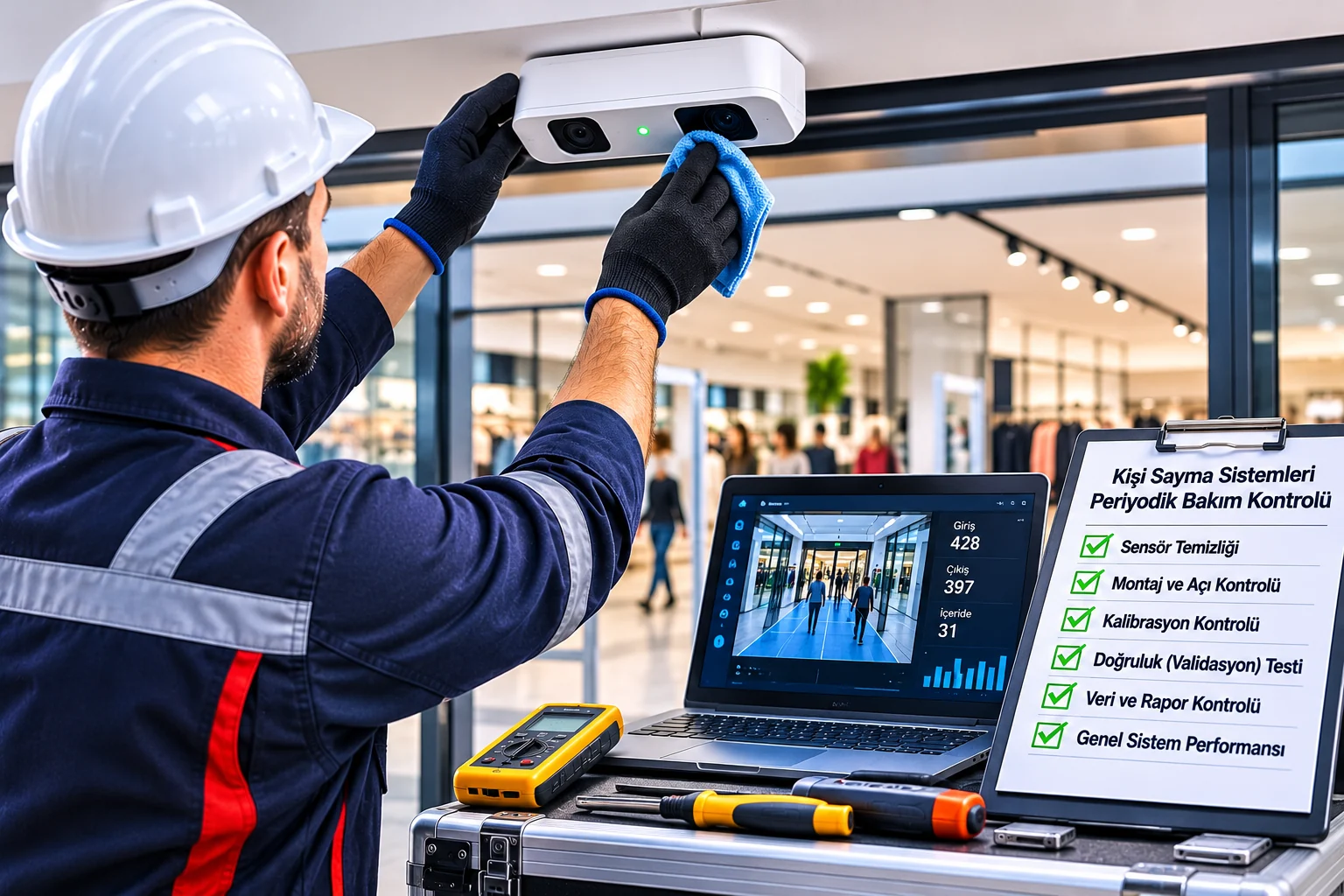
Periodic maintenance standards for people counting systems cover the technical inspections, calibration, validation, and maintenance processes used to preserve measurement accuracy, data integrity, and system continuity in visitor-counting technologies deployed in stores, shopping malls, airports, museums, hospitals, and other commercial facilities.
Unlike conventional security cameras, the primary output of people counting sensors is not an image, but measurable visitor movement data. Therefore, a system being online or data appearing on a reporting screen does not prove that it is counting accurately.
For example, a 3D people counting sensor at a store entrance may report 2,000 visitor entries over the course of a day. However, the actual visitor count may differ because of a change in the sensor's mounting angle, a new display stand placed at the entrance, an incorrectly positioned counting line, or software parameters.
Similarly, the device may detect every passage correctly, while network connectivity problems prevent some data from reaching the central reporting software.
Therefore, three distinct performance areas should be assessed when maintaining professional people counting systems:
Measurement accuracy: How accurately actual passage movements are counted.
System availability: The extent to which the sensor and associated infrastructure are operational.
Data integrity: Transferring the generated count data to the reporting system without loss, with the correct time and store information.
Successful people counting system maintenance means not merely verifying that the sensor is operating, but proving through measurements that visitor traffic data can be used reliably for business decisions.
What Is Periodic Maintenance for People Counting Systems?
Periodic maintenance for people counting systems is the process of checking the sensors' physical and electronic condition, assessing counting parameters, conducting accuracy tests against actual passages, and inspecting the reporting infrastructure.
Maintenance activities generally cover the following areas:
Checking sensor mounting and field of view.
Verifying counting lines and detection zones.
Checking entry and exit directions.
Assessing 3D depth or relevant sensor settings.
Cleaning camera and sensor surfaces appropriately.
Accuracy testing using a manual reference count.
Network, PoE, and power checks.
Verifying data transfer and central reporting.
Clock synchronization.
Checking staff exclusion and filtering functions.
Separate assessment of RE-ID performance, if supported.
Software version and cybersecurity review.
Remedying nonconformities and revalidation.
These activities do not necessarily need to be performed to the same scope at every maintenance visit.
However, if an organization's key performance indicators rely on people counting data, accuracy and data integrity checks should be core components of the maintenance program.
Which Standards Are Used for People Counting Systems?
Because people counting systems involve different hardware and software technologies, appropriate technical references should be used for each system's function rather than relying on a single standard that covers every application.
Standard or reference | Scope | Role in people counting maintenance |
|---|---|---|
ISO/IEC 25012:2008 | Data quality model | Data quality criteria such as accuracy, completeness, and consistency |
IEC 62676-4:2025 | Security video surveillance systems | Installation and maintenance approach for relevant CCTV-based components |
IEEE 802.3 PoE standards | Power over Ethernet | Power and connectivity suitability of PoE sensors |
ISO/IEC 27001:2022 | Information security management system | Corporate information security approach |
Manufacturer installation and maintenance manuals | Model-specific technical procedures | Mounting, configuration, testing, and troubleshooting |
Contractual accuracy and SLA criteria | Project performance | Counting errors, data continuity, and response targets |
ISO/IEC 25012:2008 provides a general model for assessing the quality of structured data in computer systems. According to ISO's official record, the standard was reviewed again in 2025 and its validity was confirmed.
However, this is not a specific people-counting standard stating that people-counting sensors must be calibrated every six months or achieve at least 98% accuracy.
Similarly, IEC 62676-4:2025 covers the planning, installation, testing, commissioning, and maintenance of security video surveillance systems. It should not be treated as an accuracy standard directly applicable to every people counting sensor that produces only visitor statistics.
Therefore, measurable acceptance criteria for people counting systems should be set according to the actual use case and verified manufacturer performance.
The Difference Between Calibration, Validation, and Periodic Maintenance
Three commonly used terms in people counting projects refer to technically different processes.
Process | Main purpose | Example |
|---|---|---|
Periodic maintenance | Preserving the operational reliability of the sensor and infrastructure | Mounting, PoE, network, and software checks |
Calibration / field adjustment | Adapting detection parameters to actual installation conditions | Setting the counting line and tracking zone |
Validation | Comparing the system's result with a reliable reference | The sensor counts 485 entries against a manual count of 500 |
Revalidation | Rechecking the result after maintenance or a change | A new counting test after changing the sensor's direction |
Data integrity audit | Verifying that the generated data is reported correctly | Comparing the sensor with the cloud report |
What Is Calibration in People Counting Systems?
In the people counting industry, calibration often means adjusting installation parameters.
These procedures may include:
Defining the sensor mounting height.
Setting entry and exit directions.
Defining the counting line.
Configuring the detection and tracking zone.
Setting the necessary object filters.
Preparing depth measurement for suitable technologies.
and similar activities.
However, these procedures do not necessarily mean that metrologically traceable measurement calibration is performed or that an accredited calibration certificate is issued.
Some 3D sensors use specific geometric calibration tools.
For example, AXIS 3D People Counter documentation describes geometric calibration using special markers during the device's initial installation, followed by configuration of the counting zone.
What Is Validation?
Validation is the process of testing whether a people counting system meets its defined measurement objective under actual field conditions.
For example, an independent reference count is performed during specific time periods and compared with the entry-exit values produced by the sensor.
Calibration does not prove accuracy. A system should not be considered to meet the expected measurement quality without validation.
How Often Should People Counting Systems Be Maintained?
Maintenance frequency should be determined by the system's intended use, sensor technology, site conditions, and the importance of data quality to the business.
For example, regular data quality audits are important in chain retailers where store performance is assessed using visitor traffic.
A different maintenance program may be appropriate for a small facility where only general traffic patterns are reviewed.
Sample Periodic Maintenance Program
Interval | Recommended check |
|---|---|
Daily | Sensor online status, data flow, and critical error alerts |
Weekly | Unusual count values, data gaps, and entry-exit trends |
Monthly | Data integrity report, sample count validation, and change review |
Quarterly | Comprehensive entrance-based accuracy check and system health review |
Every six months | Comprehensive maintenance of the sensor, mounting, detection zone, network, and reporting system |
Annually | System-wide performance audit, revalidation, and inventory check |
After a change | Retesting after renovation, sensor replacement, or a major software update |
These intervals are an example of a risk-based maintenance approach.
It should not be regarded as a general provision legally requiring all people-counting systems to be calibrated every three or six months.
The maintenance plan should be prepared in conjunction with manufacturer instructions and the project contract.
Physical Maintenance Standards for People Counting Sensors
People counting accuracy can be affected by sensor mounting position and environmental conditions.
Especially in ceiling-mounted optical systems, even small changes in position can alter the detection area.
Mounting Checks
The sensor is mechanically secure.
The mounting angle matches the reference installation.
The device is within the relevant manufacturer-specified height range.
The counting area covers the entire entrance.
No new physical obstructions are present.
The camera or sensor surface is clean.
Cables and connectors are in suitable condition.
Does Store Renovation Affect Accuracy?
Yes.
Installing a new product display stand at the entrance, changing the type of door, or rearranging visitor routes can affect counting performance.
FootfallCam's official documentation also lists store renovation, sensor relocation, and changes to the mounting angle among conditions that may require readjustment.
Therefore, checking that the sensor is online is not sufficient after a store renovation is completed.
Accuracy testing should be repeated where necessary.
Maintenance of 3D Stereo People Counting Sensors
3D stereo people counting systems can use depth information in images when equipped with suitable optics and processing infrastructure.
Maintenance of these sensors is not limited to cleaning the lens.
Items to Check on 3D Sensors
Check | Technical purpose |
|---|---|
Mounting height | Suitable detection geometry |
Sensor direction | Correct counting zone |
Depth calibration | Measurement in accordance with the manufacturer's method |
Entry-exit line | Correct direction classification |
Tracking zone | Correct handling of people who turn back or wait |
Multiple-person passage | Detecting people walking side by side and in groups |
Obstructions to the field of view | Reducing the effects of doors and displays |
Field validation | Verifying actual counting performance |
Testing should be conducted especially during group crossings and simultaneous movement in both directions.
However, it should not be assumed that all models of 3D sensors deliver the same performance, or that depth measurement will be flawless under every condition.
Maintenance Differences Among ToF, AI Cameras, and Other Sensors
Maintenance procedures for people-counting systems vary according to the detection technology used.
Technology | Key maintenance concern | Possible limitation |
|---|---|---|
3D stereo | Geometry, depth, field of view | Sensor alignment and environmental conditions |
ToF | Depth measurement, optical surface, installation conditions | Material reflections and environmental effects |
2D AI video | Viewing angle, lighting, FPS, analytics settings | Shadows, occlusion, and movement conditions |
Thermal counting | Sensor view and thermal detection conditions | Thermal contrast and environmental effects |
Infrared beam | Transmitter-receiver alignment | Separating people passing together |
mmWave radar | Detection zone, mounting, and movement tracking | Performance dependent on reflections and the scene |
A calibration procedure applicable to one technology should not be transferred directly to another.
For example, geometric markers used with 3D stereo sensors are not a suitable calibration method for all mmWave radar sensors.
The verification method specific to the device model, as specified by its manufacturer, should be used for each sensor.
How Is the Accuracy of People-Counting Systems Measured?
One of the most common ways to assess people-counting accuracy is to compare automated results with a manual reference count.
However, a single accuracy percentage may not explain every aspect of a system’s behavior.
Counting Error Rate Formula
For a given time interval:
Absolute percentage counting error = |Sensor count − Reference count| / Reference count × 100
This formula cannot be used for periods when the reference count is zero.
A simplified accuracy indicator can be expressed as:
Count agreement rate = 100 − Absolute percentage counting error
as follows.
However, if the error exceeds 100%, this indicator may not provide a meaningful accuracy percentage. Reports should therefore clearly identify the metric used.
Example: Store Entrance and Exit Accuracy Test
Measurement | Manual reference | Sensor result | Absolute error | Count agreement |
|---|---|---|---|---|
Entrance | 500 | 485 | 15 | %97 |
Exit | 450 | 459 | 9 | %98 |
Total | 950 | 944 | 24* | %97.47* |
In the total row, the error is calculated as the sum of the absolute entrance and exit errors. Thus, the weighted absolute error is 24 / 950 × 100 = 2.53%, and count agreement is 97.47%.
In this example, entrance and exit directions are assessed separately.
Undercounting entrances and overcounting exits can result from different technical causes.
Important: Obtaining counts of 485 entrances and 459 exits does not, by itself, show which people were counted incorrectly. The difference in the total count is only an error metric.
Does 100% Overall Accuracy Really Mean Error-Free Counting?
No.
For example, suppose a manual reference count found that 100 people entered.
The system:
missed 10 actual crossings,
incorrectly added 10 crossings,
could have.
The automated total would still appear as 100.
The difference calculated from the total count is zero.
However, the system actually missed 10 crossings and generated 10 false counts.
Assessing performance using total counts alone can therefore conceal some errors.
Event-Based Performance Metrics
If suitable video or event-matching infrastructure is available, the following can be measured:
Actual crossings detected correctly.
Missed crossings.
Falsely generated crossings.
Movements classified in the wrong direction.
Movements counted more than once.
Using these data:
Precision = Correctly detected crossings / (Correctly detected crossings + Falsely generated crossings)
Recall = Correctly detected crossings / (Correctly detected crossings + Missed crossings)
can be calculated.
These two metrics help assess sensor behavior in greater detail, particularly at busy entrances.
How Many People Should Be Counted in an Accuracy Test?
There is no single mandatory sample size for all people-counting systems.
However, manufacturers’ verification procedures provide important practical examples.
AXIS People Counter: Its official technical documentation recommends that, for manual verification, 100 or more passages be counted. The same document states an expectation of at least 95% overall accuracy under normal conditions.
FootfallCam: Its accuracy audit document describes an approach involving sensor adjustment and manual review of short video recordings. One relevant version of the procedure specifies at least 20 samples and an accuracy result above 90%, while other corporate documents set performance targets of at least 95%.
This variation shows that manufacturers’ procedures may differ by version and application conditions.
Testing 20, 100, or 200 crossings does not, by itself, guarantee a particular statistical confidence level or the same accuracy under all operating conditions.
For professional projects, the sample size should be set in advance, taking into account the target error margin and actual traffic volume.
How Is a People-Counting System Validated?
A standardized test protocol should be established to assess field accuracy.
1. Define the Measurement Objective
The movements the system is expected to count are identified.
For example:
Entry into a store.
Exit from a store.
Movement between specific indoor areas.
Visitor traffic excluding staff.
Total entry events.
Unique visitors.
These are different measurements.
2. Identify the Test Area
The sensor’s physical counting line and detection zone are verified.
The person conducting the reference count must use the same crossing boundary.
3. Prepare the Reference Method
Manual observation or short verification footage obtained in a legally compliant manner may be used.
It is important that the reference counter’s method aligns with the system’s counting rules.
4. Test Different Traffic Conditions
Testing only during quiet hours may not be sufficient.
The following scenarios should be assessed:
Test scenario | Aspect to verify |
|---|---|
Single-person entry | Basic entrance counting |
Single-person exit | Basic exit counting |
Two people side by side | Simultaneous crossing |
Large group | Occlusion and following |
Entry and exit at the same time | Bidirectional counting |
Waiting in the counting zone | False or duplicate counting |
Turning back after entering | Counting-line logic |
Child and family crossing | Target-person classification |
Stroller | False object detection |
Wheelchair | Accessibility and measurement |
Bag or shopping cart | Object filtering |
Effects of doors and air curtains | Moving environmental elements |
The contract should specify which scenarios fall within the system’s intended scope.
5. Compare the Data
Entrance and exit directions should be calculated separately.
Where possible, missed and additional counts should also be reviewed at the event level.
6. Address Nonconformities
Appropriate adjustments can be made in response to the issues identified.
For example, the counting line or tracking zone can be repositioned.
7. Revalidation
The test should be repeated after any adjustment.
A new accuracy percentage should not be reported unless the conditions that caused the initial test to fail have been addressed.
8. Prepare the Accuracy Report
Test results should be documented together with the sample and field conditions.
Why Should Entrance and Exit Accuracy Be Reported Separately?
Entrance and exit directions can exhibit different error patterns in people-counting systems.
For example, the direction in which a door opens may not affect the sensor on entry but may approach the detection zone on exit.
Similarly, customers entering a store may spread out over a wider area, while their movement on exit may differ because of a checkout queue.
Accordingly, rather than reporting a single overall accuracy percentage, the following should be shown:
Entrance accuracy.
Exit accuracy.
Accuracy during busy hours.
Accuracy during low-traffic periods.
Performance in specific crossing scenarios.
should be reported separately.
Particularly in shopping mall and chain-store projects, counting errors at different doors may offset one another in the total, but this does not mean the system is actually working correctly.
What Is Data Integrity in People-Counting Systems?
For people-counting data to be reliable, it is not enough for the sensor to count accurately.
The generated data must also be transmitted correctly to the central reporting system.
ISO/IEC 25012’s data-quality approach is a general reference that can be used to assess this process.
Data Integrity Check Criteria
Check | Risk |
|---|---|
Missing time intervals | Data gaps in reports |
Duplicate records | Inflated visitor figures |
Incorrect store mapping | Traffic attributed to the wrong branch |
Incorrect entrance-exit direction | Distorted occupancy and traffic reports |
Time-zone error | Incorrect hourly traffic figures |
Delayed transmission | Missing data in real-time reports |
Incorrect filtering | Staff counted as customers |
Data collection error | Inconsistency in multi-sensor reports |
Are Missing Data and a Zero Count the Same Thing?
No.
A store may have zero visitors during a particular 15-minute interval.
That is a valid measurement result.
It is different from having no data at all for that interval because the sensor was offline.
If the reporting system displays a no-data status as zero visitors, it can cause serious data-quality problems.
For this reason, maintenance and data audits should distinguish zero values from missing measurements.
How Is the Data Completeness Rate Calculated?
It is possible to measure whether the reporting system generates valid data for the expected time intervals.
Example formula:
Data completeness rate = Expected time intervals containing valid data / Total expected time intervals × 100
Example Calculation
Suppose a store is open for 12 hours every day for 30 days, and data is reported in 15-minute intervals.
Expected daily time intervals:
12 × 4 = 48
Expected intervals over 30 days:
48 × 30 = 1440
Suppose valid data was generated for 1,425 time intervals during this period.
1425 / 1440 × 100 = %98.96
the data completeness rate is obtained.
This result does not mean that visitor-counting accuracy is 98.96%.
It only shows how many of the expected data intervals are validly available.
A valid time interval may also have a value of zero. In that case, a period in which the system was operating and a zero reading was confirmed should not be classified as missing data.
How to Test Network Outages and Data Backfilling
Some people-counting sensors can store counting data locally up to a certain capacity when the network connection is lost.
When the connection is restored, this data can be transferred to the central software.
However, not all devices support the same local storage and backfill capabilities.
Data Backfill Test
Under approved test conditions:
Normal data flow is verified.
The network-outage behavior supported by the sensor is assessed.
It is checked whether the sensor continues counting locally during the test period.
Data synchronization is examined when the connection is restored.
Missing or duplicate time intervals are identified.
Sensor data is compared with central reports.
This process must be planned so that it does not cause uncontrolled data loss in the production environment.
The sensor merely coming back online does not prove that all data from the outage was transferred completely to the central software.
Clock Synchronization in People-Counting Systems
Time information is critical in visitor analytics systems.
This is especially true in chain retail systems where multiple stores are reported on the same platform:
Sensor clock.
Local time zone.
Central server clock.
Store opening hours.
Reporting intervals.
POS transaction times.
must be aligned.
Incorrect time zones or inadequate synchronization can cause counts to be recorded in different time zones.
This particularly affects hourly sales conversion rates, campaign performance and peak-hour analyses.
During maintenance, an appropriate NTP or equivalent clock synchronization mechanism should be checked.
Staff Exclusion Checks in People-Counting Systems
Store employees entering and leaving can affect visitor traffic data.
However, not all people-counting sensors can automatically distinguish employees.
Methods used to exclude staff:
Separate staff entrances.
Specific software filters.
Staff identification methods supported by the manufacturer.
Other authorized data sources.
may be used.
Each of these methods may entail different accuracy and personal data protection requirements.
Staff Exclusion Validation
The following questions should be checked during maintenance:
Are staff movements actually being excluded?
Are customers being mistakenly classified as staff?
Does filtering produce different results at certain times?
Are visitors who are not staff being affected?
Do reports correctly distinguish gross and net counts?
The visitor count with staff excluded is not the same metric as the sensor's raw entry count.
Therefore, the definition of each data type and the method for comparing them must be clear.
Maintenance of People-Counting Systems Featuring RE-ID
RE-ID (Re-Identification), in supported systems, may refer to associating the reappearance of a person at different times or detection points with specific technical methods.
However, not all RE-ID technologies use the same data or deliver the same performance.
Some applications use visual characteristics, while other systems may use different identification or matching methods.
Therefore, RE-ID should be assessed separately from standard entry and exit counting.
Parameters to Check When Maintaining RE-ID
Matching time window.
Matching threshold used by the system.
False matching rate.
Missed repeat-visit matches.
Data retention and deletion policy.
Clock alignment across multiple sensors.
Analytics software version.
Data access permissions.
Will a Person Be Detected if They Return an Hour Later?
The answer depends on the RE-ID technology used, the matching time window, the data retained and the system's actual detection performance.
There is no guarantee that the system will match a person as the same individual when they return an hour after leaving the store.
During maintenance and validation, repeat-visit scenarios of this kind should be tested separately against the functions claimed for the system.
RE-ID matching performance and entry-exit counting accuracy are different KPIs.
Furthermore, re-identifying or tracking people may have different implications for personal data processing and privacy than standard anonymous aggregate counting.
KVKK and Data Security in People-Counting Systems
People-counting systems can use different data-processing methods.
Some systems generate only aggregated entry and exit counts, while others may process video footage, personal characteristics or data that enables re-matching.
Therefore, using a people-counting device does not automatically mean that no personal data is processed.
The Personal Data Protection Authority's workplace camera systems announcement dated 8 June 2026 explains the importance of clearly defining the purposes of image capture, data minimization and the principle of proportionality.
Data Protection in Maintenance and Validation
The purpose for recording short validation videos must be defined.
Unnecessary video and audio recordings should be avoided.
Access to test recordings should be restricted.
Any required transparency obligations should be assessed.
Test files containing personal data must not be shared with unauthorized persons.
Retention and destruction periods for test files must be established.
Cloud and remote support access should be checked.
RE-ID and biometric characteristics should be assessed separately.
Personal data risks may be more limited in systems that use only aggregate statistics irreversibly anonymized so that they cannot be traced back to individuals.
However, where images are processed temporarily or people can be re-associated, the relevant data-processing activities should be assessed separately.
Sensor Firmware and Cybersecurity Maintenance
People-counting sensors are mostly devices connected to an IP network.
Therefore, during maintenance, the following should be reviewed:
Administrator accounts.
Firmware versions.
Security updates.
Remote access policies.
API authentication.
Network segmentation.
HTTPS and supported secure connections.
License and cloud service status.
Configuration backups.
System and user event logs.
should be reviewed.
However, updating firmware at every maintenance visit is not appropriate.
Some updates may change the counting algorithm, reporting schema or integration behavior.
Therefore, after major software updates:
Counting accuracy + data transfer + reporting integrity
must be revalidated.
Maintenance KPIs for People-Counting Systems
Professional maintenance contracts should include measurable service indicators in addition to the number of sensors.
KPI | Description |
|---|---|
Entry counting error | Difference between reference entries and sensor entries |
Exit counting error | Difference between reference exits and sensor exits |
Event-based Precision | Assessing overcounting behavior |
Event-based Recall | Assessing missed crossings |
Sensor availability | Device uptime |
Data completeness rate | Availability of expected valid reporting intervals |
Data latency | Time taken for counts to reach the central system |
Missing data duration | Measurement or transfer gaps |
Revalidation rate | Completion status of required tests |
Open critical nonconformities | Unresolved significant issues |
RE-ID matching performance | Separate measurement in supported systems |
Is 95 Percent or 98 Percent Accuracy Mandatory?
The same accuracy threshold is not mandatory for all people-counting systems.
For example, a project may target 95% accuracy, while another may target 98% or higher.
However, this target:
What metric is being measured.
Which entries and exits are covered.
Test sample.
Traffic density.
Environmental conditions.
Acceptance method.
does not become a meaningful contractual criterion unless these are defined.
The phrase “at least 98% accuracy” is not a sufficient technical acceptance criterion unless it specifies how and under what conditions accuracy will be measured.
Example SLA and Fault Priorities for People-Counting Systems
Priority | Example issue | Recommended approach |
|---|---|---|
P1 — Critical | Central reporting has stopped completely | Urgent assessment |
P1 — Critical | Data loss across many branches | Priority response |
P2 — High | Serious accuracy error at the main entrance sensor | Accelerated validation |
P2 — High | Persistent data transfer issue at a single branch | Priority technical service |
P3 — Medium | Accuracy deviation in a specific traffic scenario | Scheduled calibration |
P4 — Low | Non-urgent report display issue | Scheduled support |
Two time periods should be defined separately in the SLA:
Response time: Start of the technical assessment after a fault is reported.
Resolution time: Resolution of the issue and completion of any required revalidation.
A sensor in a people-counting system coming back online does not mean that data loss and accuracy issues have automatically been resolved.
Sample Technical Maintenance Report for People-Counting Systems
Report field | Sample entry |
|---|---|
Facility | Sample Store A |
Sensor ID | PC-014 |
Entry point | Main entrance |
Manufacturer / model | Actual device information |
Serial number | Actual device number |
Firmware | Current version |
Maintenance date | Actual date |
Installation | Suitable |
Counting line | Checked |
Entry direction | Compliant |
Exit direction | Compliant |
Reference entry count | 500 |
Sensor entry count | 485 |
Entry count agreement | %97 |
Reference exit count | 450 |
Sensor exit count | 459 |
Exit count agreement | %98 |
Data transfer | Compliant |
Clock synchronization | Compliant |
Issue identified | Undercounting in the entry direction |
Action taken | Tracking area adjusted |
Revalidation | Required |
Final status | Open nonconformity |
Responsible party | Assigned technical staff |
This table is an example technical maintenance and validation template.
The final rows are particularly important: If an adjustment has been made but revalidation has not yet been performed, the system must not be reported as corrected and fully compliant.
The Most Common Maintenance Errors in People Counting Systems
Error | Consequence |
|---|---|
Checking only whether the sensor is online | Counting errors go unnoticed |
Comparing only daily totals | Missed and overcounted events are concealed |
Combining entry and exit directions | Loss of direction-specific performance |
Failing to test after store renovation | Detection area is disrupted |
Changing the counting line without a reference | New, unknown counting errors |
Data gaps are shown as zero counts | Traffic reports are corrupted |
Failing to validate after a firmware update | Measurement behavior changes |
Failing to check staff filters | Net visitor count is corrupted |
Confusing RE-ID with entry count accuracy | Incorrect performance assessment |
Claiming definitive accuracy based on an inadequate sample | Unreliable acceptance report |
Periodic Maintenance Checklist for People Counting Systems
- Has the current sensor inventory been verified?
- Have the sensor position and mounting angle been checked?
- Does the installation height comply with the manufacturer's requirements?
- Are the entry and exit directions correct?
- Have the counting line and detection zone been checked?
- Have new displays, doors, or physical obstructions been assessed?
- Have the sensor's optical surfaces been inspected in accordance with the manufacturer's instructions?
- Has the calibration status specific to 3D or other technologies been checked?
- Have single-person passages been tested?
- Have side-by-side and group passages been verified?
- Have simultaneous entry and exit been tested?
- Have return and lingering scenarios been checked?
- Have scenarios involving children, strollers, and other targets been assessed?
- Have manual reference counts been made for entry and exit?
- Are the error and accuracy formulas used explained in the report?
- Has the sample size been recorded?
- Have counting errors and, where necessary, event-level errors been examined?
- Have the sensor's network connection and PoE power supply been checked?
- Has central data transfer been verified?
- Have missing and duplicate time intervals been checked?
- Have zero counts been distinguished from the absence of data?
- Are the store-to-sensor mappings correct?
- Have clock and time zone synchronization been verified?
- Has data backfill after a network outage been assessed?
- Have staff-exclusion functions been tested?
- If RE-ID is used, has a separate performance test been conducted?
- Have firmware and software changes been reviewed?
- Have KVKK and data access conditions been checked?
- Has revalidation been performed after corrective actions?
- Have open nonconformities and responsible parties been reported?
- Has the technical maintenance and accuracy report been delivered to the business?
Frequently Asked Questions About Periodic Maintenance Standards for People Counting Systems
What is the periodic maintenance standard for people counting systems?
A single mandatory maintenance standard applicable to all people-counting technologies could not be confirmed. Manufacturer procedures, the ISO/IEC 25012 data quality approach, relevant technical standards, and contractual acceptance criteria should be considered together.
How often should people counting systems be serviced?
Maintenance frequency should be determined according to the device technology, site conditions, and data quality requirements. Risk-based programs can be established, such as daily remote monitoring and comprehensive maintenance every three or six months.
Is calibration necessary for people counting systems?
It is important to set installation and detection parameters appropriately. However, the calibration method used and its requirements depend on the sensor model.
Are calibration and validation the same?
No. Calibration or field adjustment aims to improve the system's measurement behavior. Validation, by contrast, involves comparing results with reference measurements.
How is the accuracy of people counting systems measured?
Automatic entry and exit data are compared with manual reference counts taken over defined time intervals. Where necessary, missed and overcounted passages are also examined at the event level.
Is 98 percent accuracy mandatory for people counting sensors?
No. There is no 98% accuracy requirement that applies to all sensors. The target and acceptance method should be defined for each project.
How many people should be counted in an accuracy test?
There is no universal number. A specific AXIS People Counter procedure recommends 100 or more passages. Procedures from other manufacturers may differ.
Do 3D people counting sensors require maintenance?
Yes. Installation, detection area, depth settings, network, and data quality should be checked. However, it cannot be said that physical calibration must be repeated at every maintenance visit.
Is recalibration required after a store renovation?
If the renovation has changed the sensor's field of view, the passage route, or the detection conditions, readjustment and validation may be necessary.
Is the data accurate if the sensor is online?
No. Being online does not prove that the count is accurate or that the data has been transferred completely to the central reporting system.
How can data loss in people counting systems be detected?
Missing or duplicated data can be detected by comparing expected time intervals, sensor logs, and central reports.
Should staff counting be checked during maintenance?
Yes. If staff exclusion is used, the filtering behavior and its effect on the actual visitor count should be verified.
How is maintenance performed on RE-ID systems?
The matching window, false matches, missed repeat visits, software version, and data security should be assessed separately.
What should a people counting accuracy report include?
It should include sensor ID, installation conditions, reference counts, automated results, the error formula, sample size, test scenarios, nonconformities, and revalidation results.
How is the maintenance cost of a people counting system determined?
The number of sensors and locations, remote access, on-site maintenance, manual validation sample, reporting, licensing, and support requirements all affect the cost.
Conclusion: Data Reliability Is the Key Criterion for Maintaining People Counting Systems
People counting systems are important data sources that support operational decision-making in retail and commercial facilities.
However, the reliability of information obtained from these systems does not depend solely on the sensor's technical specifications.
Installation conditions, the counting line, actual traffic behavior, data transfer, software configuration, and system maintenance processes should be evaluated together.
In professional maintenance practices:
Accuracy validation + system health check + data integrity audit
should be treated as three complementary core processes.
Regular monitoring of measurement quality, particularly in multi-branch retail businesses, helps produce comparable data across stores.
Successful periodic maintenance of a people counting system is a process that demonstrates not merely that the sensor is working, but that visitor traffic data is being reliably generated, transferred, and reported under real-world site conditions.
For this reason, maintenance contracts for people counting projects should be drawn up not solely on the basis of the number of technical service visits, but also with measurable criteria for accuracy, data completeness, fault management, and revalidation.