
What Are Perimeter Security Systems? How Do They Work and How Are They Chosen?
Perimeter security systems aim to detect unauthorized intrusions at an early stage along the boundaries of factories, warehouses, energy facilities, and large land areas. We examine thermal cameras, radar, AI-powered video analytics, fiber optic fence sensors, and perimeter intrusion detection technologies; including their advantages, technical limitations, and criteria for selecting the right system.
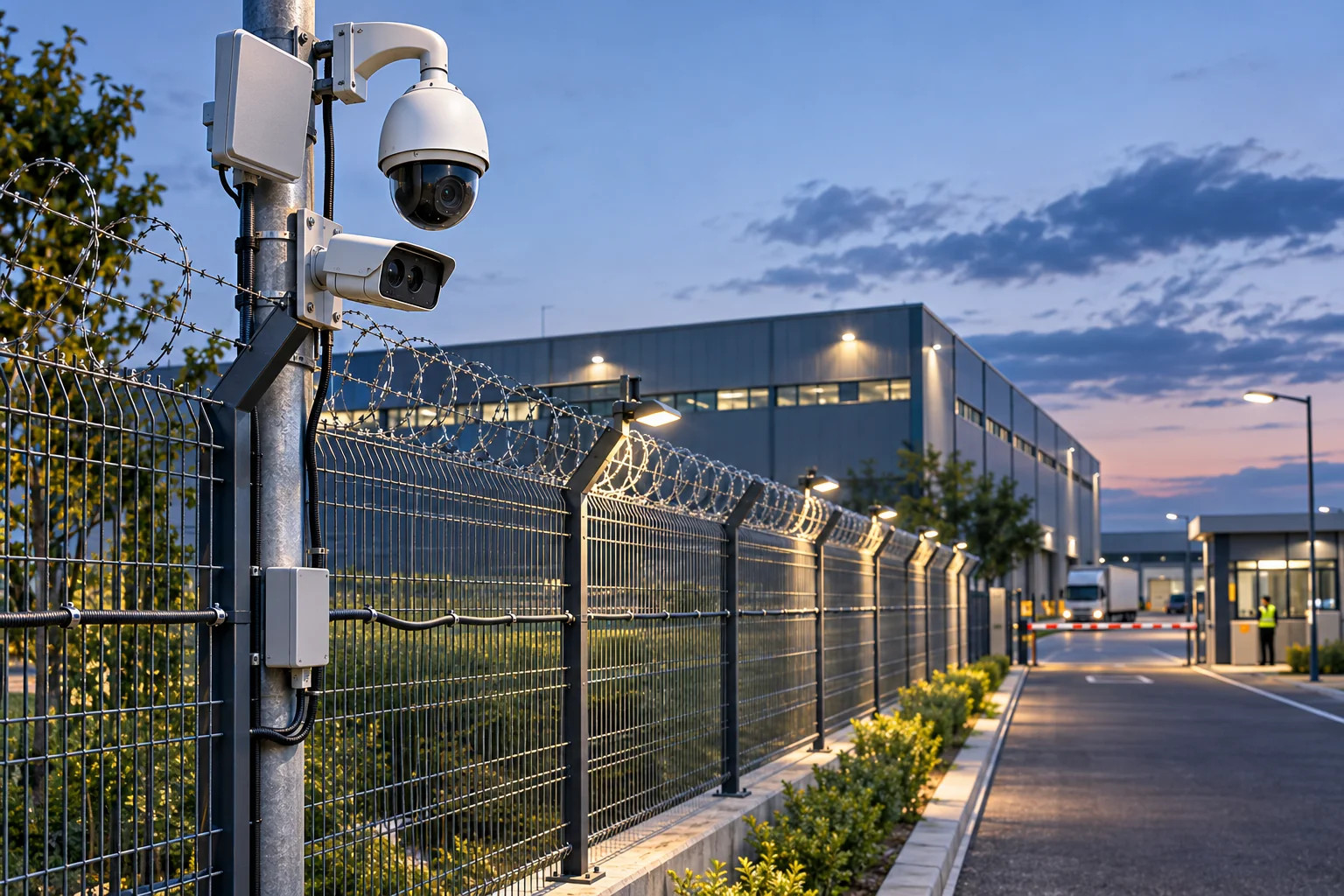
In facilities such as factories, logistics centers, power plants, warehouses, and those with large land areas, security does not begin solely at building entrance gates. Early detection of unauthorized intrusions that may occur at the facility's outer boundaries plays a significant role in managing security risks.
For this purpose, perimeter security systems help protect facility boundaries by combining physical barriers with electronic detection technologies.
While traditional fence and wall systems create a physical barrier, technologies such as thermal cameras, security radars, fiber optic sensors, and AI-powered video analytics can enable the detection of movements and potential intrusions along the boundary line.
However, a successful perimeter security project is not merely about placing cameras along a fence.
Proper perimeter security design requires the integrated planning of risk analysis, early detection, alarm verification, physical deterrence, and security response.
So, how do perimeter security systems work? Which technologies are used, and how is the right solution determined for different facilities?
What is a Perimeter Security System?
A perimeter security system is a physical and electronic security infrastructure used to monitor a facility's defined physical boundaries or open areas requiring protection against unauthorized entry, detect potential intrusions, and support security personnel intervention.
In international technical literature, electronic intrusion detection solutions in this field are referred to as Perimeter Intrusion Detection Systems (PIDS).
These systems can be used to protect fences, walls, open areas, vehicle access points, and designated security zones around a facility.
The main objectives of a perimeter security system are:
To identify unauthorized intrusions towards the facility boundary at an early stage.
To detect suspicious interventions occurring on fences or barriers.
To identify people or vehicles entering protected areas.
To provide security personnel with information regarding the event's location.
To support alarm verification with camera footage.
To ensure the recording of security incidents.
To assist in the timely initiation of response procedures.
Perimeter security solutions are not systems that eliminate all threats on their own. Effective protection is created by the collaboration of different security layers.
How Do Perimeter Security Systems Work?
The operating principle of a perimeter security system depends on the chosen detection technology.
However, in professional applications, the basic process typically consists of four stages.
1. Intrusion Detection
When movement, vibration, physical contact, object passage, or another detection criterion occurs along the protected boundary line, sensors attempt to identify the relevant event.
For example, a detection cable placed on a fence can monitor vibrations occurring on the fence.
A thermal camera, on the other hand, can detect a moving person by analyzing the thermal image of objects within its field of view.
2. Alarm Generation
The detection system can generate an event notification for the relevant security zone when configured alarm conditions are met.
This notification can be transmitted to a central alarm panel, video management system, or security control center.
3. Alarm Verification
Security personnel can evaluate the cause of an alarm by reviewing camera footage from the relevant area or information from other sensors.
This stage is particularly important in perimeter security systems.
Because wind, precipitation, animal movements, and physical vibrations can generate nuisance alarms in some detection systems.
4. Initiation of Security Response
Depending on the nature of the verified event, security personnel can be informed, relevant footage can be monitored, or predefined response procedures can be implemented.
If necessary, deterrent systems such as audible warnings and lighting can also be activated.
The success of perimeter security depends not only on the detection of an intrusion but also on the verification of the detected event and the timely execution of an appropriate response.
Technologies Used in Perimeter Security Systems
Perimeter protection technologies with different detection principles are used in industrial and commercial facilities.
Each technology has different advantages and technical limitations.
1. CCTV and AI-Powered Video Analytics Systems
IP security cameras are one of the primary imaging components of perimeter security projects.
Advanced video analytics software can analyze camera footage to detect specific behaviors and movements.
For example:
Violation of a virtual boundary line.
Entry of people or vehicles into a restricted zone.
Motion detection in a defined area.
Human and vehicle classification.
Monitoring movements in specific directions.
AI-powered analytics can help reduce some sources of nuisance alarms in suitable environments.
However, the performance of video analytics is not solely dependent on the software.
Camera resolution, lens, target distance, field of view, lighting, weather conditions, and image quality all affect detection success.
Especially in perimeter security, covering the camera's field of view and providing reliable analytical detection are distinct requirements.
For technical criteria regarding camera selection and image detail, GüvenlikOnline's guide titled What to Consider When Choosing a Security Camera? can be reviewed.
2. Perimeter Security with Thermal Cameras
Thermal cameras detect infrared energy emitted by objects to create a thermal image.
These systems can be particularly valuable for perimeter security in low-light and dark environments.
Their ability to generate thermal images without needing visible light is a significant advantage.
Thermal cameras, when combined with appropriate analysis software, can be used to detect human or vehicle movements.
Advantages of thermal cameras:
Reduced reliance on visible illumination.
Ability to monitor large open areas.
Human and vehicle detection under suitable conditions.
Integration with video analytics applications.
Technical limitations:
Heavy precipitation, fog, low thermal contrast, and certain environmental conditions can affect detection performance.
Furthermore, detailed identification of individuals' faces or identities is not the same function as thermal imaging.
Therefore, thermal cameras can be used in conjunction with visible light cameras when necessary.
3. Radar-Supported Perimeter Security Systems
Security radars can detect moving objects within a specific area using radio waves.
Depending on the radar technology used, information such as the object's distance, direction of movement, and speed can be obtained.
Some radar systems support human and vehicle classification features.
Especially in large open areas, radar technology can complement camera-based detection solutions.
Advantages of radar systems:
Wide-area detection under suitable conditions.
Ability to operate day and night.
Capability to provide information about the location of moving objects.
Automatic tracking integration with PTZ cameras.
Technical limitations:
Radar detection performance is affected by object characteristics, mounting location, surrounding structures, and the radar's technical capacity.
Building walls, metal structures, and some physical obstacles can create coverage gaps.
Furthermore, radar is not a camera. Appropriate camera infrastructure may be required for visual verification of detected objects.
4. Fiber Optic Perimeter Security Systems
Fiber optic detection technologies can be used to monitor mechanical impacts occurring along a fence or a specific route.
Depending on the system type, changes in vibration or strain occurring on the fiber are analyzed.
This approach can be considered for electronic intrusion detection along long perimeter lines.
Advantages:
Detection capability over long routes.
Ability to determine the event regionally or positionally in suitable systems.
Advantages of fiber optic sensing elements against electromagnetic interference.
Integration with central monitoring systems.
Technical limitations:
System performance depends on fiber placement, the mechanical structure of the fence, ambient vibrations, and the detection unit used.
Vibrations caused by heavy vehicles passing near the fence or by wind can be a source of nuisance alarms, depending on the system's settings.
The use of fiber optic cable alone does not guarantee high detection accuracy.
5. Fence-Mounted Vibration and Impact Sensors
Fence-mounted vibration detection systems monitor movements resulting from mechanical interventions.
These systems can help detect climbing, cutting, or other physical interventions on the fence.
In some applications, sensors are configured into specific zones.
This allows for determining which perimeter section the alarm originated from.
However, correct installation of the detection cable, the mechanical integrity of the fence, and appropriate sensitivity adjustment for environmental conditions are crucial.
Loose or swaying fence sections can increase the risk of false alarms.
6. Underground Detection Systems
Underground detection systems can analyze movements or physical changes occurring in the vicinity through sensors buried along a specific route.
Depending on the technology used, changes in pressure, vibration, seismic effects, or electromagnetic fields can be evaluated.
These solutions may be preferred in some applications where the use of visible physical detection equipment is not suitable.
However, soil structure, drainage, vehicle movements, underground infrastructure, and installation conditions can affect system performance.
7. Microwave and Active Infrared Barrier Systems
Microwave barrier systems can create a detection zone between suitable transmitter and receiver hardware.
Active infrared barriers, on the other hand, operate on the principle of an interrupted beam line.
These technologies can be used particularly along specific boundary lines and in access corridors that need to be controlled.
However, vegetation, weather conditions, mounting alignment, and obstacles affecting the line of sight must be considered.
The detection range and operating principle of each barrier technology are not the same.
Perimeter Security Technologies Comparison Table
| Technology | Prominent Use | Critical Selection Criterion |
|---|---|---|
| AI video analytics | Human/vehicle and virtual boundary intrusion | Camera placement, image quality, algorithm accuracy |
| Thermal camera | Open area detection in low light | Thermal resolution, target distance, environmental conditions |
| Security radar | Moving object detection in large areas | Radar coverage, obstacles, classification |
| Fiber optic sensor | Long perimeter lines | Fiber placement, vibration analysis, zone determination |
| Fence vibration sensor | Detection of physical fence interventions | Fence structure, wind effect, sensitivity |
| Underground sensor | Buried detection along specific routes | Ground, drainage, environmental effects |
| IR/microwave barrier | Passage detection along specific lines | Alignment, coverage geometry, obstacles |
This table is a general technical comparison. It does not imply exact detection distance, accuracy, or product performance. The final selection should be based on the facility's risk assessment and verified manufacturer data.
The Importance of Physical Barriers in Perimeter Security
In addition to electronic detection systems, physical barriers are also important components of perimeter security.
Fences, walls, security gates, and vehicle barriers are used to deter or delay unauthorized passage.
However, a physical barrier alone cannot prevent every intrusion.
For example, a physical intervention on a fence might go unnoticed by security personnel if an appropriate detection system is not in place.
Therefore, it is crucial to consider physical barriers and electronic detection together.
In a professional perimeter security approach, the main goal is to detect an event as early as possible and to initiate an appropriate response within the physical delay time.
Why is Nuisance Alarm Management Critically Important?
Perimeter security systems, operating in outdoor conditions, can be affected by certain environmental factors.
Specifically:
Strong winds.
Heavy precipitation.
Tree and vegetation movements.
Animal movements along the perimeter line.
Vehicle and machinery vibrations.
Light changes within the camera's field of view.
Mechanical issues in the fence structure.
can lead to the generation of nuisance alarms.
A very high number of false alarms can negatively impact security personnel's attention to alarm notifications.
However, excessively reducing detection sensitivity to decrease false alarms also increases the risk of missing actual intrusions.
Therefore, in perimeter security, detection success and the nuisance alarm rate must be evaluated together.
How Should Alarm Verification Be Performed?
When an alarm occurs in the security control center, the camera footage of the relevant area can be automatically displayed.
For example, fence vibrations reported by a fiber optic sensor can be evaluated with the footage from a fixed or PTZ camera monitoring the same area.
This allows security personnel to understand the cause of the event more quickly.
However, the use of multiple sensors does not mean that all events will be fully detected. Integration and alarm scenarios must also be verified under real-world conditions.
How is Detection Performance Measured in Perimeter Security Systems?
The performance of a perimeter security system cannot be evaluated solely based on the maximum detection distance stated by the manufacturer.
Important parameters include:
Probability of Detection
Probability of detection indicates how many of the intrusion scenarios under specific and defined test conditions were detected.
However, a result obtained in one test does not guarantee the same performance will be achieved under all weather and operating conditions.Nuisance Alarm Rate
Nuisance alarm rate is the evaluation of the number of alarms generated without an actual security breach over a specific period or perimeter length.
This rate can be expressed, for example, as alarms/zone/day or alarms/km/day.
For different systems to be comparable, measurements must be taken under the same conditions.Alarm Location Accuracy
Especially along long perimeter lines, determining which zone an event originated from is important.
The number of zones and location accuracy can affect the response time of security personnel.
Alarm Transmission and Verification Time
The time taken from the sensor detecting an event to its transmission to the central system, the display of footage, and the evaluation by security personnel should be examined together.
The true performance of a perimeter security system should be evaluated not only by detection but also by the process of an alarm transforming into a security operation.
How to Design a Professional Perimeter Security System?
For a proper perimeter security project, site and operational needs must be determined before technology selection.
1. Determine Facility Security Risks
The purpose of the area to be protected, its environmental conditions, and potential intrusion scenarios should be evaluated.
For example, the security needs of an energy facility are not the same as those of an open vehicle parking area.
2. Examine the Physical Perimeter Line
The condition of fences and walls, perimeter length, terrain slope, vegetation, vehicle entrances, and other access points should be evaluated.
3. Create Detection Zones
The perimeter line can be divided into manageable security zones based on site and operational needs.
Zone sizes should not be determined solely to create equal distances.
The need to determine the alarm's location, the sensor technology to be used, and response capabilities should be evaluated together.
4. Plan Sensor and Camera Placements
The coverage of detection sensors, camera fields of view, and physical obstacles should be examined together.
In camera-based systems, the imaging and design criteria in the applicable IEC 62676-4 version should be considered.
Specifically, analytical detection objectives and the level of detail an operator needs to obtain from the image should not be confused.
5. Define Alarm and Response Scenarios
When an alarm occurs, it should be defined which camera will be activated, who will be notified, and which control procedure will be applied.
6. Conduct Real-World Site Tests
After installation is complete, the system's performance must be verified with controlled test scenarios.
If necessary, tests should be planned for day, night, and varying environmental conditions.
Tests should be conducted safely in coordination with security officers and authorized technical personnel.
Example Scenario: Industrial Facility Perimeter Security
Let's consider protecting the perimeter of a large factory complex.
Assume the facility has physical fences, vehicle entrances, service roads, and storage areas around its perimeter.
In such a project, the following multi-layered approach can be considered.
First layer – Physical protection: Perimeter fence, gates, and appropriate physical barriers.
Second layer – Electronic detection: Fence vibration sensors, fiber optic systems, or other intrusion detection technologies suitable for site conditions.
Third layer – Image verification: Fixed IP cameras, thermal cameras, or radar-supported imaging systems.
Fourth layer – Central security management: Alarm management, video management software, and event records.
Fifth layer – Security response: Security personnel responding to verified events with appropriate procedures.
This approach aims to achieve different security functions with interrelated components rather than a single device.
However, not all of these layers need to be implemented in the same way across all facilities.
The correct system architecture should be determined based on risk analysis, operational needs, and budget.
In Which Sectors Are Perimeter Security Systems Used?
Factories and Industrial Facilities
Can be used for the protection of production areas, warehouses, technical structures, and external facility boundaries.
Power Plants and Critical Infrastructures
Perimeter security is crucial in energy production and distribution facilities, specific infrastructure centers, and areas requiring high security.
Logistics Centers and Warehouses
Can help monitor unauthorized entries in large vehicle parking areas, loading docks, and storage zones.
Airports and Ports
Different detection technologies can be used together for the protection of large areas and the early detection of security incidents at specific boundaries.
Organized Industrial Zones
Common perimeter security and facility-based protection systems can be established in large industrial complexes.
Solar Power Plants
Thermal cameras, radar, and other detection methods can be considered for the security of energy equipment and facility boundaries in large open areas.
Military and High-Security Facilities
Multi-layered perimeter protection systems can be used according to relevant special security requirements and the criteria of authorized institutions.
Residential Complexes and Large Housing Estates
Can be used to identify unauthorized entries into common areas and support controlled vehicle access.
Which Standards Should Perimeter Security Systems Be Evaluated Against?
Since perimeter security systems combine multiple technologies, they should not be evaluated against a single standard covering all components.
IEC 62676-4:2025
Addresses application criteria for the planning, design, installation, testing, commissioning, and maintenance of video surveillance systems.
The second edition of this standard, dated 2025, is one of the current international references that should be considered in professional CCTV projects.
IEC 60839-11-1:2013
Defines the functional and performance requirements for electronic access control systems and their associated components.
It is relevant for access control components used in personnel or vehicle entry systems along the perimeter line.
IEC 62642-1:2010
Pertains to the general requirements for indoor intruder and hold-up alarm systems.
However, the scope of this standard should not be interpreted as including all outdoor perimeter intrusion detection systems.
NPSA Perimeter Intrusion Detection Guide
The UK National Protective Security Authority (NPSA) publishes comprehensive guides for the selection, technical specification, installation, commissioning, and maintenance processes of perimeter intrusion detection systems.
These guides are useful resources for technical planning; they do not supersede Turkish legislation or national standards.
The Turkish Standards Institution (TSE) equivalents of relevant standards and applicable legislative provisions for the project should also be checked separately.
KVKK and Cybersecurity in Perimeter Security Systems
In perimeter security projects, IP cameras, radar devices, sensor control units, and central monitoring systems can communicate over a network.
Therefore, cybersecurity infrastructure is also important.
Specifically:
Prevention of unauthorized access.
Strong user authentication.
Secure network segmentation.
Keeping system software up-to-date.
Storing alarm and video recordings with access control.
Monitoring critical communication lines.
Taking precautions against power and network outages.
are required.
Furthermore, if individuals' images are recorded for perimeter security purposes, the legal basis, transparency, proportionality, and data security principles under Law No. 6698 on the Protection of Personal Data (KVKK) must be evaluated.
When determining camera viewing angles, care should be taken not to unnecessarily capture neighboring properties and public areas.
The retention period for recordings should be determined in line with relevant legislation and the purpose of processing.
Technology used for security purposes should not unnecessarily restrict individuals' privacy rights.
What to Consider When Choosing a Perimeter Security System?
The following criteria should be evaluated in professional procurement and project design processes:
The facility's security risk and characteristics of the area to be protected.
Perimeter line length, terrain structure, and physical obstacles.
Operating principle of the detection technology.
Detection performance and nuisance alarm behavior.
Operating characteristics in day, night, and challenging weather conditions.
Positioning of detection zones.
Integration with camera and alarm systems.
Alarm verification and security response times.
Continuity of power, network, and communication.
Maintenance, calibration, and periodic verification needs.
Manufacturer support and total cost of ownership.
Standard, regulatory, and personal data security requirements.
Maximum detection distances found in product technical data sheets alone do not guarantee that the same performance will be achieved under all site conditions.
Technical Checklist for Perimeter Security Systems
Has a perimeter security risk analysis been conducted?
Have fences, walls, gates, and entry points been examined?
Have detection and camera coverage areas been determined?
Have blind spots and physical obstacles been evaluated?
Have detection technologies been compared?
Have sources of nuisance alarms been analyzed?
Has the required environmental durability been verified?
Has alarm positioning and zoning been planned?
Have camera-based alarm verification scenarios been created?
Has the security personnel's response process been defined?
Have network and power outage scenarios been tested?
Have cybersecurity and KVKK requirements been evaluated?
Have site tests and commissioning criteria been determined?
Has a periodic maintenance and system verification plan been prepared?
This checklist is for technical evaluation purposes. It does not imply definitive engineering design or product selection for every facility.
Frequently Asked Questions
What is the purpose of a perimeter security system?
A perimeter security system is used to detect unauthorized entries at a facility's physical boundaries or designated open areas, generate alarms, and support security response.
Is a thermal camera or radar better for perimeter security?
The two technologies have different detection principles. Thermal cameras create thermal images, while radar systems can detect moving objects using radio waves. The correct choice depends on target distance, coverage geometry, environmental conditions, and verification needs.
Can AI-powered cameras detect perimeter intrusions?
With appropriate cameras and analysis software, human or vehicle entries, specific area violations, and virtual boundary crossings can be detected. However, the success rate must be verified under real-world site conditions.
How does a fiber optic perimeter security system work?
Fiber optic sensors, in suitable systems, can detect potential physical interventions by analyzing changes in vibration and strain occurring on a fence or route.
Do perimeter security systems generate false alarms?
Yes. Weather conditions, vegetation movements, animals, and other environmental factors can generate nuisance alarms in some systems. System design and sensitivity settings are therefore important.
Is it mandatory to use cameras in perimeter security systems?
It cannot be said that there is a general camera requirement for every application. However, verifying electronic intrusion alarms with camera footage is a beneficial approach in many professional projects. Requirements should be evaluated based on the facility's security risks and relevant legislation.
In which facilities are perimeter security systems used?
Factories, logistics centers, power plants, organized industrial zones, ports, airports, warehouses, large campuses, and extensive residential complexes are the main areas of use.
Conclusion: Effective Perimeter Security Requires Multi-Layered Protection
Perimeter security systems offer significant technologies in modern facility security that go beyond mere surveillance cameras.
Thermal cameras, radar, fiber optic sensors, fence vibration systems, and AI-powered video analytics can help detect unauthorized intrusions at an early stage under suitable conditions.
However, no single technology can fully address all threats and environmental conditions on its own.
A successful perimeter security project requires the integrated design of physical protection, appropriate detection technologies, correct camera placement, alarm verification, and security response.
In professional system selection, not only product features but also real-world site performance, maintenance requirements, and long-term operational reliability should be considered.
The primary goal of reliable perimeter security is not merely to review recordings after an intrusion has occurred, but to detect potential threats early, enabling security personnel to respond promptly and correctly.
Resources
Axis Communications – Perimeter Security and Intrusion Detection
Axis Communications – Perimeter Protection for Airports with Intelligent Video Surveillance
IEC – IEC 62676-4:2025, Video Surveillance Systems Application Guidelines
IEC – IEC 60839-11-1:2013, Electronic Access Control Systems
Personal Data Protection Authority – Use of Security Camera Systems in Workplaces
GüvenlikOnline – What to Consider When Choosing a Security Camera?