
People Counting Systems in Museums: Visitor Analysis and Density Management
People counting systems in museums measure visitor entries and exits, exhibition hall density, and area utilization, providing data-driven decision support for museum management. We examine key technical criteria for 3D people counting sensors, AI-powered visitor analytics, real-time occupancy tracking, exhibition performance measurement, and counting accuracy.
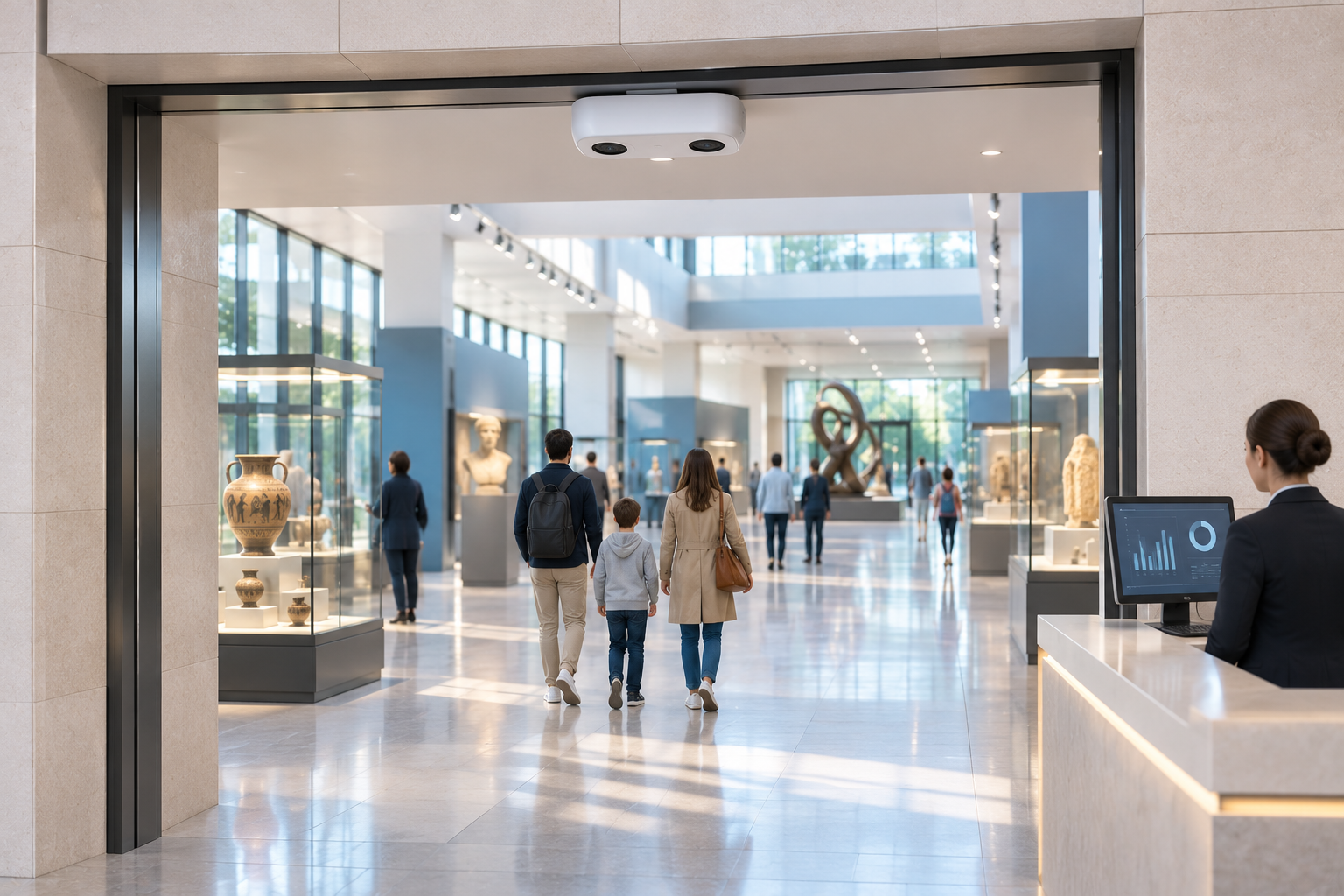
People counting systems in museums are technological solutions that enable the measurement of visitor entries and exits, the analysis of human movement in exhibition halls, and the evaluation of usage density in different areas. Beyond tracking visitor numbers, these systems can help museum managements make data-driven decisions regarding exhibition planning, capacity management, staff organization, and visitor experience.
Traditional visitor tracking may use ticket sales data, turnstile records, or manual counts. However, these methods can be limited, especially in museums with free entry, structures with multiple entry points, and when measuring the visit rates of different exhibition halls.
Modern people counting technologies enable the automatic measurement of visitor movements through 3D sensors, thermal detection, and AI-powered video analysis.
The primary goal of people counting systems in museums is not merely to ascertain how many people have arrived, but to understand how visitors utilize museum spaces, thereby improving exhibition and operational processes.
What is a People Counting System in Museums?
A museum people counting system is a combination of hardware and software that enables the automatic detection, counting, and reporting of data for people passing through designated entry points or exhibition sections.
In international literature, these solutions are referred to by concepts such as Museum Visitor Counting, People Counting, and Visitor Flow Analytics.
Depending on the system's features and installation scope, the following information can be obtained:
Total entry and exit movements of the museum.
Hourly, daily, weekly, and monthly visitor numbers.
Peak visitor hours.
Entry counts to specific exhibition halls.
Visitor traffic distribution between exhibitions.
Estimated real-time occupancy within the museum.
Regional density in supported systems.
Visit duration and movement trends in suitable analytical infrastructures.
There is an important technical distinction here:
Entry count, unique visitor count, and exhibition hall visit count are not the same data.
For example, if a visitor enters the same exhibition hall twice, a standard entry counter might record two entry movements. This does not mean that two different people visited the exhibition.
Therefore, the meaning of the indicators to be reported should be defined before the system is installed.
Why is Visitor Counting Important in Museums?
Museums are not merely spaces where artifacts are displayed. They are also structures where educational activities, temporary exhibitions, cultural events, and visitor services are conducted concurrently.
Understanding visitor movement is crucial for the effective management of these activities.
The visitor counting guide published by Historic England also states that automatic people counting systems are among the methods that can be used for museums and historical buildings with distinct entry and exit points.
Measuring Visitor Traffic
The number of visits to the museum during the day, the hours when density increases, and how visitor movements change on different days can be regularly monitored.
This data can be particularly useful for comparing weekends, public holidays, school trips, and special exhibition periods.
However, changes in visitor numbers alone should not be considered proof of an event's success. Opening hours, seasonality, transportation conditions, and other factors should be evaluated together.
Evaluating Exhibition Hall Performance
Not all halls in a museum may be visited with the same intensity.
Total visitor data collected from the main entrance does not directly indicate which exhibition received more interest.
By placing appropriate sensors at the entrances of exhibition halls, the number of passages in different areas can be compared.
This information can contribute to processes such as:
Evaluating the visit levels of temporary and permanent exhibitions,
Arranging exhibition routes,
Identifying underutilized areas,
Reviewing visitor guidance applications.
However, entering an exhibition hall does not prove that the exhibited works were carefully examined or that the visitor was satisfied with the exhibition.
Such conclusions may require observation, surveys, and other visitor research.
Improving Visitor Experience
In museums, density can occur around specific exhibitions or artifacts.
Especially narrow passages, halls containing popular artifacts, and areas where guided tour groups gather can affect visitor movement.
Thanks to density data, museum management can consider directing visitor flow more evenly during specific hours.
For example, time-interval visit applications or alternative visitor routes can be planned based on the density at the temporary exhibition entrance.
Staff and Operations Planning
The work schedules of museum staff, visitor information teams, and hall supervisors can be arranged by considering the hours when visitor traffic changes.
This approach can help direct resources to areas where they are needed.
However, the number of staff should not be determined solely based on people counting data. Artifact security, surveillance requirements, and relevant operational conditions should also be considered.
People Counting Technologies Used in Museums
Different counting methods can be used in museums. Which technology is suitable depends on the entrance width, visitor density, installation conditions, and expected analytical features.
1. Infrared Passage Sensors
Infrared beam-based counters perform counting by detecting the effect of people passing through a specific passage line on the beam.
They can offer low-complexity solutions for simple entrances.
However, accurately distinguishing people walking side-by-side, crowded groups, and visitors turning back during passage can be challenging.
Additional detection arrangements may also be required for direction determination.
2. 3D People Counting Sensors
3D people counting sensors utilize technologies to distinguish people through height and depth information.
These devices, when placed looking downwards from the ceiling in suitable models, can separately measure the entry and exit directions of visitors passing through the defined counting line.
Advantages they can provide in museums:
Ability to separate entry and exit movements.
Ability to count people passing side-by-side under suitable conditions.
More detailed detection in crowded entrances compared to single-beam systems.
Ability to provide data for occupancy calculation of specific areas.
However, mounting height, field of view, visitor density, and the sensor's processing capacity can affect the results.
3. AI-Powered Video Analytics
AI-powered people counting systems can perform counting by analyzing human movements in suitable camera footage.
Depending on product features, they can offer virtual entry lines, regional counting, and specific movement analysis functions.
However, a standard security camera recording images does not automatically mean it can perform high-accuracy people counting.
Camera angle, resolution, overlap, image processing capacity, and the functions supported by the algorithm are important.
Furthermore, image-based solutions may entail additional requirements regarding personal data protection.
4. Thermal People Counting Sensors
Thermal detection technologies can detect movement or presence in specific areas by utilizing the heat energy emitted by people.
In some applications, their reduced dependence on visible light can be an advantage.
However, the resolution, detection geometry, and ambient temperature conditions for thermal sensors differ.
It should not be assumed that all thermal devices will perform directional people counting with the same accuracy in high-density entrances.
Museum People Counting Technologies Comparison
Technology | Prominent Use | Advantage | Technical Limitation |
|---|---|---|---|
Infrared passage sensor | Narrow and simple entrances | Simpler installation | Counting errors in group passages |
3D people counting sensor | Museum and exhibition hall entrances | Directional counting with depth information | Mounting and detection area limits |
AI-powered video | Entrances and suitable regional analyses | Advanced analysis options | Visibility conditions, processing, and data protection |
Thermal sensor | Suitable entrance and presence detection applications | Less dependence on visible light | Resolution and environmental conditions |
The comparison of technologies is based on general operating principles. The final selection should be made based on the product's datasheet and its performance under actual field conditions.
How is Visitor Counting Performed at Museum Entrances?
The first stage in designing a visitor counting system for museums is to identify the entry and exit points.
In structures with multiple entrances, service doors, ticket control points, or courtyard connections, the counting architecture should be planned more carefully.
For example, the presence of a people counting sensor at the main entrance may not accurately reflect the museum's total visitor traffic if passages through other doors are not measured.
Separate Measurement of Entries and Exits
Directional people counting systems can analyze the direction in which visitors cross a defined counting line.
This allows entry and exit data to be reported separately.
However, the device's direction detection performance depends on the geometry of the passage line and sensor settings.
Integration with Turnstile and Ticketing Systems
Ticketing, reservation, and QR code control systems in museums are important data sources for visitor management.
However, the number of tickets sold, reservations made, and actual physical visits are not always the same.
For example, free entries, unused reservations, group visits, and different entry methods can affect reports.
If combined reporting is to be done, data from turnstile, ticketing, and people counting systems should be handled with different definitions.
The UK Department for Culture, Media and Sport's museum performance indicators guide, updated on April 29, 2026, also highlights the need to differentiate between physical visits, staff, and other entry types.
This guide is not a binding standard for Turkey; however, it is a useful methodological example of how museum visit data can be defined.
How is Visitor Density Measured in Exhibition Halls?
The total count at the museum entrance is not sufficient to explain how different exhibition halls are utilized.
If the visitor flow to specific exhibitions needs to be measured, the entry and exit points of the respective halls should be evaluated separately.
Hall-Based Counting
Entry and exit movements can be measured in each exhibition section with appropriate sensors.
This allows museum management to compare which hall is used more intensively.
However, since the same person re-entering a hall can generate multiple passages, the hall passage count should not be directly presented as the unique visitor count.
Visitor Distribution Between Exhibitions
The visitor traffic of one exhibition can be compared with that of other exhibitions.
This information can help in evaluating signage, exhibition layouts, or visitor routes within the museum.
However, a high passage count for a particular exhibition does not prove that visitors spent more time in that exhibition.
Visit Duration and Waiting Time
Visit duration cannot be measured solely by the number of entries through a door.
Aggregate duration estimates can be generated from hall entry-exit data; however, different analytical methods may be required to determine individual visit durations or to match the movements of specific individuals.
The accuracy of these methods and personal data processing conditions should be evaluated separately.
Similarly, queue length and waiting time analysis are not inherent features of a standard door counter. Such functions require appropriate additional sensors or software features.
Real-time Occupancy and Capacity Management in Museums
By evaluating entry and exit counts together, the estimated real-time occupancy of a specific area can be calculated.
The basic calculation is as follows:
For example, in a hall where visitor entries and exits are monitored, the estimated number of people inside can be calculated by adding new entries to the determined initial occupancy and subtracting exits.
However, for the reliability of this calculation:
All relevant entries and exits must be measured,
Counting directions must be correctly defined,
The initial occupancy must be known,
Counting errors must be checked at regular intervals,
The scope of staff and visitors must be clearly defined.
is required.
Accumulated counting errors can lead to deviations in the real-time occupancy calculation over time.
Capacity Threshold and Density Alerts
In suitable systems, notifications can be generated for operational teams when defined occupancy thresholds are approached.
This feature can be particularly useful in managing exhibition halls with limited capacity.
However, the occupancy threshold defined in the people counting system does not automatically determine the museum's legally permitted or fire safety capacity.
Capacity limits should be established in accordance with authorized assessments and relevant building safety requirements.
Furthermore, an estimated people counting system should not be considered an independent life safety system that verifies the exact staff or visitor presence during emergency evacuation.
Factors Affecting People Counting Accuracy in Museums
For accurate visitor counting in museums, merely examining the technical specifications of the sensor is not sufficient.
Conditions in the actual museum environment can affect system performance.
Group Visits and School Trips
School groups, guided tours, and crowded visitor movements are important test scenarios for people counting systems.
Children walking side-by-side, visitors passing close to each other, or individuals moving in opposite directions simultaneously can cause counting errors.
Children and Visitors of Different Heights
The sensor's detection method and mounting height are important for accurately measuring individuals of different heights.
The detection of children, in particular, and their passages alongside adults should be evaluated in field tests.
Ceiling Height and Architectural Conditions
Historical museum buildings may feature high ceilings, domes, arched passages, and various architectural details.
The sensor's manufacturer-supported mounting height and field of view must be verified.
If necessary, suitable alternative mounting points or different sensor technologies should be considered.
Lighting and Sunlight
Glass entrances, strong natural light, or variable exhibition lighting can affect some image-based detection methods.
The technology to be used must be tested under actual environmental conditions.
Counting Line and Calibration
Even if the sensor is correctly mounted, an incorrectly defined counting line or detection zone can reduce the reliability of the results.
Therefore, field calibration and verification with manual counts should be performed after installation.
How Should Validation Be Performed in Museum People Counting Systems?
Validation is the comparison of the counting data produced by the system with an independent reference measurement.
In museum people counting projects, a proper validation process should cover different visitor densities and passage scenarios.
Recommended evaluation steps:
A manual or appropriately verified counting method is determined as a reference.
The sensor and reference count are performed within the same time interval.
Entry and exit directions are compared separately.
Individual, group, and opposing directional passages are evaluated.
Passages of children, guided tours, and visitors with mobility limitations are tested.
Under-counting and over-counting incidents are analyzed.
The measurement is repeated after correcting necessary sensor settings.
The results are recorded.
Here, it is not sufficient for only the total daily count to be close to manual counts.
For example, under-counting a certain number of visitors and over-counting others can bring the total result closer. Despite this, the actual passage accuracy might be low.
Therefore, directional counting errors, total values, and the cumulative effect on real-time occupancy need to be evaluated separately.
Accuracy rates stated by manufacturers should only be considered valid for the described test conditions and should not be presented as independent field results.
How Should People Counting Data Be Reported in Museum Management?
Appropriate reporting software is required for the data provided by people counting systems to be usable.
Key indicators that can be evaluated in museum management are as follows:
Indicator | Description | Use in Management |
|---|---|---|
Total entry movement | Number of entries from selected entrances | Tracking visitor traffic |
Peak hours | Time periods with the highest number of entries | Operations planning |
Hall entries | Number of entries to specific exhibition sections | Comparing exhibition traffic |
Estimated real-time occupancy | Value calculated from initial occupancy and net passages | Capacity tracking |
Periodic visit change | Comparison of specific time intervals | Trend analysis |
Traffic distribution between exhibitions | Differences in passage counts between areas | Exhibition and guidance planning |
Counting data quality | Sensor connection, validation, and error status | Report reliability |
These indicators can be reported daily, weekly, monthly, or on an exhibition period basis with appropriate software.
In museum management, especially when comparing different periods, opening days, special events, and the usage status of halls should be considered.
For additional information regarding software selection in report generation, GüvenlikOnline's article titled People Counting Software can be reviewed.
People Counting Sensor Installation in Historical Museum Buildings
Sensor installation in historical structures or museums with protected architectural features may require different conditions compared to standard commercial buildings.
Particular attention should be paid to the cabling route, intervention with ceiling and wall surfaces, the visibility of the device, and its relationship with exhibited artifacts.
Within the scope of the project:
Preservation of existing architectural elements.
Avoidance of unnecessary drilling and structural interventions.
Identification of appropriate cable routes.
Ensuring sensors do not negatively impact the visitor experience.
Providing safe access for maintenance.
Checking necessary protection and implementation permits.
is important.
In historical museums, sensor selection should be based not only on technological performance but also on the preservation of the space and feasible installation conditions.
People Counting Systems in Museums and KVKK
People counting systems can use different data collection methods.
While some sensors only generate passage counts, image-based systems may involve the processing of personal data depending on the device's features and configuration.
Therefore, the use of a people counting system does not automatically mean that personal data is not processed.
Specifically, the recording of identifiable images of visitors, the tracking of device identifiers, or the individual matching of visitor movements in different areas should be evaluated separately from a data protection perspective.
The Personal Data Protection Authority (KVKK) states that image recordings can constitute personal data processing activities, and this processing should be evaluated in terms of legal basis, purpose limitation, data security, and retention period.
The data protection approach applicable in museums should include the following principles:
Processing the minimum data necessary for the measurement purpose.
Using aggregated counting data that does not identify individuals, where possible.
Determining appropriate legal bases and transparency processes if image recording and personal data processing occur.
Defining retention periods.
Restricting user access permissions.
Evaluating data transfer and cloud services.
Implementing necessary technical and administrative security measures.
Generating only aggregated numerical data is not the same data processing approach as tracking visitor identities or movement histories.
Each application should be evaluated according to the actual data processing features of the technology it uses.
In Which Areas Can People Counting Systems Be Used in Museums?
The priorities of visitor analytics may vary across different museum types.
Museum Type | Potential Use |
|---|---|
Archaeology museums | Entrance traffic and density of different exhibition sections |
Art museums | Traffic comparison of permanent and temporary exhibitions |
History museums | Evaluation of exhibition routes and area utilization |
Science and technology museums | Usage density of event and experience areas |
Children's museums | Group visits and density in specific sections |
Palaces and historical structures | Density of passage points and limited areas |
Open-air museums | Measurement of different entrances and visitor routes |
Special exhibition and cultural centers | Event periods and exhibition traffic analysis |
These are potential use scenarios. It should not be assumed that the same system will operate with the same performance in every museum type.
What Should Be Considered When Choosing a Museum People Counting System?
The selection of a people counting system for museums should not be based solely on sensor price or the maximum accuracy value stated by the manufacturer.
The following criteria should be evaluated during project preparation:
Number of Entrances and Door Geometry
All visitor entry and exit points should be identified, and door width and passage directions should be examined.
Sensor Installation Conditions
Ceiling height, viewing angle, lighting, physical obstacles, and historical building conditions must be verified.
Visitor Profile
School groups, children, guided tours, wheelchair users, and high-density group passages should be included in test scenarios.
Measurement Requirement
It should be determined whether only total visitor traffic is required, or if hall-based counting and estimated occupancy information are also needed.
Software and Integration
The compatibility of sensors with the reporting platform, existing ticketing systems, and other suitable infrastructures should be examined.
Data Security
Image processing, recording, data storage, and access management requirements should be evaluated.
Maintenance and Validation
Post-installation calibration, periodic verification, and fault notification processes should be planned.
Technical Checklist for Museum People Counting Systems
System integrators and museum managers can use the following checklist before purchasing:
- Have all visitor entry and exit points of the museum been identified?
- Has the difference between total visitor count and hall passage count been defined?
- Has it been determined how staff and service entries will be handled in counting?
- Have the sensor technologies to be used been compared?
- Have the sensor mounting height and detection width been checked?
- Have test scenarios for group visits and counting children been prepared?
- Have historical building and artifact protection conditions been evaluated?
- Have hall-based analysis and real-time occupancy requirements been determined?
- Has integration with ticketing and reservation systems been evaluated?
- Have reporting indicators for counting data been defined?
- Have KVKK and data retention requirements been examined?
- Has validation with manual reference counts been planned?
- Has a program for reporting sensor failures and maintenance been created?
This checklist has been prepared to assist in determining the correct system architecture. Field surveys and verification studies are required for definitive technical selection.
Frequently Asked Questions
How do people counting systems work in museums?
People counting systems generate counts by detecting human movements at entry and exit points with appropriate sensors. Depending on the system's features, hourly visitor traffic, hall entries, and estimated real-time occupancy can be reported.
Can't museum visitor numbers be learned from ticket sales?
Ticket and reservation data are important sources. However, due to free visits, unused reservations, and different entry methods, they may not always be the same as the physical visitor count.
Can 3D people counting sensors be used in museums?
Yes. Under suitable installation conditions, 3D people counting sensors can be evaluated for directional visitor counting at museum entrances and exhibition hall passages.
Can real-time visitor numbers be measured in museums?
Estimated real-time occupancy can be calculated with appropriate entry and exit measurements. However, the reliability of this value depends on measuring all relevant passage points and controlling counting errors.
Does a people counting system indicate which exhibition received more interest?
By comparing hall entry counts, it can be understood which exhibition areas are visited more frequently. However, this data alone does not indicate how satisfied visitors were with the exhibition or how carefully they examined the artifacts.
Do people counting systems identify visitors?
Not every people counting system operates for identification purposes. Some systems only generate aggregated counting data, while others may process images or different identifiers. The data processing features of the technology used should be examined separately.
Can people counting sensors be installed in historical museum buildings?
They can be installed under suitable technical and architectural conditions. However, sensor placement and cabling should be planned considering the requirements for preserving the historical structure and any necessary permit processes.
Why is Accurate Visitor Analytics Important in Museums?
Beyond measuring visitor traffic, people counting systems in museums are technological solutions that help understand the utilization of exhibition areas, density distribution, and operational needs.
Thanks to a correctly selected and field-validated system, museum managers can regularly analyze visitor movements, compare usage trends of different exhibitions, and support their decisions to improve the visitor experience with stronger data.
However, reliable visitor analytics is achieved not only through sensor installation but also through correct measurement definitions, appropriate mounting, calibration, validation, and a sustainable reporting infrastructure.
To examine the use of people counting technologies in different sectors, GüvenlikOnline's article titled In Which Sectors Are People Counting Systems Used? can also be read.
References
Historic England — Methods for Counting Visitors — Visitor counting methods in museums and historical sites, advantages and limitations of manual and automatic systems.
UK Department for Culture, Media and Sport — Museums and Galleries Performance Indicator Guidance — Definition of physical museum visits and reporting indicators.
ICOM UK — AI to Increase Visitor Figures — Sectoral evaluation on visitor flow analysis and data usage in cultural institutions.
T.C. Kültür ve Turizm Bakanlığı — Müze İstatistikleri — Official source regarding museum visitor statistics in Turkey.
Personal Data Protection Authority — Use of Security Camera Systems in Workplaces — Explanations regarding image processing, data security, transparency, and retention periods.
Personal Data Protection Authority — Anonymization of Personal Data — Guidance on anonymization and personal data protection.