
People Counting System Software: A Guide to Cloud Reporting, Visitor Analytics and Integration
People counting system software turns sensor entry and exit data into visitor analytics, business performance indicators and management reports. We examine cloud and on-premises reporting platforms, sales conversion and occupancy calculations, data accuracy checks, RE-ID technologies, API/POS integrations and multi-branch management features from a technical perspective.
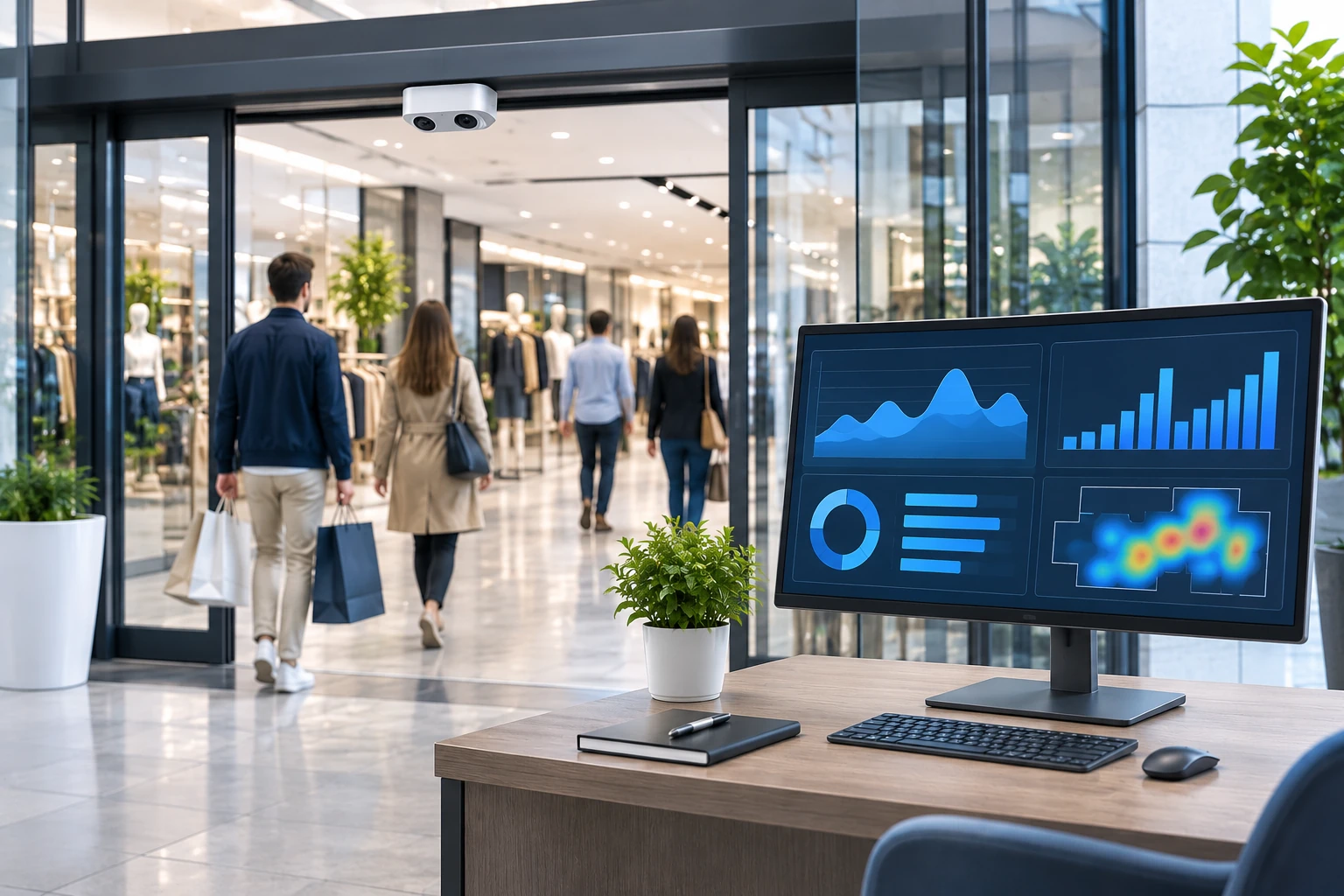
People counting system software is a data management and reporting platform that enables analysis of visitor movements in stores, shopping malls, retail chains and other commercial facilities. It processes entry and exit information from people-counting sensors to generate reports on visitor traffic, peak hours, area occupancy and business performance.
Today, people counting software has evolved beyond applications that simply show how many people entered each day. Advanced platforms can centrally consolidate data from different stores, integrate with sales systems, generate indicators related to visitor behavior and support operational decisions.
Especially in multi-branch retail businesses, using the right people counting software helps compare different locations using shared data definitions and assess store performance more consistently.
However, the correct operation of a people-counting sensor does not mean that the data in the reporting software is automatically accurate as well. Measurement accuracy, data transmission, time synchronization, report calculations and integration processes must be evaluated together.
Therefore, when selecting professional people counting software, the priorities should be data integrity, analytical capability, integration architecture and system verifiability—not just the user interface or variety of reports.
What Is People Counting System Software?
People counting software is a software system that collects, processes, stores and reports information from sensors that convert detected human movements through physical spaces into numerical data.
In the international market, applications of this kind People Counting Software, Footfall Analytics, Visitor Analytics Platform and Retail Traffic Analytics Software are among the names used to describe them.
A typical people counting system consists of three core layers:
Measurement layer: 3D stereo, ToF, a suitable AI-enabled camera or other people-counting sensors.
Data communication layer: The network infrastructure that transfers count information from sensors to an on-premises or cloud system.
Analytics and reporting layer: Software that processes data according to store, region, time and business indicators.
For the basic operating principles of people-counting technologies and sensor differences, consult the guide What Are 3D People Counting Systems? .» «يمكن الرجوع إلى الدليل
How Does People Counting Software Work?
People counting software works by converting raw count data obtained from sensors into indicators that are meaningful to a business.
A typical data flow consists of the following stages:
The sensor detects people passing through the defined counting zone.
The direction of passage—entry or exit—is determined.
A count event or aggregate data for a specified time interval is generated.
The data is sent to the central system along with the relevant sensor and location information.
The software matches incoming data to the relevant time and device.
Data is consolidated by store, door, floor, area and date range.
The reporting engine calculates visitor traffic and defined performance indicators.
Results are made available to users through dashboards, reports, APIs or other integrations.
In some systems, people detection and counting take place entirely on the sensor, while in other architectures the analysis may be performed by a local server or centralized processing infrastructure.
This difference affects the system’s network requirements, maintenance approach and data privacy assessment.
What Features Should Professional People Counting Software Have?
1. Real-Time Visitor Reporting
One of the core functions of people counting software is to show visitor traffic at stores and facilities over time.
In supported systems, the following can be reported:
Live entry and exit counts.
Hourly visitor traffic.
Daily, weekly and monthly reports.
Period-over-period comparisons.
Visitor totals by store and location.
Peak-hour analysis.
Traffic distribution by opening and closing times.
can be reported.
However, the technical meaning of the term “real-time reporting” is not the same in every software product.
Some platforms use event-based data transmission, while others send aggregated data at set intervals. Dashboard refresh delays and behavior during connection outages should therefore be assessed separately.
2. Multi-Branch and Centralized Management
One of the most important features of people counting software for retail chains is the ability to manage data from different locations through a shared central hub.
For example, in a retail chain with 150 stores, connecting all sensors to a central platform makes it possible to assess store visitor traffic from a single management screen.
The software may support the following organizational structure:
Company → Region → City → Store → Entrance → Sensor
This structure allows:
Regional managers to review the performance of their stores.
Central management to compare results across all locations.
Store managers to access only the data they are authorized to view.
Technical teams to monitor device connectivity and operating status.
Using the same time interval for every store is not sufficient for multi-branch reporting. Store opening hours, public holidays, time zones and differing operating conditions must also be taken into account.
3. Dashboards and Management Reports
A dashboard is a visual reporting interface in people counting software that allows users to monitor different indicators on a single screen.
An effective dashboard should not be judged solely by the number of charts it contains.
The information presented on the management screen should be accurate, easy to understand and suitable for decision-making.
Key indicators include:
Total entry and exit counts.
Visitor change compared with previous periods.
Traffic performance by store.
Busiest days and hours.
Live occupancy, in supported systems.
Sales conversion rate.
Sales performance per visitor.
Device operating and connection status.
Warnings about missing or unverified data.
It is important for the management dashboard to show the reliability status of the data alongside numerical results.
For example, a sudden drop in a store’s visitor count may result from an actual decline in traffic, but it may also be caused by a sensor connectivity problem.
Which KPIs Are Calculated in People Counting Software?
KPI (Key Performance Indicator) is a key performance metric used to assess business performance.
People counting software can calculate various KPIs using suitable sensor data and integrations.
Visitor Traffic (Footfall)
This refers to the measured number of people passing through a specified entrance or area.
Hourly, daily or period-based visitor traffic can be calculated using data from sensors installed at store entrances.
However, the number of visits is not the same as the number of unique visitors.
If one person enters a store twice in a day, a standard people counting system may record two entry events.
Sales Conversion Rate
The sales conversion rate is an indicator used to assess the relationship between store visitor traffic and sales transactions.
Common transaction-based calculation:
Sales conversion rate (%) = (Number of sales transactions / Number of visitor entries) × 100
Example:
Example store performance
Visitor entries
1000
Sales transactions
120
Conversion rate
%12
In this example, the store’s transaction-based sales conversion rate is 12%.
However, this result does not definitively show that 12% of the unique individuals who entered the store made a purchase. A customer may make multiple transactions, or a single transaction may represent purchases made by more than one person.
For a valid comparison, POS transactions and visitor counts should be assessed for the same store and period, using consistent data definitions.
Revenue per Visitor
This is one of the indicators used to relate visitor traffic to commercial performance.
Revenue per visitor = Net sales revenue / Measured visitor entries
This indicator can help assess how effectively stores convert visitor potential into commercial results.
However, directly comparing stores with different product prices, store concepts, campaigns and customer profiles may produce misleading results.
Peak-Hour Analysis
Peak-hour analysis identifies the time slots when visitor movement is busiest during the day.
It can help retail businesses plan staff shifts, checkout capacity and operations.
For example, a concentration of visitor traffic between 5:00 p.m. and 7:00 p.m. may indicate that greater service capacity may be needed during this period.
However, visitor counts alone should not be assumed to determine staffing needs with certainty.
Area Occupancy
The occupancy indicator refers to the estimated number of people present within a specified area.
In a simple indoor-area model:
Estimated occupancy = Starting occupancy + Total entries − Total exits
For example, if 240 people enter an area verified to be empty at the outset and 190 people leave, the calculated occupancy is 50 people.
However, sensor counting errors, unmeasured entrances and communication outages can accumulate into deviations over time.
Therefore, professional occupancy software should include validation of the starting value, detection of missing entries and, where necessary, controlled correction mechanisms.
The Difference Between Visitor Traffic, Unique Visitors and RE-ID
One concept often encountered in people counting software is RE-ID (re-identification) technology.
RE-ID refers to methods that, in suitable technologies, match the same target again at different times or at different detection points.
However, not all people counting software supports this feature.
Three key indicators should be distinguished:
Indicator | What does it measure? | Key limitation |
|---|---|---|
Entry count | Measured entry events | Repeat entries may be counted again |
Unique visitor | Different visitors within the defined scope | Additional identification or matching is required |
Repeat visit | The same visitor returning | Depends on the time window and matching accuracy |
When using RE-ID functions, the matching method, false-match rates, data retention period and conditions for processing personal data should also be examined.
The presence of a RE-ID feature does not mean that visitors’ real identities are known or that the system can identify all repeat visits with certainty.
A system that produces only anonymous aggregate passage data cannot generate a unique-visitor report without additional measurement or data processing.
How Is Data Accuracy Checked in People Counting Software?
The reliability of reports in people counting systems should be assessed in two separate stages:
1. Measurement accuracy: Whether the sensor correctly counts actual pass-throughs.
2. Data integrity: Whether the data generated by the sensor is transferred to the central reporting system accurately and completely.
This distinction is particularly important in multi-store systems.
For example, a sensor may generate 1,000 entry events. However, missing records, incorrect time matching or duplicate records during data transfer may cause the software to show a different total.
Data Integrity Checks
Professional software should be assessed for the availability of the following checks:
Detection of missing hourly data.
Sensor-offline alerts.
Detection of duplicate data records.
Checks for incorrect store or door mapping.
Timestamp and time-zone validation.
Management of late-arriving data.
Logging of data transfer and processing errors.
Access to data sources and correction history.
In advanced implementations, processing data records using a unique event number or an appropriate time-interval key may help reduce the risk of double counting when the same data is sent more than once.
In data quality assessments, the ISO/IEC 25012:2008 data quality model a reference that can be used to assess general quality characteristics such as accuracy, completeness and consistency.
However, this standard does not specify a mandatory accuracy percentage for people counting sensors.
Counting Accuracy and Validation
A sensor’s actual measurement performance can be validated by comparing it with a defined reference count.
An example error calculation:
Absolute counting error (%) = |Sensor count − Reference count| / Reference count × 100
For example, if the reference count is 500 and the sensor count is 490, the absolute total counting error in this example is 2%.
However, this calculation alone does not explain the full measurement quality. Entry and exit directions should be assessed separately; high-traffic flows, people walking side by side, children and other relevant field scenarios should also be tested.
For counting accuracy validation and calibration processes, the Periodic Maintenance Standards for People Counting Systems guide can be consulted.
What Is Cloud-Based People Counting Software?
Cloud-based people counting software works by storing counting data on remote server infrastructure and processing it through web-based interfaces.
These platforms may be considered particularly for centralized data access and reporting in businesses with multiple locations.
Functions supported by cloud software may include:
Centralized store management.
Remote access to reports.
User and permissions management.
Automatic generation of periodic reports.
Sensor status monitoring.
Data transfer via API.
Performance comparison across multiple locations.
Software updates and maintenance services.
may be available.
However, using cloud software alone does not guarantee that sensors will not lose data during an internet outage.
This capability depends on the sensor’s local storage capacity, data synchronization and software architecture.
Comparing Cloud, On-Premises and Hybrid People Counting Software
Criterion | Cloud | On-premises server | Hybrid |
|---|---|---|---|
Data hosting | Service provider | Business infrastructure | Distributed architecture |
Multi-branch access | Usually centralized | Depends on network configuration | Centralized or mixed |
Internet dependency | Depends on the transfer and service model | Local operation is possible | Depends on the design |
Updates | Usually managed by the provider | Organization or contractor | Shared |
Data control | Depends on the contract | Managed within the organization | Depends on the components |
Setup cost | May be subscription-based | Server investment may be required | Both types of costs |
Scalability | Depends on service capacity | Depends on infrastructure capacity | Depends on the architecture |
This comparison shows general architectural differences. It does not represent all the features or guaranteed performance of any particular product.
When evaluating cloud software, other aspects should also be examined, including the location of the data center, service continuity, backups, user permissions, data export and data migration when the contract ends.
How Is People Counting Software Integrated with POS and ERP Systems?
One of the most important benefits of people counting software for businesses is the ability to use visitor data alongside other business systems.
POS Integration
POS (Point of Sale) is a system that records sales transactions carried out in a store.
The sales conversion rate can be calculated by evaluating people counting data and POS transactions over common time intervals.
The following data must be aligned during integration:
Store codes.
Date and time information.
Time zones.
Number of sales transactions.
Reporting approach for returns and cancellations.
Number of visitor entries.
Store opening and closing schedule.
Evaluating the number of transactions in the POS system and the visitor count in the people counting software over different time intervals may lead to inaccurate KPI results.
ERP and Business Intelligence Integration
ERP (Enterprise Resource Planning) and business intelligence platforms can combine people counting data with sales, staff scheduling and operations reports.
On supported systems, data can be shared via API, scheduled file transfers or appropriate data connections.
Before integration, API authentication, the data schema, date format, transfer frequency, data limits and error handling should be verified.
Vendor-Agnostic Software Support
Some people counting manufacturers offer software that can process data only from their own devices, while some platforms may enable integration with different manufacturers.
However, the availability of open API support does not mean that all brands and models will automatically be compatible.
Entry and exit direction, time resolution, event format, staff filtering and zone definitions may vary between manufacturers.
For this reason, data models and device adapters must be technically validated on a vendor-agnostic platform.
Staff Exclusion in People Counting Software
Store employees’ entries and exits can affect customer traffic data.
Particularly in small stores, employees repeatedly passing through the entrance during the day may make actual customer traffic appear higher than it is.
Some people counting systems offer staff exclusion functions when configured appropriately.
The methods available may vary depending on the product and technology.
For example, certain manufacturers may offer special tags, software algorithms or different entrance arrangements.
However, the accuracy of staff exclusion should be tested separately.
Under-counting staff traffic or mistakenly classifying customers as staff may adversely affect visitor analytics.
If data identifying staff is processed, KVKK obligations should be assessed separately.
Queue and Waiting-Time Analysis in People Counting Software
Some advanced visitor analytics platforms can analyze queues and waiting times in specific areas, rather than merely counting entries and exits.
These features may be considered particularly for:
Supermarket checkouts.
Airport checkpoints.
Hospital information and registration areas.
Store payment points.
Service counters.
for these settings.
Queue analytics may report the estimated number of people in a queue, waiting time and congestion at specific service points.
However, it should not be assumed that a standard entry-exit sensor can automatically measure queues or waiting times. These functions may require specialized sensor placement, tracking algorithms or additional analytics modules.
KVKK and Data Security in People Counting Software
Whether personal data is processed in people counting software depends on the detection and analysis methods used.
A system that processes only aggregate entry and exit counts that cannot be associated with individuals does not have the same data protection risks as a system that uses image recordings, person-tracking information or device identifiers.
The following data types should be assessed in particular:
Camera images.
Tracking records that make a person identifiable.
Individual movement and tracking information.
Device identifiers.
Visitor matching data.
Staff identification data.
Not storing a person’s name or facial image does not automatically mean that all data used is anonymous.
Under KVKK, anonymization requires that data be rendered incapable of being associated with an identified or identifiable natural person, even by using appropriate techniques.
When selecting people counting software, data minimization, access permissions, retention period, secure transfer and service provider responsibilities should be assessed.
If personal data is transferred abroad in a cloud system, the transfer rules under Article 9 of Law No. 6698 must also be followed.
For detailed information on this subject, the KVKK-Compliant People Counting Systems guide can be consulted.
What Should You Consider When Choosing People Counting Software?
The right software should be selected based not only on a business’s current reporting needs but also on its future expansion and integration goals.
Selection criterion | Feature to check |
|---|---|
Sensor compatibility | Supported manufacturers, models and data protocols |
Data accuracy | Separate validation of counting and data transfer |
Multi-branch management | Company, region, store and entrance hierarchy |
Reporting | Hourly, daily, periodic and comparative reports |
Dashboard | Role-based KPI and management screens |
POS integration | Transaction-based sales conversion calculations |
API support | Data import, export and error handling |
Data integrity | Missing data, duplicate records and connection checks |
Occupancy analysis | Entry-exit balance and correction mechanism |
Data security | KVKK, encryption, permissions and record management |
System continuity | Offline buffering, backup and recovery |
Scalability | Support for increasing numbers of stores, sensors and data volumes |
In addition to these criteria, the software’s licensing model, technical support hours, update policy and data migration options should also be assessed.
Technical Acceptance and Validation Tests for People Counting Software
In a professional people counting project, launching the software and generating a report alone are not sufficient acceptance criteria.
The main areas that should be tested using real-world usage scenarios are:
Test scenario | Expected check |
|---|---|
Data transfer from the sensor | Accurate capture of entry and exit counts |
Sensor direction mapping | Preventing entry and exit directions from being confused |
Multiple entrances | Accurate calculation of the total for a single site |
Network outage | Supported recovery of lost data |
Resubmission | Preventing the same count from being added twice |
Time and date | Time zone and business-day mapping |
Device failure | Missing-data warning in reports |
POS integration | Using the same store and time period |
User permissions | Preventing unauthorized data access |
Report export | Consistency between source data and report totals |
Data correction | Preserving the transaction history and original data |
System restoration | Verifying backup availability |
Especially in multi-store systems, sample datasets should be created and all calculations tested before installation.
Sample Acceptance Scenario
Suppose a store has three entrance doors.
An independent people-counting sensor operates at each entrance.
The entry counts received by the software from the sensors for the same period are:
First entrance: 650 people.
Second entrance: 420 people.
Third entrance: 230 people.
Total measured entries: 1,300
The software is expected to show 1,300 entries in the store report.
However, this assumes that all sensors are configured in the correct direction, the doors belong to the same store, the data arrives complete, and the counting zones do not count the same passage twice.
Therefore, an accurate numerical total alone does not prove that field measurement was necessarily performed correctly.
Applications of People-Counting Software
Chain Retail Stores
It can be used for analyzing visitor traffic across multiple branches, sales conversion rates, store comparisons, and staff planning.
Shopping Malls
Mall entrances, floors, and passage areas, as well as store performance with suitable integrations, can be evaluated centrally.
Museums and Exhibition Spaces
Visitor numbers, usage intensity in specific exhibition areas, and time-based visitor movements can be analyzed.
Airports and Transport Hubs
Passenger flow, occupancy in specific areas, and queue performance with supported additional modules can be assessed.
Hospitals and Public Buildings
Visitor entries, the occupancy of service areas, and the statistics needed for facility management can be generated.
Not every application requires the same measurement and reporting capabilities. The software architecture should be determined according to the sector and operational objectives.
Frequently Asked Questions About People-Counting Software
What is people-counting software?
People-counting software is an application that processes entry and exit data from people-counting sensors and reports indicators such as visitor traffic, occupancy, peak hours, and sales conversion rate.
Can people-counting software be cloud-based?
Yes. In cloud-based platforms, data can be processed on centralized server infrastructure and delivered over the web. Local-server or hybrid architectures are also possible.
Can people-counting sensors from different brands be used with a single software platform?
This is possible depending on the data protocols and integration capabilities supported by the software. However, automatic compatibility with every brand and model is not guaranteed.
Can people-counting software calculate the sales conversion rate?
Software with a suitable POS integration can compare visitor traffic with the number of sales transactions to calculate a transaction-based conversion rate.
Can people-counting software calculate occupancy in real time?
In supported systems, estimated occupancy can be calculated from entry and exit data. Its reliability depends on counting all relevant passages, the starting value, and error handling.
Does people-counting software work without internet access?
This feature depends on the product architecture. Some sensors can store offline data and transfer it when connectivity is restored. It should not be assumed that every system has this capability.
Can repeat visitors be counted without RE-ID?
The actual number of repeat visitors cannot be determined directly from total entry and exit events alone. Repeat-visit analysis requires a suitable matching method or additional data.
What is the most important feature in people-counting software?
One of the most important features is the accurate, complete, traceable, and consistent conversion of sensor data into management reports. Data quality should be assessed alongside the usefulness of the reports.
Conclusion: How to Choose the Right People-Counting Software
People-counting software platforms turn physical visitor movements into measurable data that can inform business decisions.
However, a successful people-counting solution is built on more than just a modern dashboard or extensive reporting options.
The right people-counting software should combine reliable count data, data-integrity checks, multi-branch reporting, flexible integration, user authorization, and system continuity.
Especially in chain retail and large commercial facilities, sensor accuracy, software calculations, and sales-data integrations need to be tested together.
For this reason, when investing in people-counting systems, it is important to assess not only device specifications but also the software's data-management architecture and long-term operational requirements.