
What Should Be Considered When Installing Outdoor Cabling? A Technical Installation Guide
How is outdoor cabling installed? We examine UV and water resistance, underground and aerial installation, PoE, lightning protection, IP-rated junction boxes, and technical testing criteria for outdoor Cat6, Cat6A, and fiber-optic cables. Critical considerations for professional field installations.
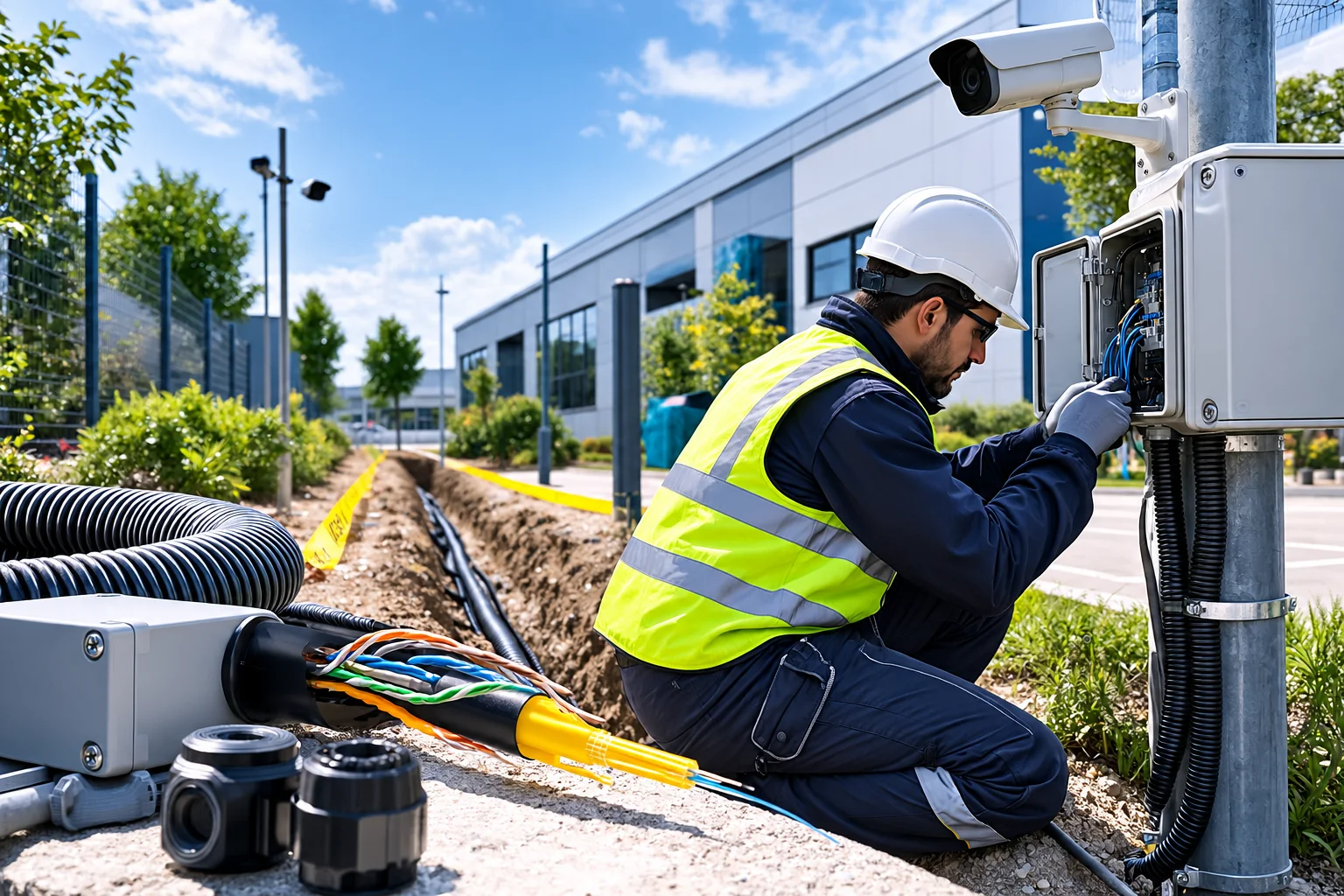
Outdoor cabling is an important physical infrastructure application that ensures the reliable operation of security cameras, perimeter security systems, network devices, access-control equipment, and communications infrastructure outside buildings. Unlike indoor cabling, outdoor installations may be exposed to sunlight, rain, moisture, temperature fluctuations, wind, mechanical impact, underground conditions, and electrical risks caused by lightning.
Therefore, outdoor cabling projects require more than simply selecting the right cable category. The cable’s environmental resistance, installation method, mechanical protection, electrical safety, sealing of connection points, and system testing must be assessed together.
Especially in IP camera and perimeter security projects, an incorrect cable choice or unsuitable installation practices can cause video interruptions, PoE power problems, connection failures, and high maintenance costs over the long term.
What Is Outdoor Cabling?
Outdoor cabling is the cable infrastructure installed in areas outside a building or facility to transmit data, video, control, and communications signals.
In international telecommunications terminology, outdoor field cabling infrastructure is generally known as Outside Plant (OSP) internationally.
OSP covers not only the cable itself, but also cable routes, underground conduits, aerial support structures, junction boxes, distribution points, protection systems, and related physical infrastructure.
Outdoor cabling is widely used in the following areas:
Perimeter security at factories and industrial facilities.
Campus and site-wide camera systems.
Open-air parking lots and vehicle entry points.
Ports, logistics centers, and warehouses.
Agricultural land, farms, and solar power plants.
Residential compounds and housing developments.
Road, bridge, and transportation infrastructure.
Fiber-optic network links between buildings.
Outdoor access-control and perimeter-detection systems.
The cable used in these applications should be selected with its construction, physical route, and operating conditions in mind.
Differences Between Outdoor and Indoor Cabling
Although indoor and outdoor cabling systems may use similar data-transmission technologies, their environmental protection requirements differ.
Feature | Indoor cabling | Outdoor cabling |
|---|---|---|
Sunlight | Usually limited | May be directly exposed to UV |
Moisture and water | A controlled environment is intended | Rain, condensation, water accumulation |
Temperature | Generally more controlled | Wide temperature fluctuations |
Mechanical risk | Indoor building installation conditions | Impact, crushing, pulling, and external factors |
Cable jacket | Suitable for indoor building fire conditions | UV- and moisture-resistant, depending on the application |
Installation method | Tray, trunking, conduit | Conduit, direct burial, aerial support |
Electrical risk | Depends on indoor building conditions | Lightning and potential-difference risks may be more pronounced |
Connection points | Indoor protection | Outdoor sealing and mechanical protection |
Important: Not every cable with a black outer jacket is automatically suitable for outdoor use.
Similarly, not every cable marked “Outdoor” may be suitable for direct burial, submersion, or use as an aerial line.
The use classification and installation conditions specified in the manufacturer’s datasheet must always be checked.
What to Consider When Choosing an Outdoor Cable
1. UV Resistance
The effect of ultraviolet (UV) radiation from sunlight is an important selection criterion for outdoor cables.
Some cable jackets without UV resistance may harden, crack, or deteriorate in their mechanical properties over time.
This can leave the cable’s inner layers more vulnerable to moisture and environmental effects.
For cables that will be exposed to direct sunlight, the manufacturer’s specified compliance sunlight resistant / UV resistant should be verified.
However, UV resistance alone does not mean waterproofing, rodent protection, or suitability for direct burial.
2. Water and Moisture Resistance
Outdoor cables may be exposed not only to rain, but also to prolonged moisture and condensation.
Water may accumulate, especially in underground conduits and outdoor junction boxes.
Therefore, when selecting a cable, consider:
Moisture resistance of the outer jacket.
Design measures used to prevent water ingress.
Water-blocking tape or filling compounds, if present.
Sealing of the junction box.
Suitability of cable-entry glands.
Protection of cable splice points.
should be assessed.
Routing a cable through protective conduit does not mean it will never come into contact with water.
Because underground conduits may contain water due to rain, condensation, or other causes, the cable must be suitable for the actual environmental conditions.
3. Operating and Installation Temperature
For outdoor cables, operating temperature and installation temperature may be different technical parameters.
For example, a cable may be suitable for operation at low temperatures but not suitable for being pulled or bent at the same temperature.
In cold weather, some jacket materials may become less flexible. At high temperatures, the electrical or mechanical properties of the cable and connection components may be affected.
Therefore, the manufacturer’s specifications for the following should be checked:
Operating temperature range.
Storage temperature.
Installation temperature.
Permissible pulling force.
Minimum bend radius.
Each should be checked separately.
4. Mechanical Strength
Mechanical risks such as pulling force, crushing, vibration, and impact should be considered for outdoor field cables.
Depending on the cable route, protective conduit, cable trunking, a special outdoor jacket, or a suitable armored cable may be selected.
Armored cable is not mandatory for every project; the selection should be based on actual mechanical risks.
For products with metal armor, electrical bonding and equipotential bonding requirements should also be reviewed.
Outdoor Cat6 and Cat6A Cables
Cat6 and Cat6A copper cables are widely used in IP camera systems and network connections.
However, a cable’s Cat6 or Cat6A category does not automatically make it suitable for outdoor conditions.
An outdoor Ethernet cable must meet two different requirements:
The electrical transmission performance required for the Ethernet connection in question.
Mechanical and environmental resistance suitable for the operating environment.
Choosing an Outdoor Cat6 Cable
When choosing an outdoor Cat6 cable, consider the outer-jacket material, UV resistance, moisture protection, conductor construction, and installation methods permitted by the manufacturer.
Suitable conductor resistance and thermal performance are particularly important for IP cameras powered by PoE.
Copper-clad aluminum (CCA) products should not automatically be considered equivalent to standards-compliant solid-copper communications cables.
When Should an Outdoor Cat6A Cable Be Used?
Cat6A can be used in 10GBASE-T applications to support the standard 100-meter Ethernet channel with suitable connection components and system design.
However, Cat6A is not required at every outdoor camera point where 10 Gigabit connectivity is not needed.
The cable category should be selected according to bandwidth, total connection length, PoE requirements, and the project’s expansion plan.
For detailed technical specifications of Cat5e, Cat6, Cat6A, and other categories, our guide titled What Is CAT Cable? Differences Between Cat5e, Cat6, Cat6A, Cat7, and Cat8 is available for you to consult.
Outdoor Fiber-Optic Cabling
Fiber-optic cables offer significant advantages outdoors for long-distance connections and applications with a high risk of electromagnetic interference.
Fiber-optic systems transmit data using light rather than electrical signals.
For this reason, a suitable optical cabling architecture may be selected for connections between different buildings or across large sites.
However, checking only the OS2 or OM class is not enough to determine whether a fiber-optic cable is suitable for outdoor use.
Outdoor Fiber-Optic Cable Selection Criteria
Singlemode or multimode fiber type.
Required fiber count and spare capacity.
Suitability of the cable for outdoor use.
Suitability for underground, aerial, or in-conduit installation.
Water-blocking structures.
Pulling and crush resistance.
Minimum bend radius.
Metal armor or an all-dielectric construction.
Termination and splice-box requirements.
Compatibility with optical modules.
Total optical loss budget.
International standard IEC 60794-3:2022 covers the relevant requirements for optical fiber cables used outdoors. Its scope also includes in-conduit, direct-buried, and aerial applications.
For detailed information about fiber types, SFP modules, and OTDR/OLTS testing, our guide titled What Is Fiber-Optic Cable? Types, Features, and Technical Guide is available for you to consult.
How Is Outdoor Cabling Installed?
Outdoor cable routes can be built using different methods. The main ones are underground conduit installation, direct burial, and aerial cabling.
1. Underground Conduit Cabling
Underground conduit cabling involves routing outdoor field cables through suitable protective conduits and, where needed, access chambers.
This method can protect cables from mechanical effects and, with suitable design, make future replacement easier.
Points to consider for underground installations:
Existing power, water, gas, and communications lines along the route must be identified.
Required excavation permits and infrastructure coordination must be secured.
The conduit material should be selected to suit the soil and environmental conditions.
Vehicle crossings and heavy-load risks should be assessed.
Sharp bends in conduit routes should be avoided.
Cable-pulling capacity and future expansion needs should be planned.
Suitable access and pulling points should be provided.
Water accumulation and drainage conditions should be assessed.
Cable entries should be protected using suitable methods.
The route and location of buried infrastructure should be documented.
Critical technical point: It should not be assumed that outdoor cabling conduits will always remain completely dry.
Therefore, the cable used inside a conduit must be suitable for the moisture or water exposure expected along the relevant route.
2. Direct-Buried Cabling
Some cables are designed by their manufacturers for direct burial.
These products are generally classified as direct-burial products.
A cable suitable for direct burial is not the same as a cable suitable only for outdoor use.
For direct-burial cabling:
Verify that the cable product is suitable for direct burial.
Assess soil conditions and mechanical risks.
Select the required bedding and backfill materials.
Reduce the risks posed by sharp stones and mechanical pressure.
Provide appropriate marking and route documentation.
Plan protection against damage that may result from future excavation.
It is not appropriate to specify a single depth that applies to every project for cable burial.
Determine the depth by taking into account land use, vehicle loads, other infrastructure, local regulations, and the cable protection method.
3. Aerial Cabling
Aerial cabling involves routing cables over poles or suitable support systems.
This method may be used particularly in some campus, agricultural land, and industrial site applications.
However, aerial cabling requires careful design with regard to mechanical loads.
Key criteria:
Cable suitability for aerial use.
Pole load capacity.
Span length.
Wind loads and, where applicable, ice loads.
Cable sag and tensile force.
Support and anchoring arrangement.
Clearances for vehicle and pedestrian passage.
Risks associated with proximity to electrical power lines.
Effects of vibration and movement on the cable.
Do not exceed the tensile forces permitted by the cable support system.
Cables that are not self-supporting should not be used as aerial lines by suspending them solely from their outer jackets.
For aerial fiber applications, specialized cable designs such as ADSS may be considered. However, the availability of an ADSS product does not automatically make it suitable for installation on every pole or near every power line.
Why Is the IP Rating Important in Outdoor Cabling?
Cable connection and termination points are among the areas where failures are most likely to occur in outdoor cabling.
The camera having an IP67 rating does not mean that the exposed RJ45 connector used between the camera and the cable is also IP67.
For this reason, outdoor connections should be protected inside suitable enclosures.
Differences Between IP65, IP66, and IP67
Protection rating | General meaning |
|---|---|
IP65 | Protection against dust and a specified degree of protection against water jets |
IP66 | Protection against dust and a specified degree of protection against powerful water jets |
IP67 | Protection against dust and protection against temporary immersion in water under defined conditions |
IP ratings are defined in the IEC 60529 standard.
An enclosure having a particular IP rating does not mean it will provide the same protection under every installation condition.
Cable-entry glands, gasket design, proper closure of covers, and the installation method are also important.
Also, an IP67 rating should not be interpreted as automatically including the powerful water-jet test covered by IP66. Each required protection characteristic must be verified separately.
What Should You Consider for Outdoor Junction Boxes?
IP rating suitable for the environment.
Cable gland of the appropriate diameter.
UV and temperature resistance.
Correct routing of cable entries.
An arrangement that reduces the likelihood of water running along the cable into the box.
Condensation management where necessary.
Mechanical fastening.
Service access.
Suitable electrical protection and connection components.
Applying silicone alone to prevent water from entering the box may not replace the sealing solution specified by the manufacturer.
Lightning and Surge Protection in Outdoor Cabling
Outdoor copper data cables may be exposed to transient overvoltages caused by lightning-induced electromagnetic effects or differences in ground potential.
Pole-mounted IP cameras, open-area network equipment, and copper connections between buildings should be assessed particularly carefully in this regard.
The following are important in protection design:
Risks to which the cable is exposed outdoors.
The building entry point.
Characteristics of the network equipment to be protected.
PoE compatibility.
Selection of appropriate surge protection devices.
Grounding and equipotential-bonding connections for protection devices.
Approach to connecting cable shields.
Coordination with the lightning protection system.
Important: Surge protection devices do not eliminate all risks from the direct physical effects of lightning.
Using an SPD device alone is also insufficient. Effective protection depends on selecting the appropriate device and providing the correct electrical connection infrastructure.
Applicable IEC 62305 and IEC 61643 series standards, as well as local electrical safety requirements, should be considered in protection design.
When a cable with metallic conductors is used between different buildings, potential differences and lightning effects are particularly important.
Therefore, where conditions permit, a fully dielectric fiber-optic connection, is an important alternative to consider for data communications between buildings.
However, using a fiber-optic link does not eliminate the power requirements of the camera at the remote end.
PoE Cabling for Outdoor IP Cameras
Power over Ethernet (PoE) enables IP cameras and compatible network devices to receive electrical power over an Ethernet cable alongside the data connection.
In outdoor PoE applications, cable resistance, voltage drop, temperature rise, and electrical protection are important in addition to data transmission.
Criteria to Check in PoE Design
The camera's maximum power consumption.
Power consumption of the night-time IR illumination.
Additional loads, if any, such as PTZ motors, a heater, or a wiper.
The switch's power capacity per port.
The switch's total PoE budget.
Ethernet channel length.
Conductor material and resistance.
Heating within the cable bundle.
PoE-compatible surge protection.
Required electrical grounding and equipotential bonding.
For example, a camera may consume little power during the day but draw more when its IR illumination switches on at night.
Therefore, power calculations should consider not only average consumption but also the maximum consumption specified by the manufacturer.
What Is the Maximum Length for Outdoor Cat6 Cable?
In the commonly used four-pair copper Ethernet horizontal cabling model:
The Permanent Link limit is generally 90 meters.
The total Channel limit is generally 100 meters.
However, certain specialized Ethernet applications and manufacturer-specific long-reach modes may offer different distance capabilities.
For long-distance requirements, consider a fiber-optic connection, a suitable remote-site switch, or alternative network architectures.
Using a non-standard long-reach mode does not guarantee that all cameras and network devices will operate at the same data rate over that distance.
Comparison of Cable Options for Outdoor Cabling
Cable type | Suitable use | Main limitation |
|---|---|---|
UV-resistant outdoor Cat6 | Outdoor Ethernet connections | Burial and continuous water exposure must be verified separately |
Direct-burial Cat6 | Suitable direct-burial Ethernet line | Distance, mechanical, and electrical risks |
Outdoor Cat6A | Copper line designed for higher performance | Size, cost, and installation conditions |
Outdoor single-mode fiber | Long distances and building backbone | Optical module and splicing/termination requirements |
Armored outdoor fiber | Lines requiring additional mechanical protection | Assessment of metallic armor and grounding |
ADSS fiber | Suitable aerial fiber applications | Pole, span, tension, and power-line conditions |
This table provides an initial comparison for product selection. The actual suitability of the cables should be verified against the manufacturer's technical specifications, the installation method, and the standards applicable to the project.
Most Common Installation Mistakes in Outdoor Cabling
Using Indoor Cable Outdoors
Using cables without UV or moisture resistance directly outdoors can, over time, cause jacket deterioration and failures.
Assuming All Outdoor Cables Can Be Buried
Do not assume that a cable suitable for outdoor use is also suitable for direct burial underground.
Leaving the RJ45 Connector Exposed
Water and moisture entering connection points can cause connection and power problems, particularly in PoE systems.
Excessive Bending and Pulling
Exceeding the bending and pulling limits permitted by the manufacturer may adversely affect the cable's mechanical or electrical performance.
Improper Cable Splice
Connections made outdoors using electrical tape alone may not provide adequate protection against prolonged moisture and mechanical conditions.
Ignoring Lightning Risk
Directly connecting devices in outdoor copper network links without assessing transient overvoltage risks can cause equipment failures.
Failing to Calculate the PoE Power Budget
The fact that a cable establishes a data connection does not mean the camera receives sufficient power at its maximum consumption.
Handing Over Without Cable Testing
Receiving video over a cable does not prove that the connection meets all required performance criteria.
What Tests Should Be Performed on Outdoor Cabling?
Post-installation tests should be determined according to the cable type used and the project requirements.
Copper Data Cable Tests
For copper Ethernet infrastructure:
Wiremap and connection pairing.
Cable length.
Required category or class certification.
Insertion Loss.
Performance parameters such as NEXT and Return Loss.
Resistance and connection checks required for PoE.
Connection and power testing with the actual device.
may be assessed.
A basic continuity test alone does not prove that a connection meets the Cat6 or Cat6A category.
Fiber-Optic Tests
For fiber connections:
Fiber continuity.
Connector end-face inspection.
End-to-end optical loss measurement.
OTDR analysis where required.
Optical module and link budget.
Connection direction and speed tests.
should be performed.
Field Functional Tests
In addition to cable performance tests, the operation of the actual system should also be verified.
For example, in IP camera projects, test daytime and nighttime images, PoE consumption, network connectivity, recording continuity, and remote management functions, if any.
Technical Checklist for Outdoor Cabling
Check item | Criteria to verify |
|---|---|
Application area | Indoor/outdoor, underground, aerial |
Cable type | Copper or fiber, appropriate category |
UV resistance | Manufacturer's suitability information |
Water and moisture | Protection suitable for the environment |
Mechanical strength | Pulling, crushing, and bending limits |
Cable route | Conduit, tray, direct burial, or aerial support |
Cable distance | Ethernet or optical connection limits |
Junction box | Suitable IP rating and cable gland |
Electrical safety | Surge protection, grounding, bonding |
PoE | Maximum power, cable resistance, temperature |
Testing | Copper certification or fiber loss testing |
Labeling | Cable and termination identifiers |
Documentation | Routes, measurements, as-built drawings |
This list has been prepared for general field inspection purposes. It does not replace project-specific electrical, mechanical, or structural engineering assessments.
Standards Used in Outdoor Cabling
Outdoor cabling projects should be assessed in accordance with standards from several technical disciplines considered together.
Standard | Scope |
|---|---|
ANSI/TIA-758-B | Outside plant telecommunications infrastructure |
IEC 60794-3:2022 | Outdoor fiber-optic cable requirements |
ANSI/TIA-568.2-E | Balanced copper cabling performance |
ISO/IEC 11801 series | Generic structured cabling |
IEC 60529 | Enclosure IP protection ratings |
IEC 62305 series | Lightning protection |
IEC 61643 series | Suitable surge protection devices |
BICSI G2.2-22 | Aerial outside-plant cable installation |
BICSI G3-2026 | Underground outside-plant cable pathways and infrastructure |
These standards cover different subjects, and each does not necessarily have to be applied in the same way to every project. The required standards should be determined according to the facility's location, intended use, and applicable regulations.
Frequently Asked Questions About Outdoor Cabling
What is an outdoor Cat6 cable?
It is an Ethernet cable in the Cat6 performance class, manufactured with a suitable jacket and environmental resistance for use in outdoor conditions. UV resistance and suitability for direct burial should be verified for each product.
Can a standard Cat6 cable be used outdoors?
A standard Cat6 cable designed for indoor use may not be suitable for direct exposure to sunlight, rain, or moisture. The cable manufacturer's conditions of use are decisive.
Can an outdoor cable be buried underground?
Not every outdoor cable can be buried directly. For direct-burial applications, verify that the product is designed for this purpose.
Should an outdoor cable be installed in conduit?
Using conduit can provide mechanical protection and maintenance benefits. However, it should not be assumed that all outdoor cables must be installed in conduit or that conduit will protect the cable completely from water.
Should Cat6 or fiber-optic cable be used outdoors?
For short-distance Ethernet and PoE connections, suitable copper cable may be considered. Fiber-optic cable may be more suitable for long distances, connections between buildings, and certain electrical-risk conditions. The choice depends on distance, power, and risk analysis.
Is lightning protection required for an outdoor IP camera cable?
Lightning and transient overvoltage risks should be assessed for exposed outdoor copper connections. The appropriate protection device, placement, and grounding approach are determined by project conditions.
How should outdoor cable joints be protected?
Outdoor joints and terminations should be protected with suitable enclosures, cable glands, and connection components. The jointing method should be appropriate for the cable type and environmental conditions.
Conclusion
Outdoor cabling is a critical infrastructure component for the reliable operation of electronic security systems in field conditions.
Using high-quality cable alone is not enough for successful implementation. The cable's UV and moisture resistance, installation method, connection protection, mechanical loads, lightning risk, PoE power supply, and required tests must all be planned together.
Correct outdoor cabling is an integrated engineering process that begins with cable selection and is validated through field testing.
Especially in CCTV, perimeter security, campus networks, and industrial facilities, this approach supports system continuity, helps reduce faults, and contributes to controlling long-term maintenance costs.